R E S E A R C H A R T I C L E
Open Access
Media multitasking is associated with
altered processing of incidental, irrelevant
cues during person perception
Richard B. Lopez
1*, Julia M. Salinger
2, Todd F. Heatherton
3and Dylan D. Wagner
4Abstract
Background:Media multitasking (MMT)—using and switching between unrelated forms of media—has been implicated in altered processing of extraneous stimuli, resulting in performance deficits. Here, we sought to extend our prior work to test the hypothesis that MMT might be associated with enhanced processing of incidental environmental cues during person perception.
Method:We tested the relationship between individual differences in MMT and person perception, by experimentally manipulating the relevance of environmental cues that participants could use to make trait and personality judgements of an unfamiliar social target. Relevant environmental cues consisted of neat or messy arrangements of the target’s belongings, whereas irrelevant cues consisted of similarly neat or messy arrangements of the testing room in which participants viewed a video of the target.
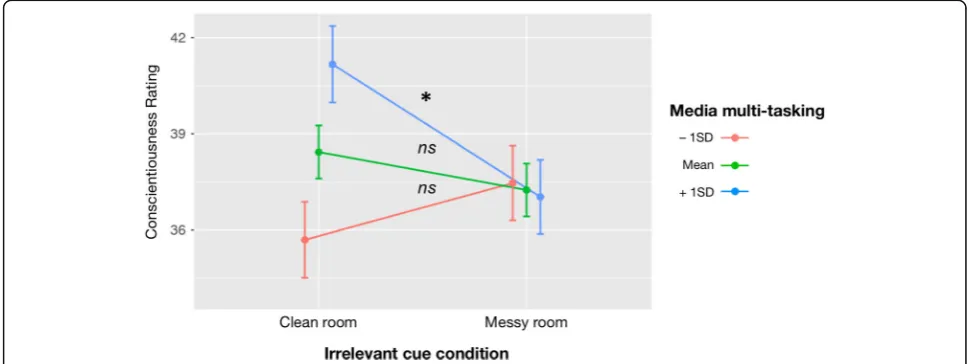
Results:In general, relevant cues affected ratings of the target’s conscientiousness. Additionally, and consistent with our hypothesis, there was a significant interaction between irrelevant cue condition and MMT, such that high media multitaskers more readily incorporated irrelevant environmental cues into their evaluations of the target’s conscientiousness.
Conclusions: These results suggest that high media multitaskers are more responsive to irrelevant environmental cues, which in turn can lead them to form inaccurate impressions of others.
Keywords:Person perception, Media multitasking, Individual differences, Social cues
Background
In the twenty-first century, humans face a unique cogni-tive challenge never faced before by our species: to div-ide attention between multiple media devices, such as smartphones, tablets, computers, and television. Because content across devices often competes for attention, many people attempt to engage in media multitasking (MMT), the simultaneous use of and switching between unrelated forms of media (e.g., tablet, smartphone, com-puter, smartwatch, etc.). Anyone who has ever looked up reviews or actor filmographies on their smartphone while binge watching a television show is familiar with this phenomenon. However, the human brain has limited
attentional resources [1] and evolutionarily is ill-equipped to process this barrage of stimuli [2]. Under such conditions, irrelevant external cues may compete for people’s attention and become incorporated into their evaluations. Here, we examine the relation between MMT, irrelevant external cues, and social perception.
Previous research has associated MMT with incorpor-ation of extraneous, irrelevant cues during cognitive tasks. In a landmark study researchers showed that high (versus low) media multitaskers were unable to filter ex-traneous cues in the environment while performing cog-nitive tasks, leading to the seemingly paradoxical finding of reduced performance in high media multitaskers on a task-switching task [3]. Additionally, high MMT may cause people to indiscriminately attend to peripheral cues, whether or not those cues are helpful and relevant to the task at hand [4]. Some have proposed that high * Correspondence:[email protected]
1Department of Psychology, Rice University, 6500 Main Street, MS-663, Houston, TX 77030, USA
Full list of author information is available at the end of the article
media multitaskers have domain-general biases in atten-tion [5]. For example, in research assessing how MMT is related to processing information, MMT was associated with increased responsiveness to rewarding, extraneous food cues and put people at higher risk for obesity [6,7]. Here, we sought to extend our prior work to test the hypothesis that MMT might be associated with altered processing of incidental environmental cues during per-son perception. As an undeniably social species [8], hu-man beings are motivated to make inferences about others’traits and intentions, as well as to perform behav-iors that balance needs for survival and sociability. Vari-ous environmental stimuli can influence how people are perceived, which in turn impact downstream social be-haviors such as approach (or withdrawal), affiliation, and cooperation. Indeed, person perception can be influ-enced by incidental cues in the environment that need not be consciously perceived, yet nonetheless prime and shape behavior [9,10].
One category of such cues is the material objects and decor in residential and personal settings, since objects and decorating schemes in one’s personal space often serve as statements of personality and identity [11, 12]. Moreover, as research shows, prim-ing with mundane, common objects can subtly induce changes in the subsequent behavior of the perceiver [13]. Thus, it is likely that incorporation of incidental environmental cues into person evaluation may lead to attributional errors, especially if those cues are ir-relevant or inaccurate indicators of the target’s per-sonality traits. It is important, therefore, to identify person-environment interactions in which implicit in-corporation of irrelevant cues is likely to occur.
In this study, we tested whether high media multitas-kers would incorporate incidental environmental cues into their trait judgments of a social target. To this end, we adapted Gosling and colleagues’ “Room With a Cue” procedure, which examines how people use environmen-tal cues found in offices and bedrooms to make trait judgments about previously unknown individuals [11]. Gosling’s work drew from the earlier perspective of Egon Brunswik (1952), who proposed that environmental cues in a living space can serve as a“lens”through which per-ceivers evaluate the personality dimensions of the space’s inhabitant(s) [14]. Brunswik also suggested that this process is complex because perceivers may use some cues more than others, and because cues can vary in the extent to which they reflect the occupant’s personality traits. That is, if the environment is a private space, it likely contains diagnostic cues that are indicative of the inhabitant’s personality and dispositions.
Here, participants watched a video clip of a previ-ously unknown social target (being interviewed in his dorm room about his daily routine at college.
Following the video, participants made trait judg-ments of the target’s conscientiousness. We focused on conscientiousness because the cues used for these judgments (i.e., those pertaining to order and tidiness) are visually salient and easy to manipulate in a lab setting, and also because participants in Gosling and colleagues’ study made accurate and reliable judg-ments along this trait dimension [11]. To alter the
nature of the environment, we experimentally
manipulated relevant and irrelevant cues that partici-pants could incorporate into these trait judgments. Relevant cues consisted of objects in the video clip depicting the target’s personal room as neat or messy, whereas irrelevant cues consisted of neat or messy ar-rangements of objects in the testing room where par-ticipants watched the video clip. Participants’ tendency to media multitask was assessed via a brief questionnaire.
We hypothesized that, replicating previous work, par-ticipants would incorporate the relevant (video) cues into their judgments of the target’s conscientiousness (i.e., the neat or messy room conditions depicted in the video would bias participants to rate the target as more or less conscientiousness, respectively), with the possibil-ity that high MMT would be associated with exaggerated effects on their ratings. Critically, we also predicted that high (versus low) media multitaskers would be more likely to incorporate irrelevant cues in their trait judg-ments. Specifically, we hypothesized that high media multitaskers would: (1) attribute lower conscientiousness to the target in the video in the messy testing room con-dition (regardless of the neat or messy room cues in the target’s depicted dorm room); and (2) give higher ratings of conscientiousness in the neat testing room condition (again, regardless of video condition).
Method
Participants
Procedure
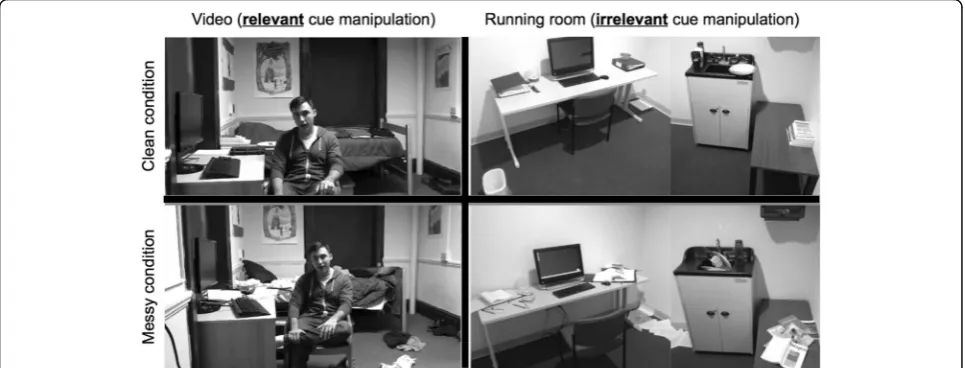
The study followed a two-by-two between-subjects de-sign, with relevant cue (i.e., neat or messy arrangement of room in the video; described below) and irrelevant cue (i.e., neat or messy arrangements of the testing room; described below) as experimental factors, and par-ticipants’ media multitasking scores as a measured co-variate. Accordingly, participants were randomly assigned to watch the video clip depicting either the neat or messy room (relevant cue), and also pseudo-randomly assigned to complete study tasks in either a neat or messy testing room (irrelevant cue). Since participants were often scheduled for the experiment back-to-back, the testing room was initially arranged in either a neat or messy configuration at the beginning of the day, and the testing room condition was subsequently counterba-lanced by day. Props used in the messy/neat conditions for the testing room included cups, dishes, a stack of books, binders, pens, folders, a waste-paper basket, paper clips, binder clips, CDs, and miscellaneous papers (see Fig.1).
After subjects provided informed consent, they were told they would be watching a video and completing sev-eral questionnaires. The experimenter brought the par-ticipant to the testing room, mentioning that “We are running a bit behind today and most of the rooms have been in use, so we’ll borrow this one.” This deception was necessary to prevent participants from becoming suspicious of the experimental manipulation of room, particularly the messy condition. The experimenter then explained that the participant would be watching a video of a Dartmouth student describing what he did yester-day, and that half of the interviews were pre-scheduled while the timing of the other half was a surprise. All subjects were told that the interview they would be
watching was a surprise interview, to clarify that the tar-get’s environment had not been preemptively cleaned or altered. Raters were led to believe that these video inter-views were to be subsequently used for research on interview performance and corporate recruiting.
The video consisted of messy-background and neat-background versions (see Fig.1, left two quadrants). A research confederate (who was not a Dartmouth undergraduate student, but one of the co-authors, Lopez) posed as an undergraduate student within the video, which was shot in a “student’s dormitory room” to provide a set of valid cues for trait analysis. The script was identical in both neat and messy conditions, and was designed to balance extraverted and introverted be-haviors while reflecting the individual’s diverse interests. In this way, the confederate served as a neutral target who was difficult to evaluate based on non-verbal cues alone. For the messy and neat versions of the video re-spectively, clothes were either strewn across the bed and floor or folded neatly on the bed, the bed was un-made or un-made, and books and binders were either scattered across the bed and floor or on neat pile on the bed (see Fig. 1).
After viewing the video, subjects were brought into an adjacent room to complete a current state questionnaire, which was designed to provide a time buffer between viewing the video and rating the target. After completing the survey, participants were asked to “answer a few questions about the video.” Items on the trait inventory consisted of 11 conscientiousness items from the Big Five Inventory [16] interspersed with 7 filler items, also from the Big Five, representing traits orthogonal to con-scientiousness (e.g.,“has a lot of fun”). Participants indi-cated their responses to all items using a Likert scale ranging from 1 (not at all likely) to 5 (very likely).
Several conscientiousness items were reverse-coded, so that a higher rating on any item reflected a greater en-dorsement of conscientiousness; following this reverse coding, all 11-items were summed to generate a com-posite conscientiousness score.
Next, participants completed a questionnaire assessing levels of media multitasking and distractibility. To assess media multitasking tendencies, we used the 18-item Media Multitasking-Revised (MMT-R) scale [6,7], which has been developed and validated in another study using a large, independent sample (N= 995) and was found to have high internal reliability (Cronbach’s alpha = 0.86) [7]. As reported in [7], the MMT-R scale has a two-factor structure, with items loading on factors that reflect either: (1) (pro)active behaviors of compulsive/in-appropriate phone checking, e.g.,“When talking to some-one face-to-face, how often do you feel the urge to check your phone for unread messages, notifications?”; or (2)
more passive tendencies, including distractibility and interference from using various media, e.g., “How often does your multimedia use interfere with your homework or work?”Each scale item is answered on a 5-point likert scale, with the following response choices: 1-Never, 2-Rarely, 3-Sometimes, 4-Often, 5-Always for “how often” items, and 1-Not at all, 2, 3-Somewhat, 4, 5-Very(much) for all other items. There is one reverse-scored item, and all scale items (reflecting the abovementioned factors) are summed together, with a total possible score range of 18–90. Higher scores reflect a greater tendency to engage in MMT related behaviors.
At the conclusion of the experiment, all participants underwent a debriefing, were given the opportunity to ask any remaining questions, and reimbursed for their time with course credit.
Manipulation check
As it was impossible to conduct a double-blind protocol with our video confederate, we conducted a follow up series of surveys to rule out behavioral confirmation ef-fects as a potential confound. Both versions of the target video were cropped, removing background cues and leaving only the confederate’s face as a source of nonver-bal information. Each version was then shown to an in-dependent sample (N= 12) who completed the same series of trait ratings. We predicted that the ratings be-tween video conditions would not differ significantly, in which case we could rule out the possibility that actual behavioral differences in the confederate contributed to differences in trait ratings. Independent t-tests con-firmed that the confederate’s nonverbal cues did not dif-fer significantly between versions of the video, all
p’s > .05. Note, however, that although the confederate
was not blind to room condition, this could not influ-ence the results of the primary manipulation of interest
(whether the testing room where the video was shown was neat or messy).
Results
For our main analysis, we ran a multiple regression model with participants’conscientiousness ratings of the target as the outcome variable, video (relevant cue) con-dition and room (irrelevant cue) concon-dition as categorical predictors, and participants’(centered) MMT scores as a continuous predictor. Unless otherwise stated, the alpha level for all inferential tests on parameter estimates from the model was set to .05. We also included several inter-action terms, including: (1) the interinter-action between video (relevant cue) and room (irrelevant cue) condi-tions; (2) the interaction between MMT and the video (relevant cue) condition; and (3) the interaction between MMT and the room (irrelevant cue) condition (refer to Table1for complete model results and statistics).
Overall, the model fit the data well, F(6, 89) = 9.22,
p< .001, and captured a reasonable percentage of variance in conscientiousness scores, adjusted R2= 0.342. Replicating prior research by Gosling and col-leagues [11], there was a main effect of relevant cues (i.e., video condition) on participants’ conscientious judgments, with participants assigned to the messy (vs. clean) video condition providing lower conscien-tiousness ratings, b=−7.83 (95% CI: -10.17, −5.49),
t =−6.65, p< .001. There was no significant main ef-fect of irrelevant cues (i.e., testing room condition),
p= .305. There was, however, a main effect of media-multitasking, with those participants reporting frequent media multitasking providing higher scientiousness ratings, regardless of testing room con-dition,b= 0.141 (95% CI: 0.01, 0.27),t =2.14,p= .035, As far as the model’s interaction terms, there was a significant interaction between MMT and the room (irrelevant cue) condition, b=−0.335 (95% CI: -0.60, −0.07),t =−2.54,p= .013.
for line plots depicting all simple slope effects) There was no significant interaction between the video (rele-vant cue) and room (irrele(rele-vant cue) conditions,p= .911, and no interaction between MMT and the video (relevant) condition,p= .252.
Discussion
This study found that people who report frequent media multitasking are influenced by irrelevant cues during person perception. Specifically, the observed interaction between testing room condition and media multitasking suggests that media multitasking is associated with al-tered cue processing in the presence of incidental, irrele-vant cues. High media multitaskers, compared to their low multitasking counterparts, readily incorporated inci-dental and irrelevant room cues into personality judg-ments of a social target’s overall conscientiousness. These findings suggest that media multitasking may characterize individuals who are more likely to be in-fluenced by incidental environmental cues, and this
person-by-environment interaction can impact
subsequent perception and judgments of core person-ality traits, such as conscientiousness.
In addition to demonstrating a relationship between media multitasking and person perception, our study replicated and extended previous work showing that en-vironmental cues affect person perception (e.g., [11]). First, the robust main effect of the relevant (i.e., video) cues on participants’ impressions of trait conscientious-ness suggests that, in general, individuals tend to incorp-orate environmental cues into personality evaluation. Since participants were not explicitly directed to at-tend to the background in the video, we can presume that this cue incorporation potentially occurred automatically.
Given the nature of the effects we observed in the current study, we speculate that there may be implica-tions of media multitasking behaviors in other domains, beyond person perception. For example, those who en-gage in more frequent media multitasking may have al-tered attentional processing that biases them to be more responsive toward other cues in the environment (e.g.,
Table 1Parameter estimates from multiple regression model predicting participants’conscientiousness ratings
95% Confidence Interval
Predictor Estimate SE Lower Upper t p
(Intercept) 37.785 0.5889 36.6152 38.9553 64.166 < .001
Room (irrelevant cue) condition −1.210 1.1736 −3.5415 1.1223 −1.031 0.305
Video (relevant cue) condition −7.828 1.1779 −10.1686 −5.4878 −6.646 < .001
Media multi-tasking (centered) 0.141 0.0658 0.0102 0.2716 2.142 0.035
Room Condition✻Media multi-tasking −0.335 0.1317 −0.5963 −0.0728 −2.540 0.013
Room Condition✻Video Condition −0.264 2.3557 −4.9447 4.4169 −0.112 0.911
Video Condition✻Media multi-tasking 0.152 0.1316 −0.1097 0.4133 1.154 0.252
food advertising) and/or emotionally evocative stimuli (e.g., physical danger or social threat). A potentially fruit-ful avenue of future work would be to examine the de-velopment of media multitasking behaviors in children and adolescents and assessing subsequent changes across domains, including person perception, appetitive behaviors, and emotional reactivity. Indeed, recent stud-ies have begun employing longitudinal designs to ad-dress such questions, with one study showing that media multitasking and attentional problems not only co-vary, but early adolescents’ media multitasking tendencies may lead to increased distractibility over time [17]. An-other study has demonstrated that some sub-groups of adolescents (i.e., middle school aged girls) are also prone to developing sleeping problems following increased media multitasking [18].
Despite the significance and novelty of our media mul-titasking finding for social cognition, there are some lim-itations in our study design and procedure that necessarily constrain the interpretability and generalizability of the results. First, although we experi-mentally manipulated multiple cue types (relevant and irrelevant), and participants were pseudo-randomly assigned to all conditions, the observed relationships with MMT are correlational. This precludes any strong inferences as to the directionality of the effects. For ex-ample, over time a person might become a high media multitasker, and this may induce changes in attentional processing of various cues. Or, a third variable (such as existing cognitive and attentional biases) may be a
con-founding factor, predisposing individuals to
media-multitasking while also causing these individuals to more readily process extraneous cues—including ir-relevant cues that could be incorporated into potentially inaccurate perception of others’ traits and qualities. If the former scenario is the case (i.e., increased MMT resulting in attentional biases over time), chronic media multitasking cannot be manipulated easily in short la-boratory sessions. Of course, this is generally true of all research that examines behavior as a function of individ-ual differences or personality. At best, future studies might consider employing longitudinal designs like those employed by Baumgartner and colleagues [17, 18] that measure people’s MMT tendencies and attentional pro-cesses at multiple time points, with a priori justification for an appropriate time scale and assessment intervals (see [19]).
Lastly, we did not incorporate additional measure-ments to track patterns of participants’ attention while they watched the video in the testing room. Thus, we cannot make strong claims as to the relative viewing time of room versus target cues for the video, as well as potentially switching attention between the video and the peripheral (irrelevant) neat or messy cues in the
testing room. Future studies should address this by add-ing eye-trackadd-ing measures to this or a similar type of paradigm, and this would be illuminating to see whether high media multitaskers show distinct or divergent attentional profiles during person perception.
Conclusions
To conclude, this study demonstrated that MMT is as-sociated with altered processing of incidental, irrelevant cues that can impact person perception. The study de-sign allowed us to investigate the role of incidental cues in the immediate environment that had greater or less relevance to guide person perception. Although the test-ing room cues were completely irrelevant to the task at hand, they nonetheless exerted effects on those partici-pants with greater propensity to engage in media multi-tasking behaviors. This experimental design has ecological validity in that it simulates the type of com-mon, multi-cue contexts in which people often find themselves, such as working on a computer in a neat (or messy) office setting, or doing housework while checking one’s phone. Future studies would benefit from using crossed designs like the one here, in which both relevant and irrelevant environmental cues are manipulated. This would enable researchers to examine whether media multitasking is associated with altered cue processing as-pects of social cognition in which implicit processes are often at play, such as racial bias or stereotype formation. More broadly, the present work highlights subtle ways in which media multitasking behaviors are associated with altered perceptual processing of environmental cues.
Abbreviations
MMT:Media multi-tasking; MMT-R: Media Multi-tasking Revised (scale)
Funding
There was no specific grant from any funding agency that supported this work. All participants were compensated with course credit.
Availability of data and materials
All study materials and de-identified raw data generated and/or analysed during the current study are available for viewing and via theOpen Science Frameworkrepository at this link:https://osf.io/c7n9p/
?view_only=b506ee7da4e24409aaf5048e936b061f
Authors’contributions
RL, JS, and TH developed the study design. JS ran all study participants. RL and JS analyzed the data, and RL, JS, and TH all contributed to the writing of the manuscript, with DW providing substantive feedback and edits for the final revision of the manuscript. All authors read and approved the final manuscript.
Ethics approval and consent to participate
The authors received Ethical Approval to run this study from Dartmouth’s review board, the Committee for the Protection of Human Subjects (CPHS). Informed, written consent was obtained from all participants, in accordance with guidelines set by CPHS.
Consent for publication
Competing interests
The authors declare that they have no competing interests.
Publisher’s Note
Springer Nature remains neutral with regard to jurisdictional claims in published maps and institutional affiliations.
Author details
1Department of Psychology, Rice University, 6500 Main Street, MS-663, Houston, TX 77030, USA.2Department of Psychology and Neuroscience, University of Colorado Boulder, Muenzinger D244, 345 UCB, Boulder, CO 80309, USA.3Department of Psychological and Brain Sciences, Dartmouth College, 6207 Moore Hall, Hanover, NH 03755, USA.4Department of Psychology, The Ohio State University, 140H Lazenby Hall, Columbus, OH 43220, USA.
Received: 24 April 2018 Accepted: 28 August 2018
References
1. Alvarez GA, Franconeri SL. How many objects can you track?: evidence for a resource-limited attentive tracking mechanism. J Vis. 2007;7:14.
2. Gazzaley A, Rosen LD. The distracted mind: ancient brains in a high-tech world. Cambridge: MIT Press; 2016.
3. Ophir E, Nass C, Wagner AD. Cognitive control in media multitaskers. Proc Natl Acad Sci. 2009;106:15583–7.
4. Cain MS, Mitroff SR. Distractor filtering in media multitaskers. Perception. 2011;40:1183–92.
5. Lin L. Breadth-biased versus focused cognitive control in media multitasking behaviors. Proc Natl Acad Sci U S A. 2009;106:15521–2.
6. Lopez RB, Heatherton TF. Media multitasking is associated with reduced activity in frontoparietal (versus reward) systems, lower trait self-control, and higher body mass index. Social cognitive and affective neuroscience annual meeting; 2017; Los Angeles, CA.
7. Lopez RB, Heatherton TF, Wagner DD. Media multitasking is associated with higher risk for obesity and increased responsiveness to rewarding food stimuli.https://osf.io/qkgk4/.
8. Heatherton TF. Neuroscience of self and self-regulation. Annu Rev Psychol NIH Public Access. 2011;62:363–90.
9. Dijksterhuis A, Bargh JA. The perception-behavior expressway: automatic effects of social perception on social behavior. Adv Exp Soc Psychol Volume 33. Elsevier; 2001. pp. 1–40.
10. Bargh JA, Morsella E. The unconscious mind. Perspect Psychol Sci. Sage publications. Inc. 2008;3:73–9.
11. Gosling SD, Ko SJ, Mannarelli T, Morris ME. A room with a cue: personality judgments based on offices and bedrooms. J Pers Soc Psychol American Psychological Association. 2002;82:379–98.
12. Sadalla EK, Vershure B, Burroughs J. Identity symbolism in housing. Environ Behav. 1987;19:569–87.
13. Kay AC, Wheeler SC, Bargh JA, Ross L. Material priming: the influence of mundane physical objects on situational construal and competitive behavioral choice. Organ Behav Hum Decis Process. 2004;95:83–96. 14. Brunswik E. The conceptual framework of psychology. Chicago: University of
Chicago Press; 1952.
15. Cohen J. Statistical power analysis for the behavioral sciences 2nd edition. Hillsdale: Erlbaum Associates; 1988.
16. John OP, Donahue EM, Kentle RL. Big five inventory [internet]. PsycTESTS Dataset. 17. Baumgartner SE, van der Schuur WA, Lemmens JS, te Poel F. The
relationship between media multitasking and attention problems in adolescents: results of two longitudinal studies. Hum Commun Res Oxford University Press. 2018;44:3–30.
18. van der Schuur WA, Baumgartner SE, Sumter SR, Valkenburg PM. Media multitasking and sleep problems: a longitudinal study among adolescents. Comput Human Behav. 2018;81:316–24.