O R I G I N A L R E S E A R C H
Open Access
New algorithm for calculating chromatic
index of graphs and its applications
F. Salama
1,2Correspondence:fatma.salama@ science.tanta.edu.eg
1Department of Mathematics,
Faculty of Science, Tanta University, Tanta, Egypt
2
Department of Mathematics, Faculty of Science, Taibah University, Madinah, Kingdom of Saudi Arabia
Abstract
The problem of edge coloring is one of the fundamental problems in the graph theory. Graph coloring problem arises in several ways like to allocate scheduling and assignments. To follow this line of investigation, we design a new algorithm called “RF algorithm”to color the edges of a graph. In addition, we reinstate some classical results by applying the RF algorithm.
Keywords:Graph, Edge coloring, Chromatic index, Incidence matrix
2010 Mathematics subject classification:05C15, 05C99, 05C90, 05C30.
Introduction
The problem of edge coloring appeared with the four-color problem. In 1880, Tait wrote the first paper dealing with the problem of edge coloring. Tait proved that only three colors are used to color the edges of every 3-connected planar graph. An s-edge coloring, s is a positive integer, is a way to color edges with s colors. The chromatic indexχ΄(x) is the minimum number of different colors needed to color edges such that any two adjacent edges are colored by different colors (for more details, see [1, 3–5, 7–9,11–14]). K nig has proved, in 1916, thatχ΄(x) =Δ(x) for every bipartite graph.3Δ2ðxÞis the most number of colors that any graph can be edge-colored with, this was given by Shannon. Moreover, Viz-ing obtained for any simple graphΔ(x) + 1≥χ΄(x). Omai et al. [10] determined the AVD-chromatic index for the powers of paths. Further, Lehner [6] established a result state that if every non-trivial automorphism of a countable graphGwith distinguishing indexD΄(G) moves infinitely many edges, thenD΄(G)≤2. Grzesik and Khachatrian [2] proved thatk1,
m,nis interval colorable iff gcd(m+ 1,n+ 1) = 1.
The above discussions motivate us to design a new algorithm to calculate the chromatic index of the graph. The main objective of our algorithm is to find a coloring that uses the smal-lest possible number of distinct colors. Some examples are given in support of our algorithm.
The main results
In this article, a new algorithm, RF coloring algorithm, will be designed to evaluate chro-matic index of loopness graph. RF coloring algorithm is introduced as follows:
Consider a graphGof ordernand sizem. List its vertices asv1,v2,v3,…,vnand its
edges ase1,e2,e3,…,em.
Step1. Write the incidence matrix of the graphG
I Gð Þ ¼
a11 a12 … a1m
a21 a22 … a2m
⋮ an1
⋮ an2
⋱ … anm⋮ 2
6 4
3 7 5:
Step2. In this step, we constitute the RF coloring matrix from the incidence matrix as follows:
(a) In the first row of the RF matrix, put
a11¼
0 if a11¼0
1 if a11¼1
8 < :
After that put
a12¼
0 if a12¼0 1 if a12¼1;a11¼0 2 if a11 ¼a12¼1 8
< :
In the same way, for entrya1j, where 1 <j≤m, put
a1j¼
0 if a1j¼0
max a11;a12;…;a1ðj−1Þ
n o
þ1 if a1j¼1
8 < :
(b) Any columnkhas the entrya1k ¼hput
aik¼
h if aik¼1
0 if aik ¼0 8
< :
where 1 <i≤n and 1 <k≤m.
(c) Now start from the second row put
a2l¼0 if a2l¼0
min a1j:a1j≠0;
n o
n a2j;asj:a2j≠0;asj≠0
n o
if a2l¼1;aSl¼1; a1j:a1j≠0
n o
n a2j;aSj:a2j≠0≠aSj
n o
≠Âo
max a1j;a2j;asj:a1j≠0;a2j≠0≠asj;
n o
þ1 if a2l¼1;aSl¼1; a1j:a1j≠0
n o
n a2j;aSj:a2j≠0≠aSj
n o
¼Âo 8
> > > < > > > :
(d) Any columnlhas the entrya2l¼ f put
ail¼
f if ail¼1
0 if ail¼0 8
< :
(e) Again repeat steps (c) and (d) to complete the RF coloring matrix
RCIð Þ ¼G
a11 a12 … a1m a21 a22 … a2m
⋮ an1
⋮ an2
⋱ … anm⋮ 2
6 6 4
3 7 7 5
Step3. The greatest number in the RF coloring matrix is the chromatic index of the graphGand the value of entryaijis the color of the edgeejwhereaij≠0.
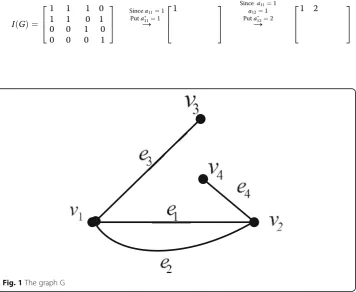
In the following, we give examples solved by the new algorithm: Example1. LetGbe a graph shown below (Fig.1).
The chromatic index of the graphGwill be calculated by using the RF coloring algo-rithm as follows:
I Gð Þ ¼
1 1 1 0
1 1 0 1
0 0
0 0
1 0
0 1 2
6 4
3 7
5 →
Sincea11¼1
Puta11¼1
1 2 6 4
3 7
5 →
Sincea11¼1 a12¼1
Puta12¼2
1 2 2 6 4
3 7 5
→
Sincea11¼a12¼a13¼1Puta13¼3 1 2 3 2 6 4
3 7
5 →
Sincea14¼0
Puta14¼0
1 2 3 0 2
6 4
3 7
5 →
Column 1 Puta
21¼1;
a31¼a41¼0
1 2 3 0
1 0 0 2 6 4
3 7 5
→
Column 2 Puta22¼2; a32¼a42¼0
1 2 3 0
1 2
0 0
0 0
2 6 4
3 7
5 →
Column3 Puta33¼3; a23¼a43¼0
1 2 3 0
1 2 0
0 0
0 0
3 0
2 6 4
3 7
5 →
2ndrow Sincea24¼1 thena24¼ max 1f;2;3gnf1;2g ¼3
1 2 3 0
1 2 0 3
0 0
0 0
3 0
2 6 4
3 7 5
→
Column 4 Puta44¼3;
a43¼0
1 2 3 0
1 2 0 3
0 1
0 2
3 0
0 3
2 6 4
3 7 5
Then, the RF coloring matrix is given by
RCIð Þ ¼G
1 2 3 0
1 2 0 3
0 1
0 2
3 0
0 3
2 6 4
3 7 5:
From the above matrix, we find the chromatic indexχ΄(G) of the graphGis equal to 3.
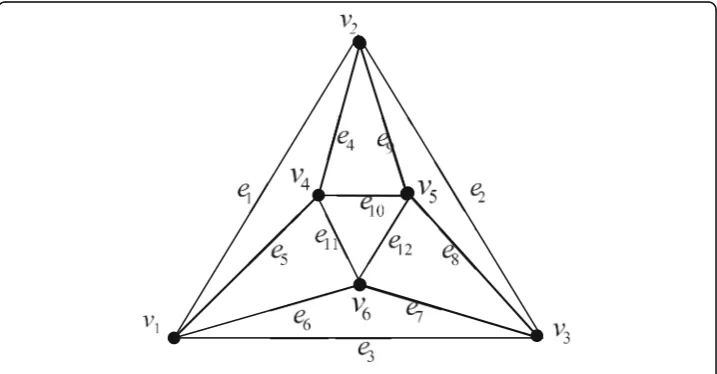
Example2. Given a graphG, shown in Fig.2.
Applying the RF coloring algorithm step by step to evaluate the colors of edges and chromatic index as shown in the sequence of matrices below:
Hence, the RF coloring matrix is given by
RCIð Þ ¼G
1 1 0 0 0 0
0 3 3 0 0 0
2 0 2 0 0 0
0 2 0 2 0 0
3 0 0 3 0 0
4 0 0 0 0 4
0 0 1 0 0 1
0 0 5 0 5 0
0 4 0 0 4 0
0 0 0 1 1 0
0 0 0 5 0 5
0 0 0 0 2 2 2
6 6 6 6 6 4
3 7 7 7 7 7 5:
It is clear from the RF coloring matrix that the chromatic index of the graphGis 5, i.e.,χ΄(G) = 5 and the color ofe1,e7,e10is 1, the color ofe3,e4,e12is 2, the color ofe2,
e5is 3, the color ofe6,e9is 4, and the color ofe8,e11is 5.
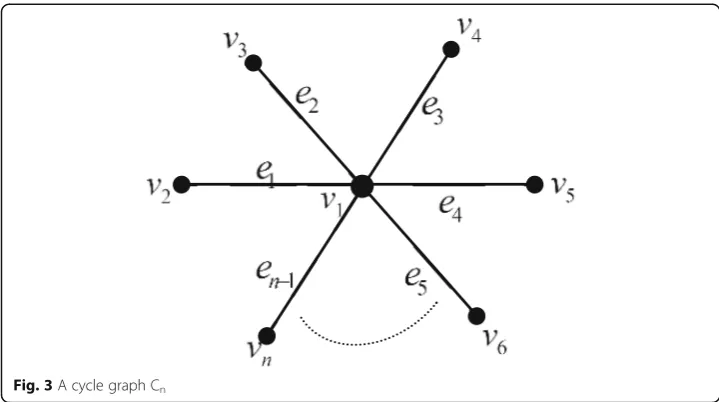
In the following section, we reprove some theorems by using RF coloring algorithm Theorem 1Let Snbe a star graph of order n. Then,χ΄(Sn) =n−1, whereχ΄(Sn)is the
chromatic index of Sn.
ProofLetSnbe a star graph of ordernas shown in Fig.3.
By applying the RF coloring algorithm, we found the RF coloring matrix is given by
RCIð Þ ¼Sn
1 2 3 … n−1
1 0
0 0 2 0
…
… 00
⋮
0
⋮ ⋮
0 0
⋱ … n−⋮1
2 6 6 6 4
3 7 7 7 5
The greatest number in the RF coloring matrix is n−1, then the chromatic index of Snequalsn−1.
Theorem 2 Let Cn be a cycle graph of order n. Then χ΄ðCnÞ ¼
2 if n is even
3 if n is odd
8 <
: ,
Proof LetCnbe a cycle graph of ordern. Applying the RF coloring algorithm, we will
stop when the RF coloring matrix will become
RCIð Þ ¼Cn
1 0 0 … 0 0 2
1 2 0 … 0 0 0
0 2 1 … 0 0 0
⋮ ⋮ ⋮ ⋱ ⋮ ⋮ ⋮
0 0 0 … l 0 0
0 0 0 … l m 0
0 0 0 … 0 m 2
2 6 6 6 6 6 6 6 4
3 7 7 7 7 7 7 7 5 :
Now we want to evaluate the values oflandmand we have two cases:
Case 1.When nis even thenlis the entry inaðn−1Þðn−2Þ, i.e.,l= 2. Sinceaðn−1Þðn−2Þ¼2 andanm¼2 thenm= 1; hence, the RF coloring matrix is
RCIð Þ ¼Cn
1 0 0 … 0 0 2
1 2 0 … 0 0 0
0 2 1 … 0 0 0
⋮ ⋮ ⋮ ⋱ ⋮ ⋮ ⋮
0 0 0 … 2 0 0
0 0 0 … 2 1 0
0 0 0 … 0 1 2
2 6 6 6 6 6 6 6 4
3 7 7 7 7 7 7 7 5
and the chromatic index ofCnfrom the RF coloring matrix is 2, i.e.,χ΄(Cn) = 2.
Case 2. When n is odd then lis the entry in aðn−1Þðn−2Þ, i.e.,l= 1. So,m= 3 because aðn−1Þðn−2Þ¼1 andanm¼2; hence, the RF coloring matrix in this case is given by
RCIð Þ ¼Cn
1 0 0 … 0 0 2
1 2 0 … 0 0 0
0 2 1 … 0 0 0
⋮ ⋮ ⋮ ⋱ ⋮ ⋮ ⋮
0 0 0 … 1 0 0
0 0 0 … 1 3 0
0 0 0 … 0 3 2
2 6 6 6 6 6 6 6 4
3 7 7 7 7 7 7 7 5 ;
and the chromatic index ofCnequals 3, i.e.,χ΄(Cn) = 3.
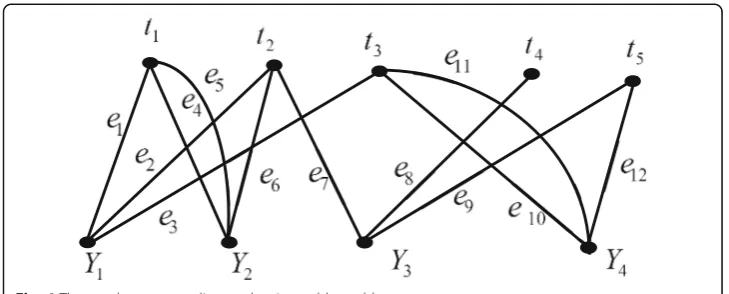
One of the most famous applications on edge coloring of a graph is the timetable; let us give an example and solve it by our new algorithm as follows:
In a particular faculty of science, the Mathematics department has five teacherst1,t2,
t3,t4,t5. The teaching assignments of the five teachers are given by the array:
I Year II Year III Year IV Year
Y1 Y2 Y3 Y4
t1 1 2 __ __
t2 1 1 1 __
t3 1 __ __ 2
t4 __ __ 1 __
t5 __ __ 1 1
We want to find the minimum period timetable. To solve this problem, first we draw the graph corresponding to this problem, see Fig.4
By applying the RF coloring algorithm, we find the RF coloring matrix is given by:
1 0 0 0 1 0 0 0 0 2 0 0 0 0 2 0 0 0 3 0 0 0 0 0 3 0 0 0 2 0 0 2 0 0 0 0 0 3 0 0 3 0 0 0 0 0 1 0 0 0 1 0 0 0 0 0 3 0 0 3 0 0 0 0 0 1 0 0 0 0 1 0 0 0 2 0 0 0 0 0 2 0 0 0 1 0 0 1 0 0 0 0 0 2 0 0 2 0 0 0 0 0 3 0 0 0 0 3 2 6 6 6 6 6 6 6 6 6 6 6 4 3 7 7 7 7 7 7 7 7 7 7 7 5
It is clear from the RF coloring matrix above that we have a 3-period timetable given by:
Period I Period II Period III
t1 Y1 Y2 Y2
t2 Y2 Y3 Y1
t3 Y4 Y1 Y4
t4 __ __ Y3
The main results(Continued)
t5 Y3 Y4 __
Conclusion
In the present manuscript, we have designed a new algorithm to find the chromatic index to color the edges of a graph. It has been found that some classical results are successfully established by our new algorithm. The new introduced algorithm has been successfully applied to a real-life example where a correct result has been obtained. It has a great scope for further research in the field of graph theory, computer program-ming, and algebraic-specific structures.
Acknowledgements
I am so grateful to the reviewers for their many valuable suggestions and comments that significantly improved the paper.
Funding
Department of Mathematics, Faculty of Science, Tanta University, Tanta, Egypt.
Availability of data and materials
Not applicable.
Author’s contributions
The author worked on the results and also read and approved the final manuscript.
Competing interests
The author declares that she has no competing interests.
Publisher’s Note
Springer Nature remains neutral with regard to jurisdictional claims in published maps and institutional affiliations.
Received: 10 October 2018 Accepted: 16 December 2018
References
1. Bondy, J.A., Murty, U.S.R.: Graph Theory, Graduate Texts in Mathematics Series, Elsevier Science Publishing Co. Inc., (2008) 2. Grzesik, A., Khachatrian, H.: Interval edge-colorings ofk1,m,n. Discret. Appl. Math.174, 140–145 (2014) Elsevier
3. Harris, J.M., Hirst, J.L., Mossinghoff, M.J.: Combinatorial and Graph Theory. Springer science +Business Media, USA (2008) 4. Hermann, F., Hertz, A.: Finding the chromatic number by means of critical graphs. Electron. Nin. Discret. Math.5, 174–176
(2000) Elsevier
5. Kandel, A., Bunke, H., Last, M.: Applied Graph Theory in Computer Vision and Pattern Recognition. Springer-Verlag, Berlin Heidelberg (2007)
6. Lehner, F.: Breaking graph symmetries by edge colourings. J. Combinatorial Theory, Series B.127, 205–214 (2017) Elsevier 7. Liu, C., Zhu, E.: General vertex-distinguishing total coloring of graphs. J. Appl. Math.2014, 7 (2014) Hindawi Publishing
Corporation.https://doi.org/10.1155/2014/849748.
8. Luna, G., Romero, J.R.M., Moyao, Y.: An approximate algorithm for the chromatic number of graphs. Electron. Notes Discret. Math.46, 89–96 (2014) Elsevier
9. Molloy, M., Reed, B.: Colouring graphs when the number of colours is almost the maximum degree. J. Combinatorial Theory, Series B.109, 134–195 (2014) Elsevier
10. Omai, M.M., de Almeida, S.M., Sasaki, D.: AVD-edge coloring on powers of paths. Electron. Notes Discret. Math.
62, 273–278 (2017) Elsevier
11. Salama, F.: 1-mother vertex graphs. Int. J. Math. Comb.1, 123–132 (2011)
12. Salama, F., Rafat, H., El-Zawy, M.: General-graph and inverse-graph. Appl. Math.3, 346–349 (2012) 13. Salama, F., Rafat, H.: General-graph and inverse-graph. Appl. Math.3, 346–349 (2012)