Introduction
Headache prevalence is age-dependent, declining progres-sively, especially after 55–60 years of age. This has been confirmed by almost all epidemiologic studies [1–17]. Despite this trend, after the age of 65 years, more than 13% of women and 7% of men continue to complain of headache [18]. Chronic tension-type headache, instead, does not seem to decrease with increasing age [18, 19]. The etiology of headache is also age-dependent. The incidence of prima-ry headaches declines, while that of secondaprima-ry headaches tends to become higher with increasing age [20–23]. Some headaches, such as that secondary to giant cell arteritis, appear in almost all cases after age of 60 years [23]. Among primary headaches, hypnic headache presents an onset
prevalently in the elderly [24–26]. Elderly patients more often have comorbidity with other disorders [27–30]. Although the prevalence of headache in the elderly is rele-vant, few clinical and epidemiologic studies have been con-ducted until now in patients aged over 65 years. In some studies of the general adult population, only subjects up to 65 years of age have been studied [9, 10, 31]. We report the prevalence of headache in a population of subjects over 65 years of age seen at our centre.
Materials and methods
We retrospectively analyzed the clinical charts of 4417 consecu-tive patients ≥18 years of age referred to our Headache Centre
Headache in the elderly: a clinical study
C. Lisotto Headache Unit,
Hospital of San Vito al Tagliamento, San Vito al Tagliamento (PN), Italy
F. Mainardi •F. Maggioni •F. Dainese G. Zanchin ()
Headache Centre, Department of Neurosciences, University of Padua, Via Giustiniani 5, I-35128 Padua, Italy e-mail: [email protected] Tel.: +390498213600
Fax: +390498751770 C. Lisotto F. Mainardi F. Maggioni F. Dainese G. Zanchin
Abstract Although the prevalence of headache in the elderly is rele-vant, until now few studies have been conducted in patients over the age of 65 years. We analyzed the clinical charts of 4,417 con-secutive patients referred to our Headache Centre from 1995 to 2002. There were 282 patients over 65 years of age at the first visit, corresponding to 6.4% of the study population. Primary
headaches were diagnosed in 81.6% of the cases, while sec-ondary headaches and non-classi-fiable headaches represented,
respectively, 14.9% and 3.5% of the cases. Among primary headaches, the prevalence was almost the same for migraine without aura (27.8%), transformed migraine (26.1%) and chronic ten-sion-type headache (25.7%). The most frequent secondary
headaches were trigeminal neural-gia and headache associated with cervical spine disorder.
Key words Elderly •Primary
headache •Secondary headache •
Prevalence Received: 27 August 2003
from 1995 to 2002, with particular attention to the subgroup of patients over 65 years of age. The following parameters were evaluated: age and sex of the patients, age at headache onset and diagnosis of headache type, according to the criteria established by the International Headache Society in 1988. Headache trend over the last 10 years and the abuse of drugs, if present, in patients affected by chronic headache were also evaluated. The criteria proposed by Silberstein et al. [32] in 1998 were used to the classify chronic headaches and drug abuse. As for secondary headaches, the criteria proposed by Sjaastad et al. [33] in 1998 were used for the diagnosis of cervicogenic headache.
Results
Of the 4417 patients seen at the Headache Center between 1995 and 2002, a total of 282 (6.4%) were over 65 years of age at their first evaluation. Primary headaches were diagnosed in 230 (81.6%) of the subjects studied (mean age 68.9 years; SD=5.4). Secondary headaches were diag-nosed in 42 (14.9%) patients of mean age 73.8 years (SD=6.3), while non-classifiable headaches were recorded in 10 (3.5%) subjects of mean age 76.6 years (SD=8.2). In the last two groups, the average age of the patients was significantly greater than that of patients affected by pri-mary headache.
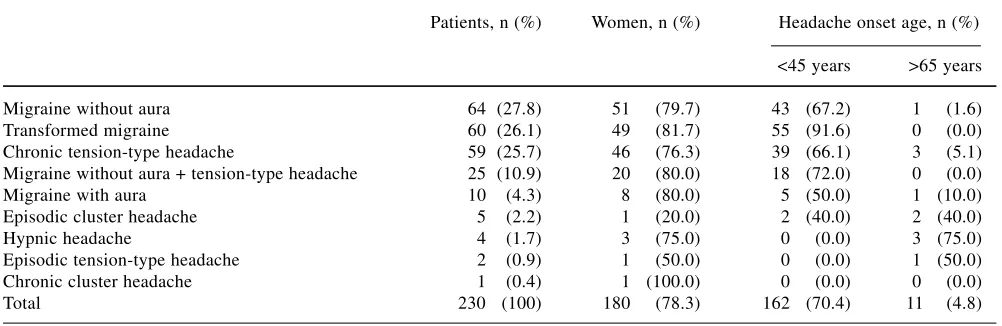
In the group of patients with primary headaches (Table 1), the prevalence was almost identical for migraine with-out aura (27.8%), transformed migraine (26.1%), and chronic tension-type headache (25.7%). The remaining cases included: migraine without aura + tension-type headache, migraine with aura, episodic cluster headache, hypnic headache, episodic tension-type headache and chronic cluster headache.
Overall, almost 80% of the cases affected by migraine and tension-type headache belonged to the 65–69 year and
70–74 year age groups; the number of patients over 80 years of age was remarkable (Table 2).
As for the distribution according to gender, women represented the vast majority, accounting for 78.3% of the cases. In patients with migraine and tension-type headaches, the highest percentage of women was found in the group with transformed migraine (81.7%). Among the 5 cases of episodic cluster headache, female patients rep-resented 20.0%, whereas the only case of chronic cluster headache was a female subject. Female patients represent-ed 75.0% of the cases of hypnic headache (Table 1).
Among the patients affected by primary headaches, the onset of symptoms occurred before the age of 45 years (Table 1) in almost all cases of transformed migraine (91.6%), and in the majority of patients with migraine without aura (67.2%) and chronic tension-type headache (66.1%). The onset of the other types of headaches occurred more rarely before 45 years, respectively in 50.0% of the cases of migraine with aura and in 40.0% of the patients with episodic cluster headache. In no patients affected by hypnic headache did the clinical symptoms start before that age.
The onset of primary headaches over age 65 was reported in only 11 of 230 cases (4.8%). Within the vari-ous types of primary headaches (Tables 1, 2), in subjects affected by migraine without aura the onset after this age was reported in only 1 of 64 cases (1.6%), and in patients with chronic tension-type headache in 3 of 59 cases (5.1%); whereas in migraine with aura, 1 of 10 patients (10.0%) referred the beginning of symptoms after this age. The clinical picture for episodic cluster headache began after age 65 in 2 of 5 patients (40%). Patients affected by hypnic headache had the first attacks over age 65 in 75% of the cases (3 of 4 subjects).
An analysis of the trend of primary headaches (Table 3) in the past 10 years showed that 60% of the 10 patients affected by migraine with aura had noted an improvement
Table 1 Diagnoses of primary headaches in 230 patients over 65 years of age at first evaluation
Patients, n (%) Women, n (%) Headache onset age, n (%)
<45 years >65 years
Migraine without aura 64 (27.8) 51 1(79.7) 43 (67.2) 1 1(1.6)
Transformed migraine 60 (26.1) 49 1(81.7) 55 (91.6) 0 1(0.0)
Chronic tension-type headache 59 (25.7) 46 1(76.3) 39 (66.1) 3 1(5.1) Migraine without aura + tension-type headache 25 (10.9) 20 1(80.0) 18 (72.0) 0 1(0.0)
Migraine with aura 10 1(4.3) 8 1(80.0) 5 (50.0) 1 (10.0)
Episodic cluster headache 5 1(2.2) 1 1(20.0) 2 (40.0) 2 (40.0)
Hypnic headache 4 1(1.7) 3 1(75.0) 0 1(0.0) 3 (75.0)
Episodic tension-type headache 2 1(0.9) 1 1(50.0) 0 1(0.0) 1 (50.0)
Chronic cluster headache 1 1(0.4) 1 (100.0) 0 1(0.0) 0 1(0.0)
while 20% experienced a worsening. An improvement, even if less evident, was reported also by 18 patients (28.1%) affected by migraine without aura. A worsening clinical picture was noted above all in subjects with chron-ic tension-type headache (32.2%). Transformed migraine presented the minor changes in the last 10 years (Table 3). Among patients affected by chronic headache, overuse of drugs was found in the majority of the cases of trans-formed migraine (66.7%, in 40 of 60 cases). Overuse was observed in 28.8% (17 of 59 cases) of the patients with chronic tension-type headache.
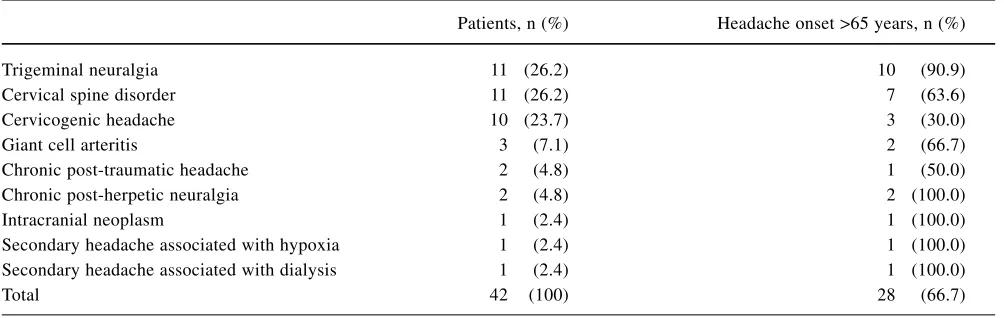
Secondary headaches were represented above all by headache associated with cervical spine disorder (26.2%), trigeminal neuralgia (26.2%), and cervicogenic headache (23.7%).
Onset of secondary headaches (Table 4) occurred in most patients (66.6%) after 65 years of age, with the only
exception of cervicogenic headache, which started after this age in 30% of the patients. Trigeminal neuralgia, in particular, began in more than 90% of subjects after the age of 65 years. Late onset was reported by patients affected by cervical spine disorder (63.6%) and giant cell arteritis (66.7%).
Discussion
The prevalence of headache in the elderly appears to be relevant, even if few clinical and epidemiologic studies have been carried out concerning headache patients over age 65 years. These subjects frequently present other dis-orders and subsequently the pharmacological treatments, both symptomatic and prophylactic, require particular Table 3 Headache trend in the last 10 years. Values are number (percentage) of 193 of 230 patients over 65 years of age with prima-ry headache
Unchanged Worsened Improved
Migraine without aura (n=64) 41 (64.0) 5 1(7.9) 18 (28.1)
Migraine with aura (n=10) 2 (20.0) 2 (20.0) 6 (60.0)
Transformed migraine (n=60) 48 (80.0) 8 (13.3) 4 1(6.7)
Chronic tension-type headache (n=59) 35 (59.3) 19 (32.2) 5 1(8.5)
Table 4 Diagnoses of secondary headaches in 42 of 282 patients over 65 years of age at first evaluation
Patients, n (%) Headache onset >65 years, n (%)
Trigeminal neuralgia 11 (26.2) 10 1(90.9)
Cervical spine disorder 11 (26.2) 7 1(63.6)
Cervicogenic headache 10 (23.7) 3 1(30.0)
Giant cell arteritis 3 1(7.1) 2 1(66.7)
Chronic post-traumatic headache 2 1(4.8) 1 1(50.0)
Chronic post-herpetic neuralgia 2 1(4.8) 2 (100.0)
Intracranial neoplasm 1 1(2.4) 1 (100.0)
Secondary headache associated with hypoxia 1 1(2.4) 1 (100.0)
Secondary headache associated with dialysis 1 1(2.4) 1 (100.0)
Total 42 .(100) 28 1(66.7)
Table 2 Age distribution for 193 of 230 elderly patients with primary headache, by headache diagnosis
Age groups, years Migraine without Migraine with Transformed Chronic tension-type aura (n=64) aura (n=10) migraine (n=60) headache (n=59)
65–69 60.7% 80.0% 60.0% 50.8%
70–74 19.1% 20.0% 25.0% 25.4%
75–79 13.5% 0% 11.7% 15.3%
80–84 4.5% 0% 3.3% 3.4%
caution [24, 26–29]. In our study, patients over 65 years of age accounted for 6.4% of the whole adult headache pop-ulation which was studied. Primary headaches (81.6% of the cases) were more frequent than secondary headaches (14.9%), consistent with the data reported in the literature [18–24, 26–30].
Among primary headaches, migraine without aura, transformed migraine and chronic tension-type headache, which accounted for 79.6% of the cases, were the most frequent disorders, with similar prevalences. These data confirm the results of other studies carried out in other headache centres [23, 34, 35]. In population-based stud-ies, conversely, tension-type headache was the most fre-quent headache in the elderly, although these studies did not differentiate the chronic from the episodic pattern [1, 3, 8, 18–22, 24, 26–30, 36, 37]. This apparent discrepan-cy can be justified by the fact that mainly patients with disabling and severe headaches, particularly transformed migraine, refer to a headache centre. Only occasionally subjects with episodic tension-type headache seek consul-tation at a specialized centre.
Among the patients in the present study with primary headaches, 4.3% had migraine with aura. In some popula-tion-based studies, percentages greater than 25% have been reported [22, 36]. The difference appears to be relat-ed to different methodological approaches, regarding in particular the design of the questionnaires sent out to the patients in the population-based studies. In our study, the percentages of patients ≥80 years of age suffering from migraine without aura and transformed migraine were 6.7% and 3.3%, respectively, whereas more patients were affected by chronic tension-type headache (8.5%). These data are in accordance with other population-based epi-demiologic studies that showed a progressive decrease in migraine and a persistent increase in chronic tension-type headache with increasing age [8, 11, 18, 36].
Our study population had a large proportion of women (78.3%); only in two other studies similar results were reported [11, 35], whereas in other papers the female-male ratio varied between 2.0 and 2.5. The predominance of the female gender also concerns patients with hypnic headache (75.0% of cases), a disorder which typically begins over age 60 years and is more common in women [26, 38]. Episodic cluster headache was more prominent in male patients (80.0% of 5 cases).
Among primary headaches, onset occurred before age 45 years in almost all the cases of transformed migraine and in the majority of cases of migraine without aura and chronic tension-type headache. In this regard there is a general agreement in the literature. In a population-based study concerning chronic headaches, the chronic pattern started on average at the age of 33 years for transformed migraine and at the age of 44 years for tension-type
headache [30]. Among the 5 patients affected by migraine with aura, headache onset occurred after age 45 years in 50% of cases and over age 65 years in 10%. In these cases a correct diagnosis is mandatory, and computed tomogra-phy and magnetic resonance imaging are often required to rule out a possible secondary form.
In our study, the onset of episodic cluster headache before age 45 occurred in 2 of 5 subjects. This finding indicates how cluster headache still active in advanced age, seems to present a rather late onset, in the majority of the cases over age 45, but also over age 65, as noticed in 2 patients (40.0%).
The clinical symptoms began over age 65 years in 5.1% of our subjects affected by chronic tension-type headache and in 1 of the 2 patients with episodic tension-type headache, whereas migraine without aura only exceptionally appeared for the first time in the elderly (1 of 64 cases). The rarity of this event is confirmed by other studies: 3 of 92 cases in the population-study by Prencipe et al. [18] and 1 of 193 cases in the study by Pascual and Berciano [34]. It should be noted that, as mentioned above, episodic cluster headache can start over 65 years of age, as it was observed in 2 of 5 cases in our study, in 6 of 14 cases in the paper by Solomon et al. [23] and in 3 of 6 cases in the study by Pascual and Berciano [34]. These findings appear to be in contrast with the literature, since it has been reported that the mean age at onset for cluster headache is 30 years and that its beginning in advanced age should be considered extremely rare [39]. Only one female patient had chronic cluster headache; in another study a female preponderance in the elderly had been described [39].
In 75.0% of 4 cases, hypnic headache began over age 65 years. This finding agrees with the literature, since the mean age at onset of this headache occurs usually over the age of 60 years [38].
relation to sociocultural and environmental factors [19]. The most frequent secondary headaches were headache associated with cervical spine disorder and trigeminal neuralgia, as also found in the few studies conducted in geriatric patients [23, 34]. Cervicogenic headache was diagnosed in 23.7% of our cases; the other secondary headaches were less frequent. We diagnosed 3 patients with giant cell arteritis and 2 patients with chronic post-herpetic neuralgia, secondary to a previous herpes zoster infection involving the first trigeminal branch.
In secondary headaches, onset occurred in 66.7% of cases after 65; this was noted above all in trigeminal neu-ralgia (90.9% of cases). Giant cell arteritis and headache associated with cervical spine disorder began over age 65 years in two-thirds of the cases. Cervicogenic headache had a different pattern, starting more frequently before age 65 years (70.0% of the cases), as reported by another study [33].
Conclusions
Overall, the prevalence of headaches in this elderly popu-lation is remarkable and noteworthy. Primary headaches were more frequent, in particular chronic headaches (transformed migraine and chronic tension-type headache). Migraine without aura was, however, more commonly diagnosed in advanced age. Migraine with aura and episodic cluster headache can still affect the geriatric patients. These headaches may even begin after age 65 years, and in such cases a differential diagnosis versus secondary headaches is mandatory.
Considering the major difficulties in the choice of headache treatment in the elderly, due also to the frequent comorbidity with other disorders, further clinical and, in particular, epidemiologic studies should be carried out, with the aim of defining possible therapeutic guidelines for these patients.
References
1. Waters WF (1974) The Pontypridd headache survey. Headache 14:81–90 2. Zhao F, Tsay J-Y, Cheng X-M, Wong W-J, Li S-C, Yao S-X, Chang S-M, Schoenberg BS (1988) Epidemiology of migraine: a survey in 21 provinces of the People’s Republic of China, 1985. Headache 28(8):558–565 3. D’Alessandro R, Benassi G, Lenzi PL,
Gamberini G, Sacquegna T, De Carolis P, Lugaresi E (1988) Epidemiology of headache in the Republic of San Marino. J Neurol Neurosurg Psychiatry 51(1):21–27
4. Stewart WF, Lipton RB, Celentano DD, Reed M (1992) Prevalence of migraine headache in the United States. Relation to age, income, race and other sociodemographic factors. JAMA 267(1):64–69
5. Winnem J (1992) Prevalence of adult migraine in general practice. Cephalalgia 12(5):300–303 6. Henry P, Michel P, Brochet B,
Dartigues JF, Tison S, Salamon R (1992) A nationwide survey of migraine in France: prevalence and clinical features in adults. GRIM. Cephalalgia 12(14):229–237 7. Honkasalo ML, Kaprio J, Heikkila K,
Sillanpaa M, Koskenvuo M (1993) A population-based survey of headache and migraine in 22,809 adults. Headache 33(8):403–412
8. Göbel H, Petersen-Braun M, Soyka D (1994) The epidemiology of headache in Germany: a nationwide survey of a representative sample on the basis of the headache classification of the International Headache Society. Cephalalgia 14(2):97–106
9. Rasmussen BK (1995) Epidemiology of headache. Cephalalgia 15(1):45–68 10. Launer LJ, Terwindt GM, Ferrari MD (1999) The prevalence and characteris-tics of migraine in a population-based cohort: the GEM study. Neurology 53(3):537–542
11. Wang J, Fuh J-L, Young Y-H, Lu S-R, Shia B-C (2000) Prevalence of migraine in Taipei, Taiwan: a popula-tion-based survey. Cephalalgia 20(6):566–572
12. Mattsson P, Svärdsudd K, Lundberg PO, Westerberg CE (2000) The preva-lence of migraine in women aged 40–74 years: a population-based study. Cephalalgia 20(10):893–899
13. Dahlöf C, Linde M (2001) One-year prevalence of migraine in Sweden: a population-based study in adults. Cephalalgia 21(6):664–671
14. Lipton RB, Stewart WF, Diamond S, Diamond ML, Reed M (2001) Prevalence and burden of migraine in the United States: data from the American Migraine Study II. Headache 41(7):646–657
15. Lipton RB, Scher AI, Kolodner K, Liberman J, Steiner TJ, Stewart WF (2002) Migraine in the United States: epidemiology and patterns of health care use. Neurology 58(6):885–894 16. Henry P, Auray JP, Gaudin AF,
Dartigues JF, Duru G, Lantéri-Minet M, Lucas C, Pradalier A, Chazot G, El Hasnaoui A (2002) Prevalence and clinical characteristics of migraine in France. Neurology 59(2):232–237 17. Lampl C, Buzath A, Baumhackl U,
Klingler D (2003) One-year prevalence of migraine in Austria: a nation-wide survey. Cephalalgia 23(4):280–286 18. Prencipe M, Casini AR, Ferretti C,
Santini M, Pezzella F, Scaldaferri N, Culasso F (2001) Prevalence of headache in an elderly population: attack frequency, disability, and use of medication. J Neurol Neurosurg Psychiatry 70(3):377–381
19. Wang S-J, Fuh J-L, Lu S-R, Liu C-Y, Hsu L-C, Wang P-N, Liu H-C (2000) Chronic daily headache in Chinese elderly: prevalence, risk factors, and biannual follow-up. Neurology 54(2):314–319
21. Hale WE, May FE, Marks RG, Moore MT, Stewart RB (1987) Headache in the elderly: an evaluation of risk fac-tors. Headache 27(5):272–276 22. Cook NR, Evans DA, Funkenstein HH,
Scherr PA, Ostfeld AM, Taylor JO, Hennekens CH (1989) Correlates of headache in a population-based cohort of elderly. Arch Neurol
46(12):1338–1344
23. Solomon GD, Kunkel RS Jr, Frame J (1990) Demographics of headache in elderly patients. Headache
30(5):273–276
24. Edmeads J (1997) Headaches in older people. How are they different in this age-group? Postgrad Med
101(5):91–100
25. Lisotto C, Maggioni F, Zanchin G (2000) Sindrome della cefalea ipnica: prima descrizione di un caso italiano. In: Gallai V, Mazzotta G, Sarchielli P, Alberti A (eds) Le cefalee verso il terzo millennio. Atti del XIV Congresso Nazionale della Società Italiana per lo Studio delle Cefalee. Centro Stampa dell’Università di Perugia, Perugia, pp 277–279 26. Biondi DM, Saper JR (2000) Geriatric
headache. How to make the diagnosis and manage the pain. Geriatrics 55(12):40–50
27. Baumel B, Eisner LS (1991) Diagnosis and treatment of headache in the elder-ly. Med Clin North Am 75(3):661–675 28. Edmeads J, Takahashi A (1993)
Headache in the elderly. In: Olesen J, Tfelt-Hansen P, Welch KMA (eds) The headaches. Raven, New York, pp 809–813
29. Lipton RB, Pfeffer D, Newman LC, Solomon S (1993) Headaches in the elderly. J Pain Symptom Manage 8(2):87–97
30. Castillo J, Muñoz P, Guitera V, Pascual J (1999) Epidemiology of chronic daily headache in the general popula-tion. Headache 39:190–196
31. Scher AI, Stewart WF, Liberman J, Lipton RB (1998) Prevalence of fre-quent headache in a population sample. Headache 38:497–506
32. Silberstein SD, Lipton RB, Sliwinski M (1996) Classification of daily and near-daily headaches: field trial of revised IHS criteria. Neurology 47(4):871–875
33. Sjaastad O, Fredriksen TA, Pfaffenrath V (1998) Cervicogenic headache: diag-nostic criteria. The Cervicogenic Headache International Study Group. Headache 38(6):442–445
34. Pascual J, Berciano J (1994) Experience in the diagnosis of headaches that start in elderly people. J Neurol Neurosurg Psychiatry
57(10):1255–1257
35. Mazzotta G, Gallai V, Alberti A, Billeci AMR, Coppola F, Sarchielli P (2003) Characteristics of migraine in an out-patient population over 60 years of age. Cephalalgia 23(10):953–960
36. Wang S-J, Liu H-C, Fuh J-L, Liu C-Y, Lin K-P, Chen H-M, Lin C-H, Wang P-N, Hsu L-C, Wang H-C, Lin K-N (1997) Prevalence of headaches in a Chinese elderly population in Kinmen: age and gender effect and cross-cultur-al comparisons. Neurology
49(1):195–200
37. Lu S-R, Fuh J-L, Chen W-T, Juang K-D, Wang S-J (2001) Chronic daily headache in Taipei, Taiwan: preva-lence, follow-up and outcome predic-tors. Cephalalgia 21(10):980–986 38. Goadsby PJ, Lipton RB (1997) A review of paroxysmal hemicranias, SUNCT syndrome and other short-last-ing headaches with autonomic feature, including new cases. Brain 120(Pt 1):193–209