R E S E A R C H
Open Access
Concurrent non-malleable
zero-knowledge and simultaneous resettable
non-malleable zero-knowledge in constant
rounds
Zhenbin Yan
1,2, Yi Deng
1,2*and Yiru Sun
1,2Abstract
Concurrent non-malleable zero-knowledge(CNMZK) considers theconcurrentexecution of zero-knowledge protocols in a setting even when adversaries can simultaneously corruptmultipleprovers and verifiers. As far as we know, the round complexity of all the constructions of CNMZK arguments forNPis at leastω(logn). In this paper, we provide the first construction of aconstant-round concurrent non-malleable zero-knowledge argumentfor every language inNP. Our protocol relies on the existence of families ofcollision-resistant hash functions,one-way permutationsand
indistinguishability obfuscators. As an additional contribution, we study the composition of two central notions in zero knowledge, thesimultaneously resettable zero-knowledgeandnon-malleable zero-knowledge, which seemingly have strongerproved security guarantees. We give the first construction of aconstant-round simultaneously-resettable non-malleable zero-knowledge. To the best of our knowledge, this is the first study to combine the two security concepts described above together in the zero-knowledge protocols.
Keywords: Zero-knowledge, Concurrent non-malleable zero-knowledge, Simultaneously resettable zero-knowledge, Concurrent security computation
Introduction
Zero-knowledge proof systems were introduced by Goldwasser, Micali and Rackofi in (1989). Informally, an interactive proof protocol is zero-knowledge if the prover can convince the verifier that a statement is true with-out revealing any information other than the fact itself. With such an intriguing nature, zero-knowledge proof has played a central role in the design and study of crypto-graphic protocols. The notion ofconcurrentzero knowl-edge(CZK) was first introduced by Dwork, Naor and Sahai (1998) to consider that many copies of the zero-knowledge protocol are executed simultaneously in anasynchronous network, where messages from different copies may be arbitrarily interleaved by the verifier. The notion of non-malleablezero knowledge(NMZK) was first introduced by Dolev, Dwork and Naor (2000) to consider the execution
*Correspondence:[email protected]
1State Key Laboratory of Information Security, Institute of Information Engineering, Chinese Academy of Sciences, Beijing, China
2School of Cyber Security, University of Chinese Academy of Sciences, Beijing, China
of zero-knowledge protocol in the setting where the man-in-the-middleadversary interacts with an honest prover in the left session and an honest verifier in the right session.
Concurrent Non-malleable Zero-Knowledge. By
combining the concurrent zero-knowledge with the
security against man-in-the-middle adversaries, Barak, Prabhakaran and Sahai (2006) introduced a stronger form of zero knowledge referred to as concurrent non-malleable zero knowledge(CNMZK). In such protocol, the adversary can complete control over the communication channel and participate in anunboundednumber of con-current executions. It guarantees that the proofs in the left sessions does not help the adversary to give proofs in the right sessions.
After the original protocol by (Barak et al.2006), various otherconcurrent non-malleableZK protocols have been obtained (Ostrovsky et al.2008,2010; Lin et al.2010; Lin and Pass2011; Orlandi et al.2014; Kiyoshima2015). Lin, Pass, Tseng and Venkitasubramaniam (2010) focused on
enhancing the soundness property by combining the nota-tion of robust non-malleable commitments introduced by Lin et al. (2009) with the concurrently extractable commitments (CECom) introduced by Micciancio et al. (2006). They showed a poly(n)-round CNMZK proof for all of NPbased on one way functionassumption and a
O(log(n))-round protocol based on the existence of col-lision resistant hash-functions(CRHFs). Recently, Orlandi et al. (2014) achieved the first statistical CNMZK argu-ment system. In their protocol, they used a special kind of commitment scheme called “mixed non-malleable com-mitment” scheme based on the DDH assumptions. Very recently, Kiyoshima (2015) achieved a poly(n) rounds statistical CNMZK argument system only assuming the existence ofone-way functions. In their protocol, instead of using a non-malleable commitment to commit the real witness (see (Barak et al. 2006; Lin et al. 2010)), they used a constant-roundk-robust one-one CCA-secure commitment (Canetti et al. 2010; Lin and Pass 2012; Kiyoshima2014; Goyal et al.2015) to commit a random string (e.g., 0n).
However, we observe that the round complexity of all the above protocols based on the standard assumptions is at leastO(logn)rounds. Indeed, in the standard model without set-up assumptions, Canetti, Kilian, Petrank and Rosen (2001) based on earlier works by (Kilian et al. 1998; Rosen2000) have showed that any black-box con-currentzero-knowledge protocol require at least(logn) rounds. It can be observed that the lower bound also holds for the black-box concurrent non-malleable zero-knowledge protocol. A breakthrough work was made by Barak in (2001), he proposed the firstnon-black-box simu-lation techniques and constructed the firstconstant-round boundedCZKargument systemassuming the existence of CRHFs. Recently, Pandey, Prabhakaran and Sahai (2015) showed a newnon-black-boxsimulation technique inde-pendent of the PCP theorem and constructed a 4-round
CZKargument system based on the existence of CRHFs and differing-input obfuscation (diO)(Barak et al. 2001; Boyle et al.2014; Ishai et al.2015). Very recently, Chung, Lin and Pass (2015) achieved constant-round CZK with non-uniformsoundness assuming the existence of CRHFs, OWP and iO (Barak et al. 2001; Garg et al. 2013) for
P/poly. We stress that Ostrovsky, Persiano and Visconti in (2008) have showed aconstant-round concurrent non-malleablezero-knowledge argument system forNPin the Bare Public-Key model. However, in this model each ver-ifier have to register thepublic keyin a public file during apreprocessing stageand thesecret keyis known only to itself. Thus, one natural question we ask in this work is:
Whether a constant rounds concurrent non-malleable zero-knowledge protocol in the standard model can be obtained?
Simultaneous Resettable Zero-Knowledge. The
notion ofresettable zero-knowledge(rZK) was first intro-duced by Canetti, Goldreich, Goldwasser and Micali (2000). It requires the zero-knowledge condition holds even when the verifier can reset the prover to reuse the previous randomness. From the definition, we can see that the security of resettable zero-knowledge is stronger than that of concurrent zero-knowledge, because a resetting verifier could emulate any concur-rent attack in the CZK protocol. Subsequently, Barak, Goldreich, Goldwasser and Lindell (2001) introduced the notion ofresettably-sound zero-knowledge (rsZK). It requires the soundness condition holds even when the prover can reset the verifier to use the same random tape in multiple concurrent executions. Following the two works above, a number of works have investigated the resettable security in zero-knowledge protocols (Deng et al.2009; Cho et al.2012; Garg et al.2012; Chung et al. 2013b,2014; Bitansky and Paneth2015; Ostrovsky et al.2015), which focused on either reducing the com-plexity assumptions or reducing the round comcom-plexity and so on. Recently, Chung et al. (2013a) presented a con-struction of thesimultaneous resettablezero-knowledge protocol with polynomial rounds based on the min-imal assumption of one-way functions. Very recently, Chongchitmate et al. (2017) showed a constant-round simultaneous resettable zero-knowledge argument system based on the work of Chung et al. (2015). Thus, another question in this work is:
Whether a constant rounds interactive protocol can be both simultaneous resettable zero-knowledge and non-malleable zero-knowledge?
Our results
In this paper, we combine the forementioned approaches and answer the above question positively. In the main result, we construct the first constant-round non-malleable concurrentzero-knowledge argument system.
Theorem 1Assuming the existence of collision-resistant
hash functions, one-way permutations andiOforP/poly (with slightly super-polynomial security), there exists a constant-round concurrent non-malleable zero-knowledge argument system forNP.
Our additional contribution is that by combining our CNMZK argument system with the approach of (Chongchitmate et al. 2017) and (Deng et al. 2009), we get the firstconstant-round simultaneously resettable and non-malleablezero-knowledge protocol.
Theorem 2Assuming the existence of collision-resistant
(with slightly super-polynomial security), there exists a constant-round simultaneously resettable and non-malleable zero-knowledge argument system forNP.
Our techniques
Below, we first recall the techniques in (Barak 2001; Chung et al. 2015; Kiyoshima 2015) and then give an overview of our construction approach.
Barak’s protocol. Barak’s non-black-box
zero-knowledge argument system consists of three stages. In stage 1, the verifierVchooses a hash functionh←−R Hand sends it to the proverP, whereHis a collision-resistant hash function family. In stage 2,P sends a commitment c ← Com(0n,ρ) to V, where Com is a statistically binding commitment scheme; then V responds with a random stringr ∈ {0, 1}2ntoP. In stage 3,PandV start a witness-indistinguishable universal argument(WIUA) system whereP proves to V that there existsx ∈ Lor
(h,c,r)∈. The languageis defined as(h,c,r)∈iff there exists a programsuch thatc=Com(h(),ρ)and
on inputccan outputrwithinnlog lognsteps.
The soundness of Barak’s protocol follows from the fact that even if a malicious proverP∗tries to commit to some program (instead of committing to 0n), with a high probability, the output of(c)will be different from the stringrsent byV for every stringr ∈ {0, 1}2n. To prove zero knowledge, just use the code of the malicious verifier V∗as trapdoor in stage 2. By the definition of the language
, it must holds thatc=Com(h())=Com(h(V∗))and
(c)=V∗(c)=r.
Chung et.al’s constant-round CZK protocol. In
(Chung et al. 2013), Chung et.al presented a P -certificates assumption for the language Lc ∈ P where Lc = {(M,x,y) : M(x) = y within |x|c steps}. In a
P-certificate system, an efficient prover can generate a short certificate π of a fixed polynomial length (inde-pendent of the running-time andsize of M) for a tuple
(M,x,y) in a prior bounded polynomial time in|x|c. By usingπ the verifier can check the validity of the deter-ministicpolynomial-time computationM(x)=yin some fixed polynomial time (independentof the running-time of M). Such proof system has two salient features, i.e., the “non-interactivity” and “succinctness”, which guaran-tee the simulator canreuse the same certificatein many nested sessions andamortizethe cost of generatingWIUA
proof. We stress that this is essentially to overcome the exponentially blow-up problem in the running time of the concurrent simulation. Based on the Barak’s non-black-box zero-knowledge protocol, they modified the part of the stage 3 and defined a new language. More specifically, they defined that a statement(h,c,r) ∈ iff there exists a program M, a certificate π, a vector
λ = ((1,π1),(2,π2)· · ·) and a vector −→m such that c =
Com(h(M)),πis a proof forM(λ)=rand eachπjcertifies
thatM(λ<j)outputsmjin itsj-th communication round (whereλ<j=((1,π1),(2,π2)· · ·(j−1,πj−1))).
The soundness can be obtained as follows. Roughly speaking, from the statistically binding property of the
Com, for every commitment c (i.e., m1), there exists a
prior fixeddeterministicpolynomial-time programM. By theuniquecertificate property of theP-certificate, we can infer that the certificateπ1forM(·)=m1is alsouniquely
defined. Due to the same analysis, we can conclude that for every j > 1, mj is uniquelydefined. Thus, also the unique(accepting) certificateπjcertifyingM(λ<j) = mj. That is, there is auniquevalid vectorλfor programM, so there exists a singlersatisfied the computationM(λ) = r. From the soundness of the previous Barak’s protocol (Barak2001), we can obtain that, with a high probability, the stringrsent byVwill be different fromM(λ)for every stringr∈ {0, 1}4n.
To prove the zero-knowledge, the key difference from Barak’s protocol is that each certificateπigenerated dur-ing construct the WIUA proofs in stage 3 of a session,
can be reused as a part of the input witness λ =
((1,π1),(2,π2)· · ·)for the subsequent sessions that
con-tains this session. Thus, the only expensive part of the generation of theWIUA in each session isthe generation of theP-certificatesπ, which can be generated in aprior bounded polynomial timefor the following reasons. Recall that when arriving at the point of stage 3, the simulator
Shas emulated the partial execution ofMand outputted the messager. We assume that the time spent in this part is bounded by|x|cfor some constantc∈N, wherexis the statementM(λ) = r. Then thecertificateπ for this part computation can be implemented in polynomial time in
|x|cby theP-certificates system. So the whole simulation can be finished in polynomial time, we refer the reader to (Chung et al.2015) for more detail about this part.
Our Approach on CNMZK.Our protocol attempts to
2016; Khurana and Sahai2017) to commit the real witness. However, we note that this is not necessary, as described in (Barak et al. 2006), since we only need to prove that the adversary still commits the real witness in each ses-sion rather than all the right sesses-sions together. That is stand-alone non-malleable commitment is sufficient for our purpose.
By the definition of CNMZK, the crux of the proof is to show that even during simulation, when the simula-tor commits a fake witness (instead of real witnesses) in left interactions, theman-in-the-middleadversaryAstill cannot change its committed values in right interactions. The most delicate part of the proof is that we need to consider the mutual influence on the both sides of the rewinds when extract the trapdoors in the left and the wit-nesses in the right. That is we should carefully design a series of hybrids to argument the rewinds do not affect the reduction of theconcurrent non-malleabilityof our zero-knowledge protocol to(non-concurrent) non-malleability of the commitment scheme.
In the previous protocol (Lin et al.2010), they used a special skill to reduce the difficulty of the proof. More specifically, the prover first uses a non-malleable com-mitment scheme with a robust property to commit to a witnessw twice(sequentially), and then they designed a series of hybrids to show that the adversary must com-mit the valid witness (except with a negligible probability) in each case. Otherwise, they can use the adversary to break the non-malleable property with respect to itself or the non-malleable property w.r.t. k-round protocols. In the protocol (Kiyoshima 2015), because their goal is to implement a statistically CNMZK argument system, instead of using a non-malleable commitment to com-mit the witness, they comcom-mit a random string (e.g., 0n). Thus, in their simulation-extractability proof, they can not directly use the extractability of the commitment scheme, instead they have to rewind the sWIAOK proof to extract the witness in the right. Their proof strat-egy is that assume there exists an adversary which can extract a fake witness in the right, then they can give a series of indistinguishable hybrids to show that even the simulator in the right interaction (act as an hon-est verifier) just send a commitment with the value 0n, the adversary still can extract this fake witness, this is a contradiction.
Because our goal is to construct theconstant-round con-current non-malleable zero-knowledge protocol, so the non-malleable commitment scheme should be constant rounds, here we use theconstant-round4-robust one-one CCA-securecommitment scheme which first appeared in (Kiyoshima2015) based Canetti et al. (2010). Such com-mitment scheme can be based on the minimum assump-tion of the existence ofone way functions. The difference from (Kiyoshima2015) is that our protocol use the
CCA-secure commitment scheme to commit the witness not therandomstring.
More specifically, the commitment scheme we use has a salient feature, i.e., its security can be guaranteed even the adversaries have access to the committed-value ora-clein the right. This advantage brings us the convenience in designing the hybrids since we need not consider the impact on the left side when we do oracle access to the committed-value oracle in the right sessions. Indeed, in our final proof, we use an opposite argument which is essentially the same. Roughly speaking, we consider the following hybrids SEOi and SEOi+, where the former simulator-extractorSEuses the “fake” witness in thei-th left session and the later simulator-extractorSEuses the real witness in the i-th left session, while allowing both
SEto access the committed oracleO. If the adversaryA can convince the verifier accept a right session and uses a different identity from all the left sessions, then from the soundness of theWIAOKand the binding property of the commitment, theone-one CCAcommitment of this right session must commit a right witnessexcept with a negli-gible probability. Now we can forward it to the external committed-value oracleand obtain its commit value. Next assume there exists an adversaryAwhich can distinguish the two simulator-extractor SEOi andSEOi+, then we can use such adversary to break thewitness indistinguishabil-ity of the 4-roundWISSP or the k-robust CCA security. This gives a contradiction, thus each hybridsSEOi andSEiO+
are indistinguishable and we can claim that our proto-col isconcurrent non-malleable zero-knowledge argument. The more details proofs are given in “Constant-round
Concurrent Non-malleable Zero-Knowledge” section.
Since we only add aconstant-roundcommitment on the original constant-round CZK, the whole protocol also a constant-roundprotocol, so we can draw the conclusion given in Theorem1.
Towards Simultaneously-Resettable NMZK. Let us
turn to the second question namely the simultaneously-resettable non-malleable zero-knowledge argument sys-tem. The formal definition is somewhat complicated and will be given in the “Simultaneously-Resettable and
Non-Malleable Zero-Knowledge” section. Roughly
speak-ing, the protocol need to satisfy the non-malleable security even if the man-in-the-middle adversary A can reset the prover to have several interactions in the left, at the same time, A can reset the veri-fier to have multiple interactions in the right. Thus, all the previous protocols will not satisfy our new security requirements, our solution is to enhance the recently result of Chongchitmate et al. (2017) in the following.
from any -round CZK argument system to O( )-round resettable zero-knowledge argument. Then they can achieve a resettably-sound concurrent zero-knowledge argument(rsCZK) by plugging aconstant-round rZKinto aconstant-roundCZKsystem. Finally, following the gen-eral transformation of (Deng et al.2009), they obtained asimultaneously-resettableZK protocol. We stress that, to the best of our knowledge, this transformation is the most direct route to achieve simultaneously-resettable zero-knowledge argument system (see also (Bitansky and Paneth 2015; Chung et al. 2013a; Canetti et al. 2013)). In this paper, we observe that this construc-tion actually preserves non-malleability: If the original protocol is a constant-round concurrent non-malleable zero-knowledge argument system, then the new one is a constant-round resettably-sound concurrent non-malleablezero-knowledge argument. Further, by applying a combination of the transformations in (Deng et al. 2009), we can achieve a constant-round simultaneously-resettableNMZK, thus we can draw the conclusion given in Theorem2.
Organization
The rest of this paper is organized as follows. Some necessary preliminaries and security notion are given
in “Preliminary” section. The concrete construction
and the security analysis for constant-round CNMZK
argument system are described in “Constant-round
Concurrent Non-malleable Zero-Knowledge” section.
Finally, we show how to use our CNMZK argument
system to construct the constant-round simultaneously-resettable non-malleableZKargument systemin “
Simulta-neously-Resettable and Non-Malleable Zero-Knowledge”
section.
Preliminary
k-robust (one-one) CCA-secure Commitment Schemes (Canetti et al.2010)
Atag-basedcommitment schemeC,Ris a commitment scheme where the committer and the receiver receive a tag∈ {0, 1}n(also calledid) ascommon input. An adver-saryAOcan interact with a committed value oracleOas a committer by using identities adaptively in many sessions. At the end of each session, if the session isvalid, the oracle Orevealstheuniquecommitted value of that session toA; otherwise, it sends⊥. Consider the following probabilistic experimentINDb
C,R,AO, 1n,z. The oracle adversary AO is allowed to adaptively choose anidand a pair of valuesv0,v1 ∈ {0, 1}nas thechallengemessages. When the adversaryAO receives a commitment tovb, it guess a bit b as the output of the experiment. The additional constraint is that if during the execution the adversaryA interacts withO using thechallengeidentityid, then the experiment outputs⊥.
Definition 1We say a tag-based commitment scheme
C,RisCCA-securew.r.t.the committed-value oracleO, if for everyPPToracle machine A, the following ensembles are computationally indistinguishable:
– IND0
C,R,AO,n,zn∈N,z∈{0,1}∗ – IND1
C,R,AO,n,zn∈N,z∈{0,1}∗
Additionally, ifC,RisCCA-secure only against adver-saries that start asinglesession withO, then we say that
C,Risone-oneCCA-secure.
The notion of non-malleability w.r.t. arbitraryk-round protocols is introduced in (Lin and Pass2009), which con-siders theman-in-the middleadversaries can participate arbitraryk-round protocols in the left when running the commitment scheme in the right. Roughly speaking, we sayC,Risk-robust w.r.tOif the (joint) output of every k-round interaction with an adversary having access to the oracleO, can be simulated without the oracle.
Definition 2Let C,R be a tag-based commitment
scheme andObe the committed-value oracle. For any con-stant k ∈N, we say thatC,Ris k-robustw.r.t.Oif there exists aPPToracle machineSsuch that for anyPPT adver-saryAand any k-roundPPTinteractive Turing machine B, the following are computationally indistinguishable:
– {outputB,AO[B(1n,x,y)]↔ AO(1n,x,z)}
n∈N,x,y,z∈{0,1}∗
– {outputB,SA[B(1n,x,y)]↔ SA(1n,x,z)]}n∈N,x,y,z∈{0,1}∗
In our protocol, we use the constant-round
4-robustone-oneCCA-secure commitment scheme (namely
CCACom1:1) which first appeared in (Kiyoshima2015) and can be constructed from one-way functions based on the result of (Goyal et al.2015).
Forward-secure PRG (Bellare and Yee2003; Chung et al.
2013)
Definition 3(Forward-secure Pseudorandom Generator)
We say a polynomial-time computable function is a for-ward secure pseudorandom generator (fsPRG) if the follow-ing properties hold:
Consistency: For every n, ∈ N, s ∈ {0, 1}n, if
fsPRG(s, )=((s ,s −1,· · ·,s1),
(ρ ,ρ−1,· · ·,ρ1)), then fsPRG(s , − 1) =
((s−1,· · ·,s1),(ρ−1,· · ·,ρ1)).
Forward Security: For every polynomial p(n), the follow-ing ensembles are computationally indistfollow-inguishable:
– {st←Un,ρ←(Un) :st,ρ≤t}n∈N,∈[p(n)],t∈[]
where Unis the uniform distribution over{0, 1}n, and
ρ≤t=(ρt,ρt−1,· · ·,ρ1).
From the definition above, if the seed st is exposed then the later sequence(ρt+1,ρt+2,· · ·)are also exposed,
but the earlier sequenceρ1,· · ·,ρtremain pseudorandom. The existence of a fsPRG is implied by any (traditional) PRG, thus it is also implied by the existence of one-way functions (Håstad et al.1999).
P-certificates in the delegatable CRS model (Chung et al.
2015)
For every constantc ∈ N, consider the languageLc ∈ P
such thatLc= {(M,x,y):M(x)=ywithin|x|csteps}, let TM(x)denotes the running time ofMon inputx.
Definition 4 A tuple ofPPTalgorithms(Setup,PreGen,
CRSGen,Pcert,Vcert), is aP-certificate system in the
delegat-able CRS modelif there exist polynomials d, κ, CRSand
π, such that the following holds:
Syntax and Efficiency: for every c ∈ Nand every q =
(M,x,y) ∈ Lc, the verification of the statement pro-ceed as follows:
1)CRS SETUP: (PP,K)←−$ Setup(1n,c), where PP the public parameter and K the key;
2)CRS PREPROCESSING: d = PreGen(PP,q)where
|d|is bounded by d;
3)CRS GENERATION: κ ←−$ CRSGen(PP,K,q) and CRS =(PP,κ), where|k|is bounded by κ and
|CRS|is bounded by CRS
4)PROOFGENERATION: π ←−$ Pcert(1n,c,q,CRS),
where|π|is bounded by lπandPcertruns in time
poly(1n,|x|,min(TM(x),|x|c))
5)PROOFVERIFICATION: b=Vcert(1n,c,CRS,q,π),
whereVcert runs in time poly(k,|q|).
Addition-ally, if the verification procedureVcert is
inde-pendent of the statement q and the language index c, then we say that the verification algo-rithm issimple.
(Perfect) Completeness: For every c,c ∈ N, there exists a negligible function μ such that for every q =
(M,x,y)∈Lcsuch that|q| ≤kc, the probability that Vcertoutputs 1 is 1.
Selective Strong Soundness: There exists a super-polynomial function T(n)=nω(1)and a super-constant function C(n) = ω(1) such that for every probabilistic algo-rithm P∗ with running-time bounded by T(n), there exists a negligible functionμ(n), such that, for every n∈Nand c≤C(n),
Pr
⎡ ⎢ ⎢ ⎢ ⎣
(q,st) ←−$ P∗(1n,c)
CRS ←−$ Gen(1n,c)
π ←−$ P∗(st,CRS)
:Vcert(1n,c,CRS,q,π)=1∧q∈/Lc
⎤ ⎥ ⎥ ⎥ ⎦≤μ(n)
Unique certificate: We say that aP-certificate system is uniqueif for every c ∈ N, stringCRS∈ {0, 1}∗and q∈ {0, 1}∗, there exists at most one stringπsuch that Vcert(1n,c,CRS,q,π)=1.
Theorem 3 (Chung et al. 2015) Assume the existence
of an iO for P/poly and an injective pseudo-random generator, then there exists a P-certificate system for
NTIME(nw(1)) with (strong) soundness, uniqueness in delegatable CRS Model and the verification algorithm issimple.
Concurrent non-malleable zero-knowledge arguments (Barak et al.2006; Lin et al.2010; Kiyoshima2015)
Let (P,V) be an interactive protocol for a language L, n be the security parameter and m be a polynomial. Consider a PPT man-in-the-middle adversary A given the common input (x1,· · ·,xm) and an auxiliary input z ∈ {0, 1}∗. On the left, the adversary A acts as a verifier V∗ to interact with m independent copies of P using (id1,· · ·,idm), and each copy of prover P will be given a valid witness wi ∈ RL(xi) . On the right, the adversaryA acts as a proverP∗that, on common input
(x1,· · ·,xm)to prove the validity of each statement using
id1,· · ·,idm
. During the experiment, the statements proved in the right interactions and the identities in both the left and right interactions are all chosen by the adver-sary A, and the messages of the left sessions can be scheduled by the adversary A without any restriction. LetviewA(1n,x1,· · ·,xm,z)denotes the random variable
that describes the view of A in the above experiment. Loosely speaking, an interactive proof is a concurrent non-malleable zero-knowledgeprotocol, if for all man-in-the-middleadversaryA, there exists aPPTmachine (called thesimulator-extractor) that can simulate both the left and the right interactions for A, while outputting a witness for each statement proved by the adversary in the right interactions.
Definition 5 An interactive protocol(P,V)for L ∈NP
is said to beconcurrent non-malleable zero-knowledgeif for every n ∈ N, every polynomial m, and everyPPT man-in-the-middle adversaryAthat participates in at most m(n) concurrent executions, there exists aPPTmachineSEsuch that:
1. The following ensembles are computationally indistinguishable:
–{viewA(1n,x1,· · ·,xm,z)}n∈N,x1,···,xm∈L∩{0,1}n,z∈{0,1}n
– {S(1n,x1,· · ·,xm,z)}n∈N,x1,···,xm∈L∩{0,1}n,z∈{0,1}n
whereS(1n,x1,· · ·,xm,z)is the first output of
2. Let(x1,· · ·,xm)be the statements to be proved in the right interactions and(view,{wi}i∈m)denote the outputs ofSE(1n,x1,· · ·,xm,z). For everyi∈[m], if thei-th right interaction is accepting andidi=idjfor allj∈[m], thenwiis a valid witness such that RL(xi,wi)=1.
Indistinguishability obfuscation (Barak et al.2001)
Definition 6(Indistinguishability obfuscation) A PPT
algorithm iOis said to be anindistinguishability obfuscator for a collection of polynomial size circuitsC = ∪n∈NCn, if it satisfies:
1. Functionality: For anyC∈C,
Pr
iO[∀x:iO(C)(x)=C(x)]=1 .
2. Indistinguishability: For any poly-size distinguisherD there exists a negligible functionμ, such that for any n∈N,C1,C2∈Cnof the same size and functionality
Pr
iO[D(iO(C1))=1]−PriO[D(iO(C2))=1]
≤μ(n).
Resettable zero-knowledge (Canetti et al.2000)
Let(P,V)be an interactive proof system for a languageL, zbe anauxiliary input received byV∗,t = poly(n),x = x1,x2,· · ·,xt∈L∩{0, 1}nbe a sequence ofcommon inputs andw = w1,w2,· · ·,wt be the corresponding witnesses such that(xi,wi) ∈ RLfori = 1,· · ·,t. The distribution
{viewP(w)V∗(z)(x)}is the view ofV∗that defined as follows:
1. Randomly select and fixtrandom tapesr1,r2,· · ·,rt
forP, resulting in deterministic strategies P(i,j)=P
xi,wi,rj, defined byPxi,wi,rj(α)=P(xi,wi,rj,α)
1, fori,j∈[t].
2. A resetting verifierV∗is allowed to run
poly(n)-many sessions with theP(i,j).V∗can send arbitrary messages to each of theP(i,j)and obtain the responses ofP(i,j)to such message.
3. OnceV∗decides it is done interacting with theP, it produces its view of these interactions.
The distribution {SV∗(z)(x)}, indexed by a sequence of common inputs x=x1,x2,· · ·,xpoly(n)∈L∩ {0, 1}n, is the
output of anexpectedPPTmachineS that interacts with V∗oncommon inputs x.
Definition 7(Resettable Zero-knowledge)We say that
(P,V)isresettable zero-knowledgeif for everyPPT adver-sary V∗ there exists an expected PPT simulator SV∗ such that the for all pairs (x,w) ∈ RL, the ensembles
viewP(w)V∗(z)(x)
and{SV∗(z)(x)}are computationally indis-tinguishable
Theorem 4(Chongchitmate et al. 2017) Assuming the
existence of one-way functions, then any -round concur-rent zero-knowledge argument system can be transformed into a O( )-round resettable zero-knowledge argument system.
Resettably-sound arguments (Barak et al.2001)
Definition 8(Resettably-sound arguments). Let (P,V)
is an interactive proof protocol for L ∈ NP. A resetting attack of a cheating prover P∗is defined as follows:
1. Lett=poly(n), uniformly select and fixt random-tapesr1,· · ·,rtforV, resulting in deterministic strategiesV(j)(x)=Vx,rj, defined by Vx,rj(α)=V(x,rj,α)2, wherex∈ {0, 1}nandj∈[t].
EachV(j)(x)is called anincarnationofV.
2. P∗is allowed to initiatepoly(n)-many interactions with theV(j)(x). The activity ofP∗proceeds in rounds. In each round,P∗choosesx∈ {0, 1}nand j∈[t], definesV(j)(x), and conducts a complete session with it.
We say that (P,V) is a resettably-soundargument if for every polynomial-size resetting attack, the probability that in some session the corresponding V(j)(x)has accepted and x∈/L is negligible.
Theorem 5(Chung et al.2014) Assume the existence of
one-way functions, then there exists a 4-round resettably-sound zero-knowledge argument of knowledge for every language inNP.
Theorem 6(Deng et al. 2009, Chongchitmate et al.
2017) Assuming the existence of ZAPs (i.e., 2-round resettably-sound resettable witness-indistinguishable proof systems) and family of pseudorandom functions, then there exists a transformation from a -round resettably-sound concurrent zero-knowledge argument to a O( )-round resettably-sound resettable zero-knowledge argument.
Constant-round concurrent non-malleable zero-knowledge
Our protocol
In this section, we give our construction of the constant-round concurrent non-malleable zero-knowledge argu-ment system. We use the following building blocks:
1. Two-roundstatistically binding commitment scheme:Com
3. Four-roundspecial-sound witness indistinguishability proofs:WISSP
4. O(1)-roundwitness indistinguishability universal argument:WIUA
5. Four-roundP-certificates in the delegatable CRS Model :PC
Now consider a languageL∈ NPand a security parame-tern. Let the prover and verifier receive acommon inputs x∈ {0, 1}n,id∈ {0, 1}n. The auxiliary input to the prover is a NP witness w such that RL(x,w) = 1. Let m(n) be a polynomial that upper bounds the number of con-current sessions, andDbe a super-constant bounded by log log logn. Then, our protocol proceeds in five stages as follows:
• In stage 1, the proverPcomputesc1=Com(0n,ρ1)
and sends it toV;Vresponds with a string r←R− {0, 1}4n.
• In stage 2, the proverPcomputesc2=Com(0n,ρ2)
and sends it toV.PandVrun aWIUAsystem where Pproves toVthat there exists(M,ρ1,Oπ,(j,sj),ρ2)
s.t.,(h,c1,c2,r)∈1or existsws.t.,(x,w)∈RL. In more detail, in the simulation phase,Pproves that c1=Com(h(M))for a programMand
c2=Com(h(q))forq=((M,Oπ),(j,sj),r). The statementqrepresents that the oracle programMOπ
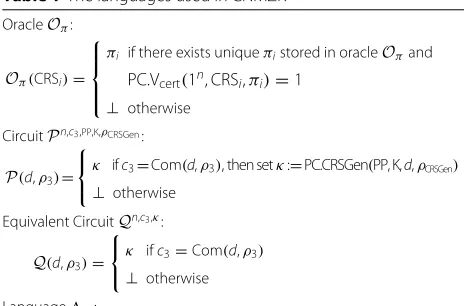
on input(j,sj)can output a messager. The oracleOπ stores all theCRSand proof pairs{(CRSi,πi)}that generated by theP-certificate system in the current history(see the definition in Table1).
• In stage 3, the verifierVinvokes the algorithm PC.setupto generate(PP,K)and sends the public parameterPPto P. The proverPcomputes c3=Com(0n,ρ3)and sends it toV.PandVrun a
WIUAsystem wherePproves toVthat there exists (M,Oπ,(j,sj),d,ρ2,ρ3)s.t.,(h,PP,c2,c3,r)∈2or
existsws.t.,(x,w)∈RL. In more detail, in the simulation phase,Pproves thatc2=Com(h(q))and
c3=Com(d,ρ3)whered=PC.PreGen(PP,q).
• In stage 4, the verifierV sends an obfuscation algorithmPˆCRSGentoPand gives aZKargument of the statement(PP,c3,PˆCRSGen)∈3. In more detail,V proves that there exists
(K,Pc3,PP,K,ρCRSGen,ρ
Setup,ρCRSGen,ρiO)such that (PP,K)=PC.Setup(1n,D,ρSetup)and
ˆ
PCRSGen=iO(Pc3,
PP,K,ρCRSGen,ρ
iO). The detailed descriptions of the circuitPandQare given in Table1.
• In stage 5, the proverPcomputes c4=CCACom1:1id (w,ρ4)under identityid,
c5=Com(0n,ρ5)and sends them toV.P andVruns
aWISSPsystem wherePproves toVthat there exists (d,ρ3,π)s,t.,(PP,PˆCRSGen,c5)∈4or existsws.t.,
Table 1The languages used in CNMZK
OracleOπ:
Oπ(CRSi)= ⎧ ⎪ ⎪ ⎨ ⎪ ⎪ ⎩
πi if there exists uniqueπistored in oracleOπand
PC.Vcert(1n, CRSi,πi)=1
⊥ otherwise CircuitPn,c3,PP,K,ρCRSGen:
P(d,ρ3)= ⎧ ⎨ ⎩
κ ifc3=Com(d,ρ3), then setκ:=PC.CRSGen(PP, K,d,ρCRSGen)
⊥ otherwise Equivalent CircuitQn,c3,κ:
Q(d,ρ3)= ⎧ ⎨ ⎩
κ ifc3=Com(d,ρ3) ⊥ otherwise Language1:
We say(h,c1,c2,r)∈1, iff there exist(M,ρ1,Oπ,(j,sj),ρ2)such that
–ρ1,ρ2,sj∈ {0, 1}n,j∈[m] ,M,Oπ∈ {0, 1}nlog logn
;
–c1=Com(h(M),ρ1);
–c2=Com(h(q),ρ2)where q=((M,Oπ),(j,sj),r).
Language2:
We say(h, PP,c2,c3,r)∈2, iff there exist(M,Oπ,(j,sj),d,ρ2,ρ3)such that
–d,sj,ρ2,ρ3∈ {0, 1}n,j∈[m] ,M,Oπ∈ {0, 1}nlog logn;
–c2=Com(h(q),ρ2)where q=((M,Oπ),(j,sj),r);
–c3=Com(d,ρ3)whered=PC.PreGen(PP, q).
Language3:
We say(PP,c3,PˆCRSGen)∈3, iff there exist
K,Pc3,PP,K,ρCRSGen,ρSetup,ρCRSGen,ρiOsuch that
– K,ρSetup,ρCRSGen,ρiO∈ {0, 1}n;
–(PP, K)=PC.Setup1n,D,ρ Setup
;
–PˆCRSGen=iO
Pc3,PP,K,ρCRSGen,ρiO.
Language4:
We say(PP,PˆCRSGen,c5)∈4, iff there exist(d,ρ3,π)such that
–d,ρ3,π∈ {0, 1}n;
–κ= ˆPCRSGen(d,ρ3);
–c5=Com((PP,κ),ρ5);
– PC.Vcert(1n,(PP,κ),π)=1.
c4=CCACom1:1id (w,ρ4)and(x,w)∈RL. In more detail, in the simulation phase,Pproves that κ= ˆPCRSGen(d,ρ3),c5=Com((PP,κ),ρ5)and
PC.Vcert(1n,(PP,κ),π)=1.
The formal protocolCNMZKis described below in Table1 and Table2.
Completeness and soundness
Completeness.The completeness of the protocol can be
Table 2Constant-round concurrent non-malleable zero-knowledge argument
Common input:x∈Land identity id∈ {0, 1}n.
Auxiliary input toP:w∈RL(x).
Stage 1:PandVruns a generation protocol as (Barak2001)
P←−V:h←−R Hn
P−→V:c1=Com(0n,ρ1)
P←−V:r←− {R 0, 1}4n
Stage 2:Pruns a WIUA using its auxiliary inputw
P ⇐⇒ V:Psendsc2toVand gives a WIUA argument of the
statementx∈Lor(h,c1,c2,r)∈1, wherec2=Com(0n,ρ2).
Stage 3:Pruns a WIUA again upon receiving the public parameter PP
P←−V:Vinvokes the PC.Setupalgorithmto generate(PP,K)and sends PP toP.
P ⇐⇒ V:Psendsc3toVand gives a WIUA argument of the
statementx∈Lor(h, PP,c2,c3,r)∈2, wherec3=Com(0n,ρ3).
Stage 4:V delegates Pto generate the CRS
P ⇐⇒ V:V sends thealgorithmPˆCRSGen toPand gives a ZK argument of the statement(PP,c3,PˆCRSGen) ∈ 3, wherePˆCRSGen =
iO(Pc3,PP,K,ρCRSGen,ρiO).
Stage 5:Pruns a WISSP using its auxiliary inputw
P⇐⇒V:Psends(c4,c5)toVand gives a WISSP argument of the
statement that(x,w) ∈ RL(x)or(PP,PˆCRSGen,c5) ∈ 4, wherec4 =
CCACom1:1id(w,ρ4)andc5=Com((PP,κ),ρ5).
from the completeness of theWIUAsystem in stage 2 and stage 3, the completeness of the ZK argument system in stage 4 and the completeness ofWISSPsystem in stage 5, we have that Pr[P(w),V(z)(x,id)]=1.
Soundness.The soundness of protocol follows from (1)
the binding property of the commitmentsc1,c2,c3in stage
1, 2 and 3; (2) the hiding property ofiOfor the circuitPin stage 4; (3) theselective strongsoundness ofP-certificates and (4) thespecial-soundness of WISSP used in stage 5. Roughly speaking, assume that the statementx∈/L. Con-sider the point where the prover has given the commit-mentc3and is now expecting the verifier messagePˆCRSGen.
Because at this point,c1,c2,c3,PP,Kare determined, the
two circuitP andQ described in Table1are functional equivalent. We assume that, w.l.o.g, P and Q have the same polynomial size inn, then from the security defini-tion ofiO, we can infer that the secret keyKis hiding in the obfuscation circuitPˆ. Otherwise, we can use the adver-sary to distinguish the circuit iO(P) andiO(Q), which leads to a contradiction. Next in stage 5, if there exists a
PPTcheatingP∗who can convince the verifier, then from the definition ofP-certificate system, there must exist an acceptedP-certificate π argument of the statement qis
true based onCRS = (PP,κ)except with negligible prob-ability. That is there exists an PPTmachineMon input a short bit string(j,s)(of length bounded in 3n) can pre-dict the challenge messager(length of 4n). However, this is information theoretically impossible. Thus, we reach a contradiction through violate the soundness of Barak’s protocol.
Next, we describe the construction of our simulator-extractor SE in “Our simulator-extractor” section and show its correctness satisfies the definition of CNMZK
in “The view generated by the simulator” section and
“The witnesses output by the extractor” section.
Our simulator-extractor
Recall that the definition ofCNMZKrequires the existence of a simulator-extractorSEthat can simulate the view of aman-in-the-middleadversaryAwhile extracting a wit-ness in every accepted right session. Below, we sketch how to build a simulator-extractor. First, we construct aPPT
simulator S that simulates the view of A but does not extract witnesses in the right seasons. Then, we construct aPPTsimulator-extractorSEvia the intermediate simula-torS, which can simulate the view of Aand extract the witnesses by the committed value oracle.
SimulatorS On a high level,Sinternally invokesAand
interacts withA as honest prover and honest veri-fier in the following way. To simulate the view of each session in the right interactions,Ssimply follows the honest verifier strategy. To simulate the view of each session in the left interactions,Suses the description of the adversary A as the fake witness and reused the previous generatedP-certificates if necessary in astraight-linemanner. The formal description of this process will be given below. Finally, S outputs the view of the adversaryA.
SimulatorSE On a high level,SEsimulates the view ofA
by executingSas the first part of its output. For each i∈[m], if thei-th right session is accepted andidiis different fromidjfor allj∈[m],SEextracts a witness from the sessioniby oracle access to theone-session committed-value oracleOccaofCCACom1:1.
The view generated by the simulator
In this section, we show that the view generated bySis indistinguishable from the real view ofA:
Lemma 1The following ensembles are computationally
indistinguishable:
- {viewA(1n,x1,· · ·,xm,z)}n∈N,x1,···,xm∈L∩{0,1}n,z∈{0,1}n
denote the total number of messages between the simula-torSandA, wherecis the rounds of ourCNMZKprotocol andmis the total number of concurrent sessions bounded by a polynomial.
We invoke the forward-secure pseudorandom
gen-erator to generate the random-tape we needed. Let
fsPRG(s,N) = ((sN,· · ·,s1),(ρN,· · ·,ρ1)), where s ∈
{0, 1}nis the random seed and eachρj∈ {0, 1}nis the ran-domness used to generate thej-th prover message in the left side.
We use three tables V,Oπ,T. V stores the commit-ment values in the simulation of the left interaction. Oπ stores all the CRSand proof pairs {(CRSi,πi)} gen-erated by theP-certificate system in the current history. T stores the messages simulated so far in both left and right sides. We initialize Oπ,T to be empty and add the code descriptions of the simulatorS andA to table V. Next we give a detailed description of the program
S(1n,x1,· · ·,xm,A,V,Oπ,T,s,N):
In each right session, S interacts with A simply by following thehonestverifier strategy described in our pro-tocol2. It can generate its random coins by using the PRG on a random seed in this part of the execution. In each left session, do as follows:
Simulate Stage 1 Upon receiving a hash function hi
in session i, S provides a commitment c1i to Mi((·,·),A,T), where Mi is an interactive Turing machine with the code description ofSandAplus the current state of them. Here the first two param-eters of Mi will be given when Mi is used as the witness to construct the statementqiin stage 2.
Simulate Stage 2 Upon receiving a challenge ri in
ses-sion i during the j-th communication round, S
retrieves the committed value Mi and provides a commitment c2i to the trapdoor statement qi = ((Mi,Oπ),(j,sj),ri), wheresjis the random seed used byfsPRGin thej-th round. According to our previous definition, the oracle programMOπ on input(j,sj) can recover all the previous randomness and any oracle queries{CRSi}thatMOπ makes before it out-putsrcan be answered using the currentOπ. Thus, the simulatorScan use(Mi,Oπ,(j,sj))and the cor-responding randomness to finish the WIUA for the statement(hi,c1i,c2i,ri)∈1.
Simulate Stage 3 Upon receiving a challenge PPi in
session i during the j-th communication round, S
provides a commitment c3i to the digest di, where
di = PC.PreGen(PPi,qi). Now we can make S use the fake witnesses (Mi,Oπ,(j,sj),di) and the cor-responding randomness to finish the WIUA for the statement(hi,PPi,c2i,c3i,ri)∈2.
Simulate Stage 4 Upon receiving an obfuscated program
ˆ
PCRSGen in session i during the j-th communication
round, S interacts with A as an honest verifier to finish theZKargument part.
Simulate Stage 5 Upon receiving the last message from
A in Stage 4 of session i, S computes κi =
ˆ
PCRSGen(d,ρ3)andπi=PC.Pcert(qi,CRSi). Now for the
CRSi=(PPi,κi),Schecks ifPC.Vcert(1n,CRSi,πi)=1 and extends the pair(CRSi,πi)to the oracleOπ, oth-erwise it willabort. Next,Sprovides a commitment c4i to a dummy string i.e.,0n and a commitmentc5i toCRSi. Thus,Shas all the witnesses(di,ρdi,πi)for the statement
PPi,PˆCRSGen,c5i
∈4, it can finish the
WISSPin stage 5.
Finally, the simulator will output all the messages of the both interactive sides stored in the tableT.
Correctness of the simulation.We observe the
correct-ness ofS. By our construction, the only place whereabort
is likely to happen is when the simulator computes an unaccepted certificateπi forCRSi based on a true state-ment qi in stage 5. However, the only difference of the
P-certificates system used in our protocol is that, instead of sendingκ in directly, the verifier first send the indis-tinguishability obfuscation of theGenCRSalgorithm and then give aZKargument to prove their correctness. Thus, from the perfect correctness of the indistinguishability obfuscator, thecompletenessof zero-knowledge argument and theperfect completenessof ourP-certificates system, it suffices to show that for a true statementqi, the prob-ability ofVcert(1n,CRSi,πi) = 1 is onlynegligible. So the probability of simulator outputabortis alsonegligible.
Indistinguishability of the simulation.Now we use the
hybrid argument to show the indistinguishability of the simulation, consider 2N hybrid experiments as follows. ExperimentHybi, 0 ≤ i ≤ N: the firsticommunication rounds are simulated by simulator S with the pseudo-randomness and fake witness, and all the later communi-cation roundj> iare simulated by simulatorSwith true randomness and the true witnesses. We also define hybrid
Hybi+that proceed identically asHybiexcept that it sim-ulates thei-th round following the honest prover strategy using the real witness.
Claim The output ofHybi+ andHybi are
computation-ally indistinguishable.
ClaimThe output ofHybi+andHybi+1are computation-ally indistinguishable.
ProofBecauseHybi+andHybi+1differs only which ran-domness (true or pseudo) is used in thei-round of the left interaction. The indistinguishability ofHybi+andHybi+1
follows directly from the forward security of the PRG.
Finally, it is easy to see that the output ofHybN is iden-tical to the output ofS, and the output ofHyb0is identical to the real viewviewA. Because there are at most polyno-mial hybrids in this experiment, we can conclude that the output ofSis indistinguishable from the output of the real interaction.
Combining the above, the Lemma1follows.
The witnesses output by the extractor
ProofOur simulator-extractorSEin “Our Simulator-Ex-tractor” section allows the extractor to access the decom-mitment oracle. We note that this is allowed for the reason of a k-robust CCA-secure commitment scheme used in our protocol. From the definition2, we know that, for any constant-roundk, the joint output of everyk-round inter-action, with an adversary (here it means theSE) having access to the oracle Occa, can be simulated without the
oracle in polynomial time. That is, the simulator-extractor
SE access to the oracle does not help it in participating in any k-round protocols. But allowing the simulator-extractorSEto access the oracle has the following benefits, we only need to pay attention to the impact of the hybrid experiment onSEwhen switching on the left witness from real to fake, without any further analysis of the interfer-ence from the right rewinding. So in the following, we just need to analyze whether such simulator-extractor can output the witness.
Consider the series of hybrids, we defineSEiSEi+the same asSEexcept that the execution ofSis replaced with that ofHybiHybi+. Then, by the definition ofCNMZK, we need to argument that, in the experimentSEN (which identical toSE), for anyPPTman-in-the-middleadversary Aand everyx1,· · ·,xm ∈ {0, 1}n∩L, such that for each
right interaction that is accepted and uses a different iden-tity from all left interactions, the simulator-extractorSE
does extract a valid witness of the statement proved. Observe that in the experiment SE0+, the simulator S
holds all the real witnesses of the left sessions and just acts as an honest prover in each left interaction and an hon-est verifier in each right interaction. Then following from the soundness of our protocol, we can conclude that in every accepted right interaction, A commits a real wit-ness in theCCACom1:1successfullyexcept with negligible probability. In other words, A never cheats in SE0+, so the simulator-extractor can extract the witness with the help of the committed value oracleexcept with negligible probability.
Next, we observe the experimentSEN which based on the definition ofHybN. Now we assume that there exists a polynomial function p such that A cheats in one of the right sessions in the experimentSEN with probability 1/p(n). In other words, there exists a right session which is accepted and uses a different identity from all the left interactions such that A fails to commit to a valid wit-ness in Stage 5 with probability 1/p(n). ThenSENcan not extract the witness from this right session with probability 1/p(n)as well. However, we have thatSE0+can extract the witness from this right sessionexcept with negligible prob-ability. Thus, from an average argument, there must exist anisuch that the probability of cheating differ by at least a polynomial amount in the hybridsSEiandSEi+or in the hybridsSEi+andSEi+1. Therefore, there is a gap between A’s chance of committing the valid witness on the right in
SEi+andSEi+1or there is a gap betweenA’s chance of com-mitting the valid witness on the right inSEiandSEi+. We analyze these two cases as follows:
In the first case, the only difference betweenSEi+ and
SEi+1is which randomness (true or pseudo) is used in the i-round of the left interaction. Therefore, they are com-putationally indistinguishable from claim2. In the second case, the only difference between SEi and SEi+ is which witness (fake or real) is used in thei-th round. The for-mer, in stage 5, uses a dummy string 0nas the committed value ofCCACom1:1followed with anWISSPfor knowing the fake witness instead of the witnesswiofxi. The latter, in stage 5, acts as an honest prover holding a real wit-nesswiofxi. If the gap is due to the committed value of
CCACom1:1, then we can use this gap to break the security of the non-malleable w.r.t itself. If the gap is due to the wit-ness used in the four-roundWISSPof the left session, then we can use this gap to break the4-robustness CCA-secure ofCCACom1:1.
Thus, we reach a contradiction, in the experimentSEN, Amust commit to a valid witness in Stage 5except with negligible probability. We know that the output ofSEN
is identical to the output of SE, hence the simulation-extractability of protocol2follows.
Combining “The View Generated by the
Simu-lator” section and “The Witnesses Output by the
Extractor” section, the concurrent non-malleable zero-knowledge property follows. This completes the proof of Theorem1.
Simultaneously-resettable and non-malleable zero-knowledge
From concurrent NMZK to resettable NMZK
if the original protocol is a constant-round concurrent
NMZK, then the new protocol will be a constant-round resettable NMZK. We provide the details of the transfor-mation in Table3, which are taken almost verbatim from (Chongchitmate et al. 2017), except that we require the prover and the verifier to have a extra commonid. Then we give a proof about the non-malleability for this new protocol.
Lemma 2ProtocolrNMZKin Table3is a constant-round
resettable non-malleableZKargument system.
ProofThe proof of the completeness and soundness conditions are similar to our proof in “The View
Gene-rated by the Simulator” section, and are omitted. The
proof of the resettable zero-knowledge can be directly obtained from the Theorem 4, because the protocol
CNMZKitself is aconstant-roundCZKprotocol. Next, we give the analysis of non-malleability.
Roughly speaking, for aman-in-the-middleadversaryA with an extra power of resetting attack, we need to prove that the view of A in the real interaction can be simu-lated by a simulator without all the witnesses of the left sessions, and there exists an extractor that can extract the witnesses in every accepting right session from this simulated view. More specifically, we first construct a sim-ulator and give an extractor based on this simsim-ulator as the previous section. Then, we reduce the security to the underlying assumptions by using a series of hybrids.
LetH0 = {real-viewfs,{wi}i∈[m]} denote the combined view ofAin the real experiment of the protocol rNMZK
and the values extracted by the committed value ora-cle. Then, following from the soundness of the protocol
rNMZK that, except with negligible probability, in every accepting right interaction,Acommits to a real witness in stage 5 and the extracted value is a real witness as well.
Next, we modify the protocol rNMZK into a protocol
rNMZKF by replacing the pseudorandom functionfswith
Table 3Constant-Round Resettable NMZK Argument(rNMZK)
The proverPand the verifierVon common input 1n,xand id, and private inputwforP:
1.Vsendsm0 =(Com(r1),· · ·, Com(r))toP, where =O(1)is the
number of rounds of the CNMZK protocol.
2. P chooses a random seed s for a pseudorandom functionfs :
{0, 1}∗→ {0, 1}l(n)wherel(n)is the upper bound of the size of random
bits thatPneeds in each round of the protocol CNMZK in Table2
3.PandVrun protocol CNMZK with the following modifications:
– For each messagemithatVsends in thei-th round of CNMZK,V andPrun(PrsZK,VrsZK)so thatVproves toPthatmiis computed using random bitsrithat committed inm0in the first round.
– For each messagemithatPsends in thei-th round of CNMZK,P
appliesfsto the transcript so far and uses the output as random bits to computemi.
a truly random function F : {0, 1}∗ → {0, 1}l(n). Let
H1= {real-viewF,{wi}i∈[m]}denote the combined view of
Ain the real experiment of the protocolrNMZKFand the values extracted the committed value oracle. It then fol-lows from the security of pseudorandom function that, the view and the value extracted from oracle are computation-ally indistinguishable inH0andH1. Otherwise, we can use
the adversary to break the indistinguishability between the pseudorandom function family and truly random function family.
Next, we construct our simulator Sˆ based on the sim-ulator S in the “The View Generated by the
Simu-lator” section. We need Sˆ to be able to emulate the
execution for theman-in-the-middleandresetting adver-saryAin the protocolrNMZKF. For the adversaryA, we divide itsresetting attack in the left into two cases. The first case is that the new first messagem0sent byAis
dif-ferent from all the first messages in the previous sessions on the left. Because our protocol rNMZKF uses the truly random functionF, in such case, we can see it as a new session, and simulatorSˆjust does the simulation of the left and right interactions in the same manner asS. Addition-ally, when executing the part of resettably-roundness ZK protocol, the simulatorSˆwill act as an honest verifier on the left. The second case is that the new first messagem0
sent byAhas been sent in a previous session, and then the simulatorSˆjust resends the responses from its history records of the corresponding session. This is because, for a fixed truly random functionF, the transcript of the whole session are fixed when the messagem0is fixed. Otherwise,
we can use this experiment to break the binding property of the commitment schemeCom.
Letsim-viewFbe the view ofAin the simulated experi-ment of the protocolrNMZKFby the simulatorSˆ,{wi}i∈[m]
be the values extracted by the committed value oracle. It is easy to see that the{sim-viewF}and{real-viewF}are com-putationally indistinguishable, otherwise we can use this experiment to break theconcurrentzero-knowledge of the protocolCNMZK. Now denoteH2= {sim-viewF,{wi}i∈[m]}
as the combined view of A in the simulate and extract experiment of the protocol rNMZKF. As before, we can construct a series of hybrids as “The Witnesses Output by the Extractor” section to argument that the view and the values are indistinguishable inH2andH1by reducing to
the security of the 4-robust one-one CCA-secure commit-ment schemeCom1:1(the non-malleable w.r.t itself or the 4-roundWISSP).