* Corresponding author. Tel: +381 18500660, Fax: +381 18500660 E-mail: [email protected] (N. Korunović) © 2014 Growing Science Ltd. All rights reserved. doi: 10.5267/j.ijiec.2014.11.003
International Journal of Industrial Engineering Computations 6 (2015) 199–210
Contents lists available at GrowingScience
International Journal of Industrial Engineering Computations
homepage: www.GrowingScience.com/ijiec
A procedure for multi-objective optimization of tire design parameters
Nikola Korunović*, Miloš Madić, Miroslav Trajanović and Miroslav Radovanović
Faculty of Mechanical Engineering, University of Niš, A. Medvedeva 14, Niš, Serbia
C H R O N I C L E A B S T R A C T
Article history:
Received September 9 2014 Received in Revised Format October 23 2014
Accepted November 25 2014 Available online
November 26 2014
The identification of optimal tire design parameters for satisfying different requirements, i.e. tire performance characteristics, plays an essential role in tire design. In order to improve tire performance characteristics, formulation and solving of multi-objective optimization problem must be performed. This paper presents a multi-objective optimization procedure for determination of optimal tire design parameters for simultaneous minimization of strain energy density at two distinctive zones inside the tire. It consists of four main stages: pre-analysis, design of experiment, mathematical modeling and multi-objective optimization. Advantage of the proposed procedure is reflected in the fact that multi-objective optimization is based on the Pareto concept, which enables design engineers to obtain a complete set of optimization solutions and choose a suitable tire design. Furthermore, modeling of the relationships between tire design parameters and objective functions based on multiple regression analysis minimizes computational and modeling effort. The adequacy of the proposed tire design multi-objective optimization procedure has been validated by performing experimental trials based on finite element method.
© 2015 Growing Science Ltd. All rights reserved Keywords:
Tire design
Multi-objective optimization Pareto
Strain energy density Finite element method
1. Introduction
stress, strain, energy, or some other physical quantities that directly influence the performance characteristics. Since tires carry out many functions and many of them have tradeoffs, it is important to find the combination of design variables that satisfy well-balanced performance in conceptual design stage (Koishi & Shida, 2006). In order to effectively maximize tire maneuverability and durability, Cho et al. (2002) refined the conventional satisficing trade-off methods (STOM), which were originally proposed for the multi-objective structural optimization, by introducing a systematic aspiration-level adjustment procedure. Five design variables i.e. nodal radii at nodes situated on sidewall portion of carcass were considered in order to improve tire maneuverability and durability by optimization of carcass contour at the sidewall.
Koishi and Shida (2006) proposed a procedure to solve multi-objective tire design problems by integrating polynomial-based response surface models, multi-objective genetic algorithm (MOGA) and self-organizing map (SOM). By means of MOGA and SOM, a map of Pareto solutions, called the multi-performance map, was determined upon which one could easily find some combinations of tire design parameters that satisfy well-balanced performance. In the proposed multi-objective optimization procedure three geometrical tire design parameters, which define the shape of the tread, were considered. The goal was to improve uneven wear and wear life for both the front tire and the rear tire of a passenger car, which was formulated using four objective functions. Serafinska et al. (2013) proposed a multi-objective optimization procedure based on the aggregate multi-objective function approach with consideration of fuzzy variables applied to structural tire design. Due to high computational effort, the numerical simulation model was subsequently substituted by an artificial neural network (ANN) based response surface approximation within the optimization loop. Belt angle, thickness of tread layer and number of cap plies were chosen as tire design parameters, while inner pressure, fiber spacing in carcass and stiffness of the tread compound were chosen as uncertain a-priori parameters. Within formulation of multi-objective optimization problem, two objective functions were considered. The first objective function was focused on achieving regular wear, which was obtained by providing a uniform contact pressure distribution in the tire-road contact zone. Within the second objective function, the occurrence of a fatigue crack was investigated by the evaluation of strain energy density.
The research presented in this paper was focused on determination of optimal tire design parameters to simultaneously minimize strain energy density at belt edge and chafer, which are known to influence tire durability. In this pilot study, axisymmetric FE model was used to simulate tire inflation process, in order to quickly test the methodology before a full study is performed using rolling analysis on a 3D FE model. In order to obtain the whole information in multi-objective solution and tire design parameters space, the proposed multi-objective optimization procedure was based on Pareto concept that enables design engineers to obtain a complete set of optimization solutions and chose a suitable tire design. In order to speed up the multi-objective optimization procedure and minimize computational and modeling effort, modeling of the relationships between tire design parameters and objective functions was based on multiple regression analysis (MRA). Finally, the adequacy of the proposed tire design multi-objective optimization procedure has been experimentally validated by performing FE experimental trials.
2. Problem definition concerning tire design and FE modeling issues
Fig. 1. Components of a radial tire Fig. 2. Axisymmetric finite element tire model As argued by De Eskinazi et al. (1990), strain energy density is seen to be a good indicator of complex stress-strain state at a given location inside the tire, taking into account material nonlinearities. Therefore, it should be a good predictor of rubber failure. It has already been used in tire optimization procedures by some authors, like Serafinska et al. (2013). For above reasons, the two objective functions considered in this paper are strain energy density at belt edge (f1) and strain energy density at chafer (f2). It is clear that in a realistic tire design optimization study, a rolling analysis of 3D FE tire model should be performed in order to get meaningful results related to behavior of the tire during its lifecycle. Nevertheless, as stated in the introduction, the main idea of the work presented in this paper was to perform a pilot study on a simple FE model that would allow the analyses to finish quickly. In this way, suitability of chosen optimization approach for tire design could be checked and compared with existing ones. Thus, axisymmetric model of one half of tire profile was selected (Fig. 2) and used for inflation analyses, in which three tire design parameters were changed: belt angle, belt cord spacing and elasticity of tread compound. From a number of parameters that are reported to have a significant influence on tire behavior (Olatunbosun & Bolarinwa, 2004; Ghoreishy, 2006), i.e. on stress-strain state inside the tire, those design parameters were chosen as they were easiest to change inside the FE model.
Axisymmetric FE model used in the analyses contains an overall optimized mesh of one-half of tire profile, resulting from a convergence study. The chosen mesh yields only 0.65% less maximal stress in belt area than the finer one used in convergence study. The mesh contains an overall of 593 elements, 421 of which are linear hybrid axisymmetric elements with twist representing rubber components, 162 are embedded linear surface axisymmetric elements with twist containing rebar definitions to present tire reinforcements and 10 are linear axisymmetric elements representing bead wire. Rubber behavior is modeled using hyperelastic Yeoh material model, while cords are modeled as linear elastic material. Similar FE model is described in detail in (Korunović et al., 2007). Inflation pressure was 0.23MPa. 3. Multi-objective optimization procedure
The applied multi-objective optimization procedure, used for determination of optimal tire design parameters for simultaneous minimization of strain energy density at belt edge and chafer is illustrated in Fig. 3. The procedure is divided into four main stages: pre-analysis, design of experiment (DOE), mathematical modeling and multi-objective optimization.
The goal of pre-analysis stage is to identify the main tire design parameters, which have a significant influence on the objective functions. As mentioned in previous chapter, for the purpose of pilot study, this phase was simplified by choosing three design parameters already reported to have significant influence on tire stresses. In order to investigate the sensitivity of objective functions to the change of selected tire design parameters values, one factor at a time (OFAT) experimental trials were performed in this stage.
In the DOE stage, considering manufacturing practices, data from literature (Olatunbosun & Bolarinwa, 2004; Serafinska et al., 2013; Yang et al. 2014) and trial FE analyses, the ranges of values for tire design parameters were determined. In order to cover investigated experimental hyper-space, the full factorial experimental plan was used. Subsequently, based on different combinations of tire design parameter values, FE simulations were performed. In the mathematical modeling stage, based on the collected FE experimental data and by using the MRA, mathematical models relating tire design parameters and strain energy density at belt edge and chafer were developed and validated. The first step in multi-objective optimization stage was the formulation of the optimization problem, which was set as identification of optimal values of tire design parameters in order to simultaneously minimize strain energy density at belt edge and chafer. Subsequently, to obtain a set of Pareto optimal solutions, genetic algorithm (GA) was applied. Finally, for the purpose of validation, FE simulation experimental trials were performed with the identified optimal values of tire design parameters.
4. Experimental plan and FE analyses results
The accuracy of scientific experimentation can be increased by using the experimental plans from the DOE, which offer an efficient plan to study the entire experimental region of interest for the experimenter. Among the various DOE such as OFAT, factorial, fractional factorial, central composite design, Box-Behnken, Taguchi, etc., in this study a 33 full factorial experimental plan was adopted.
Although more time consuming than some other plans, this high resolution experimental plan was applied since it allows independent estimation of all main and interaction effects of design parameters, analysis of the interaction effects of design parameters and development of mathematical models of higher order. In the present experimental study, three tire design parameters, namely belt angle (xd1), belt cord spacing
(xd2), and elasticity of tread compound (xd3), were considered. The tire design parameter ranges were
selected based on preliminary OFAT results as well as by considering some technically manageable ranges and guidelines from literature. Here it should be noted that all tire design parameters can be considered as continuous design parameters i.e. can take any value within the specified ranges. For the experimentation purpose boundary points within the specified ranges of each tire design parameter were selected as low and high levels, while the centre level was taken at the middle of the range. The configuration of the initial design is defined as xd1 = 22º, xd2 = 1.05 mm and xd3 = 1. Tread compound was modeled using hyperelastic Yeoh material model. The value of xd3 = 1 corresponds to nominal values of Yeoh coefficients: C10=1.0236 N/mm2, C20= -0.4272 N/mm2 and C30=0.1732 N/mm2. Values of Yeoh
coefficients used in various FE models were obtained by multiplication of all the coefficients with the value of xd3. Therefore, xd3 is dimensionless. Table 1 gives the ranges of tire design parameters and their levels within the experimentation.
Table 1
Tire design parameter ranges and their levels in the experiment
Tire design parameter Unit 1 2 3 Level
Belt angle, xd1 º 18 22 26
Belt cord spacing, xd2 mm 0.65 1.05 1.45
Elasticity of tread compound, xd3 0.6 1 1.4
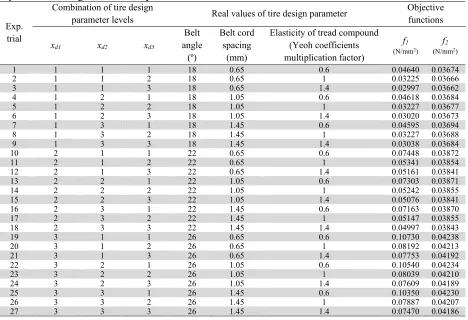
regarding objective functions (f1 and f2), i.e. strain energy density at belt edge and chafer, based on each combination of tire design parameter values are given in Table 2.
Fig. 4. Strain energy density obtained by FE analysis of axisymmetric model
Table 2
Experimental design and FE analysis simulation results
Exp. trial
Combination of tire design
parameter levels Real values of tire design parameter
Objective functions
xd1 xd2 xd3
Belt angle
(º)
Belt cord spacing
(mm)
Elasticity of tread compound (Yeoh coefficients multiplication factor)
f1
(N/mm2) f2
(N/mm2)
1 1 1 1 18 0.65 0.6 0.04640 0.03674
2 1 1 2 18 0.65 1 0.03225 0.03666
3 1 1 3 18 0.65 1.4 0.02997 0.03662
4 1 2 1 18 1.05 0.6 0.04618 0.03684
5 1 2 2 18 1.05 1 0.03227 0.03677
6 1 2 3 18 1.05 1.4 0.03020 0.03673
7 1 3 1 18 1.45 0.6 0.04595 0.03694
8 1 3 2 18 1.45 1 0.03227 0.03688
9 1 3 3 18 1.45 1.4 0.03038 0.03684
10 2 1 1 22 0.65 0.6 0.07448 0.03872
11 2 1 2 22 0.65 1 0.05341 0.03854
12 2 1 3 22 0.65 1.4 0.05161 0.03841
13 2 2 1 22 1.05 0.6 0.07303 0.03871
14 2 2 2 22 1.05 1 0.05242 0.03855
15 2 2 3 22 1.05 1.4 0.05076 0.03841
16 2 3 1 22 1.45 0.6 0.07163 0.03870
17 2 3 2 22 1.45 1 0.05147 0.03855
18 2 3 3 22 1.45 1.4 0.04997 0.03843
19 3 1 1 26 0.65 0.6 0.10730 0.04238
20 3 1 2 26 0.65 1 0.08192 0.04213
21 3 1 3 26 0.65 1.4 0.07753 0.04192
22 3 2 1 26 1.05 0.6 0.10540 0.04234
23 3 2 2 26 1.05 1 0.08039 0.04210
24 3 2 3 26 1.05 1.4 0.07609 0.04189
25 3 3 1 26 1.45 0.6 0.10350 0.04230
26 3 3 2 26 1.45 1 0.07887 0.04207
27 3 3 3 26 1.45 1.4 0.07470 0.04186
All FE experimental data given in Table 2 were used for the development of objective functions in analytical form, regarding tire design parameters.
5. Mathematical models for response surface approximation
complex and highly nonlinear functional dependencies, it is more beneficial, in terms of speed and simplicity, to use simpler modeling methods such as MRA. Therefore, response surface approximation based on MRA was attempted. MRA is a conceptually simple method that when applied in tire design can be expressed by the following equation:
1,..., ; ,...,0
m d dn p
f f x x (1)
where fm is the objective function being modeled, xd1, ..., xnd are tire design parameters, β0, ..., βp are regression coefficients and is the error.
5.1. Development of MRA models
To establish mathematical relationships between tire design parameters that is belt angle (xd1), belt cord spacing (xd2) and elasticity of tread compound (xd3), and strain energy density at belt edge and chafer, second order MRA models (quadratic regression models with interactions) were developed. By using the obtained FE experimental data and by the application of least square method for regression coefficients determination, the objective functions were obtained as:
1 1 2 3 1 2
2 2
1 3 1 3
= 0.030111+0.000741 +0.008828 -0.089748 -0.000503 -0.002078 +0.000188 +0.05366
d d d d d
d d d d
f x x x x x
x x x x
(2a)
2 1 2 3 1 2
2
1 3 1
= 0.0488-0.00167 0.00103 +0.000813 -0.000044 -0.000053 +0.000055
d d d d d
d d d
f x x x x x
x x x
(2b)
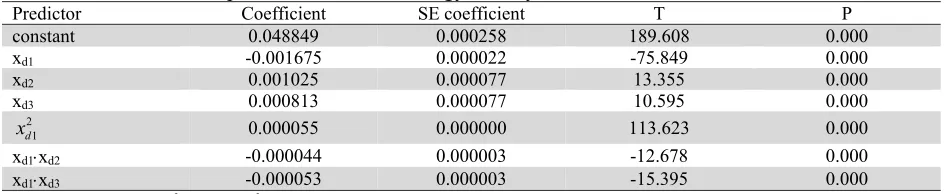
More detailed results of MRA with all the corresponding coefficients and P-values are given in Tables 3 and 4. The adequacy of the developed MRA models was checked based on standard and adjusted coefficients of multiple determinations, R2 and R2 (adj.). The R2 values indicate that the tire design
parameters explain more than 99% of variance in strain energy density. These values indicate that the developed models fit FE experimental data very well.
Table 3
The MRA model for the prediction of strain energy density at belt edge
Predictor Coefficient SE coefficient T P
constant 0.030111 0.015163 1.986 0.062
xd1 0.000741 0.001281 0.579 0.570
xd2 0.008828 0.004454 1.982 0.062
xd3 -0.089748 0.007205 -12.456 0.000
2 1
d
x 0.000188 0.000028 6.622 0.000
2 3
d
x 0.053660 0.002832 18.948 0.000
xd1xd2 -0.000503 0.0002 -2.512 0.021
xd1xd3 -0.002078 0.0002 -10.378 0.000
S = 0.0011099; R2=0.9984; R2(adj)=0.9978. T, value of Student’s distribution; P, probability density.
Table 4
The MRA model for the prediction of strain energy density at chafer
Predictor Coefficient SE coefficient T P
constant 0.048849 0.000258 189.608 0.000
xd1 -0.001675 0.000022 -75.849 0.000
xd2 0.001025 0.000077 13.355 0.000
xd3 0.000813 0.000077 10.595 0.000
2 1
d
x 0.000055 0.000000 113.623 0.000
xd1xd2 -0.000044 0.000003 -12.678 0.000
xd1xd3 -0.000053 0.000003 -15.395 0.000
In addition, the adequacy of FE experimental data fit by the developed MRA mathematical models was assessed using the absolute percentage errors. The mean absolute percentage errors between MRA model predictions and FE experimental data, for strain energy density at belt edge and chafer, were found to be 1.76% and 0.43% respectively. The obtained values as well as the results from Tables 3 and 4 suggest that the predictions of both MRA models are in very good agreement with FE experimental values of strain energy density within the scope of tire design parameter ranges investigated in the study. Thus, the developed MRA models can be used to analyze the effect of the tire design parameters on the strain energy density at belt edge and chafer. Also, MRA mathematical models can serve as objective functions for the optimization of tire design parameters.
5.2. Effects of tire design parameters on strain energy density
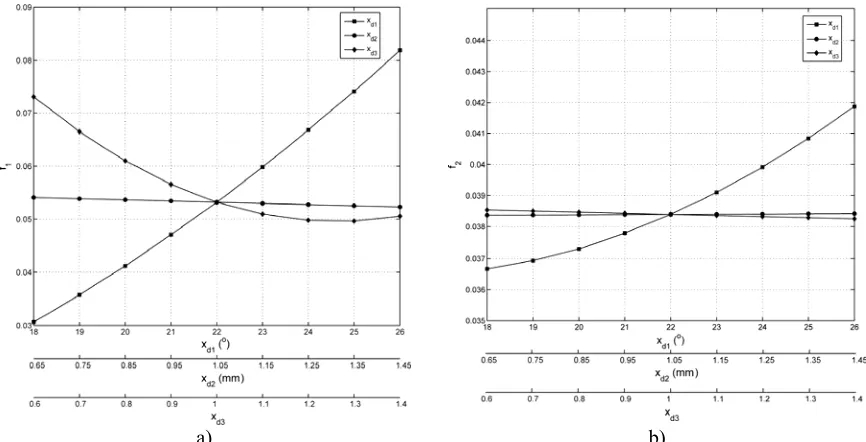
Initially effects of the tire design parameters on the strain energy density at belt edge and chafer were analyzed by changing one parameter at a time, while keeping the all other parameters constant at central level (level 2) (Fig. 5).
a) b)
Fig. 5. Main effects of the tire design parameters on the strain energy density at: a) belt edge, b) chafer
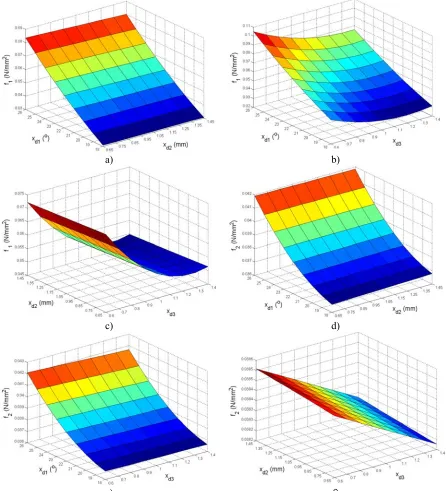
xd2, xd1 and xd3, and xd2 and xd3), three 3-D plots were generated for strain energy density at belt edge (Fig. 6) and three 3-D plots were generated for the strain energy density at chafer (Fig. 6).
From Fig. 6 it can be seen that the increase in belt angle and decrease in belt cord spacing as well as increase in belt angle and decrease in elasticity of tread compound results in increase of the strain energy density at belt edge and at chafer. This is the expected combination of the separate influence of the two parameters. Fig. 6 confirms the negligible influence of the belt cord spacing in interaction with other tire design parameters on the strain energy density. From Fig. 6c and Fig. 6f it could be observed that decrease in elasticity of tread compound produces a nonlinear increase in strain energy density at belt edge, whereas the dependence of the strain energy density at chafer and elasticity of tread compound is linear.
6. Pareto based optimization and results
6.1. Multi-objective optimization problem formulation
The optimal selection of tire design parameters should increase tire durability to some extent by minimizing strain energy density at belt edge and chaffer. Therefore, one needs to define the multi-objective optimization problem, which in this study was formulated as follows:
1 1 2 3 2 1 2 3
1 2 3
Minimize: , , and , , ,
subject to: 18 26 ( ), 0.65 1.45 (mm), 0.6 1.4
d d d d d d
d d d
f f x x x f f x x x
x x x
(3)
In the present multi-objective optimization procedure of tire design, two objective functions defined by Eq. (2a) and Eq. (2b) are considered and both are to be minimized.
6.2. Solving approach
Solving multi-objective optimization problems as the one formulated in Eq. (3) is quite difficult, because there is no unique solution; rather there exists a set of acceptable solutions. Methods for solving multi-objective optimization problems are usually divided into three categories: a priori methods, a posteriori methods and interactive methods, which involve active participation of a decision maker during the solving of an optimization problem and in essence combine a priori and a posteriori approaches (Deb, 2001).
In this study, a posteriori approach based on Pareto optimality concept was applied. Thus, determined optimal solutions are solutions, which are not dominated by any other solutions. The set of all Pareto optimal solutions is called the Pareto optimal set and the corresponding objective function vectors are said to be on the Pareto front (Ngatchou et al., 2005). As it is difficult to find Pareto solutions of multi-objective design problems of tires (Koishi & Shida, 2006), genetic algorithm (GA), as one of the most powerful meta-heuristic optimization algorithms, was applied. GAs are powerful and broadly applicable probabilistic algorithms which combine elements of direct and stochastic search showing a high level of robustness (Michalewicz, 1996). The idea of GA is based on the principles of natural genetics and natural selection (Rao 2009). GAs have the advantage of evaluating multiple potential solutions in a single iteration. Moreover, they offer additional advantages such as greater flexibility for the decision maker,
mainly in cases where no a priori information is available and handling non differentiable and
mutation, population size, population type, and number of generations. In this study, repeated simulations were performed to find commensurate values for the main GA parameters (See Table 5).
a) b)
c) d)
e) f)
Fig. 6. Interaction effects of the tire design parameters on the strain energy density at belt edge (a,b,c)
and strain energy density at chafer (d,e,f) Table 5
Main parameter values of the GA used in the optimization process
Population size 60
Population type double vector
Selection stochastic uniform
Reproduction elite count: 2 crossover fraction 0.9 Crossover function scattered
Mutation function Gaussian
Max. generations 800
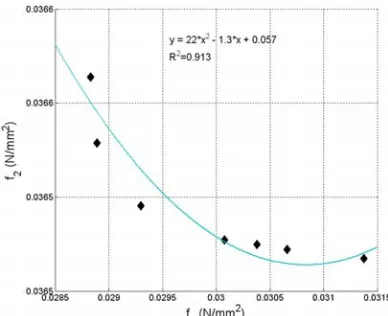
As a result of multi-objective optimization, a set consisting of 7multi-objectiveoptimal solutions was obtained based on the best fitness values (Fig. 7).
Fig. 7. The Pareto front of non-dominated solutions
As shown in Fig. 7, minimization of strain energy density at belt edge and minimization of strain energy density at chafer are contradicting objectives. However, it is obvious that the change in strain energy density at chafer is very small. From Fig. 7 it can be also observed that the relationship between strain energy density at belt edge and strain energy density at chafer is nonlinear and can be expressed with a second degree polynomial. None of the solutions in the Pareto-optimal front is absolutely better than any other, so as any one of them is an acceptable solution. The choice depends upon the specific design requirements and a suitable combination of tire design parameter values can be selected from Table 6. Table 6
Multi-objective optimal values of tire design parameters and corresponding values of strain energy density
Solution xd1 (º) xd2 (mm) xd3 f1(N/mm2) f2 (N/mm2)
1 18 0.65 1.4 0.031375 0.036517
2 18 0.927 1.183 0.028828 0.036614
3 18 0.653 1.351 0.030377 0.036525
4 18 0.652 1.333 0.030076 0.036527
5 18 0.692 1.273 0.029296 0.036545
6 18 0.65 1.366 0.030659 0.036522
7 18 0.795 1.209 0.028889 0.036579
The analysis of the results from the Table 6 indicates that, for belt angle of xd1=18º, there are different combinations of belt cord spacing and elasticity of tread compound that yield acceptable solutions regarding simultaneous minimization of strain energy density at belt edge and at chafer. Note that the solution 1 actually corresponds to the experimental trial 3 from Table 2. In order to check the quality of the obtained multi-objective optimization solutions, two independent single objective optimizations (minimizations) were performed. From the minimizations of the objective functions, the following results were obtained:
1min 0.0287 for d1 18 , d2 1.45mm, d3 1.185
f x x x (4a)
2min 0.036517 for d1 18 , d2 0.65mm, d3 1.4
f x x x (4b)
multi-objective optimization procedure. Once the optimal combinations of tire design parameters are determined, the final step is to predict and verify the expected responses by performing the FE simulation experimental trials. Seven FE simulation experimental trials, with the combination of tire design parameter values as given in Table 6, were performed and the solution which had the minimal percentage error was selected as the best. It should be noted that the maximal percentage errors between FE simulation experimental values and predictions were less than 7%. From Table 7 it can be observed that the there is a perfect match, with percentage errors less than 1 %, between predicted and FE experimental values of strain energy density. Consequently, this validation experimental trial gave excellent results and also revealed that the proposed multi-objective optimization approach had significantly improved the initial design (Table 8).
Table 7
Result of validation FE experimental trial
f1(N/mm2) f2 (N/mm2)
FE simulation experiment 0.03025 0.03663
Predicted 0.030377 0.036525
percentage error, % 0.4 0.3
Optimal combination of tire design parameter values: xd1=18 º, xd2=0.653 mm, xd3=1.351
Table 8
Comparison between the initial and optimal tire design parameter settings
Tire design Tire design parameter values Objective function values (N/mm2)
f1 f2
Initial design xd1=22 º, xd2=1.05 mm, xd3=1 0.05242 0.03855
Optimized design xd1=18 º, xd2=0.653 mm, xd3=1.351 0.03025 0.03663
Improvement (%) 42.3 5
6. Conclusion
In this paper, a procedure that integrates DOE, mathematical modeling and GAs for solving multi-objective optimization of tire design problems was proposed. In relation to the previous studies, the response surface approximation, used to evaluate objective functions in the optimization process, was obtained by the application of MRA. Apart from the fact that the use of response surface approximation can reduce the number of FE analyses i.e. CPU time dramatically, mathematical modeling of the relationships between tire design parameters and performance characteristics based on the use of MRA is much simpler and time saving approach. Furthermore, the proposed multi-objective optimization procedure is well suited for design engineers since it is based on the use of Pareto concept, thus providing a set of acceptable trade-of solutions of tire performance. The capabilities of the proposed procedure are illustrated through a design study. It is focused on determination of optimal tire design parameters for simultaneous minimization of strain energy density at belt edge and chafer. The results of the study are summarized in the following points:
From the analysis of the effect of tire design parameters on the strain energy density at belt edge and chafer, it is observed that belt angle is the most significant tire design parameter followed by the elasticity of tread compound, while the influence of the belt cord spacing is negligible.
The results of multi-objective optimization revealed that using small belt angle (18º) at suitable combination of belt cord spacing and elasticity of tread compound is favorable for minimization of strain energy density both at belt edge and at chafer.
The proposed multi-objective optimization procedure resulted in significantly improved initial design. Improvements of 40% and 5% in objective function values were obtained and these were experimentally validated with percentage errors less than 1 % between predicted and FE experimental values of strain energy density.
The practical application of the proposed multi-objective optimization procedure comes with increased flexibility on selecting the optimal tire design parameters by providing a set of candidate solutions for simultaneous consideration of several tire performance characteristics. Application of fractional factorial experimental plans for the analysis of several tire design parameters, including uncertain parameters, as well as the use of deterministic optimization methods for generation of Pareto solutions are future research scopes.
References
Cho, J. R., Jeong, H. S., & Yoo, W. S. (2002). Multi-objective optimization of tire carcass contours using a systematic aspiration-level adjustment procedure. Computational Mechanics, 29(6), 498-509. Deb, K. (2001). Multi-objective optimization using evolutionary algorithms. John Wiley & Sons. De Eskinazi, J., Ishihara, K., Volk, H., & Warholic, T. C. (1990). Towards predicting relative belt edge
endurance with the finite element method. Tire Science and Technology, 18(4), 216-235.
Gent, A. N., & Walter, J.D. (2006). The pneumatic tire. Washington D.C., National Higway Traffic Safety Administration, U.S. Department of Transportation.
Ghoreishy, M. H. R. (2006). Finite element analysis of steady rolling tyre with slip angle: Effect of belt angle. Plastics, Rubber and Composites, 35(2), 83-90.
Koishi, M., & Shida, Z. (2006). Multi-objective design problem of tire wear and visualization of its Pareto solutions, Tire Science and Technology, 34(3), 170-194.
Korunović, N., Trajanović, M., & Stojković, M. (2007). Finite element model for steady-state rolling tire analysis. Journal of the Serbian Society for Computational Mechanics, 1(1), 63-79.
Kovačević, M., Madić, M., Radovanović, M., & Rančić, D. (2014). Software prototype for solving multi-objective machining optimization problems: Application in non-conventional machining processes.
Expert Systems with Applications, 41(13), 5657-5668.
Michalewicz, Z. (1996). Genetic algorithms+ data structures= evolution programs. Springer.
Nakajima, Y., Kadowaki, H., Kamegawa, T., & Ueno, K. (1999). Application of a neural network for the optimization of tire design. Tire Science and Technology, 27(2), 62-83.
Ngatchou, P., Zarei, A., & El-Sharkawi, M. A. (2005). Pareto multi objective optimization. In Intelligent Systems Application to Power Systems, 2005. Proceedings of the 13th International Conference on
(pp. 84-91). IEEE.
Olatunbosun, O. A., & Bolarinwa, O. (2004). FE simulation of the effect of tire design parameters on lateral forces and moments. Tire science and Technology, 32(3), 146-163.
Rao, S. S. (2009). Engineering optimization: theory and practice. John Wiley & Sons.
Serafinska, A., Kaliske, M., Zopf, C., & Graf, W. (2013). A multi-objective optimization approach with consideration of fuzzy variables applied to structural tire design. Computers and Structures, 116, 7-19.
Yang, X., Behroozi, M., & Olatunbosun, O. A. (2014). A Neural Network Approach to Predicting Car
Tyre Micro-Scale and Macro-Scale Behaviour. Journal of Intelligent Learning Systems and