VOLUME 38, ARTICLE 44, PAGES 1339
,
1358
PUBLISHED 17 APRIL 2018
http://www.demographic-research.org/Volumes/Vol38/44/ DOI: 10.4054/DemRes.2018.38.44
Research Article
Measuring extended families over time in
informal settlements in Nairobi, Kenya:
Retention and data consistency in a two-round
survey
Sangeetha Madhavan
Donatien Beguy
Shelley Clark
This publication is part of the Special Collection on “Children and Family Dynamics in sub-Saharan Africa,” organized by Guest Editors Olivia Samuel and Véronique Hertrich.
© 2018 Sangeetha Madhavan, Donatien Beguy & Shelley Clark.
This open-access work is published under the terms of the Creative Commons Attribution 3.0 Germany (CC BY 3.0 DE), which permits use, reproduction, and distribution in any medium, provided the original author(s) and source are given credit.
1 Introduction 1340
2 Longitudinal studies of children and families in sub-Saharan Africa 1341
3 Study site, data, and methods 1343
3.1 Single mothers and construction of kinship 1344
3.2 Description of retention process 1345
4 Attrition and its implications 1346
5 Consistency in reporting across waves and implications 1348
6 Discussion and conclusion 1351
Measuring extended families over time in informal settlements in
Nairobi, Kenya:
Retention and data consistency in a two-round survey
Sangeetha Madhavan1
Donatien Beguy2
Shelley Clark3
Abstract
BACKGROUND
Researchers have increasingly turned to longitudinal data to understand how the family environment of children changes over time and how this change affects their well-being. While the value of such efforts is clear, the inherent challenges of collecting robust data over time may limit or bias our understanding of family complexity.
OBJECTIVE
Drawing on data from an exploratory study on kinship structure and support for low income single mothers and their young children in Nairobi, Kenya, this paper aims to (1) assess the strengths and weaknesses of our approach in reflecting the complexities of kinship dynamics and (2) analyze how methodological issues such as selection and reporting inconsistency can influence our understanding of the role of kin in children’s lives.
METHODS
The analysis used data from two waves of the Kinship Support Tree (KST) project. The starting sample consisted of 462 single mothers with at least one child under the age of 7, with data collected on approximately 5,000 resident and nonresident kin. Descriptive statistics and conventional tests of significance were used to analyze selection factors and inconsistencies in reporting across waves.
1 Department of African American Studies, University of Maryland, College Park, USA.
Email:[email protected].
2 Global Urban Observatory, Research and Capacity Development Branch, United Nations Human
Settlements, Nairobi, Kenya.
RESULTS
The study yielded a 91% retention rate after six months and the analysis provides some assurance that selectivity from attrition and reporting inconsistency are not entirely driven by shifts in support provision by kin. However, the selectivity of the sample underscores caution in generalizing the results.
CONCLUSIONS
While the challenges of conducting follow-up surveys such as the KST are serious, these findings suggest that it is possible to collect consistent data on kinship structure and support from the perspective of children in a mobile population. Tracking kinship structure over time using the KST is not only feasible but more importantly is unlikely to lead to incomplete or biased understanding of kinship.
CONTRIBUTION
After further testing with a wider range of women, we hope to disseminate our results for use in a wide range of contexts both in and out of Africa. We believe this data is vital to designing appropriate interventions to improve the well-being of children growing up in these communities.
1. Introduction
In demographic and public health research, it is well recognized that longitudinal studies offer a wide range of advantages over cross-sectional studies to examine changes over time and their related causal factors. The increasingly sophisticated examination of family structure and children’s well-being has benefited from such data collection efforts (Clark, Cotton, and Marteleto 2015; Ford and Hosegood 2005; Madhavan et al. 2012). However, most longitudinal data is limited to the coresidential household. This limits our definition of family to coresidents even in contexts where linkages among nonresidential kin have been seen as critical to children’s well-being (Adams, Madhavan, and Simon 2001; Cunningham et al. 2010; Sear and Mace 2008; Sear, Mace, and McGregor 2000) and constrains our ability to understand dynamism of broader social environments for children. In contexts marked by economic insecurity and spatial mobility, it would be expected that the role of kin changes even over short spans of time. Using data from an exploratory two-wave study on kinship structure and support for single mothers and their children in a highly mobile slum population in Nairobi, Kenya, this paper aims to (1) assess the strengths and weaknesses of our approach in reflecting the complexities of kinship dynamics and (2) analyze how methodological issues such as selection and reporting inconsistency can influence our understanding of the role of kin in children’s lives. While the need to expand our conceptual frameworks for studying families and children may be widely accepted, there is far less consensus about methods and the extent to which specific approaches are successful in producing robust and reliable measures of kin structure and support over time.
2. Longitudinal studies of children and families in sub-Saharan
Africa
the CAPS study collected data on financial transfers to adolescents from outside the household. While practically advantageous, the focus on coresidence limits both the measurement of family and our understanding of how households change over time. For example, if a household member moves away, they are no longer in the study in the subsequent wave, even though they continue having a relationship with members of the former household and possibly even provide support to it. Given how dynamic residential arrangements are, it is critical that we are able to track spatial mobility over time. A related issue that merits attention is the conflation of structure and support. Guided by a Becker (1981) altruistic household framework, studies tend to use the coresidential household structure as a proxy for support. In contexts of economic scarcity and unstable employment, people’s ability to provide support is likely to change even over short periods of time. Therefore, direct measures of support should be collected from both residential and nonresidential kin. Finally, reporting in most studies, particularly those concerning infants and young children, is done mostly by mothers. For example, in the BTT study, virtually all reporting was done by mothers when children were young but reports were added directly from children once they turned 14. This is important because the picture we see of extended family, both at any given time and over time, is a construction from the perspective of the person reporting. This is further complicated in data collection on kinship, where accurate reporting on particular kin may depend on the current relationship with the respondent. For example, certain people may be left out of reporting during family disputes, and then may reappear after a reconciliation. This might be further exacerbated by women’s union status such that women in dissolved unions are less likely to know much about their ex-partner’s kin.
the government plan of slum cleanup (APHRC 2007; Beguy et al. 2009). In the case of tracking kin structure and support, it is likely that people who do not have strong connections to their kin, i.e., do not receive or provide support, are more likely to be mobile, resulting in substantial selection bias. Moreover, it is also highly likely that those who lose kin support over time are more likely to leave the study.
Inconsistency in reporting over survey rounds is a common occurrence as a result of recall error, reporting biases, and errors on the part of the interviewers (Beguy et al. 2009; Mensch, Hewett, and Erulkar 2003). For example, data from another study in Nairobi slums indicates that almost half of sexually active adolescents provided inconsistent information on their sexual behavior between two rounds of surveys (Beguy et al. 2009). In rural Kenya and Malawi, evidence suggests a high degree of reporting inconsistency not only between rounds, but also among individual responses (Hewett, Mensch, and Erulkar 2004; Mensch 2003). However, misreporting due to memory is different from inconsistencies that are likely to occur when collecting longitudinal data on kin structure and support. Respondents who are not very connected to their kin would also be less likely to know much about their kin and more likely to provide inconsistent reports across waves.
Taken together, the methodological challenges described here could be seen as symptomatic of the larger task of understanding complexities of kin relationships in contemporary African contexts. We now turn to our data to demonstrate how two issues, selection due to attrition and inconsistency in reporting across waves, may impact the way we come to understand kinship and extended family interactions in a slum community in Nairobi, Kenya.
3. Study site, data, and methods
slum settlement and areas of origin are observed among residents (Beguy, Bocquier, and Zulu 2010). However, compared to the other slum where the NUHDSS is conducted, Viwandani, Korogocho has a more settled population (Emina et al. 2011).
The Kinship Support Tree (KST) is an innovative data collection instrument that our team designed to collect data on kinship structure and support (residential and nonresidential) for single mothers and their young children residing in Korogocho in 2015 and 2016. The sample was drawn from the most recent round of the NUHDSS and consisted of 462 single mothers, i.e., women who were not currently married or The instrument (described in cohabiting with a partner, with a child under the age of 7.
detail in Madhavan et al. 2017) included an enumeration of all close kin (dead and alive, coresident and nonresident) from the child’s perspective – biological father, siblings, grandparents, aunts and uncles on maternal and paternal sides – and demographic data on each kin including GPS codes for residential location. Because the reports are based on relationship to the child, both half and full siblings of the mother are included. From this group of kin who ever existed (N = 5344), we identified a subset of potential kin defined as those who are alive and over the age of 7 (N = 3453) and, therefore, in a position to be able to provide support. From this group we identified or emotional functional kin as those who have provided the mother with financial
support or child care over the past month. In earlier work (Clark et al. 2017a) we provide the distribution of the different types of kin relationships in the potential and We also collected data on the physical health status of mother and functional categories.
child, and cognitive development of the child. This survey was administered two times with a six month interval to assess 1) the feasibility of retaining a sample of single mothers in a highly mobile context and 2) the changes in reported kinship support over time.
3.1 Single mothers and construction of kinship
presumably straightforward enumeration of kin may go against emic understandings of who counts as family and under what conditions. Contact with and support from the child’s father and paternal kin are – almost by definition – likely to be very different for married versus unmarried mothers (Madhavan, Richter, and Gross 2015). Thus, we make no claims of generalizability about kin beyond the single mothers in our study. Bearing this restriction in mind, our study aims to provide key insights into how single mothers construct kinship and kinship support. In addition, we made two decisions intended to improve the complete reporting of kin. First, we used the child instead of the mother as the point of reference to collect kinship data. We did this in order to 1) have direct measures of the child’s relationship to each kin member instead of relying on reconstructed relationships based on relationship to the mother and 2) reduce the likelihood of the mother selectively leaving out kin based on her assessment of the strength of the relationship to her. Second, we explicitly differentiated structure from support to enable the respondent to enumerate the existence of kin without linking it to support.
Despite these efforts, it is worth noting that every picture of kinship has some element of subjectivity. Contextual knowledge coupled with appropriate statistical methods can help identify these reporting biases and enable researchers to gain a more complete and accurate picture of the complexities of kinship dynamics.
3.2 Description of retention process
new residential context, and the residence of the focal child. We did not ask any questions about kinship because it was impractical to conduct a long interview on the phone. However, we were able to capture some data on key outcomes of interest. It should be noted that while scheduling phone interviews proved to be difficult, having a cell number was useful in scheduling face to face interviews within the site. Among the 45 respondents who were not reinterviewed, 31 could not be traced either in their last reported residence or by phone, six refused, and three mothers and three children died in the intervening period.
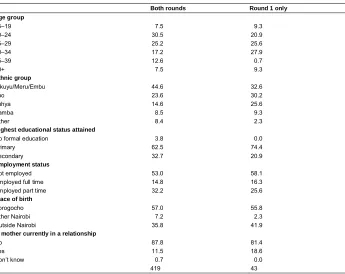
4. Attrition and its implications
Table 1: Interview status and key characteristics (%)
Both rounds Round 1 only Age group
15–19 7.5 9.3
20–24 30.5 20.9
25–29 25.2 25.6
30–34 17.2 27.9
35–39 12.6 0.7
40+ 7.5 9.3
Ethnic group
Kikuyu/Meru/Embu 44.6 32.6
Luo 23.6 30.2
Luhya 14.6 25.6
Kamba 8.5 9.3
Other 8.4 2.3
Highest educational status attained
No formal education 3.8 0.0
Primary 62.5 74.4
Secondary 32.7 20.9
Employment status
Not employed 53.0 58.1
Employed full time 14.8 16.3
Employed part time 32.2 25.6
Place of birth
Korogocho 57.0 55.8
Other Nairobi 7.2 2.3
Outside Nairobi 35.8 41.9
Is mother currently in a relationship
No 87.8 81.4
Yes 11.5 18.6
Don’t know 0.7 0.0
N 419 43
Note: ***.001; **.01; *.05.
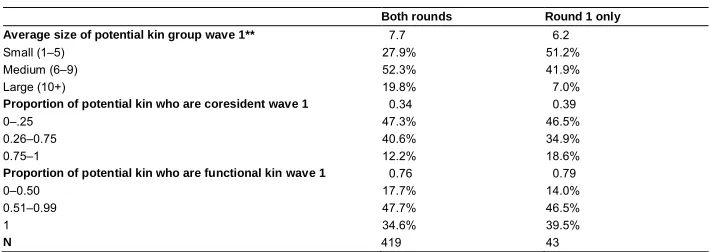
Table 2: Interview status and kinship measures
Both rounds Round 1 only Average size of potential kin group wave 1** 7.7 6.2
Small (1–5) 27.9% 51.2%
Medium (6–9) 52.3% 41.9%
Large (10+) 19.8% 7.0%
Proportion of potential kin who are coresident wave 1 0.34 0.39
0–.25 47.3% 46.5%
0.26–0.75 40.6% 34.9%
0.75–1 12.2% 18.6%
Proportion of potential kin who are functional kin wave 1 0.76 0.79
0–0.50 17.7% 14.0%
0.51–0.99 47.7% 46.5%
1 34.6% 39.5%
N 419 43
Note: ***.001; **.01; *.05.
The only significant difference noted in the table is in the average size of the potential kin group at wave 1, which is SMALLER for those who were not reinterviewed in wave 2. This suggests that the retained sample may be selected for mothers with larger potential kin groups at wave 1. However, this does not necessarily lead to biased estimates of coresidence or kinship support. In other words, although potential kin group size may be smaller for those who left the study, these women are not any less likely to live with them or receive support from them. This is consistent with Bignami-Van Assche’s (2005) finding of network stability in rural Malawi. However, it is entirely possible that those who were lost in wave 2 had kinship support decreased between the two waves. Given that we only have data from wave 1 for these respondents, the retained sample in wave 2 is likely to be endogenously selected, making any analysis of the impact of kinship support on child well-being biased. However, when we examined the extent of change in functional support for those who remained in both waves, we found that about 33% of respondents reported a decrease in the proportion providing support. This suggests that the retained sample is not selected for those whose support did not decrease.
5. Consistency in reporting across waves and implications
biological father, one maternal grandmother, one maternal grandfather, one paternal grandfather, and one paternal grandmother, so there is no possibility of inconsistency. However, aunts and uncles do not have fixed numbers, and Table 3 shows the extent of reporting consistency on numbers of aunts and uncles across waves.
Table 3: Reporting consistency over waves on numbers of aunts and uncles (%)
Maternal aunts Maternal uncles Paternal aunts Paternal uncles Extent of consistency***
Exact match 69 68 44 43
+/– 1 19 19 7 9
+/– 2 9 7 4 4
+/– 3 or more 3 6 46 43
N 412 412 412 412
Note: ***.001; **.01; *.05.
The differences, which are significant, in reporting consistency between maternal and paternal sides are due in large part to our sample, which is comprised of single mothers. Therefore, it is important to consider who is mentioned and who is not. Substantial effort was made during training to ensure that correct terminology in local language was used and that interviewers probed to make sure everyone in the universe of kin was mentioned. Moreover, because data was collected from the perspective of the child, it is less likely that shifting perceptions of half and full sibling relationships would be a major factor. Despite these efforts, it is clear that inconsistent reporting even on numbers is an issue. We were able to find exact matches on numbers of maternal aunts and uncles for about 69% and 68% of respondents, respectively. The figure goes down to 44% and 43% for paternal aunts and uncles. One might expect greater difficulty with reporting consistently with large kin groups but no significant differences by size were evident for any of the relationship categories. Possible reasons for reporting inconsistency include memory lapse particularly pertaining to those kin – i.e., paternal kin – with little connection to the respondent and selective reporting based on subjective assessments of kin support. For example, a respondent may intentionally not count a maternal uncle in wave 2 if that person has stopped providing support in between waves. Therefore, we are left with the possibility of attaining an incomplete picture of a child’s kin group as well as having biased estimates in analysis of kin effects on child well-being.
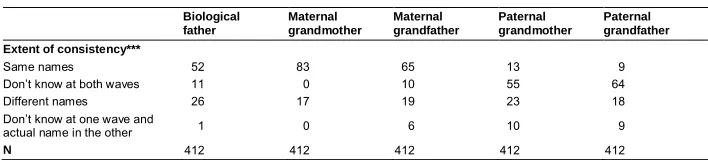
Table 4: Reporting consistency over waves on names (%) Biological father Maternal grandmother Maternal grandfather Paternal grandmother Paternal grandfather Extent of consistency***
Same names 52 83 65 13 9
Don’t know at both waves 11 0 10 55 64
Different names 26 17 19 23 18
Don’t know at one wave and
actual name in the other 1 0 6 10 9
N 412 412 412 412 412
Note: ***.001; **.01; *.05.
The differences shown are significant. For biological fathers, 63% of single mothers provided the same response across waves; 83% did so for maternal grandmothers; 75% for maternal grandfathers; 68% for paternal grandmothers and 73% for paternal grandfathers. We also find very high percentages for “don’t know” at both waves for the paternal side (55% for grandmothers and 64% for grandfathers). Given that our sample is comprised of single mothers, it is not surprising that the respondents do not know very much about their child’s paternal kin or even father including names. However, most respondents are at least consistent over waves. It is also possible that we have underestimated the proportion of name matches given the common practice of having multiple names and using them at different times in many African contexts. Therefore, we might have even done better than these figures indicate. For biological fathers, we suspect that for women with multiple partners, there may have been genuine confusion on the part of both interviewer and respondent about matching a child with his/her father.
6. Discussion and conclusion
We set out in the paper to determine whether it is possible to capture the complexity and dynamism of kinship structure and support in a contemporary urban African context. Specifically, we address both the benefits and limitations of a longitudinal approach to measuring kinship structure and support from the perspective of children and reported by single mothers. One of the key innovative features of the KST is the enumeration of all close kin regardless of their residence or their roles as support providers. This enables us to measure family connectivity directly rather than use the household as a proxy and distinguish functional from nonfunctional kin. Second is the linking of kinship data to children rather than adults which offers two advantages: direct measures of child-adult relationships (rather than a derived measure through household head) and decreases the likelihood of mothers using their perceptions of functional support as a precondition for enumeration. Taken together, these features contribute to ensuring greater completeness in the reporting of kinship structure. Moreover, we are cautiously optimistic that our approach in tracking kinship structure over time is not only feasible but, more importantly, will not lead to incomplete or biased understanding of kinship.
increase retention. Tracking migrants and conducting interviews using mobile phones have proven successful in other contexts, such as in Bangladesh (Barham and Kuhn 2014). Additionally, we might consider using periodic SMS notifications to 1) keep communication open and 2) facilitate locating respondents for the subsequent round. The use of SMS has become increasingly popular in public health research (Berkman et al. 2011; Betjeman, Soghoian, and Foran 2013; Farabee et al. 2016) but SMS use is still lagging in social science.
References
Adams, A., Madhavan, S., and Simon, D. (2001). Women’s social networks and child survival in Mali. Social Science and Medicine 54(2): 165–178. doi:10.1016/ S0277-9536(01)00017-X.
Alderman, H., Behrman, J., Kohler, H-P., Maluccio, J.A., and Watkins, S. (2001). Attrition in longitudinal household survey data: Some tests for three developing-country samples. Demographic Research 5(4): 79–124. doi:10.4054/DemRes. 2001.5.4.
APHRC (2002). Population and health dynamics in Nairobi’s informal settlements: Report of the Nairobi Cross-sectional Slums Survey (NCSS) 2000. Nairobi: African Population and Health Research Center.
APHRC (2007). NUHDSS indicators 2003–2007. Nairobi: African Population and Health Research Center.
APHRC (2014). Population and health dynamics in Nairobi’s informal settlements: Report of the Nairobi Cross-sectional Slums Survey (NCSS) 2012. Nairobi: African Population and Health Research Center.
Barham, T. and Kuhn, R. (2014). Staying for benefits:The effect of a health and family planning program on out-migration patterns in Bangladesh.Journal of Human Resources49(4): 982–1013.doi:10.3368/jhr.49.4.982.
Becker, G.S. (1981).A treatise on the family. Cambridge: Harvard University Press. Beguy, D., Bocquier, P., and Zulu, E. (2010). Circular migration patterns and
determinants in Nairobi slum settlements.Demographic Research 23(20): 549– 586.doi:10.4054/DemRes.2010.23.20.
Beguy, D., Kabiru, C., Nderu, E., and Ngware, M. (2009). Inconsistencies in self-reporting of sexual activity among the young people in Nairobi, Kenya.Journal of Adolescent Health45(6): 595–601.doi:10.1016/j.jadohealth.2009.03.014.
Berkman, E.T., Dickenson, J., Falk, E.B., and Lieberman, M.D. (2011). Using SMS text messaging to assess moderators of smoking reduction: Validating a new tool for ecological measurement of health behaviors.Health Psychology 30(2): 186–194. doi:10.1037/a0022201.
Bignami-Van Assche, S. (2005). Network stability in longitudinal data: A case study from rural Malawi. Social Networks 27(3): 231–247. doi:10.1016/j.socnet.2005. 02.001.
Campbell, A. and Rudan, I. (2011). Systematic review of birth cohort studies in Africa.
Journal of Global Health 1(1): 46–58.
Clark, S. and Hamplovà, D. (2013). Single motherhood and child mortality in sub-Saharan Africa: A life course perspective. Demography 50(5): 1521–1549.
doi:10.1007/s13524-013-0220-6.
Clark, S., Cotton, C., and Marteleto, L.J. (2015). Family ties and young fathers’ engagement in Cape Town, South Africa. Journal of Marriage and Family 77(2): 575–589.doi:10.1111/jomf.12179.
Clark, S., Kabiru, C., Laszlo, S., and Muthuri, S. (2017a). Can subsidized early child care promote women’s employment? Evidence from a slum settlement in Africa. Montreal: Institute for the Study of International Development, McGill University (GrOW Research Working Paper Series #5).
Clark, S., Madhavan, S., Beguy, D., Kabiru, C., and Cotton, C. (2017b). Who helps single mothers in Nairobi? The role of kin support. Journal of Marriage and Family79(4): 1186–1204.doi:10.1111/jomf.12404.
Cliggett, L. (2005). Grains from grass: Aging, gender, and famine in rural Africa. Ithaca: Cornell University Press.
Cunningham, S.A., Elo, I.T., Herbst, K., and Hosegood, V. (2010). Prenatal development in rural South Africa: Relationship between birth weight and access to fathers and grandparents. Population Studies 64(3): 229–246. doi:10.1080/00324728.2010.510201.
De Weerdt, J., Genicot, G., and Mesnard, A. (2015). Asymmetry of information within family networks. Cambridge: National Bureau of Economic Research (NBER Working Paper No. 21685).doi:10.3386/w21685.
Farabee, D., Schulte, M., Gonzales, R., and Grella, C.E. (2016). Technological aids for improving longitudinal research on substance use disorders. BMC Health Services Research 16(370): 1–8.doi:10.1186/s12913-016-1630-0.
Ford, K. and Hosegood, V. (2005). AIDS mortality and the mobility of children in KwaZulu Natal, South Africa. Demography 42(4): 757–768. doi:10.1353/dem. 2005.0029.
Goldberg, R.E. (2013). Family instability and pathways to adulthood in Cape Town, South Africa. Population and Development Review 39(2): 231–256. doi:10.1111/j.1728-4457.2013.00590.x.
Hetherington, P. (2001). Generational changes in marriage patterns in the Central Province of Kenya, 1930–1990. Journal of Asian and African Studies 36(2): 157–180.doi:10.1177/002190960103600201.
Hewett, P.C., Mensch, B.S., and Erulkar, A.S. (2004). Consistency in the reporting of sexual behaviour by adolescent girls in Kenya: A comparison of interviewing methods.Sexually Transmitted Infections80(2): ii43–ii48.doi:10.1136/sti.2004. 013250.
Hirsch, J.S., Wardlow, H., Smith, D.J., Phinney, H., Parikh, S., and Nathanson, C.A. (2009).The secret: Love, marriage, and HIV. Nashville: Vanderbilt University Press.
Hoogeveen, J., Croke, K., Dabalen, A., Demombynes, G., and Giugale, M. (2014). Collecting high frequency panel data in Africa using mobile phone interviews.
Canadian Journal of Development Studies 35(1): 186–207. doi:10.1080/
02255189.2014.876390.
Hunter, M. (2007). The changing political economy of sex in South Africa: The significance of unemployment and inequalities to the scale of the AIDS pandemic. Social Science and Medicine 64(3): 689–700. doi:10.1016/j. socscimed.2006.09.015.
Jensen, A.-M. (2015). Changes in brideprice payments in Christian and Muslim villages of Kenya. Journal of Comparative Family Studies 46(1): 105–120.
Madhavan, S., Clark, S., Beguy, D., Kabiru, C.W., and Gross, M. (2017). Moving beyond the household: Innovations in data collection on kinship. Population Studies71(1): 117–132.doi:10.1080/00324728.2016.1262965.
Madhavan, S., Harrison, A., and Sennott, C. (2013). Management of non-marital fertility in two South African communities.Culture, Health and Sexuality 15(5): 614–628.doi:10.1080/13691058.2013.777475.
Madhavan, S., Richter, L., and Gross, M. (2015). ‘Doing’ and ‘undoing’ gender in fathering research: Evidence from the Birth to Twenty Cohort Study in South Africa.Fathering13(2): 146–163.
Madhavan, S., Richter, L., and Norris, S. (2014). Father contact following union dissolution for low income children in urban South Africa. Journal of Family Issues37(5): 622–644.doi:10.1177/0192513X14532255.
Madhavan, S., Schatz, E., Clark, S., and Collinson, M. (2012). Children’s mobility, maternal status and household composition in rural South Africa.Demography
49(2): 699–718.doi:10.1007/s13524-011-0087-3.
Mensch, B.S., Hewett, P.C., and Erulkar, A.S. (2003). The reporting of sensitive behavior by adolescents: A methodological experiment in Kenya. Demography
40(2): 247–268.doi:10.1353/dem.2003.0017.
Norris, S.A., Richter, L.M., and Fleetwood, S.A. (2007). Panel studies in developing countries: Case analysis of sample attrition over the past 16 years within the Birth to Twenty cohort in Johannesburg, South Africa. Journal of International
Development 19(8): 1143–1150.doi:10.1002/jid.1390.
Sear, R. and Mace, R. (2008). Who keeps children alive? A review of the effects of kin on child survival. Evolution and Human Behavior 29(1): 1–18. doi:10.1016/ j.evolhumbehav.2007.10.001.
Sear, R., Mace, R., and McGregor, I.A. (2000). Maternal grandmothers improve nutritional status and survival of children in rural Gambia. Proceedings: Biological Sciences 267(1453): 1641–1647.doi:10.1098/rspb.2000.1190. Silberschmidt, M. (1999).Women forget that men are the masters: Gender antagonism
and socio-economic change in Kisii District, Kenya. Uppsala: Nordiska Afrikainstitutet.
Smith, D.J. (2007). Modern marriage, men’s extramarital sex, and HIV risk in southeastern Nigeria. American Journal of Public Health 97(6): 997–1005.
Swartz, S. and Bhana, A. (2009).Teenage tata: Voices of young fathers in South Africa. Pretoria: HSRC Press.