www.ijper.org
Framework for Action to Implement Interprofessional
Education and Collaborative Practice in Pharmacy
and Allied health Sciences Programs in India
Kingston Rajiah1* and Marikannan Maharajan1
1Department of Pharmacy Practice, School of Pharmacy, International Medical University, Kuala Lumpur, MALAYSIA.
ABSTRACT
Background: Interprofessional education is a step towards providing higher quality patient care by producing collaborative and practice-ready health care professionals who appreciate each other’s roles in the health care settings. The objectives, learning outcomes and action plans to implement IPL in various phases is discussed in this paper. Methods: A literature review was done to write a concept paper to produce a framework for action to implement interprofessional education and collaborative practice in Pharmacy and allied health sciences programs in India. Results: The key information need as per this concept paper is; effective collaboration and communication skills are needed to make the healthcare team members such as doctors, pharmacists, nurses, and other allied health graduates to work both autonomously and collaboratively in complex and challenging clinical environments.
Conclusion: The need for evidenced-based collaborative care that utilizes the expertise of various disciplines has been acknowledged worldwide. Therefore, it is important to create the opportunity for the various health professional students to understand interprofessional education and appreciate the roles played by different professionals. Interprofessional education provides a better understanding of the health care system and ultimately improves the quality of patient care.
Key words: Inter-professional education, Indian health care programs, Collaborative practice, Inter-professional learning, Pharmacy.
DOI: 10.5530/ijper.50.2.3
Correspondence Address Kingston Rajiah,
Lecturer,
Department of Pharmacy Practice, Pharmacy practice International medical University, No. 126, Jalan Jalil Perkasa 19, Bukit Jalil, 57000 Kuala Lumpur, MALAYSIA.
E-mail: kingrajiah@gmail. com
Interprofessional education
Interprofessional education (IPE) is a step towards producing collaborative and prac-tice-ready health care professionals, who appreciate each other’s roles in health care settings; it has been shown to improve the quality of care through collaborative work-ing.1 Committed academicians and
educa-tional institutions that believe in the benefits
of interprofessional education have focused on innovative strategies to strengthen the workforce of health professionals.2-6 There
is a committ ment to the preparation of professional graduates who can work for each other in a health care team. Effective collaboration and communication skills are needed to make health care team members such as doctors, pharmacists, nurses, and other allied health graduates work both autonomously and collaboratively
in-com-plex and challenging clinical environments. These skills can be achieved through inter-professional education in undergraduate
programs, which is defined as making two
or more professionals learn with, from and about each other to improve collaboration and the quality of patient care.2 In an effort
to create a leveling experience for health professional students coming from vari-ous programs (such as medicine, pharmacy, nursing and dentistry), educationalists pro-vide various activities. Interprofessional learning activities are implemented using small group teaching and hands-on experi-ence in the wards and community services.
Generally, during interprofessional learning sessions, the different health care profes-sional teams will acquire knowledge from each other through team working.7 These
Submission Date : 01-11-2015
Revised Date : 15-02-2016
sessions are normally based on one or more of the col-laborative practice domains of teamwork and team-based practice, communi cation, values and ethics, and roles and responsibilities for collaborative practice.8 Evaluation of
health care professional education techniques has been undertaken as there is an urgent need to improve patient safety by reducing preventable medical errors.9,10 Failure
in communication between health care professionals may contribute to deficiencies in clinical skills and leads to medical errors.11,12
Published articles from the World Health Organization and the Health Professions Network Nursing and Midwifery Office suggested that IPE is one solution to improve the quality of patient care by enhancing professionals’ collaboration and their teamwork skills.13
IPL activities enable students to ‘learn with, from and
about each other and encourage student interaction.14
Hence, it is recommended to provide IPL activities between health professional students, which l will enhance their willingness to work together in the future.15
Does Indian health care need interprofessional learning?
Interprofessional learning (IPL) activities among the healthcare professionals have gained recognition as a teaching–learning strategy in the developed countries and in some developing countries such as Malaysiaand Singapore. The need for evidenced-based collaborative care that utilizes the expertise of various disciplines has been acknowledged worldwide. Collaboration and teamwork among health care professionals should begin early in their education via interactive learning experiences.
In developing countries like India, health care is provided by both the public and private sectors.16 The
public health care system faces many challenges, including the deployment of health care professionals and the skill mix of staff across the entire health care system.17-20 The
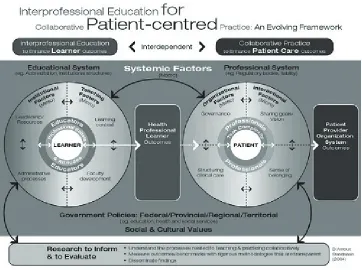
University of Toronto had projected that IPE will be leading to patient-focused healthcare practice21 which is
depicted in Figure 1.
How it benefits in Indian health care set up?
India has a broad network of institutions for future health care professionals. There are many universities and government organizations preparing students in the field of medicine, dentistry, nursing, pharmacy, psychology, biomedical science, medical biotechnology and nutrition and dietetics. Most of these health related courses are provided less than 4 years under one roof and various institutions are well connected by the universities and other official bodies.
For example, in Pharmacy, the Pharmacy Council of India keeps a close vigil on the infrastructure and teaching and training quality of institutes providing pharmacy
education in the country. The universities are the affili
-ated bodies which regularize the curriculum, based on instructions provided by the Pharmacy Council of India. Public and private institutions offering pharmacy
programs are affiliated to universities in their respective
states. The faculty and students have a better opportu-nity to interchange for professional training and other teaching activities. In such situations, interprofessional learning activities can be included in the curriculum with the help of universities and the Pharmacy Council of India.
There are various benefits to implementing interpro-fessional education as well as those for health policy. Interestingly, these were self-reported benefits rather
than being outcomes from rigorous evaluation.22 It is
also important to create the opportunity for the various health professional students to understand interpro-fessional education and appreciate the roles played by different professionals. This gives an advantage to healthcare professionals from various disciplines under-stand the health care system better. It will improve health interprofessionals’ mutual understanding and respect across a diverse range of practice disciplines, help to break functional barriers, enhance teamwork and improve healthcare outcomes.
Appropriate learning activities for IPL
Skills based learning
Interprofessional learning occurs when there are clinical skills learned ‘with’ and ‘from’ other health care profes-sionals in order to improve cooperation and the quality of clinical practice.23,24 The skill-based learning allows
different health professionals to communicate and better understand each other’s roles. Such collaborative learning will help health care professionals to achieve interpro-fessional practice in their workplace in the future and resulting in better quality of patient care.25
Problem based learning
Interprofessional learning can be systematically merged with problem-based learning.26 Problem-based learning
sessions using multi disciplinary students can bring knowledge from the students of different health pro-fessions together as they interact with each other. It also brings the learners closer to acquire knowledge from each other and help them to understand everyday pro-fessional life of others. It can be used as an effective tool for interprofessional learning.27The role of academic staff
the students are working effectively. The regular
induc-tion and de-briefing by the facilitators at the end of the
sessions will support the learning for students from each profession and foster interprofessional collegiality.28
Simulation resource package
Consecutive simulation properties maintain the expedi-tion of IPL for students and professionals healthcare.
The interprofessional learning by simulation resource package will have audiovisual resource and a facilitator guide. Firstly, the basic idea of interprofessional learning can be introduced to the students and then the human factors related with health care can be familiarized. Secondly, the audiovisual source demonstrating a sub-standard performance of the healthcare team, followed by the standard performance, improving the patient experience. The package can be designed in a way to
allow flexibility in its presentation, depending on the
educational background which is available within the institution.29
Workshops
Interprofessional learning workshops can be conducted for healthcare students. In these workshops, health care professional students can address the importance of interprofessional relationships in a given scenario/case. The involvement of students from various backgrounds in inter-personnel communication will be
informa-tive and interesting. The students’ own feedback from their real-life experiences will enhance the quality of the workshops and facilitate their learning.30
Interprofessional Peer-Assisted Learning (IPAL) Peer-assisted learning is an approach to uni-professional learning in healthcare professions. This can provide a structured peer-learning experience for students from different areas of health care. Students’ psychomotor skills and professional capabilities will be the main focus of IPAL. A well-trained faculty member can facilitate the session in which one student can act as a peer teacher, with others acting as peer learners. It will provide opportunities for students from different professions to learn new skills and practise them with others. Additionally, participants’ skills in communication, presentation, demonstration, teaching and coaching will also improve.31,32
Community-based education
Community-based education includes the complexity of the design required for IPL, as well as the attitudinal
barriers between professions.33 Team-building,
patient-centered care, knowledge about other professions, service learning, interprofessional clinical components and the impact of culture on healthcare delivery are concepts that can be learned and practised during community-based education; this will demonstrate how
Figure 1: Interprofessional education for collaborative patient-centered practice
interprofessional collaboration can impact on health care activities and improve health care.
Learning objectives of IPL activities
The learning objectives of the IPL activities can be described as:
• To develop an aptitude towards patient-centered practice,34
• To appreciate different professionals’ roles and accountabilities,35
• To develop the abilities required for operative collaboration,36
• To improve information of specific experimental
talents or themes,37
• To respect the integrity and contribution of others,38
• To improve cohesiveness of students in different programs.39
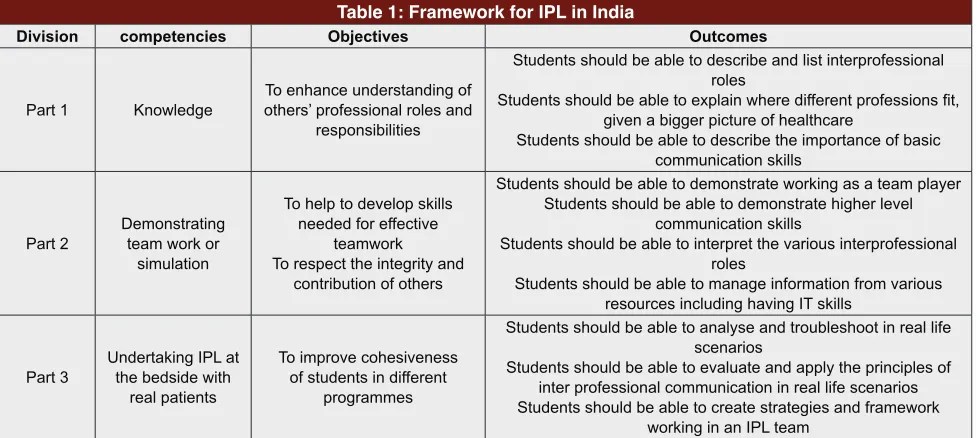
In India most of health care courses are structured as programs lasting 3-4 years. The parts 1, 2, 3 as mentioned in Table 1 can be assigned according to universities’ convenience, depending upon the semester or yearly system. In part 1, students can acquire knowl-edge about IPL. This will enrich their understanding about other health care students’ roles and responsibili-ties. In part 2, students can establish team working with other health care students which will create a rapport with them. This will improve their skills, integrity and inter professional communication (IPC). In part 3, students can undertake IPC in a real scenario/patient setup. This will progress their interprofessional relationships when they become a health care professionals in the near future.
Action plan
Part 1: IPL workshop and hands-on activities can be conducted for the students of health care courses. Students will interact with their fellow students of other professions. Activities can be based on knowledge acquiring and understanding the roles of other profes-sions. Constructive feedback by the respective academic staff members can be given to the students.
Part 2: This will involve collaborative projects along with students from other professions; for example, this could include case studies, simulations in clinical skill centers, problem-based learning, and targeted group learning activity involving discussions and debate. Constructive feedback by the respective academic staff members can be given to the students.
Part 3: Community visits can be planned specifically in healthcare management areas. Students from different programs can be involved and represent their role in the activities conducted in the community. Academic staff members can accompany the students in these activities.
How to measure and evaluate?
Assessment rubrics
For a lifelong learner, self-assessment is a significant skill.40 The studies by Boud and Falchikov, 200741 and
Topping 199842 showed that the provision of
appropri-ate guidance and support can allow students to judge their own skills. The rubrics for self-assessment are designed to improve learners’ self-appraisal and enhance their learning.43
Table 1: Framework for IPL in India
Division competencies Objectives Outcomes
Part 1 Knowledge others’ professional roles and To enhance understanding of responsibilities
Students should be able to describe and list interprofessional roles
Students should be able to explain where different professions fit,
given a bigger picture of healthcare
Students should be able to describe the importance of basic communication skills
Part 2 Demonstrating team work or simulation
To help to develop skills needed for effective
teamwork To respect the integrity and
contribution of others
Students should be able to demonstrate working as a team player Students should be able to demonstrate higher level
communication skills
Students should be able to interpret the various interprofessional roles
Students should be able to manage information from various resources including having IT skills
Part 3 Undertaking IPL at the bedside with real patients
To improve cohesiveness of students in different
programmes
Students should be able to analyse and troubleshoot in real life scenarios
Students should be able to evaluate and apply the principles of inter professional communication in real life scenarios Students should be able to create strategies and framework
Objective Structured Clinical Evaluation
The objective structured clinical examination (OSCE) can assess clinical knowledge, skills, behaviors and atti-tudes by structured observation.44 An interprofessional
OSCE (iOSCE) uses this method to assess collaborative knowledge, skills, behaviors and attitudes.45
Reflective report
IPL involves learning, and learning requires reflection. Academic staff can ask the students to provide a reflective report and can ensure that the learning outcomes for IPL and teamwork are met. This will ensure how good students’ training and knowledge and team work align to the realism.46
How can these activities be sustained?
Activities that promote inter-professional learning should be included in respective curricula. This will help to ensure the continuity of the learning and allow the activities to be evaluated. An occasion can be organized to celebrate IPL so that its importance and outcomes can be highlighted to both students and academic staff. Interest and support from all parties will help to sustain IPL in Indian health care education.
Faculty development for interprofessional learning
The role of academic staff is very important in prepar-ing curricula for interprofessional education in various programs. The academics from different faculties should work with each other. A better understanding of the work settings of other health care professionals plays a vital part in designing an interprofessional education activity. It is important to prepare academic staff for their roles to develop, deliver and evaluate interpro-fessional learning. Involvement of academicians from various professions in a case-based learning environment and where they can form interprofessional teams facili-tates the development of interprofessional learning. In addition to examining cases, faculty members also learn specific information about interacting with the other professions and gain knowledge about the roles, knowledge and contributions that can be made by pro-fessions other than their own.47 The initial attitudes of
staff members must be optimistic for interprofessional learning to be embedded successfully in the curricula. This will encourage sustained involvement and a
readi-ness to promote development in the curriculum. In the
context of interprofessional education, faculty members often bridge two or more discrete professional commu-nities to facilitate information exchange.48 Faculty
mem-bers will benefit from training in IPE and need formal development for continuing improvement as facilitators
of interprofessional group learning and other interpro-fessional learning activities.49
Implementing a faculty development program in the Indian environment
Faculty training programs in IPE by the institute/
university must be strategic in their design and
imple-mentation. A faculty development program must incorporate mentorship, self-directed learning, and lecture-based presentations as principal learning activities.
Adult learning theory should form the basis of peda-gogical approaches in faculty development for IPE. Diverse educational methods including experiential and peer learning, reflection, and feedback should be employed.50-53 The learning outcomes must include
an understanding of the roles and responsibilities of interdisciplinary team members, the identification of the challenges of an interprofessional approach to patient-centered care, and the application of collabora-tive approaches to the healthcare needs of the patient.54
Such faculty development programs involving acade-micians from various professions give faculty members the opportunity to network during the initiation of IPE.
A collection of ideas from staff members can bring out their individual ideas on the formats for IPE sessions; these ideas can be pooled so produce the best plans.
Institutional support
Institutions can allow health care teams to work collaboratively and promote interaction among faculty members from different areas. Academic staff mem-bers taking part in collaborative practice may require domain models, organized protocols and joint operating measures. Managerial support is needed in effective health-care service delivery which requires teamwork and shared accountability among the members of a working team. To deliver interprofessional collabora-tion effectively, reasonable time and space is necessary. Meanwhile, institutional policies may need to identify collaborative practice and provide funding with reason-able remuneration.
Environment
Interprofessional Fellowship
Despite recent advances in healthcare, there is a short-age of people with experience in interprofessional working to manage and operate healthcare and very few training pathways to develop such professionals. The proposal to form the Interprofessional Fellowship Program is to develop leaders with vision, who will develop and evaluate interprofessional education to advance the nation’s healthcare. The Interprofessional Fellowship Program can have a robust curriculum, an appropriate infrastructure, and qualified fellowship faculty who are experts in simulation practice, edu-cation, and research. Institutions can select efficient and enthusiastic staff members and equip them by attending these fellowship programs which may help to implement and sustain IPL in India.
Limitations of IPE
Challenges to developing interprofessional education include structural differences between faculty
organiza-tions, conflicting university and professional agendas,
and the lack of adequate human resources to imple-ment such programs, both within the university and across the community boundary. Other challenges are the complexity of communication channels within the university and with its community partners; lack of continuity of personnel due to rotation and replace-ment of team members, and the lack of regular eval-uation of interprofessional educational goals and programs. The success of implementing IPE in any academic institution depends on academicians and administrators across all faculties and schools in each individual institution.55
CONCLUSION
Framing interprofessional education is a challenge for staff members and stake holders. Though enough articles have been written on interprofessional education, it is obligatory for the staff members in different univer-sities and colleges to work towards interprofessional education and to liaise with the members of health providers to participate in discussions that discourse the collaborative practice to implement interprofessional education and collaborative practice in Pharmacy and allied health sciences programs in India.
ACKNOWLEDGEMENT
The authors thank Prof. Danielle D’Amour for giving permission to reprint his conceptual framework diagram.
CONFLICT OF INTEREST
There is no conflict of interest among the authors.
REFERENCES
1. Barnsteiner JH, Disch JM, Hall L. “Promoting Interprofessional Education,”. Nursing Outlook. 2007;55(3):144-50.
2. Centre for Advancement in Interprofessional Education (CAIPE 2002) Interprofessional education–a definition. http://www.caipe.org.uk/ (accessed on 12 Nov 2014).
3. Matthews Z, Channon A, Van Lerberghe W. Will there be enough people to care? Notes on workforce implications of demographic change 2005-2050. Geneva, World Health Organization, 2006 http://www.who.int/hrh/resources/ workforce_implications.pdf (accessed on 12 Nov 2014).
4. Strategic principles for workforce development in New Zealand. Wellington, Health Workforce Advisory Committee, 2005.
5. Working together, learning together: a framework for lifelong learning for the NHS. London, Department of Health, 2001: http://www.dh.gov.uk/en/ Publicationsandstatistics/Publications/PublicationsPolicyAndGuidance/ DH_4009558 (accessed on 12 Nov 2014).
6. The primary health care package for South Africa–a set of norms and standards. Pretoria, South Africa, Department of Health, 2000 http://www. doh.gov.za/docs/policy/norms/ fullnorms.html (accessed on 12 Nov 2014). 7. Mitchell PM, Wynia R, Golden B. Core Priniciples and Values of Effective
Team-Based Health Care. Washington, DC Institute of Medicine. Discussion Paper. 2012
8. Interprofessional Education Collaborative Core Competencies for Interprofessional Collaborative Practice: Report of an Expert Panel Interprofessional Education Collaborative, Washington, DC. 2011.
9. Brock D, Abu-Rish E, Chiu CR, Hammer D, Wilson S, Vorvick L. Interprofessional education in team communication: Working together to improve patient safety. BMJ Quality and Safety. 2013;22(5):414-23. 10. Frenk J, Lincoln C, Bhutta ZA, Cohen J, Crisp N, Evans T. Health professionals
for a new century: Transforming education to strengthen health systems in an interdependent world. The Lancet. 2010;376(9756):1923-58.
11. Agency for Healthcare Research and Quality. TeamStepps: Strategies and Tools to Enhance Performance and Patient Safety. U.S. Department of Health and Human Services (2009). http://teamstepps.ahrq.gov/index.htm. (accessed on 12 Nov 2014).
12. World Health Organization, and Health Professions Network Nursing and Midwifery Office, Framework for Action on Interprofessional Education & Collaborative Practice (WHO/HRH/HPN/10.3) WHO, Geneva 2010 http:// www.who.int/hrh/nursing_midwifery/en/ (accessed on 12 Nov 2014). 13. Australian interprofessional practice and education work. http://www.aippen.
net/criehcapabilitiesandframeworks (accessed on 12 Nov 2014).
14. Freeman S, Wright A, Lindqvist S. Facilitator training for educators involved in interprofessional learning. J Interprof Care. 2010;24(4):375-85.
15. Thistlethwaite J. Interprofessional education: A review of context, learning and the research agenda. Medical Education. 2011;46(1):58-70.
16. WHO, The World Health Report 2006: Working Together for Health World Health Organization, Geneva/CH. 2006
17. Witter S, Ha B, Thi T, Shengalia B, Vujicic M. Understanding the ‘four directions of travel’: qualitative research into the factors affecting recruitment and retention of doctors in rural Vietnam. Human Resources for Health. 2011;9(1):1-14.
18. Naryana, K. The Unqualified Medical Practitioners Methods of Practice and Nexus with the Qualified Doctors. Working Paper No. 70. Hyderabad, CESS. 2008.
19. Beaglehole R, Dal Poz MR. Public health workforce: challenges and policy issues. Human Resources for Health. 2003;1(4):1-7.
20. Hawkes M, Kolenko M, Shockness M, Diwaker K. Nursing brain drain from India. Human Resources for Health. 2009;7(1):1-2.
22. Rodger S, Hoffman JS. World Health Organization Study Group on Interprofessional Education and Collaborative Practice. Where in the world is interprofessional education? A global environmental scan. J Interprof Care. 2010;24(5):479-91.
23. Mackintosh SE, Adams CE, Singer CG, Hruby R. Osteopathic Approach to Implementing and Promoting Interprofessional Education. J Am Osteo Assoc. 2011;111(4):206-12.
24. Cant R, Hood K, Baulch J, Gilbee A, Leech M. Teachers’ Perceptions of Effective Interprofessional Clinical Skills Facilitation For Pre-Professional Students: A Qualitative Study. The Internet Journal of Medical Education. 2014;1(3):1-4.
25. NHS education for Scotland. Patient Safety Education Scenariohttp://www. nes.scot.nhs.uk/media/1705869/ipl_patient_safety_web.pdf (accessed on 12 Nov 2014).
26. Barr, H. ‘Interprofessional Education–A dentition’. CAIPE Bulletin no 13, 1997. www.caipe.org.uk. (accessed on 12 Nov 2014).
27. Dahlgren LO. Interprofessional and problem-based learning: a marriage made in heaven?. J Interprof Care. 2009;23(5):448-54.
28. Susanne M, Lindqvist SR. Facilitators’ perceptions of delivering interprofessional education: a qualitative study. Med Teach. 2007;29(4)1-6. 29. Reflective practice, Interprofessional Ambulatory Care Program http://www.
ecu.edu.au/community-engagement/health-advancement/interprofessional-ambulatory-care-program/interprofessional-learning/ipl-through-simulation/ reflective-practice (accessed on 12 Nov 2014).
30. Wee B, Hillier R, Coles C, Mountford B, Sheldon F, Turner P. Palliative care: a suitable setting for undergraduate interprofessional education. Palliat Med 2001;15(6):487-92.
31. Forbes EJ, Fitzsimons V. Education: the key for holistic interdisciplinary collaboration. Holist Nurs Pract. 1993;7(4):1-10.
32. Ongoing and recent interprofessional experiences, Interprofessional Peer-Assisted Learning:http://www.georgebrown.ca/ipe/in_action.aspx (accessed on 12 Nov 2014).
33. Sherril BG, Barbara AH, Anu FS, Morris BA. Community-Based Education and Service: The Hpsisn Experience. J Interprof Care. 1998;12(3):257-72. 34. Donini-Lenhoff FG, Hedrick HL. Increasing awareness and implementation
of cultural competence principles in health professions education. J Allied Health. 2000;29(4):241-5.
35. Chatterjee N. Infusing the Interdisciplinary into Medical/ Health Sciences Education: Vitamins or Vaccines?. Medical Education Online. 2002;7:3 accessed on 02 April 2016 Available from URL http://www.med-ed-online.org. 36. Centre for the Advancement of Interprofessional Education. Evaluating
Undergraduate Interprofessional Learning. 2003
37. Danielle D, Ivy O. Interprofessionality as the field of interprofessional practice and interprofessional education: An emerging concept. J Interprof Care. 2005; 19 Suppl 1:8-20.
38. Hosny S, Kamel MH, El-Wazir Y, Gilbert. Integrating interprofessional education in community-based learning activities: case study. Med Teach. 2013;35(1):S68-73.
39. World Health Organization Study Group on Interprofessional Education and Collaborative Practice. WHO Announcement. 2011, accessed on 02 April
2016 Available from URL http://apps.who.int/iris/bitstream/10665/70185/1/ WHO_HRH_HPN_10.3_eng.pdf?ua=1
40. Race P. (2001). A briefing on self, peer and group assessment. Assessment Series No.9: LTSN Generic Center http://internt.iha.dk/paedagogik/ seminarer/Chris%20Rust/ASS009PhilRace.pdf (accessed on 12 Nov 2014). 41. Boud D, Falchikov N (Eds.). Rethinking assessment in higher education.
Oxford, UK: Routledge 2007.
42. Topping KJ. Peer assessment between students in college and university. Review of Educational Research. 1998;68(3):249-76.
43. Vernon C, Lynn C, Valerie B, Pippa H, Tracy G, Kelly L. Interprofessional Collaborator Assessment Rubric: http://www.lcme.org/interprofessional-collaborator-assessment-rubric.pdf(accessed on 12 Nov 2014).
44. Kingston R, Sajesh KV. Objective Structured Clinical Examination in Pharm D and Clinical Pharmacy Courses in India; a Rising Need to Acquaint?. Ind J Pharm Edu Res. 2013;(47)4:1-6.
45. Simmons B1, Egan-Lee E, Wagner SJ, Esdaile M, Baker L, Reeves S. Assessment of interprofessional learning: the design of an interprofessional objective structured clinical examination (iOSCE) approach. J Interprof Care. 2011;25(1):73-4.
46. Clark PG. Reflecting on reflection in interprofessional education: implications for theory and practice. J Interprof Care. 2009;23(3):213-23.
47. Cook DA. Models of interprofessional learning in Canada. J Interprof Care. 2005May;19(Suppl 1):107-15.
48. Johnson SC, Lynch C, Lockeman KS, Dow AW. Student-defined needs during interprofessional learning: The role of faculty as facilitators. Journal of Interprofessional Education and Practice. 2015;1(2):37-42.
49. Mandy J, Kevin MS, James AB, Stacy AT, Dominique Z, Mikael DJ. Outcomes of an immersive pilot faculty development program for interprofessional facilitation: A mixed methods study, Journal of Interprofessional Education and Practice. 2015;1(3-4):83-9.
50. Leslie K, Baker L, Egan-Lee E, Esdaile M, Reeves S. Advancing faculty development in medical education: a systematic review. Acad Med. 2013;88(7):1038-45 http://dx.doi.org/10.1097/ACM.0b013e318294fd29 51. Ruiz MG, Ezer H, Purden M. Exploring the nature of facilitating
interprofessional learning: findings from an exploratory study. J Interprof Care. 2013;27(6):489-95.
52. Shrader S, Mauldin M, Hammad S, Mitcham M, Blue A. Developing a comprehensive faculty development program to promote interprofessional education, practice and research at a free-standing academic health science center J Interprof Care. 2015;29(2):165-7.
53. Silver IL, Leslie K. Faculty development for continuing interprofessional education and collaborative practice. J Contin Educ Health Prof. 2009;29(3):172-7.
54. Virant-Young D, Kathy F, McCaskey S, Smith C, Claire S, Jane G. Donald SefcikFaculty Development in Interprofessional Education: Designing and Implementing a Successful Program. Medical Science Educator December. 2014; 24(4):401-7.
55. Gilbert JHV. Interprofessional learning and higher education structural barriers. Journal of Interprofessional Care. 2005:19(S1):87-106.
SUMMARY PICTORIAL ABSTRACT
• IPL workshop and hands-on activities can be con-ducted for the students of health care courses. • Collaborative projects along with students from
other professions; for example, this could include case studies.
Kingston Rajiah: Is lecturer at International Medical University. He is attached to department of pharmacy practice. His research area is Pharmacy education, Public health, Social pharmacy and community pharmacy.
IPE: Interprofessional education, IPL: Interprofessional learning, IPAL: Interprofessional Peer-Assisted Learning, IPC: Inter professional communication,
OSCE: Objective structured clinical examination,
iOSCE: Interprofessional OSCE.