PhD Dissertation
International Doctorate School in Information and Communication Technologies
DISI - University of Trento
Data Driven Models for
Language Evolution
Antonella Delmestri
Advisor:
Prof. Maurizio Marchese
University of Trento
Co-Advisor:
Prof. Nello Cristianini
University of Bristol
Abstract
Natural languages that originate from a common ancestor are genetically related, words are the core of any language and cognates are words sharing the same ancestor and etymology. Cognate identification, therefore, represents the foundation upon which the evolutionary history of languages may be discovered, while linguistic phylogenetic inference aims to estimate the genetic relationships that exist between them.
In this thesis, using several techniques originally developed for biological sequence analysis, we have designed a data driven orthographic learning system for measuring string similarity and we have successfully applied it to the tasks of cognate identification and phylogenetic inference.
Our system has outperformed the best comparable phonetic and orthographic cognate identification models previously reported in the literature, with results statistically significant and remarkably stable, regardless of the variation of the training dataset dimension. When applied to phylogenetic inference of the Indo-European language family, whose higher structure does not yet have consensus, our method has estimated phylogenies which are compatible with the benchmark tree and has reproduced correctly all the established major language groups and subgroups present in the dataset.
Keywords
Cognate identification, phylogenetic inference, language evolution,
Acknowledgements
I would like to thank all the following people who, in different ways, have
contributed to the realisation of this thesis.
• My advisor Maurizio Marchese and my co-advisor Nello Cristianini, for helping me to pursue this project and bring it to completion.
• The members of my advisory committee, Andrea Sgarro and Liviu Dinu, for their thorough review of this dissertation.
• Clinical Trial Service Unit at Oxford University and my colleagues Christina Davies, Michael Lay, Philip Morris and Paul McGale, for their continued support and useful suggestions.
• Grzegorz Kondrak for making available his version of the test dataset, Brett Kessler for commenting on his lists, Quentin Atkinson for supplying and commenting on the Hittite and Tocharian lists, Geoff Nicholls for providing some of his papers and datasets, Martijn Wieling for his comments and material on the PHMM model.
• Ana Fortun for her contribution to the linguistic-inspired substitution matrix, Alain Thomas and Dario Brancato for their linguistic advice.
• Adam, my partner, for his amazing support, deep understanding, extraordinary patience and invaluable help in reviewing my written
Contents
1 Introduction 1
1.1 Computational historical linguistics . . . 2
1.2 Cognate identification and phylogenetic inference . . . 3
1.3 Proposed solution . . . 4
1.4 Innovative aspects . . . 6
1.5 Structure of the thesis . . . 8
2 State of the art 11 2.1 Cognate identification . . . 11
2.1.1 Orthographic methods . . . 12
2.1.2 Phonetic methods . . . 21
2.2 Phylogenetic inference . . . 28
2.2.1 Distance-based methods . . . 28
2.2.2 Maximum Parsimony . . . 31
2.2.3 Maximum Compatibility . . . 31
2.2.4 Bayesian analysis . . . 32
2.3 Indo-European linguistic datasets . . . 34
3 Language evolution 35 3.1 Introduction . . . 36
3.2 Linguistic background . . . 38
3.4 Cognate identification . . . 42
3.4.1 String matching . . . 43
3.4.1.1 String distance . . . 45
3.4.1.2 String similarity . . . 50
3.4.2 String alignments . . . 52
3.4.2.1 Global string alignment . . . 53
3.4.2.2 Local string alignment . . . 55
3.4.3 Substitution matrices . . . 57
3.4.3.1 PAM matrices . . . 60
3.4.3.2 BLOSUM matrices . . . 61
3.4.4 Cognate identification systems . . . 61
3.5 Phylogenetic inference . . . 64
3.5.1 Methods for phylogenetic inference . . . 65
3.5.1.1 Distance-based methods . . . 65
3.5.1.2 Character-based methods . . . 67
3.5.2 Evaluation of phylogenetic inference . . . 68
3.6 The Indo-European language family . . . 69
4 A string similarity measuring system 71 4.1 Architecture . . . 72
4.2 A linguistic-inspired substitution matrix . . . 73
4.3 Substitution matrices . . . 74
4.3.1 Maximum Likelihood matrices . . . 75
4.3.2 Absolute Frequency Ratio matrices . . . 76
4.3.3 Pointwise Mutual Information matrices . . . 76
4.3.4 PAM-like matrices . . . 77
4.4 A family of string similarity measures . . . 79
4.5 Cognate identification . . . 82
5 Experimental results 87
5.1 Cognate identification . . . 88
5.1.1 Datasets . . . 89
5.1.2 NEDIT . . . 92
5.1.3 Linguistic-inspired substitution matrix . . . 93
5.1.4 Maximum Likelihood matrices . . . 94
5.1.5 Absolute Frequency Ratio matrices . . . 96
5.1.6 Pointwise Mutual Information matrices . . . 98
5.1.7 PAM-like matrices . . . 101
5.1.8 Robustness of PAM-like matrices . . . 107
5.1.9 Comparison . . . 112
5.1.10 Statistical significance of PAM-like matrices . . . . 115
5.1.11 Conclusion . . . 117
5.2 Phylogenetic inference . . . 118
5.2.1 Datasets . . . 119
5.2.2 Experimental design . . . 121
5.2.3 Results . . . 123
5.2.3.1 UPGMA . . . 124
5.2.3.2 Neighbor-Joining . . . 128
5.2.4 Discussion . . . 130
5.2.5 Conclusion . . . 131
6 Related work 133 6.1 Review . . . 133
6.2 Discussion . . . 136
7 Conclusion 141 7.1 Outcome . . . 143
Bibliography 145
A Swadesh lists 165
List of Tables
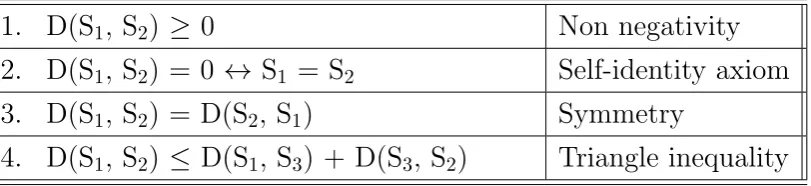
3.1 The metric axioms . . . 45
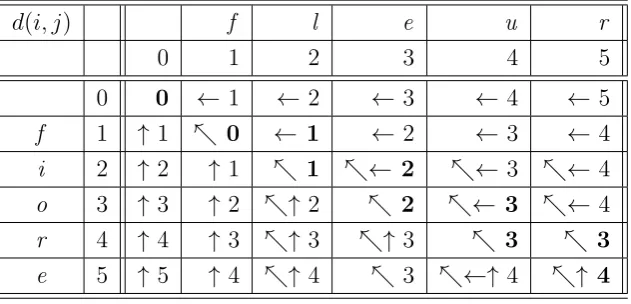
3.2 Example of tabular computation of the edit distance with
one optimal alignment . . . 47
3.3 Example of one optimal alignment produced by the edit
distance . . . 48 3.4 Example of tabular computation of the edit distance with
several optimal alignments . . . 48
3.5 Examples of several optimal alignments produced by theedit
distance . . . 48 3.6 Example of optimal alignment produced by the Hamming
distance . . . 49 3.7 Example of optimal alignments produced by LCS . . . 51 3.8 Example of tabular computation of global alignment using
the identity matrix . . . 54
3.9 Example of one optimal global alignment produced using
the identity matrix . . . 54
3.10 Example of tabular computation of local alignment using
the identity matrix . . . 57
3.11 Example of one optimal local alignment produced using the
identity matrix . . . 57
4.1 A family of parameterised string similarity measures . . . . 80
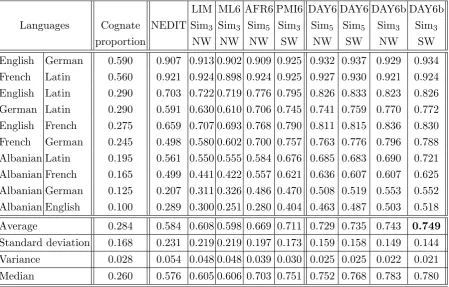
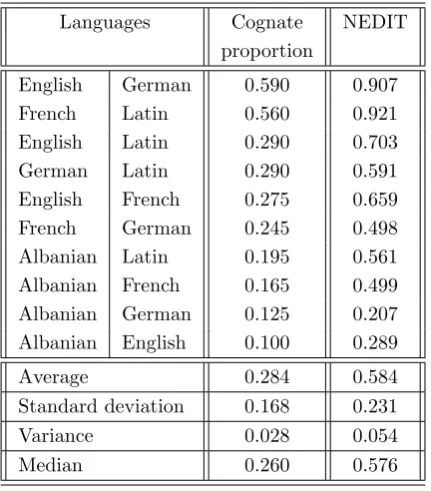
5.1 11-point interpolated average precision for NEDIT . . . 92 5.2 Averaged 11-point interpolated average precision for LIM . 93 5.3 11-point interpolated average precision for NEDIT and LIM 94 5.4 Averaged 11-point interpolated average precision for ML6
and ML6b . . . 95 5.5 11-point interpolated average precision forNEDIT,LIM and
ML6 . . . 96 5.6 Averaged 11-point interpolated average precision for AFR6
and AFR6b . . . 97 5.7 11-point interpolated average precision for NEDIT, LIM,
ML6 and AFR6 . . . 98 5.8 Averaged 11-point interpolated average precision for PMI6
and PMI6b . . . 99 5.9 11-point interpolated average precision for NEDIT, LIM,
ML6, AFR6 and PMI6 . . . 100 5.10 PAM5 generated by DAY6b . . . 102 5.11 Averaged 11-point interpolated average precision for DAY6
using NW . . . 103 5.12 Averaged 11-point interpolated average precision for DAY6
using SW . . . 103 5.13 Averaged 11-point interpolated average precision for DAY6b
using NW . . . 104 5.14 Averaged 11-point interpolated average precision for DAY6b
using SW . . . 104 5.15 11-point interpolated average precision for several models . 106 5.16 Averaged 11-point interpolated average precision for DAY76
using NW . . . 108 5.17 Averaged 11-point interpolated average precision for DAY76
5.18 Averaged 11-point interpolated average precision for
DAY76b using NW . . . 109 5.19 Averaged 11-point interpolated average precision for
DAY76b using SW . . . 109 5.20 11-point interpolated average precision for DAY6, DAY6b,
DAY76 and DAY76b . . . 111 5.21 11-point interpolated average precision for several methods 113 5.22 Statistical significance of DAY6b and DAY76b using SW . 116
6.1 Example of cognate set for the meaning to dig . . . 138 6.2 Example of rearranged cognate set for the meaning to dig . 139
A.1 Several variations of the Swadesh list . . . 172
List of Figures
4.1 An example of 11-point interpolation procedure . . . 84
5.1 Averaged 11-point interpolated average precision for DAY6
using NW and SW . . . 105 5.2 Averaged 11-point interpolated average precision for DAY6b
using NW and SW . . . 105 5.3 Averaged11-point interpolated average precision for DAY76
using NW and SW . . . 110 5.4 Averaged 11-point interpolated average precision for
DAY76b using NW and SW . . . 110 5.5 Graphic representation of the distance matrices D1, D2 and
D3 . . . 123
5.6 Indo-European phylogenetic tree produced using UPGMA
with D1 . . . 125 5.7 Indo-European phylogenetic tree produced using UPGMA
with D2 . . . 126
5.8 Indo-European phylogenetic tree produced using UPGMA
with D3 . . . 127 5.9 Indo-European unrooted phylogeny produced usingNJ with
Chapter 1
Introduction
Language is a defining feature that distinguishes modern humans
from all other species, is a carrier of culture and plays a key role in
communication. Because of its central function in human evolution,
language has always aroused a high level of interest and much debate
among scholars of different disciplines in the sciences and humanities. The
analogy of language evolution with species evolution [3] has generated
a growing attention in the scientific community as a result of the
extraordinary progress of computational molecular biology in the field of
genomes. Because of this close analogy, the study of language evolution is
being increasingly and successfully explored using techniques developed in
evolutionary biology [53, 52, 87, 109, 6].
Computational historical linguistics studies the evolution of language,
and aims to establish the existence and degree of genetic relationships
between speech varieties. It provides an interdisciplinary approach
that involves fields as diverse as linguistics, computer science, artificial
intelligence, molecular biology, statistics and mathematics, to list a few.
The main objective of this thesis has been the investigation of
evolutionary biological models and their application to the study of
1.1. COMPUTATIONAL HISTORICAL LINGUISTICS
1.1
Computational historical linguistics
Languages originating from a common ancestor are genetically related.
Historical linguistics aims to build phylogenies of these languages [53,
52] and to reconstruct as far as possible their common ancestors or
proto-languages [77], in the absence of historical records.
The evolution of language may be analysed through its phonological,
lexical and morphological changes, generally represented as a set of
features, called characters [106]. Common lexical characters used in
historical linguistics are strict or genetic cognates [80], which are words deriving from a common ancestor and sharing the same etymological
origin [77]. Cognates originate from a vertical transmission and do not include borrowings, which are words loaned from other languages through a
horizontal transmission [138]. However, in many areas of natural language processing, the term cognates has a wider meaning and also comprises loans [80]. As vertical and horizontal transmissions are both significant, cognates
and borrowings play crucial, but different, roles in the investigation of
language evolution [106].
Genetic cognates have the advantage of exhibiting the same character
state only as a result of an evolutionary relationship and not because of
parallel developments or back mutations [106]. For this reason, the study of
genetic cognate words provides evidence of historical relationships between
languages and may be used to identify genetic relationships between speech
varieties and to infer phylogenies.
The synergy between cognate identification and phylogenetic inference,
both representing very promising applications of computational historical
linguistics, may contribute to the tracing of language evolution and to
the investigation of the origin of language. In this thesis, we have
CHAPTER 1. INTRODUCTION
evolutionary biological models to the cognate identification problem and
their deployment in the task of linguistic phylogenetic inference.
1.2
Cognate
identification
and
phylogenetic
inference
In order to make a contribution to the fascinating and intricate
problem of language evolution, we have investigated the fields of cognate
identification and phylogenetic inference, as the latter depends on the
former, with respect to the Indo-European language family.
Several different approaches to the cognate identification problem have
been proposed in the literature and phonetic or orthographic methodologies
have been applied, as well as learning algorithms or manually-designed
procedures [76, 86, 83, 80]. In automatic cognate identification, as in
computational molecular analysis, strings may be successfully studied
by inexact string matching techniques, which allow their similarity to
be measured and their optimal alignment to be found. Global or local
alignment algorithms, widely used in biological sequence analysis [41],
usually consist of a substitution matrix and a procedure that finds the
optimal pairwise alignment. The significance of the resulting alignment
depends greatly on the chosen scoring scheme [56].
Phylogenies are evolutionary trees and phylogenetic inference aims
to estimate the genetic relationships between taxa, which in principle
may be species, languages or other entities [46]. In computational
historical linguistics, a phylogenetic tree represents one hypothesis about
the evolutionary relationships among groups of languages, based upon
similarities and differences in their characters [106]. Methods for linguistic
phylogenetic inference estimate the evolutionary history of languages using
1.3. PROPOSED SOLUTION
matrix. Depending on this coding, methods are classified as distance-based methods or character-based methods and most of them are guaranteed to reproduce the true evolutionary tree under certain conditions. The
evaluation of linguistic phylogenetic inference is very difficult because
the true evolutionary history is not generally entirely known, even for
the best understood language families. The “Compatible resolution” and “No missing subgroups” criteria are considered essential and desirable, respectively [106], when evaluating linguistic phylogenetic estimations.
1.3
Proposed solution
We have designed a new learning system for measuring string
similarities, inspired by biological sequence analysis, and we have applied
it to the tasks of cognate identification and phylogenetic inference. We
have developed our proposal using data in orthographic format based on
the Roman alphabet. However, it may easily be adapted to any alphabetic
system, including the phonetic alphabet, if data were available. The system
consists of three main modules, each presenting an original aspect:
• The first module is a pairwise aligner that performs sensible global alignments on cognate pairs and prepares a meaningful training
dataset, guided by a novel linguistic-inspired substitution matrix.
This 26-by-26 matrix aims to represent the a priori likelihood of
transformation between pairs of characters in the Roman alphabet
and tries to code well-known systematic sound changes left in written
Indo-European languages. This component is necessary because there
are no databases of aligned cognate words available for linguistic
CHAPTER 1. INTRODUCTION
• The second module is a generator of substitution matrices that we have implemented using several techniques, including Maximum Likelihood, Absolute Frequency Ratio, Pointwise Mutual Information and PAM-like. For the latter, which had the superior performance, we have developed a new technique inspired by the Point Accepted Mutation (PAM) method. This was designed by Margaret Dayhoff and co-workers [30, 31, 32] and is widely used for amino acid sequence
analysis.
• The third module is a pairwise aligner that measures the similarity between words by using the generated substitution matrices and
a novel family of parameterised string similarity measures. The
similarity measures derive from different normalisations of a generic
scoring algorithm and take into account the similarity of each string
with itself with the aim of eliminating, or at least reducing, the bias
due to different string length.
We have successfully applied this learning system to the task of cognate
identification and phylogenetic inference.
To test the ability of our string similarity measuring system in the task
of cognate identification, we have evaluated the likelihood that two words
with the same meaning from two different languages were cognates, by
calculating their similarity score. We have sorted the scores computed for
each language pair, taking into account the alphabetic order when more
than one word pair has shown the same rate. To evaluate the accuracy
of the system in identifying correctly cognate words, we have not used
a threshold, because this may be influenced by the type of application,
the method used and the degree of language relatedness [80]. Instead we
1.4. INNOVATIVE ASPECTS
evaluation metric originally built for ranking computation in the field of
Information Retrieval. This measure has frequently been used in the field of cognate identification by other studies, with which we wanted to make
a direct comparison.
We have also applied this learning system for measuring string
similarities to the task of phylogenetic inference, in order to test its efficacy
against documented aspects of the Indo-European language family. We
have utilised the similarity scores between word pairs to calculate similarity
scores between language pairs. We have then converted these similarity
scores into distance scores, which we have employed in distance-based methods to estimate phylogenies.
1.4
Innovative aspects
Our main contributions to the study of language evolution are:
1. The development of a new learning system for measuring word
similarity that has been inspired by biological sequence analysis. The
system benefits from several original features: a linguistic-inspired
substitution matrix to align globally the training dataset, a scoring
matrix generator to learn substitution parameters and a novel family
of string similarity measures to improve the alignment and rate of word
pairs. In particular, for learning PAM-like matrices we have developed a technique similar to the PAM method, designed by Dayhoff et al. [30, 31, 32], which is one of the gold standard in amino acid sequence
analysis.
2. The successful application of this learning system to the task
of cognate identification. Indeed, the system has shown its
CHAPTER 1. INTRODUCTION
pairs, when evaluated against the best comparable phonetic and
orthographic models previously proposed in the literature [76, 87, 83].
3. The assessment of the system’s robustness, regardless of the dimension
of the training dataset. The system has been tested by increasing the
training dataset dimension by a factor of approximately 100, which
implied extending the number of Indo-European languages by a factor
of approximately 13. The results have been impressively stable and
have shown no relevant difference in the performance.
4. The investigation of the statistical significance of our results when
compared with earlier proposals and with each other. The outcome
has shown, with strong and good evidence, that our results are more
accurate than those previously reported in the literature and that
the training dataset dimension does not influence their statistical
significance.
5. The application of the proposed methodology to the task of
phylogenetic inference in order to test its effectiveness against
recognised aspects of the Indo-European language family, whose
higher structure is still controversial. Our results have reproduced
correctly all the established major language groups and subgroups
present in the dataset and have shown to be compatible with the
Indo-European benchmark tree. In doing this, our outcome has
successfully met the required linguistic evaluation criteria and, in
addition, it has included some of the supported higher-level structures.
These results have been presented in the following publications:
1.5. STRUCTURE OF THE THESIS
• Delmestri A., Cristianini N., ”Robustness and Statistical Significance of PAM-like Matrices for Cognate Identification”, Journal of Communication and Computer, vol. 7, no. 12, pp. 21-31, 2010.
• Delmestri A., Cristianini N., ”Linguistic Phylogenetic Inference by PAM-like Matrices”, Submitted.
1.5
Structure of the thesis
Chapter 1 provides a brief overview of this thesis. Firstly, it
introduces computational historical linguistics as a research field and it
presents cognate identification, together with phylogenetic inference, as
key problems in the study of language evolution. It then gives a concise
description of the string similarity measuring system that we have designed
using a machine learning, data driven approach, inspired by biological
sequence analysis. Finally, it describes our main contributions to the state
of the art in the fields of cognate identification and phylogenetic inference,
together with our related publications.
Chapter 2 reports the state of the art in both the fields of cognate
identification and phylogenetic inference. For the former, it reviews the
most authoritative studies proposed in the literature, covering orthographic
and phonetic methods, as well as learning systems and static procedures.
For the latter, it describes the more interesting distance-based and character-based methods introduced by other scholars to date. It also presents the two main datasets recommended for linguistic studies.
Chapter 3 introduces the problems of cognate identification and
phylogenetic inference as fundamental fields in computational historical
linguistics. The cognate identification problem is expressed as an
CHAPTER 1. INTRODUCTION
distance or string similarity approach. The task of calculating the distance
or similarity between two strings is shown to be closely related to the
problem of finding their optimal alignments. Particular attention is given
to the similarity approach, which is the standard in biological sequence
analysis and has been used in our investigation. Global and local string
alignment algorithms are explained and the crucial role that substitution
matrices play in them is highlighted. PAM matrices and BLOSUM matrices are briefly described as the most significant amino acid scoring
schemes used in bioinformatics. Chapter 3 continues with the presentation
of the phylogenetic inference problem, together with a classification of
several distance-based and character-based methods. The difficulty of evaluating linguistic phylogenetic estimations is explained and evaluation
criteria are provided. Finally, the Indo-European language family is
introduced as the target of our phylogenetic estimation. Its particular
role in the field of historical linguistics is addressed, which motivates our
investigation.
Chapter 4 proposes a new learning system for measuring string
similarity as a solution to both the cognate identification and the
linguistic phylogenetic inference problems. The main architecture is
described, together with the innovative aspects of our proposal. A
novel linguistic-inspired substitution matrix is used to align sensibly the
training dataset. Several techniques are utilised to learn substitution
parameters, including Maximum Likelihood, Absolute Frequency Ratio, Pointwise Mutual Information and PAM-like, which has been inspired by the PAM method used in biological sequence analysis. A new family of parameterised string similarity measures is employed to improve the
alignment and rate of string pairs. Finally, the application of the learning
system to the tasks of cognate identification and phylogenetic inference is
1.5. STRUCTURE OF THE THESIS
Chapter 5 presents the experimental results in the tasks of cognate
identification and phylogenetic inference. For the former, the datasets
used are described, together with the results produced by our system.
PAM-like models are recognised as the most successful and their robustness is assessed towards the variation of the training dataset dimension.
PAM-like methodology results are compared with others reported in the literature, their outstanding and highly consistent performance is
highlighted and their statistical significance verified. Chapter 5 also
describes the experimental results in inferring phylogenies, together with
the datasets used and the proposed experimental design. The compatibility
with the Indo-European benchmark tree, and the correct reproduction of
all the established major language groups and subgroups present in the
dataset, is assessed.
Chapter 6 provides a detailed description and critical analysis of those
successful studies in the field of cognate identification that share with our
investigation an orthographic learning approach and that our system has
outperformed.
Chapter 7 summarises the work presented in this thesis. It describes the
achievements reached by our investigation and highlights the advancements
to the state of the art. It also reports our conclusions and outlines our
Chapter 2
State of the art
In this chapter we review several studies in the fields of cognate
identification and phylogenetic inference. Our aim is to provide a solid
background of knowledge, but also to show the research history and its
progression in these areas over time. For this reason, whenever possible,
we follow the chronological order of the proposals. We apologise to the
many valuable authors whom, owing to space limitations, we are not able
to mention.
2.1
Cognate identification
Words are strings belonging to a natural language and cognates are
words sharing the same ancestor and etymology. Cognate identification
has been successfully applied to several tasks of computational historical
linguistics, including dialectology [72, 103, 140, 141], phylogenetic inference
[42, 53, 115, 52, 113, 104, 105, 123, 16, 40, 118] and proto-language reconstruction [22, 23, 76, 107, 77]. Moreover, it has been beneficially
utilised in many different areas of natural language processing, where the
term cognates has a wider connotation and also comprises borrowings [80]. These areas include semantic word clustering [1], bilingual lexicography
2.1. COGNATE IDENTIFICATION
parallel corpora sentence alignment [124, 21, 94, 96], parallel corpora word
alignment [134, 78], cross-lingual information retrieval [111] and confusable
drug name detection [81].
A number of different approaches to the cognate identification problem
have been proposed, and orthographic or phonetic models have been used
as well as learning systems or static procedures. In Sections 2.1.1 and 2.1.2
we will review the most relevant methods presented in the literature, which
frequently focus on goals unrelated to historical linguistics.
2.1.1 Orthographic methods
The Dice’s similarity coefficient [39] is a similarity measure reinvented several times in different fields, which has been frequently utilised in
cognate identification. It was originally known as Czekanowski’s similarity index [26], from the statistician and linguist who proposed it in 1913 to analyse the similarity between two samples, in order to create numerical
taxonomies. Czekanowski applied his index to samples of phonemes and words in text corpora of different languages. In 1945, the index was
introduced to the field of biological communities classification by Dice [39], when it assumed its current name. In 1948, it was applied to the study
of ecological communities classification by Sørensen where it assumed the name of Sørensen’s similarity coefficient [129]. More recently, it has also been used in the field of information retrieval [89].
In stringology, where a bigram is an ordered and contiguous pair of characters, the Dice’s similarity coefficient (DICE) [39] of two strings S1 and S2 is defined as the ratio of twice the number of bigrams shared by
the two strings to the sum of bigrams present in each string:
DICE(S1, S2) =
2∗b12 b1 +b2
CHAPTER 2. STATE OF THE ART
where b1 and b2 are the numbers of bigrams in S1 and S2, respectively,
and b12 is the number of shared bigrams between S1 and S2. Bigrams give
some information about the sequence of the characters in a word that single
characters do not. When compared with longern-grams, which are ordered and contiguous substrings of n characters, bigrams give less information about the character proximity, but do not miss the occurrence of shorter
substrings. DICE [39] can assume real values in the range [0,1], where 0 means no similarity and 1 maximum similarity.
Adamson and Boreham [1] pioneered one of the first attempts to identify automatically cognate words based on their orthographic form. They used
DICE [39] as an association measure to cluster automatically sets of words from a chemical database into semantically related groups. DICE [39] was not chosen for its absolute value, but to order significantly the word pairs
so that the higher the coefficient, the stronger the association between the
words. By defining different thresholds for DICE [39], the authors found one that allowed a successful identification of clusters containing related
words. The roots of the chemical element names contained in the word
sample made the experiment significant in the field of genetically related
word identification.
Simard et al. [124] made another early effort to identify automatically broad cognate words based on their orthography. Their research was
functional to the task of sentence alignment in bilingual corpora, which
are corpora composed of a source text along with a translation of that text
into a different language. When the two different versions of the same text
are finally aligned, they are called a bitext [60]. The authors started from the assumption that cognate words are more likely to be used as mutual
2.1. COGNATE IDENTIFICATION
approach [56], they proposed a method, later called Truncation, which consisted of a binary measure of broad cognateness between two words
based on their matching prefix. If two words shared a common prefix at
least four characters long, they were considered cognates, otherwise they
were not. An obvious limitation of this approach is shown by those words
that share the first four characters, but are not cognates (false positive), and by those words that do not share the first four characters, but are
actually cognates (false negative).
Church [21] used Truncation [124] to align bilingual corpora at the character level. He assumed that characters matched across languages
if they participated in broad cognates.
McEnery and Oakes [94], working in the task of sentence alignment in parallel corpora, made an attempt to identify broad cognate words between
English, French and Spanish. They applied several string matching
techniques, including DICE [39], Truncation [124] and a variation of the Damerau-Levenshtein distance (DL) [27], which they called Dynamic Programming (DP):
DP(S1, S2) = 1−
DL(S1, S2) max(|S1|,|S2|)
(2.2)
For each method, the authors divided the word pairs into bands
according to their scores and set a threshold for them. They calculated
a value of 0.9 for DICE [39] and a length of 8 for Truncation [124] in order to obtain 95% accuracy. They also discovered that DICE [39] performed better than the DP technique, which they proposed.
CHAPTER 2. STATE OF THE ART
to identify English and French broad cognates, they evaluated several
methods, including DICE [39] and five variants of it, which changed how the bigrams were defined and weighted. We have reviewed here those
variations that have been used successively in the literature.
XDICE is a variant of DICE [39], which is applied onextended bigrams, consisting of the standard bigrams plus the ordered letter pairs produced
from trigrams, without considering the middle letter:
XDICE(S1, S2) =
2∗xb12 xb1 +xb2
(2.3)
where S1 and S2 are two strings, xb1 and xb2 the number of extended bigrams in S1 and S2, respectively, and xb12 the number of shared extended bigrams between S1 and S2.
XXDICE is an extension of XDICE, where the contribution of each shared extended bigram is not simply 2, but consists of the following normalisation, andpos is a function that returns the position of anextended bigram in a string:
2
1 + (pos(xbigram1)−pos(xbigram2))2 (2.4)
The authors did not specify how to match the bigrams, if they are not
unique within a word [79].
LCSA, as we have named it, is another similarity measure between
two words defined as the ratio of the length of their Longest Common Subsequence (LCS) [137] to the Average length of the two strings. The normalisation prevents bias towards longer words:
LCSA(S1, S2) =
2∗ |LCS(S1, S2)|
|S1|+|S2|
2.1. COGNATE IDENTIFICATION
The authors established a threshold for the similarity measures under
test and demonstrated that XXDICE outperformed all the others, reaching a high precision in detecting English-French cognates.
Melamed [95], in the task of N-Best translation lexicons induction, introduced a cognate filter, setting a threshold for the Longest Common Subsequence Ratio (LCSR) of two words, which he defined as the ratio of the length of their longest common subsequence, to the length of the
longest word. The normalisation again prevents bias towards longer words:
LCSR(S1, S2) =
|LCS(S1, S2)| max(|S1|,|S2|)
(2.6)
Melamed [96] identified broad cognates by setting a threshold for LCSR in the task of bitext alignment via pattern recognition at the sentence
level. The system produced mappings and alignments for a large corpus
of French-English bitexts. The author suggested that his approach could
be extended to the phonetic level, if phonetic transcriptions of the source
texts were provided.
Tiedemann [134] proposed the automatic construction of three weighted string similarity measures, which could be used to identify broad cognates
in bilingual corpora. His approach aimed to learn the recurrent
spelling changes between candidate cognates, using bitext co-occurrence
in Swedish-English parallel corpora. These two languages represent a good
example of etymologically related languages presenting a different way of
spelling. The training set consisted of reference lexicons and the test set of
bilingual word pairs. The first approach identified character mappings,
the second vowel and consonant subsequence mappings, and the third
CHAPTER 2. STATE OF THE ART
co-occurrences by DICE [39], defined in terms of frequencies for each pair in the list of set mappings, and used it in the string matching functions.
The third method, that outperformed the others, measured co-occurrence
of non-matching pair mappings, such as Swedishska and English c using a variant of LCSR [95]. The introduction of the learning aspect in the task of cognate identification represented a very significant contribution of this
study.
Mann and Yarowsky [88] explored ways of using cognate pairs to create a translation lexicon and proposed an automatic induction of it
via bridge languages. In order to detect broad cognate words, they
experimented with three variations of the alphabet-weight edit distance [56] with modified costs for edit operations. In the first model, called
Levenshtein-Vowel, the substitution operation weights between vowels were manually modified. On the contrary, the other two models were adaptively
trained and the alphabet weights were learnt from a training set by a
stochastic transducer, proposed by Ristad and Yianilos [116]. The second model, called Levenshtein-All, was trained on all the languages considered, while the third, called Levenshtein-Single, was trained on each language pair. The authors compared these three models against the Levenshtein distance [84] and two other methods introduced in the field of speech recognition: the stochastic transducer by Ristad and Yianilos previously mentioned [116] and a Hidden Markov Model (HMM) proposed by Jelinek [69]. The model Levenshtein-Single outperformed all the others in the task of cognate identification and confirmed the effectiveness of learning
substitution alphabet weights.
2.1. COGNATE IDENTIFICATION
proposed a family of n-gram similarity measures called n-SIM as a generalisation of LCSR [95]. BI-SIM andTRI-SIM represented the longest common subsequence of bigrams and trigrams, respectively. They also
presented a family of n-gram distance measures, called n-DIST, as a generalisation of the edit distance [84] normalised by the length of the longer string. BI-DIST and TRI-DIST represented the edit distance between subsequences of bigrams and trigrams, respectively. The authors
also introduced a generalisation of Truncation [124], which they called the PREFIX coefficient. They defined it as the length of the Longest Common Prefix (LCP) between two words, normalised by the length of the longer of the two words, to obtain a real value in the range [0,1]:
P REF IX(S1, S2) =
|LCP(S1, S2)| max(|S1|,|S2|)
(2.7)
Kondrak and Dorr tested all these measures of similarity between strings plus several others, including ALINE [76], which is a phonetic aligner that will be discussed in Section 2.1.2. They showed that the similarity
measure BI-SIM outperformed all the others on a test dataset containing orthographically and phonetically similar drug names. ALINE [76] achieved the greater accuracy on a test dataset including only phonetically
similar pairs.
Mackay [86] developed a cognate identification orthographic learning system using Pair Hidden Markov Models (PHMMs) [41]. Mackay and Kondrak [87] tested and compared this system with several other methods, including ALINE [76], showing its superior accuracy in identifying broad
cognates. These last two studies will be reviewed and discussed in detail
CHAPTER 2. STATE OF THE ART
Kondrak [78] focussed on identifying broad cognate words in orthographic format in the task of word alignment in bitexts. The author
proposed a variant of LCSR [95], called Longest Common Subsequence Formula (LCSF). This is a similarity measure designed to avoid, or at least mitigate, the bias towards both longer and shorter words that no
normalisation, or normalisation by the length of the longer word, may
produce. LCSF between two strings S1 and S2 is defined as:
LCSF(S1, S2) = max (−log ( n
k
!
n
k
!
pk),0) (2.8)
where n is the length of the longer word, k is the length of the LCS [137] between S1 and S2 and p is the probability of a match of two randomly
selected letters. The author compared the accuracy in detecting broad
cognates of several similarity measures, including PREFIX [81], DICE [1], LCSR [95] and LCSF, the latter consistently outperforming the others.
Inkpen et al. [67] employed thirteen orthographic similarity measures to identify automatically cognates in French and English for learning aid
purposes. The similarity measures included PREFIX [81]; DICE [1]; TRIGRAM, which was defined as DICE, but worked on trigrams instead of bigrams; XDICE and XXDICE [15]; LCSR [96]; NED, the edit distance [84] normalised by the length of the longer string; a variation of the
SOUNDEX system [58] that, after reducing all strings to aSoundex code of one letter and three digits, removes the zeros, truncates the resulting strings
to four characters and returns theedit distance between two codes; BI-SIM, TRI-SIM, BI-DIST and TRI-DIST [81]. The authors collected word pairs from different sources and trained several machine learning classifiers from
the Weka package1, a Java open source collection of machine learning
1
2.1. COGNATE IDENTIFICATION
algorithms for data mining tasks. They tested the similarity measures and
the machine learning classifiers on a test dataset and showed that many of
the similarity measures reached good accuracy, outperforming the learning
methods. XXDICE [15] achieved the better results.
Kondrak [79] presented a formal definition of the families of n-SIM and n-DIST similarity measures previously proposed by Kondrak and Dorr [81]. He also provided dynamic programming algorithms [11] for their computation. The author tested these measures against the corresponding
standard unigram similarity measures to evaluate their effectiveness on
three different word-comparison tasks: the identification of strict cognates,
broad cognates, and confusable drug names. The results suggested that
the n-gram measures outperformed their unigram equivalents.
Kondrak and Sherif [83], working on orthographic data, developed four different learning models of a Dynamic Bayesian Network (DBN) [48]. They also evaluated and tested a group of other phonetic and orthographic
algorithms, includingALINE [76] andPHMM [87]. One of theDBN, called hereinafter onlyDBN, outperformed all the other systems includingPHMM [86], but not significantly. This work will be reviewed and examined in more
detail in Chapter 6.
Cysouw and Jung [25] experimented an iterative process of multi-gram alignment between words in order to identify broad cognates from large
parallel corpora in orthographic format. They utilised automatically
extracted, semantically equivalent word pairs in English, French, Spanish,
Portuguese, Russian and Hunzib, which is a Caucasian language. The
algorithm considered all possible multi-gram pairs, up to four characters
CHAPTER 2. STATE OF THE ART
the multi-gram pairs based on their incidence in the whole list of word pairs.
In order to align and evaluate the cognate candidates, the authors proposed
an extension of the Levenshtein distance [84], that included mappings of up to four length multi-grams and used the previously calculated DICE [39] as a cost function. The alignments that were found, were utilised to
infer iteratively a new cost function, until it reached stabilisation. The
authors also tested the method on a random variation of the dataset and it
succeeded in recognising noise from broad cognates. One interesting aspect
of this method is that it is orthography-independent and can be applied
to graphemes written with different alphabets (e.g. Roman and Cyrillic
alphabets) without the need of transliteration.
2.1.2 Phonetic methods
Guy [57], following the phonetic approach, developed COGNATE in an early attempt to develop a correspondence-based system for the
identification of broad cognates in bilingual word-lists, for the task of
machine translation. The author worked on bilingual lists of phonetically
transcribed word pairs and, by identifying probable sound correspondences,
estimated the likelihood that the words of each pair were cognate. A
variant of the χ2 statistic [108] was used on the phoneme correspondences
discovered, to calculate correspondence probabilities. For each word pair,
the alignment that maximised the sum of the correspondence probabilities
was found and the alignment score was transformed into a cognate
estimation by an empirical formula. The author did not provide any
quantitative evaluation of his system, which was tested subsequently by
2.1. COGNATE IDENTIFICATION
Kessler [72] pioneered in the task of measuring phonetic distance between dialects. He compared several methods including the Levenshtein distance [84] and the alphabet-weight Levenshtein distance [56], where the alphabet was the set of phones, i.e. the atomic phonetic characters. He
considered the Irish Gaelic dialects, which were represented by phonetic
word lists provided by Wagner [136], each containing about 50 concepts. In order to detect cognate words based on their phonetic transcription, the
author proposed the feature string comparison approach that associated arbitrarily discrete ordinal values, scaled between 0 and 1, to each of
the twelve phonetic features recognised. The distance between any two
phones was calculated as the difference between the averages of all twelve
feature values and these distances were used in the computation of the
alphabet-weight Levenshtein distance [56]. The author found that the basic Levenshtein distance [84] outperformed the more sophisticated variant based on features comparison.
Covington [22] evaluated phonetic distances in an attempt to align cognate candidates for historical linguistic comparison. He developed a
guided search algorithm for finding probable correct alignments between
two words, presented in a broad phonetic transcription, on the basis of their
surface form, without looking for sound laws or phonological rules. The
author distinguished three types of phonetic segments: vowels, glides (i.e.
w, y) and consonants. He manually assigned penalties for substitutions by a trial and error procedure on a dataset of 82 concepts in several languages
derived from the Swadesh lists [132] provided by Ringe [114]. On this dataset, the algorithm proved to be able to align successfully, challenging
word pairs in several languages, such as Spanish-French, English-German
and English-Latin, where the best alignment was considered the one
CHAPTER 2. STATE OF THE ART
acknowledged by Covington himself, was that it did not use phonetic features that would have been beneficial, even if vocalicity and vowel length
were implicitly considered.
Covington [23] extended his algorithm to perform the challenging task of multiple string alignment, as opposed to pairwise string alignment. The
author tested the new algorithm on data from several languages and the
results were reasonable, considering it was one of the first attempts at
multiple string alignment in computational historical linguistics.
Nerbonne and Heeringa [103] followed the phonetic approach in the task of measuring phonetic distances between Dutch dialects. They compared
fourteen variants of the Levenshtein distance [84]. The simpler two were based on phones, while the more complex twelve required the phoneme
decomposition into vectors of phonetic features. For the latter group,
the authors experimented with weighting each feature by information gain
and with three ways of calculating the distances between phonemes: the
Manhattan distance [36], the Euclidean distance [36] and the distance based on the Pearson correlation [36]. Moreover, on both groups, they tested the benefit achieved by utilising diphthongs of one or two phones.
The authors normalised the absolute distance between two words, by the
length of the longer word. The distance between two dialects was then
calculated as the sum of the Levenshtein distances [84] between two lists of corresponding words, composed of approximately 100 items from 40
Dutch dialects. This created a 40-by-40 symmetric matrix, which was
then processed by a distance-based clustering algorithm using the Ward’s method [68] for the visualisation of a dendrogram, which accorded well with
dialectal scholarship. The authors found that, in the task of measuring
2.1. COGNATE IDENTIFICATION
vectors of non-weighted features, whose comparison was better evaluated
by the Manhattan distance using diphthongs of two phones.
Somers [127] proposed a special algorithm for the automatic analysis of children mis-articulations in the field of speech therapy. The algorithm
was an aligner of children phonetic segments with the adult model. The
author implemented and tested three versions of the algorithm. The three
procedures were based on different substitution cost computation, which
used binary articulatory features, perceptual features and multivalued
features, respectively. The first version, called CAT proved to be the more accurate. The author tested CAT on the Covington’s test dataset [22] and the results, in terms of accuracy, were comparable with those achieved by
the Covington’s algorithm [22].
Oakes [107] developed JAKARTA, a set of phonetic-based programs, that represented and performed automatically several steps of the
comparative method [2], in order to achieve proto-language reconstruction. JAKARTA contained a phonetic aligner, which aimed to discover regular sound changes between historically related languages. The author
identified three phonetic features: place, manner, and voicing, and assigned
multiple values to the former two and a single value to the latter. He
considered numerous possible sound changes, including lenition, fortition,
assimilation, dissimilation, apocope, syncope, epenthesis and prothesis
[18]. He assigned to all of them a uniform cost of 1, while to the other substitutions, insertion and deletion operations, he gave a cost of 2. Oakes considered two words to be cognate if their edit distance [84] was below a certain threshold, regardless of the words length. He calculated the
threshold by examining the distances between cognate and non-cognate
CHAPTER 2. STATE OF THE ART
as well. The reconstructions found by JAKARTA were compared with the corresponding ones in the linguistic literature and the results were
satisfactory. The choice of using the same development and test dataset
represented an obvious limitation of this approach, which might have had
a lower performance on a different test dataset, as demonstrated [77].
Kondrak [76] developed ALINE, a manually-designed algorithm for phonetic sequence alignment. The aligner represented phonetic segments
as vectors of feature values and calculated their similarity through a local
alignment procedure, performed bydynamic programming [11]. The twelve phonetic features were weighted according to their salience, which was
established manually by trial and error. For example, the most significant
features, which are Place and Manner, were assigned higher weights than less important features, like High and Long. The numerical values of each feature were based on data reported in the literature and aimed to reflect
the distances between vocal organs during verbal emission. The author
tested ALINE against the Covington algorithm [22] using the dataset employed byCovington [22] and found thatALINE outperformed the other in terms of accuracy and efficiency in cognate alignment. The author also
compared the alignments produced bySomers withCAT [128] on the same dataset and found that ALINE produced more accurate alignments.
Kondrak [77] presented techniques and algorithms for automatically performing various stages of language reconstruction and evaluated them
against several other methods. The test dataset was composed of the
2.1. COGNATE IDENTIFICATION
[96]. ALINE outperformed all the other approaches, whose accuracy, from lowest to highest, was ordered as follows: DICE, JAKARTA, Truncation, LCSR and ALINE. Kondrak also compared COGNATE [57] with JAKARTA [107] and several other models. The outcome showed that JAKARTA and COGNATE achieved a similar, but low, accuracy in cognate identification.
Wieling et al. [140] followed the Mackay’s approach [86, 87] and applied a Pair Hidden Markov Model (PHMM) to the task of dialect comparison. The authors also employed a variation of the Levenshtein distance [84], where vowels could not match with consonants and vice-versa. They gave
the same weight to all the edit operations of substitution, insertion and
deletion, and they did not normalise the final score. The authors trained a
PHMM with Dutch dialect data and they tested the two methods on the same data, as they wanted to determine the sound distances on the basis
of their data. The results produced by the PHMM were very similar to those achieved by the variation of the Levenshtein distance [84], but the training computational time of the PHMM was very expensive.
Kondrak [80] investigated the identification of cognates and recurrent sound correspondences. He tested several phonetic methods on a dataset
composed of the 200-word Swadesh lists [132] of English, German, French, Latin and Albanian provided by Kessler [73]. His best result was achieved combining ALINE [76] with a sound correspondence-based method trained using a six-language development dataset, including Italian, Spanish,
Romanian, Polish, Russian and Serbo-Croatian. This dataset was
extracted from the orthographic Comparative Indo-European corpus by
CHAPTER 2. STATE OF THE ART
in broad cognate identification, but did not outperform the orthographic
systems PHMM [87] and DBN [83] previously described.
Wieling et al. [141] evaluated several pairwise alignment methods on phonetic strings. They used a large corpus of corrected gold standard
pairwise alignments extracted from Bulgarian dialect data, in order to
compare three variants of the Levenshtein distance [84] with the Pair Hidden Markov Model (PHMM), proposed by Mackay [86]. PHMM was also tested byMackay and Kondrak [87] and utilised byWieling et al. [140]. The firstedit distance variation, calledVC-sensitive Levenshtein algorithm, did not allow alignments of vowels with consonants and vice-versa. The
second variation, called Levenshtein swap algorithm, was an extension of the first and also allowed two adjacent characters to swap. The
third variant, called Levenshtein PMI algorithm, used Pointwise Mutual Information (PMI) [21] to learn sound distances from pairwise alignments. PHMM andPMI were trained with the same data used for the test in order to determine the sound distances on the basis of those data. The authors
evaluated the four methods with respect to the quality of the alignments
produced and all the algorithms correctly aligned approximately 95% of
the pairs. The Levenshtein PMI algorithm presented the lower percentage of incorrect alignments, while PHMM showed the lower error rate of misaligned segments, but, as usual, its training computational time was
2.2. PHYLOGENETIC INFERENCE
2.2
Phylogenetic inference
Recent decades have seen a large number of studies developing and
employing phylogenetic techniques to investigate the evolution of language.
We have reviewed some of the more interesting results especially regarding
the Indo-European language family, which is the most intensively studied,
but we have mentioned studies involving other language families as well.
Depending on the information coding, methods for linguistic
phylogenetic inference may be classified as distance-based methods or character-based methods. Distance-based methods include the UPGMA [126] and the Neighbor-Joining algorithms [119, 130], whilecharacter-based methods comprise Maximum Parsimony, Maximum Compatibility, Maximum Likelihood and Bayesian Inference [46]. Investigations comparing different methods include Nakhleh et al. [100], Barban¸con et al. [9], Wichmann and Saunders [139].
2.2.1 Distance-based methods
Dyen et al. [42] collected an Indo-European dataset described in Section 2.3, made a lexicostatistical classification [132] of the 84 languages
included in the monograph and calculated the percentage of cognates
shared by each language pair, creating an 84-by-84 distance matrix. In
order to estimate a phylogeny, the authors developed a non-standard
clustering algorithm. It belonged to the family of pair-group methods
[46], like UPGMA [126], and was adapted to deal with lexicostatistical percentages. The phylogenetic tree proposed was not compatible with the
benchmark tree of the Indo-European language family: it reproduced all
the established major Indo-European branches with the exclusion of the
CHAPTER 2. STATE OF THE ART
Ellison and Kirby [43] calculated a word similarity measure within each of the 95 languages extracted from the digital version of the Indo-European
dataset by Dyen et al. [42]. They called it lexical metric and defined it as a distribution of confusion probabilities, based on theLevenshtein distance [84] normalised by the average length of the words. The divergence between
two languages was defined as the divergence of their lexical metrics and
calculated as the geometric path between the two distributions, creating a
distance matrix. In order to root the tree, they added a random outgroup,
which was a questionable choice, and used Neighbor-Joining [119, 130] to build a phylogeny. This tree was not compatible with the benchmark tree
of the Indo-European language family, even if it showed correct groupings
for many languages.
Serva and Petroni [123] applied theLevenshtein distance [84] normalised by the length of the longer word, to 50 language pairs extracted from
the Indo-European dataset by Dyen et al. [42]. For each language pair they compared 200 words with the same meaning and they computed the
average of these edit distances in order to create a 50-by-50 matrix of language distances. The authors transformed this distance matrix into a
time distance matrix following the glottochronology approach [132]. They imposed established time distances to the system with the aim of providing
a phylogenetic tree topology with absolute time scales. Finally, they
inferred a rooted phylogenetic tree usingUPGMA[126]. The proposed tree topology satisfied the “No missing subgroups” criterion, but violated some compatibility requirements for phylogenetic estimation [106]. The same
methodology was applied by Petroni and Serva [110] to the Austronesian language family. This method was expanded by Blanchard et al. [13] to represent geometrically the relationships between languages belonging to
2.2. PHYLOGENETIC INFERENCE
Brown et al. [16] developed Automated Similarity Judgment Program (ASJP) aiming to perform a large-scale classification of languages by calculating their lexical similarity following a lexicostatistical approach
[132]. They used 100-word Swadesh lists [133] from 245 globally distributed languages, with the objective of expanding their database to all the
world’s languages. They used the Neighbor-Joining [119, 130] algorithm to generate the phylogenetic trees. The list dimension was subsequently
reduced to 40 more stable lexical elements for the achievement of better
results, and the database was expanded to 900 languages [64]. The
algorithm used to determine whether or not words were likely to be
cognate, was changed by Bakker et al. [8]. They employed theLevenshtein distance [84], as proposed by Serva and Petroni [123], but with a double normalisation. Firstly, they divided the edit distance by the length of the longer word and then divided this quantity by the averaged normalised
Levenshtein distance among the words with different meaning. ASJP presented non-uniform performance, passing both evaluation tests for some
language families and failing both for others [106].
Downey et al. [40] estimated phylogenies for the Sumbanese language family using ALINE [76] to produce a distance matrix that was then processed by distance-based methods [46]. In order to control the bias due to different string length, the authors normalised the algorithm score
by the Arithmetic mean of ALINE [76] applied to rate each string with itself. Downey et al. utilised both UPGMA [126] and Neighbor-Joining [119, 130] to estimate phylogenetic trees. The proposed evolutionary trees
were close to the historical reconstruction, especially the phylogeny built
CHAPTER 2. STATE OF THE ART
2.2.2 Maximum Parsimony
Gray and Jordan [53] made one of the first attempts to apply biological phylogenetic methods to historical linguistics. They encoded
the presence or absence of 5,185 lexical characters of cognateness for 77
Austronesian languages in a binary matrix and they employed aMaximum Parsimony analysis [46] that produced a single most parsimonious tree. The topology of this tree supported the express-train model of Austronesian expansion [37] and showed considerable agreement with
traditional linguistic groupings, even if the tree violated the “Compatible resolution” criterion [106].
Rexov´a et al. [113] used Maximum Parsimony and greedy consensus trees [46] on the comparative Indo-European corpus by Dyen et al. [42] focussing on the impact of the character encoding. They employed three
different methods of character encoding, creating a standard multi-state
matrix, an altered multi-state matrix and a binary matrix. The study
showed substantial dissimilarities between the two multi-state matrices and
the binary matrix, including different tree rooting. This suggested that the
binary encoded data matrix produced less reliable trees than those created
employing the multi-state matrices.
2.2.3 Maximum Compatibility
Ringe et al. [115] prepared an Indo-European, dataset described in Section 2.3, and used Maximum Compatibility [46] to estimate the phylogenetic tree of the Indo-European language family. They utilised
lexical, morphological and phonological characters from 24 Indo-European
2.2. PHYLOGENETIC INFERENCE
model very dependent on the linguistic choice. The authors rooted the tree
by hand, after examination of the unrooted tree produced by Maximum Compatibility [46], and their methodology passed the two evaluation criteria of phylogenetic inference [100].
2.2.4 Bayesian analysis
Gray and Atkinson [52] estimated the language-tree divergence times for the Indo-European language family, suggesting a root age of Indo-European
of between 7,800 and 9,800 Before Present (BP), consistent with the
Anatolian theory of Indo-European origin. In order to aid the estimation
of older language relationships, they added to the 84 Indo-European
speech varieties included in the monograph of Dyen et al. [42], three extinct Indo-European languages, Hittite, Tocharian A and Tocharian
B, reaching a total of 87 languages. Based on cognate judgments from
this extended corpus, they produced a binary matrix of 2,449 lexical
characters indicating the presence or absence of words in each cognate
group. This binary matrix was then examined using Maximum-Likelihood models, Bayesian Markov Chain Monte Carlo (MCMC) analysis and rate-smoothing algorithms to produce a majority-rule consensus tree [46].
This model allowed homoplasy, i.e. back mutation or parallel evolution.
It supported polymorphism, i.e. the presence of multiple words in one
language for a given meaning, coded as multiple states for that character
in one language. The proposed tree topology satisfied the two criteria
required by Nichols and Warnow [106] for phylogenetic estimation, while the dating failed the calibration criterion. The Gray and Atkinson method was subsequently extended [7, 5, 4] and also applied to study the Bantu
CHAPTER 2. STATE OF THE ART
Nicholls and Gray [104, 105] applied to language evolution a stochastic model, first introduced by Huson and Steel [66], and dated the Indo-European language family at about 8,000-9,000 BP. The model
implemented Dollo Parsimony principles, used Bayesian phylogenetic inference [46] andMCMC algorithms [61] to generate a sample distribution of trees, and screened them using constraints before producing a consensus
tree. The authors used encoded multi-state lexical characters from the
Ringe et al. dataset [115] and from the Dyen et al. corpus [42, 52], extended with Hittite, Tocharian A and Tocharian B. They ran several
analyses considering 3 subsets of the first dataset and 6 subsets of the
second. They found that age estimations of the root were uniform across
all analyses, whereas the topologies were not reliable. This model did not
allow homoplasy and supported polymorphism. On the other hand, it
could not handle missing data and so the analyses were necessarily limited
to those characters shown in all speech varieties, discarding some languages
that presented too much missing data.
Ryder and Nicholls [118] extended the Nicholls and Gray method [105] to handle missing data, using binary encoding of cognate classes as lexical
traits from the Ringe et al. dataset [115]. They also gave an analysis of the Dyen et al. corpus [42, 52], extended with Hittite, Tocharian A and Tocharian B, in the paper supplement. They estimated the date of the
2.3. INDO-EUROPEAN LINGUISTIC DATASETS
2.3
Indo-European linguistic datasets
The corpora prepared by Dyen et al. [42] and by Ringe et al. [115] for the Indo-European language family are recommended datasets for
linguistic studies [106]. They differ in many aspects, including the number
of languages considered, their dating and the types of characters reported.
The Comparative Indo-European corpus by Dyen et al. [42] provides lexical data in the form of 200-word Swadesh lists [132] of universal, non-cultural and stable meanings from 84 contemporary Indo-European
speech varieties. In it, each word is presented in orthographic format
without diacritics, using the 26 letters of the Roman alphabet. The data
are grouped by meaning and cognateness, which is reported as certain or doubtful. The digital version of the dataset covers 95 languages, of which only 84 were considered accurate enough to be included in the monograph.
The dataset of Ringe et al. [115] is provided in two versions, unscreened and screened, both containing phonological, morphological and lexical
characters for 20 extinct and 4 existing Indo-European languages. These
speech varieties have been chosen to represent the 12 major subgroups
of Indo-European languages through their oldest and best documented
languages in each branch. The screened dataset is produced from the
unscreened version by removing all characters that clearly exhibited
homoplasy. The data are provided in three matrices, each corresponding
to a character type. A multi-state coding is used to describe each of the
Chapter 3
Language evolution
Languages that are genetically related originate from a common
ancestor. The estimation of their evolutionary relationships is the
primary aim of historical linguistics. The evolution of languages may
be studied through their phonological, lexical and morphological changes
and cognate words are frequently used lexical characters. For this reason,
cognate identification is one of the principal tasks of historical linguistics,
together with phylogenetic inference, which seeks to represent these genetic
relationships through evolutionary trees.
In this chapter, we present the problems of cognate identification and
phylogenetic inference as strategic and promising fields for computational
historical linguistics. Because of the close analogy between language
evolution and species evolution, we focus on evolutionary biological
techniques, that can be successfully borrowed from that field and applied
to our context.
We choose and introduce the Indo-European language family as the
target of our investigation for the high significance and particular role it
3.1. INTRODUCTION
3.1
Introduction
Charles Darwin in “On the Origin of Species” [28] had a premonitory vision about the analogy between language evolution and species evolution:
“If we possessed a perfect pedigree of mankind, a genealogical arrangement of the races of man would afford the best classification of the various languages now spoken throughout the world.”
This hypothesis states that languages and genes each form genealogical
relationships among populations, and that the co-evolution of languages
and populations should make these genealogies resemble each other. However, invasions could sometimes have altered this pattern [117].
The analogy between language evolution and species evolution is now
widely accepted, as it is based on evidence from the fields of linguistics,
archaeology and genetics. The latter has been recently enhanced by data
from mitochondrial DNA1 [19] and Y-chromosome2 [71], which suggest the “Out of Africa” model. In this theory, modern Homo sapiens, or Homo sapiens sapiens, originated in East Africa about 200,000 years ago from some non-human ancestor and spread from there, replacing more
archaic human populations, such as Neanderthals [117]. This theory was
also suggested by Charles Darwin in “The Descent of Man” [29]. Natural selection [28] and neutral evolution, proposed by Motoo Kimura [74], may be considered the main mechanisms driving species evolution as well as
language evolution.
1 Mitochondrial DNA is passed down from mother to offspring. “Mitochondrial Eve<


![Figure 5.2 presents in a graphical format the averaged 11-pointinterpolated average precisionDAY6b [90] produced by the PAM-like matrices of, when using NW [102, 51] and SW [125, 51], respectively, and thesimilarity measures that are based on them.](https://thumb-us.123doks.com/thumbv2/123dok_us/696740.2067617/121.595.98.524.632.727/presents-graphical-averaged-pointinterpolated-precisionday-produced-respectively-thesimilarity.webp)