International Doctorate School in Information and Communication Technologies
DISI - University of Trento
Exploiting Contextual and Social Variability for
Software Adaptation
Fabiano Dalpiaz
Advisor:
Prof. John Mylopoulos
Universit`a degli Studi di Trento
Co-Advisor:
Prof. Paolo Giorgini
Universit`a degli Studi di Trento
Self-adaptive software systems are systems that monitor their environment and com-pensate if there are deviations from their requirements. Self-adaptivity is gaining promi-nence as an approach to lowering software costs by reducing the need for manual system maintenance. Self-adaptivity is particularly important for distributed systems that involve both software and human/organizational actors because of the volatility as well as un-certainty that permeates their operational environments. We refer to such systems as Socio-Technical System (STS).
The thesis proposes a comprehensive framework for designing self-adaptive software that operates within a socio-technical system. The framework is founded upon the notions of contextual and social variability. A key ingredient of our approach is to rely on high-level abstractions to represent the purpose of the system (requirements model), to explicitly rep-resent the commitments that exist among participating actors in an STS, and also to con-sider how operational context influences requirements. The proposed framework consists of (i) modelling and analysis techniques for representing and reasoning about contextual and social variability; (ii) a conceptual architecture for self-adaptive STSs; and (iii) a set of algorithms to diagnose a failure and to compute and select a new variant that ad-dresses the failure. To evaluate our proposal, we developed two prototype implementations of our architecture to demonstrate different features of our framework, and successfully applied them to two case studies. In addition, the thesis reports encouraging results on experiments we conducted with our implementations in order to check for scalability.
Keywords
I am extremely grateful to John Mylopoulos, whose vision and enthusiasm have guided and encouraged my research over the last four years. It was a privilege to have such an outstanding supervisor. I owe special thanks to Paolo Giorgini, not only for his co-supervision, but also for convincing me to leave my job in industry and embark on a doctorate. Thanks to the professors who served on my thesis committee: Luciano Baresi (Politecnico di Milano), Schahram Dustdar (Technical University of Vienna), and Franco Zambonelli (Universit`a di Modena e Reggio Emilia).
I am thankful to my main co-authors Raian Ali and Amit K. Chopra. Each played an essential role in different phases of my thesis. I will always remember with pleasure our intellectually stimulating meetings. I can’t help saying “Grazie mille!” to Michele Vescovi, who developed the automated reasonerEL+2SAT that I applied to the variants generation problem. You all are very good friends of mine.
My discussions with professors and researchers have stimulated my work and have provided me with useful directions and suggestions. I benefited much from the discussions with researchers located in Trento, in particular Fabio Massacci (University of Trento), Anna Perini and Angelo Susi (FBK-IRST), Nicola Guarino and his group (LOA-CNR). Thanks to Jaelson Castro (Universidade Federal de Pernambuco), who demonstrated interest in my work and provided valuable suggestions throughout my doctorate. Eric Yu (University of Toronto) and Oscar Pastor (Universidad Politecnica de Valencia) hosted me during visiting periods. Thanks for the opportunity to present and discuss my work, meet your research groups, and for the warm hospitality.
Thanks to all my colleagues in Trento, Valencia, and Toronto. I apologize for not listing your names. I think it would be unfair for the people I would certainly forget to mention. It was a pleasure to interact with you during my doctorate. I hope we will keep in touch. Thanks to all my friends: the nice time we spent together reminded me of the importance of social life.
Last but not least, thanks to my parents Flavia and Antonio, to my brother Luca, and to Francesca for their encouragements during my doctorate. You have been the greatest psychologists ever. The mood of a PhD student—my mood—is extremely vari-able. Thanks for standing me when I was in low mood, and thanks for your advices and unconditional love.
1 Introduction 1
1.1 The age of socio-technical systems . . . 1
1.2 Software design in the age of STSs . . . 3
1.3 Evolution and adaptation . . . 5
1.4 Research objectives . . . 7
1.5 Application areas . . . 8
1.6 Approach overview and contribution . . . 10
1.7 Structure of the thesis . . . 13
1.8 Published work . . . 14
1.8.1 Refereed . . . 15
1.8.2 Un-refereed . . . 16
2 State of the art 17 2.1 Baseline models for self-adaptive software . . . 17
2.1.1 Modelling requirements via goal models . . . 18
2.1.2 Modelling social interaction . . . 22
2.1.3 Software variability modelling . . . 25
2.2 Approaches to adaptive software . . . 29
2.2.1 Conceptual models of adaptation . . . 29
2.2.2 Programming frameworks . . . 31
2.2.3 Software architectures . . . 33
2.2.4 Service-oriented approaches . . . 38
2.2.5 Requirements engineering approaches . . . 42
2.2.6 Adaptation algorithms and policies . . . 47
2.2.7 Agent reasoning and planning . . . 49
2.2.8 Self-organization . . . 51
2.3 Chapter summary . . . 53
3.2 From variability to self-adaptive software . . . 56
3.3 Contextual variability . . . 59
3.3.1 On the notion of context . . . 59
3.3.2 Context and goals . . . 60
3.3.3 Contextual goal model . . . 62
3.3.4 Context analysis . . . 64
3.3.5 Methodological guidance . . . 68
3.3.6 Variation points and self-adaptive software . . . 69
3.4 Social variability . . . 72
3.4.1 Sociality and interaction . . . 73
3.4.2 Modelling service-oriented applications . . . 76
3.4.3 The framework applied . . . 82
3.4.4 Dealing with social variability . . . 85
3.5 Chapter summary . . . 89
4 An architecture for self-adaptive software 91 4.1 Underlying principles . . . 91
4.2 Logical view . . . 95
4.2.1 Monitor . . . 97
4.2.2 Diagnosis . . . 98
4.2.3 Reconfiguration . . . 100
4.3 Requirements models for the architecture . . . 101
4.3.1 Contextual goal models . . . 101
4.3.2 Context model . . . 102
4.3.3 Plan specification . . . 103
4.3.4 Domain assumptions . . . 106
4.3.5 Interaction modelling via commitments . . . 106
4.4 Applying the architecture . . . 108
4.5 Chapter summary . . . 110
5 Diagnosis and reconfiguration algorithms 111 5.1 Diagnosis algorithms . . . 111
5.1.1 Goal failure . . . 112
5.1.2 Plan failure . . . 116
5.1.3 Commitment violation . . . 117
5.2 Reconfiguration algorithms . . . 118
5.3 Adaptation patterns for socio-technical systems . . . 132
5.3.1 Variant selection and operationalization . . . 136
5.4 Chapter summary . . . 139
6 Prototype implementations 141 6.1 Prototype for settings with contextual variability . . . 141
6.2 Prototype for settings with social variability . . . 148
6.3 Chapter summary . . . 156
7 Evaluation and scalability 157 7.1 Case study 1: smart-home for health support . . . 158
7.1.1 Modelling contextual variability . . . 159
7.1.2 Simulations: adaptation in the smart-home STS . . . 163
7.1.3 Scalability experiments for the first prototype . . . 166
7.2 Case study 2: hazardous materials emergency response . . . 169
7.2.1 Modelling social variability . . . 170
7.2.2 Simulations: adaptation in the HazMat STS . . . 174
7.2.3 Scalability experiments for the second prototype . . . 180
7.3 Chapter summary . . . 186
8 Conclusions and future work 187 8.1 Conclusions . . . 187
8.2 Ongoing work and future directions . . . 191
Bibliography 195
2.1 Categories of approaches to adaptive software . . . 29
3.1 Messages and their effects; a commitment is understood as a contractual relation . . . 80
5.1 Expected and visible goals and plans for an agent . . . 112 5.2 A fire-fighting scenario to illustrate variant selection: (a) The current
vari-ant for Jim; (b) capabilities and commitments cost; (c) commitments in the scenario . . . 130 5.3 Generic criteria for variant selection . . . 137 5.4 Event-Condition-Action rule for variant selection with goal redundancy
(Figure 5.4) . . . 137 5.5 Generic criteria for variant operationalization . . . 138
6.1 Encoding a goal model to propositional logic . . . 153
7.1 Specification for some plans in Figure 7.1. Preconditions in bold are critical 162 7.2 Diagnosis scalability: increasing the number of top-level goals; time in ms . 167 7.3 Diagnosis scalability: increasing the number of agents; time in ms . . . 167 7.4 Diagnosis scalability: increasing goal model’s depth; time in ms . . . 167 7.5 Reconfiguration scalability: increasing the number of variants; time in ms . 169 7.6 Commitments in the hazard materials response simulation . . . 175 7.7 Capabilities in the hazard materials response simulation . . . 176 7.8 Scalability results showing the progress with different timeouts. The first
part refers to increasing commitments in the case study; the second part refers to increasing capabilities . . . 183 7.9 Scalability results for variant generation with restricted syntax . . . 186
1.1 Overview of our approach to self-adaptive software . . . 10
2.1 A strategic rationale model in i* [Yu96] . . . 21
2.2 A feature model using the FODA notation [KCH+90] . . . 26
2.3 Self-managed systems three-layer reference architecture [KM07] . . . 36
2.4 MAPE-K autonomic control loop with functions to adapt service ensem-bles [DD10] . . . 41
2.5 Requirements-based adaptation [FFvLP98] . . . 44
2.6 Relation between the different types of policies defined in [KW04] . . . 49
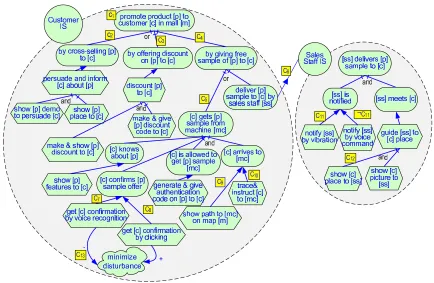
3.1 Contextual goal model for a mall promotion information system. Contexts are associated to variation points as labels . . . 63
3.2 Context analysis for context c1 in Figure 3.1 . . . 67
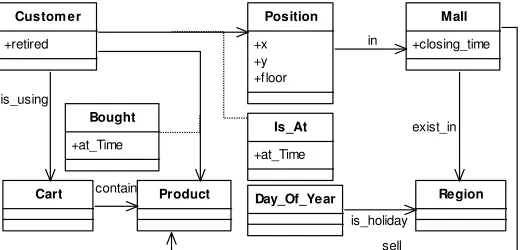
3.3 Data conceptual model specifying required data to observe c1 (Figure 3.1) . 67 3.4 Methodological guidance for contextual goal modelling . . . 68
3.5 Contextual OR-decomposition taken from Figure 3.1 . . . 70
3.6 Contextual means-end decomposition taken from Figure 3.1 . . . 70
3.7 Contextual AND-decomposition taken from Figure 3.1 . . . 71
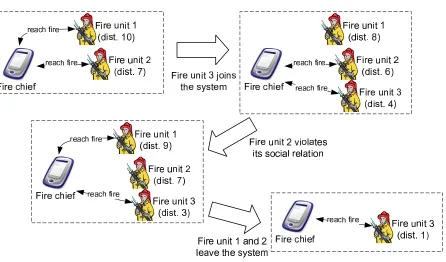
3.8 Social variability and adaptation in an STS concerning fire-fighting . . . . 73
3.9 Interaction between two agents via messages (A) and its meaning (B) . . . 75
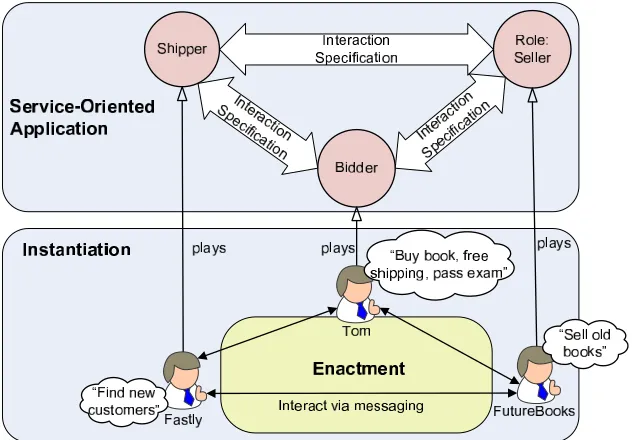
3.10 A service-oriented application is specified in terms of roles. It is instantiated when participants adopt those roles; it is enacted when participants interact according to the adopted roles . . . 77
3.11 Conceptual model for service-oriented applications and participating agents 78 3.12 A (partial) service engagement depicting an auction application. The labels are for reference purposes only. Figure 3.13 shows an enactment of this engagement between a bidder agent and a seller agent . . . 81
3.13 An enactment . . . 81
3.15 Visual modelling of Tony’s engagement-bound specification. Tony plays
repairer . . . 84
3.16 Agent model of Jim; he is a fire chief . . . 84
3.17 Simple role model for the fire-fighting example . . . 85
4.1 Logical view on the conceptual architecture for self-adaptation . . . 96
4.2 Overview of the Event normalizer component . . . 98
4.3 Contextual goal model with runtime extensions . . . 102
4.4 Part of the context model for the smart-home scenario . . . 103
4.5 Statechart showing the possible state transitions for a plan . . . 105
4.6 Statechart representing the state evolution of commitments (adapted from [SCD09]) . . . 107
4.7 SPEM 2.0 diagram showing how to create the architecture for an STS . . . 108
5.1 An example from the smart-home scenario to show visibility . . . 113
5.2 An example from the smart-home scenario to show variant generation and selection . . . 121
5.3 Alternative goals: Jim switches from a variant involving fire hydrant usage to another involving tanker truck usage . . . 133
5.4 Goal redundancy: Jim adopts a redundant variant, which involves also calling a water tanker truck . . . 134
5.5 Commitment redundancy: Jim gets C4 from Tanker 2 . . . 134
5.6 Switch debtor: Jim releases Tanker 1 from C3 and takes C4 from Tanker 2 . 135 5.7 Division of labour: Jim releases Brigade 1 from C5 and takes commitment C3 from Tanker 1 . . . 135
5.8 Bind commitments to agents: Jim delegates C2 on the basis of trust . . . . 138
6.1 Runtime operation of the prototype for STSs with contextual variability . 142 6.2 Meta-model for contextual goal models, the context model, and plan spec-ifications . . . 143
6.3 Meta-model for domain assumptions . . . 145
6.4 Screen-shot showing the simulation editor embedded in the prototype . . . 146
6.5 Runtime screen-shot of the prototype for settings with contextual variability147 6.6 EL+2SAT input files created by our prototype during variant generation . 150 6.7 Basic operation of EL+2SAT [SV09] applied to variant generation . . . 151
6.8 Runtime screen-shot of the prototype for settings with social variability . . 154
7.1 Contextual goal model for a smart-home patient: goals wake up and call
helper . . . 160
7.2 Contextual goal model for a smart-home patient: goal have breakfast . . . . 161
7.3 Screen-shot of the architecture applied to the smart-home case study (Sim-ulation 2) . . . 165
7.4 Scalability evaluation for diagnosis (left side) and reconfiguration (right side) mechanisms . . . 168
7.5 Hazardous materials emergency response options (from [Ben75]) . . . 170
7.6 Commitments in the HazMat case study . . . 171
7.7 Goal model for agent Mike who wants to playIncident Commander . . . 173
7.8 Initial variant for the simulations . . . 177
7.9 Variant generation for the case study: (a) 16 variables, 6 solutions; (b) 20 variables, 25 solutions . . . 180
7.10 Variant generation for the case study with 25 variables and 120 solutions: (a) entire execution; (b) zoom till the last solution is found . . . 181
7.11 Variant generation for the case study with 27 variables and 216 solutions: (a) entire execution; (b) zoom till the last solution is found . . . 182
7.12 Variant generation for the case study with 32 variables, timeout at 12500 seconds . . . 182
7.13 Variant generation, increasing the number of solutions: (a) 14 variables and 144 solutions; (b) 16 variables and 256 solutions . . . 183
7.14 Variant generation, increasing the number of solutions: (a) 16 variables and 324 solutions; (b) 18 variables and 576 solutions; (c) 19 variables and 874 solutions; (d) 20 variables and 1024 solutions; (e) 21 variables and 1600 solutions; (f) 23 variables and 2000 solutions . . . 184
Introduction
Software systems operate in dynamic environments, wherein expected and unexpected changes threaten their capability to meet their requirements. Developing self-adaptive software seems to be a promising way to cope with such volatility. Traditional approaches to self-adaptivity are conceived from a technical standpoint, and conceive adaptation as the adoption of a different technical configuration. However, many software systems do not operate in a purely technical environment. Conversely, they engage in social relationships with social actors (humans and organizations). This interplay of technical systems and social actors constitutes a Socio-Technical System (STS). In this chapter, we revisit software adaptation from a socio-technical perspective.
1.1
The age of socio-technical systems
There is no question that the software weinteractwith today is far more complex than that used just a few years ago. Think of a not-so-complex web application such as eBay. eBay enables you to conduct business: you browse the eBay.com website, select an item and place a bid, or you purchase immediately using the “Buy It Now” option. Alternatively, you can create auctions for your own items (that you do not necessarily own) and, as the auction finishes, ship the item to the winner through an express courier.
Importantly, modern software systems weave a network of business relations. eBay engages you in business transactions with the auctioneer or the bidders, payment pro-cessors, shippers, and the eBay corporation. Some people open personal shops on eBay, whereas some companies open virtual branches. Essentially, software acts as a means to create such relations on behalf of the social actor it represents.
item you bought is not delivered, etc. Compare this to the application you used less than two decades ago, when the Web was just born and desktop applications were mainstream. Software is rapidly shifting from a computational setting where it works in isolation— or with few hard-coded interconnections with other technical systems—to social settings where it is part of a broader system composed of both technical and social subsystems. The term Socio-Technical System (STS) was coined in organizational theory to refer to a complex interplay of human actors—the traditional constituents of organizations—and technical systems [Eme59]. Software is a prominent example of technical system in an STS; humans and organizations exemplify social systems.
We encounter many examples of STSs in our daily lives. A smart-home that helps heart patients carry out everyday activities constitutes an STS. It includes a smart-home controller software, cameras, biomedical sensors, and other devices, human actors such as the patient itself, social workers, caregivers, doctors. The LinkedIn1 social network
de-fines an STS consisting of the LinkedIn website (technical system), professionals looking for a job, business scouts searching for interesting profiles, companies advertising open positions, and the LinkedIn corporation that aims at increasing revenues by offering pro-fessional relationships management. Likewise, a logistics department in a wholesale fruit company is an STS. A logistics management system supports purchases while warehouse personnel ensures fruit arrives to the warehouse just in time for delivery.
We rely here on the characterization of socio-technical system proposed by Ropohl [Rop99], which is founded upon general systems theory [VB73]. At the basis of his char-acterization is the notion of action system, a system that acts to transform a starting situation into a final one according to pre-setgoals. Action relates not only to work (mod-ifications in the environment), but also to communication with other systems. Ropohl asserts that a socio-technical system is an action system.
The principle of excluded reductionism, from general systems theory, states that sys-tems are hierarchical. An STS can be understood in terms of internal subsyssys-tems that effectively execute the actions of the STS. These subsystems need informational coordi-nation and communication to operate effectively. Communication and work are regulated by the goals of the STS and of its subsystems. In turn, each subsystem is an action sys-tem and can be hierarchically decomposed. Though not explicitly mentioned by Ropohl, this property supports a third kind of subsystem: organizations. Along with humans, organizations are the social components in an STS.
The principle of equi-functionality states that the function of a system may be pro-duced by different structures. In an STS, actions can typically be performed by human subsystems as well as by technical subsystems. Only goal-setting cannot be performed by
1
technical subsystems. STSs are characterized bysocio-technical division of work, the dis-tribution of acting functions among humans and machines. This applies because technical systems are largely equi-functional with human abilities.
The discussion above suggests that an STS is an action system composed of both social and technical subsystems. Notice how the goal-orientation of STSs naturally leads to adaptation. Indeed, socio-technical systems should adapt to ensure their goals are met. Given their hierarchical structure, this results in different divisions of labour across the subsystems. To enact adaptation, the subsystems would typically consider the current division of labour and select the alternative that differs the least.
1.2
Software design in the age of STSs
The network of social relationships that arises and evolves in an STS has a deep impact on each participating subsystem. A single subsystem—either technical or social—cannot be merely understood in isolation, for this would ignore its relations with other subsystems. We are concerned here with a specific type of technical system, software. Specifically, our objective is to understand howsoftware design needs to evolve to cope with the distinctive features of STSs, and to determine if and how well current design paradigms are suited.
Over the years, software evolved from monolithic structure to computational distribu-tion. Pervasive [Sat01] and ubiquitous [Wei91] computing represent distribution brought to its extreme, where software becomes transparent to its users being well-camouflaged in the environment. Moreover, software is oftencross-organizational: it enables different companies to make business together, as well as to build virtual organizations [Mow94]. For instance, service-oriented computing [PG03] lets each organization maintain its inter-nal logic private and interact with others by exposing the interface of offered services.
Another relevant trend in software design is adaptivity. Adaptive (and self-adaptive) software emerged as a way to cope with the volatility of operational environments, which poses threats to the satisfaction of system goals. Software adaptation has been consid-ered at different levels: some approaches emphasize the role of architecture in adapta-tion [OGT+99, GS02]; some others provide programming frameworks to program
adap-tive behaviour [AHP94, AST09]; requirements-based approaches ensure that the system adapts to fulfil its purpose [FFvLP98, WMYM09]; service-oriented approaches analyse adaptation in terms of composition and recomposition [TP04, BDNGG07]; multi-agent systems literature provides algorithms for a single agent [Mye99, vdKdWW03] and envi-ronments that enable self-organization for a set of agents [MZ04, DNDM09].
Yu96, vL01]. A notable example isi*, an agent- and goal-oriented requirements modelling framework. i* is a social modelling framework in the sense that it depicts an organiza-tion as a set of actors that depend on each other for achieving goals, executing tasks, and providing resources. However, the social relations that are identified at requirements-time are not necessarily preserved in the system to-be.
The challenge. The evolution of software design does not adequately take into account the social perspective that is so crucial for STSs. Although software design techniques do recognize the decomposition principles of STSs, social subsystems are typically not considered as first-class citizens. Consequently, overall STS designs are less than ideal. Our challenge is toprovide design techniques that lead to software that is operable in STSs. In particular, this new class of software has to provide the following key features:
− Take into account interaction with technical and social subsystems. An STS consists of both technical and social subsystems. Software designed to operate in an STS should explicitly take into account such characteristic and be able to effectively interoperate with other subsystems. A smart-home controller should be able to interact with technical systems such as sensors and effectors, also to establish social relationships with social actors, such as patients, nurses, and catering services.
− Operate in open systems. Open systems [HdJ82, Hew86] are applications com-posed of multiple subsystems developed independently. They are founded on the communication between subsystems. As observed by Singh et al. [SCDM04], open systems involve autonomous and heterogeneous subsystems, and they are speci-fied by the interaction among these subsystems. Many socio-technical systems are open systems. Consequently, software operating in an STS cannot control other participants—due to their autonomy—and cannot know how others reason—due to their heterogeneity and autonomy. The smart-home controller, for instance, cannot control the patient nor can it be sure of her intentions.
− Deal with volatility via adaptation. The environment where an STS operates is very dynamic. Therefore, participants—in our case, software—should be able to successfully cope with the threats of such volatility. To prevent failures, software should be able to self-adapt. Self-adaptation consists of the selection and enactment of a variant behaviour that better deals with the situation at hand. Different variant behaviours for software in an STS typically include different interactions with other subsystems. We consider two major types of volatility:
house, temperature and humidity in the various rooms, availability of food in the fridge, network connectivity. Moreover, devices in the smart-home suffer of sudden disruptions and temporal unavailability;
– The social context is volatile. New actors (subsystems) can join and leave the system as they wish. Additionally, they add, remove, and modify services of-fered to others. Social actors in a smart-home STS vary over time. New social workers come into play, some others leave the STS, catering services offer differ-ent service levels and price, neighbours might be available or not. Notice that these actors might—intentionally or not—leave even when the patient relies on them. For instance, the nurse in charge of measuring the patient’s blood pressure may have a car accident while reaching the smart-home.
1.3
Evolution and adaptation
The problem outlined in Section 1.2 is part of the broader challenge of software evolution. In this section we draw a parallel between natural (biological) evolution and software evolution. On the one side, this enables us to adapt concepts and mechanisms that operate successfully in nature. On the other side, this comparison helps us to determine the main differences between natural and software evolution.
Natural/biological evolution is the change in the inherited traits of a population of organisms through successive generations [Fut05]. This means that our descendants will be different from us in some trait. Software evolves as well: versioning might be considered as a basic evolutionary mechanism for software. New versions are released to ameliorate previous ones by adding, replacing, or dropping some features. However, evolution is not always ameliorative, neither in nature nor in software.
A key ingredient for evolution is variation, the existence of variants in a population. Variation is a result of a complex interplay of processes that introduce variation and others that remove it. The concepts of software variation and software variant refer to the existence of multiple instances of the same system class/family. Each instance differs from others in the features it delivers, i.e. in the way it meets requirements.
Software developers artificially introduce variation in software systems. The current mechanisms to introduce variation are quite different from natural ones. Software prod-uct families are exploited to derive a number of variants with different characteristics; developers select which are the features to deploy. Variants arise when a project splits to different branches; this is the case, for instance, of the PostgreSQL and Ingres databases and of the many Linux distributions based on the same kernel.
In nature, there are two main mechanisms to produce evolution. Natural selection favours genes that aid the survival and reproduction of the population. Genetic drift is the random change in the frequency of alleles, and is caused by the random sampling of genes during reproduction. Natural selection can be easily found in software, and refers to the survival of software that better fits with the current environment—the software variant that best meets users’ expectations. Genetic drift does not traditionally apply to software, since it arises from random recombinations.
The outcome of evolution are the changes that observers can see. We list the major outcomes in nature and show how they map to software:
− adaptation is the process whereby an organism becomes better suited to its habi-tat [May82]. Adaphabi-tation is noticeable by the modification of some trait in the exemplar: either a new feature is gained, or an ancestral feature is loss. Also soft-ware adaptation is characterized in terms of the features that are added, removed, or replaced. Software adaptation is performed to enable software to better fulfil its purpose in the current operational environment. For instance, the smart-home controller might be enriched with a feature to check patient’s blood sugar level, if the doctor discovers the patient suffers from diabetes.
− co-evolution occurs when a biological entity changes in response to the change of a related entity. For instance, the production of tetrodotoxin in the rough-skinned newt produced the evolution of tetrodotoxin resistance in its predator, the common garter snake. Software co-evolution usually refers to the joint evolution of different software-related artefacts, e.g. implementation and design [DDVMW02]. Another type of co-evolution occurs in software suites (e.g. office suites) where the evolution of one application requires other applications to evolve to maintain interoperability.
− speciation makes a species diverge into two or more descendant species. In software, this is the case of a software project that is split into multiple variants, that differ for some feature from the original one. Differently from adaptation, speciation generates new entities whose identity is different from the original one.
This thesis focuses on adaptation. More specifically, we consider self-adaptation, the capability of a software system to adapt without the intervention of external forces. We partially consider co-evolution: software in an STS interacts with other social and tech-nical systems, therefore the evolution of any of these systems might require co-evolution by the considered software.
1.4
Research objectives
We outlined the research challenge tackled by this thesis—provide design techniques that lead to software operable in STSs—in Section 1.2, and we have shown how this relates to the broader theme of software evolution in Section 1.3. We specify now our challenge in terms of research objectives and questions.
Research Objective: define a systematic process for designing self-adaptive software for socio-technical systems.
We decompose the research objective into five specific research questions.
RQ1. What are software adaptation and variability?
As argued earlier, adaptation and variability are fundamental traits for STSs. Indeed, they enable software (and any other system) participating in an STS to cope with the volatility of their physical and social context. We propose to provide a precise account for them, as a prerequisite for tackling the following research questions.
RQ2. Which is an adequate conceptual model?
We employ a model-driven approach for the construction of self-adaptive software. One or more models are integral part of software and are used to diagnose failures, to iden-tify new alternatives, and to keep track of the current configuration. We will address this research question by proposing a conceptual model that—based on the notions of adaptation and variability in RQ1—is effective for self-adaptive software in STSs. Our conceptual model will represent software requirements, explicitly support social relations, deal with variability in an efficient way, and provide traceability links from requirements to implementation.
RQ3. How can self-adaptive software be architecturally designed?
if needed. Fourth, the architecture should be designed for socio-technical systems. Thus, it derives existing social relations from interaction and exploits these relations during both system operation and adaptation. Finally, the architecture has to be applicable to several settings (i.e. should not be application specific).
RQ4. Which are effective and general adaptation algorithms?
Adaptation is the transition from the current configuration—variant—to another one that better satisfies system requirements. The effectiveness of self-adaptive software depends on the usage of sound adaptation policies and algorithms. First, adaptation should be performed only if needed and if the expected benefit from the new variant is higher than the effort required to adapt. Second, efficient algorithms should be devised to perform diagnosis and to plan and select new variants. Third, the algorithms should be general and rely on domain-independent criteria. Domain-specific criteria might be applied by tuning the algorithms. In a long-term view, a catalogue of adaptation policies should be defined to collect reusable adaptation strategies.
RQ5. How well does the approach perform when applied to realistic settings? Any engineering approach needs empirical evidence to assess its applicability and per-formance. To evaluate our approach we shall conduct thorough experiments to verify whether it can be applied to realistic socio-technical systems and to assess its scalability. Specifically, we will verify if (i) the conceptual model is sufficiently expressive to repre-sent requirements and social relations in STSs; (ii) the conceptual architecture can be adequately implemented and applied; and (iii) the proposed adaptation algorithms and policies are efficient.
1.5
Application areas
Our approach should be applicable to several types of socio-technical system. To such extent, the notion of adaptation has to be defined in terms of high-level and domain-independent abstractions. We describe three STSs we will use throughout this thesis to exemplify the introduced concepts.
e.g. for authenticating people. As well, general-purpose devices, such as cameras, are employed for motion detection and trajectory recognition. Effectors actuate changes to the environment, e.g. servomotors for doors and windows, automatic 911 callers, light switches, displays, and remote controllers for multimedia devices such as TVs.
Suppose the smart-home, while monitoring the health of its inhabitant Bob, detects that he has a heart attack and has collapsed on the floor. The smart-home reacts to this event by requesting paramedic services. Since there is uncertainty on how quickly paramedics can be on the scene, the smart-home also requests assistance from a neighbour and pro-ceeds to unlock the entrance door as the neighbour approaches. Alternatively, a police patrol may be dispatched in order to deliver first-aid services.
As an alternative scenario, suppose that Bob is to have breakfast within one hour after he wakes up, and that he needs to take his medicine just after breakfast. If Bob has not had breakfast and the hour is almost expired, the smart-home might send gentle reminders such as turning on a light positioned on the fridge to attract his attention. If such strategy doesn’t work and the hour is expired, the smart-home might call a catering service or check whether a social worker can assist the patient in having his breakfast.
Emergency response coordination. Emergency response is the phase of emergency management that includes mobilization of emergency services as well as responses to an emergency. Core actors involved in emergency response are fire brigades, police, and ambulances. Emergency response is a well-thought out activity for most countries. Emer-gency response plans are defined by municipalities, counties, regions, also at the national level. These plans assign responsibilities to different actors. Recent plans involve also the usage of an integrated information system to facilitate the collaborative efforts of par-ticipating actors. Emergency response unfolds in a very dynamic setting, and therefore adaptation is a required skill. For the supporting information system, this might mean detecting threats to the plans currently executed, also being able to identify opportunities to better deal with the emergency.
Suppose a fire-fighter squad requests additional water, for no fire hydrant is located in the fire area. If a traffic jam threats on-time arrival of the truck, the squad might request air delivery, if the weather is good enough for water tanker planes. If that is not the case, the squad might interact with another squad that is dealing with a low-priority emergency. In case the fire gets worse and toxic substances are burning, the squad might adapt its strategy and use chemicals instead of water, also contact a specific team that deals with hazardous substances.
customer depends on the specific context where it operates: the customer, the product, the sales staff and the shopping mall itself. A promotion process is initiated when a cus-tomer is within the mall building and is therefore able to accept a promotion offer. In choosing a promotion, the system has different alternatives: (i) cross-selling by suggesting a combination of products, if the customer is interested in a product for which a comple-mentary product exists; (ii) offer a discount by showing a discount code, if the product is under promotion or is outdated; (iii) give free samples by calling a staff member, if free samples for that product exist.
To fulfil its requirements, the system has to continuously adapt. If the customer is inter-ested in an item, and cross-selling is not working well (i.e. the customer is not interinter-ested in the cross-sold product), the system might either propose another cross-selling option or give a discount code. Similarly, if cross-selling is being offered but another customer has just checked out the last item of the cross-sold product, the system has to adapt and choose another option.
1.6
Approach overview and contribution
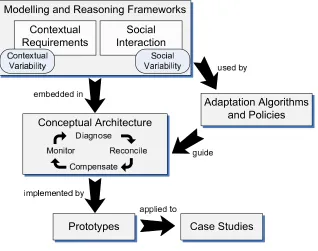
Figure 1.1: Overview of our approach to self-adaptive software
showing the tackled research questions and the contribution beyond the state of the art.
− Modelling and Reasoning Frameworks. We devise modelling primitives to rep-resent contextual requirements and social interaction, respectively. Their shared baseline consists of Tropos goal models [BPG+04]. Each language includes a
graph-ical modelling notation as well as supporting automated reasoning techniques:
– The contextual requirements framework associates contextual annotations to variation points in goal models. Each of these annotations describes when and where certain options (variants) in the goal model are applicable. Each contextual annotation is analysed to determine how its validity can be assessed at runtime via monitoring.
– The social interaction framework is founded upon the notion of social commit-ment [Sin98]. Commitcommit-ments represent social relations between heterogeneous and autonomous agents. They are publicly verifiable since they arise from in-teraction (the messages that are exchanged between agents). They capture the meaning of interaction, rather than describing interaction as a sequence of exchanged messages. Our framework integrates commitments with goal mod-elling. This enables to reason about how an agent can achieve its current goals, given a set of commitments that hold in the STS.
Addressed research questions: RQ1 and RQ2.
Contribution beyond state of the art: the modelling frameworks enable to explic-itly deal with contextual and social variability at a high-level of abstraction. Our approach supports a different variability space than other goal-oriented approaches. Wanget al. [WM09] support variation points in goal trees. Souzaet al. [SLRM10] extend Wang’s work with control parameters. In our approach, the supported vari-ability space consists of variation points, context, and the social interactions between systems (the enactment of dependencies via commitments).
identifies possible variants to reconcile system behaviour with correct behaviour, as well as selects the best variant; and (iv) compensates the problem by enacting the selected variant.
Addressed research questions: RQ3.
Contribution beyond state of the art: differently from existing architectures for self-adaptive software (e.g. [OGT+99, GS02, KM07]), ours is expressly suited for
socio-technical systems. It preserves the autonomy and heterogeneity of subsystems, for it does not control other subsystems nor requires knowledge about their rationale. This is possible because social relations—commitments between subsystems—are decoupled from intentions—the goals of the supported system. If agent x intends to satisfy goal g through a commitment offered by y, then x need not know why y
promises to deliver g or how y will bring about such goal.
− Adaptation Algorithms and Policies. We devise a set of adaptation algorithms that are used at runtime during the adaptation control loop:
– We propose diagnosis algorithms that determine failures on the basis of moni-tored data. Failures occur when observed data deviate from data predicted by the models at-hand. Additionally, we consider proactive adaptation triggers to deal with opportunities the system has to improve its performance.
– We define algorithms to enumerate possible variants to support current goals and to select the best variant. In particular, we present two algorithms for variant selection. The first one balances two factors: (i) it maximizes the con-tribution of the system to soft-goals, and (ii) it minimizes the difference from the current variant. The second one is a cost-based framework where goals are supported via capabilities and commitments; the best variant is that having minimal cost. Additionally, it can be customized by (i) specifying which events types trigger adaptation and (ii) enabling adaptation to a new behaviour only if significantly better than the current one.
Addressed research questions: RQ4.
Contribution beyond state of the art: most approaches to self-adaptive software pay little attention to the algorithms used in the adaptation control loop. In our approach, we specify algorithms for diagnosis—understanding what went wrong— and for reconciliation—identifying and selecting possible variants. We rely on widely applicable concepts—such as soft-goals and cost—to keep our algorithms general.
– The first implementation focuses on contextual requirements—expressed as con-textual goal models [ADG10]—and adapts in response to failures. This pro-totype selects the best variant by maximizing contribution to soft-goals and minimizing compensation cost. This implementation is applied to an Ambient Intelligence case study where a patient lives in an adaptive smart-home that monitors his health and supports him in everyday activities. The case study is adapted from the Serenity project2.
– The second implementation focuses on social interaction and variability. It en-ables the system to achieve its goals in a dynamic social environment where social relations vary. Such volatility consists of participants that join and leave the system as they wish, new commitments made by the system itself or by other systems, threats to and violations of existing commitments. This im-plementation exploits our cost-based adaptation framework, and lets system administrators specify adaptation policies. The implementation is applied to a simulated emergency response setting.
Addressed research questions: RQ5.
Contribution beyond state of the art: the implementations and their application to case studies allows us to identify bottlenecks and limitations of our approach. These implementations demonstrate the applicability of our conceptual architecture, and evaluate the effectiveness of the algorithms in practice.
1.7
Structure of the thesis
The thesis is structured as follows:
− Chapter 2 provides an extensive survey of the state of the art. First, we review modelling languages in the areas of requirements engineering and social interaction. These modelling languages represent the baseline for the models used in our ap-proach. Then, we examine approaches to self-adaptive software. These approaches are classified into different categories to better contrast and position related work.
− Chapter 3 presents a study of the notion of variability and its role in self-adaptive software. We present two modelling frameworks that extend Tropos [BPG+04] to
deal with two facets of variability: contextual and social. For each framework, we describe how each factor—the physical context and social interaction—influences
2
system operation, we present the modelling framework, and emphasize how such framework deals with variability.
− Chapter 4 presents our conceptual architecture. It applies to multi-agent settings, where several subsystems (agents) interact within the scope of an overall socio-technical system. First, we present the underlying principles (the requirements) for the architecture. Second, we detail the logical view on the architecture via a component diagram. Finally, we show how it can be applied to an existing system.
− Chapter 5 introduces diagnosis and reconfiguration algorithms. The diagnosis algo-rithms allow for efficient detection of failures by checking monitored data against requirements models. While identifying new variants, reconfiguration algorithms consider not only qualities, but also to what extent each variant differs from the cur-rent one. We propose an adaptation framework for STSs with heavy social variability that enables the specification of adaptation policies.
− Chapter 6 describes two prototype implementations of our architecture; these proto-types implement the algorithms presented in Chapter 5. The first prototype focuses on contextual variability. It supports the entire adaptation cycle, from events moni-toring to the actual variant enactment. The second prototype is specific for settings with social variability, and selects variants based on choosing commitments and capabilities to achieve current goals.
− Chapter 7 evaluates our approach on two case studies and presents scalability re-sults. First, we model each case study using our frameworks for contextual and social variability. Second, we apply the prototypes to the case studies: we describe simulated scenarios where the prototypes perform adaptations. Third, we present scalability experiments for each prototype.
− Chapter 8 draws conclusions for this thesis, describes ongoing work, and presents future directions.
1.8
Published work
1.8.1 Refereed International Journals
1. Raian Ali, Fabiano Dalpiaz, and Paolo Giorgini. A Goal-based Framework for Con-textual Requirements Modeling and Analysis. Requirements Engineering, Vol. 15, Nr. 4, pp. 439–458, 2010.
2. Raian Ali, Fabiano Dalpiaz, and Paolo Giorgini. Modeling and Analyzing Location-based Requirements: Goal-oriented Approach. International Journal of Computer Science and Software Technology (IJCSST). Vol. 2, Nr. 2, pp. 89–95, 2009.
International Conferences
3. Fabiano Dalpiaz, Amit K. Chopra, Paolo Giorgini, John Mylopoulos. Adaptation in Open Systems: Giving Interaction its Rightful Place. In proceedings of the 29th International Conference on Conceptual Modeling (ER 2010), Springer LNCS 6412, pp. 31–45, 2010.
4. Amit K. Chopra, Fabiano Dalpiaz, Paolo Giorgini, John Mylopoulos. Modeling and Reasoning about Service-Oriented Applications via Goals and Commitments. In proceedings of the 22nd International Conference on Advanced Information Systems Engineering (CAiSE’10), Springer LNCS 6051, pp. 113–128, 2010.
5. Amit K. Chopra, Fabiano Dalpiaz, Paolo Giorgini, John Mylopoulos. Reasoning about Agents and Protocols via Goals and Commitments. In proceedings of the 9th International Conference on Autonomous Agents and Multiagent Systems (AAMAS 2010), pp. 457–464, 2010.
6. Fabiano Dalpiaz, Paolo Giorgini, John Mylopoulos. An Architecture for Require-ments-driven Self-Reconfiguration. In proceedings of the 21st International Confer-ence on Advanced Information Systems Engineering (CAiSE ’09), Springer LNCS 5565, pp. 246–260, 2009.
7. Raian Ali, Fabiano Dalpiaz, and Paolo Giorgini. A Goal Modeling Framework for Self-Contextualizable Software. In proceedings of the 14th International Conference on Exploring Modeling Methods in Systems Analysis and Design (EMMSAD’09), Springer LNBIP 29, pp. 326–338, 2009.
Conference on Conceptual Modeling (ER 2008), Springer LNCS 5231, pp. 169–182, 2008.
9. Raian Ali, Fabiano Dalpiaz, and Paolo Giorgini. Location-based Variability for Mo-bile Information Systems. In proceedings of the 20th International Conference on Advanced Information Systems Engineering (CAiSE 08), Springer LNCS 5074, pp. 575-578, 2008.
10. Raian Ali, Fabiano Dalpiaz and Paolo Giorgini. Modeling and Analyzing Variability for Mobile Information Systems. In proceedings of the International Conference on Computational Science and Its Applications (ICCSA 2008), Springer LNCS 5073, pp. 291–306, 2008.
Workshops
11. Raian Ali, Amit K. Chopra, Fabiano Dalpiaz, Paolo Giorgini, John Mylopoulos, and Vitor E. Silva Souza. The Evolution of Tropos: Contexts, Commitments and Adaptivity. In the proceedings of the 4th Internationali* Workshop, co-located with CAiSE 10. CEUR-WS Vol-586, pp. 15–19, 2010.
12. Fabiano Dalpiaz, Raian Ali, Yudistira Asnar, Volha Bryl, Paolo Giorgini. Applying Tropos to Socio-Technical System Design and Runtime Configuration. In the Pro-ceedings of the 9th WOA workshop, From Objects to Agents (Dagli Oggetti Agli Agenti), ISBN 978-88-6122, 2008.
Other refereed publications
13. Fabiano Dalpiaz, Paolo Giorgini, John Mylopoulos. Software Self-Reconfiguration: a BDI-based approach (Extended Abstract). In proceedings of the 8th International Conference on Autonomous Agents and Multiagent System (AAMAS 2009), pp. 1159–1160, 2009.
14. Raian Ali, Fabiano Dalpiaz, and Paolo Giorgini. Goal-based Self-Contextualization. In the Forum of the 21st International Conference on Advanced Information Systems (CAiSE 09 - Forum). CEUR-WS Vol-453, pp. 37–42, 2009.
1.8.2 Un-refereed
State of the art
The state of the art in the area of self-adaptive software is broad and includes very diverse approaches belonging to different research sub-areas, including conceptual models, software architectures, service-orientation, requirements engineering, algorithms, agent reasoning, and self-organization. We overview these sub-areas and assess their adequacy in supporting self-adaptation for socio-technical systems. Section 2.1 reviews literature that defines our research baseline, covering Requirements Engineering, Social Interaction, and Software Variability. Section 2.2 provides a comprehensive survey on approaches to self-adaptive software.
2.1
Baseline models for self-adaptive software
Our approach to self-adaptive software is model-driven: models are used at runtime to detect adaptation needs and to identify alternative behaviours. Thus, our baseline in-evitably consists of modelling concepts and techniques. According to the big picture we presented in Chapter 1, we need models that represent:
− The purpose of the system, captured by requirements models. We review goal-oriented modelling languages in Section 2.1.1.
− The social relations the system is currently or might potentially be engaged in. Social relations are the glue that ties together different participants in an STS, and they are established and modified by the interaction between participants. We review modelling frameworks for social interaction in Section 2.1.2.
2.1.1 Modelling requirements via goal models
Goal-Oriented Requirements Engineering (GORE) has emerged as a prominent approach within Requirements Engineering (RE). According to GORE, stakeholder needs are goals —desired states-of-affairs—and should be elicited, modelled and analysed accordingly. There is a large amount of work in the area, which encompasses all phases of RE [vL00]: domain analysis, elicitation, negotiation and agreement, specification, specification anal-ysis, documentation, and evolution.
A common thread in all GORE research is that goals and their refinements are cap-tured by goal models using a formal or semi-formal notation. Goal models serve as a communication artefact among requirements engineering and stakeholders, but also as abstract specifications of the system-to-be. We review here the most influential goal modelling approaches and show their main strengths, specific features, and limitations.
well the different alternatives satisfice the high-level non-functional requirements.
KAOS (Knowledge Acquisition in autOmated Specification) [DvLF93] is a goal-orien-ted methodology heavily focused on the formalization of requirements. The authors’ claim is that representing requirements—conceptualized as goals—formally enables automated reasoning. They suggest KAOS as a supporting methodology for the requirements ac-quisition phase, where designers aim to understand which are the requirements of the system to-be. Central to their framework is the concept of goal model, a graph where each node captures an abstraction (goal, action, agent, entity, event), and whose edges represent semantic links between such abstractions. The conceptual model of KAOS en-ables to express both functional and non-functional requirements. KAOS includes also an acquisition process to construct requirements models and an automated support tool. The conceptual meta-model of KAOS consist of three levels: the meta-level represents domain-independent abstractions (e.g. agent, action, relationship); the domain level de-scribes concepts specific to the application domain (e.g. resource management, telephone network); the instance level refers to specific instances of domain-level concepts. Ac-cording to the KAOS world-view, objects are things of interest which can be referenced in requirements; objects are specialized into entities, relationships, events, and agents. Agents decide on their own behaviour. The KAOS requirements acquisition process con-sists of eight steps: it starts with the acquisition of an initial goal structure and the identification of concerned objects, and it ends with the assignment of actions to agents. Roughly, the six intermediate steps refine the initial structure and identify responsibilities.
provide any graphical notation to represent and structure goals; rather, it makes use of textual tables in so-called goal schemas.
Rollandet al. [RSA98] propose a method that integrates goal modelling with scenario authoring. Their approach supports goal identification through scenarios. They focus the discovery of goals around the concept of Requirement Chunk (RC), a pairhGoal, Scenarioi. They define a bidirectional goal-scenario coupling: goals help in scenario discovery, and scenarios help in goal discovery. Consequently, requirements elicitation consists of two steps: scenario authoring and goal discovery. Another key feature of their work is the distinction between the refinement relationship and the AND/OR relationships among goals. Requirements chunks are organized in a requirement chunk model, which keeps track of all RCs and their refinements. Refinement is used to go from high-level fuzzy goals to lower-level concrete goals, whereas AND/OR relations create a hierarchy for each concrete goal. The structure of both goals and scenarios is specified through a conceptual model that helps defining these artefacts on the basis of natural language statements. For example, a goal has at least one verb and at least one parameter, where parameters can be target, direction, way, and beneficiary. This approach also provides guidelines to assist the designer during requirements identification.
the execution of tasks, and the provision of resources. Intentional elements—goals, tasks, and resources—may contribute positively or negatively to other intentional elements. The
Figure 2.1: A strategic rationale model ini* [Yu96]
i* framework exploits these abstractions in two models: Strategic Dependency (SD) and Strategic Rationale (SR). An SD model is a network of dependency relationships among actors, and captures the intentionality of the processes in the organization and what is important to its participants. SR models are exploited to describe the rationale behind the processes in systems and organizations. In SR models, the rationale of every actor is described in terms of intentional elements: goals, soft-goals, tasks, and resources, and the relationships among them. Figure 2.1 shows how a strategic rationale model looks like.
Tropos [BPG+04] is an agent-oriented software engineering (AOSE) methodology that
2.1.2 Modelling social interaction
Social interaction arises naturally, both in our physical environment and, increasingly, in our virtual (software) world. Social interaction occurs whenever two or more actors interact (typically, for some purpose). Examples of everyday social interaction are visiting a doctor, buying a car from a car dealer, exchanging information about summer holidays. Social interactions often involve technology—in particular, software systems. Think of your payments via credit card, where you interact with a software system that processes the payment, your credit card company, the item seller. Social interaction creates social relationships between the interacting participants. There is a large amount of research about social interaction modelling; the most prominent approaches are in agents and multi-agent systems, conceptual modelling, software and service engineering.
dif-ferences between these two languages in the work by Labrouet al. [LFP99]. FIPA-ACL describes how messages exchanged by agents should be structured. Being based on speech acts, a performative field is needed to represent the communicative act of the message. Examples of communicative acts are accept, agree, cancel, call for proposals, confirm, inform, failure, request, and query. Three fields are used to represent participants in the conversation: sender, receiver, and reply-to. The content is the core of the message, which is interpreted by the receiver agents according to the communicative act, the encoding, the ontology, and the protocol. FIPA-ACL contains some fields to represent control of con-versation: the protocol to which the message belongs to, a conversation ID that uniquely represents different conversations, reply-with and in-reply-to to deal with conversations where multiples dialogues occur simultaneously, reply-by to indicate response deadlines.
In his “Rethinking the principles” paper on agent communication [Sin98], Singh ob-serves that agent communication languages do not let heterogeneous agents communicate, and that approaches that rely on mental agency are unrealistic. If agents are autonomous and heterogeneous, the sender cannot make any hypothesis about the receiver’s ratio-nale. Singh shows that an agent communication language has to emphasize social agency. Communication is inherently public and depends on the agent’s social context. The long-term challenge he poses is the definition of agent communication languages that (i) are based on formal semantics; (ii) support high autonomy; (iii) enable high heterogeneity; (iv) support open dialects. Singh calls for a radical shift from previous agent communi-cation languages, that make many assumptions concerning the structuring of the single agents—violating their heterogeneity—and have very little flexibility.
Cheong and Winikoff [CW06] propose Hermes, a goal-oriented approach to agent in-teraction. Hermes is to be used by engineers that want to define interaction protocols for multi-agent systems, and includes (i) a methodology to design goal-based interac-tions; (ii) failure handling mechanisms; and (iii) a process to map design artefacts to an executable implementation. They observe that message-centric approaches are not suitable for flexible and robust interaction, being rooted in low-level abstractions. Such inflexibility—typically expressed by the sequencing of messages to be exchanged—restricts the autonomy of agents and does not allow the exploitation of shortcuts (reduced versions of a protocol). In Hermes, an interaction protocol is a set of goals to be achieved and some temporal constraints about these goals. The Hermes methodology supports the design of an interaction protocol in six steps, starting from the identification of roles and inter-action goals and ending with the definition of messages to exchange. Hermes supports action failure and interaction goal failure. An action failure occurs when an action does not achieve its interaction goal. An interaction goal failure occurs if an interaction goal cannot be achieved. The main limitation of this approach is to suppose that goals exist at the level of an overall multi-agent system: this assumption holds when designing an entire MAS, but does not hold in case of autonomous and heterogeneous agents, which can join and leave as they wish.
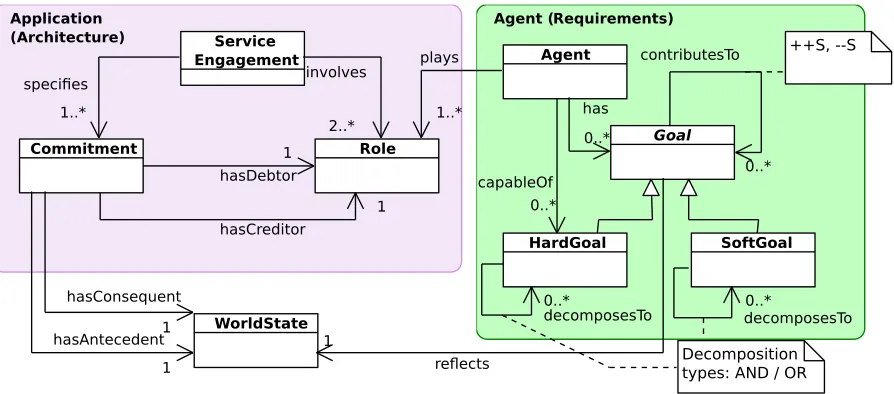
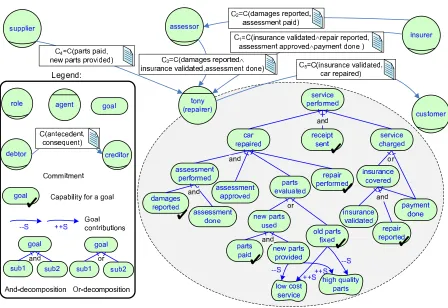
To overcome the limitations of existing agent communication languages, Singh pro-poses the concept of social commitment [Sin99] as the interaction abstraction for multi-agent systems. In his work, commitments are described and exploited in a multi-multi-agent architecture named spheres of commitment. His work on commitments relies on sev-eral assumptions: agents are autonomous (and constrained only by social commitments to avoid chaos), social commitments cannot be reduced to internal commitments, social commitments are revocable through appropriate operations, commitments exist only in a social context, commitments are different from the way agents use them, commitments are a social abstraction—not a mental one. Formally, a commitment is a four-place relation involving a proposition p and three agents x, y, and G. A commitment c=C(x, y, G, p) denotes a commitment from x to y in the context of G for the proposition p. x is called debtor, yis the creditor, Gis the context group, andp is the discharge condition of com-mitmentc. The semantics is that the debtorxcommits to the creditory to bring aboutp
creditor to another agent. A commitment is conditional if the debtor commits to the discharge condition only if a certain precondition holds. In subsequent work, Singh and colleagues consider mainly conditional commitments—which are particularly adequate to represent business relations—as a five-place relation c = CC(x, y, G, p, q), in which p is called antecedent,q is called consequent, and the debtor x commits to y for q if p holds. Commitments have been used by Desaiet al. [DMCS05] to define flexible interaction protocols for business processes. In their approach, a business protocol is an abstract, modular, and public specification of an interaction among different partner roles. They contrast protocols defined in terms of commitments to traditional message-flow based protocols, and show that their approach is more flexible and robust. They also show how composite protocols can be defined. Their framework is formalized in π-calculus in order to allow inference reasoning about (in)correctness, compatibility, equivalence, and flexibility. Telang and Singh [TS09] apply the concept of commitment to the Tropos methodology in order to enable to specify cross-organizational business processes. The motivation of this work is similar to that of Desai et al. [DMCS05], but the approach is different. Here, a business process consists of a set of agents having goals and tasks, and a set of roles related via dependencies and commitments. The two abstractions related to interaction—dependencies and commitments—are used at different steps of the methodology. First, goals and goal dependencies between roles are identified. Then, goals and goal dependencies are refined into tasks and task dependencies between roles. Finally, task dependencies are further refined into conditional commitments. The authors explain the importance of verifying agent interaction, since agents autonomy does not guarantee that their interaction will follow the protocol defined as commitments between roles.
2.1.3 Software variability modelling
Software variability refers to “the ability of a software system or artefact to be efficiently extended, changed, customized or configured for use in a particular context” [SvGB05]. Software variability is an essential property for adaptive systems, for software adaptation does not exist in absence of variability. We review here the most influential approaches to software variability modelling.
Kang et al. propose Feature-Oriented Domain Analysis (FODA) [KCH+90], the first
but they its distinctive trait. Figure 2.2 shows a feature model for a car. A car has two
Figure 2.2: A feature model using the FODA notation [KCH+90]
mandatory features—that every car instance has—transmission and horsepower. Cars have optional features—that a car instance may have or not—such as air conditioning. Alternative features are those that vary from one instance to another; transmission can be manual or automatic. Optional and alternative features represent variation points, i.e. constructs where variability is introduced. The feature model in Figure 2.2 contains two additional element: a composition rule saying that air conditioning requires horsepower to be bigger than 100; and a rationale saying that manual transmission is more fuel efficient than automatic transmission. These two elements allow for more expressiveness and help designers to choose among variants.
The same authors extend FODA and propose FORM [KKL+98], which focuses on
the development of reusable architectures and components. While FODA focuses on re-quirements only, FORM supports the entire software design phase. FORM prescribes how the feature model is used to develop domain architectures and components for reuse. FORM is based on abstraction principles, and is composed of four layers. Every layer ex-ploits feature models; higher-level features are refined in lower-levels. The four supported layers are: capability, operating environment, domain technology, and implementation technique. FORM enables to transform a feature model to a reference architecture. Such transformation takes into account non-functional features, which influence the structure of the architecture.
to any stakeholder, not just users. Features can be of two kinds: solitary features and grouped features. Grouped features appear in feature groups. Cardinality-based feature models express cardinalities as intervals over integers. Their approach also proposes the concept of staged configuration, the process of specifying a product family member in stages, where each stage eliminates some configuration choices. The formalization of the cardinality-based feature model is in terms of context-free grammars.
Von der Maßen and Lichter [vdML02] study how UML use case diagrams can ex-press variability. They first define the requirements for a variability modelling language: representation of common and variable parts, distinction between types of variability, representation of dependencies between variable parts, support to model evolution, and provision of good tangibility and expressiveness. Their baseline is the UML use case diagram, which is extended by adding the concepts of variation point, alternative, and option. Halmans and Pohl [HP03] propose a different way to express variability via use case diagrams. First, they show how the “include” and “extend” links can be used as a primitive means to represent variability. Second, they observe the inflexibility of such solution and propose an alternative approach based on UML stereotypes. Specifically, they introduce the concept of variation point to explicitly take into account variants.
Asikainen et al. propose Koalish [ASM04], a modelling language to express config-urable software product families supporting the automatic configuration of product in-stances. The language extends Koala [vOvdLKM02], a component model and architecture description language, by adding explicit variation modelling mechanisms. Unlike most ap-proaches in variability modelling, Koalish does not define variation points, while it allows for selecting the number and type of parts of components, and writing constraints. A Koalish model represents the properties of a software product family and describes com-ponent and interface types that can occur in configurations. A configuration is a set of instances of these types; a configuration is valid if it satisfies the constraints in the Koalish model.
the six lower-level models to represent the structure and the functionalities of a specific architecture. Fundamental to express variability are the Options, Variants, and Boolean Guard schemas. Together, these schemas allow for modelling variability in space through explicit variation points in the architecture. The Options schema supports the definition of optional architectural elements; the Variants schema enables to define variant elements that can be configured to be one of a set of alternative types; the Boolean Guard schema allows to define the preconditions for the Options and Variants schemas.
Gomaa and Webber propose the Variation Point Model (VPM) [GW04]. The authors outline four approaches to modelling variability: parametrization, information hiding, inheritance, and variation points. The variation point model belongs to the last category. Parametrization means changing some core attribute of the application, e.g. varying a greeting depending on the device display. Information hiding relies on the implementation of different version of a same component sharing the same interface, e.g. developing a multi-language ATM based on different language components. Inheritance is also based on components but relies on specialization (e.g. by extending a generic class); thus, the components need not have the same interface. VPM is based on an explicit representation of variation points, that are contained in reusable components. VPM uses UML models to describe variability and consists of four points of view. The requirements point of view shows the variation point in terms of the variations of the common core. The component variation point view is a composite view that shows all the variation points that belong to a particular component. The static point view exploits an UML class diagram to show structural variability. The dynamic variation point view shows how to make a variant known to the other components.
Liaskoset al. explore the use of goal models for variability representation and analysis [LLY+06]. The core idea is to explore OR-decompositions to represent alternative ways
2.2
Approaches to adaptive software
In this section we present our literature survey on adaptive software. We organize the state of the art according to the categories listed in Table 2.1. Approach that fall into more categories are described in the most representative category.
Category Section Description
Conceptual models 2.2.1 Provide conceptual foundations to conceive and understand adaptation
Programming frameworks 2.2.2 Enable the development of adaptive software by extending programming languages
Software architectures 2.2.3 Define architectural styles or are frameworks to build adaptive software
Service-oriented 2.2.4 Conceive adaptation in a setting composed of multiple interacting (web) services
Requirements engineering 2.2.5 Guarantee that the system fulfils its require-ments
Algorithms and policies 2.2.6 Define criteria about how to adapt and enable designers to specify adaptation policies
Agent reasoning and planning 2.2.7 Characterize adaptation from the perspective of an intelligent agent
Self-organization 2.2.8 Adaptation in a multi-agent system results from the individual behaviour of the agents
Table 2.1: Categories of approaches to adaptive software
2.2.1 Conceptual models of adaptation
Some approaches address software adaptation from a conceptual perspective, rather than through a technical framework. The main questions they tackle are: what is adaptation?; why and how should software adapt?; how does adaptive software differ from non-adaptive one?; and when should an adaptation process start?
operat-ing in a different domain. Adaptation models guide the transi
![Figure 2.1: A strategic rationale model in i* [Yu96]](https://thumb-us.123doks.com/thumbv2/123dok_us/694033.2067416/37.595.171.469.184.432/figure-a-strategic-rationale-model-in-yu.webp)
![Figure 2.5: Requirements-based adaptation [FFvLP98]](https://thumb-us.123doks.com/thumbv2/123dok_us/694033.2067416/60.595.130.434.374.579/figure-requirements-based-adaptation-ffvlp.webp)
![Figure 2.6: Relation between the different types of policies defined in [KW04]](https://thumb-us.123doks.com/thumbv2/123dok_us/694033.2067416/65.595.175.450.276.353/figure-relation-dierent-types-policies-dened-kw.webp)