R E S E A R C H
Open Access
Effect of elastomeric monomers as polymeric
matrix of experimental adhesive systems: degree
of conversion and bond strength characterization
Eliseu Aldrighi Münchow
1*, Guilherme Duarte de Barros
2, Lucas da Silva Alves
2, Lisia Lorea Valente
1,
Sergio da Silva Cava
2, Evandro Piva
1and Fabrício Aulo Ogliari
2* Correspondence: [email protected] 1Department of Restorative
Dentistry, School of Dentistry, Federal University of Pelotas, Rua Gonçalves Chaves 457, Pelotas, RS 96015-560, Brazil
Full list of author information is available at the end of the article
Abstract
The aim of this study was to characterize the degree of conversion and the bond strength of experimental adhesive systems formulated with elastomeric monomers (Exothanes). Two-step self-etch adhesive systems were formulated, where the primer was constituted by HEMA, HEMA-P, water and ethanol, and the resin bonds were prepared mixing one type of Exothane (8, 9, 10, 24, or 32) (75 wt%) with TEGDMA (25 wt%). CQ, EDAB, and DPI were added as photo-initiation system. UDMA was used as control, so six different resin bonds were formulated at all. The adhesive system Clearfil SE Bond (CLSE) was used as a commercial control. The degree of conversion (DC) of each resin bond was evaluated in infrared spectroscopy (RT-FTIR, Shimadzu Prestige-21) using a diamond crystal (n = 3). The microshear bond strength (μSBS) test was performed using a universal testing machine (EMIC DL-500). While the DC data was analyzed by one-way ANOVA and Tukey (p < 0.05), theμSBS data was analyzed by Kruskal-Wallis test and Student-Newman-Keuls (p < 0.05). The resin bonds containing the Exothanes 8, 9, and 32 demonstrated DC values higher than 80%, differently to the other Exothane-based adhesives, which showed DC values close to 50%. UDMA and CLSE demonstrated lower DC than E8, E9, and E32 (p < 0.001). The Exothane 24 resulted in the lowest DC value of the study (p < 0.001), although it was similar to the E10and UDMA adhesives (p > 0.05). LowμSBS results were seen for the Exothane-based materials. CLSE demonstrated significantly higher bond strength than the other materials (p < 0.001). UDMA has also presented lowμSBS to the dentin substrate. It can be concluded that the Exothanes evaluated demonstrated satisfactory degree of conversion, with some of them reaching almost full conversion of monomers in polymer. However, considering the formulations investigated, they were not good bonding agents. So, they were not reliable options for composing the polymeric matrix of dental adhesive materials.
Keywords:Dental adhesives; Exothanes; Elastomeric monomers; Elastomers; Microshear bond strength; Degree of conversion; Polymerization reaction
Background
Dental adhesive systems are commonly used for bonding the restorative material to the tooth structure. The bonding mechanism is basically characterized by the substitution of superficial tooth minerals for resin monomers, which polymerize in situ, creating a micro-mechanical interlocking between the tooth and the bonding substance. This process is known as hybridization, where a hybrid layer is formed between the tooth
substrates and the restorative material [1]. The bonding mechanism starts with the appli-cation of an acidic substance, which enables the superficial tooth demineralization; then, another substance is used to prepare the demineralized substrate (primer), followed by the application of a resinous substance (resin bond), which links the tooth to the restorative material. Depending on the mode of using or combining these adhesive substances (acid, primer, and resin bond), different adhesive systems are present in the dentistry field.
The adhesive systems are polymer-based materials, and they are commonly constituted by methacrylate monomers, solvents, and a photo-initiation system, which makes them photo-curable [2]. The monomeric nature plays important roles for each bonding step, where the primer should be a polar substance (hydrophilic) as the tooth is a humid sub-strate, and the resin bond should be a more non-polar substance (hydrophobic) than the former as this characteristic increases its mechanical strength and reduces the polymer network degradation (hydrolysis). This dual characteristic (polarity and nonpolarity) are very important for acquiring high adhesion between the tooth and the restorative material. Even so, there are severalin vitrostudies which evaluated the bond strength stability be-tween tooth substrates (enamel or dentin) and restorative materials and most of them have concluded that the adhesive interface degrades over time [2-5], mainly because of the monomers used in their composition. This fact may influence negatively with the per-formance of the restorative procedure. Consequently, materials showing higher strength and stability to wet environment are still needed in dentistry.
Recently, new types of monomers were brought up to the chemistry industry. The Exothane™ Elastomers are categorized as the most recent advance in Esstech’s urethane chemistry [6], which could be used for a broad range of demanding formulations, includ-ing the adhesive ones. They present different physical characteristics when compared to the urethane dimethacrylate (UDMA), which is a common monomer found in dental ma-terials composition [7,8], such as higher elongation and toughness properties. Moreover, these monomers have the potential of acquiring high conversion values, which is ex-tremely desirable in adhesive materials, improving physical properties and maybe leading to low leachable activity as lower amount of residual monomers would be present at the hybrid layer, and as a consequence lower cytotoxicity [9]. In addition, considering that the Exothanes present elastomeric characteristics, they may imply mobility and capability to relax the polymer network, which is important for relieving the shrinkage stress phenomenon [10]. Nevertheless, there are several types of Exothanes and no existing stud-ies investigating them.
Thus, the aim of the present study is to characterize the degree of conversion and the bond strength of experimental adhesive systems formulated with elastomeric mono-mers (Exothanes). The null hypothesis evaluated was that the experimental materials would not differ to the performance of a broadly used commercial adhesive system.
Methods
Formulation of the experimental adhesive systems
previously described [11]. It was mixed with distilled water, 2-hydroxyethyl methacrylate (HEMA) and ethanol. On the other hand, the resin bonds were formulated using the Exothane monomers, which were Exothane 8 (E8), Exothane 9 (E9), Exothane 10 (E10),
Exothane 24 (E24), and Exothane 32 (E32). They were all purchased from Esstech (Esstech
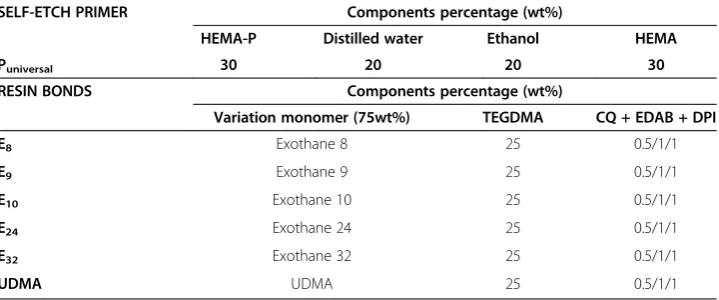
Inc, Essington, PA, USA) and used without further processing. UDMA was used as con-trol (Table 1). Also, the two-step self-etch adhesive system Clearfil SE Bond (Kuraray, Tokyo, Japan) was used as the commercial control. For the experimental resin bonds for-mulation, each resin matrix was constituted by one type of the Exothanes (75 wt%) and 25 wt% of triethyleneglycol dimethacrylate (TEGDMA); 0.5 wt% of camphorquinone (CQ), 1 wt% of ethyl-4-dimethylaminobenzoate (EDAB), and 1 wt% of diphenyliodonium hexa-fluorphosphate (DPIHFP) were added as photo-initiators (Table 1). All the primers and the resin bonds were ultrasonicated for 15 minutes.
Degree of conversion analysis
The degree of conversion (DC) of each resin bond was evaluated in triplicate using Fourier Transform mid-infrared spectroscopy (Prestige21, Shimadzu, Tokyo, Japan). A standard adhesive drop (3μL) was dispensed over a diamond crystal (Smiths) where a preliminary reading (monomer) for the unpolymerized material was taken. Then, the composite was light-activated with a light-emitting diode unit (LED Radii, SDI, Bayswater, Australia) for 30 seconds (s) and another reading was carried out (polymer). The DC was calculated as previously described [12].
Microshear bond strength (μSBS) evaluation and Failure analysis
TheμSBS test was conducted according to a previous study [13]. Twenty-eight freshly bo-vine incisors were obtained, cleaned, and stored in 0.5% chloramine T for seven days. Then, they were transferred to distilled water and kept frozen until their use. Each tooth was em-bedded in acrylic resin, followed by the grounding of its vestibular surface in wet 600-grit silicon carbide paper to expose the dentin substrate. After that, the experimental adhesive systems were actively applied: one coat of the universal self-etch primer (Puniversal) for 20 s
and gently air-dried for 10 s; and one coat of the experimental resin bonds, which were Table 1 Experimental materials formulated in the study: a universal self-etch primer and different resin bonds
SELF-ETCH PRIMER Components percentage (wt%)
HEMA-P Distilled water Ethanol HEMA
Puniversal 30 20 20 30
RESIN BONDS Components percentage (wt%)
Variation monomer (75wt%) TEGDMA CQ + EDAB + DPI
E8 Exothane 8 25 0.5/1/1
E9 Exothane 9 25 0.5/1/1
E10 Exothane 10 25 0.5/1/1
E24 Exothane 24 25 0.5/1/1
E32 Exothane 32 25 0.5/1/1
UDMA UDMA 25 0.5/1/1
HEMA-P, Methacryloyloxyethyl dihydrogen phosphate plus bis(methacryloyloxyethyl) hydrogen phosphate;HEMA, hydroxyethyl methacrylate;TEGDMA, triethyleneglycol dimethacrylate;CQ, camphorquinone;EDAB,
applied for 10 s. Clearfil SE Bond (Kuraray, Tokyo, Japan) was applied as the manufacturer instructions. To delimitate the bond testing area, a circular silicon matrix (array) with three orifices of 1.5 mm in diameter was positioned over the dentin surface, and the light-activation for 20 s was performed on each orifice with the same light-curing unit previously described. Then, an increment of composite resin (Filtek Z-250, 3M ESPE, St. Paul, USA) was inserted into the orifices and light-activated for 40 s. Then, the matrix was gently re-moved, resulting in specimens with three cylindrical restorations at the dentin surface, which were stored in distilled water at 37°C. After 24 hours, the specimens were positioned in a universal testing machine (DL-500, EMIC, São José dos Pinhais, Brazil), where a thin wire was looped around the composite cylinder restoration. The specimens were submitted to microshear bond strengthμSBS) test at a crosshead speed of 1 mm/min and the results were expressed in MPa. After the test execution, the dentin surfaces were examined with a stereomicroscope at a magnification of 40x in an attempt of determining the failure pattern, which was classified as adhesive (on the adhesive interface), cohesive in dentin, cohesive in adhesive resin, or mixed.
Statistical analysis
Data of the degree of conversion were submitted to one-way Analysis of Variance and the Tukey test at the 0.05 level of significance as a post hoctest. The microshear bond strength data were submitted to Kruskal-Wallis and Student-Newman-Keuls test as a
post hoctest at the 0.05 level of significance.
Results
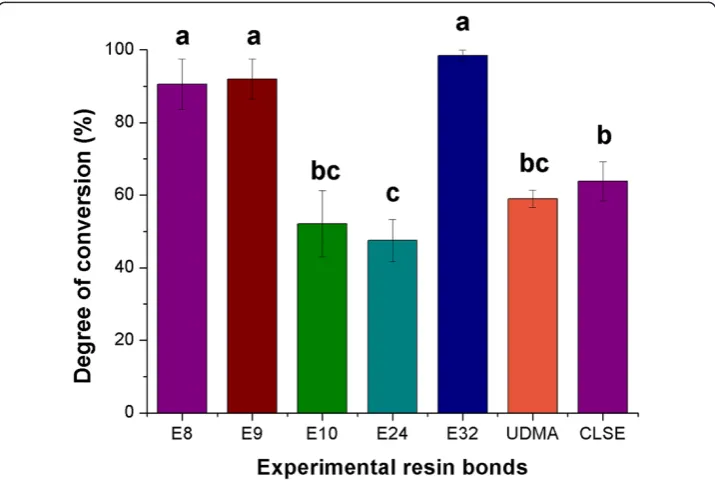
The degree of conversion (DC) obtained with each experimental resin bond formulated and the commercial control is shown in Figure 1. The resin bonds containing the
Exothanes 8, 9, and 32 demonstrated DC values higher than 90%, showing higher DC than the control groups and the other resin bonds (E10 and E24) (p < 0.001). The resin
bonds containing the Exothanes 10 and 24 presented DC values near to 50%, which were similar to the experimental control group (59%) (p = 0.769 and p = 0.257, respect-ively). The commercial control group showed a DC value of 63.8%, which was similar to the E10(p = 0.247), but significantly different to the E24(p = 0.048).
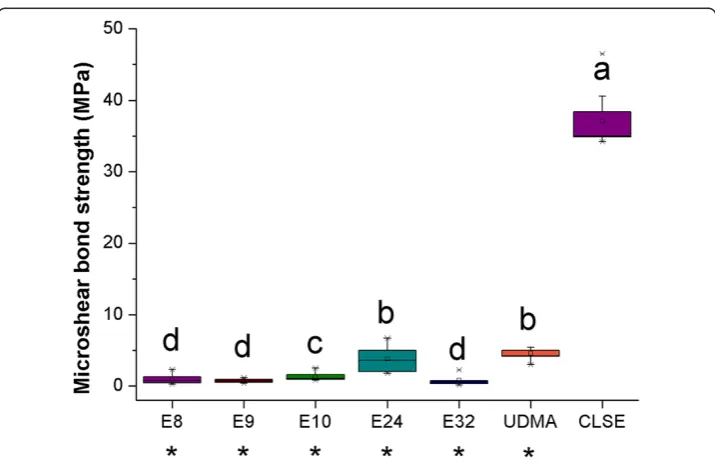
The microshear bond strength (μSBS) results are presented in Figure 2. All the experi-mental materials (Exothane-based and UDMA-based adhesive systems) resulted in low
μSBS values. In contrast, the commercial CLSE adhesive resulted in 35.6 MPa of bond strength, which was the highest μSBS median value of the study. CLSE showed higher bond strength than UDMA and the other adhesives (p < 0.05). UDMA was as strong as the E24adhesive system (p > 0.05), which demonstrated higherμSBS values than the other
Exothane-based adhesives (p < 0.05). With regard to the failure pattern distribution, the Exothane-based and UDMA-based adhesive systems generated only adhesive failure modes, differently to the control CLSE, which demonstrated equilibrium of adhesive (45%) and cohesive/mixed (55%) failures (see in Figure 2, image and legends).
Discussion
The aim of this study was to investigate about the reliability of using the Exothane mono-mers as polymeric matrix of dental adhesive materials. So, experimental adhesive systems containing these monomers were prepared. It is already known that a satisfactory per-formance of polymeric dental materials is directly correlated to a proper polymerization reaction of monomers in polymer [7,12,14]. Interestingly, within the degree of conversion results obtained from each resin bond formulated it is possible to verify that some
Exothanes acquired excellent conversion values (Figure 1). In fact, adhesives containing the Exothanes 8, 9, and 32 showed almost full polymerization, and according to Ferracane (2006) [7] how greater the degree of conversion, higher the material’s stability to the hy-drolysis degradation phenomena. This will probably generate a long-durable material with improved physic-mechanical properties [15]. Nevertheless, not by all the experimental Exothane-based resin bonds resulted in excellent conversion values, as the Exothanes 10 and 24 showed degree of conversion near to 50% (Figure 1).
The conversion of monomers into a polymer network is influenced by intrinsic factors, such as the monomer’s degree of functionality (number of double bond terminations per molecule) [16], chain extender length [17], viscosity [18], and reactivity [19]. According to the Esstech site, no data of molecular formula or weight are supplied for the Exothanes 8, 10, 24, and 32. Consequently, their degree of functionality, chain extender length, and re-activity are unknown by the scientific community. In contrast, the Exothane 9, which is not new in the chemistry field, has been already commercialized with another product name (PEG 400 Extended Urethane Dimethacrylate, Item # X-726-0000 from the Esstech catalog) [6]. It presents a functionality 2 and a high molecular weight (1139.4 g/mol), but a low viscosity (1.855 PaS), fact that has probably contributed to its high degree of conver-sion (Figure 1), as low viscosities facilitate the molecule mobility, increasing its converconver-sion [18]. Unfortunately, the absence of knowledge about the molecular structure and weight of the other Exothanes limits the discussion and understanding of why they react so differ-ently, leading to polymers with almost full conversion (those containing the Exothanes 8 and 32) and others with only half-conversion values (those containing the Exothanes 10 and 24) (Figure 1).
When the Exothane-based resin bonds are compared to the control materials, it can be observed that the presence of the Exothanes 8, 9, and 32 has improved the degree of con-version, differently to the other two Exothanes (10 and 24), which contributed to convert similarly to the UDMA-based resin bond. Considering this result, it can be inferred that these latter Exothanes present a similar molecular structure of UDMA, as they are also urethane-based monomers. With regard to the degree of conversion obtained with the CLSE resin bond, it is in accordance with previous studies [20,21]. In addition, the 64% of monomeric conversion achieved with this adhesive was similar to the UDMA and E10
groups (Figure 1), but different to the E24resin bond, which showed a statistically lower
degree of conversion, probably because the Exothane 24 monomer may present low mo-bility amo-bility, limiting the polymerization reaction [17].
With regard to the bond strength results, it is possible to verify that the Exothanes are not good options for the development of dental adhesive systems, at least using the formulations evaluated in this study. When only the degree of conversion results are observed, it can be expected a satisfactory adhesive capacity for all the Exothanes, as conversion values higher than 50% are enough for bonding to tooth substrates [22]. However, the bond strength results obtained in this study showed low adhesive ability for all the Exothane-based adhesive systems (Figure 2).
the complete or incomplete volatilization of any solvent retained in the adhesive layer [26], or the light source and intensity used for photo-activate the adhesive [12]. Consid-ering each of these aforementioned factors, the acidic substance used for the experi-mental materials formulation was the HEMA-P, which has demonstrated satisfactory demineralization ability in a previous study; [11] after the primer’s application, the solv-ent was volatilized by air stream for 10 s, leading to the formation of a shiny layer over the substrate (a solvent-free pellicle was visually formed); lastly, the light source used was the same for all the materials evaluated. Nevertheless, the polarity of each resin blend formulated is unknown, and this fact may have probably caused the different bond strength results obtained in the study.
The polarity of a monomer is a characteristic that shows its hydrophilicity/hydropho-bicity ratio [7]. Generally, the primer substance is applied over the dentin substrate, which is a humid structure that is chemically compatible with hydrophilic molecules; so, the primer should be hydrophilic, enabling the resin monomers infiltration into the demineralized dentin, leading to their entanglement with the exposed collagen fibrils [27]. Nevertheless, hydrophilic substances tend to suffer faster degradation phenomena due to the hydrolysis processes that occur in the oral environment [7,24]. In contrast, the resin bond substance, which is applied over the primer, should be a hydrophobic material, as this characteristic implies strength and more stability for the adhesive to re-sist the degradation phenomena [28]. Even so, the resin bond should be only moder-ately hydrophobic, as a poor interaction between the primer and the resin bond may occur (phase separation). Considering that the same primer formulation was used in the current study, the Exothane-based adhesives (experimental resin bonds) have prob-ably an extremely hydrophobic nature, as very low bond strength results were obtained (Figure 2), whit complete adhesive failure modes. This characteristic shows that a proper interaction between the primer and the experimental resin bonds have not occurred, in-cluding for the control UDMA-based resin bond. This result may suggest that the ureth-ane derivatives investigated in this study are hydrophobic substances, even when they are mixed with TEGDMA (a more hydrophilic monomer). On the other hand, the control CLSE showed 55% of cohesive/mixed failure modes, indicating that a strong hybrid layer was created between the dentin substrate and the adhesive components. This is already understood because the CLSE is constituted by 10-methacryloyloxydecyl dihydrogen phosphate (MDP), which enables a chemical and a micro-mechanical bonding mecha-nisms [2], improving the bond strength results, as confirmed by the present study.
Considering the results obtained in this study, the null hypothesis evaluated that the experimental adhesive systems would not differ to a broadly used commercial adhesive system can be partially accepted, as regarding the degree of conversion analysis, some of the materials (E10and UDMA) demonstrated similar conversion when compared to
Conclusion
Despite of the limitations of this in vitrostudy, it can be concluded that the Exothanes evaluated demonstrated satisfactory degree of conversion, with some of them reaching almost full conversion of monomers in polymer. However, considering the formulations investigated, they were not good bonding agents. So, they were not reliable options for composing the polymeric matrix of dental adhesive materials.
Competing interests
The authors declare that they have no competing interests.
Authors’contributions
EAM and LLV participated in the supervision of the experiments and in the writing of the manuscript. GDB and LSA participated in the formulation of the materials and in performing the experiments. EP participated in the design of the study and performed the statistical analysis. SSC and FAO conceived of the study, participating in its design and coordination, helping to drafting the manuscript. All the authors have read and approved the final manuscript.
Acknowledgements
Authors would like to thank Esstech Inc for reagents donation.
Author details
1Department of Restorative Dentistry, School of Dentistry, Federal University of Pelotas, Rua Gonçalves Chaves 457,
Pelotas, RS 96015-560, Brazil.2Department of Organic Chemistry, School of Materials Engineering, Federal University of Pelotas, Rua Félix da Cunha 809, Pelotas, RS, Brazil.
Received: 2 September 2013 Accepted: 5 November 2013 Published: 3 February 2014
References
1. Nakabayashi N, Kojima K, Masuhara E (1982) The promotion of adhesion by the infiltration of monomers into tooth substrates. J Biomed Mater Res 16:265–273, doi:10.1002/jbm.820160307
2. De Munck J, Van Landuyt K, Peumans M, Poitevin A, Lambrechts P, Braem M, Van Meerbeek B (2005) A critical review of the durability of adhesion to tooth tissue: methods and results. J Dent Res 84:118–132, doi:84/2/118 3. Khoroushi M, Rafiei E (2013) Effect of thermocycling and water storage on bond longevity of two self-etch
adhesives. Gen Dent 61:39–44
4. Sacramento PA, de Castilho AR, Banzi EC, Puppi-Rontani RM (2012) Influence of cavity disinfectant and adhesive systems on the bonding procedure in demineralized dentin - a one-year in vitro evaluation. J Adhes Dent 14:575–583, doi:28730 5. Zanchi CH, Munchow EA, Ogliari FA, de Carvalho RV, Chersoni S, Prati C, Demarco FF, Piva E (2013) Effects of
long-term water storage on the microtensile bond strength of five experimental self-etching adhesives based on surfactants rather than HEMA. Clin Oral Investig 17:833–839, doi:10.1007/s00784-012-0791-4
6. Esstech Inc http://catalog.esstechinc.com/viewitems/all-categories/esstech-specialty-chemicals-exothane? Access 24 August 2013
7. Ferracane JL (2006) Hygroscopic and hydrolytic effects in dental polymer networks. Dent Mater 22:211–222, doi:S0109-5641(05)00158-2
8. Van Landuyt KL, Snauwaert J, De Munck J, Peumans M, Yoshida Y, Poitevin A, Coutinho E, Suzuki K, Lambrechts P, Van Meerbeek B (2007) Systematic review of the chemical composition of contemporary dental adhesives. Biomaterials 28:3757–3785, doi:S0142-9612(07)00359-6
9. Henn S, Nedel F, de Carvalho RV, Lund RG, Cenci MS, Pereira-Cenci T, Demarco FF, Piva E (2011) Characterization of an antimicrobial dental resin adhesive containing zinc methacrylate. J Mater Sci Mater Med 22:1797–1802, doi:10.1007/s10856-011-4364-x
10. Ye S, Azarnoush S, Smith IR, Cramer NB, Stansbury JW, Bowman CN (2012) Using hyperbranched oligomer functionalized glass fillers to reduce shrinkage stress. Dent Mater 28:1004–1011, doi:S0109-5641(12)00164-9 11. Lima Gda S, Ogliari FA, da Silva EO, Ely C, Demarco FF, Carreno NL, Petzhold CL, Piva E (2008) Influence of water
concentration in an experimental self-etching primer on the bond strength to dentin. J Adhes Dent 10:167–172 12. Moraes RR, Faria-e-Silva AL, Ogliari FA, Correr-Sobrinho L, Demarco FF, Piva E (2009) Impact of immediate and
delayed light activation on self-polymerization of dual-cured dental resin luting agents. Acta Biomater 5:2095–2100, doi:S1742-7061(09)00040-3
13. Münchow EA, Bossardi M, Priebe TC, Valente LL, Zanchi CH, Ogliari FA, Piva E (2013) Microtensile versus microshear bond strength between dental adhesives and the dentin substrate. Int J Adhes Adhes 46:95–99, doi:10.1016/j.ijadhadh.2013.06.005
14. Sulca NM, Munteanu AV, Popescu RG, Lungu A, Stan R, Iovu H (2010) Dibenzylidene sorbitol derivatives for improving dental materials properties. UPB Sci Bull 72:25–36
15. Obici AC, Sinhoreti MAC, Frollini E, Sobrinho LC, Consani S (2005) Degree of conversion and knoop hardness of Z250 composite using different photo-activation methods. Polymer Testing 24:814–818
16. Andrzejewska E (2001) Photopolymerization kinetics of multifunctional monomers. Prog Polym Sci 26:605–665 17. Ogliari FA, Ely C, Zanchi CH, Fortes CB, Samuel SM, Demarco FF, Petzhold CL, Piva E (2008) Influence of chain
18. Oguri M, Yoshida Y, Yoshihara K, Miyauchi T, Nakamura Y, Shimoda S, Hanabusa M, Momoi Y, Van Meerbeek B (2012) Effects of functional monomers and photo-initiators on the degree of conversion of a dental adhesive. Acta Biomater 8:1928–1934, doi:S1742-7061(12)00020-7
19. Scranton AB, Bowman CN, Klier J, Peppas NA (1992) Polymerization reaction dynamics of ethylene glycol methacrylates and dimethacrylates by calorimetry. Polymer 33:1683–1689
20. Faria ESAL, Piva E, Moraes RR (2010) Time-dependent effect of refrigeration on viscosity and conversion kinetics of dental adhesive resins. Eur J Dent 4:150–155
21. Faria-e-Silva AL, Lima AF, Moraes RR, Piva E, Martins LR (2010) Degree of conversion of etch-and-rinse and self-etch adhesives light-cured using QTH or LED. Oper Dent 35:649–654, doi:10.2341/10-066-L
22. Kanehira M, Finger WJ, Hoffmann M, Endo T, Komatsu M (2006) Relationship between degree of polymerization and enamel bonding strength with self-etching adhesives. J Adhes Dent 8:211–216
23. Leal FB, Madruga FC, Prochnow EP, Lima GS, Ogliari FA, Piva E, Moraes RR (2011) Effect of acidic monomer concentration on the dentin bond stability of self-etch adhesives. Int J Adhes Adhes 31:571–574, doi:10.1016/j.ijadhadh.2011.05.007 24. Takahashi M, Nakajima M, Hosaka K, Ikeda M, Foxton RM, Tagami J (2011) Long-term evaluation of water sorption
and ultimate tensile strength of HEMA-containing/-free one-step self-etch adhesives. J Dent 39:506–512, doi:S0300-5712(11)00120-5
25. Wang Y, Spencer P (2002) Quantifying adhesive penetration in adhesive/dentin interface using confocal Raman microspectroscopy. J Biomed Mater Res 59:46–55, doi:10.1002/jbm.1215
26. Manso AP, Marquezini L Jr, Silva SM, Pashley DH, Tay FR, Carvalho RM (2008) Stability of wet versus dry bonding with different solvent-based adhesives. Dent Mater 24:476–482, doi:S0109-5641(07)00143-1
27. Kanca J 3rd (1992) Improving bond strength through acid etching of dentin and bonding to wet dentin surfaces. J Am Dent Assoc 123:35–43
28. Guo X, Spencer P, Wang Y, Ye Q, Yao X, Williams K (2007) Effects of a solubility enhancer on penetration of hydrophobic component in model adhesives into wet demineralized dentin. Dent Mater 23:1473–1481, doi:S0109-5641(07)00011-5
doi:10.1186/2196-4351-2-3
Cite this article as:Münchowet al.:Effect of elastomeric monomers as polymeric matrix of experimental
adhesive systems: degree of conversion and bond strength characterization.Applied Adhesion Science20142:3.
Submit your manuscript to a
journal and benefi t from:
7Convenient online submission 7Rigorous peer review
7Immediate publication on acceptance 7Open access: articles freely available online 7High visibility within the fi eld
7Retaining the copyright to your article