Reviewed v1 Research Article
Supercritical carbon dioxide pasteurization to
reduce the activity of muscle protease and its
impact on physicochemical properties of Nile
tilapia
Sugeng Pondang Sugiharto , Nursigit Bintoro, Joko Nugroho Wahyu Karyadi, Yudi Pranoto
‡ Gadjah Mada University, Yogyakarta, Indonesia
§ Agency for Assesment and Application of Technology, Tangerang Selatan, Indonesia
Corresponding author: Nursigit Bintoro ([email protected]) Received: 24 Jul 2020 | Published: 31 Jul 2020
Citation: Sugiharto SP, Bintoro N, Karyadi JNW, Pranoto Y (2020) Supercritical carbon dioxide pasteurization to reduce the activity of muscle protease and its impact on physicochemical properties of Nile tilapia. Research Ideas and Outcomes 6: e56887. https://doi.org/10.3897/rio.6.e56887
Abstract
The studies of the effect of supercritical carbon dioxide (scCO ) pasteurization on solid food from fish origin are scarcely available. This study was intended to address that gap by investigating the effect of scCO on the reduction of muscle protease activity and its impact on physicochemical properties of the Nile tilapia. Tilapia were exposed to CO pressure at 70, 75, 80, 85, and 90 bar; temperature at 40 °C; and holding time for 15 min. This study discovered that 80 bar was the minimum pressure to achieve half residual activity of muscle protease and two logs reductions of microbial counts. The applications of 80 and 85 bar were found to achieve significant reduction of tilapia muscle protease activity while still maintained acceptable textural properties. Both 80 and 85 bar were found to be effective to inhibit softening development of tilapia fillet during 14 days of chilled storage. Eighty-five bar and 15 min CO pasteurization was considered as maximum level of CO pressure that tilapia could withstand without degrading its texture significantly.
‡,§ ‡ ‡ ‡
2
2
2
2 2
Keywords
tilapia, supercritical, CO , protease, physicochemical
Introduction
High-pressure carbon dioxide process (HPCD) has gained considerable interests in the scientific fields. Since the 1980s, HPCD has been increasingly reported as a promising technique to induce the pasteurizing or sterilizing effects to solid and liquid foodstuffs. Compared to liquid foods, the HPCD process that is applied to solid foods has been under-researched due to the complexity of the biological matrices, which could make CO bactericidal action more arduous, and the lack of information about the inactivation mechanism which is almost obscure and scarcely studied (Ferrentino and Spilimbergo 2011). Most studies of HPCD were conducted under supercritical phase (pressure > 73.9 bar and temperature > 31.9 °C), which CO has density like liquid (0.9–1.0 × 10 kg m ) (Span and Wagner 1996), gas-like diffusivity and viscosity (10 –10 m s and 3–7 ×10 N s m , respectively), and zero surface tension (McHugh and Krukonis 1994 ). These properties enable supercritical carbon dioxide (scCO ) to penetrate the complex structures much more easily.
Most studies of scCO effects on solid food from fish sources were mostly focused on the bactericidal efforts. Wei et al. 1991 applied CO pressure to reduce Listeria monocytogenes and Salmonella. Meujo et al. 2010 reported the effect of scCO on total plate count (TPC) of the digestive system of oysters. Another study by Ji et al. 2012 investigated microbial inactivation on shrimps. In addition, de Matos et al. 2018 used scCO to reduceVibrio parahaemolyticus on oysters. All of these reports applied the CO pressure less than 200 bar to reduce the survivability of targeted bacteria.
Though reports of inactivation of isolated enzymes are available, studies of the effect of HPCD on muscle enzymes are rarely found. The effects of the high-pressure processing on muscle proteases were mostly reported from the High Pressure Processing (HPP) application. Ashie and Simpson 1996 reported the effect of HPP on protease extract and muscle protease of fresh bluefish (Pomatomus saltatrix) and sheephead, along with its effect on its texture and color. Lakshmanan et al. 2005 reported the effect of HPP on proteolytic enzymes of both extract and muscle enzymes of cold smoked salmon.
In this study, Nile tilapia (Oreochromis niloticus) was used as a solid food because tilapia is the second most produced freshwater fish after carps. Global production of tilapia was 5.7 million tonnes, which was 7.4% of the total global aquaculture production in 2015. Ten percent of global tilapia products were traded in international market (Miao 2015) The global tilapia market is valued at USD 9.8 billion annually and the fish is grown in more than 80 countries worldwide (Holmyard 2019).
The objective of this study, therefore, was to evaluate the HPCD process on muscle protease and its effect on selected physicochemical properties of tilapia fillet, particularly
2
2
2 3 -3
-7 -8 2 -1
-5 -2
2
2
2
2
2 2
on the color and firmness of fish. Protease, a causing factor for meat softening during storage, even under low temperature, was examined. In addition, color and firmness, which are the determining factors for consumers’ acceptance in purchasing raw fishes, were investigated. This work was intended to search the balance between good inactivation rate of muscle protease and keeping changes of fish physicochemical properties as low as possible.
The fish itself was not intended for direct human consumption. This HPCD pasteurization was intended to reduce quality degradation during chilled storage, and eventually, extend shelf life. For human consumption, this HPCD treated fish should be handed over to further processing, such as heat cooking, fermentation, etc.; which would depend on intended final products.
Material and methods
Material
The Nile tilapia fishes (weight ranging from 100 to 150 g each) were purchased alive from the local market. All fishes were slaughtered, gutted, headed, and cleaned with tap water. These cleaned fishes were cut into two pieces, inserted into a polyethylene plastic pouch (20 × 15 cm), and subsequently placed into the pressure vessel. The plastic pouch tips were folded and unsealed to allow CO exchange as well as prevented any external solid or liquid entering the pouch container.
The pressure vessel was developed in Gadjah Mada University with gross volume of 500 mL. Its lid was equipped with 180 bar analog pressure gauge with five bar resolution. A calibrated digital thermostat (Elitech STC-3000) with a 10 KΩ negative-temperature-coefficient (NTC) thermistor was used to control barrel temperature of the pressure vessel. Food grade CO was supplied into the pressure chamber by inverting the 25 kg-type CO cylinder. This equipment could provide a maximum pressure of 90 bar at 40 °C (CO density = 0.486 g/mL at 40 °C), which was the upper limit of this experiment. The schematic installation of the pressure vessel is shown in Fig. 1.
Methods
CO pressurization
Liquid CO was supplied into the pressure vessel by inverting the CO cylinder upside and down. During the filling process, exhaust orifice was opened slightly to remove non-CO gas and reduce pressure chamber temperature simultaneously. Experimental pressure was achieved by raising barrel temperature. In order to prevent overpressure, the pressure was maintained by releasing excess CO through exhaust orifice when temperature and pressure approached experimental setting. The time required to raise the temperature from 30 °C to 40 °C was ±10 min. Decompression time was set for 2–3 min. Rapid decompression was found destroyed the texture of fish during previous preliminary study.
2
2 2
2
2
2 2
2
Crude enzyme extract
The enzyme extraction process followed the method proposed by Lakshmanan et al. (2005) . Ten grams of samples were homogenized by IKA Turax T25 S5 (Janke and Kunkel Gmbh) homogenizer in 50 mL ice-cold deionized water for 2 min with occasional stirring. Homogenate was allowed to stand for 30 min in ice with occasional stirring. After that, the homogenate was centrifuged at 14,600 g and 4 °C for 20 min in refrigerated centrifuge (Beckman Alegra X30R). The supernatant was filtered by 0.45 μm PTFE syringe filter (Merck milipore) and stored at -80 °C before further analysis.
Figure 1.
Schematic installation of pressure vessel.
Residual protease activity measurement
Protease assay followed the method of Amano Enzyme Inc. (2016). One mL of crude enzyme extract was added into 5 mL 0.2% casein solution in 0.02 M phosphate buffer at pH 8.0, incubated at 37 ± 0.5°C for 10 min then shaken at 300 rpm. Enzymatic digestion was terminated by addition of 5 mL TCA solution and incubated for 10 min at 37 ± 0.5°C for 10 minutes and shaken at 300 rpm. Reaction solution was centrifuged at 10,000 g at 25°C for 10 min. One mL of reaction solution was added to 5 mL mixture of 3-folds folin reagent (1 part) and of 0.55 M Na CO (5 parts). The reaction solution was vortexed and allowed to stand at 37 ± 0.5°C for 30 min. Two hundred μL of solution was pipetted into 96 wells microplate and its absorbance was read at 660 nM in ELISA reader (Bio-Tek μQuant). The residual activity (A/A ) is stated as a percentage of protease activity of treated samples (A) to the protease activity of untreated samples (A ).
Aerobic microbial counts determination
Ten grams of samples in 90 mL of 0.85% NaCl were homogenized in bag stomacher (Interscience BagMixer 400P) for 5 min. Serial dilution of untreated samples was performed to find appropriate dilution level. One mL of diluted sample was mixed with melted plate count agar (44–46 °C) and incubated at 35 °C for 48 hrs. After incubation, the petri dishes of the incubated sample were placed on top of backlight source and digitally photographed with resolution of 10 million pixels. All the images were processed, cropped, and scaled at 2772 pixels horizontally. OpenCFU software was used to enumerate the colony forming unit (CFU) (Geissmann 2013). The minimum diameter of the enumerated colony was set at 8 pixels which was equal to 0.25 mm spot diameter. Total Plate Count (TPC) of aerobic microbial is expressed as CFU.g sample. Detection limit was set at 25– 250 CFU/plate (Maturin and Peeler 2001).
Texture measurements
TA.XT plus texture analyzer (Stable Microsystem Inc.) with 50 kg load cell was used to measure textural property of fish chunks. Fish chunks with 40 mm width were compressed to 50% of their original height using a 36 mm diameter cylindrical probe. The compression speed was set at 2 mm/s. The readings were recorded with an interval of 0.005 s.
Color readings
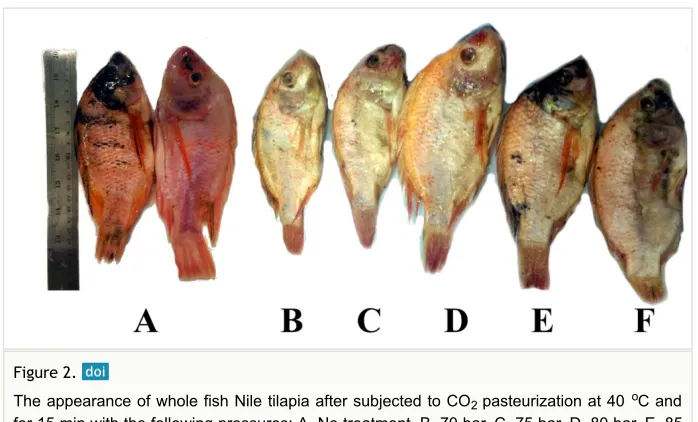
Fish muscle was filleted, and the inner part of fillet surface color was read using a handheld colorimeter (Color muse, Variable Inc). Subcutaneous or skin color could not be used for color readings due to uneven skin pigmentation. The skin appearance of pre and post-treated whole fish is displayed in Fig. 2. The colorimeter was placed on top of the fillet to record the colors. The colorimeter had a 4 mm reading diameter area, 45 illumination angle, 0 reading angle, and 2 standard observer.
2 3
0
0
-1
o
Before color reading, colorimeter had to be calibrated against supplied standard white. Each fillet was read on three different spots. Color was expressed in CIE L* (whiteness or brightness), a* (redness/greenness), and b* (yellowness/blueness) coordinates. Total Color differences (ΔΕ ) were calculated according to CIEDE-2000 standard (Sharma et al. 2004).
Proximate analysis and pH
Fat content was measured through soxhlet methods (Carpenter 2010) with slight modification. Hexane (CAS 110-54-3) was used as a solvent instead of Petroleum ether (CAS 8032-32-4) or ethyl ether (CAS 60-29-7). Protein content was determined as total Nitrogen through Kjehldahl method (Nielsen 2010).
Ash content was calculated by furnace burning at 600 °C for 6 hours. Moisture content was analyzed by overnight (12 hours) oven drying at 105 °C. Lastly, pH was determined by immersion of pH meter electrode (Metler Toledo FiveEasy F20) into the suspension of 1:9 sample in deionized water.
Observation of muscle softening during chilled storage
During storage under frozen and chilled temperature, protease is responsible for muscle softening. Beside muscle protease, spoilage microorganism also contributes protease into the fish tissue that could worsen muscle softening.
The fillets, which their texture were not significantly different compared to control, were monitored its softening development under chilled storage. To minimize the effect of
00
Figure 2.
The appearance of whole fish Nile tilapia after subjected to CO pasteurization at 40 C and for 15 min with the following pressures: A. No treatment, B. 70 bar, C. 75 bar, D. 80 bar, E. 85 bar, and F. 90 bar
2 o
decomposition due to spoilage microorganisms, fish chunks were stored in chilled temperature (4 °C) in 14 days storage. Seven points observations were taken, on initial day (day 1), 3 , 6 , 8 , 10 , 12 and 14 day. Mean values were taken from means of three replications. Each replication was conducted on individual fish. Observations were chosen from treatments that retained texture, which were not significantly different than that of initial untreated samples. To measure the progression of muscle softening, fillet hardness was measured on each observation day.
The percentage of softening was stated as a ratio of observed hardness of the pasteurized samples (H) to initial hardness of the untreated samples (H ).
Experimental design and statistical analysis
Due to the equipment’s limitation, which was limited at the maximum of 90 bar at 40 °C (the maximum density was 0.4855 g/mL CO at 40 °C), five points pressures from 70 to 90 bar at 40 °C with 5 bar intervals were applied. Subcritical phase was 70 bar, and supercritical phases were 75, 80, 85, and 90 bar, respectively. The observation parameters were protease residual activity (%), color (L*a*b color space), hardness, weight, and proximate analysis. The performed proximate analysis was fat content, protein content, and ash content. Each replication was performed from different fish.
Results were expressed as mean values ± standard deviation of three replications. One way analysis of variance (ANOVA) was carried out to examine the significance of treatments (p < 0.05). After ANOVA, New Duncan Multiple Range Test was used to perform pairwise comparisons. All statistical works were performed with R statistical language (R Core Team 2016).
Results
Effect of CO pressure and density on muscle protease activity and microbial counts reduction
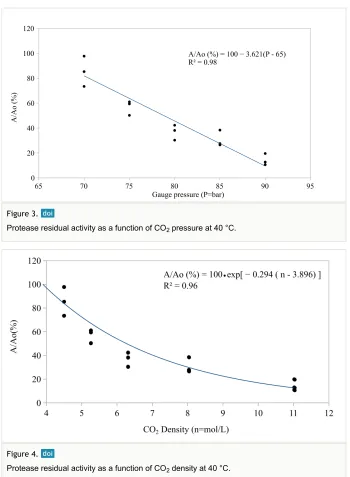
The CO pressure and density affected the reduction of protease activity and microbial loads significantly as shown in Fig. 3 and Fig. 4, respectively. All significant reductions of protease activity and microbial counts were achieved under supercritical phase of CO . Subcritical pressure was considered inadequate to reduce both muscle protease activity and raw fish microbial counts significantly. At 70 bar, residual activity of protease was remaining high at 85.47% and total microbial counts reduction was still less than 1-log. Two logs reductions of microbial counts was achieved under 80 bar or more. Therefore, 80 bar was considered as minimum pressure to achieve significant reduction for both protease inactivation and microbial loads of raw fillets.
rd th th th th th
0
2
2
2
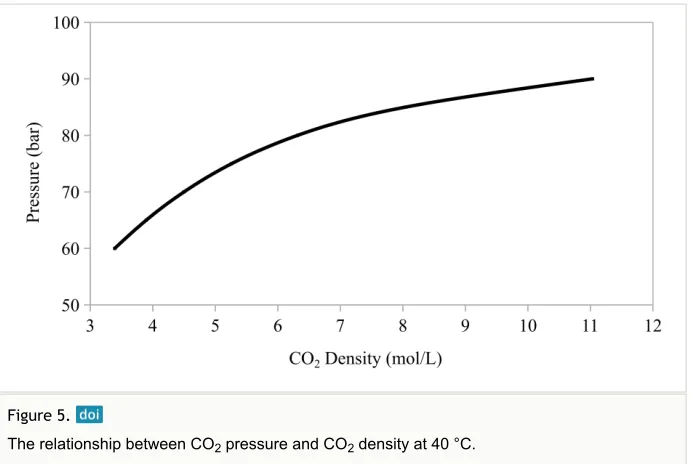
Since the relationship between pressure and density of CO at 40 °C is not linear as shown in Fig. 5 (Lemmon et al. 2020), the density differences among treatments were increased along with pressure increase (Fig. 4). The relationship between CO pressure and protease residual activity was found to follow zero order reaction (Fig. 3) and the relationship between CO density and protease residual activity was found to follow first order reaction (Fig. 4).
2
2
2
Figure 3.
Protease residual activity as a function of CO pressure at 40 °C.2
Figure 4.
Protease residual activity as a function of CO density at 40 °C.2
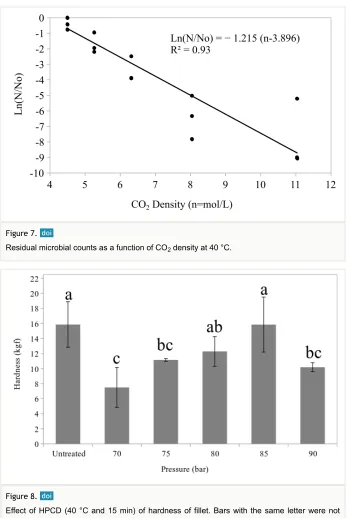
As shown in Fig. 6, 70 and 75 bar were found inadequate to make significant effect on reduction of microbial counts. After 90 bar exposure, the reduction of microbial loads was still less than 4-logs. The relationships between CO pressure and CO density with residual microbial counts were found to follow first order reaction, as shown in Fig. 6 and Fig. 7, respectively.
2 2
Figure 5.
The relationship between CO pressure and CO density at 40 °C.2 2
Figure 6.
Figure 7.
Residual microbial counts as a function of CO density at 40 °C.2
Figure 8.
Effect of HPCD (40 °C and 15 min) of hardness of fillet. Bars with the same letter were not significantly different. Vertical lines indicate standard deviation.
Effect of CO pressure on muscle texture
The relationship between pressure and treated fillet texture was not linear, as shown in Fig. 8. In the subcritical stage of HPCD, the texture of treated samples was softened significantly compared to untreated samples. The texture was improved in the supercritical phase (75-85 bar). However, it was softened again at 90 bar. Ninety bar CO pressure resulted fully cooked appearance of fillet and destroyed texture. Though the texture and visual appearance of 90 bar treated fillet was similar to that of fully cooked fillet, the odor of raw fish was still left.
In the range from 70 to 90 bar, only 80 and 85 bar treatments could retain texture that were not significantly different than that of untreated samples. All other treatments showed significant softening compared to untreated samples. Hence, 85 bar and 15 min HPCD treatment was considered as maximum level of CO pressure that tilapia fillet could withstand without suffering severe textural degradation.
Effect of CO on fillet color
The HPCD pressure was found to have very significant effect on Lightness values (L*), as shown in Table 1. The values of a* (redness/greenness) and b* (yellowness/blueness) did not show significant differences than that of untreated samples. Higher pressure of applied CO was found to increase the lightness (L*) of fillet while both redness/greenness(a*) and yellowness/blueness (b*) remain unaltered.
Pressure (Bar) L* a* b* Color difference (ΔE )
untreated fillet 53.01 ± 1.89 8.50 ± 1.87 3.32 ± 2.74
-70 78.48 ± 3.18 7.48 ± 1.00 9.37 ± 1.70 21.43 ± 2.000 75 77.79 ± 0.76 8.87 ± 2.72 7.19 ± 2.38 20.65 ± 0.277 80 75.05 ± 5.46 13.13 ± 2.10 8.99 ± 1.87 19.12 ± 3.548 85 69.77 ± 6.36 9.95 ± 2.78 10.87 ± 6.54 15.77 ± 5.59 90 78.95 ± 4.65 9.02 ± 4.65 9.36 ± 5.83 22.11 ± 2.25
means with the same superscript letter were not significantly different against untreated samples.
For consumers’ perception, color is one of the most important sensory characteristics of fish muscles in determining their purchasing decision (Liu et al. 2013). In HPP processing, possibly one of the most detrimental sensory attributes of HPP fish muscles is its cooked appearance due to the increase in the whiteness or the loss of translucency, of pressurized fish flesh (Matser et al. 2000). Similar to HPP treated fish, the whiteness increase also appeared on HPCD pasteurized Nile tilapia. Discoloration remains a drawback for food processing that using high pressure.
2
2
2
2
2
† 00
c a a
a a a
a a a
ab a a
b a a
a a a
a-d †
Table 1.
Effect of CO on proximate analysis and pH
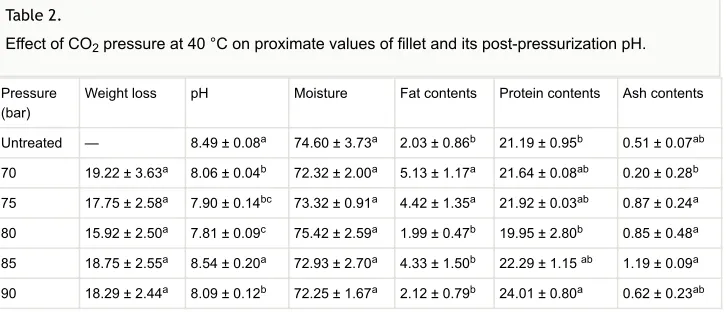
As shown in Table 2, all treated samples suffered weight loss compared to untreated samples. The increase of pressure itself did not result in significant differences among treated samples. The moisture contents of all samples were not significantly difference compared to that of untreated samples. For all three lowest residual protease activity (80, 85, and 90 bar), 80 bar sample resulted the lowest protein and fat contents, and experienced the lowest post-pressurization pH.
Pressure (bar)
Weight loss pH Moisture Fat contents Protein contents Ash contents
Untreated — 8.49 ± 0.08 74.60 ± 3.73 2.03 ± 0.86 21.19 ± 0.95 0.51 ± 0.07 70 19.22 ± 3.63 8.06 ± 0.04 72.32 ± 2.00 5.13 ± 1.17 21.64 ± 0.08 0.20 ± 0.28 75 17.75 ± 2.58 7.90 ± 0.14 73.32 ± 0.91 4.42 ± 1.35 21.92 ± 0.03 0.87 ± 0.24 80 15.92 ± 2.50 7.81 ± 0.09 75.42 ± 2.59 1.99 ± 0.47 19.95 ± 2.80 0.85 ± 0.48 85 18.75 ± 2.55 8.54 ± 0.20 72.93 ± 2.70 4.33 ± 1.50 22.29 ± 1.15 1.19 ± 0.09 90 18.29 ± 2.44 8.09 ± 0.12 72.25 ± 1.67 2.12 ± 0.79 24.01 ± 0.80 0.62 ± 0.23
Means with the same superscript letter were not significantly different.
Compared to the untreated samples, 80 and 85 bar treatments did not experience hardness change significantly (Fig. 8). The significant differences between 85 bar samples and untreated samples were only color change and fat contents. For 85 and 90 bar treatments, the weight loss was mostly contributed by moisture loss. Meanwhile, weight loss in 80 bar treatment was mostly contributed by solid loss, indicated by higher moisture, lower fat and lower protein contents.
Effect of HPCD on softening development during 14 days of storage
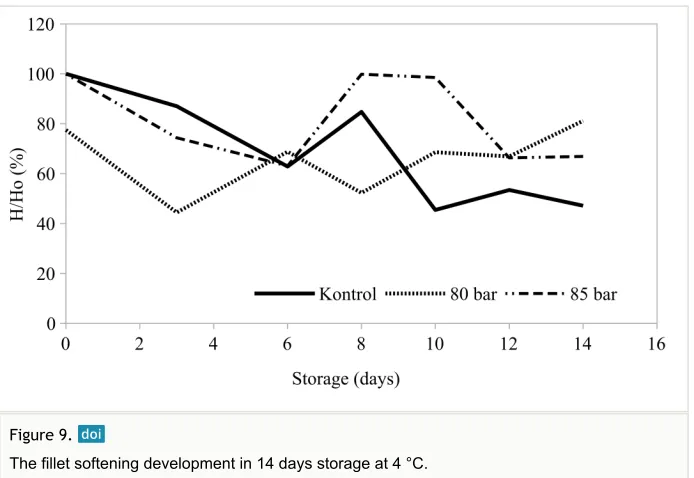
As shown in Fig. 8, there were only texture of 80 and 85 bar treated samples, which were not significantly different than that of untreated samples. Untreated, 80, and 85 bar treated samples were stored at 4 °C for 14 days and recorded their softening progress. The softening development of untreated fillets, 80 bar, and 85 bar of the treated fillets is displayed in Fig. 9. All the untreated samples showed that softening was increased with time, with the exception from 6 to 8 days of storage. Meanwhile, for both 80 and 85 bar, there were some observations, which had the same level of its initial hardness and the rest were softer than their initial hardness. The softening development of pasteurized samples were not as fast as untreated samples. Since each observed sample was from individual fish, it developed independent behavior to each other. For an example, observation on 10 day of 80 bar treated samples was higher than observation on 8 day. Both observations were from different fish; therefore, the onset of softening performed by individual sample might be different to each other.
2
a a b b ab
a b a a ab b
a bc a a ab a
a c a b b a
a a a b ab a
a b a b a ab
a-c
th th
Table 2.
Effect of CO pressure at 40 °C on proximate values of fillet and its post-pressurization pH.2
On the final day of observation, untreated samples lost 52.9% of its initial hardness. This finding was in agreement with the softening of climbing perch (Anabas testudineus), which lost 50.1% of its initial hardness after 15 days stored in ice (Varghese and Mathew 2017 ). The hardness of 80 bar treated samples was at the same level to its initial hardness, but still lost 18.8% hardness of fresh untreated samples. Eighty-five bar treated samples lost 33.1% hardness of fresh samples, which was better than untreated samples on 14 day of chilled storage.
Discussion
Pasteurization effect of CO pressure and density on protease inactivation and microbial counts reduction
In this work, the CO pressure significantly affected the reduction of protease activity and microbial counts. The mechanisms of protease inactivation by HPCD were proposed by several researchers. The pressure itself is not adequate to reduce protease activity as reported by HPP application. Bilbao-Sáinz et al. (2009) reported 70% residual activity of milk protease after subjected to HPP application at 600 MPa, 15 min, and 60 °C. Leite Júnior et al. (2015) reported no change of protease activity from Rhizomucor miehei after subjected to 190 MPa and 25 °C. Permanent inactivation of an enzyme is due to the changes of secondary structure of the enzyme and only achievable by pressure not less than 700 MPa (Tauscher 1995), Therefore, beside pressure, there must be one or more factors of HPCD that affect protease inactivation.
th
2
2
Figure 9.
Ishikawa et al. (2014)*1 reported inactivation of alkaline and acid protease with supercritical CO bubbling method from 40 to 250 bar. In order to produce micro-bubble scCO , this report injected scCO through 10 μm filter into the enzyme solution. Micro-bubbling application was reported to inactivate glucoamylase three folds than without micro-bubbling methods. Carbon dioxide is known to dissolve in water and lowering its pH. The correlation between CO pressure increase and pH decrease was reported by Meyssami et al. (1992). However, effect of pH was reported insufficiently to reduce protease activity (Damar and Balaban 2006). Chen et al. (1993) reported that the combination of low pH solution of polyphenol oxidase (PPO) and N pressure resulted much higher residual activity than that of scCO application on buffered PPO solution. The significance of CO presence in the mechanism of enzyme inactivation during gas pressure pasteurization was reported by Ishikawa et al. (1996). It was reported that scCO decomposed α-helix structures and left 31.3% of residual α-helix structures after exposed to micro-bubble supercritical CO at 250 bar for 30 min. This decomposition of α-helix
would result irreversible inactivation of the enzyme.
The solubility of CO and its dissolution rate into the cell cytoplasm and muscle tissue liquid when HPCD applied on muscle tissue is still unknown and need further investigation. The cell size of eukaryotes is within 10-100 μm (Campbell and Reece 2005) and the cell membrane pores are much smaller, 110 ± 40 nm (Zhou et al. 2009) . Therefore, it was possible that muscle tissue acted as the micro-filter and cell membranes play its role as the nano-filter, similar to the micro-filter used in Ishikawa et al. (2014). Smaller bubble size of scCO increase its solubility and dissolution rate in pure water was reported by Suzuki et al. (2013). Higher dissolved CO is expected to yield higher inactivation of enzymes, since it increase the availability of CO for altering secondary structure of the enzyme.
It could be expected that if subjected to HPCD pressure higher than 90 bar (at 40 °C), the fish texture would be deteriorated severely. Since this work was to search the balance between low residual protease activity and acceptable textural properties, complete inactivation of protease should be avoided. Elimination of muscle protease activity would result in severe degradation of fillet textural properties. In this regard, 80 and 85 bar of HPCD pressure at 40 °C can be considered as optimum pressure to reduce activity of muscle protease, as well as maintaining good textural properties of tilapia fillet.
Beside enzymatic activity, microbial activity also plays significant role on food deterioration. The bactericidal effect of scCO could be contributed by one or more mechanisms. It could be cell disruption (Fraser 1951 and Lin et al. 1992 ), extraction of cellular components (Kamihira et al. 2014 and Lin et al. 1991), and cell membrane modifications that could cause cytoplasm leakage (Hong and Pyun 2001). Cellular disruption usually requires short compression and decompression stage, which cause cell rupture. For the solid foodstuffs, which requires texture stability, this approach should be avoided. Bactericidal effect due to cellular components extraction and membrane modification could be exploited for the effort of microorganism reduction on solid foodstuff while maintaining acceptable texture. This work only applied single cycle of compression and decompression, therefore, the pasteurization effect on the reduction of microbial loads might be the accumulated effect of
2
2 2
2
2 2
2
2
2
2
2
2 2
2
cell disruption by compression and decompression stage, extraction of cellular components, and cytoplasm leakage due to cell membrane modification.
Acceptable residual microbial counts in this work was achieved by 90 bar application. Unfortunately, 90 bar application was failed to maintain acceptable texture (Fig. 8). Both 80 and 85 bar were able to maintain most of their original texture, but their microbial counts exceeded maximum limit of 5·10 CFU/g. Since 80 bar application could reduce microbial counts down to 2-logs, it could be expected that the raw fish with 10 CFU/g could be reduced to 10 CFU/g with 80 bar or more of scCO pressure. Therefore, any additional treatment for reducing microbial loads prior to HPCD treatment is necessary in the future.
Maximum aerobic microbial counts of frozen raw fish was recommended at 5·10 CFU/g (International Commission on Microbiological Specifications for Foods. 1986 and Badan Standarisasi Nasional 2009). Normally, fish skin contains 10 –10 CFU/cm , and between 10 –10 CFU/g in intestine and gills (Huss 1993). The fresh fishes used in this study were fallen under 10 CFU/g, which was normal but below standard required by safety regulation. Cleaning the fish with flowing tap water before HPCD treatment was found insufficient to reduce initial microbial counts.
Effect of CO pressure on selected fish physicochemical properties
The effect of HPCD pressure on texture was found significant but did not produce stable trend. Some researchers reported the effect of pressure of scCO on texture of some seafoods qualitatively (de Matos et al. 2018, Ji et al. 2012, Meujo et al. 2010, Wei et al. 1991), but those works did not measure the effect of CO pressure on seafood texture. However, the reports of high-pressure effect on seafood texture are available from HPP pasteurization and in agreement with the result in this work. Ashie and Simpson (1996) reported that at 1,000 atm, the strength and elasticity of bluefish muscle was better than original across all holding time. At 2,000 and 3,000 atm, until 10 min holding time; 2,000 atm treatment was better than original texture and 3,000 atm pressure. However, after 10 min holding time; 3,000 atm was better than 2,000 atm results. Kaur et al. (2016) reported the increase of hardness, springiness, chewiness, gumminess, and cohesiveness of
Penaeus monodon along with the HPP pressure increase. Therefore, the increase of pressure did not increase or decrease textural quality of fish muscle consistently.
At 90 bar application, scCO pressure resulted severe adverse effect on textural property and muscle integrity. Maximum pressure for the fish fillet could withstand CO pressure was considered at 85 bar. Ninety bar CO pressure or more might be justified for cooking application to eliminate completely both enzymatic and microbiological activities. HPCD might be a prospective application for the meat better than for the fish. Consumers preference for raw meat is freshness and tenderness (Ma and Ledward 2013), while for fresh fish they prefer freshness and firmness (Sriket 2014).
Compared to HPP, color change induced by HPCD was initiated at much lower pressure. Color change of HPP treatment on carp fillet was reported to be initiated at 1,000 bar (Meuhreg 2004,Sequeira-Munoz et al. 2006, and Yoshioka et al. 1996). In this study, color
5
5 3
2
5
2 7 2
3 9
9
2
2
2
2
change began from the lowest pressure of the experiment (70 bar). Wei et al. (1991) reported that shrimp and chicken color was changed after treated with 137 bar supercritical CO for two hours. In this study, color changes occurred in lower pressures (90 bar or less) and shorter holding time. It should be noted that for economic consideration, commercial processing time is typically limited to 20 min (Truong et al. 2014 ), therefore 15 min exposure time was acceptable but preheating and decompression time needs further improvement.
The color changes affected by high pressure is likely due to degradation of muscle myoglobin. The required temperature to denature myoglobin of tilapia significantly was reported at 60 °C (Chen et al. 2004). Myoglobin degradation is started at neutral and mildly acidic pH due to oxidation. The denaturation of myoglobin is increased along with the decrease of pH and completely denaturated at pH 2.0 (Pandiscia 2013). Therefore, the decrease of pH due to dissolved CO might cause most of the myoglobin degradation.
As it was explained previously, scCO extracted cellular components and in this work, also squeezed out these components out of the cells and muscle tissues. This extraction and squeezing effect reduced fillet mass, especially during decompression stage. Lipids also well known dissolved in scCO . Gupta and Shim (2007) reported the solubility of fish oil in scCO from 90 to 200 bar at 313.2 K to 353.2 K, respectively. Other investigator, Hammam (1992) reported the solubility of pure lipids in 150-350 bar scCO In this study, which used lower pressure (90 bar or lower), there was no correlation between fat solubility and pressure increase. Possibly, required density of CO at 40 °C for dissolving fat should be equal to or more than the density of CO at 90 bar. On the one hand, fat loss was not caused by its solubility in supercritical CO , but mostly by compression and decompression effects of pressure that squeezed out fat and other solids from its biological matrices. On the other hand, from 80 to 90 bar, protein was more concentrated along with pressure surge. This result indicated that protein was embedded firmly in its biological matrices.
Brief comparison of HPCD and HPP, the advantage and disadvantage
In the non-thermal food processing technology, HPP and HPCD are two novel technologies that use high pressure. HPP employs ultrahigh hydrostatic pressure, up to 10,000 bar (Heinz and Buckow 2009), while HPCD uses significantly lower CO pressure. The pressure of HPCD is the function of interaction between CO density and CO temperature (Span and Wagner 1996), while HPP pressure is the product of hydraulic pressure. Since the inactivation of the enzyme and microbial loads in HPCD is mostly contributed by the penetration and concentration of CO into the cell and tissue, the pressure produced by CO density is much lower than that of HPP. However, the disadvantage of HPCD over HPP is material losses as shown in Table 2. Beside product weight loss, due to diffusivity properties of CO , HPCD is prone to gas leakage during pasteurization. To achieve stable pressure during long HPCD application, gas leakage is compensated by CO reinjection. Meanwhile, HPP process is applied on top of final vacuum packed product (Hogan et al. 2005) , which prevent product leakage. Since hydraulic liquid could not penetrate both the product packaging and pressure vessel seal, HPP is relatively capable to maintain product
2 2 2 2 2 2. 2 2 2 2 2 2 2 2 2 2
quantity throughout compression, holding, and decompression time. In HPCD pasteurization, CO must be diffused into treated products, which require open or perforated container of the product. This open or slightly open package is the source of material losses during HPCD application.
The operational pressure of HPCD, which is significantly lower than that of HPP, requires less pressure resistant assembly than that of HPP equipments. HPP pasteurization requires 7,000 bar or more to achieve permanent inactivation of enzymes and need ultra-high pressure capable installation. Though HPCD requires lesser pressure resistant installation than that of HPP installation, it requires seal that impenetrable from scCO diffusion. Soft metal seal such as aluminum might be impenetrable from scCO but requires much more tightening force to be well sealed; while polymer seals, e.g. rubber and silicone, could not withstand scCO penetration during long or repetitive HPCD application. HPP requires much more rugged installation than that of HPCD, including its seals, while HPCD requires lesser pressure resistant installation but need impenetrable seal from high diffusivity CO . If the same product is pasteurized by both HPP and HPCD, HPP requires more pumping power to deliver hydraulic pressure but need lower material input than that of HPCD, while the HPCD requires less power input to pump CO but need more material input than that of HPP. Furthermore, products subjected to HPP do not need post treatment after pressurization, since it is already packed in final packaging; while HPCD products need immediate post pressurization handling since its packaging is remaining open after pasteurization.
Conclusion
This study discovered that HPCD technique was able to demonstrate its potential to reduce muscle protease activity and microbial contamination of raw tilapia fillet, while simultaneously maintained some of its physicochemical qualities. Eighty-five bar at 40 °C for 15 min was considered as the optimum pressure to reduce muscle protease activity without reducing its textural quality significantly. The softening development of 80 and 85 bar treated fillets were found slower than that of untreated fillets during 14 days chilled storage. Prior to HPCD pasteurization, microbial counts on raw fishes should be reduced in order to comply with food safety regulation.
The residual activity of both protease and microbial counts was found as the function of CO density and follow first order reaction. The CO density is the main reason for much lower necessary pressure of HPCD application when compared to HPP pressure.
Funding program
This works is funded partially by Ministry of Research, Technology, and Higher Education; and Thesis Recognition Program, Gadjah Mada University, Grant Number 3395/UN1/ DITLIT/DIT-LIT/LT/2019.
2
2 2
2
2
2
References
• Amano Enzyme Inc. (2016) Protease (Aspergillus alkaline proteinase, EC 3.4.21.63). http://cy-bio.com/Administrator/Order/20091222125934b.pdf. Accessed on: 2016-9-16. • Ashie IN, Simpson BK (1996) Application of high hydrostatic pressure to control enzyme
related fresh seafood texture deterioration. Food Research International 29: 569‑575. https://doi.org/10.1016/s0963-9969(96)00012-9
• Badan Standarisasi Nasional (2009) SNI 7388-2009 tentang Batas Maksimum
Cemaran Mikroba dalam Pangan. [SNI 7388-2009: Maximum limit of microbial contamination on food]. Badan Standarisasi Nasional, Jakarta, 41 pp. [In Indonesian]. • Bilbao-Sáinz C, Younce F, Rasco B, Clark S (2009) Protease stability in bovine milk
under combined thermal-high hydrostatic pressure treatment. Innovative Food Science & Emerging Technologies 10 (3): 314‑320. https://doi.org/10.1016/j.ifset.2009.01.003 • Campbell NA, Reece J (2005) Campbell - Biology. 7th Edition. Pearson Education,
1312 pp. [ISBN 080537146X] https://doi.org/10.1083/jcb.200503162
• Carpenter C (2010) Determination of fat content. In: Nielsen SS (Ed.) Food analysis laboratory manual. 2nd Edition. Springer, New York, 29-37 pp. [ISBN 9780123693976]. https://doi.org/10.1007/978-1-4419-1463-7
• Chen JS, Balaban MO, Wei CI, Gleeson RA, Marshall MR (1993) Effect of carbon dioxide on the inactivation of florida spiny lobster polyphenol oxidase. Journal of the Science of Food and Agriculture 61 (2): 253‑259. https://doi.org/10.1002/jsfa. 2740610219
• Chen L, LIN S, Chen H (2004) Thermal stability and denaturation rate of myoglobin from various species of fish. Fisheries Science 70 (2): 293‑298. https://doi.org/10.1111/j. 1444-2906.2003.00803.x
• Damar S, Balaban M (2006) Review of dense phase CO2 technology: Microbial and
enzyme Inactivation, and effects on food quality. Journal of Food Science 71 (1). https://doi.org/10.1111/j.1365-2621.2006.tb12397.x
• de Matos KO, Lerin L, Soares D, Soares LS, de Lima M, Monteiro A, Vladimir Oliveira J (2018) Effect of supercritical carbon dioxide processing on Vibrio parahaemolyticus in nutrient broth and in oysters (Crassostrea gigas). Journal of Food Science and Technology 55 (10): 4090‑4098. https://doi.org/10.1007/s13197-018-3335-3
• Ferrentino G, Spilimbergo S (2011) High pressure carbon dioxide pasteurization of solid foods: Current knowledge and future outlooks. Trends in Food Science & Technology 22 (8): 427‑441. https://doi.org/10.1016/j.tifs.2011.04.009
• Fraser D (1951) Bursting bacteria by release of gas pressure. Nature 167 (4236): 33‑34. https://doi.org/10.1038/167033b0
• Geissmann Q (2013) OpenCFU, a new free and open-source software to count cell colonies and other circular objects. PLOS One 8 (2). https://doi.org/10.1371/ journal.pone.0054072
• Gupta RB, Shim J (2007) Solubility in supercritical carbon dioxide. CRC-Press, Boca Raton-FL, 357-368 pp.
• Hammam H (1992) Solubilities of pure lipids in supercritical carbon dioxide. The Journal of Supercritical Fluids 5 (2): 101‑106. https://doi.org/10.1016/0896-8446(92)90026-g
• Heinz V, Buckow R (2009) Food preservation by high pressure. Journal für Verbraucherschutz und Lebensmittelsicherheit 5 (1): 73‑81. https://doi.org/10.1007/ s00003-009-0311-x
• Hogan E, Kelly AL, Sun D (2005) High pressure processing of foods: An overview. Emerging Technologies for Food Processing 3‑32. https://doi.org/10.1016/ b978-012676757-5/50003-7
• Holmyard N (2019) Tilapia players debate industry future.
https://www.seafoodsource.com/features/tilapia-players-debate-industry-future. Accessed on: 2019-9-21.
• Hong S, Pyun Y (2001) Membrane damage and enzyme inactivation of Lactobacillus plantarum by high pressure CO2 treatment. International Journal of Food Microbiology 63: 19‑28. https://doi.org/10.1016/s0168-1605(00)00393-7
• Huss HH (1993) Traditional microbiological quality control. http://www.fao.org/3/T1768E/ T1768E04.htm. Accessed on: 2019-5-13.
• International Commission on Microbiological Specifications for Foods. (1986) Microorganisms in foods 2. Sampling for microbiological analysis: Principles and specific applications. 2nd Edition. University of Toronto Press, Toronto, 293 pp. URL: https://seafood.oregonstate.edu/sites/agscid7/files/snic/sampling-for-microbiological-analysis-principles-and-specific-applications-icmsf.pdf [ISBN 0802056938]
• Ishikawa H, Shimoda M, Yonekura A, Osajima Y (1996) Inactivation of Enzymes and Decomposition of α-Helix Structure by Supercritical Carbon Dioxide Microbubble Method. Journal of Agricultural and Food Chemistry 44 (9): 2646‑2649. https://doi.org/10.1021/jf9602075
• Ishikawa H, Shimoda M, Kawano T, Osajima Y (2014) Inactivation of enzymes in an aqueous solution by micro-bubbles of supercritical carbon dioxide. Bioscience, Biotechnology, and Biochemistry 59 (4): 628‑631. https://doi.org/10.1271/bbb.59.628 • Ji H, Zhang L, Liu S, Qu X, Zhang C, Gao J (2012) Optimization of microbial inactivation
of shrimp by dense phase carbon dioxide. International Journal of Food Microbiology 156 (1): 44‑49. https://doi.org/10.1016/j.ijfoodmicro.2012.02.020
• Kamihira M, Taniguchi M, Kobayashi T (2014) Sterilization of microorganisms with supercritical carbon dioxide. Agricultural and Biological Chemistry 51 (2): 407‑412. https://doi.org/10.1080/00021369.1987.10868053
• Kaur BP, Rao PS, Nema P (2016) Effect of hydrostatic pressure and holding time on physicochemical quality and microbial inactivation kinetics of black tiger shrimp (
Penaeus monodon). Innovative Food Science & Emerging Technologies 33: 47‑55. https://doi.org/10.1016/j.ifset.2015.12.002
• Lakshmanan R, Patterson M, Piggot J (2005) Effects of high-pressure processing on proteolytic enzymes and proteins in cold-smoked salmon during refrigerated storage. Food Chemistry 90 (4): 541‑548. https://doi.org/10.1016/j.foodchem.2004.05.015 • Leite Júnior BRdC, Tribst AAL, Cristianini M (2015) Influence of high pressure
homogenization on commercial protease from Rhizomucor miehei: Effects on proteolytic and milk-clotting activities. LWT - Food Science and Technology 63 (1): 739‑744. https://doi.org/10.1016/j.lwt.2015.03.020
• Lemmon EW, McLinden MO, Friend DG (2020) Thermophysical properties of fluid
• Lin HM, Chan EC, Chen C, Chen LF (1991) Disintegration of yeast cells by pressurized carbon dioxide. Biotechnology Progress 7 (3): 201‑204. https://doi.org/10.1021/ bp00009a001
• Lin HM, Yang Z, Chen LF (1992) An improved method for disruption of microbial cells with pressurized carbon dioxide. Biotechnology Progress 8 (2): 165‑166.
https://doi.org/10.1021/bp00014a012
• Liu D, Zeng X, Sun D (2013) NIR spectroscopy and imaging techniques for evaluation of fish quality— a review. Applied Spectroscopy Reviews 48 (8): 609‑628. https:// doi.org/10.1080/05704928.2013.775579
• Ma H, Ledward DA (2013) High pressure processing of fresh meat — Is it worth it? Meat Science 95 (4): 897‑903. https://doi.org/10.1016/j.meatsci.2013.03.025
• Matser A, Stegeman D, Kals J, Bartels P (2000) Effects of high pressure on colour and texture of fish. High Pressure Research 19: 109‑115.
https://doi.org/10.1080/08957950008202543
• Maturin L, Peeler JT (2001) Bacteriological Analytical Manual. Chapter 3: Aerobic Plate Count. https://www.fda.gov/food/laboratory-methods-food/bam-aerobic-plate-count. Accessed on: 2017-11-16.
• McHugh MA, Krukonis VJ (1994) Supercritical fluid extraction. 2nd Edition, 53 Volume. Butterworth-Heinemann, Newton, MA, 1-16 pp. [ISBN 0080518176]
https://doi.org/10.1016/B978-0-08-051817-6.50004-7.
• Meuhreg CA (2004) Control of eschericia coli O157:H7, generic Escherichia coli, and
Salmonella spp. on beef trimmings prior to grinding using a controlled phase carbon dioxide (CPCO2) system. Kansas State University, Kansas, 142 pp. URL: https://krex.k-state.edu/dspace/bitstream/handle/2097/231/CarlosTanus2006.pdf?
sequence=1&isAllowed=y
• Meujo DF, Kevin D, Peng J, Bowling J, Liu J, Hamann M (2010) Reducing oyster-associated bacteria levels using supercritical fluid CO2 as an agent of warm pasteurization. International Journal of Food Microbiology 138: 63‑70. https://doi.org/10.1016/j.ijfoodmicro.2009.11.012
• Meyssami B, Balaban M, Teixeira A (1992) Prediction of pH in model systems pressurized with carbon dioxide. Biotechnology Progress 8 (2): 149‑154. https://doi.org/10.1021/bp00014a009
• Miao W (2015) Aquaculture production and trade trends: carp, tilapia and shrimp, FAO RAP. http://www.fao.org/fi/static-media/MeetingDocuments/WorkshopAMR17/ presentations/28.pdf. Accessed on: 2017-11-15.
• Nielsen SS (2010) Protein nitrogen determination. In: Nielsen SS (Ed.) Food analysis laboratory manual. 2nd Edition. Springer, New York, 39-45 pp. [ISBN
978-1-4419-1462-0]. https://doi.org/10.1007/978-1-4419-1463-7_5
• Pandiscia L (2013) Myoglobin secondary structure effects of pH - circular dichroism In: JASCO Applications Book. https://jascoinc.com/applications/circular-dichroism-myoglobin-ph-titration/. Accessed on: 2020-6-08.
• R Core Team (2016) R: A language and environment for statistical computing. https://www.R-project.org/. Accessed on: 2016-2-10.
• Sequeira-Munoz A, Chevalier D, LeBail A, Ramaswamy H, Simpson B (2006)
Physicochemical changes induced in carp (Cyprinus carpio) fillets by high pressure processing at low temperature. Innovative Food Science & Emerging Technologies 7: 13‑18. https://doi.org/10.1016/j.ifset.2005.06.006
*1
• Sharma G, Wu W, Dalal E (2004) The CIEDE2000 color-difference formula:
Implementation notes, supplementary test data, and mathematical observations. Color Research & Application 30 (1): 21‑30. https://doi.org/10.1002/col.20070
• Span R, Wagner W (1996) A new equation of state for carbon dioxide covering the fluid region from the triple-point temperature to 1100 K at pressures up to 800 MPa. Journal of Physical and Chemical Reference Data 25 (6): 1509‑1596.
https://doi.org/10.1063/1.555991
• Sriket C (2014) Proteases in fish and shellfish: Role on muscle softening and prevention. International Food Research Journal 21 (2): 433‑445. URL: http://www.ifrj.upm.edu.my/
21%20(02)%202014/2%20IFRJ%2021%20(02)%202014%20Sriket%20014.pdf • Suzuki K, Miida H, Wada H, Horikawa S, Ebi T, Inaba K (2013) Feasibility study on CO2
micro-bubble storage (CMS). Energy Procedia 37: 6002‑6009. https://doi.org/10.1016/ j.egypro.2013.06.528
• Tauscher B (1995) Pasteurization of food by hydrostatic high pressure: chemical aspects. Zeitschrift für Lebensmittel-Untersuchung und -Forschung 200 (1): 3‑13. https://doi.org/10.1007/bf01192901
• Truong B, Buckow R, Stathopoulos C, Nguyen M (2014) Advances in high-pressure processing of fish muscles. Food Engineering Reviews 7 (2): 109‑129.
https://doi.org/10.1007/s12393-014-9084-9
• Varghese T, Mathew S (2017) Assessment of the textural variation of iced stored
Anabas testudineus (Bloch, 1792) muscle tissue with emphasis on their collagen and myofibrillar protein content. Journal of Food Science and Technology 54 (8): 2512‑2518. https://doi.org/10.1007/s13197-017-2695-4
• Wei CI, Balaban MO, Fernando SY, Peplow AJ (1991) Bacterial effect of high pressure CO2 treatment on foods spiked with Listeria or Salmonella . Journal of Food Protection 54 (3): 189‑193. https://doi.org/10.4315/0362-028x-54.3.189
• Yoshioka K, Yamada A, Maki T (1996) Application of high pressurization to fish meat: Changes in the physical properties of carp skeletal muscle resulting from high pressure thawing. High Pressure Bioscience and Biotechnology, Proceedings of the International Conference on High Pressure Bioscience and Biotechnology 369‑374.
https://doi.org/10.1016/s0921-0423(06)80062-6
• Zhou Y, Kumon R, Cui J, Deng C (2009) The size of sonoporation pores on the sell membrane. Ultrasound in Medicine & Biology 35 (10): 1756‑1760.
https://doi.org/10.1016/j.ultrasmedbio.2009.05.012