Several new records, synonyms, and
hybrid-origin of Chinese begonias
Dai-Ke Tian1,2, Yan Xiao1,2, Yan-Ci Li1,2,3, Ke-Jian Yan4
1 Shanghai Chenshan Plant Science Research Center of Chinese Academy of Sciences, Shanghai Chenshan Botanical Garden, Shanghai 201602, China 2 Shanghai Key Laboratory of Plant Functional Genomics and Resources, Shanghai 201602, China 3 Shanghai Normal University, Shanghai 200234, China 4 Guangxi Institute of Traditional Chinese Medicine & Pharmaceutical Science, Nanning 530022, China
Corresponding author: Dai-Ke Tian ([email protected])
Academic editor: J. Wieringa | Received 4 February 2020 | Accepted 7 May 2020 | Published 16 July 2020
Citation: Tian D-K, Xiao Y, Li Y-C, Yan K-J (2020) Several new records, synonyms, and hybrid-origin of Chinese begonias. PhytoKeys 153: 13–35. https://doi.org/10.3897/phytokeys.153.50805
Abstract
Begonia is a mega-genus with about 2500 species by most estimates, with China having over 210 ac-cepted species. After field surveys, literature review and examination of herbarium specimens, some new taxa, new records, synonyms and the hybrid-origin of some taxa have been confirmed. Here, we report that Begonia dioica Buch.-Ham. ex D.Don and B. flagellaris Hara, both from Xizang (Tibet) are new to China; Begonia lipingensis Hance, B. muliensis T.T.Yu and B. sizemoreae Kiew are synonyms of B. circum-lobata Hance, B. taliensis Gagnepain and B. longiciliata C.Y.Wu, respectively; and Begonia × lancangensis S.H.Huang and B. × malipoensis S.H.Huang & Y.M.Shui are natural hybrids.
Keywords
Begoniaceae, China, the Himalayas, natural hybrid, Nepal, stolon, taxonomy, Tibet
Introduction
Begonia is a mega-genus with an estimated 2500 species (Tian et al. 2018) and, so far, there are about 1978 known accepted species (Hughes et al. 2015–present). China has over 210 accepted names of Begonia and its southwest region is one of the distribution centres of this genus. In the past two years, ten Begonia species were newly described
http://phytokeys.pensoft.net
Copyright Dai-Ke Tian et al. This is an open access article distributed under the terms of the Creative Commons Attribution License (CC BY 4.0), which permits unrestricted use, distribution, and reproduction in any medium, provided the original author and source are credited.
(Chen et al. 2018a, 2019; Ding et al. 2018; Li et al. 2018, 2019; He et al. 2019; Tian et al. 2019; Tong et al. 2019; Wang et al. 2019a) and many more are likely awaiting discov-ery and description in China. At the same time, several newly-recorded Chinese Begonia
species (Yang et al. 2015; Wang et al. 2019b) and synonyms (Shui and Chen 2017; Chen et al. 2018b) have also recently been reported. With the support of the National Natural Science Foundation of China, we conducted many field surveys along with a review of literature and herbarium specimens related to Chinese Begonia. The diversity of Chinese Begonia is now better understood and several taxonomic issues have been resolved. Here, we report two new records, three new synonyms and two hybrid-origins of Begonia in China. Their conservation status was evaluated according to Guidelines for Using the International Union for Conservation of Nature (IUCN) Red List Categories and Criteria (v. 14) (IUCN Standards and Petitions Subcommittee 2019).
New records
In September 2017, Daike Tian and his associates searched for wild begonias in Xizang (Tibet) of China. During this trip, two new records of stoloniferous begonias were discovered, namely Begonia dioica Buch.-Ham. ex D.Don (Don 1825) from Chentang town of Dingjie County and B. flagellaris H.Hara (Hara 1973) from Jilong town of Jilong County. Both species are distributed near the border between China and Nepal. At the time, B. dioica had only immature fruits with persistent tepals, while very few plants of B. flagellaris were still in bloom.
Begonia dioica Buch.-Ham. ex D.Don [sect. Diploclinium]
Fig. 1
走茎秋海棠 (Chinese name)
Begonia dioica Buch.-Ham. ex D.Don [sect. Diploclinium] D. Don, Prodr. Fl. Nepal. 223. 1825: 223; R. Camfield & M. Hughes, Eur. J. Taxon. 396: 35. 2018.
Description. Tuberous, creeping, stoloniferous, dioecious, deciduous herb, 3–11 cm
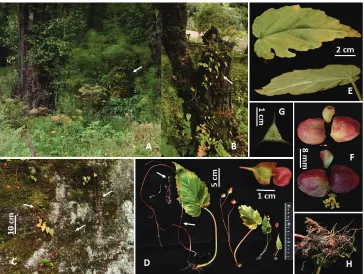
non-Figure 1. Habitat and morphology of Begonia dioica (Photos by Daike Tian) A, B habitat (rock-moss surface and tree trunk, arrows indicate begonia plants) C individuals with long red stolons (arrows indi-cate stolons) D plants of different size and stolons with small whitish aerial bulbs (arrows indiindi-cate tiny bulbs) E leaves showing glabrous adaxial (upper) and abaxial (low) surfaces F female flowers with three tepals (upper: adaxial view, low: abaxial view) G cross-section of ovary with bilamellate axile placenta and three locules H tubers under moss.
overlapped, margin crenate to dentate or double serrate; apex acuminate. Inflorescence:
cymose, usually 1, terminal, 8–22 cm long, rachis pink to red, 6–10 cm long, 1–2 mm thick; peduncle branched up to three times, primary 5–10 cm long, secondary and tertiary 3–5 mm long, with 2–5 female flowers or 3–5 male flowers. Bract: lanceo-late 2–8 × 1–2 mm, caduceus. Male flower: pedicel 10–25 mm long; tepals 4; outer tepals ovate-orbicular, 6–15 × 5–10 mm, pink to red, margin entire; inner tepals el-liptic, 4–8 × 2–4 mm, white to pale pink; androecium with 15–20 stamens; filaments 1–2 mm long, unequal, fused at base into a short column; anther obovate, 1 mm long, dehiscing via short slits near the tip, not hooded, connective not extended. Female
flower: pedicel 12–30 mm long; bracteoles absent; tepals 3 (occasionally 2), persistent,
Specimen collected from China. Xizang (Tibet): Chentang Zhen of Dingjie
Xian, 27°50'54.11"N, 87°26'30.70"E, alt. 2427 m, on rock surface and tree trunks. 19 Sept 2017, Daike Tian, Yan Xiao and Zhu Lu TDK3306 (CHS).
Distribution and phenology. Southern Xizang of China, northern Pakistan,
northern India, Nepal and Bhutan; alt. 1350–2430 m; Flowering July to September, fruiting August to November.
Conservation status. Least Concern (LC). Begonia dioica has numerous suitable
hab-itats throughout its distribution range (Camfield and Hughes 2018). However, it should be considered as Critically Endangered (B2ab(v)) for China at the country level because only one population has been found so far and a continuing decline in the number of mature individuals is predicted due to road construction and other human’ activities.
Remarks. Most of the individuals develop long stolons only from tubers formed in
the previous year. The stolons are often branched in large individuals and the branch tops produce one to many tiny whitish bulbs, which grow larger as they touch the sur-face of a rock, tree trunk, soil or moss and then can develop into small plants in the sec-ond year. The tepals of female flowers are always persistent, even as the fruits mature.
Begonia flagellaris Hara [sect. Diploclinium]
Fig. 2
鞭状秋海棠 (Chinese name)
Begonia flagellaris Hara [sect. Diploclinium] J. Japan. Bot. 48(12): 358–359, f. 3 (1973).
Description. Tuberous, stoloniferous, dioecious, deciduous herb, 2–20 cm tall. Tubers
usually 2–4 (1–3 old, red-brown, one new, white) connected, 3–15 mm diameter.
Stolon: developing from underground tubers or inflorescence; usually one per plant,
Female flower: pedicel 20–35 mm long, 1 mm thick; tepals 5, unequal, glabrous; ovary hairy, 3-locular, placentae bifid; stigmas and styles 3. Fruit: pendulous, capsule ellipsoid, 6–9 × 4.5–5 mm; wings 3, unequal, green, adaxially wing extremely long, narrowly triangular, 10–28 × 5–7 mm, lateral wings extremely narrow to nearly absent; stalk red at lower part, 24–40 mm long, 1 mm thick.
Specimen collected from China.Xizang: Jilong Xian, Jilong Zhen, under bamboos,
28°21'41"N, 85°21'12"E, alt. 2030 m, 23 Sept 2017, Daike Tian, Yan Xiao and Zhu Lu,
TDK3343 (CHS); on steep slope under forest or rocky hill, 28°21'48"N, 85°21'43"E, alt. 2360 m, same date, Daike Tian, Yan Xiao and Zhu Lu, TDK3344 (CHS).
Distribution and phenology.China: Xizang, Jilong Xian, Jilong Zhen, border
of China and Nepal; nepal. Alt.1650–2900 m. Flowering August to September (early
October), fruiting September to November.
Conservation status. Near Threatened (NT). Begonia flagellaris is distributed in
both Nepal and China, and there are many individual plants in each population. How-ever, this species should be considered as Endangered (B1ab(iii)) for China because only two populations have so far been found and both are by the roadside.
Remarks. Stolons develop from underground tubers or the top of inflorescence
(usually on larger plants), with several small leaves. Hara (Hara 1973) compared the similarity between this species and B. picta J.E.Smith (Smith 1805); however, the two are quite different in appearance. Begonia flagellaris is mostly similar to B. adscendens
C.B.Clarke (1890: 26), but differs mainly by having long stolons and more hairs on the outer tepals of the male flowers.
New synonyms
Begonia circumlobata Hance, J. Bot. 21: 203, 1883 (Hance, 1883)
Fig. 3
-Begonia lipingensis Irmscher, Mitt. Inst. Allg. Bot. Hamburg 6: 353, 1927 (Irmscher 1927). syn. nov. Type: China, Kweitschou (Guizhou), Liping, alt. 600 m, 21 July 1917, Handel-Mazzzetti 10909 (holotype: WU0038812, WU!; isotype: E00265121, E!)
Type. China, Canton (Guangdong), 05 Oct 1881, Rev. Benjamin Couch Henry s.n.
(BM000944652, BM!).
Note.Begonia lipingensis has been treated as a species differing from B.
names. After our careful review of type specimens and comprehensive field surveys on a large number of populations of both entities, it was confirmed that no differences could be found between them. Since B. lipingensis was described later, it should be considered as a synonym of B. circumlobata.
Begonia circumlobata displays significant variation in plant size, morphology of leaves, and flowers (Fig. 3E–H). The leaves may be shallowly to very deeply lobed in the same population, even for the same individual and very few of the plants are shal-lowly double-lobed like B. jinyunensis C.I Peng, B.Ding & Q.Wang (Ding et al. 2014) (Fig. 3G, H). The leaves of most plants are pure green on two sides, while others may have deep green leaves with abxially red surface. Occasionally, variegated plants with white-spotted leaves could be seen in some populations such as in Huangsang National Nature Reserve of Suining, Hunan Province. Flowers can be white, whitish-pink, pink or nearly red (Fig. 3D, E).
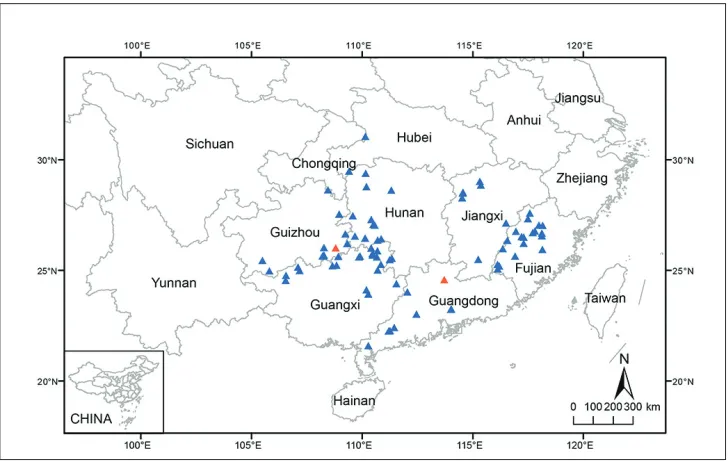
Distribution and phenology.Begonia circumlobata is widely distributed in at least
seven provinces of China, from western Hubei to Hunan, Jiangxi, Fujian, Guangdong, Guangxi and Guizhou, growing on flat areas, steep slopes or rock surfaces along or near stream and valley. Alt. 200–1230 m (Fig. 4). Flowering June to September, fruiting July to October.
Conservation status. Least Concern (LC) due to wide distribution and usually
large populations. However, in some places, a small number of plants with variegated
leaves (adaxially white spots) have high value as ornamentals. Therefore, these varie-gated individuals may be over-collected by humans.
Remarks. Begonia circumlobata has sparsely hairy leaf blades and outer tepals of
male flowers (Fig. 3C). It is most similar to B. jinyunensis and B. laminariae, particu-larly in the morphology of its leaves, flowers and fruits. Begonia circumlobata is also easily confused with some individuals of B. pedatifida Lév. (Léveillé 1909), particularly when examining herbarium specimens. Unpublished morphological and molecular data (Tian et al.) suggests that B. jinyunensis should be treated as a subspecies of B. circumlobata. At the same time, a study is ongoing concerning the taxonomic relation-ship of B. circumlobata, B. lamiariae Irmsch. (Irmscher 1951) and B. pedatifida. Since plants with intermediate morphology amongst these three taxa exist in the wild, it ap-pears that gene flow or natural hybridisation might occur between them.
Begonia longiciliata C.Y.Wu, Acta Phytotaxon. Sinica 33(3): 251, 1995 (Wu and Ku 1995)
Fig. 5
-Begonia sizemoreae Kiew, Gard. Bull. Singap. 54(6): 95–100, 2004. syn. nov. Type: Vietnam, Ha Tay Province: Ba Vi National Park, no date, R. Kiew 5304 (holotype: SING!; isotype: HN!).
Type. China, Guizou: Anlong, alt. 990 m, 14 May 1960, Guizhou Exped. 5117
(holo-type: KUN!; isotye: PE!).
Note.Begonia longiciliata (Fig. 5) is mostly close to B. rex Putz. (Putzey, 1857), but
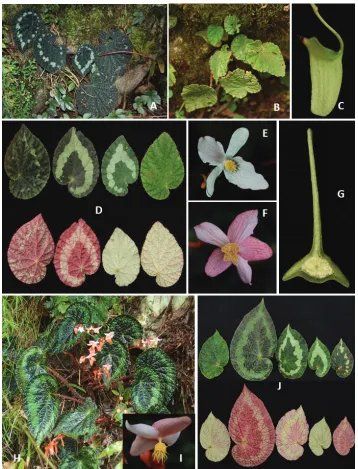
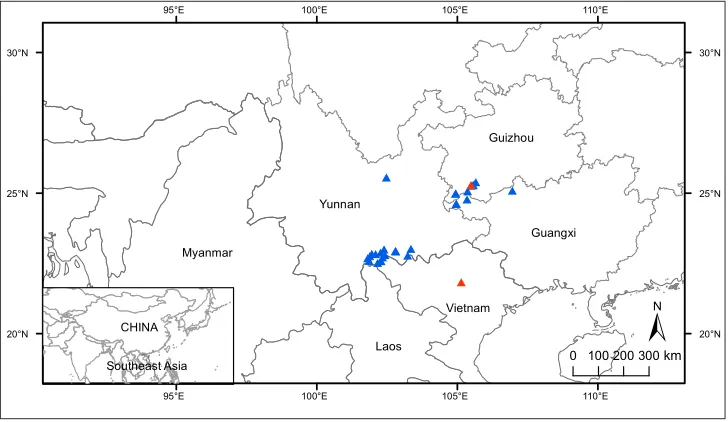
differs mainly by its narrower tepals of both its male and female flowers and longer an-thers (up to 4 mm long) with acuminate tips that occur towards the apex of the androe-cium (Fig. 5I). Notably, it has large variation in leaf colour, variegation patterns and flower colour varying from white, pink to even nearly red (Fig. 5). Begonia rex is only found in India, while B. longiciliata has a wide distribution from Guizhou, Guangxi and southern Yunnan of China, to the north of both Laos and Vietnam (Fig. 7). The name longiciliata probably refers to the long fibre-like hairs found on the adaxial leaf surface in some populations of this taxon in Guizhou Province (type locality) (Fig. 6B), but most populations have glabrous adaxial leaf surface or nearly so (Fig. 6C) particu-larly in Yunnan Province. It is also similar to B. annulata K.Koch (Koch, 1837) in leaf morphology, but can be easily separated by the latter’s hairy (vs. glabrous) tepals of both male and female flowers and fruits (Camfield and Hughes 2018).
Figure 6. Comparison on hairy and glabrous adaxial leaf surface of B. longiciliataA plant with hairs (cultivated as Begonia U388, American Begonia Society Conference 2012) B Guizhou population with hairs (arrow direction) C Yunnan population with glabrous adaxial leaf surface.(Photos by Daike Tian).
nam boundary regions; recently, the species was recorded as B. sizemoreae in northern Laos (Ding et al. 2020); no stably different key characteristics are found between B. longicilata and B. sizemoreae. Therefore, B. sizemoreae is considered by us as a synonym of B. longicilata.
Specimens examined. China: Yunnan, Jiangcheng: Kukazai Qushui, 14 Dec.
1991, Guoda Tao 49032; Tukahe, 18 Dec 1991, Guoda Tao 47818, 49127 (HITBC); Jiahe, 23 Sept 2015, Daike Tian et al. TDK2659 (CHS). Pingzhangzhai, Ping-zhang village, Jiahe, 30 Oct 2012, Jiangcheng Survey Team 5308260564 (IMDY); Jiahe to Xiaoheijiang, 21 Oct 2011, Daike Tian et al. TDK252, TDK253 (CHS); Jiangcheng county to Daheishan, 21 Oct 2011, Daike Tian et al. TDK257 (CHS).
Jinping: Riverside, 22 Oct 2008, Xiaohua Jin 9467 (PE); Laomeng, 22 Nov 2007,
Daike Tian et al. TDK2629 (CHS) (cultivated). Guangxi, Longlin: Jinzhongshan, 23 May 1977, Zhou Fakai 3-0701 (GXMI); Same locality, 24 Sept 1984, Chinese Medicine Team 0185 (GXMI). Tian’e: Xiangyang, 01 May 1978, Tian’e Team 4-6-0255 (GXMI). Guizhou, Anlong: Huali of Tingya, 14 May 1960, Zhisong Zhang & Yongtian Zhang 3320 (PE); Xiaojiatang, Lishu village of Dushan, 15 Oct 2017, Daike Tian et al. TDK3473 (CHS); Xiaoanhe, Pojing of Dushan, 15 Oct 2017, Daike Tian et al. TDK3474 (CHS). Xingyi: Daojiao, Gongqiao of Zerong, 14 Oct 2017, Daike Tian et al. TDK3460 (CHS). Zhenfeng: 19 Sept 1936, Shiwei Deng 90987 (IBSC).
Unknown county: Feb 1921, M. Cavalerie, unknown collection no. (P06841311)
(P); Oct 1917, M. Esquirol, unknown collection no. (P05495115) (P). laos: Phongsaly, Tan et al. L0559 (HITBC) (Ding et al. 2020).
Vietnam: Ba Vi National Park, Ha Tay province, R. Kiew 5304 (SING, HN);
Tonkin (Mountain Bavi), Dec 1887, B. Balansa 3765 (P); Tonkin, 29 Apr 1936, M. Polane 25811 (P).
Distribution and phenology. China: Guangxi (Longlin, Tian’e), Guizhou
(Anlong, Xingyi, Zhenfeng), Yunnan (Jiangcheng, Jinping, Lüchun, Luquan); laos
(Phongsaly); Vietnam (Ba Vi) (Fig. 7). Alt. 300–1300 m. Flowering May to
Novem-ber, fruiting June to December.
Conservation status. Near Threatened (NT). Begonia longiciliata has a relatively
broad distribution, particularly in the borders of China, Laos and Vietnam (Fig. 7); however, the size of most populations is small and the habitats are fragmented. Its dis-tribution range is extremely narrow in both Guangxi and Guizhou provinces of China. Several populations exist with less than 20 or even 10 individuals. In these two prov-inces, the population size continues to decrease, with very little seedling recruitment,
# ### ## # ###### # ## ##### ### # # # # 110°E 110°E 105°E 105°E 100°E 100°E 95°E 95°E 30°N 30°N 25°N 25°N 20°N 20°N Yunnan Guizhou Guangxi Myanmar
±
CHINA Southeast Asia Vietnam0 100 200 300km Laos
#
due to habitat deterioration and disturbance from agricultural activities. This species also needs an environment that has a high level of humidity to survive well. Addition-ally, because of its beautiful foliage, wild plants are at risk of overharvesting, therefore, it should be considered Vulnerable (B2ab(iv)) in China.
Remarks.Begonia longiciliata has been treated as a synonym of B. rex for a long time
in China (Ku 1999; Gu et al. 2007). Several horticultural cultivars have been produced by crossing it with other Begonia taxa at Kunming Botanical Garden of China (Tian et al. 2001, 2002). However, B. rex has not been collected or observed in the wild in Chi-na. It was recorded in several locations from Arunachal Pradesh (Camfield and Hughes 2018) (called southern Tibet by China), a currently China-India disputed region. In ad-dition, B. longiciliata was previously cultivated under the code U3888 (with long hairs on adaxial leaf surface, Fig. 6A) by the American Begonia Society and these cultivated plants were correctly identified as B. longiciliata by Golding (Golding 2004), but were later treated by other researchers as B. rex (Ku 1999; Gu et al. 2007) or B. sizemoreae
(Tebbitt 2005). Begonia longiciliata is officially established, based on our extensive field surveys, literature review, specimen examination and the observation of plants in cul-tivation. According to their morphological similarity and adjacent distribution, B. lon-giciliata and B. rex are similar to each other and they may have differentiated possibly due to geographic isolation. Further investigation is needed on their relationship and whether it is more reasonable to treat B. longiciliata as a subspecies or variety of B. rex.
Begonia taliensis Gagnepain, Bull. Mus. Natl. Hist. Nat. 15: 279, 1919
Fig. 8
-Begonia muliensis T.T.Yu, Bull. Fan. Mem. Inst. Biol., 1:119, 1948 (Yu 1948). syn. nov. Type: China, Sichuan: no locality data, no date, T.T. Yü, 14024 (A!)
Type. China,Yunnan: Tali (Dali), 4 Sept. 1883, J.M. Delavay 220 (Lectotype, P!,
des-ignated here).
Note.Begonia taliensis is relatively widely distributed in many counties from
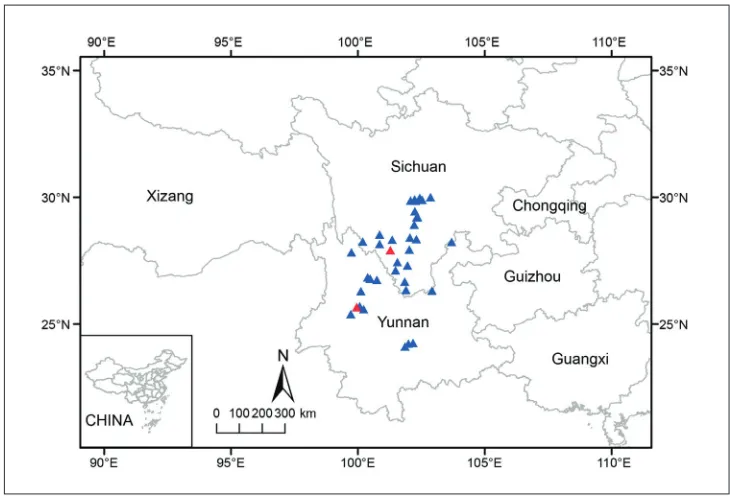
Yun-nan Province to Sichuan Province in China (Fig. 9). It exhibits considerable variation in size of plant, leaf and inflorescence, shape of lobes, leaf colour and blade variegation patterns (Fig. 8). However, its net-like pattern of red lines on the fruits is a stable char-acter (Fig. 10F, left corner). There is no distinction in distribution and morphology between it and B. muliensis (isotype, Fig. 10D) (HU). In addition, when B. taliensis
Figure 8. Habitat and morphology of B. taliensis (Photos by Daike Tian) A habitat B population with pure-green leaves C, D blooming individuals with variegated leaves E comparison of variegated and solid green-leaved individuals (adaxially and abaxially views) F–H inflorescence of large individuals and young fruits with red lines (G) I underground tubers (usually 2–3 connected) with numerous roots.
further study is undergoing. Based on our literature review, field survey and type speci-mens, Delavay 220 is designated here as the lectotype of B. taliensis and Dulcoux 5184 as its syntype. The syntype Henry 8946 belongs to another species and should not be considered for future nomenclatural decisions.
Distribution and phenology. China: Sichuan (Daocheng, Dechang, Luding,
Meigu, Mianning, Muli, Panzhihua, Shimian, Tianquan, Yanbian, Xide); Yunnan
(Dali, Eyuan, Heqing, Lijiang, Yangbi, Yongsheng, Zhongdian) (Fig. 9). Alt. 1000– 3200 m. Flowering July to October, fruiting August to November.
Conservation status.Begonia taliensis has a relatively-wide distribution (recorded
Figure 9. Distribution map of Begonia taliensis (syn. B. muliensis) Triangles show distribution sites, based on specimens and field surveys and red triangles indicate type locality of B. muliensis (Muli of Sichuan) and B. taliensis (Dali of Yunnan), respectively.
populations is usually small. In addition, many of its distribution sites are near road-sides; therefore, the habitats could be easily disturbed by human activities. Additionally, this species is used as an ornamental due to its beautiful foliage and flowers or as a veg-etable by local residents (Yang et al. 2018). Continuous human collection for different purposes may cause a decrease in population size and individual numbers. Therefore, its conservation status should be currently considered Near Threatened (NT).
Remarks. The leaf colour of B. taliensis varies amongst populations and
occasion-ally even amongst the individuals of a small population. The plants usuoccasion-ally have leaves with abaxially purple-red blotches. Sometimes, a few plants or even all individuals of a small population are pure green in leaf colour. The leaf could be shallowly to 1/2 deeply lobed (vs. over 2/3 deeply lobed for B. imitans) depending on plant size or distribution site. The flower number ranges from around 10 for a small flowering individual to over 100 for a large one.
Hybrid-origin taxa
two previously published species are considered to be of hybrid origin: B. lancan-gensis S.H.Huang (Shui and Huang 1999: 13) and B. malipoensis S.H.Huang & Y.M.Shui (Huang and Shui 1994). Therefore, these two species are formally recog-nised here as hybrids.
Begonia × langcangensis S.H.Huang
Fig. 11A, B
-Begonia langcangensis S.H.Huang, Acta Bot. Yunnanica 21:13, 1999; S.H. Huang & Y.M. Shui in C.Y. Wu (ed.), Fl Yunnan 12: 230, 2006; T.C. Ku et al. in C.Y. Wu & P.H. Raven (eds), Fl. China 13: 181, 2007.
Note. Begonia langcangensis was described and published in 1999 and its type
col-lection was made from Fazhan He of Lancang County in Yunnan Province. Since then, no additional specimens have been collected. During our field surveys in 2010 and 2017, respectively, we did not find any plants of this taxon in the type locality and only observed B. acetosella Craib (Craib 1912: 347) (Fig. 11C, D), B. handelii
Irmsch. (Irmscher 1921) (Fig. 11E, F) and B. palmata D.Don (Don 1825). Based on the intermediate morphology of B. langcangensis and the overlapping distributions of B. acetosella and B. handelii, it is hypothesised that B. langcangensis is very likely a natural hybrid of these two species. To further investigate this, by artificially crossing
B. acetosella and B. handelii, we produced, at Kunming Botanical Garden, a hybrid that was morphologically almost the same as B. langcangensis (Fig. 11A, B). Therefore, we confirmed that B. langcangensis is a natural hybrid. It is very similar to the hybrid (unpublished) in the same section of B. acetosella × B. silletensis subsp. mengyanensis
Tebbitt & K.Y.Guan (Tebbitt and Guan 2002), which has hairy stems and petioles and larger leaves (Tian et al. 2017).
Distribution and phenology.China: Yunnan, Lancang, only seen in type locality,
alt. 1600 m; laos: Luang Namtha Province, Nam Ha National Biodiversity
Conserva-tion Area, Near Na Lun Village, alt. 687 m (Ding et al. 2020). Flowering March to May, fruiting April to July.
Conservation status. Regionally Extinct (RE). The living plants of Begonia
×lancangensis have not been found in the type locality during field surveys after its first description. Recently, however, other researchers found wild plants in Laos (Ding et al. 2020).
Remarks. Like B. acetosella, B. handelii and B. silletensis C.B.Clarke (Clarke 1879),
dioecious Begonia × lancangensis has berry-like fruits and was previously classified in section Sphenanthera, but has recently been integrated into section Platycentrum
Begonia × malipoensis S.H.Huang & Y.M.Shui
Fig. 12
-Begonia malipoensis S.H.Huang & Y.M.Shui, Acta Bot. Yunnanica 16:333, 1994.
Note.Begonia malipoensis was described for the first time in 1994 and its type locality is
Douchidian of Malipo Xian, Yunnan Province (Huang and Shui 1994). In the wild, it grows closely with B. hemsleyana Hook.f. (Curtis et al. 1899) (Fig. 12F) and B. versicolor
Irmsch (Irmscher 1939) (Fig. 12E, F). Later, Daike Tian (Tian 1999) conducted field surveys on the diversity of B. versicolor in southeastern Yunnan and found a few plants of
B. malipoensis in the same locality and at Daweishan National Nature Reserve of Pingbi-an County, YunnPingbi-an Province. Based on the very limited number of individuals Pingbi-and inter-mediate morphology between B. hemsleyana and B. versicolor, B. malipoensis is considered a natural hybrid and this supposition was confirmed by artificial cross experiments (Tian 1999). From natural hybrids, one type, with densely white-spotted leaves, was selected as a new cultivar, B. × malipoensis ‘White Snow’ (Tian et al. 2001). The hybrid status of B.
×malipoensis was further supported by molecular evidence (Tian et al. 2018).
The hybrid B. × malipoensis is derived from either B. hemsleyana × B. versicolor or
B. versicolor × hemsleyana. No significant differences were observed in the hybrid when either B. hemsleyana or B. versicolor acts as the mother plant. However, based on a pre-sumed closer distance with mother plants and molecular data (Tian et al. 2017), more wild hybrids occurred with B. hemsleyana as a mother plant in Malipo county, while more with B. versicolor as mother plant were observed in a hybrid zone in Pingbian county.
Distribution and phenology.B. × malipoensis has only been seen in Malipo and
Pingbian counties in Yunnan Province. Flowering June to July, fruiting July to September.
Conservation status. Critically Endangered (C2a(i)). It is extremely narrowly
dis-tributed with less than 100 mature individuals and can only be found in the hybrid zones of two locations in China. The hybrid plants are continuously collected by hor-ticultural researchers or plant enthusiasts, mainly for ornamental purposes.
Remarks. B. × malipoensis is difficult to bloom under ex-situ cultivation. When
the seeds from an artificial cross between B. hemsleyana and B. versicolor were sown, the plants produced had various types of leaf colour and colour patterns (Tian 1999).
Acknowledgements
The National Natural Science Foundation of China (Grant code: 31570199) and the Shanghai Administration Bureau of Landscape and City Appearance (Grant code: F122416) funded this study. The authors are also grateful to Li-Zhi Tian from Songjiang Agricultural Investment Co. Ltd., Pei-Song Zhang from Xishuangbanna National Nature Reserve of Yunnan, Zheng-Ming Zhu from Huanglianshan Na-tional Nature Reserve of Yunnan and Ce-Hong Li from Emeishan Botanical Garden of Sichuan for their help on field surveys and to Wen-Ke Dong from Beijing Green Garden Group Co. Ltd. for his suggestion on manuscript improvement. Specimens were accessed by http://plants.jstor.org/ or examined by visiting herbaria of the Mu-seum National d’Histoire Naturelle Paris, the Botanic Garden and Botanical Muse-um Berlin, Royal Botanic Garden Edinburgh and Harvard University. Special thanks are given to Stephen Maciejewski, Vice-president of American Begonia Society and Michael LoFurno, Adjunct Professor of Temple University, Philadelphia, USA, for editorial assistance.
References
Camfield R, Hughes M (2018) A revision and one new species of Begonia L. (Begoniaceae, Cucurbitales) in Northeast India. European Journal of Taxonomy 396: 1–116. https://doi. org/10.5852/ejt.2018.396
Chen WH, Radbouchoom S, Nguyen HQ, Phutthai T, Leonid VA, Shui YM (2018b) Reassess-ment of Begonia arboreta and B. sonlaensis (Begoniaceae) based on field observation and type examination. Phytotaxa 381(1): 132–140. https://doi.org/10.11646/phytotaxa.381.1.17
Chen WH, Guo SW, Radbouchoom S, Dong WK, Wang ZX, Xi HH, Shui YM (2019) A new berry-fruited species of Begonia (Begoniaceae) from Xizang (Tibet). Phytotaxa 407(1): 29–35. https://doi.org/10.11646/phytotaxa.407.1.5
Clarke CB (1879) Begoniaceae. In: Hooker JD (Ed.) Flora of British India 2: 635–636. https:// biodiversitylibrary.org/page/37371521[accessed 20.01.2020]
Clarke CB (1890) On the plants of Kohima and Muneypore. Journal of the Linnean Soci-ety. Botany 25: 1–107. https://doi.org/10.1111/j.1095-8339.1889.tb00793.x [accessed 20.01.2020]
Craib WG (1912) Contributions to the Flora of Siam. Bulletin of Miscellaneous Information, Kew (3): 144–154. https://doi.org/10.2307/4104569
Curtis W, Hooker JD, Hooker WJ, Prain D, Stapf O (1899) Curtis’s Botanical Magazine 125: Tab. 7685. https://www.biodiversitylibrary.org/item/14253#page/212/mode/1up [ac-cessed 20.01.2020]
Ding B, Nakamura K, Kono Y, Ho MJ, Peng CI (2014) Begonia jinyunensis (Begoniaceae, sec-tion Platycentrum), a new palmately compound leaved species from Chongqing, China. Bo-tanical Studies (Taipei, Taiwan) 55(1): 62–69. https://doi.org/10.1186/s40529-014-0062-6
Ding QL, Zhao WY, Yin QY, Ye HG, Song HZ, Liao WB (2018) Begonia ehuangzhangen-sis (sect. Diploclinium, Begoniaceae), a new species from Guangdong, China. Phytotaxa 381(1): 107–115. https://doi.org/10.11646/phytotaxa.381.1.14
Ding HB, Maw MB, Yang B, Bouamanivong S, Tan YH (2020) An updated checklist of Be-gonia (Begoniaceae) in Laos, with two new species and five new records. PhytoKeys 137: 187–301. https://doi.org/10.3897/phytokeys.138.46718
Don D (1825) Prodromus Florae Nepalensis. J. Gale Press, London, 256 pp. https://doi. org/10.5962/bhl.title.86 [accessed 20.01.2020]
Gagnepain MF (1919) Nouveaux Begonia d’Asie quelques synosymes. Bulletin du Muséum National d’Histoire Naturelle 15: 1–279.
Golding J (2004) Begonia U 3888 is Begonia longiciliata C.Y.Wu. The Begonian 71: 154–156. Gu CZ, Peng CI, Turland NJ (2007) Begoniaceae. In: Wu CY, Raven PH (Eds) Flora of China
(Vol. 13). (Clusiaceae through Araliaceae). Science Press & Missouri Botanical Garden, Beijing & St. Louis, Missouri. http://flora.huh.harvard.edu/china/mss/volume13/Begoniaceae.pdf
Hance HF (1883) Three new Chinese begonias. Le Journal de Botanique 21(7): 202–203. Hara H (1973) New or noteworthy flowering plants from eastern Himalaya. Shokubutsu
Ken-kyu Zasshi 48(12): 358–359.
He SZ, Chen SW, Chen WH, Zhang RM, Shui YM (2019) A new species of Begonia Linn. (Begoniaceae) in karst regions from Guizhou, China. Phytotaxa 409(1): 49–52. https:// doi.org/10.11646/phytotaxa.409.1.7
Huang SH, Shui YM (1994) New taxa of Begonia from Yunnan. Yunnan Zhi Wu Yan Jiu 16(4): 333–342.
Hughes M, Moonlight PW, Jara-Muñoz A, Tebbitt MC, Wilson HP, Pullan M (2015–Present)
Irmscher E (1921) Plantae novae sinenses, diagnosibus brevibus descriptae a Dr. Henry Han-del-Mazzetti. Anzeiger der Akademie der Wissenschaften in Wien. Mathematische-natur-wissenchaftliche Klasse 58: 24–27.
Irmscher E (1927) Beitrage zur kenntnis der ostasiatischen Begonien. Mitteilungen aus dem Institut für allgemeine Botanik in Hamburg 6(3): 343–360.
Irmscher E (1939) Die Begoniaceen Chinas und ihre Bedeutung fur die Frage der Formbildung in polymorphen Sippen. Mitteilungen aus dem Institut für Allgemeine Botanik in Ham-burg 10: 431–557.
Irmscher E (1951) Some new Chinese species of Begonia. Notes from the Royal Botanic Garden Edinburgh 21(1): 35–45.
Kiew R (2004) Begonia sizemoreae Kiew (Begoniaceae), a handsome new Begonia from Vi-etnam. Gardens’ Bulletin (Singapore) 54(6): 95–100. https://biodiversitylibrary.org/ page/435991921 [accessed 20.01.2020]
Koch K (1837) Drei neue Schiefblatter oder Begonien. Berliner Allgemeine Gartenzeitung 25(10): 1–76.
Ku TC (1999) Begoniaceae. In: Ku TC (Ed.) Flora Reipublicae Popularis Sinica (Vol. 52(1)). Science Press, Beijing. [in Chinese]
Léveillé H (1909) Decades plantarum novarum XVI, in Fedde. Repertorium Specierum No-varum Regni Vegetabilis 7(1–3): 20–23. https://doi.org/10.1002/fedr.19090070108 [ac-cessed 20.01.2020]
Li JW, Tan YH, Wang XL, Wang XW, Jin XH (2018) Begonia medogensis, a new species of Be-goniaceae from Western China and Northern Myanmar. PhytoKeys 103: 13–18. https:// doi.org/10.3897/phytokeys.103.25392
Li HZ, Guan KY, Lin CW, Peng CI (2019) Begonia qingchengshanensis (sect. Reichenheimia, Begoniaceae), a new species from Sichuan, China. Phytotaxa 349(2): 197–200. https:// doi.org/10.11646/phytotaxa.349.2.12
Moonlight PW, Ardi WH, Padilla LA, Chung KF, Fuller D, Girmansyah D, Hollands R, Jara-Munoz A, Kiew R, Leong WC, Liu Y, Mahardika A, Marasinghe LDK, O’Connor M, Peng C-I, Perez AJ, Phutthai T, Pullan M, Rajbhandary S, Reynel C, Rubite RR, Sang J, Scherberich D, Shui YM, Tebbitt MC, Thomas DC, Wilson HP, Zaini NH, Hughes M (2018) Dividing and conquering the fastest-growing genus: Towards a natural sectional classification of the mega-diverse genus Begonia (Begoniaceae). Taxon 67(2): 267–323.
https://doi.org/10.12705/672.3
Putzey JAAH (1857) Begonia rex. In: Van Houtte L (Ed.) Flores des Serres et des Jardins de l’Europe 12: 141–146. http://biodiversitylibrary.org/page/27803796 [accessed 20.01.2020] Shui YM, Chen WH (2017) Begonia of China. Yunnan Publishing Group Corporation and
Yunnan Science & Technology Press, Kunming, 285 pp.
Shui YM, Huang SH (1999) Note on the genus Begonia from Yunnan. Yunnan Zhi Wu Yan Jiu 21(1): 11–23.
Smith JE (1805) Exotic Botany (Vol. 2). Taylor, London.
Tebbitt MC (2005) Begonias: Cultivation, Identification and Natural History. Timber Press, Portland, 3 pp.
Tebbitt MC, Guan KY (2002) Emended circumscription of Begonia silletensis (Begoniaceae) and description of new subspecies form Yunnan, China. Novon 12(1): 133–136. https:// doi.org/10.2307/3393252
Tian DK (1999) Horticultural Study on Begonia versicolor. Kunming Institute of Botany, Chi-nese Academy of Sciences, Master Thesis, Kunming. [in ChiChi-nese with English abstract] Tian DK, Li JX, Guan KY (2001) New Begonia varieties –‘Kunming Bird’, ‘Kang-er’ and
‘White Snow’. Yuan Yi Xue Bao 28(2): 186–186. [in Chinese with English abstract] Tian DK, Guan KY, Li JX, Xiang JY (2002) New varieties of Begonia – ‘Dabai’, ‘Jianlü’, ‘Meinü’
and ‘Zhongda’. Yuan Yi Xue Bao 29(1): 90–91. [Chinese with English Abstract]
Tian DK, Li C, Tong Y, Fu NF, Wu RJ (2017) Occurrence and characteristics of natural hy-bridization of Begonia in China. Biodiversity Science 25(6): 654–674. [in Chinese with English abstract] https://doi.org/10.17520/biods.2017050
Tian DK, Xiao Y, Tong Y, Fu NF, Liu QQ, Li C (2018) Diversity and conservation of Chinese wild begonias. Plant Diversity 40(3): 75–90. https://doi.org/10.1016/j.pld.2018.06.002
Tian DK, Li C, Yu XL, Zhou JL, Liu KM, Shu JP, Zhou XL, Xiao Y (2019) A new tuberous Be-gonia species endemic to Danxia landforms in central China. Phytotaxa 407(1): 101–110.
https://doi.org/10.11646/phytotaxa.407.1.12
Tong Y, Tian DK, Shu JP, Xiao Y, Wang BM, Fu NF (2019) Begonia yizhouensis, a new spe-cies in Begonia sect. Coelocentrum (Begoniaceae) from Guangxi, China. Phytotaxa 407(1): 59–70. https://doi.org/10.11646/phytotaxa.407.1.9
Wang WG, He XS, Ma XD, Lin YL, Shi JP, Gong QB, Shen JY (2019a) Pycnarrhena pleniflora
and Begonia gemmipara, two newly recorded species from China. Acta Botanica, Boreali-Occidentalia Sinica 39(3): 563–567. [in Chinese with English abstract]
Wang WG, Lang XA, Yang LL, Wu H, Zhang S-Z (2019b) Begonia zhongyangiana, a new spe-cies of Begonia (Begoniaceae) from western China. Phytotaxa 407(1): 51–58. https://doi. org/10.11646/phytotaxa.407.1.8
Wu CY, Ku TC (1995) New taxa of the Begonia L. (Begoniaceae) from China. Acta Phytotax-onica Sinica 33(3): 251–280.
Yang ZZ, Zhou SS, Li ZH, Wang J, Chen WH, Shui YM (2015) Two new records of Begonia
L. (Begoniaceae) from China. Plant Diversity and Resources 37(4): 425–427. [in Chinese with English abstract] https://doi.org/10.7677/ynzwyj201514131
Yang NT, Zhang Y, He LJ, Fan RY, Wang C, Wang YH (2018) Ethnobotanical study on tra-ditional edible sour plants of Bai nationality in Dali area. Journal of Plant Resources and Environment 27(2): 93–100. [Chinese with English Abstract]