Lysimachia xiangxiensis
(Primulaceae), a new species
from limestone area in Hunan Province, central China
Cun Mou1,2,3*, Yu Wu4*, Liang Xiang5, Xiao-Mei Xiang6, Dai-Gui Zhang6
1 Hunan Forest Botanical Garden, Changsha 410116, Hunan, China 2 Key Laboratory of Cultivation and Protection for Non-Wood Forest Trees of Ministry of Education, Changsha 410004, Hunan, China 3 Key Laboratory of Non-Wood Forest Product of State Forestry Administration, Central South University of Forestry and Technology, Changsha 410004, Hunan, China 4 College of Life Sciences, Hunan Normal University, Changsha 410081, Hunan, China 5 Jishou Dehang Scenic Area Management Office, Jishou 416000, Hunan, China 6 College of Biology and Environmental Sciences, Jishou University, Jishou 416000, Hunan, China
Corresponding author:Dai-Gui Zhang ([email protected])
Academic editor:Peter de Lange | Received 4 November 2019 | Accepted 12 December 2019 | Published 24 February 2020
Citation: Mou C, Wu Y, Xiang L, Xiang X-M, Zhang D-G (2020) Lysimachia xiangxiensis (Primulaceae), a new species from limestone area in Hunan Province, central China. PhytoKeys 140: 23–32. https://doi.org/10.3897/phytokeys.140.47995
Abstract
A new species of Lysimachia, L. xiangxiensis (Primulaceae), is described and illustrated from western Hu-nan, central China. The species is similar to L. melampyroides in plant densely strigillose, leaves subgla-brous adaxially, and flowers usually solitary in axils of upper leaves, but differs by the succulent leaves, the creeping or ascending stems 15–25 cm long, and the suborbicular to broadly elliptic corolla lobes. This new species is also supported by a molecular phylogenetic analysis of some Lysimachia species based on ITS sequence data.
Keywords
Lysimachia, L. xiangxiensis, new species, taxonomy, western Hunan
Introduction
The genus Lysimachia L., a large genera of Primulaceae s. l. (APG III 2009), consists of over 180 species of annual or perennial herbs (Hu and Kelso 1996). Lysimachia has a nearly cosmopolitan distribution, mainly occurring in the temperate and
subtropi-* These authors contributed equally to this work http://phytokeys.pensoft.net
Copyright Cun Mou et al. This is an open access article distributed under the terms of the Creative Commons Attribution License (CC BY 4.0), which permits unrestricted use, distribution, and reproduction in any medium, provided the original author and source are credited.
cal parts of the northern hemisphere, with a few species in Africa, Australia and South America (Hu and Kelso 1996, Liu et al. 2014a). Southwestern China and its neighbor-ing region of Indochina Peninsula have an extremely high species diversity with ca. 130 species and have been considered to be the diversity center of the genus (Yan et al. 2017).
During our expedition in 2017 and 2019 to the Youshui River valley in western Hu-nan, China, an unusual population of Lysimachia, with the plants having revolute suc-culent leaves, caught our attention. After consulting the relevant literature (Chen et al. 1989, Hu and Kelso 1996, Yan and Hao 2012, Liu et al. 2014a, Liu et al. 2014b, Zhou et al. 2015, Wang et al. 2018) and checking relevant specimens, we determined that the population represents a new species. Additionally, the new species is supported by a molecular phylogenetic analysis of some Lysimachia species based on ITS sequence data.
Materials and methods
Taxon sampling and morphological analysis
The type specimens and fresh materials of the new species were collected from Hu-ayuan County and Jishou City, Hunan Province, central China. Morphological ob-servations and measurements were randomly made on flowering and fruiting plants. We examined related specimens kept in JIU and HUN and also specimen images in the online database of Chinese Virtual Herbarium (http://www.cvh.ac.cn) and JSTOR Global Plants (https://plants.jstor.org).
A total of 39 nuclear ribosomal ITS sequences for 34 species (Appendix S1) were downloaded from GenBank, following a study of Lysimachia (Zhang et al. 2011, Zhou et al. 2015). Two accessions of the putatively new species were sequenced for this study (GenBank Acc. No.: MN647744, MN647745). Ardisia verbascifolia Mez was selected as outgroup following Zhang et al. (2011). Voucher specimens of those specimens of the new species used for sequencing were deposited in JIU.
Molecular analyses
Total genomic DNA of the two accessions of the putatively new species was isolated from silica gel-dried leaves using a modified cetyltrimethylammonium bromide pro-cedure (Doyle and Doyle 1987). The ITS region was amplified and sequenced by method of Zhang et al. (2011).
of the two runs was accessed with the average standard deviation of split frequencies less than 0.01. After the first ca. 25% discarded as burn-in, the remaining trees were imported into PAUP* v.4.0b10 (Swofford 2002) and a 50% majority rule consensus tree was produced to obtain posterior probabilities (PP) of the clades.
Results and discussion Morphological comparisons
According to the key in Hu and Kelso (1996), the new species is positioned to “Key 2” by flowers 5-merous, homomorphic, corolla yellow, anthers shorter than filaments, and further to “19a” by anthers distinctly dorsifixed (1b), inflorescences not paniculate(3b), stems more than 5 cm and leaves opposite (5b), corolla subfun-nelform, filaments connate 1/3–1/2 into a tube (7b), flowers axillary and solitary or in terminal clusters with bracts leaflike (12b), inflorescences not capitate (17a), leaf blade not connate-perfoliate (18b), flowers solitary and axillary or in terminal racemes, plants strigillose (19a).
Morphologically, the new species is most similar to L. melampyroides R. Knuth in Engler with which it shares such features as the plants densely strigillose, leaves subgla-brous adaxially, and flowers that are usually solitary in axils of upper leaves. However, the new species differs from L. melampyroides by the succulent leaves, the creeping or drooping stems 15–25 cm long, and the suborbicular to broadly elliptic corolla lobes. A morphological comparison between the new species and L. melampyroides is pre-sented in Table 1.
Phylogenetic position
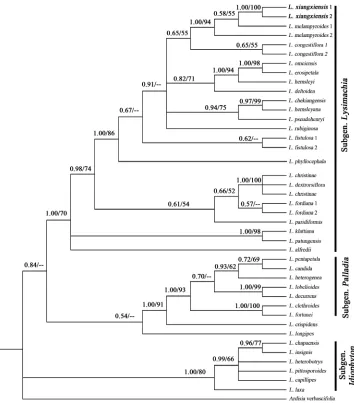
The aligned lengths of ITS are 655 bp with gaps treated as missing data. BI and ML analyses produced similar topology and only the BI tree was presented in Figure 1.
Table1. Morphological comparison between Lysimachia xiangxiensis sp. nov. and its similar species.
Character L. xiangxiensis sp. nov. L. melampyroides
Stems creeping or drooping. erect or ascending.
Plant height 15–25 cm 15–50 cm
Petiole not auriculate at base dilated and auriculate at base Blades of lower leaves succulent, rhomboid-ovate to ovate, the basal 1 or 2
pairs scale-like
papery, ovate to linear-lanceolate Blades of upper leaves succulent, ovate to elliptic-lanceolate, 2–5.5 cm ×
1–2.3 cm
papery, ovate to linear-lanceolate, 1.5–9 × 0.3–2.5 cm Secondary veins blurry or invisible on adaxial surface, slightly raising on
abaxial surface
visible on both surfaces Glandular dots on leaves Absent transparent, sparse Corolla lobes suborbicular to broadly elliptic, apex cuspidate or
Figure 1. The phylogram of Bayesian inference (BI) tree from the ITS sequence data, showing the phy-logenetic position of Lysimachia xiangxiensis sp. nov. (shown in bold). Values above the branches represent Bayesian posterior probabilities (PP) and bootstrap values (LP) for maximum likelihood, respectively; the dash (–) indicates LP < 50%.
The phylogenetic results indicate that two samples of the new species were grouped together with a strong support (PP = 1.00, LP = 100%) and closely related to L. mela-mpyroides (PP = 1.00, LP = 94%).
On the basis of the classification in Handel-Mazzetti (1928), Chen and Hu (1979) divided the genus into five subgenera as well as many series, Subgen. Lysimachia, Sub-gen. Palladia (Moench) Hand.-Mazz, Subgen. Idiophyton Hand. -Mazz., Subgen.
M. Hu. In this topology, all Lysimachia species form three main clades: Subgen. Lysi-machia (PP = 1.00, LP = 70%), Subgen. Palladia (PP = 1.00, LP = 93%) and Subgen.
Idiophyton. (PP = 1.00, LP = 80%). In addition, L. crispidens (Hance) Hemsley in F. B. Forbes & Hemsley of Subgen. Heterostylandra is close to Subgen. Palladia (PP = 1.00, LP = 91%) and L. longipes Hemsley is assigned to Subgen. Lysimachia with weak sup-ported (PP = 0.54) in a neutral position between Subgen. Lysimachia and L. crispidens. But classification of series are not well reflected in this analysis.
Taxonomic treatment
Lysimachia xiangxiensis D.G.Zhang & C.Mou, Y.Wu, sp. nov.
urn:lsid:ipni.org:names:77206205-1
Figure 2–4
Type. CHINA. Hunan Province, Huayuan County, Buchou Town, Da-long-dong, cliff of a valley, 28°19'06.42"N, 109°30'03.22"E, alt. 295 m, 26 August 2019, D. G. Zhang 0826075 (holotype: JIU!; isotype: JIU!).
Diagnosis. The new species differs from L. melampyroides by the succulent leaves; the creeping or drooping stems (15–25 cm long); and the suborbicular to broadly el-liptic corolla lobes.
Description. Terrestrial, perennial herbs. Rhizome brown, reduced to a small tuber or rarely creeping, with sparse fibrous roots. Stems creeping or drooping on cliffs, 15– 25 cm long, clustered, branched at base, unbranched or rarely branched from the mid-dle, terete, purple-red, densely strigillose, the internodes usually 3–7 cm long. Leaves petiolate, opposite. Petioles 5–7 mm long, with a furrow on adaxial side, green or pur-ple-red, strigillose. Leaf blade succulent; blade of lower leaves rhomboid-ovate to ovate, with 1 or 2 pairs of basal leaves scalelike (much smaller); blade of upper leaves ovate to elliptic-lanceolate, 2–5.5 cm × 1–2.3 cm, base cuneate, apex acuminate or acute to su-bobtuse, margin entire and revolute, adaxially dark green, shiny, subglabrous, abaxially
purple-red (in arid places) or light green (in moist places), densely strigillose along the midrib, not glandular on both surfaces; secondary veins 3–4 pairs, blurry or invisible adaxially, slightly raising abaxially, veinlets invisible. Flowers bisexually, solitary in axils of upper leaves, occasionally in terminal racemes with bractlike leaves. Pedicels 1.5–3 cm long, gradually reduced toward stem apex, purple-red or light purple-red, densely strigillose, recurved in fruit. Calyx lobes 5, rarely 6, persistent, lanceolate with indis-tinct costa, 6–8 mm × 1.5–2 mm, apex acuminate-subulate, inside glabrous and with 3–4 veins, outside purple-red or green, densely strigillose. Corolla yellow, tube 1–2 mm long, actinomorphic, contorted; lobes 5, 7–9 mm × 7–9 mm, suborbicular to broadly elliptic, apex cuspidate or rounded, erose above the middle. Stamens 5, yellow, oppo-site to corolla lobes; filaments connate basally into a tube ca. 2.5 mm high, free parts 3.5–4.5 mm; anthers ca. 2 mm long, dorsifixed, opening by lateral slits. Style ca. 6 mm long, apex slightly expanded, strigillose on lower part. Ovary cylindrical, ca. 1.5 cm in diam., strigillose on apex, superior. Capsule brown, subglobose, 3–4 mm in diam., densely strigillose, dehiscing by valves. Seeds small, black, angular, papillate.
Phenology. Flowering May–June, fruiting July–August.
Distribution and habitat. This new species is currently known from Huayuan County and Jishou City in western Hunan Province, central China. It usually grows on limestone cliffs in valleys (Figure 2), and is associated with e.g. Eriophorum comosum
(Wallich) Nees in Wight, Pteris vittata Linnaeus, Pteris deltodon Baker, and Dryopteris sp.
Etymology. The specific epithet “xiangxiensis”, literally meaning western Hunan, refers to the Xiangxi Tujia and Miao Autonomous Prefecture in central China, to which Huayuan County and Jishou City belong. The Chinese name of the Lysimachia xiangxiensis is xiang xi guo lu huang in Pinyin.
Conservation status.Lysimachia xiangxiensis usually grows on limestone cliffs in valleys so we suggest its placement in the Data Deficient category of IUCN (2017)
Additional collection. CHINA. Hunan Province, Jishou City, Aizhai Town, Na-tional Forest Park, cliff of a valley, 31 May 2019, Y. Wu 0531001(paratype, JIU!).
Acknowledgments
This work was supported by STS Program of the Chinese Academy of Sciences (No. KFJ-3W-No1) and the Traditional Chinese Medicine Public Health Special Project ([2017] 66). We thank Dr Wannachai Chatan for their thoughtful review of our sub-mitted paper .
References
Burnham KP, Anderson DR (2003) Model Selection and Multimodel Inference: a Practical Information-theoretic Approach, Second Edition. Springer-Verlag, New York, 347. Chen FH, Hu CM (1979) Taxonomic and phytogeographic studies on Chinese species of
Lysi-machia. Acta Phytotax Sinica 17(4): 21–53.
Chen FH, Hu CM, Fang YI, Cheng CZ (1989) Primulaceae. In: Chen FH, Hu CM (Eds) Flora Reipublicae Popularis Sinicae 59. Science Press, Beijing, 3–133
Doyle JJ, Doyle JD (1987) A rapid DNA isolation procedure for small quantities of fresh leaf tissue. Phytochemical bulletin, botanical Society of America 19: 11–15.
Handel-Mazzetti H (1928) A revision of the Chinese species of Lysimachia. Notes from the
Royal Botanic Garden Edinburgh 16: 51–122.
Hu CM, Kelso S (1996) Primulaceae. In: Wu ZY, Raven PH (Eds) Flora of China 15. Science Press, Beijing and Missouri Botanical Garden Press, St Louis, 39–189
Huelsenbeck JP, Ronquist F (2001) MRBAYES: Bayesian inference of phylogenetic trees. Bio-informatics 17(8): 754–755. https://doi.org/10.1093/bioBio-informatics/17.8.754
IUCN (2017) Guidelines for using the IUCN red list categories and criteria. Version 13. Pre-pared by the Standards and Petitions Subcommittee. https://www.iucnredlist.org/resourc-es/redlistguidelines
Liu K, Hong X, Zhou SB, Cheng YS, Tang CF, Xu HJ (2014a) A new species of Lysimachia
(Myrsinaceae) from Dabieshan Mountain, China. Plant Systematics and Evolution 300(7): 1615–1620. https://doi.org/10.1007/s00606-014-0986-z
Liu K, Zhou SB, Chen YS, Hong X (2014b) Lysimachia dabieshanensis sp. nov. (Primulaceae),
a new species from Dabieshan Mountain, China. Phytotaxa 174(2): 119–122. https://doi. org/10.11646/phytotaxa.174.2.8
Nylander JAA (2004) MrModeltest v2. Program distributed by the author. Evolutionary Biol-ogy Centre, Uppsala University, 2.
Stamatakis A (2006) RAxML-VI-HPC: Maximum likelihood-based phylogenetic analyses with thousands of taxa and mixed models. Bioinformatics (Oxford, England) 22(21): 2688– 2690. https://doi.org/10.1093/bioinformatics/btl446
Swofford DL (2002) PAUP*: Phylogenetic Analysis Using Parsimony (*and other methods), version 4.0. Sinauer Associates, Sunderland, Massachusetts, 142.
Wang Y, Ma W, Zhou SB, Liu K (2018) Lysimachia tianmaensis (primulaceae), a new species
from Anhui, China. PhytoKeys 98: 117–124. https://doi.org/10.3897/phytokeys.98.23751
Yan HF, Hao G (2012) Lysimachia huchimingii sp. nov. (Primulaceae) from China. Nordic
Journal of Botany 30(4): 443–445. https://doi.org/10.1111/j.1756-1051.2012.01401.x
Yan HF, Xu Y, Zhu ZM, Hu CM, Hao G (2017) Lysimachia sinopilosa (Primulaceae), a new
species from Yunnan, China. Annales Botanici Fennici 54(1-3): 45–48. https://doi.
org/10.5735/085.054.0308
Zhang CY, Wang FY, Yan HF, Hao G, Hu CM, Ge XJ (2011) Testing DNA barcoding in
closely related groups of Lysimachia L. (Myrsinaceae). Molecular Ecology Resources 12(1):
98–108. https://doi.org/10.1111/j.1755-0998.2011.03076.x
Zhou JJ, Yu XL, Deng YF, Yan HF, Lin ZL (2015) Lysimachia huangsangensis (Primulaceae), a
Appendix
Appendix S1. Accessions of the genus Lysimachia L. examined in this study.
Taxon GenBank
Acc. No.
Voucher Locality
L. alfredii Hance JN638405 Hao394 Lianping, Guangdong, China
L. candida Lindley JF976885 Ge2010001 Yangchun, Guangdong, China
L. capillipes Hemsley in F. B. Forbes & Hemsley JF976886 Y2009200 Jiujiang, Jiangxi, China
L. chapaensis Merrill JF976888 GBOWS878 Hekou, Yunnan, China
L. chekiangensis C. C. Wu JF976891 Y2009263-1 Longquan, Zhejiang, China
L. christiniae Hance JF976894 Y2009244 Lin'an, Zhejiang, China
JF976896 Y2009209 Jiujiang, Jiangxi, China
L. clethroides Duby in A. de Candolle JF976899 Y2009157 Tongbai, Henan, China
L. congestiflora Hemsley in F. B. Forbes & Hemsley JF976902 GBOWS262 Malipo, Yunnan, China
JF976903 Y2009266 Longquan, Zhejiang, China
L. crispidens (Hance) Hemsley in F. B. Forbes & Hemsley JF976906 Hao212 Yichang, Hubei, China
L. decurrens G. Forster JF976908 GBOWS1234 Hekou, Yunnan, China
L. deltoidea Wight JF976909 GLM081121 Zhongdian, Yunnan, China
L. dextrosiflora X. P. Zhang, X. H. Guo & J. W. Shao JF976913 Y2009265-1 Longquan, Zhejiang, China
L. erosipetala F. H. Chen & C. M. Hu JF976914 Y2010037-2 Emeishan, Sichuan, China
L. fistulosa Handel-Mazzetti JF976916 Ning20101 Jinggangshan, Jiangxi, China
JF976917 Ye et al. 3561 Lianshan, Guangdong, China
JF976919 Y2009285 Ruyuan, Guangdong, China
JF976920 Ye et al. 3940 Lianshan, Guangdong, China
L. fortune Maximowicz JF976925 Y2009195 Jinggangshan, Jiangxi, China
L. hemsleyana Maximowicz ex Oliver JF976932 Guo20001 Ningguo, Anhui, China
L. hemsleyi Franchet JF976935 Hao713 Huili, Sichuan, China
L. heterobotrys F. H. Chen & C. M. Hu JF976936 Y2010053-2 Ningming, Guangxi, China
L. heterogenea Klatt JF976939 Y2009199 Jiujiang, Jiangxi, China
L. insignis Hemsley JF976945 Hao245 Napo, Guangxi, China
L. klattiana Hance JF976947 Y2010014-1 Tongbai, Henan, China
L. laxa Baudo JF976949 Han longran6 Puer, Yunnan, China
L. lobelioides Wallich in Roxburgh JF976951 Hao303 Menglian, Yunnan, China
L. longipes Hemsley JF976952 Guo xinhu200012 Shitai, Anhui, China
L. melampyroides R. Knuth in Engler JF976955 Dengyunfei15945 Xinning, Hunan, China
JF976956 Lichanghan8174 Shangzhi, Hunan, China
L. omeiensis Hemsley JF976958 Y2010033 Emeishan, Sichuan, China
L. paridiformis Franchet JF976962 Y2010044 Emeishan, Sichuan, China
L. patungensis Handel-Mazzetti JF976964 Ye et al. 3851 Lianshan, Guangdong, China
L. pentapetala Bunge JN638407 Y2010013-1 Tongbai, Henan, China
L. phyllocephala Handel-Mazzetti JF976969 Y2010030 Emeishan, Sichuan, China
L. pittosporoides C. Y. Wu JF976970 Hao248 Malipo, Yunnan, China
L. rubiginosa Hemsley in F. B. Forbes & Hemsley JF976972 Hao419 Dujiangyan, Sichuan, China
Lysimachia xiangxiensis D.G.Zhang & C.Mou, Y.Wu,
sp. nov. MN647745MN647744 D. G. Zhang 0826075Y. Wu 0531001 Huayuan, Hunan, ChinaJishou, Hunan, China