Received 27 October 2015 Revised 31 May 2016 Accepted 13 June 2016 Published 27 October 2016
ISSN: 1473-0111 (Online)Journal homepage: http://www.cimt.org.uk/ijmtl/index.php/IJMTL
Enabling Pupils to Conceive Part-Whole Relations of Numbers and
Develop Number Sense: Year One of Primary Schools in Malaysia
Santi Sinnakaudan*, Seffetullah Kuldas, Shahabuddin Hashim, and Munirah Ghazali
School of Educational Studies, Universiti Sains Malaysia
Abstract
This review examines reasons for Malaysian pupils’ underperformance in solving mathematics problems that demand numerical estimation and mental computation. Their underdeveloped number sense appears to be the major reason. According to the Ministry of Education, the national mathematics curriculum is unlikely to account for this underachievement. By contrast, this article argues that the curriculum largely focusing on written computation skills, is likely to account for the underperformance, given that the development of number sense has yet to become the focus of attention. This review further suggests teaching and learning activities that may enable the Malaysian pupils, in year one of primary schools, to conceive part-whole relations of numbers and thus develop number sense. The earlier they understand the part-whole relationship, the stronger they may develop number sense and thus the better can be their performance.
Keywords: Malaysia, primary school, pupil, number sense, part-whole, activity
A number is made of two or more parts (e.g., 9 is 2 + 7 or 1 + 3 + 5). Thus, it can be referred to as either a whole unit of smaller numbers or a part of a larger number in the same place. Understanding numbers as part-whole relations as well as showing an inclination and ability to use this understanding for operations or solving numerical problems in daily life inside and outside the classroom, is referred to as number sense (McIntosh, Reys, & Reys, 1992; Reys et al., 1999).
“The acquisition of number sense is a gradual, evolutionary process, beginning long before formal schooling begins” (McIntosh et al., 1992, p. 3). Therefore, number sense can start to develop even among preschool pupils, as they think or try to make sense of numbers at an early age (Dyson, Jordan, & Glutting, 2013). Pupils as young as five years old can have a sufficient understanding of the basic concepts of numbers (Cheng, 2012).
The earlier development of pupils’ number sense, the stronger is the prediction of their later mathematics achievements (Dyson et al., 2013). In contrast, underdeveloped number sense is a strong predictor of underachievement or failure in solving problems demanding estimation and mental computation (Ghazali, Idros, & McIntosh, 2004). The development of pupils’ number sense is closely associated with their ability to make numerical estimations and do mental computation (Tsao, 2004). The ability to estimate is an
*
Corresponding author: Santi Sinnakaudan
approximate calculation that facilitates problem solving, whereas mental computation is the performance of an exact mathematical calculation to solve problems.
Notwithstanding these facts, earlier identification of pupils with underdeveloped number sense has been overlooked (Gersten, Jordan, & Flojo, 2005) in many mathematics school settings around the world (Reys et al., 1999), particularly in developing countries like Malaysia (Ghazali et al., 2004; Kuldas, Sinnakaudan, Hashim, & Ghazali, 2016). As Ghazali and colleagues stated: “Although considerable attention to number sense is occurring in countries like the US, Australia and the UK, the term ‘number sense’ is rarely heard in mathematics education, the national mathematics curriculum, school classrooms, teachers or educational journals in Malaysia” (p. 93). If number sense development is out of the focal attention, then how successful is the national curriculum in enabling pupils to deal with problems that require numerical estimation and mental computation?
A growing concern and challenge among primary and secondary school mathematics teachers in Malaysia is whether the pupils understand number relations and operations or do they simply apply basic algorithms to calculations? (Ghazali, Othman, Alias, & Saleh, 2010; Kuldas et al., 2016; Noordin, Dollah, & Talib, 2012). Findings indicate that the pupils are generally able to manipulate and follow basic algorithmic rules rather than making sense of numerical situations (Ghazali et al., 2010). This is because they learn traditional algorithms for performing basic operations mostly without knowing why or what they are doing (Ghazali et al., 2004). They are usually taught to calculate the correct answer without understanding the underlying process. Finding the correct answer alone is no longer considered an essential indicator of the required understanding and computation skills (Ghazali et al., 2010). According to researchers concerned with the Malaysian context (Ghazali et al., 2004; Noordin et al., 2012), pupils who have developed the understanding are expected to demonstrate the ability: (a) to apply their own problem-solving strategies instead of focusing on a correct answer, (b) to know why and how to calculate rather than simply following computation rules, and (c) to find their own answers or solutions instead of waiting for teacher assistance. However, these expectations have yet to be fulfilled in Malaysian primary and secondary schools.
Methods
Aiming to provide insights into those questions addressed above, this review includes studies and reports in a period of 16 years, between 1999 and 2015. First, in 1999, Ghazali and Zanzali (1999) raised the concern for Malaysian pupils’ understanding of part-whole relations of numbers and the development of number sense.
To identify articles published in peer-reviewed journals or as conference proceedings concerning the issue, keywords like "part-whole", "number sense", and “Malaysia” were searched in subscribed databases, namely EBSCOHost, ERIC, Web of Science, and Scopus. However, to find the relevant literature that is published in local peer-reviewed journals or as conference proceedings, which is mostly not indexed in these mainstream databases, the search was done mainly in Google Scholar. A combination of the keywords ―"part-whole" AND "number sense" AND "Malaysia"― was searched in Google Scholar. The search retrieved 18 papers, but only 12 of them were very relevant to the raised issue in the Malaysian context.
Why the Development of Number Sense should be the Focus of the Mathematics Curriculum for Malaysian Primary and Secondary Schools?
The Mathematics curriculum for Malaysian primary and secondary schools requires teachers to enable their pupils to understand numbers and acquire computational skills (Curriculum Development Centre, 2006), but also for pupils to be able to make numerical estimations (Ministry of Education, 2004). However, whether or not this requirement has been sufficiently met is questionable. Findings indicate that the pupils still lack the required understanding and application of number systems and operations, involving relative meanings, relations, sizes, and representations of numbers (Mohamed & Johnny, 2010; Parmjit, 2009). What is striking is that this lack of number sense is not demonstrated only by the pupils who are low achievers but also by those high achievers (Parmjit, 2009). Mohamed and Johnny tested the estimation ability of 32 primary school pupils (from year four) who achieved a score of 80% and above in their “Mathematics Take Off Value” for the year 2010. These results showed that the pupils got a mean score of only 58.28% on a Number Sense Test (adapted from Ghazali & Zanzali, 1999), although they showed a high level of competence (a mean score of 86.38%) in the mathematics achievement test. In a more comprehensive study on the number sense proficiency of pupils (N=1756) from thirteen secondary schools in Selangor, a state of Malaysia (Parmjit, 2009), the majority (74.9%), who obtained A grades for the year-end school mathematics examinations, got a score of less than 48% on a Number Sense Test (adapted from McIntosh, Reys, Reys, Bana, & Farrel, 1997). Such evidence has confirmed McIntosh and colleagues’ (1992) prediction that pupils even those who are higher mathematics achievers and highly skilled at paper/pencil computation, can also suffer from their underdeveloped number sense.
to meet the minimum numerical benchmarks in mathematics (Ministry of Education, 2012). Their underachievement or failure can be representative of Malaysian secondary school students, given that “The sample of schools tested in TIMSS reflects the overall performance of Malaysia’s schools based on a distribution of schools by national performance band” (Ministry of Education, 2012, p. 3-9). Thus, for the past two decades, there has been only a promising improvement in Malaysian pupils’ learning and performance of mathematics (Kuldas et al., 2016).
Researchers (Ghazali, Rahman, Ismail, Idros, & Saleh, 2003) strongly asserted that this issue reoccurs mainly due to the fact that conventional curriculum and textbooks for mathematics teaching and learning activities in the classroom are geared toward the memorisation rather than the understanding of why and how algorithms are computed. Therefore, for many of the pupils, learning mathematics is an “endless sequence of memorizing and forgetting facts and procedures that make little sense to them” (Parmjit, 2009, p. 4). Memorisation and following algorithmic rules without understanding is referred to as a lack of number sense, a deficiency in pupils' ability that leads them to underperform in problem-solving settings in many countries (McIntosh et al., 1997; Reys et al., 1999), including Malaysia (Ghazali et al., 2004, 2010; Kuldas et al., 2016).
Accordingly, a way to develop number sense is likely to be a careful redevelopment of the mathematics curriculum and textbooks along with teaching and learning activities, which allow the pupils to develop their number sense (Ghazali et al., 2004, 2010; Parmjit, 2009). By contrast, the Ministry of Education (2012) stated that: “Incomplete coverage of the concepts assessed in TIMSS by the national curriculum is unlikely to account for the decline” (p. 3-9), but more likely that mathematics teachers insufficiently perceive and practice the curriculum content. However, the Ministry showed no compelling reason or evidence neither for the decline nor for the teacher perception and practice. There is a scarcity of evidence on teacher perception and only few research papers on the development of number sense. Therefore, the evaluation by the Ministry appears to be inconclusive. Since the development of number sense has yet to be an explicitly stated objective of the national mathematics curriculum, underdeveloped number sense of the pupils is likely to account for their underachievement, failure, or the decline in mathematics tasks. Although the focus of the national curriculum on the pupils’ written computation skills may allow them to satisfactorily perform standardised tests for mathematics achievement in the classroom, they are generally unable to successfully use memorised rules and formulae in their daily life outside the classroom (Parmjit, 2000). In contrast to the belief that computation skills is equal to mathematical competence, extensive literature shows that a high-level of computation skills is not equal to it (Alsawaie, 2012; Yang & Huang, 2004), nor is it an indicator of developed number sense (McIntosh et al., 1992; Yang, 2005). Their achievement of a higher grade in the national mathematics examination is more likely to be an indicator of their rote learning than meaningful learning (Parmjit, 2009).
Theoretical Framework and Test of Number Sense
Before the term number sense was coined, Payne and Rathmell (1975) proposed the terms ‘whole’ and ‘parts’ to explain relations of numbers. Part-whole relationship of numbers means that quantities are interpreted as being composed of other numbers where a quantity (a whole) can be partitioned into two or more parts (Fischer, 1990; Jung, 2011). Enabling pupils to interpret quantities and numbers in this way can be considered as a key conceptual achievement in the early years of their mathematics education. As Resnick (1983) stated:
of other numbers. This enrichment of number understanding permits forms of mathematical problem solving and interpretation that are not available to younger children. (p. 114)
Understanding the totality of gathered objects (whole) and their sub-categories (parts) with respective classifications leads children to develop the part-whole concept (Jung, 2011; Piaget, 1965), which is a major transition from concrete to abstract thinking in mathematics (Steinke, 2001, 2008). Children who grasp this concept have the sense that parts and whole of a quantity coexist but are not in complete isolation or combination in the same place. In contrast, pupils who have little or no understanding of the part-whole relationship represent the parts and whole in isolation or combination. Steinke (2001) illustrated this comparison between students who lack the concept of part-whole and those who have in the following Figure 1.
Figure 1. A comparison of understanding the part-whole concept
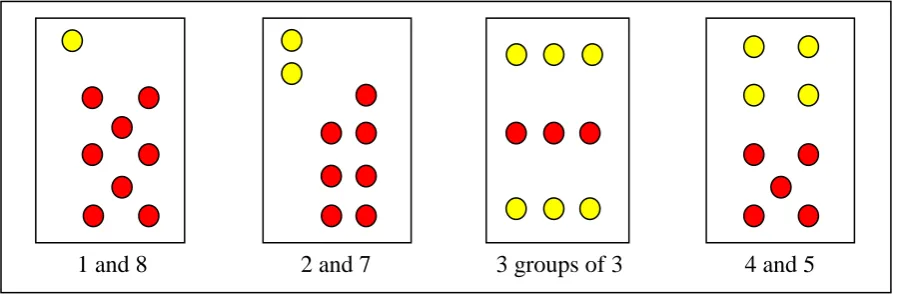
The part-whole concept facilitates interpretation of conceptual structures of different addition and subtraction problems. Young pupils can therefore deal with mathematics problems more flexibly (Fischer, 1990), demonstrating multiple and flexible representations of numbers. For example, as Figure 2 illustrates (Jung, 2011), number 9 can be represented in multiple ways as 1 + 8, 2 + 7, 3 + 3 + 3, and 4 + 5.
Figure 2. Multiple representations of number 9
Understanding the part-whole relationship can enhance the conception of place value (Fischer, 1990; Resnick, 1983), measurement, and fractions (Charlesworth, 2012). Pupils may hereby develop the ability to deconstruct quantities, keep track of the parts, put the parts
and OR
No understanding the part-whole concept
4 2
6
6
Understanding the part-whole concept
2
4
back together in a different way to solve numerical problems, referred to as making sense of numbers (Steinke, 2008). As Greeno (1991) remarked, pupils display their developed or underdeveloped number sense in a problem-solving situation or conceptual domain (i.e., knowing the domain of numbers and quantities).
According to a theoretical framework of number sense, proposed by Mclntosh and colleagues (1992), pupils are expected to understand the relationship between operations (addition and subtraction) and thus see the effect of operation on whole numbers (i.e., understanding that the whole of number is greater than its parts). Therefore, Mclntosh and colleagues (1992), suggest teachers and researchers consider number sense, based on pupils’ knowledge and facility, with regard to three major categories: number concepts, operations with number, and applications of numbers and operations.
Based on this framework, Reys et al. (1999) identified six major components of number sense. First, the meaning and size of numbers. Second, equivalent representations of numbers (e.g., asking them to show different ways that number 5 can be represented). Third, the meaning and effect of operations. Fourth, equivalent expressions. Fifth, flexible computing and counting strategies for mental and written computations. Sixth, measurement benchmarks (e.g., asking them to estimate the height of a large object).
Using these components as items of the number sense test, earlier validated by McIntosh et al. (1997), Reys et al. (1999) later provided its cross-cultural perspectives across several countries, but noted that the number sense instruments in each country were unique. Reys and colleagues drew several conclusions from their study. First, items of the number sense test can provide insights into pupils’ levels of number sense for both teachers and researchers. Second, though the group number-sense test provides an incomplete picture, the individual items can provide markers to assess progress or to identify areas where additional probing is useful. Third, format of the written item can be used for eliciting pupils’ thoughts about numbers, even within a group-testing format.
Taking into account the cultural uniqueness of the test for number sense, Ghazali and colleagues (2003, 2004) designed and administered the test for an assessment of Malaysian primary school pupils’ number sense. This instrument allows for measuring number sense based on its four components: counting, addition and subtraction, multiplication and division, and place value. Items for each component reflect three main numerical representations: contextual, pictorial, and symbolic. The items hereby provide an assessment of whether pupils are able (a) to use pictorial representations in solving problems, (a) to write mathematical sentences, and (c) to visualise problem solving situations and create stories based on given mathematical sentences. Ghazali et al. (2004) suggested that the four components should be an integral part of the national mathematics curriculum. An interview should also be incorporated into the classroom assessment as a diagnostic tool, so that mathematics teachers can have a deeper insight into the strengths and weaknesses of their pupils’ conceptual understanding of mathematical problems and contents. This may positively change mathematics teachers’ perceptions of number sense development in Malaysian primary schools.
Making Sense of Numbers through their Part-Whole Relations: No Counting but the Composition/Decomposition Strategy!
Starkey, 1998). Such an understanding includes the ability to take out a small part of specified cardinality from a whole set, to identify the number of units in a group of objects, and to compare the numbers in two different groups of objects (Sophian, 1988; Zhou, 2002).
However, as their computation skills are constrained by the number of fingers or objects, pupils may show incapability to solve addition problems involving slightly larger numbers (Cheng, 2012). In a series of studies, pupils could not competently add numbers larger than 10 using finger counting (Carpenter & Moser, 1982) or had difficulties when they were asked to calculate 19 + 8 (Cheng & Chan, 2005), though this counting strategy, the use of fingers or objects, could be useful for some pupils in solving addition problems. Thus, as Lee and Ginsburg (2009) suggested, the use of objects or fingers is effective only when they encourage pupils to think and make connections between numbers.
Accordingly, the use of counting strategies to solve addition or subtraction problems is not the optimal way to realise or develop mathematical potential of pupils (Cheng, 2012). Since children as young as five years old can have sufficient understanding of the basic concepts of numbers (from 1 to 10) and frequently use the inversion principle between addition and subtraction (Baroody & Lai, 2007), teaching them how to mentally construct and understand the part–part–whole relationship of numbers (1-10) is possible (Cheng, 2012). Fischer (1990) designed and applied a part–part–whole curriculum for teaching number relations to pre-schoolers and suggested that it can broaden their understanding of numbers and help them solve addition and subtraction problems, but they may still draw on the counting strategies to get the quantities in a set or subsets of objects. Cheng (2012) extended Fischer’s study and confirmed that five-year-old children can learn how to use the decomposition strategy and effectively solve addition problems. According to Cheng (2012), when pupils count, conduct basic mathematical operations, or solve mathematics problems, they usually use strategies, like decomposing and composing, whereby they demonstrate their levels of number sense. Pupils may either be inclined to find out parts that constitute a whole amount they already know (i.e., decomposing strategy) or put together two or more parts to know the whole amount (i.e., composing strategy). In the process of finding a sum or subtraction of numbers, children can make all possible combinations of the ten numbers in their mind. This mental computation, also called make-a-ten decomposition strategy (Baroody et al., 2006), improves their ability to solve addition and subtraction problems (Cheng, 2012). Repeatedly seeing the composition and decomposition of the same number leads to accuracy in addition and subtraction. Pupils can hereby develop a sense or recognise that counting is guided by rules associated with one-to-one correspondence, fixed order, and cardinality (Griffin, 2004).
These findings have confirmed Piaget’s (1965) prediction that the composition and decomposition of numbers, which is fundamental to learning of addition and subtraction, requires prior knowledge of part–part–whole relations of numbers. According to Piaget’s logical-prerequisite model, before pupils can comprehend the essential meaning of number composition, they must first learn to classify objects in multiple ways, understand the cardinal numbers 1–10, and identify corresponding numbers. They must also comprehend hierarchical class inclusion through classification, that is, to understand that a whole set (e.g., 5 fruits) is the sum of its parts or subsets (e.g., 2 apples and 3 pears), and to recognise that the whole is greater than its parts. Thus, depending on their ability to classify objects, they can understand the part-whole relations of numbers.
numerical problems like addition and subtraction may be harmful to their development of number sense. Cheng and Chan (2005) showed that pupils using the counting strategies to solve addition problems exerted little effort to understand part–part–whole relationship between numbers, in contrast to those applying the decomposition strategy. Even older students, particularly those low achievers, may continue to use the counting strategies to solve simple single-digit addition problems (Christensen & Copper, 1992). In other words, as they move into the higher levels of school education, their reliance on memorised algorithms and procedures increase. Interestingly, primary pre-service teacher education students demonstrated very similar behaviour (Kaminski, 1997). This behaviour can subsequently impede conceptual understanding of addition or part–part–whole relationship. These findings confirm that “students’ number sense does not develop hand in hand with their computational
skills growth” (Reys et al., 1999, p. 68), nor does growing older necessarily “ensure either the
development or utilization of even the most primitive notions of number sense” (McIntosh et al., 1992, p. 3).
Materials for Teaching and Learning the Part–Whole Relations of Numbers: Pupils in Year One of Primary Schools in Malaysia
Numbers and their part-whole relations are of the concern of the mathematics curriculum for year one in primary schools in Malaysia. The national Curriculum Development Centre requires mathematics teachers to enable the pupils to identify number pairs and construct a relevant whole number (Bahagian Perkembangan Kurikulum, 2010). Enabling pupils to understand the part-whole relationship in the early years allows pupils to represent numbers or quantities flexibly (NCTM, 2000). Pupils are hereby expected to solve problems related to the part-whole relationship within numbers. When pupils have little or no understanding of the part-whole relationship, they usually deal unsatisfactorily with operations (addition, subtraction, multiplication, division) and other mathematics problems (Baroody, 2000).
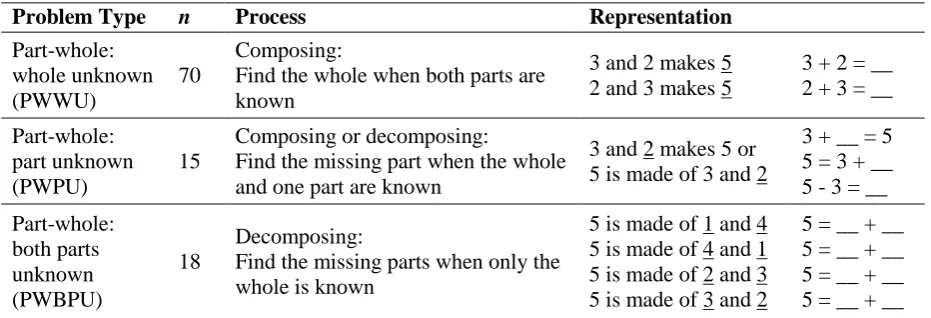
In line with the national curriculum, almost half of basic number problems (74 out of 152) in mathematics textbooks, which are currently used for the year one pupils in Malaysian primary schools, are about the part-whole relations (see Table 1).
Table 1
Part-Whole Problems in Mathematics Textbooks for Year-One of Malaysian Primary Schools
Problem Type n Process Representation
Part-whole: whole unknown (PWWU)
70
Composing:
Find the whole when both parts are known
3 and 2 makes 5 2 and 3 makes 5
3 + 2 = __ 2 + 3 = __ Part-whole:
part unknown (PWPU)
15
Composing or decomposing:
Find the missing part when the whole and one part are known
3 and 2 makes 5 or 5 is made of 3 and 2
3 + __ = 5 5 = 3 + __ 5 - 3 = __ Part-whole: both parts unknown (PWBPU) 18 Decomposing:
Find the missing parts when only the whole is known
5 is made of 1 and 4 5 is made of 4 and 1 5 is made of 2 and 3 5 is made of 3 and 2
5 = __ + __ 5 = __ + __ 5 = __ + __ 5 = __ + __
‘part-whole part unknown’ (PWPU) and ‘part-whole both parts unknown’ (PWBPU), due to the fact that the part-whole relationship in three types of problems has been inadequately represented or unevenly distributed (i.e., 56 for PWWU, 15 for PWPU 18 for PWBPU) in the mathematics textbooks. Moreover, not only those low achievers but also top-class pupils have difficulties or underperform because of such distribution. Similar findings were presented by Parmjit (2006) and colleagues (Parmjit & Hoon, 2010), who measured mathematics success of Malaysian top-class pupils. They analysed the content of primary 1 and 2 mathematics textbooks used in Malaysian schools and revealed that all types of addition and subtraction word problems are inadequately distributed in the textbooks. This conveys that the pupils have less exposure to solving or exercising these types of problems and therefore demonstrate underperformance. Hence, their inability in the word problem-solving can be attributed mainly to their lack of knowledge about the types of word problems. An optimal design of materials and activities for teaching the part-whole relationship should be considered to establish a strong basis for pupils’ number sense and learning mathematics. Redesigning the part-whole concept in textbooks should be considered in order to contribute to the development of pupils’ number sense in early years of their mathematics education in Malaysia.
Properly designed textbooks can serve as the primary source of knowledge acquisition (Garner, 1992) and development of number sense, whereby pupils yield more flexible and creative solutions. In contrast, improperly or superficially designed textbooks can delay developing critical mathematical ideas or creative solutions (Sheetal Sood & Jitendra, 2007). For example, by utilising textbooks overemphasising algorithm rules, teachers, parents, or private tutors may play a significant role in the lack of pupils’ number sense, if they give positive reinforcement only for following rules while assisting pupils in doing their mathematics homework or preparing them for mathematics examinations (Alsawaie, 2012). This suggests not that pupils should not use textbooks to learn written computations, but they should conceptually understand mathematical procedures and develop their own problem-solving strategies (McIntosh et al., 1997). Otherwise, pupils will only memorise basic algorithmic rules and apply them without understanding (Howden, 1989). This can be the main reason for why they can improperly use rules or be confused when confronted with novel problems (Alsawaie, 2012). For instance, when Malaysian primary and secondary school pupils, who have very good performance in the school mathematics examination, are given a problem not from a textbook, “they will be lost” (Abu Hasan, 2007, p. 93). Noordin et al. (2012) documented that Malaysian secondary school pupils who performed satisfactorily in the school mathematics examination exhibited unsatisfactory performance when given a different problem from what they found in textbooks. This fact has yet to be given due attention by textbooks writers, curriculum designers, and mathematics teachers, who emphasise written computation skills as the main focus of primary and secondary school mathematics education in Malaysia (Kuldas et al., 2016). Enhancing their perceptions of number sense (e.g., avoiding the overemphasis on written computation skills) can be a way to develop the pupils’ number sense. Otherwise, the Malaysian school pupils will fail to develop number sense in the classroom where textbooks and mathematics teachers allow them to practise algorithms with an overreliance on paper/pencil computation (Parmjit, 2009).
Teaching and Learning Activities for the Understanding of Part-Whole Relationship
Mathematics teachers usually vary greatly in their own understanding of what number sense is as well as in their instructional activities for how children make sense of numbers (Reys et al., 1999). Teacher perception of the teaching and learning can underlie teaching effectiveness (Askew, Brown, Rhodes, Johnson, & William, 1997). For example, their classroom practices can be based on their beliefs about the ways pupils learn or about a variety of mathematical ideas or representations for real life applications. Related studies suggest mathematics teachers ought to believe that the development of number sense is more important than teaching mathematics rules associated only with written computation (Yang, Reys, & Reys, 2009) in Malaysian primary and secondary schools (Parmjit, 2009).
Askew et al. (1997) classified characteristics of effective teachers into four categories. First, having organisational and management strategies, such as allocating maximum time for tasks and catering for collective and individual needs. Second, having teaching styles that involve intervention strategies, questioning techniques, intelligible explanations, and identification and handling pupils’ errors. Third, having teaching resources for activities, including a range of tasks and expected outcomes. Fourth, having pupils’ responses, recognising how they work and understand. Additionally, several instructional principles of effective teaching of number sense are stressed. Griffin (2004) proposed three instructional principles to teach number sense through activities that allow pupils (a) to make connections between concepts, (b) to explore and discuss concepts, and (c) to ensure appropriate sequence of concepts. As Malaysian mathematics teachers need to develop and apply such characteristics and principles (Parmjit, 2009), which are ought to be included in their teaching practices in primary schools in Malaysia (Ghazali et al., 2010).
Thus, unless mathematics teachers recognise and apply number sense, the desired development of their pupils’ number sense is unlikely to take place in mathematics teaching and learning activities in Malaysian primary and secondary schools (Parmjit, 2009). As Yang et al. (2009) stated: “If we want to improve elementary students’ knowledge and use of number sense, then action should be taken to improve the level of their future teachers’ number sense” (p. 383). The enhancement of mathematics teachers’ knowledge about number sense is needed, as it is crucial to developing number sense of pupils in primary schools in Malaysia (Ghazali et al., 2010; Kuldas et al., 2016; Parmjit, 2009). In particular, they need to acquire knowledge and skills that enable them to design and conduct instructional activities whereby they can stimulate their pupils’ interest in making sense of numbers.
Given that the development of part-whole number sense of primary pupils is one of the main concerns, the following activities for teaching and learning part-whole relationship of numbers are suggested to develop number sense of pupils in year one in Malaysian primary schools. Further research on these activities can be carried out to provide empirical evidence and recommend the best activity. The first activity is about building, modelling and designing numbers. The second activity is a game, finding the missing part. The third activity suggests finding the missing part in storybooks for pupils. The fourth activity is also the missing part but in a five-frame or ten-frame.
Building, Modelling and Designing Numbers
Teaching and learning activities for building, modelling and designing numbers can pave the way for understanding the part-whole relationship, thereby developing number sense. Examples of such activities are: Build it in parts! Make number designs! In how many different ways can you …? Two out of three! Such suggested activities and corresponding illustrations under relative subtitles have been adapted from Novakowski (2007), Smith (2006), and Van de Walle, Karp, and Bay-Williams (2013).
Build it in parts! In ‘build it in parts’ activity, pupils are provided with materials,
(c) 1 and 1 and 1 makes 3 (a) 1 and 2 makes 3 (b) 2 and 1 makes 3
blocks, in order to solve a numerical task. This task is aimed at seeing how many different combinations for a particular number pupils can make using two parts as shown in Figure 3 (a) and (b).
Teachers may ask pupils to count out 3 cubes (or any number from 2-10) aloud and show different ways to make three (e.g., counting aloud that one and two makes three). Pupils may hereby learn from one another and come up with a variety of ways to model the number three with parts, in such a form (1 and 2, 2 and 1, or 1 and 1 and 1) as shown in Figure 4. Teachers can also record pupils’ ideas of different combinations on a class chart with both drawings and numbers; so that pupils can later see that the combination of cubes was the same, even if the numbers were in a different order.
.
Make number designs! For this activity, one type or a variety of materials can be used to make number designs. Most commonly used materials are connecting cubes, rubber bands, craft sticks, felt sponges, counters, toothpicks, ice cream sticks, plastic jewels, straws, paper tiles, or any other objects that a mathematics teacher finds suitable. Pupils should be encouraged to record the whole and parts of the number they are designing. Figure 5 shows various designs for number seven that can be made of a variety of materials as the parts: (a) 3 + 1 + 3, (b) 3 + 2 + 2, (c) 2 + 5, (d) 4 + 3, or (e) 6 + 1.
Figure 5. Designs of number seven with a variety of materials 1 and 3 makes 4
2 and 2 makes 4
3 and 1 makes 4
2 and 3 makes 5
3 and 2 makes 5
4 and 1 makes 5
(a) (b)
Figure 4. Modelling number three in different forms
Figure 3. Building parts of number (a) four with stick-on dots or (b) five with connecting cubes
A number design (e.g., for number six) can also be with only one type of material like toothpicks shown in Figure 6. Pupils usually enjoy creating such a design in a form of flower, house, or animal. After the pupils have completed their task, they should be encouraged to share what various subgroups they made for each design. Pupils may say the house of six toothpicks is made of “3 and 2 and 1” parts. They may also easily record (drawing lines) the number of toothpicks on paper. Successfully representing at least one way to make the number six can be an example for peers in the class. With the single material, designs for number six can be made of parts as made of: (a) ‘3 and 2 and 1,’ (b) ‘3 and 3,’ (c) ‘4 and 1 and 1,’ and (d) ‘1 and 1 and 1 and 1 and 1 and 1’ parts.
Figure 6. Designs of number six with a single material (toothpicks)
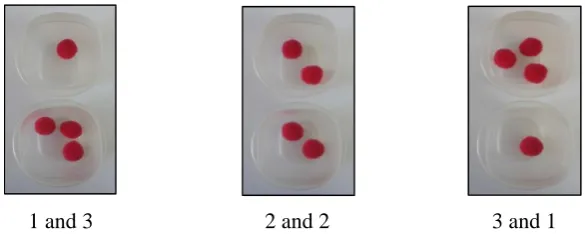
In how many different ways can you …? In this activity, teachers can provide pupils with different types of objects, such as four counters (see Figure 7) and ask: In how many different ways can you arrange four counters in two containers? Pupils are expected to find all the three different parts that make the whole number four. However, pupils usually tend to find one answer for one question. Therefore, teachers should assist or guide them to find all the answers (e.g., requiring pupils to explain and justify whether they have found all the solutions), if pupils stop solving the problem after finding one solution.
Two out of three! In this activity, teachers can ask pupils to find pairs for a number, such as six (see Figure 8), in a list of three numbers in ascending, descending, and mixed order. With the list on the board, pupils can take turns selecting the two numbers that make the whole. As with all problem solving activities, pupils should be challenged to justify their answers.
2 1 5 5 1 2 2 5 1
3 2 4 4 2 3 3 3 4
3 3 5 1 3 3 2 4 3
4 3 2 2 3 4 4 3 2
2 5 1 1 5 2 2 1 5
(a) (b) (c)
Figure 8. Number pairs for ‘six’ in (a) ascending, (b) descending, and (c) mixed order.
(a) (b) (c) (d)
1 and 3 2 and 2 3 and 1
Finding the Missing Part
In activities for finding a missing-part (a hidden or unknown part), pupils may either know the whole number or one of the part, but try to find out the unknown (covered or hidden) part(s) or whole. Finding the missing part usually elicits the maximum reflection on a combination or subtraction of numbers (Van de Walle et al., 2013). For instance, presenting pupils only with 3 out of a whole amount of 5, they can find the missing parts 2 (writing 5 – 3 = 2). Two or more pupils can engage in missing part activities alone or with teacher assistance or guidance. Following activities for finding the missing part (respectively, hiding monkeys! How many are hidden? I wish I had…!) with corresponding illustrations have been adapted from Confer (2005) and Van de Walle et al. (2013).
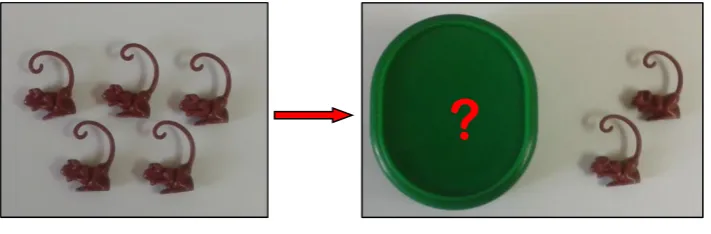
Hiding monkeys. Teachers can provide pupils with a set of counters that represent ‘monkeys’ (or other animals) equal to the target amount, which needs to be counted out, and the rest are put aside. As illustrated in Figure 9, one pupil may place the monkeys under a small plastic container, which represents a ‘cave’. While the pupil pulls some of the monkeys out into view (this amount could be none, all, or any amount in between), other pupils should be encouraged to guess how many monkeys are hiding inside the cave and explain why they think so. Hereafter, they can check to see if their guesses were correct. For example (see Figure 9), if 5 monkeys are the whole and only 3 are not shown, pupils may say: “three and two is five”. If they hesitate or the hidden part is unknown, teachers ought to exhibit all the monkeys immediately.
How many are hidden? A teacher can also ask pupils to count out counters, like six coloured stones, in his or her open palm. Then the teacher should close the palm and confirm that pupils know how many are hidden there. Hereafter, the teacher must show them some (e.g., an amount of 4) of the stones in the open palm, but hide the rest in the other palm hand, as illustrated in Figure 10. The next will be to ask pupils: “How many are hidden?” and “How do you know?” The teacher can repeat this activity with different amounts or hidden parts. If a pupil responds rapidly and correctly, it can be deduced that he/she had mastered that number.
Figure 9. Hiding monkeys …!
?
Figure 10. How many are hidden?
I wish I had…! This is an activity for holding out a bar of connecting cubes, a dot strip, a dot plate, a dice, or some objects less than a whole amount, such as number six. Teachers can also consider adding a familiar context, like “I wish I had six books to read” as shown in Figure 11. A teacher by saying “I wish I had six …” expects pupils to respond with the part needed to make six. Counting on can be used to check. The game can focus on a single number especially as a starting point for pupils, or the “I wish I had …” number can change each time as the pupils become advanced in understanding the part-whole relationship.
“I wish I had six books” I need
I have (I need one more)
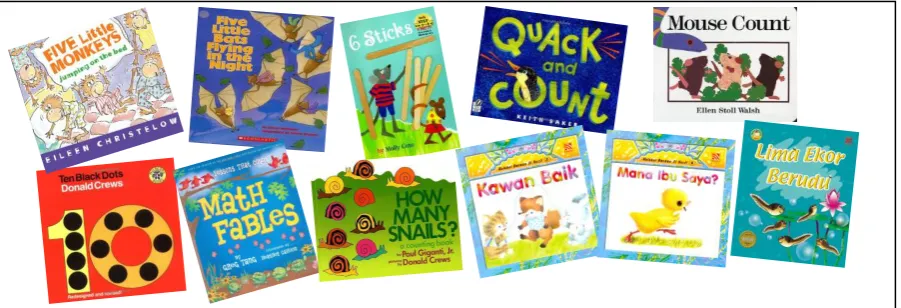
Finding the missing part in storybooks. Storybooks in which the part-whole relationship is embedded with corresponding illustrations can facilitate mental representations of numbers and thus allow pupils to better draw or build a design of numbers (Novakowski, 2007). Such storybooks, promoting pupils’ understating of the part-whole concept, are easily available in Malaysia. Teachers can guide pupils to explore the part-whole relationship through reading and acting out the stories, such as those depicted in Figure 12. For example, the part-whole relationship of number five can be explored in Christelow’s (2000) ‘Five Little Monkeys
Jumping on the Bed’, Jenkin’s (2001) ‘Five Creatures’, Metzger’s (2004) ‘Five Little Bats
Flying in the Night’, and Tan’s (2006) ‘Lima Ekor Berudu’ (Five Little Tadpoles). For other
numbers like six and seven, Coxe’s (1999) ‘Six Sticks” and Baker’s (1999) ‘Quack and Count’,
can be referred to respectively. Pupils can also explore two-number combinations, which yield a particular sum up to 10, through Kellogg’s (1997) ‘Jack and the Beanstalk’.
Reading or listening to stories usually taps into children’s enjoyment (Confer, 2005). Therefore, children may particularly engage in finding the missing-part activity in Walsh’s (1991) ‘Mouse Count’, whereas for exploring situations where both parts are unknown, they can read or listen to Cuyler’s (2010) ‘Guinea Pigs Add Up’ and Schwartz’s (1982) ‘There is a
Carrot in My Ear and Other Noodle Tales’. Teachers can also read Crews’s (1995) ‘Ten
Black Dots’, Tang’s (2004) ‘Math Fables’, Giganti’s (1988) ‘How many snails?’, and other
story books in the local language (i.e., Bahasa Malaysia), such as ‘Mana Ibu Saya’ and
‘Kawan Baik, which are published by Pelangi Publication (1999).
?
Figure 12.Storybooks for enhancement of pupils’ understanding of the part-whole relationship Before showing pictures in a storybook, teachers may ask their pupils to predict combinations for each number mentioned in the book. In particular, teachers should guide pupils to represent (i.e., saying, reading aloud, or writing) what they have learnt (Protheroe, 2007). Writing can be in the form of drawings (●●● ●●), numbers written in blanks (a group of 3 dots and a group of 2 dots), or addition equations if these are already introduced (3 + 2 = 5 or 5 = 3 + 2). Reading or writing a combination can elicit their reflective thoughts on the part-whole relationship (Van de Walle et al., 2013). Pupils should therefore be encouraged to explain reasons for their answers or performance in the entire activity (Smith; 2006). Their feedback can provide insights into what they understand and can do (i.e., their understanding of the part-whole concept and their representation of numbers), thereby helping teachers know what needs to be done for promoting their understanding of the part-whole relationship (Novakowski, 2007).
The missing part in a five-frame and ten-frame. Another way to encourage conception of numbers in the part-whole relationship is to see them as anchors or benchmarks of 5 and 10 (Walle et al., 2013) by utilising a ‘five-frame’ and ‘ten-frame’. The National Council of Teachers of Mathematics has provided online resources for teaching math (see the website link in the reference list) that are freely available to teachers whereby they can conduct activities using a five-frame and ten-frame, as illustrated in Figure 13.
Figure 13. Online resources for learning the part-whole concept: (a) Five-frame (b) Ten-frame.
With the frames, pupils usually tend to perform mental calculations using 5s and 10s to count up and back (Jung, 2011; Smith, 2006). For example, the five-frame facilitates to see that 2 is 3 less than 5, while the ten-frame makes it easy to see that 3 is 7 less than 10.
Considering that most pupils like to work in groups, they can be motivated by the challenge and enjoyment to solve problems, finding the missing part or parts, along with their peers (Palloff, 2007). In the group activity, teachers should also encourage pupils to understand and explain how a number can be formed from two parts in different ways as well as to represent (write or draw) what they have learnt. Pupils may hereby share their ideas or show their own unique ways of finding the part-whole relationship. This would allow teachers or researchers to assess how sufficiently pupils understand the part-whole concept and demonstrate number sense. For such an assessment the theoretical framework and test of number sense can be referred.
Conclusion
This review has examined several reasons (e.g., the national curriculum, mathematics textbooks, and teacher perception) for the underperformance of Malaysian pupils, including those high achievers, in solving mathematical problems that demand numerical estimation and mental computation. This examination has found the pupils’ underdeveloped number sense as the major reason. Contrary to the report by the Ministry of Education, this article has argued that the incomprehensive focus of the national mathematics curriculum is likely to account for this reason and the underperformance thereof. The curriculum and corresponding instructions and textbooks largely focus on written computation skills. The development of number sense has yet to become the focus of attention. The review has therefore highlighted the concern: How the Malaysian pupils’ need for the development of their number sense can be met?
This review has aimed to provide insights into this concern as well as to enhance the perception of curriculum designers, mathematics teachers, and researchers towards several issues. First, the incomprehensive focus of the national mathematics curriculum, which is heavily reliant on written computation skills, which appears to be inhibitory to the development of number sense. Second, mathematics teachers and researchers may use the theoretical framework (Mclntosh et al., 1992) and test of number sense, adapted to the sociocultural context (see Ghazali & Zanzali, 1999), in order to assess the essential components of number sense and also identify pupils who have or lack number sense in primary and secondary schools in Malaysia. Third, the pupils can make better sense of numbers through their part-whole relations, if the Malaysian school teachers promote the composition/decomposition strategy instead of counting strategies. Fourth, the part-whole relations should be adequately presented or evenly distributed in mathematics textbooks in a way allowing the pupils to exercise and understand various part-whole relations of numbers in basic operations. Lastly, given that the earlier conception of the part-whole relationship (i.e., the earlier development of number sense) is one of the main concerns, this review has suggested mathematics teachers conduct several teaching and learning activities, such as building, modelling, and designing numbers and also finding the missing part in games, storybooks, and in the five or ten frames, for pupils in year one of the Malaysian primary schools. The teachers should also encourage the pupils to engage in solving challenging word problems, to guide pupils to use multiple representations, and to communicate and share mathematical ideas.
Finally, “Although many documents have proclaimed the importance of number sense, ideas and ways to explore and investigate different aspects of number sense are needed” (Reys et al., 1999, p. 68) for the Malaysian context. Therefore, further research is needed to provide insights into several questions: Do mathematics teachers in Malaysian primary schools sufficiently understand and value the development of number sense? How do they design and conduct instructional activities to stimulate their pupils to make sense of numbers? Prospective findings could explain what and how teaching and learning activities contribute to the development of number sense.
Acknowledgments
References
Abu Hasan, Y. (2007). Mathematics education and technology: Past, present and future – the Malaysia experience. The Electronic Journal of Mathematics and Technology, 1, 90-94. Retrieved from https://php.radford.edu/~ejmt/deliveryBoy.php?paper=eJMT_v1n1n4 Alsawaie, O. N. (2012). Number sense-based strategies used by high-achieving sixth grade
students who experienced reform textbooks. International Journal of Science and
Mathematics Education, 10, 1071-1097. doi:10.1007/s10763-011-9315-y
Askew, M., Brown, M., Rhodes, V., Johnson, D., & William, D. (1997). Effective teachers of
numeracy. London: School of Education, King’s College.
Bahagian Perkembangan Kurikulum (2010). Dokumen standard kurikulum standard sekolah
rendah matematik tahun 1. [Document Standard Curriculum Standard Primary
School: Mathematics Year 1]. Malaysia: Kementerian Pelajaran Malaysia.
Baroody, A. (2000). Does mathematics instruction for three- to five-year-olds really make sense? Young Children, 55, 61-67.
Baroody, A. J., & Lai, M. L. (2007). Preschoolers’ understanding of the addition-subtraction inverse principle: A Taiwanese sample. Mathematical Thinking and Learning, 9, 131-171. doi:10.1080/10986060709336813
Baroody, A. J., Brach, C., & Tai, Y. (2006). The application and development of an addition goal sketch. Cognition and Instruction, 24, 123-170. doi:10.1207/s1532690xci2401_3 Carpenter, T. P., & Moser, J. M. (1982). The development of addition and subtraction
problem-solving skills. In T. P. Carpenter, J. M. Moser, & T. A. Romberg (Eds.),
Addition and subtraction: A cognitive perspective (pp. 9–24). Hillsdale, NJ: Lawrence
Erlbaum Associates.
Charlesworth, R. (2012). Experience in math for young children (6th ed.). Boston, MA: Wadsworth.
Cheng, Z. J. (2012). Teaching young children decomposition strategies to solve addition problems: An experimental study. The Journal of Mathematical Behavior, 31, 29-47. doi:10.1016/j.jmathb.2011.09.002
Cheng, Z. J., & Chan, L. K. S. (2005). Chinese number-naming advantages? Analyses of Chinese pre-schoolers' computational strategies and errors. The International Journal
of Early Years Education, 13, 179–192. doi:10.1080/09669760500171279
Christensen, C. A., & Copper, T. J. (1992). The role of cognitive strategies in the transition from counting to retrieval of basic addition facts. British Educational Research
Journal, 18, 37–44. doi:10.1080/0141192920180104
Confer, C. (2005). Teaching number sense. USA: Math Solution Publication.
Curriculum Development Centre (2006). Integrated curriculum for primary schools:
Curriculum specifications. Putrajaya, Malaysia: Ministry of Education Malaysia.
Dyson, N. I., Jordan, N. C., & Glutting, J. (2013). A number sense intervention for low-income kindergartners at risk for mathematics difficulties. Journal of Learning
Disabilities, 46, 166-181. doi:10.1177/0022219411410233
Fischer, F. E. (1990). A part–part–whole curriculum for teaching number in the kindergarten.
Journal for Research in Mathematics Education, 21, 207–215. doi:10.2307/749374
Garner, R. (1992). Learning from school texts. Educational Psychologist, 27, 53–63. doi:10.1207/s15326985ep2701_5
Gersten, R., Jordan, N. C., & Flojo, J. R. (2005). Early identification and interventions for students with mathematics difficulties. Journal of Learning Disabilities, 38, 293-304. doi:10.1177/00222194050380040301
Ghazali, M., & Zanzali, N. A. A. (1999). Assessment of school children’s number sense.
Ghazali, M., Idros, S. N., & McIntosh, A. (2004). From doing to understanding: An
assessment of Malaysian primary pupils' number sense with respect to multiplication and division. Journal of Science and Mathematics Education in South East Asia, 27, 92-111. Retrieved from http://www.recsam.edu.my/R&D_Journals/2004.html Ghazali, M., Othman, A. R., Alias, R., & Saleh, F. (2010). Development of teaching models
for effective teaching of number sense in the Malaysian primary schools.
Procedia-Social and Behavioral Sciences, 8, 344-350. doi:10.1016/j.sbspro.2010.12.048
Ghazali, M., Rahman, A. S., Ismail, Z., Idros, S. N., & Saleh, F. (2003, September).
Development of a framework to assess primary students’ number sense in Malaysia.
Paper presented at the International Conference: The Decidable and the Undecidable in Mathematics Education. Brno, Czech Republic.
Ginsburg, H. P., Klein, A., & Starkey, P. (1998). The development of children’s
mathematical knowledge: Connecting research with practice. In W. Damon, I. E. Sigel, & K. A. Renninger (Eds.), Handbook of child psychology (pp. 401–476). New York, NY: Wiley & Sons.
Greeno, J. G. (1991). Number sense as situated knowing in a conceptual domain. Journal for
Research in Mathematics Education, 22, 170-218. doi:10.2307/749074
Griffin, S. (2004). Teaching number sense. Educational Leadership, 61, 39-42. Retrieved from http://www.ascd.org/publications/educational-leadership/feb04/vol61/num05/Teaching-Number-Sense.aspx
Howden, H. (1989). Teaching Number Sense. The Arithmetic Teacher, 36, 6-11. Retrieved from http://search.proquest.com/docview/208776791?pq-origsite=gscholar
Jung, M. (2011). Number relationships in a preschool classroom. Teaching Children
Mathematics, 17, 550-557.
Kaminski, E. (1997). Teacher education students’ number sense: Initial explorations.
Mathematics Education Research Journal, 9, 225-235. doi:10.1007/bf03217312
Kuldas, S., Sinnakaudan, S., Hashim, S., & Ghazali, M. (2016). Calling for the development of children's number sense in primary schools in Malaysia. Education 3-13, 1-13. doi:10.1080/03004279.2016.1143521
Lee, J. S., & Ginsburg, H. P. (2009). Early childhood teachers’ misconceptions about
mathematics education for young children in the United States. Australasian Journal
of Early Childhood, 34, 37–45.
McIntosh, A., Reys, B., & Reys, R. (1992). A proposed framework for examining basic number sense. For the Learning of Mathematics, 12, 2-8. Retrieved from http://flm-journal.org/Articles/94F594EF72C03412F1760031075F2.pdf
McIntosh, A., Reys, B., Reys, R., Bana, J., & Farrell, B. (1997). Number sense in school
mathematics: Student performance in four countries. Perth, Australia: Edith Cowan
University.
Ministry of Education (2012). Preliminary report: Malaysia education blueprint 2013-2025. Retrieved from
http://www.moe.gov.my/en/pelan-pembangunan-pendidikan-malaysia-2013-2025
Ministry of Education. (2004). Integrated curriculum for secondary schools syllabus:
Mathematics. Selangor: Ministry of Education Malaysia.
Mohamed, M., & Johnny, J. (2010). Investigating number sense among students.
Procedia-Social and Behavioral Sciences, 8, 317-324. doi:10.1016/j.sbspro.2010.12.044
Mullis, I. V. S., Martin, M. O., Foy, P., & Alka, A. (2012). TIMSS 2011 international results
in mathematics. Chestnut Hill, MA: TIMSS & PIRLS International Study Center,
Lynch School of Education, Boston College. Retrieved from
National Council of Teachers of Mathematics (1989). Curriculum and evaluation standards
for school mathematics. Reston, VA: National Council of Teachers of Mathematics.
National Council of Teachers of Mathematics. Five-frame: http://illuminations.nctm.org/Activity.aspx?id=3564 National Council of Teachers of Mathematics. Ten-frame
http://illuminations.nctm.org/Activity.aspx?id=3565
Noordin, N., Dollah, R., & Talib, R. L. (2012). Inability to handle simple mathematics among lower secondary school students: A cause for worry. OIDA International Journal of
Sustainable Development, 3, 49-58. Retrieved from
http://papers.ssrn.com/sol3/papers.cfm?abstract_id=2048041
Novakowski, J. (2007). Developing ‘Five-ness’ in kindergarten. Teaching Children
Mathematics, 14(4), 226-31.
Palloff, R., & Pratt, K. (2007). Building online learning communities: Effective strategies for
the virtual classroom. San Francisco: John Wiley & Sons, Inc.
Parmjit S. (2000). Understanding the concepts of proportion and ratio among grade nine students in Malaysia. International Journal of Mathematics Education, Science and
Technology, 31, 4, 579-599. doi:10.1080/002073900412688
Parmjit, S, (2009). An assessment of number sense among secondary school students.
International Journal for Mathematics Teaching and Learning, 1-27. Retrieved from
http://www.cimt.plymouth.ac.uk/journal/singh.pdf
Parmjit, S. (2006). An analysis of word problems in school mathematics texts: Operation of addition and subtraction. Journal of Science and Mathematics Education in Southeast
Asia, 29, 41-61.
Parmjit, S., & Hoon, T. S. (2010). An analysis of addition and subtraction word problems in mathematics textbooks used in Malaysian primary school classrooms. Brunei
International Journal of Science and Mathematics Education, 2(1), 68-85.
Payne, J. N., & Rathmell, E. C. (1975). Number and numeration. In J. N. Payne (Ed.).
Mathematics learning in Early Childhood: 37th Yearbook NCTM (pp.125-160).
Reston, VA: National Council of Teachers of Mathematics.
Piaget, J. (1965). The child’s conception of number. New York, NY: Norton.
Protheroe, N. (2007). What does good math instruction look like? Principal, 7(1), 51-54. Resnick, L. (1983). A developmental theory of number understanding. In H.P. Ginsburg
(Ed.). The Development of Mathematical Thinking (pp. 109-151). New York: Academic Press.
Resnick, L. B. (1989). Defining, assessing and teaching number sense. In J. Sowder & B. Schappelle (Eds.), Establishing foundations for research on number sense and related
topics: Report of a conference. San Diego, CA: San Diego State University, Center
for Research in Mathematics and Science Education.
Reys, R., Reys, B., Emanuelsson, G., Johansson, B., McIntosh, A., & Yang, D. C. (1999). Assessing number sense of students in Australia, Sweden, Taiwan, and the United States. School Science and Mathematics, 99, 61-70.
doi:10.1111/j.1949-8594.1999.tb17449.x
Santi, S., & Munirah, G. (2015). An analysis of numbers parts-whole relationship in
Malaysian year one mathematics textbooks. Paper presented at the 1st International
Conference on Educational Studies, Pulai Springs Resort, Johor, Malaysia. Sheetal Sood, S., & Jitendra, A. K. (2007). A comparative analysis of number sense
instruction in reform-based and traditional mathematics textbooks. The Journal of
Special Education, 41, 145–157. doi:10.1177/00224669070410030101
Sophian, C. (1988). Limitations on preschool children’s knowledge about counting: Using counting to compare two sets. Developmental Psychology, 24, 634–640.
doi:10.1037/0012-1649.24.5.634
Sowder, J. (1990). Mental computation and number sense. TheArithmetic Teacher, 37, 18-20. Retrieved from http://search.proquest.com/docview/208777492?pq-origsite=gscholar Steinke, D. (2008). Using part-whole thinking in math. Focus on Basics: Connecting
Research & Practice, 9(A), 1-7.
Steinke, D. A. (2001, June). Does “Part-Whole Concept” understanding correlate with
success in basic math classes? Paper presented at the 8th Annual Adults Learning
Mathematics Conference. Roskilde, Denmark.
Thornton, C. A., & Tucker, S. C. (1989). Lesson planning: The key to developing number sense. The Arithmetic Teacher, 36, 18-21. Retrieved from
http://search.proquest.com/docview/208783025?pq-origsite=gscholar
Tsao, Y. (2004). Exploring the connections among number sense, mental computation performance, and the written computation performance of elementary preservice school teachers. Journal of College Teaching and Learning, 1(12). Retrieved from http://www.cluteinstitute.com/ojs/index.php/TLC/article/view/2022
Van de Walle, J., Karp, K., & Bay-Williams, J. (2013). Elementary and middle school
mathematics: Teaching developmentally (8th ed.). Boston: Pearson.
Yang, D. C. (2005). Number sense strategies used by sixth grade students in Taiwan.
Educational Studies, 31, 317-333. doi:10.1080/03055690500236845
Yang, D. C., & Huang, F. Y. (2004). Relationships among computational performance, pictorial representation, symbolic representation and number sense of sixth-grade students in Taiwan. Educational Studies, 30, 373-389. doi:10.1080/0305569042000310318 Yang, D. C., Reys, R., & Reys, B. (2009). Number sense strategies used by pre-service
teachers in Taiwan. International Journal of Science and Mathematics Education, 7, 383-403. doi:10.1007/s10763-007-9124-5
Zhou, X. (2002). Preschool children’s use of counting to compare two sets in cardinal situations. Early Child Development and Care, 172, 99-111.
doi:10.1080/03004430210889
Storybooks
Baker, K. (1999). Quack and count. San Diego: Harcourt and Brace Company.
Christelow, E. (2000). Five little monkeys jumping on the bed. New York: Scholastic Inc. Coxe, M. (1999). Six sticks. New York: Random House Books for Young Readers. Crews, D. (1995). Ten black dots. Toronto: Harper Collins.
Cuyler, M. (2010). Guinea pigs add up. New York: Walker & Co.
Giganti, P. (1988). How many snails? Donal Crews. New York: Green Willow Book. Jenkins, E. (2001). Five creatures. New York: Francis Foster Books.
Kellogg, S. (1997). Jack and the beanstalk. New York: William Morrow & Company, Inc. Metzger, S. (2004). Five little bats flying in the night. Laura Bryant. New York: Scholastic Inc. Schwartz, A. (1982). There is a carrot in my ear, and other noodle tales. New York: Harper & Row. Tan, J. (2006). Five little tadpoles. Johor Bahru, Malaysia: Penerbitan Pelangi Sdn. Bhd.
Tan, J. (2006). Lima ekor berudu. Johor Bahru, Malaysia: Penerbitan Pelangi Sdn. Bhd. Tang, G. (2004). Math Fables. Illustrated by Heather Cahoon. New York: Scholastic Press. Walsh, E. (1991). Mouse count. Harcourt Brace Jovanovich.
Are you my mother? (1999). Johor Bahru, Malaysia: Penerbitan Pelangi Sdn. Bhd.
Good friends. (1999). Johor Bahru, Malaysia: Penerbitan Pelangi Sdn. Bhd.
Kawan baik. (1999).Johor Bahru, Malaysia: Penerbitan Pelangi Sdn. Bhd.