ISSN 1392-2785 ENGINEERING ECONOMICS. 2008. No5 WORK HUMANISM
Improving the Development of Managers’ Personal and Professional Skills
Povilas Zakarevi
č
ius
1, Erika Župerkien
÷
2 1Vytauto Didžiojo universitetas Daukanto g. 28, LT-44246, Kaunas 2Klaip
÷dos universitetas
Minijos g. 153, LT-93185, Klaip÷da
The present article analyzes the development of personal and professional skills of managers who perform managing function in contemporary organizations. Research shows that it is necessary to develop managers‘ skills using a set of different methods and tools. In the course of time, a number of models for manager skills development that recommend the potential ways for the implementation of these processes have been created.
One of these models is the training cycle proposed by Kolb (1992) encompassing four stages: actions, thinking, understanding, and checking. Another model – the one made by Byham, Smith, and Pease (2002) - is based on application of group training method. It is carried out in five stages: 1) formation of a group of employees, 2) defining training abilities of the employees, 3) making recommendations for the development, 4) implementing the program, 5) defining directions for new improvements. Probably, the most widely applied and used model is Statt‘s(2000) sequence of development processes: defining demand for development, formulating the goals, compiling the content, choosing the methods, evaluating the results. The most modern model is Whetten and Cameron‘s (2002) five-step model applying social science theory. It is based on the following steps: assessment of a skill, development of the skill, analysis of the skill, testing the skill in practice, using the skill in practical performance.
The above listed models have their strengths and weaknesses. The most typical weakness is underestimated complexity and sophisticated character of the development process. Having made the analysis of the described models of managers‘ personal and professional skills development and having generalized the results of particular research carried out in Lithuanian organizations, it could be stated that the process of skills development needs to be improved. This process holistically combining possible 17 activities.
On a basis of research results, the article offers a holistic development process that is comprised of the following fields: defining personal and professional priority skills of managers; selecting of employees and assessing of their possessed skills; choosing the best tool for the assessment; systematization of the skills to be developed; search for the possible development ways and methods; choosing the development method that corresponds the goals; providing managing activity to the trained employees; correcting the development process depending on specific situations; responding to the needs of the development; combining several development tools;
applying of short-term development tools; choosing the most suitable development program; defining the role of direct supervisor in the development process; appointing mentors for the employees involved in self-development; career planning.
Implementation of the holistic model of managers‘ skills development process showed that this attitude has positive impact on the results of this process.
In order to survive in constantly changing society, people must learn a lot on their own; most often it is related to competence training seminars, re-qualification training, maintenance of professional competence level, development of personal and professional skills.
Keywords: manager, manager’s skill, skill development, development model, personnel development, development process.
Introduction
will be able to keep a company of qualified, intelligent, and initiative showing employees.
An excellent overview of research on a manager‘s personal skills is proposed in two Stogdill‘s studies (1948, 1974). In his first study, Stogdill compiled and analyzed more than 124 research works on personal skills carried out in 1904 – 1947. In his second study, he analysed the other 163 studies that were made in 1948 – 1970. Analysing each of these studies in more detail, it becomes clear, how personal qualities contribute to management.
Mann (1959), Miner (1978), Lord DeVader and Alliger (1986), R.Bleik and J.Mouton (1985), Kirkpatrick and Locke (1991), Wilson (2004), etc. also studied personal skills of managers.
Robert Katz (1955) started a more detailed research of professional skills that resulted in a management model based on the manager‘s professional qualities (skills), and which was improved in 1990-ies by Mumford, Zaccaro, Harding, Jacobs and Fleishman (2000); Yammarino, (2000), Connelly, Gilbert, Zaccaro, Threlfall, Marks, Mumford(2000).
Although managers‘ personal skills have been studied since the beginning of the 20th century, and their professional skills - since the middle of the 20th century, the constantly changing environment of organizations raises new requirements, therefore the definition of personal and professional skills of managers who correspond to such new requirements and improvement of their development is an urgent scientific and practical problem.
The objective. The objective of the research that resulted in the present article: to analyse models of developing managers‘ personal and professional skills, define their strengths and weaknesses; to offer an option for managers‘ skills development that would create conditions for a successful development of managers‘ skills taking into account challenges of contemporary world.
Research methods. Comparative analysis of scientific literature, critical analysis, systematization, and generalization were used as the methods of scientific research.
Models of organisation of managers’ personal
and professional skills development
Development of managers‘ skills – one of personnel management activities – is a part of personnel development used in the management process. Therefore, the development of managers‘ personal and professional skills in the organization should be related to the development of the organization‘s personnel, where one of strategic directions is development of personal and professional skills necessary for managerial work of such organization employees who have aspirations to build their career. When analysing the issue of developing managers‘ value orientation and personal as well as professional skills, one faces a multiple problem encompassing not only development itself as a process, but also an analysis of its models, development as personnel management activity and a component of career planning, as well as a strategy for inciting individual‘s active performance.
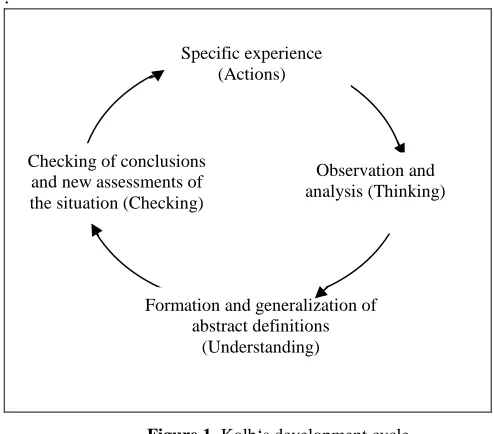
Models and programs are used for the development of personal and professional skills. Many programs improving manager‘s work are based on application of specific management theories; for instance, education programs are based on LPC accident theory (Fiedler, Chemers, 1982, 1984), a normative solution model (Vroom, Jago, 1988), transforming management (Bass, 1990, 2000; Bass, Avolio, 1990) and a manager‘s motivation (Miner, 1986). A review of research made on the basis of such theories showed that all these methods can improve the quality of duties performed by a manager (Bass, 1990; Latham, 1988; Tetrault, Schriesheim, Neider, 1988). However, many researchers did not disclose whether increased effectiveness stems from the application of a theory or, rather, from acquiring of interpersonal and managerial skills. In practice, a number of development organisation models aimed at the development of both managers and all employees are widely applied. One of the earlier models is the development cycle offered by Kolb (1976). According to Kolb (1992), four stages could be defined in a successful development process:
1. Actions. Specific experience from what we call “the real life“.
2. Thinking. Empiric observation and analysis of activities.
3. Understanding. Logical analysis of the observations, search for respective patterns in observations, memorising what was taught.
4. Checking. Checking how new expertise relates to “the real world“ and how the behaviour has changed.
Kolb demonstrated this cycle using a round diagram (Figure 1)
.
Figure 1. Kolb‘s development cycle
Seeking for a truly integrated development of managers‘ personal and professional skills, one needs to go through this cycle at least once. However, a round diagram is not the most appropriate way to demonstrate Kolb‘s idea, as the development does not end where it started. In any case, seeking for better results, each stage is important regardless of which one is given priority by a person- mentor of a manager.
Specific experience (Actions)
Formation and generalization of abstract definitions
(Understanding) Checking of conclusions
and new assessments of the situation (Checking)
1 Stage. Employees having high level of potential are drawn together Structural sub-divisions select members of express-development groups. All candidates are discussed and group’s members are selected from them.
A candidate is informed about all the benefits and shortcomings of being in the development group; after that, he/she decides whether he wants to become a group member.
2 Stage. Further assessment of the employees‘ development/training possibilities
Defining the group member’s strengths and development/training needs with the help of the express-development centre.
The participant is informed about the results of the evaluation; his/her further development/training priorities are defined.
3 Stage. Making specific recommendations for improvement
Decisions are made on the nature of the tasks, special exercises given to participant, instructor’s appointment, progress assessment and information about the methods of completion of the program.
Specific goals related to his/her job or new tasks are established for further employee‘s development.
The group member together with his/her supervisor define target fields and form a strategy for his/her further development/training. This process might be carried out changing job authorities, setting additional goals of development.
4 Stage. Implementation of the program and process documentation Develops crucial behavioural skills
by participating in special trainings and working under a mentor‘s supervision.
Uses new expertise and behaviour patterns during a new appointment or short-term training.
The participant reports on how successfully he/she uses new skills and behavioural templates.
Each group member compiles a career-building portfolio and meets with his/her supervisor or mentor to make assessment of the development process and to set new development goals.
5 Stage. Assessment of progress and defining new directions.
A group of observers watch the participant‘s progress and make decisions regarding assignment of further tasks.
Figure 2. A model of managers’ skills development
The model of organisation of managers‘ skill development offered by Byham, Smith, and Paese (2002) is based on the group method. They offer to organize groups consisting of personnel who all have high potential of taking new positions in the future. Development of necessary skills of such persons is achieved through extending job descriptions and delegating new responsibilities. That results in a faster learning pace and a clearer evaluation of career opportunities. Every group members are assigned a mentor-supervisor; the group participates in special tutoring-improvement programs
.
Each member is provided with information on his/her progress (feedback), they receive consultations of specialists on a regular basis while top managers attentively watch employees‘ abilities and evaluate their readiness to take new positions.
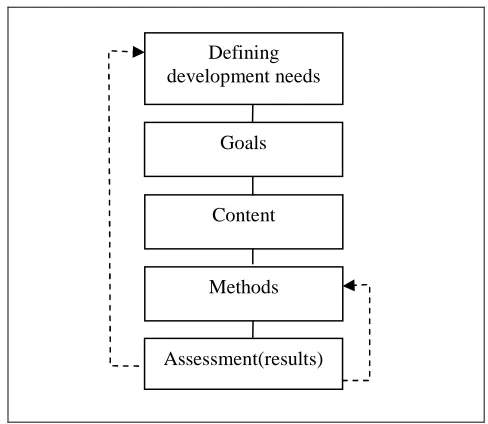
This model is exhibited in Figure 2. Another quite often applied model of development organisation is Statt‘s (2000) sequence of development process stages (Figre 3).
As the author emphasises, the first stage of the development process organisation is defining develop-pment needs – an action rarely implemented in practice in organizations. Managers usually limit themselves to an announcement made to employees that some of them need training since there are certain performance problems or because there are some funds left in the training budget. Organizations often incompletely implement this important stage of defining development needs or pay to
that too little attention thinking that skills that need to be developed are obvious or that specialists will be able to better define the content of the development trainings.
Figure 3. Stages of the development organisation process
The second stage is defining the goals for development. If the goals are specific, short-term, it is easier to achieve positive results, and they will be less related to managerial
Defining development needs
Goals
Content
Methods
problems. However, long-term goals are of no less importance, although they are more difficult to achieve, they should not become a reason for giving up the entire development program since they often pay back.
On the third stage, while compiling the content of the development program, it is necessary to ensure that it corresponds to the level of the trained persons. Besides, it is proven that information which can be related to the already possessed expertise is easier to understand. This principle is especially important when compiling development programs. The role of feedback is crucial while developing both practical and communication skills.
A lot of educative methods can be successfully used for the development of managerial qualities and skills (the fourth stage): lectures, demonstrations, textbooks, videotapes, simulation equipment and dialogue computer tutors, exercises, professional games. Statt (2000) divides educative methods into three groups: information presentation methods, modelling methods and educating methods applied at work, simultaneously with the main duties of the trained.
The fifth stage of the development organisation process is assessment – a rather complex task, thus it is either carried out incompletely or not performed at all. Ideal assessment has to be an ongoing process, continuing throughout the entire development program. When making assessment of the development program, it is recommended to use 4 different criteria listed in an order of increasing importance: response (how the trained respond to the training), expertise (feedback tools are used, i.e. tests before and after the program to find out what the participants have really learned), behaviour (reaction of the direct supervisors to the performance results of the trained upon completion of training is observed. It is a way to define how the acquired expertise is applied at work), results (improvement level of performance results of the trained are assessed, and decisions are made on what needs to be done in order to maintain the same results). Social science theory method proved itself as one of the most effective tools in developing manager‘s skills (Boyatzis, Kolb, 1995; Whetten, Cameron, 2002). It is based on interaction of existing conceptual, practically applied expertise and the acquired expertise. As methods for skill development both cognitive work (related to cognition) and behaviour-related activities are used. Various options of this method are used differently – both during training at work and during training seminars of managers. In business schools this method is used less often. Four stages, corresponding to the four Kolb‘s development cycle stages, compose this training process (Hopkins, 1993; Boyatzis, Kolb, 1995; Boyatzis, Stubbs, Taylor, 2002; Statt, 2000; Whetten, Cameron, 2002): (1) instruction (behaviour principles and sequence of actions are indicated); (2) demonstration of these principles with the help of various cases, films, documents or incidents; (3) a role game or exercises that allow to apply these principles; (4) discussion (ensuring a feedback channel), with colleagues, instructors and experts.
Research on understanding of the similar skills and skills development (Boyatzis and Kolb, 1995; Whetten,
Cameron, 2002) demonstrated that effectiveness of this method can be increased under three important conditions. First, the applied behaviour principles have to be based on psychology theories of a relevant case and relevant serious studies (the validity of development tools is supported by real and reliable scientific research, determining effectiveness of application of one or another principle). Second, the trained must understand their own level of competence and be motivated enough to develop it further (it is important to ensure feedback allowing people to assess their level of competence). Third, there has to be an applicability condition in the development model. When training sessions are held in classrooms, a fast feedback communication is available, thus the trained can make decisions without fear to make a mistake; however, the real work conditions are difficult to re-create, therefore the tasks are usually limited to consultation-like exercises, independent analysis of publications, solving of specific problems defining preconditions for success or failure of every decision.
It is recommended (Whetten, Cameron, 2002) to apply a five-element development model instead of the four-element one thus improving the development process cycle created by Kolb. In order to implement this method, Whetten, Cameron offers a development model presented in Table 1.
Table 1
Model of managers‘ personal and professional skills development
Components Content Goals
Assessment of a skill
Research instruments Role-games
Evaluation of the existing competence and expertise level; formation of readiness for a change.
Development of a skill
Tests Behaviour recommendati ons
Learning the relevant
principles, substantiation of the behaviour recommendations
Analysis of a skill
Cases Examples of successful and
unsuccessful activities, analysis and support of behaviour principles
Practice Exercises,
Imitations, Role-games
Practical understanding of behavioural recommendations; combining the principles with individual style; using and
maintaining the feedback
communication. Application
of a skill
Tasks (behavioural and written)
Transition from classroom-based to practical actions, development of individual skills.
necessary personal skills are better developed; new projects are implemented; relevant professional skills are acquired which contribute to one‘s career-building; relevant value orientation is formed. Independent professional development and self-learning is easier to implement applying mobility strategy in organizations: when importance of higher (university) degree education is emphasised in a company, in spite of how many of such people are really needed, because it is assumed that those with higher degree of education have much more opportunities to be re-qualified and adapted to new work requirements than those with lower education level. Mobility strategy (Sakalas, 1998) is recommended in HI-TECH companies where the rapid progress of innovative technologies takes place, rapidly changing qualification requirements for the personnel. There are favourable conditions to apply this strategy in Lithuania because there are enough people with university degree; besides, companies applying this strategy make a positive impact on pre-conditions for the development of the organization and its employees. However, an organization that does not have an idea of what kind of managers it will need in the future, cannot systematically develop the required skills of its future managers and make assessment of its employees abilities to take managerial positions, because responding to the environment and organization needs, the importance of skills and qualities required for the company‘s managers may also change as well as their relevance in each specific case.
Modification of the managers‘ personal and
professional skills development process
Having made the analysis of the described models of managers‘ personal and professional skills development also having evaluated models, and having generalized the results of particular research carried out in Lithuanian organizations, it could be stated that the process of skills development needs to be improved. We offer one of possible options of this process holistically combining 17 activities.
1. Define managers‘ personal and professional priority skills. Byham, Smith, Paese‘s (2002) experience in practice proves that various organizations strive for developing specific skills by dividing them into categories: job requirements, knowledge about an organization, skills, abilities, negative personal factors. Having analysed personal and professional skills crucial for managers we offer using another categories for the skills to be developed. Personal qualities: intellect, self-confidence, determination, adherence to principles and sociability; professional skills: technical, communi-cative, conceptual; value orientation: a manager is an example for everybody, people are the most important, relations, results, precision of actions, a need for innovation, honesty and co-operation. Even in the smallest organization, the most important personal and professional skills of manager has to be listed.
2. Select employees and make assessment of existing skills. One main condition has to be set to the selected candidates – a sufficient potential for the
development of skills that are crucial for a manager. The potential is the existing or developed basic personal (initiative, active attitude, etc.) and professional (university degree or a personal tendency to extend existing knowledge) skills typical for a manager. The skills that are important for a manager are developed depending on the level of skills he/she already possesses.
Purposeful development of personal and professional skills of the employees having high potential will not be fruitful if the organization itself does not participate in the development process. Good employees know their value that was foreseen in them by the organization‘s managers, thus the development process is often understood as an enforced, automatic procedure and not as an opportunity to acquire new knowledge. According to Byham, Smith, Paese (2002), it is easier to spot an employee with high potential than to prepare him/her for a managerial position.
A relation between a person‘s individual qualities, abilities, values and the major goals of the organization performance is necessary for a successful employee skill development. Ideally, self-development of managers should be reflected in their organization‘s performance results. Striving for both of these goals, a thorough assessment is needed providing extensive information on optimal direction of further development of employee skills. Standard managerial skills courses and learning plans do not always correspond to an individual employee‘s development needs. A clear and detailed assessment allows for making a decision that suits a particular situation. When assessing an employee‘s suitability for a specific position, it is necessary to systemize data of assessment results, information about the course of development and data about the results of current performance. Such integrated data will help to discover whether the employee‘s skills correspond to his/her current position.
3. Choose the best suiting tool for assessment of existing personal and professional skills. A number of tools widely analysed in research publications are used for assessment (imitation of work situations, 360 degrees feedback, evaluation centres, personal interviews and feedback, analysis of personal qualities, tests of learning abilities, psychological analysis of personality, etc). Each assessment tool discloses yet different scope of information on existing skills. Imitations of work situations allow to disclose information about the existing skills and abilities in the most precise way; quite enough of information is provided through the 360 degrees feedback as well as interviews that are oriented toward particular behaviour in situations. Analysis of personal qualities and tests of learning abilities are not as informative. Analysis of personal qualities as well as interview with 360 degrees feedback and imitation of work situations disclose more information when assessing negative personal qualities. Interview with a 360 degrees feedback and interview oriented towards particular behaviour in situations are the best ways to get information on job requirements and knowledge about the organization.
In order to make deeper and more informative assessment, use of several, complementing each other instruments is necessary, what will allow evaluating of a manager‘s existing potential in various aspects.
as many as possible personal and professional skills that would help him/her managing in even better way; at the same time, he/she should have as few as possible negative personal qualities. When choosing an employee for a managerial position these skills have to be systemized: divide the skills to be developed into basic categories, define priority skills related to a specific position applying assessment scale (Fig., 1-5 Likert scale, DDI scale – based on behaviour patterns) .
5. Describe potential development ways and methods and search for them. It is important to look for new methods of managers’ personal and professional skills development - for ones that are most relevant to the 21st century organization and requirements of its employees. One of such alternatives is the Byham, Smith, Paese’s (2002) recommended development in groups of express-development. Even though this system might seem quite complex at first sight, it should not require more time than is spent on planning of personnel replacement. Employees suiting specific requirements are drawn into groups of express-development; directions and methods of skills development are more clearly defined for each employee; higher quality level in the analysis of group members is achieved due to clearly defined time and behaviour standards.
It is recommended to use the most advanced development models, e.g. skill assessment – skill development – skill analysis – practical testing – skill use; also: analysis of whom one wants to become – self-analysis – improvement program – practical testing and development of new behavioural habits - creation and sustainment of harmonious relationships.
6. Choose personal and professional skill development method that is most relevant to the goals of the development. It is better to choose a skill development method depending on the goals of such development: if the goals of development should correspond to a certain position requirements, in this case the most relevant is appointment method (trial position); if the case is deepening knowledge about the organization, then short-term courses, appointments, sometimes practical tasks should be chosen; if skills and abilities are to be developed, - choose various practical exercises; if personal skills need to be developed, - professional consultations should be used. Personal skills (high energy level, abilities to adapt in various situations, tendency to manage, learn, positive attitude, abilities to recognise environment changes, orientation towards innovations, towards results and strategic directions, etc.) are the most difficult to develop as well as managerial skills (entrepreneurship, management of performance processes, consolidation of resources, insight into processes in a global context, etc). It is easier to develop communication skills (communicate and influence people, communication with people with a different cultural and social backgrounds), management skills (assign and delegate tasks, communicate a vision, form effective teams).
7. Assign as many as possible managerial duties to high potential employees, setting their development goals in the development process questionnaires. Extending employees‘ duties in such a way allows to
develop their skills and abilities that are reflected in their questionnaire forms that, in their turn, disclose the effectiveness of the development process in each assignment. The questionnaire forms help employees to realize what and why they have to develop in each assignment as well as to see clearly what kind of help they need while performing new tasks. Using of questionnaire forms prevent unreasonable wasting of development opportunities.
8. Respond flexibly to changing situations and make respective amendments to the planned development processes. Members of the development groups should as often as possible participate in events and situations providing opportunities to acquire as fast as possible one or another type of practical experience. However, majority of events providing possibilities for a fast-paced development is impossible to plan ahead, because professional is full of surprises. Therefore an opportunity to get new experience should be recognised in each unplanned event or task that contribute to development of personal and professional skills. 9. Consider the employees‘ need for development depending on trends of performance. Business globalization not only offers new possibilities but also requires different personnel development policies, e.g. implementation of new work methods and restructuring of activities will not justify themselves without well trained personnel and managers who clearly understand and accept the new vision and actively disseminate new values and organizational culture.
10. Development combining several development tools during the process. Usage of only one tool does not ensure effective manager skill development; to implement the development plan, a creative combination of these tools is necessary, for instance, to combine appointment, short-term practical exercises, development programs, and professional instruction.
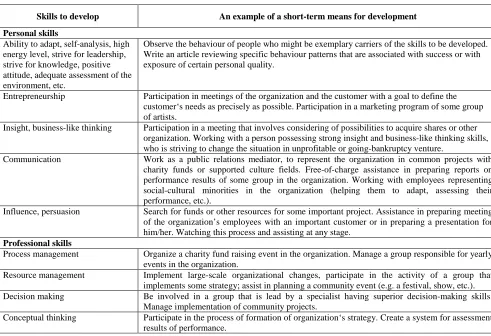
11. Use as many various short-term development tools as possible. It is necessary to use all opportunities both within and outside of the organization; to promote the initiative and creativity of the trained in their search for such opportunities. Examples of possible short-term development tools are offered in Table 2.
Table 2
Examples of a few short-term tools for managers‘ personal and professional skills development
Skills to develop An example of a short-term means for development
Personal skills
Ability to adapt, self-analysis, high energy level, strive for leadership, strive for knowledge, positive attitude, adequate assessment of the environment, etc.
Observe the behaviour of people who might be exemplary carriers of the skills to be developed. Write an article reviewing specific behaviour patterns that are associated with success or with exposure of certain personal quality.
Entrepreneurship Participation in meetings of the organization and the customer with a goal to define the
customer‘s needs as precisely as possible. Participation in a marketing program of some group of artists.
Insight, business-like thinking Participation in a meeting that involves considering of possibilities to acquire shares or other organization. Working with a person possessing strong insight and business-like thinking skills, who is striving to change the situation in unprofitable or going-bankruptcy venture.
Communication Work as a public relations mediator, to represent the organization in common projects with
charity funds or supported culture fields. Free-of-charge assistance in preparing reports on performance results of some group in the organization. Working with employees representing social-cultural minorities in the organization (helping them to adapt, assessing their performance, etc.).
Influence, persuasion Search for funds or other resources for some important project. Assistance in preparing meeting
of the organization’s employees with an important customer or in preparing a presentation for him/her. Watching this process and assisting at any stage.
Professional skills
Process management Organize a charity fund raising event in the organization. Manage a group responsible for yearly
events in the organization.
Resource management Implement large-scale organizational changes, participate in the activity of a group that implements some strategy; assist in planning a community event (e.g. a festival, show, etc.). Decision making Be involved in a group that is lead by a specialist having superior decision-making skills.
Manage implementation of community projects.
Conceptual thinking Participate in the process of formation of organization‘s strategy. Create a system for assessment results of performance.
are no real opportunities for a promotion; when choosing a development program, find out about its ratings and recent comments of its participants, as the quality of programs might change in the course of time: instructors, fields of their interest and focal points of the program might also change; sending an employee for a training will not always be enough to remove the shortcomings of development of his/her as a future manager existing skills, however, the training might contribute to that process. The program has to be coordinated with an opportunity to apply the knowledge at work as well, supported by supervision and feedback.
13. Choose a program that is composed specifically for organization‘s personnel. Such program, despite certain peculiarities, has to correspond to general recomme-ndations: the program has to ensure a positive ROI; determine clearly what the expected results are; choose the most relevant development methods; adapt the program to particular needs of organization; make a precise development schedule; promote and create opportunities for the participants of the development process to try out the acquired skills at work; attract qualified lecturers; choose a suitable place; prepare the participants for the development; involve as many organization‘s managers as possible.
14. Convince the managers participating in training that “the key to success is in their own hands“. Partnership relationships between the participants themselves and the participants and their mentors-supervisors are
necessary for the development of managers‘ skills. The trained persons are the driving power of their progress therefore they have responsibly and on their own to seek for the implementation of their skill development plan; if an organization does not provide necessary support or a mentor is not assigned in time, they themselves have to take initiative in such case; the trained should also realize that people who agreed to help them face a difficult task: it is not easy to use all their creative skills and initiative when providing the necessary support for the trained. Thus already before the beginning of the development process, it is necessary to define responsibilities of the development process participants themselves, their managers and their mentors-supervisors.
15. Define the role of a direct supervisor in the development process. The direct supervisor of the trained has to give advice on how to implement the given tasks and develop the necessary skills as well as provide specific assistance if needed.
The direct supervisor‘s functions in the process of skills development:
Incite the trained to control his/her development independently since an independent formation of one‘s development plans results in more motivated and effective implementation of them.
Evaluate, together with the trained, his/her progress and usage of the developed skills in practice (using a 3600 feedback or considering customers’ comments).
Help implementing plans of skills development. It is important that development plans and self-education would not be hindered by internal policies or lack of resources or other reasons. Thus the help has to be provided to the trained by timely contacting necessary people, providing the trained with all necessary resources. Every appointment has to be the challenge for the trained; however, it needs to be honest and implementable.
Instruct the trained before he/she makes a mistake, i.e. explain what has to be done in advance, not afterwards, thus helping to gain positive experience, building on trust and speeding up the development process. Instructions are to help the trained to make a decision independently – not provide him/her with a ready solution, i.e. not to decide instead of the trained, but to help analyze all alternatives and promote correct decision-making.
Support the development of the supervisor‘s of the trained. Support is necessary to all without exception, even to self-confident people. When developing personal and professional skills and value orientation, one has to apply to himself/herself higher standards, thus the assurance, that the goal is being successfully achieved, is crucial. It is recommended to remind about the overall achieved progress even at the time when current performance problems are being addressed.
Help planning one‘s time. The time meant for the main duties should not be given up in the name of the appointed training position. Here the supervisor‘s help is crucial determining the priorities: what should be given more time and attention in order not to waste the organization‘s investment into an employee’s development but at the same time ensuring the smooth work of organization.
At once, after a particular event ensure feedback both on positive moments of the assessed activity and the fields that need further improvement.; provide this information to the trained and help interpreting it.
Record the progress of the trained in relevant documents.
Share your experience and work-related expertise. Assign increasingly more complicated tasks and
more responsibilities.
Disclose a different standpoint on ideas and actions, i.e. be able in principle to defend an opposite view, oppose to a generally accepted opinion. Help to have a look at the same problem from a different point of view.
16. Appoint mentors-supervisors to the trained who have wide organizational knowledge and experience.
It is necessary to evaluate all possible benefits and shortcomings when deciding what mentor (helper) to appoint to the trained. “Short-term” mentors have to help the trained to plan activities necessary for the development, watch the progress of the trained achieved during the implementation of development plans and provide other needed assistance. Short-term mentors have to help their apprentices to understand the goals, values and organizational culture of the organization, overall activity directions of the organisations, their own abilities and shortcomings in performance in the organization. The short-term mentor must observe communication between the trained and his direct supervisor; if the task set for skill development of the trained turns to be ineffective, the mentor has the right to adjust the situation. By the end of the mentoring period, a new short-term mentor has to be assigned to the trained and the plan of skill development updated accordingly. With a change of mentors, the trained is given an opportunity to get to know as many as possible people within the organization as well as diverse points of view. As the trained moves to higher position in the organizational hierarchy, the mentor has to be of higher level as well.
Long-term mentors have to be able to give career advice to their apprentices, help establishing new business relations, promote additional opportunities, “advertise“ their apprentice‘s achievements among the top management and give advice on issues related to the organization‘s policies. However, at first it is helpful to appoint a short-term mentor to the trained and replace him/her every two years by the principle of rotation. Such an appointment of mentor is much more flexible, besides the trained should also have a possibility to choose a mentor or choose the other one in addition to the already assigned one – thus the trained could compare their points of view and expect additional assistance.
When choosing a mentor for the trained from the same department where the trained is working, or from other department, distinctive benefits and weaknesses of both cases should be considered. One mentor should take care of only one trained since in case of several trained ones, it is difficult to perform mentor’s duties impartially and honestly due to a big scope of work.
17. Plan promotion to higher and higher position. As the trained moves from one position to another, he/she experiences certain hardships that need to be discussed with the trained. Only that way creates an opportunity for the development of necessary skills. When moving a manager to the higher position, it is necessary to evaluate possible and sometimes inadequate responses as a success formula that perfectly worked in one case might be inapplicable in another (this is especially typical when moving lower-level managers with developed technical skills to a higher management level where conceptual and similar skills are necessary).
ongoing observation and control as well as creative problem - solving are essential for the improvement of development process. However, implementation of the above mentioned recommendations already might result in better development of personal and professional skills in the organization.
Conclusions
1. Under conditions of globalization and internationalization of economy, the issue of managing organizations becomes more and more complicated. Organizations’ managers face new situations that require to apply modern methods, organizational forms and processes in management. As a result of these challenges, personal and professional skills of managers have to change and develop. Thus improvement of development of these skills becomes an important tool ensuring conditions for the success of the organization‘s activities.
2. The discussion on the issues of personal and professional skills development started in the first half of the 20th century. On a basis of such research, a number of models of organisation of skills development process were created and applied in practice. The most widely used are following ones: the Kolb‘s four development stages model, the Statt‘s five development stages model, and Whetten and Cameron‘s model applying social science theory. The main drawback of these and other well-known models is the fact that they incompletely evaluated complexity and sophisticated character of the development process.
3. Striving to ensure a holistic approach to the development of managers‘ skills, the process should be organised applying processes- and action-based approach, i.e. to create a systematised complex of development actions and implement it during the development process. Research publications making a basis of the present article show that one possible option for the approach of process- and actions-based skills development is a process holistically combining 17 development means. Practical application of this model showed that activity aimed at the development of managers‘ personal and professional skills is effective and yields positive results.
References
1. Bass, B. M. Bass & Stogdill's Handbook of Leadership. 3rd ed. Simon & Schuster Adult Publishing Group, 1990.
2. Bass, B. M. The future of leadership in learning organizations // Journal of Leadership Studies, 2000, Vol. 7 (3), p. 18-40.
3. Bass, B. M., & Avolio, B. J. Developing transformational leadership: 1992 and beyond // Journal of European Industrial Training, 1990, 14 (5), p. 21-27.
4. Byham, W. C., Smith, A. B., Paese, M. J. Grow your own Leaders. How to Identify, Develop, and Retain Leadership Talent. New Jersey: Prentice Hall, 2002.
5. Boyatzis, R. E. & Kolb, D. A. From learning styles to learning skills: The Executive Skills Profile // Journal of Managerial Psychology, 1995, 10(5), p. 3-17.
6. Boyatzis, R. E., Stubbs, E. C., and Taylor, S. N. Learning cognitive and emotional intelligence competencies through graduate management education // Academy of Management Learning and Education, 2002, 1(2), p. 150-162.
7. Blake, R. R., & Mouton, J. S. The Managerial Grid III. Houston, TX: Gulf, 1985.
8. Connelly, M. S., Gilbert, J. A., Zaccaro, S. J., Threlfall, K. V. Marks, M. A., & Mumford, M. D. Exploring the relationship of leadership skills and knowledge to leader perfomenace // Leadership Quarterly, 2000, 11 (1), p. 65-68.
9. Fiedler; F. E. Bell, C. H. Chemers M. M. Patrick D. Increasing Mine Productivity and Safety Through Management Training and Organization Development: A Comparative Study // Basic and Applied Social Psychology, 1984, Vol. 5, Issue 1 March 1984, p. 1-18.
10. Fiedler, F. E. & Chemers, M. M. Improving leadership effectiveness: The leader match concept, 2nd ed. New York: John Wiley, 1982.
11. Foucher, R., Tremblay, N. Atoformation et maintien de la compètence en emploi: ètudes des conitiond qui avorisent l’emergence. GIRAT, document inèdit, Universitè de Montrèal, 1991.
12. Hopkins, R. David Kolb’s experiential learning-machine // Journal of Phenomenological Psychology, 1993, 24(1), p. 46-62.
13. Katz, R. L. Skills of an effective administrator. Harvard Business Review, 1955. In: Northouse, P. G. Leadership: theory and practice. USA: Sage Publications, 2004.
14. Kirkpatrick, S. A., & Locke, E. A. Leadership: Do traits matter? // The Executive, 1991, 5, p. 48-60.
15. Kolb, J. A. Leadership of creative teams // Journal of Creative Behavior, 1992, 26, p. 1-9.
16. Kolb, David A. Learning Style Inventory. Boston, Massachusetts: McBer and Company, 1976.
17. Latham, G. P. Human resource training and development // Annual Review of Psychology, 1988, 39, p. 545-582.
18. Lord, R. G., DeVader, C. L.,& Alliger, G. M. A meta-analysis of the relation between personality traits and leadedrship: An application of validity generalization procedures // Journal of Applied Psychology, 1986, 71, p. 402-410.
19. Mann , R. D. A review of the relationship between personality and perfomance in small groups // Psychological Bulletin, 1959, 56, p. 241-270.
20. Miner, J. B. Twenty years of research on role motivation theory of managerial effectiveness // Personnel Psychology, 1978, 31, p. 739-760.
21. Miner, J. B. Managerial role motivation training // Journal of Management Psychology, 1986, 1 (1), p. 25-30.
22. Moisan, A. L’autoformation et organisaton apprenante // Education permanente, 1995, No 122, p. 39-51.
23. Mumford, M. D. Zaccaro S. J., Harding, F. D. Jacobs, O.T. & Fleishman, E. A. Leadership skills for a changing world: Solving complex social problems // Leadership Quarterly, 2000, 11(1), p. 11-35.
24. Pineau, G. L’atoformation en chantiers // Education permanente, 1995, No 122.
25. Portelli, P. Un rèseau d’èchanges rèciproques de savoirs: un lieu e pratiques sociales d’autoformtion individuelle et collective? // Education Permanente, 1995, No. 122.
26. Sakalas, A. Personalo vadyba. Vilnius: Margi raštai, 1998. 27. Stogdill, R. M. Handbook of Leadership: A survey of theory and
research. New York: Free Press, 1973.
28. Statt, D. A. Using Psychology in Management Training. The Psychological Foundations of Management Skills. Routledge: London, 2000.
29. Tetrault, L. A. Schriesheim, C. A. & Neider, L. L. Leadership training interventions: A review // Organizational Development Journal, 1988, 6 (3), p. 77-83.
30. Tremblay, N. Apprendre en situation ‘autodidaxie. Une ètude des besoins des apprenants et es compètences des intervants. Montrèal, Presse Universitaires de Motrèal, 1986.
31. Vasileff, J. Histoire de vie et pèagogie du projet. Lyon: Chronique Sociale, 1992.
33. Whetten, Davis & Kim S. Cameron. Developing Managing Skills, Fith Edition, Prentice Hall, 2002.
34. Wilson, M. S. Effective developmental Leadership: A Study of the Traits and Behaviors of a Leader who develops both People and the Organization. A Dissertation. Louisiana State University, 2004.
35. Yammarino, F. J. Leadership skills: Introducing and overwiew // Leadership Quarterly, 2000, 11 (1),p. 5-9.
Povilas Zakarevičius, Erika Župerkien÷
Vadovų asmeninių ir dalykinių savybių ugdymo tobulinimas
Santrauka
Šių dienų organizacijose visuose valdymo lygiuose vis did÷ja talentingų, gerai parengtų vadovų poreikis, o vadovavimo veiksmingumas tampa viena iš svarbiausių organizacijos veiklos s÷km÷s sąlygų. Tai siejama su įvairiomis priežastimis: globalizacija, darbo pobūdžio kitimu, darbo rinkoje esančių žmonių did÷jančia įvairove, žmonių migravimu, konkurentų veiksmais siekiant pervilioti kvalifikuotus specialistus ir kt. Organizacijų vadovai nuolat patiria vis naujų iššūkių, reikalaujančių naujų
minčių ir id÷jų: kaip valdyti organizaciją, bendrauti ir numatyti organizacin÷s veiklos ateitį greitoms permainoms, visuotinei konkurencijai, darbo j÷gos įvairovei, greitiems rinkos pokyčiams, organizacin÷s struktūros permainoms, kintančiai ekonomikai ir rinkai. Šios išor÷s ir vidaus j÷gos verčia vadovus ieškoti naujų metodų, kaip išlaikyti ne tik prekių ir paslaugų kokybę, bet ir darbuotojų moralumą bei organizacinį stabilumą. Tad vadovų asmeninių ir dalykinių savybių
ugdymas tampa priemone, užtikrinančia organizacijai vadovaujančio personalo kokybines savybes. Organizacija, radusi veiksmingą vadovų
ugdymo metodą / būdą / modelį, nestokos talentingų, veiksmingai organizuojančių savo veiklą vadovų, sumažins laiko ir išteklių sąnaudas specialistų paieškai, geb÷s išlaikyti kvalifikuotų, protingų ir iniciatyvių
darbuotojų kolektyvą.
Puiki vadovo asmeninių savybių tyrimų apžvalga pateikta dviejuose Stogdill (1948, 1974) tyrimuose. Pirmajame tyrime Stogdill surinko ir analizavo daugiau negu 124 asmeninių savybių tyrimus, kurie buvo atlikti 1904–1947 metais. Antrajame tyrime jis nagrin÷jo kitus 163 tyrimus, kurie buvo atlikti 1948–1970 metais. Atidžiau žvelgiant į kiekvieną iš šių
tyrimų, paaišk÷ja, kaip asmens savyb÷s prisideda prie vadovavimo. Asmenines vadovų savybes tyrin÷jo ir Mann (1959), Miner (1978), Lord DeVader ir Alliger (1986), R. Bleik ir J. Mouton (1985), Kirkpatrick ir Locke (1991), Wilson (2004) ir kt.
Robert Katz (1955) prad÷jo išsamesnius dalykinių savybių tyrimus, kuriais remiantis atskleistas vadovo dalykin÷mis savyb÷mis (įgūdžiais) grįstas vadovavimo modelis, patobulintas XX a. dešimtajame dešimtmetyje Mumford, Zaccaro, Harding, Jacobs ir Fleishman (2000), Yammarino (2000), Connelly, Gilbert, Marks ir kt. (2000).
Nors vadovų asmenin÷s savyb÷s tiriamos jau nuo pra÷jusio šimtmečio pradžios, o dalykin÷s savyb÷s - nuo pra÷jusio šimtmečio vidurio, nuolat besikeičianti organizacijų aplinka kelia naujus reikalavimus, tod÷l juos atitinkančių vadovų asmeninių ir dalykinių
savybiųįvardijimas bei jų ugdymo tobulinimas yra aktuali mokslin÷ ir praktin÷ problema.
Šio straipsnio objektas – vadovų savybių ugdymo modeliai.
Tikslas. Tyrimų, kurių rezultatais remiantis parašytas šis straipsnis, tikslas: išanalizuoti vadovų asmeninių ir dalykinių savybių ugdymo modelius, įvardyti jų pranašumus ir trūkumus; pasiūlyti vadovų savybių
ugdymo proceso variantą, sudarantį sąlygas s÷kmingai ugdyti vadovų
savybes, atsižvelgiant į šių dienų iššūkius.
Suformuluotiems tikslams realizuoti atlikti tyrimai parod÷, kad vadovų asmenin÷ms ir dalykin÷ms savyb÷ms ugdyti naudojami įvairūs būdai ir priemon÷s. Įvairiais laikotarpiais yra sudaryta daugyb÷ vadovų
savybių ugdymo organizavimo modelių.
Tyrimo metodai: mokslin÷s literatūros palyginamoji analiz÷, sisteminimas, apibendrinimas.
Vienas iš tokių modelių – Kolb pasiūlytas ugdymo ciklas, apimantis keturias stadijas: veiksmų, mąstymo, suvokimo, patikrinimo. Kitas modelis – Byham, Smith, Pease (2002) sudarytas modelis, pagrįstas grupinio ugdymo metodo taikymu (angl.). Jis realizuojamas penkiais etapais: 1) darbuotojų grup÷s subūrimo; 2) darbuotojų ugdymo galimybių
nustatymo; 3) rekomendacijoms tobuliniti (development) sudarymo; 4) programos realizavimo, 5) naujų tobulinimo krypčių nustatymo. Bene plačiausiai praktikoje taikomas modelis – Statt (2000) sudaryta ugdymo procesų seka: ugdymo poreikio nustatymas, tikslų formulavimas, turinio sudarymas, metodų parinkimas, vertinimo atlikimas. Moderniausias modelis - socialinio mokymo teoriją pritaikantis Whetten ir Cameron (2002) penkių veiksmų modelis. Jis apima šiuos veiksmus: savyb÷s vertinimą, savyb÷s ugdymą, savyb÷s analizę, savyb÷s patikrinimą
praktikoje, savyb÷s panaudojimą veikloje.
Apibūdinti modeliai turi ir pranašumų ir trūkumų. Būdingiausias trūkumas – neįvertintas ugdymo proceso kompleksiškumas, sud÷tingumas. Tyrimų rezultatais remiantis straipsnyje siūlomas kompleksinis ugdymo procesas, jungiantis šias veiklas: vadovų
prioritetinių asmeninių ir dalykinių savybių įvardijimą; darbuotojų
atranką ir jų turimų savybių įvertinimą; vertinimui tinkamiausio instrumento pasirinkimą; ugdytinų savybių susisteminimą; galimų
ugdymo būdų ir metodų paiešką; ugdymo metodo, atitinkančio tikslus pasirinkimą; vadovavimo veiklos ugdomiems darbuotojams suteikimą; ugdymo proceso atsižvelgiant į konkrečias situacijas koregavimą; reagavimą į ugdymo poreikius; kelių ugdymo instrumentų derinimą; trumpalaikių ugdymo priemonių taikymą; tinkamiausios ugdymo programos pasirinkimą; tiesioginio vadovo vaidmens ugdymo procese apibr÷žimą; glob÷jų besiugdantiems paskyrimą; karjeros planavimą.
Kompleksinio vadovų savybių ugdymo proceso modelio realizavimas parod÷, kad toks požiūris daro teigiamąįtaką šio proceso rezultatams.
Išvados.
1. Ekonomikos globalizavimo ir internacionalizavimo sąlygomis vadovavimas organizacijoms tampa vis sud÷tingesnis. Organizacijų
vadovai susiduria su naujomis situacijomis, reikalaujančiomis vadyboje taikyti modernius metodus, organizacines formas, naudoti procesus. D÷l iššūkių turi keistis, ugdytis vadovų asmenin÷s ir dalykin÷s savyb÷s, tod÷l šių savybių ugdymo tobulinimas tampa svarbia priemone, užtikrinančia organizacijos veiklos s÷kmingumą.
2. Vadovų asmeninių ir dalykinių savybių ugdymo problemos prad÷tos tyrin÷ti XX a. pirmojoje pus÷je. Šių tyrimų pagrindu sudaryta ir praktikoje naudojama daugyb÷ savybių ugdymo organizavimo modelių. Labiausiai paplitę modeliai yra Kolb keturių ugdymo stadijų modelis, Statt (2000) penkių ugdymo etapų modelis bei Whetthen ir Cameron (2002) socialinio mokymo teoriją pritaikantis modelis. Šių ir kitų žinomų
modelių pagrindinis trūkumas – juose neišsamiai įvertintas ugdymo proceso kompleksiškumas ir sud÷tingumas.
3. Siekiant užtikrinti vadovų savybių ugdymo kompleksiškumą jį
tikslinga organizuoti taikant procesinį–veiklinį požiūrį, t. y. sudaryti sisteminę ugdymo veiklų visumą ir ją realizuoti ugdymo proceso metu. Tyrimais, kurių rezultatais remiantis parengtas šis straipsnis, nustatyta, kad vienas iš galimų procesinio- veiklinio savybių ugdymo modelio variantų yra 17 ugdymo veiklų kompleksiškai jungiantis procesas. Praktinis šio modelio taikymas parod÷, kad vadovų asmeninių ir dalykinių
savybių ugdymo veikla yra efektyvi ir rezultatyvi.
Raktažodžiai: vadovas, vadovo savyb÷, savybių ugdymas, ugdymo modelis, personalo ugdymas, ugdymo procesas.