Vol.7 (2017) No. 5
ISSN: 2088-5334
NMEP based Gaussian Mutation Process on Optimizing Fitness
Function for MOEED
M. R. M. Ridzuan
#1, E. E. Hassan
#2, A. R. Abdullah
#3, N. Bahaman
*4, A. F. A. Kadir
#5#
Center for Robotics and Industrial Automation (CeRIA), Faculty of Electrical Engineering, Universiti Teknikal Malaysia Melaka, Hang Tuah Jaya, Durian Tunggal, 76100, Malaysia
E-mail: [email protected], [email protected], [email protected], [email protected]
*
Department of Computer System and Communication, Faculty of Information and Communication Technology, Universiti Teknikal Malaysia Melaka, Hang Tuah Jaya, Durian Tunggal, 76100, Malaysia
E-mail: 4[email protected]
Abstract— The increment of Economic Dispatch (ED) problem is very distressing today. In view of countless of the researchers doing
the research to minimize the ED problem day after day, the multi objective New Meta Heuristic Evolutionary Programming (NMEP) techniques are proposed to optimize the multi objective function in ED problem called as Multi Objective Environmental Economic Dispatch (MOEED). The techniques mimic the original Meta Heuristic Evolutionary Programming (Meta-EP) and merge with Artificial Immune System (AIS) with some improvement in Gaussian mutation process and cloning process. The NMEP produced two objective function result simultaneously by exercising the weighted sum method. In order to justify the result, the comparison between the NMEP and Meta-EP techniques is conducted with difference case number of alpha. Therefore, the outcome of the simulation shows the NMEP approach is better than Meta-EP in the both case numbers of alpha. The simulation is operated using MATLAB simulation based on standard IEEE 26 bus system in the laboratory.
Keywords— economic dispatch; artificial intelligence; multi objective function.
I. INTRODUCTION
Economic dispatch optimization is related to generating the electrical power. In this world, there are many types of electricity sources such as hydro, wind, solar, thermal, tidal energy and nuclear but the major electricity is generated from the thermal plants such as fuel generator [1]. Therefore, Secure Environmental Economic Dispatch (SEED) is studying past a decade to improve the optimization the consequence of electricity utility year after year by priority to the thermal generated. The traditional economic dispatch optimization algorithm proposed, like Linear Programming (LP), Non-Linear Programming (NLP), Lambed Iteration (LI), Lagrangian Relaxation (LR), and Quadratic Programming Algorithm (QP) so as to solve the problem in the beginning but it failed to achieve the large scale problem solution [2]. Nowadays, Artificial Intelligent family (AI) is the famous algorithm to solve the problem through the hundreds of algorithms in the world. Since AI is proposed, there are thousand algorithm dawns based on AI algorithm rules and beginning the modern algorithm due to the recent
(GA), Artificial Neural Network (ANN), Simulated Annealing (SA), Tabu Search (TS), Particle Swarm Optimization (PSO), Ant Colony Optimization (ACO), Evolutionary Programming (EP) and Artificial Immune System Algorithm (AIS) [3]-[5]. Evolutionary Programming (EP) is introduced by Lawrence J. Fogel in 1960 through the interest in stochastic optimization strategy [6]. Later in 1986, Meta Heuristic Evolutionary Programming (Meta-EP) is proposed by Glover by using higher level language to improve the optimization problem result [7]. On the other hand, the Meta-EP is the most common algorithm that successfully solves many problems related to the economic dispatch problem. Recently, Meta-EP is a very efficient method and faster than other methods in computational time. The Meta-EP involve two major parts namely as an intensification and diversification [8]. The intensification describes the ability through each optimization stage detail and outcome with high quality solutions, whereas the diversification describes the ability through plenty of dissimilar region of the exploration gap.
with modification in Gaussian mutation process and added some minor process which is cloning process, adapted from the Artificial Immune System algorithm. The AIS was proposed by Jerne in 1974 [9] and improved in 1990s as a new branch in computational intelligence [10]. The solution generates from the multi objective function technique. The multi objective function problem with a combination of two objectives which is total system loss and total generation cost to minimize both simultaneously by following the condition of constraints [11]. Then, the process of weighted sum techniques combines the objective function to produce the total fitness result [12]. Commonly, the multi objective method required longer computational time and multiple runs than single objective function to obtain the result. In this paper NMEP method has been proposed to solve multi objective economic dispatch problem or MOEED with the effect of optimizing through the elitist approaches multi objective function with the difference type number of alpha based on standard IEEE 26 bus system [13].
II. MATERIAL AND METHOD
A. Objective Function
The multi objective function will be produced from a combination of two or more objective functions into singular objective function representation. Every each multi objective function will combine differential between two or three single objective functions which are total generation cost, total emission and total system loss. Therefore, this paper involved merely in total generation cost and total system loss. The combination of single objective function detail will be discussed in the next section. The formula of each single objective function and constraint is shown below [14]-[15].
1) Multi objection function: In order to discover the
maximum fitness function result from two objective function results simultaneously, equation (1) is used to present the objective function known as multi objective function.
1
( )
k
T i ni
i
F
α
f=
= ∑ × (1)
1 1
k i=αi =
∑ and max( )
max( ) min( )
i i
ni
i i
f f f
f f
− =
−
Where, k is a number of objective functions (in this study,
k equal to two), αi is weighting factor for ith the objective
function, and fni is a normalized value for ith the objective
function.
2) Total Generation Cost Minimization: The determined by minimizing the total generation cost is the main priority for this research by following equation (2).
2
( )
i gi i i gi i gi
C P =α +b P +c P
1
( )
Ng Total i gi
i
C C P
=
= ∑ dollar per hour ($/h) (2)
Where, is Ci (Pgi) the cost of generation for unit i, Pgi is
the power generated by unit i, is the αi, bi, ci cost coefficient
for the unit i, and CTotal is the sum function of each
generating unit Ng.
3) Total System Loss Minimization: Nowadays, the
important objective function of ED is to obtain the entire minimum losses during power system operation identified to be a total system loss minimization. This objective function is presented in the mathematical formulation as in equation (3).
1
g N
loss gi load i
T P P
=
=
∑
−
Watt per hour (MW/h) (3)Where, Tloss is the sum of losses in system demand, Pgi is
the power generated by unit i and Pload is the sum of load in
system demand.
B. Constraints
The two main equations (4) and (5) is necessary involve to set the limitation of constraint before the total cost minimization process is conducted.
1) Equality constraint formula:
1
Ng
gi load loss
i
P P T
= = +
∑ (4)
Where, Pload is system load demand and Tloss is total system losses.
2) Inequality constraint formula:
min gi max
P ≤P ≤P (5)
0.95 p.u ≤ V ≤ 1.05 p.u ( for 26 and 57 bus system ) Where, Pmin is the minimum real power generation of unit,i and Pmin is the maximum real power generation of unit
i.
C. A New Meta Heuristic Evolutionary Programming Algorithm (NMEP)
The fundamental of NMEP is the combination between Meta-EP algorithm and AIS algorithm with some modification to improve the original algorithm and produce the better result of the objective function. The differences from the other algorithm are the modification occurring in the Gaussian mutation process and the cloning process will be attached to minimize the total system loss and total generation cost. This approach will be dealing with two different type numbers of alpha which is fixed value and a random value. Every each of algorithm will be simulated through the both type numbers of alpha and the result will be compared to determine the best solution for the economic dispatch problem. This algorithm is conducted in the laboratory by using MATLAB simulation based on standard IEEE 26 bus system.
Start
Generaton of Control Variable
Run Load Flow
Comply Constraints ? ( Eq. 4 and 5 )
Calculated Minimum Multi Objective Function ( Eq. 1 –3 )
Enter the pool
Pool Full ? S = 20
Mutation Process ( Eq. 6 –8 )
Run Load Flow
Comply Constraints ? ( Eq. 4 and 5 )
Calculate Minimum Multi Objective Function ( Eq.1 –3 )
Cloning Process ( Eq. 9 ) Run Load Flow Comply Constraints ?
( Eq. 4 and 5 )
Calculate Minimum Multi Objective Function ( Eq. 1 –3 )
All Mutation Parents Cloning ? Combine Parents and Offsrings
Calculate Total Fitness Rank Population According to Total Fitness
Select Best Total Fitness Solution Converge ?
(Eq. 10) Finish
Initialization Process (Parent Generated)
Mutation Process (Offspring Generated)
Cloning Process (Offspring Generated) Selection Process (Elitism Method)
All Parents Mutate ? No
No
No
No
No
No
No
Yes Yes Yes Yes Yes
Yes
Yes
Yes
Yes
Yes
Fig. 1 The Flow Chart of Multi Objective Function a NMEP Algorithm.
The primary process in NMEP is initialization process. The process practically generated the random number and depended on amount number of population by following the constraints condition in equation (4) and (5). The number of the population commonly is a set of 20 random numbers. In the MATLAB simulation, the number of each control generator will be replaced with Pg1, Pg2, Pg3, Pg4, Pg5 and Pg26 to optimize the multi objective function. The total fitness in multi objective function definitely (0 to 1) will cause a new process like finding a number of alpha before evaluation process. The sum number of alpha must equal to 1 at any condition to prevent improper result in finding a number of alpha process. Otherwise, the both numbers of alpha for multi objective function are set to 0.5 in the fixed number of alpha condition.
The evaluation process is the first process to produce the result of fitness or known as multi objective function. The load flow is conducted in order to obtain the result of minimization of total system losses, total generation cost and total emission. The fitness will compute the total system losses and total generation cost, but only observe the total emission. The total fitness calculated is based on the weighted sum process according to equations (1) but to produce the objective function result need follow equation (2) and (3). Then, every objective function will transform into (0 until 1) makes the result easily analyzed.
Then, the mutation process is the different main process from the previous algorithm because some minor modification process was conducted in the Gaussian mutation process. The mutation process is producing a new generation or known as offspring by using equation (6) to (8).
, ,
' exp( ' (0,1) (0,1))
i j i j N N
η =η τ +τ (6)
, , ,
' ' ( (0,1))
i j i j i j j
L =L +η N (7)
, , ,
' ' ( (0,1))
oi j oi j i j j
L =L +η N (8) Where,
1
2n τ =
1 '
2n τ =
Where, Li,j, Loi,j, Ni,j and η’i,j are ith components of the
respective vectors, N(0,1) is a normally distribution one dimensional random number with mean 0 and 1, Nj(0,1)
indicates the new random number for each value of j. Other than mutation process, the cloning process is a new process in EP to duplicate and produce more fitness result to be selected. The process will be executed by using equation (9) depend on offspring generated result.
The selection process occurs in the last algorithm process. The selection process exploits as a combination between fitness and new offspring result. After the tournament process, 10 best random results were selected. The selection process is most important in producing the final result for the fitness. The result will be ranked from top to lower total fitness in this process.
In the meantime, some condition must be filled before generating the total fitness result. The differences between minimum fitness and maximum fitness should be equal or less than 0.0001 in the convergence test as the following equation (10). While, if the convergence test cannot accomplish, the Gaussian mutation process, cloning process and selection process should be repeated until fulfilling the convergence condition.
maximumfitness – minimumfitness≤ 0.0001 (10)
III. RESULT AND DISCUSSION
The six units of control generator were replaced with Pg2, Pg3, Pg4, Pg5 and Pg26 respectively to optimize the multi objective functions in solving economic dispatch problem in this simulation. This simulation will be divided into four different cases and tests with MATLAB simulation based on standard IEEE 26 bus system. In each test cases, 10 independent runs were conducted. Then, some precaution has been taken to prevent the error of result by determining the suitable fixed parameter to run the simulation in each algorithm. Table 1 represents the common parameter applied into each algorithm to justify the NMEP algorithm is better than other algorithms. Besides, each of the parameters chooses from a combination of several common papers. The population size is 20 and the mutation probabilities is 0.0001 for the accuracy of the result. The result is involving common constraints to secure the solution result.
Other than that, the Meta-EP and AIS technique strategy according to researchers in [17] has been merged in order to show the quality of NMEP performance to optimize fitness function of MOEED in the overall result. Thus, the result of the NMEP is able to trustworthiness based on the comparison result with Meta-EP and AIS technique. Furthermore, the result has been convincing after NMEP technique has ability to run the MATLAB simulation in two special cases with is fixed and random number of after applied weighted sum method on two objective functions. In the fixed number of alpha, the 0.5 is applied to total system loss and total generation cost for each technique. Where, the random number of alpha is auto generated during the process until performing the criterion formula for the a total number of alpha in the final stage must equal to 1.0. The result was
divided into three categories which is fixed number of alpha, random number of alpha and comparison between both numbers of alpha cases has been explained in detail below. Hence, every objective function and observation condition solution result shown in each table for comparison scenario between NMEP, Meta-EP and AIS technique below.
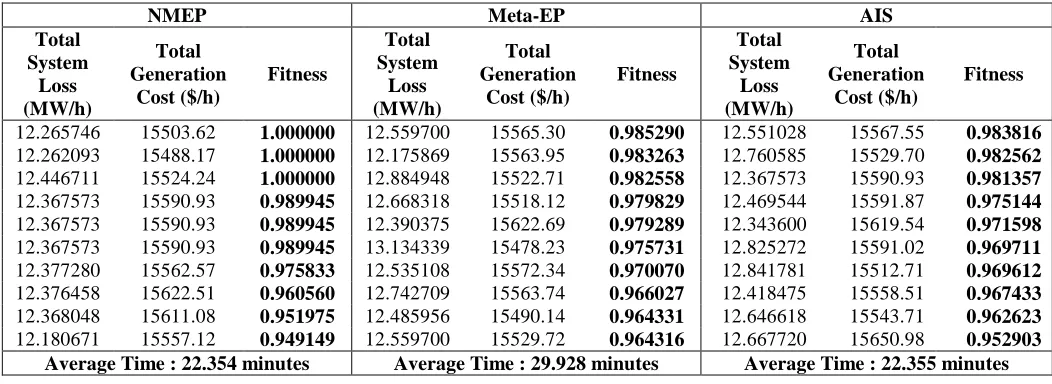
Table 2 shows the comparison result of a multi objective function in a fixed number alpha condition between NMEP, Meta-EP algorithm and AIS algorithm. Based on the table, the result of the total fitness NMEP algorithm is exactly 1.00000 and better than Meta-EP algorithm with difference about 0.014710 and AIS about 0.016184. The best fitness result for NMEP, Meta-EP and AIS in total system loss term are 12.26575 MW/h, 12.55970 MW/h and 12.55103 MW/h respectively while in total generation cost will appear in 15503.62 $/h, 15565.30 $/h and 15567.55 $/h respectively when according to the greatest total fitness. The total system loss in NMEP algorithm shows better 0.29395 MW/h from Meta-EP algorithm and 0.28528 MW/h from AIS in order to minimize the losses. In the meantime, the total generation cost of NMEP technique presents surprising results in decreasing 61.68 dollars/h from the Meta-EP and 63.93 dollars/h from the AIS technique. The result is simulated by using MATLAB simulation based on standard IEEE 26 bus system.
The comparison result of a multi objective function in a random number alpha condition between NMEP, Meta-EP algorithm and AIS algorithm is shown in Table 3. The result of total system loss in NMEP techniques is different within 1.687829 MW/h, whereas total system loss to provide 1052.11 dollars/h differently from the first run until the tenth run of MATLAB simulation. The total fitness result of NMEP technique is 0.003671 better than Meta-EP and 0.003671 better than AIS technique. This is because the fitness through some modification in Gaussian mutation process and the cloning process. Then, the comparison total system loss of NMEP result between Meta-EP and AIS approach shows that it can reduce the cost about 4663.55 dollars per year and 3766.47 dollars per year (if charge 0.26 cents = 1 kW/h). Other than that, the total generation cost decreased about 153037.20 dollars per year and 11563.20 dollars per year after using NMEP technique compared to Meta-EP and AIS respectively. An improvement of total fitness NMEP technique is the main objective of this simulation that performs 0.00367 better than Meta-EP and 0.00666 better than AIS technique. Last but not least, the NMEP approach is much faster for completing the task through the 10 times run from MATLAB simulation compared Meta-EP technique.
TABLEI
THE PARAMETER USED TO PRODUCE THE RESULT FOR STANDARD IEEE26BUS SYSTEM
No. of Generator
Cost Coefficients MV Limit Emission coefficient
αi bi ci Min Max α β γ ε Λ
1 240 7.0 0.0070 100 500 4.091 -5.543 6.490 2.0e-4 2.857
2 200 10.0 0.0095 50 200 2.543 -6.047 5.638 5.0e-4 3.333
3 220 8.5 0.0090 80 300 4.258 -5.094 4.586 1.0e-6 8.000
4 200 11.0 0.0090 50 150 5.326 -3.550 3.380 2.0e-3 2.000
5 220 10.5 0.0080 50 200 4.258 -5.094 4.586 1.0e-6 8.000
TABLEII
THE COMPARISON RESULT OF FIXED NUMBER ALPHA OF MULTI OBJECTIVE FUNCTION BETWEEN THE NMEP AND META-EPALGORITHM
NMEP Meta-EP AIS
Total System
Loss (MW/h)
Total Generation
Cost ($/h)
Fitness
Total System
Loss (MW/h)
Total Generation
Cost ($/h)
Fitness
Total System
Loss (MW/h)
Total Generation
Cost ($/h)
Fitness
12.265746 15503.62 1.000000 12.559700 15565.30 0.985290 12.551028 15567.55 0.983816 12.262093 15488.17 1.000000 12.175869 15563.95 0.983263 12.760585 15529.70 0.982562 12.446711 15524.24 1.000000 12.884948 15522.71 0.982558 12.367573 15590.93 0.981357 12.367573 15590.93 0.989945 12.668318 15518.12 0.979829 12.469544 15591.87 0.975144 12.367573 15590.93 0.989945 12.390375 15622.69 0.979289 12.343600 15619.54 0.971598 12.367573 15590.93 0.989945 13.134339 15478.23 0.975731 12.825272 15591.02 0.969711 12.377280 15562.57 0.975833 12.535108 15572.34 0.970070 12.841781 15512.71 0.969612 12.376458 15622.51 0.960560 12.742709 15563.74 0.966027 12.418475 15558.51 0.967433 12.368048 15611.08 0.951975 12.485956 15490.14 0.964331 12.646618 15543.71 0.962623 12.180671 15557.12 0.949149 12.559700 15529.72 0.964316 12.667720 15650.98 0.952903
Average Time : 22.354 minutes Average Time : 29.928 minutes Average Time : 22.355 minutes
TABLEIII
THE COMPARISON RESULT OF RANDOM NUMBER ALPHA OF MULTI OBJECTIVE FUNCTION BETWEEN THE NMEP AND META-EPALGORITHM
NMEP Meta-EP AIS
Total System
Loss (MW/h)
Total Generation
Cost ($/h)
Fitness
Total System
Loss (MW/h)
Total Generation
Cost ($/h)
Fitness
Total System
Loss (MW/h)
Total Generation
Cost ($/h)
Fitness
12.364651 15538.65 1.000000 12.569408 15556.12 0.996329 12.530021 15539.97 0.993341 12.125512 15559.19 0.990317 13.461909 15473.11 0.996215 13.028713 15570.67 0.992323 12.104303 15578.08 0.989763 12.876567 15502.85 0.994561 13.205123 15581.71 0.986905 13.394688 12672.91 0.987124 13.707969 15493.12 0.991180 12.243059 15545.44 0.986529 15.123901 15401.96 0.986374 12.933634 15486.71 0.986522 12.359122 15547.63 0.986360 14.464318 14494.20 0.978512 12.376899 15559.90 0.984977 12.915493 15508.11 0.985820 12.783565 15492.93 0.974442 12.585103 15471.31 0.980633 12.584968 15546.00 0.981810 13.341803 15538.91 0.972558 13.214646 15502.65 0.977933 12.486224 15666.57 0.975277 12.241509 15601.25 0.960652 13.845380 15545.56 0.977632 12.349834 15594.31 0.966014 14.063480 14486.54 0.948254 12.420245 15556.12 0.972501 12.706467 15564.28 0.964427
Average Time : 30.773 minutes Average Time : 34.523 minutes Average Time : 31.452 minutes
TABLEIV
THE COMPARISON SELECTED BEST RESULT OF RANDOM NUMBER ALPHA AND FIXED NUMBER ALPHA FOR MULTI OBJECTIVE FUNCTION BETWEEN THE NMEP AND META-EPALGORITHM
No. of
Alpha Algorithm
( Fitness) ( Fitness) (Observation) ( Fitness)
Total System Losses ( MW/h)
Total Generation Cost ( $/h)
Total Emission
( ton/h) Fitness
Fixed
NMEP 12.265746 15503.62 18685.16 1.000000
META-EP 12.559700 15565.30 21353.37 0.985290
AIS 12.551028 15567.55 22487.54 0.983816
Random
NMEP 12.364651 15538.65 22111.11 1.000000
META-EP 12.569408 15556.12 17904.13 0.996329
AIS 12.530021 15539.97 17494.92 0.993341
Table 4 shows the comparison selecting the best results of random number alpha and fixed number alpha for multi objective function between the NMEP, Meta-EP and AIS algorithm. Besides, despite the main multi objective function and total fitness, the total emission is attached in the final simulation to observe the emission level without distracting any objective function. Since the focused of the simulation is the difference between fixed and random number of alpha, hence each best result is collected to
First, the fixed number of alpha has discussed. The total system loss of NMEP reduces the losses about 2575.04 MW per year than Meta-EP and 2499.07 MW per year than AIS. Likewise, the important part for each generator is the total generation cost of NMEP saving the cash about 526993.92 dollar per year from Meta-EP and 560026.80 dollar per year from AIS. Beyond the result, the observation of total emission of NMEP shows impressively after generator release the clean air pollution about 23373519.60 ton per year than Meta-EP and 33308848.80 ton per year than AIS. Moreover, the NMEP win the fitness value about 0.014710 than Meta-EP and 0.016184 than AIS technique.
The second though, the random number of alpha was explained in order to understand the differences between comparative techniques. Again, the total system loss of NMEP appears to be the best technique to reduce the losses about 1793.67 MW per year than Meta-EP and 1448.64 MW per year than AIS. Also in total generation cost, the NMEP technique economy than Meta-EP about 153037.20 dollar per year and from AIS about dollar per year. On the observation condition, the NMEP emission for a random number of alpha produce more air pollution about 4206.98 ton per hour than Meta-EP and 4616.19 ton per hour from AIS. However, the worst result appears on observation and not even a little bit distracted the objective function. The NMEP completes the solution after involved about 0.003671 than Meta-EP and 0.006659 than AIS on fitness function which is the main result of this paper.
In addition, the both types of alpha have been discussed to provide comparative result clearly. Therefore, the total system losses will appear about 0.1045545 MW/h average differences between fixed and random number of alpha. Next, total generation cost produced approximately 43.41 dollars per hour average differences after comparing NMEP Meta-EP and AIS technique in both numbers of alpha. After that, the comparison between fixed and random number of alpha in case total emission is developed to about 1176.29 tons per hour average differences while the result of total fitness is only 0.010282 in average differences. As mentioned before, the NMEP algorithm is better than Meta-EP and AIS algorithm even though the best result is selected in each fitness in the MATLAB simulation. Last but not least, although the NMEP only taken less a few minutes computational time compared to other selected methods in completing the task that justifies this method achieves the best approach in optimizing the fitness for MOEED from every angle.
IV. CONCLUSION
An elitist multi objective function artificial intelligence known as a New Meta Heuristic Evolutionary Programming (NMEP) has been proposed for solving the Secured Environmental Economic Dispatch problem for this research. Then, the NMEP techniques produced the result by combined the single objective function by using a weighted sum method known as a multi objective function with differences number of alpha cases. From the multi objective function both cases for number of alpha result of NMEP algorithm shows better performances in total system loss and total generation cost compared with Meta-EP and AIS. Other than that, the random number of alpha produces
a small value of system losses and less fuel generator cost than a fixed number of alpha. However, the observation of NMEP technique objective function shows less total pollution generated from the generator compared to the Meta-EP and AIS technique on the fixed number of alpha whereas worst in a random number of alpha. However, the main objective function in this paper successful solving the EED problem on the power plants distribution. Therefore, the achievement of all performances that conclude the NMEP algorithm can develop better solutions for the economic dispatch problem than another algorithm.
NOMENCLATURE
$/h Dollar Per Hour
ACO Ant Colony Optimization AI Artificial Intelligent AIS Artificial Immune System ANN Artificial Neural Network ED Economic Dispatch EP Evolutionary Programming GA Genetic Algorithm
LI Lambed Iteration LP Linear Programming LR Lagrangian Relaxation
Meta-EP Meta Heuristic Evolutionary Programming MW/h Megawatt Per Hour
NLP Non-Linear Programming
NMEP New Meta Heuristic Evolutionary Programming PSO Particle Swarm Optimization
QP Quadratic Programming Algorithm SA Simulated Annealing
SEED Secure Environmental Economic Dispatch ton/h Ton Per Hour
TS Tabu Search Pg Power Generator
ACKNOWLEDGMENT
The research is financially supported by the team of this project from Advance Digital Signal Processing Laboratory (ADSP Lab). Special thanks also go to the Faculty of Electrical Engineering of Universiti Teknikal Malaysia Melaka (UTeM) and Ministry of Higher Education Malaysia (MOHE) for giving the cooperation and funding to ensure the feasibility and success of this research namely RAGS/1/2015/TK0/FKE/03/B0094. Their support is gratefully acknowledged.
REFERENCES
[1] Farhat, I. A., & El-Hawary, M. E. (2012, April). Multi-objective economic-emission optimal load dispatch using bacterial foraging algorithm. In Electrical & Computer Engineering (CCECE), 2012 25th IEEE Canadian Conference on (pp. 1-5). IEEE.
[2] Swain, R. K., Sahu, N. C., & Hota, P. K. (2012). Gravitational search algorithm for optimal economic dispatch. Procedia Technology, 6, 411-419.
[3] Niknam, T., Azizipanah-Abarghooee, R., & Aghaei, J. (2013). A new modified teaching-learning algorithm for reserve constrained dynamic economic dispatch. IEEE Transactions on power systems, 28(2), 749-763.
International Journal on Advanced Science, Engineering and Information Technology, 6(5), 630-637.
[5] Dhanalakshmy, D. M., Pranav, P., & Jeyakumar, G. (2016). A Survey on Adaptation Strategies for Mutation and Crossover Rates of Differential Evolution Algorithm. International Journal on Advanced Science, Engineering and Information Technology, 6(5), 613-623.
[6] Mallipeddi, R., Mallipeddi, S., & Suganthan, P. N. (2010). Ensemble strategies with adaptive evolutionary programming. Information Sciences, 180(9), 1571-1581.
[7] BoussaïD, I., Lepagnot, J., & Siarry, P. (2013). A survey on optimization metaheuristics. Information Sciences, 237, 82-117. [8] Yi, H., Duan, Q., & Liao, T. W. (2013). Three improved hybrid
metaheuristic algorithms for engineering design optimization. Applied Soft Computing, 13(5), 2433-2444.
[9] Dasgupta, D., Ji, Z., & Gonzalez, F. (2003, December). Artificial immune system (AIS) research in the last five years. In Evolutionary Computation, 2003. CEC'03. The 2003 Congress on (Vol. 1, pp. 123-130). IEEE.
[10] Basu, M. (2012). Artificial immune system for combined heat and power economic dispatch. International Journal of Electrical Power & Energy Systems, 43(1), 1-5.
[11] Singh, M., & Dhillon, J. S. (2016). Multiobjective thermal power dispatch using opposition-based greedy heuristic search. International Journal of Electrical Power & Energy Systems, 82, 339-353.
[12] Zhang, R., Zhou, J., Mo, L., Ouyang, S., & Liao, X. (2013). Economic environmental dispatch using an enhanced multi-objective cultural algorithm. Electric Power Systems Research, 99, 18-29. [13] King, R. T. A., & Rughooputh, H. C. (2003, December). Elitist
multiobjective evolutionary algorithm for environmental/economic dispatch. In Evolutionary Computation, 2003. CEC'03. The 2003 Congress on (Vol. 2, pp. 1108-1114). IEEE.
[14] Hassan, E. E., Rahman, T. K. A., Zakaria, Z., & Bahaman, N. (2015). The Improved of BFOA for Ensuring the Sustainable Economic Dispatch. In Applied Mechanics and Materials (Vol. 785, pp. 83-87). Trans Tech Publications.
[15] Yasin, Z. M., Rahman, T. K. A., & Zakaria, Z. (2012, October). Multiobjective quantum-inspired evolutionary programming for optimal location and sizing of distributed generation. In Sustainable Utilization and Development in Engineering and Technology (STUDENT), 2012 IEEE Conference on (pp. 233-238). IEEE. [16] Biethahn, J., & Nissen, V. (Eds.). (2012). Evolutionary algorithms in
management applications. Springer Science & Business Media. [17] Basu, M. (2011). Artificial immune system for dynamic economic