Behavior Analysis in the Elderly Care Center
Using Kinect Depth Sensor
Hsien-Chou Liao, Yan-Ting Lin, Jhih-Sin Chen, Min-Han Xiao, Ching-Sen Chang, and Wei-Cheng Chen
Department of Computer Science and Information Engineering, Chaoyang University of Technology, Taichung City,Taiwan (R.O.C.)
Email: {hcliao, s10027044, s10027040, s10027119}@cyut.edu.tw, [email protected], [email protected]
Abstract—The demands of elder care and long-term care are increasing as the population of elder persons is increasing. However, nursing personnel of an elderly care center have to take care of many elders in some countries. A falling accident may occur without notice by the personal in the night. It caused the problem of lawsuit or compensation. Behavior analysis of an elderly on the bed is useful to solve the above problem. A method is proposed and a prototype is developed by utilizing Kinect depth sensor in this paper. A state diagram is defined to model the behavior. When two states, sitting on the bed and getting out of bed, are detected, a siren can be issued to remind the nursing personnel for preventing the possible accident. The Kinect depth sensor can be operated in the dark environment and enables the system can monitor the behavior of an elder all the time. In addition to the dangerous behavior, all the possible behaviors can be monitored by the prototype for providing any further services. A set of testing videos with various scenarios is used to evaluate the performance. The experimental results show that the proposed method can analyze the behaviors of an elderly with high correction rate.
Manuscript received May 21, 2015; revised September 23, 2015.
in the dark environment and enables the monitoring or behavior analysis operating in 24/7 mode.
Therefore, the depth sensor is suitable for analyzing the behavior of elder people in the night. In this paper, a state diagram is designed to model the behavior of elderly. The state transition is triggered by analyzing the ROIs (Region-of-Interest) of the depth data. The proposed method is expected to prevent the possible accident, especially falling of elderly, in the night.
II. RELATED STUDIES
Some previous utilized the Kinect sensor for specific purpose. For example, A. B. H. Mohamed et al. proposed a system using Kinect sensor for assisting disabilities in the home environment [4], [5]. Kinect sensor is used to recognize the gestures of disabilities for assisting to control devices in a smart home.
M. Parajuli et al. proposed a health monitoring system using the Kinect sensor [6]. The health condition of an elder can be collected from the posture recognition (sitting or standing) and gait recognition (normal or abnormal walking). In advance, the fall of an elder can also be detected by the proposed system.
T. Banerjee et al. proposed a fall detection technique using the Kinect sensor in the real hospital [7]. Firstly, the foreground is extracted from the depth images. The foreground forms the 3D point clouds. Features are then extracted from the 3D cloud and inputted to a fuzzy rule-based inference system for detecting the possible fall event. R. Dubey et al. also proposed a method for fall recognition by using the depth camera [8]. However, fall prevention should be better than the fall detection. It is too late when a serious injury occurs.
D. Webster and O. Celik reviewed Kinect applications in elderly care [9]. They provided an overview of the state of the art, limitations, and issues of concern as well as suggestions. Authors concluded with overall remarks regarding use of Kinect in elderly care and reported a summary of critical issues and suggestions for future work in this domain.
III. SYSTEM DESIGN
The system is designed for monitoring the elder’s behavior on the bed. The basic system architecture is Index Terms—healthcare, conservation center, behavior
analysis, depth sensor
I. INTRODUCTION
The population of elderly people is increasing quickly in the modern world. Many elderly persons are enrolled in the elderly care center for some reasons. However, the number of nursing personnel in the day is usually smaller than that in the night. A falling accident may occur without notice in the night. According to the previous study, a fall might be due to variety of reasons like muscle weakness, impaired activities of daily living [1]. The falling detection, recognition, or even prevention is important issues for the elderly population.
shown in Fig. 1. A Kinect depth sensor is used to monitor the behavior of an elder. Then, the depth data is acquired and analyzed by the system. A siren alarm is triggered by the system to notify the nursing personnel to ensure the safety of an elder.
Acquire Kinect Depth Data
Trigger Siren Alarm
Check Elder's Status (Kinect Sensor)
(Elders) (Nursing Personnel) (Behavior Analysis System)
Figure 1. System architecture.
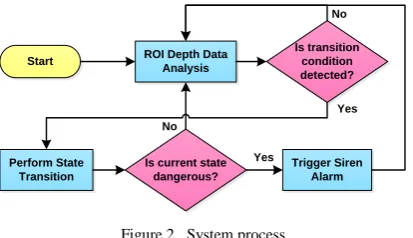
The process of the behavior analysis system is shown in Fig. 2. The process is based on a predefined state transition diagram for modeling the behavior of an elder on the bed. Several states, such as nobody, lying in the bed, sitting on the bed, are included in the diagram. Therefore, the depth data is analyzed to check whether the transition condition is satisfied, then the state transition is performed. If the state is dangerous, for example, sitting on the bed in the midnight, a siren alarm will be trigger to remind the nursing personnel.
Start ROI Depth Data Analysis
Is transition condition detected?
Perform State Transition
Is current state dangerous?
Trigger Siren Alarm
Yes
Yes
No
No
Figure 2. System process.
The state transition diagram is very important for the behavior analysis in this paper. According to the observations in the elder care center, an elderly person may lie in the bed, sit on the bed, or get out of bed. A caregiver may do an exercise program with an elderly person. Therefore, six possible states are defined and listed below and the state transition diagram is depicted in Fig. 3:
1) Nobody: There is nobody on the bed. It is the initial state of the diagram.
2) In bed: An elder is in the bed.
3) Lying in bed: An elder is lying in the bed. 4) Sitting on the bed: An elder is sitting on the bed. 5) Out of bed: An elder gets out of bed.
6) Caregiver care: A caregiver is caring an elder. The demonstration of possible state transition is shown in Fig. 4. Initially, nobody is in the bed. Then, a man who is pretending to be an elderly person is entering the FOV and lying in or sitting on the bed. A caregiver is entering the FOV to take care of the elderly person. After the
leaving of the caregiver, the elderly person is sitting on the bed and then leave the FOV.
Nobody
In bed
Sitting on the bed Lying in bed
Sitting Entering / Turning over
Lying / Sitting Out of bed
Leaving
Leaving / Entering Leaving /
Entering
Caregiver care
Leaving
Lying
Leaving / Entering Leaving / Entering Elder behavior
Elder/nursing personnel behavior
Figure 3. The state transition diagram for elderly behavior modeling.
(a) (b) (c) (d)
(e) (f) (g) (h)
Figure 4. Demonstration of possible state transitions (a) nobody (b) entering FOV (c) lying (d) sitting (e) caregiving (f) caregiver leaving (g)
getting out of bed (f) nobody.
IV. METHODS
In order to analyze the behavior of elderly, two kinds of ROIs are designed. One is red ROI and the other is green ROI, denoted as ROIR and ROIG, respectively. The
ROIR is used to detect the possible events, including:
sitting, lying, turning over, entering, and leaving. The ROIG is mainly used to detect the entering and leaving of
a person. An example of the ROIR and ROIG setting is
shown in Fig. 5.
Figure 5. The setting of ROIR and ROIG.
A depth image is two-dimensional data. A depth data of a point is a positive integer, the unit is millimeter. There are more events to be detected in ROIR than in
ROIG. Therefore, all the depths in ROIR without the
elderly are recorded as the baseline values, denoted as B. Then, the difference of the real-time depth data and the baseline values are computed. A point, P(x, y), with the difference larger than a threshold, , is marked. If the ratio of all the marked points, i.e., Dratio, is larger than
smaller than the threshold , the event lying is detected. Otherwise, the event is turning over. The above computation is represented as (1) and (2).
(1)
(2)
Besides, the entering of leaving of the elderly and nursing personnel or caregiver is also analyzed. The analysis is mainly based on the moving direction of the centroid in ROIG. The centroid of all the marked points is
computed by using (3) and (4). Here, only the x-coordinate of the centroid, denoted as Cx, is computed since only the moving direction is derived from the successive Cx. The moving direction, , is used to determine the event is either entering or leaving.
(3)
(4)
Therefore, the state transition is based on the event detected in ROIR and ROIG. For example, if the initial
state is “Nobody”, and an entering event is detected, the state is transited to “In bed”. If another entering event is detected again, it means the caregiver is caring the elder. Therefore, the elder is still in “In bed” and the state “Caregiver care” is also triggered. If the lying event is detected, the state of the elder is transited to “Lying in bed” state. Once the caregiver is leaving, the state is transited back to the current state of the elder.
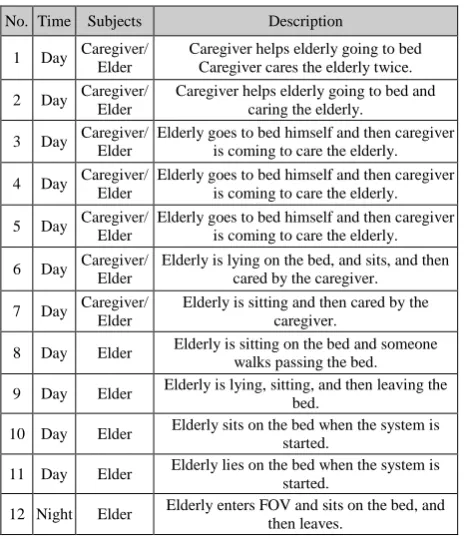
TABLEI. THE DESCRIPTIONS OF ALL THE TESTING VIDEOS
No. Time Subjects Description
1 Day Caregiver/
Elder
Caregiver helps elderly going to bed Caregiver cares the elderly twice.
2 Day Caregiver/
Elder
Caregiver helps elderly going to bed and caring the elderly.
3 Day Caregiver/
Elder
Elderly goes to bed himself and then caregiver is coming to care the elderly.
4 Day Caregiver/
Elder
Elderly goes to bed himself and then caregiver is coming to care the elderly.
5 Day Caregiver/
Elder
Elderly goes to bed himself and then caregiver is coming to care the elderly.
6 Day Caregiver/
Elder
Elderly is lying on the bed, and sits, and then cared by the caregiver.
7 Day Caregiver/
Elder
Elderly is sitting and then cared by the caregiver.
8 Day Elder Elderly is sitting on the bed and someone
walks passing the bed.
9 Day Elder Elderly is lying, sitting, and then leaving the
bed.
10 Day Elder Elderly sits on the bed when the system is
started.
11 Day Elder Elderly lies on the bed when the system is
started.
12 Night Elder Elderly enters FOV and sits on the bed, and
then leaves.
V. EXPRIMENTAL STUDY
In order to evaluate the performance of the proposed method, a prototype is implemented and a set of testing videos is recorded. The recording is using the Kinect Studio, the video and depth data can be recorded and playback synchronously. It is convenient to repeat a testing video and find out the possible problem. The descriptions of the all the testing videos are listed in Table I.
There are 12 testing videos. Twelve videos are recorded in the day and one is recorded in the night. Seven videos are related to the elderly and caregiver and six videos are elderly only. Various situations are recorded to ensure the correctness of the proposed method. Although the depth sensor can be operated in dark environment, it is unnecessary to record all the videos in the dark environment. The image is needed to ensure the behavior the elderly. A series of screenshots demonstrate the results of the prototype as shown in Fig. 6.
(a)
(b)
(c)
(d)
TABLEII. THE NOTATIONS OF STATE TRANSITIONS
State State Transition State State Transition
S1 Nobody→In bed S10 Out of bed→In bed
S2 In bed→Lying in bed S11 Nobody→Caregiver care
S3 In bed→Sitting on the bed S12 In bed→Caregiver care
S4 In bed→Out of bed S13 bed→Caregiver care Sitting on the
S5 Sitting on the bed→Lying in
bed S14
Lying in bed→Caregiver care S6 Sitting on the bed→Out of bed S15 Caregiver care→In bed
S7 Lying in bed→Sitting on the
bed S16 Caregiver care→Nobody
S8 Lying in bed→Out of Bed S17 Caregiver care→Lying
in bed
S9 Out of bed→Nobody S18 Caregiver care→Sitting
on the bed
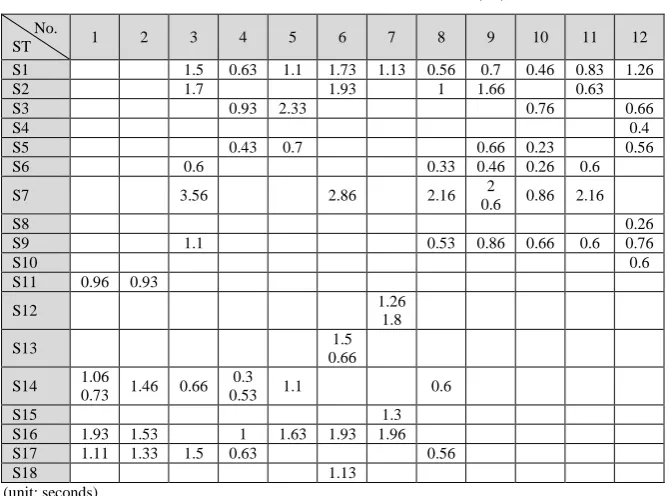
The delay of the state transition is also measured visually. All the state transitions of testing videos are listed in Table II. The error count of the transitions is listed in Table III. The delay of these transitions is listed in Table IV. There are two values in some transition. It means there are two times of transitions in the testing video. The average delay of transitions S1~S18 are depicted in Fig. 7.
TABLEIII. THE ERRORS OF STATE TRANSITIONS
No. Transition sequence Total Error
1 S11, S17, S14, S17, S14, S16 6 0
2 S11, S17, S14, S16 4 0
3 S1, S2, S14, S17, S7, S6, S9 7 0
4 S1, S3, S5, S14, S17, S14, S16 7 0
5 S1, S3, S5, S14, S16 5 0
6 S1, S2, S7, S13, S18, S13, S16 7 0
7 S1, S12, S15, S12, S16 5 0
8 S1, S2, S14, S17, S7, S6, S9 7 0
9 S1, S2, S7, S5, S7, S6, S9 7 1
10 S1, S3, S5, S7, S6, S9 6 0
11 S1, S2, S7, S6, S9 5 0
12 S1, S3, S5, S8, S10, S4, S9 7 1
Figure 7. The average delay in seconds of all the transitions.
TABLEIV. THE DELAY OF STATE TRANSITIONS (ST)
No.
ST 1 2 3 4 5 6 7 8 9 10 11 12
S1 1.5 0.63 1.1 1.73 1.13 0.56 0.7 0.46 0.83 1.26
S2 1.7 1.93 1 1.66 0.63
S3 0.93 2.33 0.76 0.66
S4 0.4
S5 0.43 0.7 0.66 0.23 0.56
S6 0.6 0.33 0.46 0.26 0.6
S7 3.56 2.86 2.16 2
0.6 0.86 2.16
S8 0.26
S9 1.1 0.53 0.86 0.66 0.6 0.76
S10 0.6
S11 0.96 0.93
S12 1.26 1.8
S13 1.5
0.66
S14 1.06
0.73 1.46 0.66
0.3
0.53 1.1 0.6
S15 1.3
S16 1.93 1.53 1 1.63 1.93 1.96
S17 1.11 1.33 1.5 0.63 0.56
S18 1.13
(unit: seconds)
By observing these results, the following remarks can be made:
Only two transition errors are found among 73 transitions in the experiment. It shows that the correctness of the proposed method is very high. An error occurs in testing video No. 9. Two transitions S7 (Lying in bed→Sitting on the bed) and S6 (Sitting on the bed→Out of bed) are expected to be detected. However, the transition is S8 (Lying in bed→Out of bed) under a parameter setting. The parameter is the minimal interval of a
transition from one state to another. The elderly sits on the bed two short and then moves away from the bed. That is why the state “Lying in bed” is transited to “Out of bed” directly. In fact, the setting can be adjusted to avoid such error. Most of the transitions can be finished in a short
period. It shows that the proposed method can be operated efficiently.
the transition is done when the depth change is larger than the threshold shown in (1). It is a reasonable delay.
VI. CONCLUSIONS
The elder care is becoming an issue in the modern world. The falling accident is also frequently occurred to the elderly. In this paper, a method is proposed by using the Kinect depth sensor for behavior analysis of an elder in the long-term care center. The Kinect sensor can be operated in the dark environment and suitable for monitor the behavior in the night. A state diagram is defined to model the behavior of an elder person in the bedroom.
The experimental results show that the proposed method can analyze the behavior with a high correctness. The transitions can be done in a very shot delay. It provides enough time for reminding the nursing to prevent the falling accident of the elderly when the elderly is sitting on the bed.
In the future, the proposed method can be used to enhance the services of the care center. For example, the log of daily states can be recorded for the relatives to realize the life of the elderly. A real-time image or live video can be sent to the children of the elderly when the state is “Caregiver care” for ensuring the service quality of the care center.
REFERENCES
[1] H. Umegaki, Y. Suzuki, M. Yanagawa, Z. Nonogaki, and H. Endo,
“Falls in elderly at high risk of requiring care,” Geriatrics &
Gerontology International, vol. 12, no. 1, pp. 147-148, 2012.
[2] S. Wang, H. Pan, C. Zhang, and Y. Tian, “RGB-D image-based
detection of stairs, pedestrian crosswalks and traffic signs,”
Journal of Visual Communication and Image Representation, vol.
25, no. 2, pp. 263-272, Feb. 2014.
[3] R. Lloréns, M. Alcañiz, C. Colomer, and M. D. Navarro, “Balance
recovery through virtual stepping exercises using Kinect skeleton
tracking: A follow-up study with chronic stroke patients,” Studies
in Health Technology & Informatics, vol. 181, pp. 108-112, 2012.
[4] A. B. H. Mohamed, T. Val, L. Andrieux, and A. Kachouri, “Using
application evaluation,” in Proc.IEEE International Conference
on Wireless Communications in Unusual and Confined Areas,
Clermont-Ferrand, France, Aug. 28-30, 2012, pp. 1-5.
[5] A. B. H. Mohamed, T. Val, L. Andrieux, and A. Kachouri,
“Assisting people with disabilities through Kinect sensors into a
smart house,” in Proc. International Conference on Computer
Medical Applications, 2013, pp. 1-5.
[6] M. Parajuli, D. Tran, W. Ma, and D. Sharma, “Senior health
monitoring using Kinect,” in Proc. Fourth International
Conference on Communications and Electronics, 2012, pp. 309-312.
[7] T. Banerjee, M. Rantz, M. Popescu, E. Stone, M. Li, and M.
Skubic, “Monitoring hospital rooms for safety using depth
images,” in Proc. AAAI Fall Symposium Series-AI for
Gerontechnology, Arlington, Virginia, US,Nov. 2012.
[8] R. Dubey, B. Ni, and P. Moulin, “A depth camera based fall
recognition system for the elderly,” in Proc. International
Conference on Image Analysis and Recognition, Aveiro, Portugal,
June 25-27, 2012, pp. 106-113.
[9] D. Webster and O. Celik, “Systematic review of Kinect
applications in elderly care and stroke,” Journal of
NeuroEngineering and Rehabilitation, vol. 11, no. 108, pp. 1-26,
2014.
Hsien-Chou Liao received the B.S. and Ph.D. degrees in Computer Science and Information Engineering from National Chiao Tung University in 1991 and 1998, respectively. He is a professor and chairman, Department of
Computer Science and Information
Engineering, at Chaoyang University of Technology, Taiwan (R.O.C.). He is also a senior member of IEEE. He has led many of his students to win awards in national competitions and international exhibition of inventions. He has also led numerous industrial and academic technology research projects. His research interests include location-based service, smart technology, mobile computing, computer vision, and pattern recognition.
Yan-Ting Lin received the B.S. in Computer Science and Information Engineering from Chaoyang University of Technology in 2011 and 2015. They are interesting in designing and developing systems related computer
vision and pattern recognition.
Jhih-Sin Chen received the B.S. in Computer
Science and Information Engineering from Chaoyang University of Technology in 2011 and 2015. They are interesting in designing and developing systems related computer vision and pattern recognition.
Min-Han Xiaoreceived the B.S. in Computer
Science and Information Engineering from Chaoyang University of Technology in 2011 and 2015. They are interesting in designing and developing systems related computer vision and pattern recognition.
Ching-Sen Chang received the B.S. in
Computer Science and Information
Engineering from Chaoyang University of
Technology in 2011 and 2015. They are interesting in designing and developing systems related computer vision and pattern recognition.
Wei-Cheng Chen received the B.S. in
Computer Science and Information
Engineering from Chaoyang University of Technology in 2010 and 2014. Now, he pursues his master’s degree in computer science and information engineering. He won
several top awards in national competitions.
He is interesting in developing automatic optical inspection (AOI) system for industrial application.