3
Impact of Calcium Source on Modification of
Properties of Saline-Sodic Soils
M.K. Abd El-Fattah
Soil Science Department, Faculty of Agriculture, Zagazig, University, Zagazig, Egypt.
SOIL column (30-cm long and 16-cm inside diameter) experiment was conducted to study the effect of calcium source on reclaiming a saline sodic clay loam soil collected from Sahl El-Tina, northern Sinai, Egypt. The calcium sources were agricultural gypsum "AG", phosphogypsum "PG" and calcium chloride "CC". Amendments were thoroughly mixed with soil. Leaching was done using the intermittent method so as to add portions to the already saturated soil columns. Six leachates of equal volumes were collected. At the end of experiment EC, pH, SAR, ESP and bulk density of soil decreased compared with the initial values which were 24.9 dSm-1,
8.78, 26.3, 40.25 and 1.42 Mgm-3, respectively. Respective values at termination of experiment were for CC: 2.72 dSm-1, 8.12, 3.40, 3.79 and1.23 Mgm-3; for PG: 3.37 dSm-1, 7.88, 4.78, 5.85 and 1.27 Mgm-3, for AG: 3.60 dSm-1, 8.02, 4.94, 6.08 and 1.32 Mgm-3, for control: 5.41 dSm-1, 8.20, 6.05, 7.75 and 1.33 Mgm-3. All amendments were greater efficiencies as compared with control treatment. With only few of exceptions the order of efficiency of amendments was CC > PG > AG. This reflects the high solubility of CC rendering it the most readily available source of soluble Ca2+. Concerning PG and AG, results show that, PG was of a relatively greater effect on reducing EC, pH, SAR, ESP and bulk density. This indicates high Ca2+ release from PG due to its more acidity. The study suggests that leaching using Ca+2 sources amendments improves physico-chemical properties of saline sodic soils especially CC followed by PG and AG.
Keywords: Saline sodic soils, Chemical amendments, Agricultural gypsum, Phosphogypsum, Calcium chloride.
In Egypt, improving salt affected soils is an important part in the agricultural security program. Saline-soils contain excess soluble salts, and sodic soils contain excess exchangeable sodium. Such soils tend to occur mainly in arid zones. Aims at removal of excess salts out of the root zone or away to the drainage system and getting rid of sodicity by replacement of exchangeable sodium by calcium as well as removing sodium carbonates if presents. The removal of salts is carried out by leaching. The amount of leaching water depends on initial soil salinity level, applied water technique, and soil type. Water suitable for irrigation is normally suitable for reclamation. Therefore, it is important to have reliable estimates of the required amount of leaching water needed to reduce soil salinity/sodicity to a desirable level (Mamoun et al., 2012).
Chemical amendments used for reclamation process be broadly grouped into three categories: totally soluble calcium salts, such as CaCl2, acids or acid
forming substances, such as sulfuric acid, iron sulfate, aluminum sulfate, pyrite, … etc and finally calcium salts of low solubility (ground lime stone). The suitability of one or another amendment for reclamation of saline or saline sodic soil largely depends on the nature of the soil and cost consideration (FAO, 1988).
Gypsum (CaSO4.2H2O) is commonly used for reclamation of saline-sodic
and sodic soils and to a lesser extent calcium chloride (CaCl2.2H2O), and sulfuric
acid (H2SO4). The first two amendments provide a direct source of calcium ions
(Ca2+) to replace exchangeable sodium, whereas sulfuric acid increases the dissolution of calcite in soil (Mace et al., 1999).
The choice of an amendment depends upon its effectiveness and crop growth and the relative costs. The time required for amendment is also a consideration in the choice. Because of its high solubility, calcium chloride is the most effective source of soluble Ca+2 but it is rarely used because of its high cost (FAO, 1988).
Carter and Robbins (1978) reported that excessive salts in soil could be removed from soil profiles by passing 300-mm depth of water per meter depth of soil. FAO (1976) stated that for leaching of salts a 300-mm depth of water leached through a 300-mm depth of soil should remove about 80% of the chloride. Feize (1998) found that application of the first 600-mm water depth (i.e., 6000 m3ha-1) decreased initial soil salinity and sodicity within 500-mm soil depth.
Abou Yuossef (2001) applied phosphogypsum and found that pH, EC, ESP and bulk density decreased with increasing PG rate. Also hydraulic conductivity, total porosity, mean weight diameter of soil aggregates, geometric mean diameter and water stable aggregates increased. Ahmad et al. (2001) and Abd El-Fattah (2006 and 2011) reported that EC, ESP, SAR, pH and bulk density decreased whereas hydraulic conductivity and infiltration rate increased with gypsum application. Singh and Bajwa (1991)and Khalifa et al. (1994) applied excessive gypsum for reclamation of sodic soil and observed a quick removal of soluble sodium with a decreased ESP and pH.
Material and Methods
Soil sampling
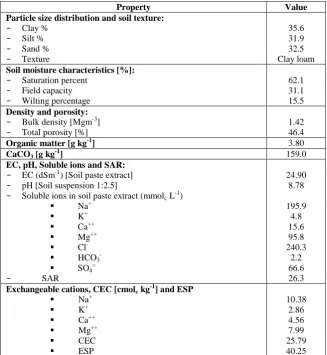
The saline-sodic soil used in the study was collected from Sahl El-Tina, Northern Sinai, Egypt. Physicochemical characteristics of the soil are presented in Table 1. Water used for leaching has of an EC of 1.5 dSm-1.
TABLE 1. Physical and chemical properties of studied soil.
Property Value
Particle size distribution and soil texture:
- Clay % 35.6
- Silt % 31.9
- Sand % 32.5
- Texture Clay loam
Soil moisture characteristics [%]:
- Saturation percent 62.1
- Field capacity 31.1
- Wilting percentage 15.5
Density and porosity:
- Bulk density [Mgm-3] 1.42
- Total porosity [%] 46.4
Organic matter [g kg-1] 3.80
CaCO3 [g kg-1] 159.0
EC, pH, Soluble ions and SAR:
- EC (dSm-1) [Soil paste extract] 24.90
- pH [Soil suspension 1:2.5] 8.78
- Soluble ions in soil paste extract (mmolc L-1)
Na+ 195.9
K+ 4.8
Ca++ 15.6
Mg++ 95.8
Cl- 240.3
HCO3- 2.2
SO4= 66.6
- SAR 26.3
Exchangeable cations, CEC [cmolc kg-1] and ESP
Na+ 10.38
K+ 2.86
Ca++ 4.56
Mg++ 7.99
CEC 25.79
ESP 40.25
Experimental
diameter were used to contain the soil columns. The bottom of each tube was sealed with perforated a mesh nylon screen and glass wool. Acid-washed inert sand was placed on the tube bottom to make a 5-cm layer of the column. Such arrangement allowed for 5-cm on top of soil column to give sufficient space for addition of water for the leaching process.
Addition of amendments
Gypsum requirements (GR) are the amount of gypsum required for reclamation in order to decrease ESP from its initial value to a required value. In the current study it is calculated to decrease initial ESP from 40.25 to 10 for the upper 30-cm soil depth. The amount equivalent to GR using calcium chloride "CaCl2.2H2O" is 0.85 GR (FAO, 1988). The experiment included four treatments
which were as follows (Table 2).
TABLE 2. Properties of amendments and their applied amount.
Treatments pH
1:10
Ca2+ g.kg-1
Purity [%]
Amount [Mg.fed-1]
Control --- --- --- 0.00
AG 7.80 227.9 98 13.69
PG* 2.67 100.5 65 20.64
CC 8.00 269.4 99 11.75
*obtained mostly as by product of super phosphate manufacture.
Calculated amount of amendments were mixed thoroughly with soil. After mixing with amendments, the soils were leached with water having EC 1.5 dSm-1, the amount of water was supplied using intermittent leaching method; water portions of 5-cm depth over soil surface. Water portions were added to the already saturated soil columns. Obtained leachates were equal to the added portions. Leachates were collected and analyzed for salinity. Termination of leaching was done after collecting six leachates, each one equals a water depth of 5-cm, therefore leachates volumes were similar.
Methods used for analysis
Following termination of leaching, each soil columns were separated into three equal segments. Soil of each segment was analyzed according to the methods described by the FAO (1988).
Results and Discussion
Salt removal
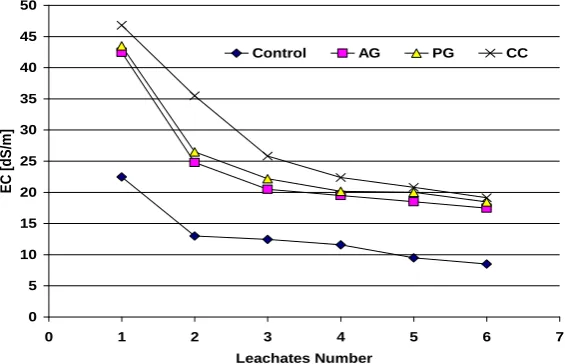
This shows that the amount of added water which made the first leachate was capable of removing the majority of the readily soluble salts and mobile ions such as Cl- and Na+, whether the soils were amended or not.
0 5 10 15 20 25 30 35 40 45 50
0 1 2 3 4 5 6 7
Leachates Number
E
C
[
dS
/m
]
Control AG PG CC
Fig. 1. Salt removal as affected by leaching and different amendments (i.e., Agricultural gypsum "AG", phosphogypsum "PG" and calcium chloride "CC").
Concerning the effect of amendments on salt leaching, the most effective material was calcium chloride. Treating soil with amendments resulted in efficiency of salt removal by 120.1, 94.6 and 84.9% due to CC, PG and AG, respectively compared with leaching only (control). Efficiency of treatments was CC > PG > AG > control.
Dissociation of slightly soluble salts (such as CaSO4 and CaCO3) and the
desorbed exchange ions released from the exchange complex would further supply the soil solution with a soluble ions especially, Na+, Ca++, SO4=, HCO3
-and CO3=. During the first period of leaching the soluble salts leached from the
soil column were mainly NaCl and Na2SO4 causing a high EC values while
during the second period, the leached salts would include NaHCO4 and finally
Na2CO3. The decreasing salinity was less considerable from the 3rd leachate
onwards. Amended treatments caused greater rates of decrease in salinity than non-amended ones. This indicates a favorable effect of amendments on the leacheability through improving the physical properties of the soil.
Soil salinity
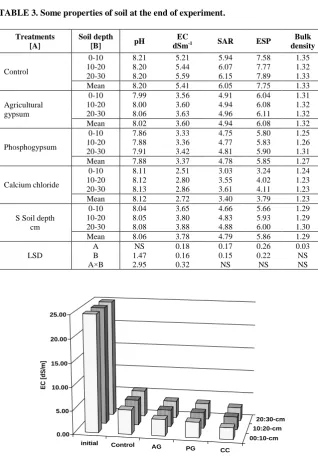
control, AG, PG and CC, respectively. Efficiency of amendments in reclamation was of the following order CC > PG > AG. Salinity in the upper layer was lower than in the lower ones.
TABLE 3. Some properties of soil at the end of experiment.
Treatments [A]
Soil depth [B] pH
EC
dSm-1 SAR ESP
Bulk density
Control
0-10 8.21 5.21 5.94 7.58 1.35
10-20 8.20 5.44 6.07 7.77 1.32
20-30 8.20 5.59 6.15 7.89 1.33
Mean 8.20 5.41 6.05 7.75 1.33
Agricultural gypsum
0-10 7.99 3.56 4.91 6.04 1.31
10-20 8.00 3.60 4.94 6.08 1.32
20-30 8.06 3.63 4.96 6.11 1.32
Mean 8.02 3.60 4.94 6.08 1.32
Phosphogypsum
0-10 7.86 3.33 4.75 5.80 1.25
10-20 7.88 3.36 4.77 5.83 1.26
20-30 7.91 3.42 4.81 5.90 1.31
Mean 7.88 3.37 4.78 5.85 1.27
Calcium chloride
0-10 8.11 2.51 3.03 3.24 1.24
10-20 8.12 2.80 3.55 4.02 1.23
20-30 8.13 2.86 3.61 4.11 1.23
Mean 8.12 2.72 3.40 3.79 1.23
S Soil depth cm
0-10 8.04 3.65 4.66 5.66 1.29
10-20 8.05 3.80 4.83 5.93 1.29
20-30 8.08 3.88 4.88 6.00 1.30
Mean 8.06 3.78 4.79 5.86 1.29
LSD
A NS 0.18 0.17 0.26 0.03
B 1.47 0.16 0.15 0.22 NS
A×B 2.95 0.32 NS NS NS
initial Control
AG PG CC
00:10-cm 10:20-cm
20:30-cm
0.00 5.00 10.00 15.00 20.00 25.00
EC [dS/m
]
Soil pH
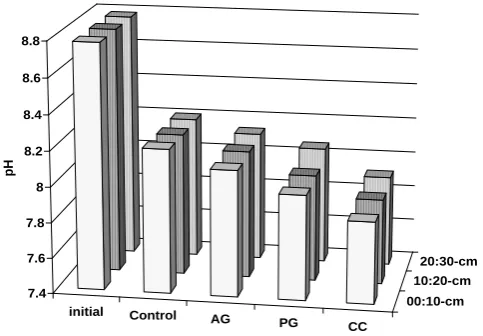
Data in Table 3 and Fig. 3 show that, the soil pH after leaching was lower as compared with before leaching. The initial soil pH of 8.78 was reduced to 8.20, 8.02, 7.88 and 8.12 for the control, AG, PG and CC, respectively. Efficiency of treatments in decreasing soil pH is of the order: PG > AG > CC > control.
Both PG and AG were relatively of greater effect on reducing pH than CC. The decrease in soil pH due to gypsum application is a manifestation of a replacement of sodium by calcium on the exchange complex, and formation of sulfate salts and a decrease in sodium concentration in soil. Moreover, gypsum solubility must have been enhanced because of the increased activity coefficient of calcium and sulfate as a result of increased ionic strength of solution and formation of the sodium sulfate ion pairs. Besides, CO2 evolved during leaching
would form carbonic acids.
initial Control AG
PG CC
00:10-cm 10:20-cm
20:30-cm
7.4 7.6 7.8 8 8.2 8.4 8.6 8.8
pH
Fig. 3. pH in the different soil segments at the end of leaching experiment (AG:: Agricultural gypsum, PG: Phosphogypsum and CC: Calcium chloride).
Soil sodicity
Data in Table 3 and Fig. 4 show that the high initial value of SAR dropped sharply to become 6.05, 4.94, 4.78 and 3.40 after the end of leaching process for the control, AG, PG and CC, respectively. Thus the comparative efficiency rating of amendments is as follows: CC > PG > AG. The decrease in SAR reflects a removal of Na+ from the soil colloidal complex. The results are in agreement with those of Chaudhry and Warkentin (1968).
of soil. This may be explained by Ca2+ released from PG being higher than AG (of a pH 7.8) due to greater acidity in PG (of a pH 2.67). These results are in agreement with those of Abd El-Fattah (2006).
initial Control
AG PG
CC
00:10-cm 10:20-cm
20:30-cm
0 5 10 15 20 25 30
SAR
Fig. 4. SAR in the different soil segments at the end of leaching experiment (AG: Agricultural gypsum, PG: Phosphogypsum and CC: Calcium chloride).
initial Control AG
PG CC
00:10-cm 10:20-cm
20:30-cm
0 5 10 15 20 25 30 35 40 45
ESP
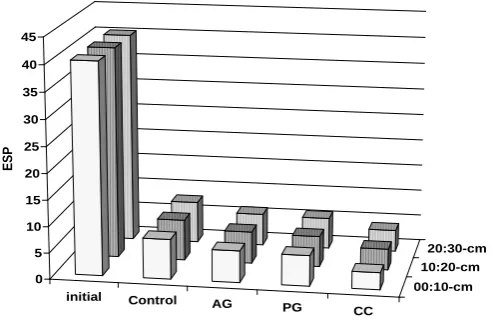
Fig. 5. ESP in the different soil segments at the end of leaching experiment (AG: Agricultural gypsum, PG: Phosphogypsum and CC: Calcium chloride).
Bulk density (BD)
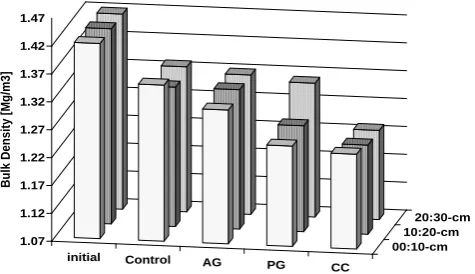
amended soils than in the non-amended ones. The lowest BD was recorded with calcium chloride "CC" followed by phosphogypsum "PG" then agricultural gypsum "AG". Leaching decreased BD by 6.33, 7.04, 10.50 and 13.38% due to non-amended, AG, PG and CC, respectively compared with that of the initial soil (of 1.42 Mg.m-3). The order efficiency of amendments was CC > PG > AG.
initial Control AG PG CC
00:10-cm 10:20-cm
20:30-cm
1.07 1.12 1.17 1.22 1.27 1.32 1.37 1.42 1.47
Bulk De
nsity
[
Mg
/m
3
]
Fig. 6. Bulk density of the soil segments at the end of leaching experiment (AG: Agricultural gypsum, PG: Phosphogypsum and CC: Calcium chloride).
Conclusion
Application of chemical amendments enhanced reclamation of the saline-sodic soil and caused more decreases in salinity as well as saline-sodicity to a considerable extent. The studied treatments could be arranged in the following order, calcium chloride (CC) > Phosphogypsum (PG) > agricultural gypsum (AG). The solubility of these sources in water, particularly calcium chloride is a result of such effect. Phosphogypsum (PG) showed a relatively greater effect in decreasing soil EC, pH, SAR, ESP and bulk density compared with agricultural gypsum (AG) reflecting more Ca2 released from the former, probably due to its acidity. This study suggests that leaching using Ca+2 sources amendments (i.e.,
AG, PG and CC) would improve the chemical and physical properties of saline sodic soils.
References
Abd El-Fattah, M.K. (2006) Some approaches for reclaiming and restoring degraded soils. M.Sc. Thesis, Fac. of Agric., Zagazig Univ., Egypt.
Abou Youssef, M.F. (2001) Use phosphogypsum fortified as a soil amendment for saline sodic soil in El-Salhiya plain. Zagazig J. Agric. Res. 28: 889 -911.
Ahmad, M., Hussain, N., Salim, M. and Niazi, B.H. (2001) Use of chemical amendments for reclamation of saline-sodic soils. Int. J. Agri. Biol. 3 (3): 305-307. Carter, D.L. and Robbins, C.W. (1978) Salt Outflows from new and old irrigated lands.
Soil Sci. Soc. Am. J. 42 (4): 627-632.
Chaudhry, G.H. and Warkentin, B.P. (1968) Studies on exchange of sodium from soils by leaching with gypsum. Soil Sci. 105: 190–97.
FAO (1988) Salt affected soils and their management. Soils Bulletin No. 39 Roma. FAO (1976) A Framework for Land Evaluation. FAO Soils Bulletin No. 32, Rome, Italy. Feize, M. (1998) Reclamation of saline sodic soils by leaching with different water
qualities. Proceeding of the International Symposium on Sustainable Management of Salt Affected Soils in the Arid Ecosystem and FAO-workshop (network group) on integrated management of sustainable use of salt affected soils. Cairo, Egypt, 21-26 September, 1997, pp. 378-385.
Khalifa, M.R., Koriem, M.A., Ibrahim, M.M. and Hammad, E. (1994) Reclamation of saline sodic soils by leaching with drainage water and gypsum application. Monofiya Agric. Res. (19): 685-698.
Mace, J.E., Amrhein, C. and Oster, J.D. (1999) Comparison of gypsum and sulfuric acid for sodic soil reclamation. Arid Soil Res. Rehab. 13:171-188.
Mamoun, A., Gharaibeh, N.I.E. and Shady, H.S. (2012) Desalination and desodification curves of highly saline-sodic soil amended with phosphoric acid and by-product gypsum. International Journal of Environmental Science and Development 3 (1): 39-42.
Salim, A., Ahmad, M., Hussain, N., Niazi, R. and Malik, K.A. (2002) Role of soil amendments in saline agriculture prospects for saline agriculture. Book: Prospects for saline agriculture, ISBN: 1-4020-0620-9, Record Number: 20033092275, pp. 433-438.
Singh, H. and Bajwa, M.S. (1991) Effect of sodic irrigation and gypsum on the reclamation of sodic soil and growth of rice and wheat plants. Indian Agricultural Water Management 20 (2): 163-171.
ةيدوصلا ةيحلملا يضارلأا صاوخ ليدعت ىلع مويسلاكلا ردصم ريثأت
حاتفلا دبع لامك دمحم
يضارلأا مولع مسق
– ةعارزلا ةيلك – قيزاقزلا ةعماج – قيزاقزلا – رصم .
ضرأ تافص ليدعت ىلع مويسلاكلا ردصم ريثأت ةساردل ةدمعأ ةبرجت تيرجأ مت ثيح ييمط ينيط ماوق تاذ ةيدوص ةيحلم ةنيطلا لهس ةقطنم نم ةبرتلا عيمجت
ءانيس ةظفاحم لامش ةعقاولا
–
رصم . مويسلاكلل ةفلتخم رداصم ةثلاث تمدختسا
( يداعلا يعارزلا سبجلا
–
ةيتافسوفلا ةدمسلأا ةعانص نم جتانلا يروفسفلا سبجلا
لبعز وبأ عنصمب –
مويسلاكلا ديرولك )
ةمزلالا ةيسبجلا تاجايتحلاا باسح متو
لاصتسلا نمو ضرلأا ح ةبرتلا دومع عم ةبوسحملا تانسحملا تايمك طلخ مت مث
قمعل 03 مس . ةقيرطلا مادختساب ليسغلا ةيلمع ءارجإ لبق ءاملاب ةبرتلا دومع عبُش
ةيمك يواست هلسغ لك يف اهلابقتسا متي يتلا هايملا ةيمك نأ ةظحلام عم ،ةعطقتملا ةفاضملا هايملا .
اعملا لك نأ جئاتنلا ترهظأ يبرهكلا ليصوتلا ةجرد ضافخنا ىلإ تدأ تلام
EC ةضومحلا مقرو pH
مويدوصلل ةيصاصمدلإا ةبسنلاو SAR ةيوئملا ةبسنلاو لدابتملا مويدوصلل ESP ةيرهاظلا ةفاثكلاو BD
بيترت نكميو ،لورتنكلاب ًةنراقم
يلي امك ةبرتلا تافصل اهنيسحت ةجردل ًاقبط ًايلزانت تلاماعملا :
مويسلاكلا ديرولك >
يروفسفلا سبجلا >
يداعلا يعارزلا سبجلا > لورتنكلا ( طقف ليسغلا ) و ك نأ ىلإ ةقباسلا ةجيتنلا رسفُت نأ نكمي ل
ءاملا يف ًانابوذ رثكأ مويسلاكلا ديرو
مث نمو تانسحملا يقاب نم ربكأ ةجردب رسيملا مويسلاكلا ررحت كلذ نع جتني امم يدوصلا لحم مويسلاكلا لحي لدابتلا دقعم ىلع مو
. يعارزلا سبجلل ةبسنلاب امأ
هريظن ىلع يروفسفلا سبجلا قوفت جئاتنلا ترهظأ دقف يروفسفلا سبجلاو يداعلا يعارزلا سبجلا نم ةضومح رثكأ يروفسفلا سبجلا نأ ىلإ كلذ عاجرإ نكميو ررحتي يلاتلابو يداعلا يعارزلا سبجلا نع هنابوذ ةدايز ىلإ يدؤي امم يداعلا ربكأ ةجردب هنم مويسلاكلا .
نأ ح رطت ةساردلا هذه نأب لوقلا نكمي ةياهنلا يفو