Volume 3, Spl. Issue 1 (2016) e-ISSN: 1694-2310 | p-ISSN: 1694-2426
A Review of Reactive Algorithms Deployed
for Mobile Ad-Hoc Wireless Network
Gurdeep Kaur
1,Vinay Bhatia
21,2Department of Electronics and Communication, BUEST, Baddi, India 1[email protected],2[email protected]
Abstract- Mobile ad-hoc network is a dynamic system of infrastructure less, multihop and mobile nodes. With increase in the availability and popularity of mobile wireless devices, several applications have led researchers to develop a wide variety of Mobile Ad-hoc Networking algorithms. Reactive is one of the ad-hoc type routing algorithm in which a path from source to the destination node is established only when required. In this paper, we consider a mobile ad hoc wireless access network where mobile nodes can access the Internet via one or more gateway nodes. The neighbouring nodes that are not in range of the gateway can continue to communicate with the gateway via intermediate nodes over multihop paths. With this paper we discuss the functionalities of earlier used algorithms such as DSR (Dynamic Source Routing), AODV (Ad Hoc on Demand Distance Vector) and comparatively new used algorithm such as LB-AODV (load balancing AODV). From the review carried out through this paper it is studied that LB-AODV algorithm has significant controlled the routing overhead has higher packet delivery fraction, a lower end to end delay as compared to the DSR and AODV routing algorithms.
Keywords- Mobile ad-hoc network (MANET), Ad-hoc On-demand Distance Vector routing (AODV), Dynamic Source Routing (DSR), Routing and Load Balancing.
1. INTRODUCTION
A mobile ad hoc network is a collection of wireless mobile nodes that dynamically establish the network in the absence of fixed infrastructure. Each node must be able to act as a router to find out the optimal path to forward a packet which is one of the unique features of MANET. The topology of the network can change continuously as nodes may be mobile, entering or leaving the network [1]. Routing in MANETS has been an active area of research in the recent years. Basically routing is the act of determining optimal routing paths and moving packet information across an internetwork from a source to a destination. Over a last few years many routing algorithms for mobile ad hoc networks have been proposed. These routing algorithms are divided into two classes; namely Reactive and Proactive [3]. In algorithms using the proactive class, the routing state information of mobile nodes is exchanged periodically with neighbour nodes. It achieves the advantage of fast routing but causes large energy consumption for maintaining the updated routing table whereas using the on demand class requires setting up a route before sending packets rather than periodically maintaining the routing table [4]. Without maintaining the routing state information, mobile nodes significantly save power, thus the network lifetime of the on-demand ad hoc network is longer than that of the proactive
routing protocols is to minimize the network traffic overhead.
In this paper the objective is to carry out a systematic performance study of two dynamic reactive routing algorithms for ad hoc networks: the Dynamic Source Routing Protocol (DSR) and the Ad Hoc On-Demand Distance Vector protocol (AODV) and the extension of AODV that is Load Balancing.
In recent years popularity of using MANETs is increased due to its applications which are described as:
a. Military Battlefield: Due to Ad Hoc networks, it is possible to maintain communication between the soldiers, vehicles, and military information headquarters.
b. Rescue Operations: These operations come under commercial sector that are used in disaster relief efforts, e.g. in fire, flood, or earthquake recovery where fixed infrastructure network is not possible so Ad Hoc networks are used.
c. Personal Area Network: Communication between devices such as Laptop, Phones, Computers are all possible due to short range MANETs.
d. Shared Environment: For i.e. Business, university environments shared computing is very important so that exchange of information can take place for any Project.
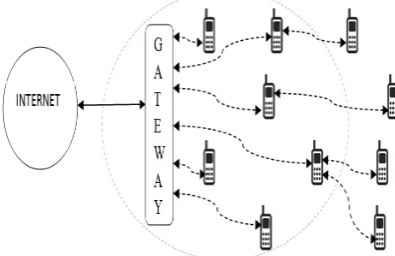
This paper is reviewed by considering a mobile ad-hoc wireless access network in which number of mobile nodes wants to access internet through a gateway directly or indirectly or via other mobile nodes.
Fig. 1 Mobile Adhoc Wireless Network
The following terms will be used in paper:
have data to send and not belong to any particular group.
c. Intermediate node is a mobile node that has valid route to the gateway and is currently being used to forward packets toward the gateway [5].
d. RREQ (Route Request Packet) -These packets are generated by the source node when it has data to send.
e. RREP (Route Reply Packet) -These packets are generated by the destination node or intermediate when find it finds its own address in the source route and then it generates RREP packet towards source.
f. RERR (Route Error Packet) -These packets are generated by that nodes when there is link breakage in the path.
The rest of paper is organized as: Section 2 provides the information regarding Dynamic Source Routing Algorithm. Section 3 introduces overview of Ad Hoc on Demand Distance Vector routing which is extension of DSR. Review of Load Balancing AODV is presented in section 4.
2. DYNAMIC SOURCE ROUTING
DSR is reactive (on demand) routing algorithm in which route is established whenever there is data to send and maintains the route throughout .It is designed by D. B. Johnson, Maltz and Broch to restrict the bandwidth occupied by packets in ad hoc wireless networks by eliminating the periodic table update messages required in the proactive routing protocols. The distinguishing feature of Dynamic Source Routing (DSR) is the use of source routing. The algorithm consists of two major procedures: Route Discovery, Route Maintenance. These are explained as follow with the help of figure:
A. ROUTE DISCOVERY
When a mobile node has data packet to be send to the destination, node will first consults its route cache to check whether it has a route to that destination or not. If it is an un-expired route, it will use this route. Route caching speeds up the routing discovery and also reduces the propagation of route requests. If the node does not have a route, it initiates route discovery by broadcasting a Route Request packet (RREQ).This Route Request contains the address of the destination, along with the source address. Each node receiving the packet checks to see whether it has a route to the destination. If it does not, it adds its own address to the route record of the packet and forwards it. A route reply is generated when the request reaches either the destination itself or an intermediate node that contains an un-expired route to that destination in its cache route. If the node generating the route reply is the destination, it places the route record contained in the route request into the route reply. When route reply packet is received by the source, transmission of information is carried out.
Steps involved in DSR routing
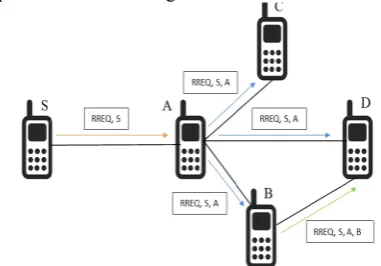
algorithm:-available in its cache then Node S broadcast RREQ packet as shown in figure 2.
Fig.2 Source Node S broadcasts RREQ packets to its neighbouring Nodes
Node A receives packet and it has no route to D, rebroadcasts packet after adding its own address to source route.
Node C and Node B receives packet and they have no route to D, rebroadcasts packet after adding its own addresses to source route.
Node D receives the packet and finds its own address in the source route, unicasts RREP to Node A and puts D in the RREP source route as shown in figure 3.
Fig.3 Destination node D unicasts RREP Packets
Node A receives RREP, adds its address to source route and unicasts to S. Whereas Node B also broadcast RREQ to Node D but drop the packet.
Node S receives RREP and uses route for data packet transmissions.
Volume 3, Spl. Issue 1 (2016) e-ISSN: 1694-2310 | p-ISSN: 1694-2426
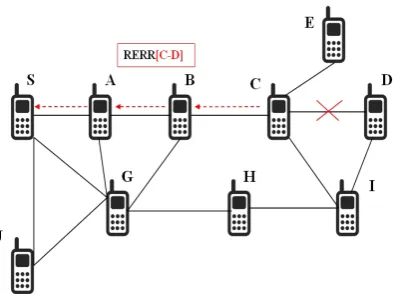
Fig. 4 Route C – D fails, Node C generates RERR packet.
B. ROUTE MAINTENANCE
1. Consider link between Node C and Node D fails then C sends a route error to S along route C-B-A-S when its attempt to forward the data packet S (with route SABCD) on C-D fails. 2. Nodes hearing RERR update their route cache
to remove link C-D.
3. Now the source nodes S reinitiate the route discovery procedure.
4. And suppose Node C has path in its cache to D, then C responds to S by generating RREP packet and information packet transmits.
Advantages of Dynamic Source Routing:
Routes are maintained only between nodes that need to communicate which reduces overhead of route maintenance in small networks.
Route caching can further reduce route discovery overhead.
A single route discovery may yield many routes to the destination, due to intermediate nodes replying from local caches.
Disadvantages of Dynamic Source Routing:
Packet header size grows with route length due to source routing.
Flood of route requests may potentially reach all nodes in the network
Care must be taken to avoid collisions between route requests propagated by neighbouring nodes.
Increased contention if too many route replies come back due to nodes replying using their local cache.
An intermediate node may send Route Reply using a stale cached route, thus polluting other caches.
3. OVERVIEW OF AD- HOC ON DEMAND DISTANCE VECTOR ROUTING
AODV belongs to the group of reactive routing protocols. These protocols initiate route discovery only when a route is needed and maintain active routes only while they are in use. It extends the limitation of DSR
size also increases which degrade the performance of system. AODV improves the DSR by maintaining routing tables at the nodes, so that data packets do not have to contain routes and also saves Bandwidth. AODV route table entries do have lifetimes but in DSR route cache entries do not have lifetimes and also the routes which are not used from long time are deleted. The Algorithm procedure is as follows:
A. ROUTE DISCOVERY
When a new route is needed, the source node broadcasts a Route Request message (RREQ). If the node does not have a route in its cache to the destination, it rebroadcasts the RREQ. It also utilizes destination sequence numbers to ensure that all routes contain the most recent or fresh route information. Each node maintains its own sequence number. During forwarding the RREQ packets, intermediate nodes record the address of the neighbour from which the first copy of the broadcast packet is received in their route tables, thereby establishing a reverse path. Once the RREQ reaches the destination with a fresh enough route, the destination responds by unicasting a route reply (RREP) control packet back to the neighbour from which first received the RREQ[4,5]. When the source node receives a RREP, the route is established and the source can start using it.
In AODV, Route discovery process is same as in Dynamic source routing algorithm accept that it adopts a very different mechanism to maintain routing information, so its format of route request packet is also improved [8].
Format of a ROUTE REQUEST packet [8]
The fields used in format of a Route Request packet are explained as follows:
1. Source address: It is the IP address of that node which has data to send.
2. Request ID: It is the local counter maintained by the each node and it is incremented each time a Route Request is broadcast.
3. Destination Address: It is the IP address of that node to which source node is looking for (destination). 4. Source sequence number and Destination Sequence number: These fields determine the freshness of the route to track accuracy of information.
5. Hop Count: This field will keep track of how many hops the packet has made. Initially its value is kept as zero.
In the format of route reply packet one more field is added:
A route discovered between a source node and destination node is maintained as long as needed by the source node. Maintenance of the discovered route is necessary for two main advantages, first to achieve stability in the network and secondly to reduce the excessive overhead required in discovering new route [6]. Neighbouring nodes periodically exchange hello messages to check the connectivity of route. When a Hello message is received and the route does not exist then the route to the neighbour is added to the routing table. If the route exists, its lifetime is increased. When the topology of the ad hoc network changes and Hello messages are not received for a defined period of time, the route expires [2]. Absence of hello message is used as an indication of link failure. Routing tables are updated for the link failures. All active neighbours are informed by sending RERR messages when a source node receives an RRER, it can reinitiate the route discovery.
Sequence number is used in AODV because of the following two reasons [12]:
1. To avoid using old/broken routes thus determines which route is newer.
2. To prevent formation of loops. This is explained as
Fig.5 Loop formation in the wireless Network
a. Assume that A does not know about failure of link C-D because RERR sent by C is lost. b. Now C performs a route discovery for D. Node A
receives RREQ (say, via path C-E-A)
c. Node A will reply since A knows a route to D via node B results in a loop (that is C-E-A-B-C) d. Now advantage of using sequence number is i.e.
A will not use the route A-B-C, because the sequence numbers will be lower than what A receives from A (Route is Fresh when the destination sequence number stored in the routing table is greater than or equal to the destination sequence number in the route request packet).
4. REVIEW OF LOAD-BALANCING AD-HOC ON DEMAND DISTANCE VECTOR ROUTING
In MANETs we study the situation in which if we increase the total number of nodes in given coverage area, what effect on the parameters such as bandwidth, routing overhead, packet delivery fraction and end to
by various algorithms such as DSR and AODV. Lots of work has been done on these algorithms, So in DSR as we increase the no. of nodes, header size increases then routing overhead also increases which degrades the performance of system. Then we extend DSR by AODV that increases the system performance by reducing the bandwidth use and routing overhead to some extent. Since on-demand routing protocols uses the flooding method to find a route to the destination, the number of rebroadcasts of route request (RREQ) packet is proportional to the number of nodes. Therefore, the routing control overhead increases with the total number of nodes. So in the mobile ad hoc wireless access networks, gateway can control or update the process by the concept of load-balancing to limit the amount of routing control packets [1].
Basically load balancing is technique that divides the amount of work that a computer has to do between two or more computers so that more work gets done in the same amount of time and, in general, all users get served faster. So in load balancing AODV, the entire coverage area of network consisting of nodes, can be divided into groups. Source nodes are allowed to forward packets through its own group and common nodes.
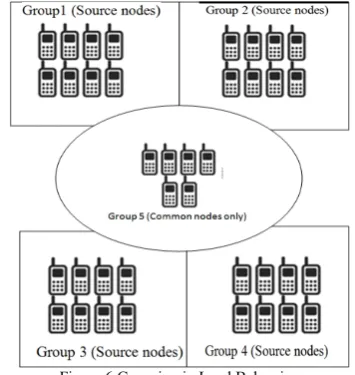
The basic idea of our grouping mechanism is to divide all mobile nodes into several divisions such as 1,2,3,4 and 5 as shown in the example in Fig. 6. All common nodes belong to the division 5 and they are allowed to forward packets from any groups toward the gateway. On the other hand, a source node, which belongs to one of the groups 1, 2, 3, and 4 is not allowed to relay packets from other than its own group. For example, packets generated by any members of group 2 can be relayed only by other source nodes of group 2 and common nodes belonging to division 5. In the route discovery process, an RREQ message is only forwarded to the common nodes and those nodes that belong to the same group. Thus, the amount of control traffic can be reduced [6].
The number of groups formed can be determined if the gateway has following information: the number of source nodes, the number of mobile nodes, and the size of network.
Figure 6.Grouping in Load Balancing
Volume 3, Spl. Issue 1 (2016) e-ISSN: 1694-2310 | p-ISSN: 1694-2426 In figure 6, suppose we have large number of nodes,
each node has N number of neighbours and there is no path in the cache route of any node to send data packets from source to destination. Then route discovery process begins, source node send RREQ packets to its neighbouring nodes, here we assume that the source node either broadcast the RREQ packet to its neighbours with probability P or drop it with probability P-1 and if the node receive the same RREQ packet again, the packet will be discarded [7].
On the basis of above consideration in LB-AODV algorithm, when a source node sends an RREQ message, M out N neighbouring nodes will broadcast the RREQ packet to its neighbours, while the other neighbouring nodes will discard the packet. Therefore, an RREQ packet can be broadcasted over more than one hop with probability P = 1 if the group number is chosen correctly [12]. Since the LB-AODV routing protocol regulates the number dynamically, it can control the number of RREQ packets being broadcasted without degrading the level of network connectivity and also significantly control the routing overhead, higher packet delivery fraction, a lower end to end delay as compared to the DSR and AODV routing algorithms [13].
B. Load-Balancing Route Maintenance Process
When a source node detects a link failure via the route error (RERR) message, it will reinitiate the route discovery process by sending an RREQ message with its group number toward the gateway. Those intermediate nodes that do not belong to this particular group will simply drop the RREQ message. When the destination node receives the RREQ message, it will send an RREP message to the source node. After finding the route data packets transmission begins. The above procedures limit the amount of routing overhead.
REFERENCES
[1] Thomas Chowdhury, Rahma Bintey Mufiz Mukta, “A Novel Approach to Find the Complete Node-Disjoint Multipath in AODV”, 3rd International Conference On Informatics, Electronics & Vision 2014.
[2] Srdjan Krco and Marina Dupcinov, “Improved Neighbor Detection Algorithm for AODV Routing Protocol”, IEEE Communication Letters, vol. 7, no. 12, December 2003, pp.-584-586.
[3] Alvin C.Valera, Student Member, IEEE, Winston K.G.Seah, Senior Member, IEEE, and S.V. Rao, Senior Member,IEEE “Improving Protocol Robustness in Ad Hoc Networks through Cooperative Packet Caching and Shortest Multipath Routing”, IEEE Transactions On Mobile Computing, vol. 4, no. 5, September/October 2005.
[4] Ben-Jye Chang, “Reliable Distributed Local Repair Approach for Maximizing Reliability and Packet Delivery Rate in Wireless on Demand AODV Networks” Springer Science & Business Media, LLC. 2007 ,pp. -11–30.
[5] Joo-Han Song, Student, IEEE, Vincent W. S. Wong, Member,IEEE, and Victor C. M. Leung, Fellow, IEEE
“Efficient On-Demand Routing for Mobile Ad Hoc Wireless Access Networks” IEEE Journal On Selected Areas In Communication, vol. 22, no. 7, September 2004.
[6] Rakesh kumar1,Siddharth Kumar2, “Modified route maintenance in AODV Routing protocol using static nodes in realistic mobility model”, International Journal on Computer Science and Engineering (IJCSE).
[7] V. Bhatia, and D. Gupta, “Throughput and Delay Analysis of Wireless LAN Security Protocols Implementing NS2,”
International Journal of Applied Engineering Research (IJAER), vol. 10, no. 8, May 2015.
[8] Andrew S.Tanenbaum, Computer Network (Fourth Edition, Vrije Universiteit,Amsterdam,The netherlnds, 19 Augest, 2002. [9] J. Li, C. Blake, S. J. Douglas, D. Couto, H. Lee, and R. Morris,
“Capacity of ad-hoc wireless network,” inProc. Acm Mobicom, Rome, Italy,Sept. 2001, pp. 61–69.
[10] V. Bhatia, D. Gupta and H.P. Sinha, “Analysis of dictionary attacks on different number of nodes,” Journal of Information Systems and Communications, ISSN: 0976-8742, vol. 3, no.1, pp. 167-169, 2012.
[11] Joo-Han Song, “Load Balancing and Secure Routing for Wireless network”, The University of British Columbia, March 2005.
[12] Shaveta Gupta, Vinay Bhatia, “Manhattan Distance approach for energy optimization in wireless sensor network”, Next Generation Computing Technologies, Ist International Conference, Digital Object Identifier: 10.1109/NGCT.2015.7375112, 2015.