752
Influence of Trainers’ Attributes on Teachers’
Perception Towards The
Implementation of Strengthening Mathematics And Science In Secondary
Education in Bungoma County, Kenya
Peter Wekesa Wamalwa
Sang’alo Institute of Science & Technology
Edwin Nyongesa Masibo Kibabii University
Department of Curriculum and Instructional Technology [email protected]
Carolyne Nabwova Simiyu Kibabii University
Department of Curriculum and Instructional Technology
ABSTRACT: - small performance in Mathematics and Science subjects poses a challenge towards realization of the Kenya National development goal of industrialization by the year 2020. The government of Kenya in liaison with the Japanese government came up with Strengthening of Mathematics and Science in Secondary Education (SMASSE) to remedy the situation. This was to be achieved through in-service training for mathematics and science teachers to improve on teacher classroom practices and student’s learning. This paper presents a study on influence of trainers’ attributes on mathematics and science teachers’ participation in the in-service training. The study was guided by Rogers’s innovation-implementation diffusion theory. Descriptive survey design was used and the target population was 1450 teachers teaching in 275 secondary schools and 9 sub-county Quality Assurance Officers (QASO). Simple random sampling and purposive sampling techniques were used for a sample size of 438. Data was collected using questionnaires, interview schedules and an observation guide. It was analyzed using descriptive statistics. It was found out that trainers’ attributes highly influence mathematics and science teachers’ participation in the SMASSE In-Service training (INSET). It was concluded that classroom implementation of SMASSE programme was influenced by trainers’. From the conclusion, it was recommended that the national SMASSE office and the MoEST should consider teachers’ views on trainers’ personal attributes for effective classroom implementation of the Activity-focused, Student-centered, Experimenting and Improvisation (ASEI) and Plan, Do, See and Improve (PDSI) innovation.
KEYWORDS: - ASEI-PDSI; Dismal Performance; National Development Goal of Industrialization; SMASSE; Trainers’ Attributes.
INTRODUCTION
Background: - One of the goals of education in Kenya is to prepare learners to contribute to the economic development of the country. In order to realize this goal, it is envisaged that Mathematics and science will play a significant role. Because of this, the Government of Kenya has put emphasis on mathematics and science as being critical for the achievement of this goal. According to Brown and Adams (2001), for such goal to be attained,
teachers must focus on student’s developmental needs to
753 factors deemed to affect the performance of Mathematics and Sciences: teachers and learners attitude; teaching
methodology; teachers’ mastery of content and
development of teaching and learning materials (SMASSE, 1998). These factors were to be addressed through INSETs for Mathematics and Science teachers in the whole country. .
Mathematics and science teachers are expected to attend all the four INSET cycles as planned, (MoEST, 1998). In cycle one; INSET emphasis is laid on attaining a positive attitude towards these subjects among the stakeholders, the teachers and the learners. In cycle two, INSETs adopt a more practical oriented approach by providing hands-on experience. This cycle provides opportunities to put into practice the principles of the ASEI movement and PDSI approach. Cycle three focuses on classroom implementation of the ASEI/PDSI classroom practices
and, cycle four involves monitoring and evaluation which aims at improving the quality of the project activities. Despite the efforts and the objectives of the SMASSE project aimed at improving performance of mathematics and science, very little has changed over the years (RoK, 2014). The continuous poor performance by students in these subjects in national examinations has drawn concern from various stakeholders (Task Force, 2014).
In Bungoma County, the training takes place at Cardinal Otunga Girl’s High school, Bungoma High School, Friends School Kamusinga and Lugulu Girls’s High school (County Director of Education, Bungoma, 2014). Despite the government’s involvement as a matter of policy, the
number of teacher’s attending SMASSE in-service
training has continued to decrease (County Director of Education, Bungoma, 2014), as shown in table I below Table I Mathematics and science teachers attending
SMASSE INSET between 2010 and 2013
County Director of Education (2014)
There have also been cases of discontent amongst the participants during in-service training (CQASO, 2014), and performance in these key subjects continue to be dismal causing concern to all education stakeholders as to what ails education in Bungoma County. This is the scenario necessitated an investigation on how trainers’
personal attributes influence teachers’ perception on the
implementation of the SMASSE ASEI-PDSI tenets in Bungoma County.
OBJECTIVE
The objective of this paper was to find out the influence of trainers’ personal attributes on the mathematics and science teachers’ participation in the SMASSE in-service training Programme in Bungoma County.
RESEARCH METHODOLOGY Research Design
This study was conducted through descriptive survey design. Descriptive survey involves collecting the information by interviewing or administering a questionnaire to a sample of individuals (Orodho, 2003). This design enabled the researcher to determine the present status of the population of the study with regard to a number of variables. It enabled the researcher to collect information about teachers’ perception towards implementation of SMASSE ASEI-PDSI tenets in
classroom teaching and learning. The study examined the situation as it is in Bungoma County. According to Mugenda (2003), descriptive survey involves collection of data in order to determine whether and to what degree a relationship exists between two or more quantifiable variables.
Figure 1 Showing a map of Bungoma County
Area of Study
This study was conducted in the secondary schools in Bungoma County together with sub-county Quality Assurance and Standards Officer (QASO). Bungoma is one of the four counties in the former Western province in Kenya. It is bordered by Busia County to the South, Kakamega County to the West and Trans Nzoia County to the East. Fig 1 below shows the map of bungoma County.
Google: maplandia.com/bungoma county.
754 Performance in Mathematics and Science subjects have been poor. The County was ranked last among the Counties bordering it.
Study Population
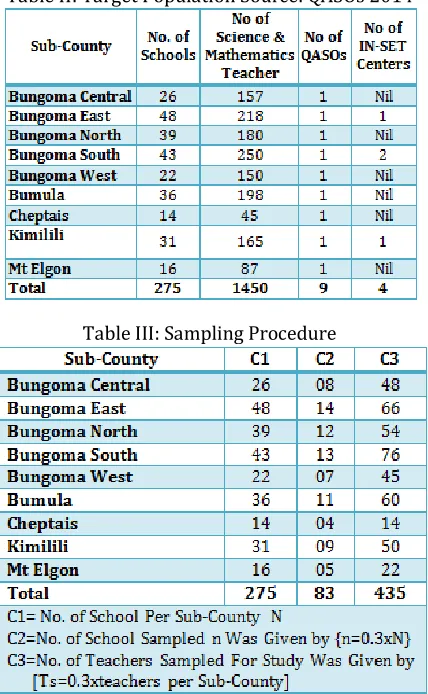
The target population for this study was one thousand four hundred and fifty nine (1459). Out of this population, one thousand four hundred and fifty (1450) were mathematics and science teachers, nine (9) Sub-County QASOs. The researcher generalized the findings to this population. Table II shows target population for schools per sub-county, number of mathematics and science teachers in each sub-county, number of QASO and the INSET centers.
Table II: Target Population Source: QASOs 2014
Table III: Sampling Procedure
SAMPLING TECHNIQUES
Since the study could not be conducted in all schools in Bungoma County, a representative sample was selected from nine sub-counties for the study. Simple random sampling method was used to select 30% secondary schools from each sub-county at a time that gave a representative sample. This was done using a rotary method so that the remaining schools had equal opportunities of being picked. The researcher picked a paper at a time and recorded the school’s name before
picking the next school. The picking continued until 30% of the schools had been picked before sampling from the next sub-county. The process continued for all the nine sub-counties and a total of 83 (30%) schools were sampled for this study as shown in table III.
The researcher used systematic random sampling procedure to sample out mathematics and science teachers per sub-county. All the possible respondents were index from 1 to a maximum in each sub-county and the researcher picked respondents at an interval that provided 30% respondents from each sub-county. The procedure was done for all the nine sub-counties and a total of 435 (30%) respondents were picked for this study. The researcher used simple random sampling to select 3 (33%) QASOs.
Table IV Sample Size
Sample Size
The main factor to consider in determining the sample size is the need to keep it manageable enough (Orodho, J.O, 2003). Therefore by studying the sample, one can be able to know more about the population without having to study the entire population. Although Bungoma County has 275 public secondary schools, only 83 (30.2%) schools were randomly sampled. A total sample of 438 (30.0%) respondents was selected from the target population for the study. This is considered as a representative sample since it falls within the range advocated by Mugenda and Mugenda (2003) who argues that, a representative sample for a descriptive survey study that fulfils requirements of efficiency, reliability and flexibility, should be in the range of 20% to 30%. Table IV shows respondents sample size.
Instruments for Data Collection
The research instruments for this study were Questionnaire, Observation and Interview schedules which were developed by the researcher.
Questionnaire
755 used a questionnaire which had both open ended and closed ended items It had three sections. Section A sought the teachers’ background information including age and academic/professional qualification. Section B sought to determine influence of trainers’ attributes on respondents’ participation in the in-service training process.
Interview Schedule
According to Koul (1993), interview method is often superior compared to other research tools. Once a rapport has been established and confidence assured, certain confidential information can be divulged that would otherwise have escaped the researcher (Platton, 1990). In addition, follow up can be made on incorrect or incomplete answers to certain questions and the interviewer has the opportunity to gauge the sincerity of the respondents’ information (Koul, 1993; Platton, 1990). This gave the researcher a complete and detailed understanding of motivation provided to respondents and attributes of trainers.
Observation Schedule
It was used to obtain data on the use of ASEI-PDSI practice during teaching and learning. The researcher was able to evaluate the lesson sampled by indicating the frequency use of teaching and learning method, teaching techniques and improvisation during teaching and learning process.
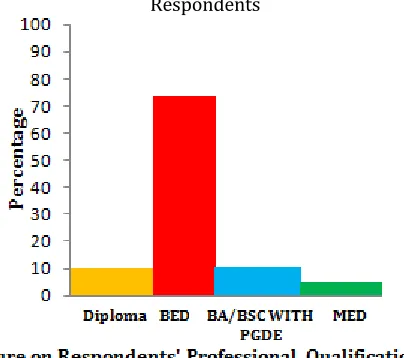
Findings Graph 1: Professional Qualification Of The Respondents
ETHICAL CONSIDERATION
The permission to carry out this research and to use information obtained was sought from relevant authorities and the concerned parties. Permission was obtained from the university, NACOSTI and the participating schools. The researcher kept any personal information confidential and did not allow any unauthorized person to access it.
DATA ANALYSIS PROCEDURE
Data was gathered from the field, coded and entered into the computer for analysis using Statistical Package for Social Sciences (SPSS). Data collected was presented using pie chart, tables and bar graphs.
Respondents were asked to indicate their professional qualifications and the findings were represented as shown below. The finding shows that 318 (74%) respondents were Bachelor of Education degree holders, 47 (11%) respondents were holders Bachelor of Science with a Post Graduate Diploma in Education, 43 (10%) were Diploma holders in Education while 21(5%) respondents were Master of Education Degree. The findings indicate that all the mathematics and science teachers were professionally trained.
Figure 2 Subjects Taught by Respondent
Table V INSET for Respondents
The findings shows that 90 (21%) respondents teach Mathematics and Chemistry, 73 (17%) teach
Mathematics/Physics, 64 (15%) teach
Chemistry/Biology and, 26 (6%) teach
mathematics/biology. It is established that 176 41%) respondents teach mathematics and other subject apart from physics, chemistry and biology.
INSET FOR RESPONDENT
The finding shows that respondents participated in the in-service training at subject level as shown in the table V below. From the data, 110 (26%) of the respondents attended Biology INSET, 103 (24%) Chemistry INSET and 81 (19%) respondents attended Physics INSET. A total of 133 (31%) respondents attended mathematics INSET. This reveals that most mathematics teachers have attended SMASSE in-service training in Bungoma County.
756 Teachers are expected to attend all the four cycles of the SMASSE INSETs. If they fail to attend any of them they are given an opportunity to attend the mop-up INSETs. The science and mathematics teachers are expected to attend one INSET in one of their teaching subject areas.
Table VI Number of INSET Cycle Attended
From the table, 429 (100%) respondents attended cycle one of SMASSE in-service training, 400 (93.2%) proceeded to attend cycle two. Only 204 (47.6%) respondents attended cycle three and 58 (13.5%) respondents attended the fourth cycle. The main theme of cycle one is attitude change and pedagogical skills. Since 100% respondents attended in-service training, it implies that all mathematics and science teachers benefited from the theme of cycle one and therefore are able to influence learners’ attitude. Participation in cycle two by respondents was 93%. Cycle two of SMASSE INSET provides an opportunity for participants to put into practice the principles of ASEI-PDSI paradigm. The respondents work in groups in order to focus on the problem areas of each subject. They also prepare ASEI lesson plans and present them to their peers. Therefore, by simple calculation, it implies that 30 (7%) who did not attend the INSET missed the “hands-on” training of the ASEI-PDSI classroom practices.
Cycle three of the INSET focuses on classroom implementation of the ASEI/PDSI principles. Activities of the INSET have been designed to transform the concept of ASEI from the theory to practice, a process known in SMASSE as actualization of ASEI. The cycle involves implementing of ASEI lessons and peer teaching session done during cycle two into actual classroom implementation in schools within the locality. Lessons are taught to different classes during the holidays (Waititu & Orado 2009). 225 (52%) respondents missed out on the actualization of the ASEI-PDSI classroom practices. Cycle four of the INSET involves monitoring and evaluation. The purpose is to improve the quality of the project activities. However, only 155 (36%) respondents participated in the in-service training. By simple calculation, 274 (64%) respondents missed essential knowledge on how the ASEI/PDSI should be monitored and evaluated in order to determine its impacts on the learners.
INFLUENCE OF TRAINERS’ PERSONAL ATTRIBUTES ON RESPONDENTS’ PARTICIPATION IN THE SMASSE
INSET
The study sought to find out the influence of trainers’ attributes on teachers’ participation in the in-service training. The SMASSE INSET programme design incorporates the teachers in the training of other teachers of mathematics and science. Therefore, the competency of INSET trainer’s should be clearly defined so as to have the best person selected for the position of a trainer. The trainer should have good interpersonal skills and understand the role and functions of in-service training as a management strategy to help the organization achieve its mission, and knows how competency-based training can promote "best practice" throughout the implementation of an innovation (Rogers, 1995).
He/she should understand the impact of personal appearance and dressing, physical positioning in relation to trainees, hands and body movements, positioning of a podium or tables, and tone of voice, on both the quality of the presentation, and receptivity by trainees. The trainer knows how to use name tags/name tents, "ice-breaker" exercises, introductions, and other activities at the beginning of a session to create a positive group climate and begin the engagement process. He/she should know the importance of speaking clearly at an appropriate volume (Rogers, 1983),and can vary volume, pace, tone, and inflection to maintain trainee's attention; and can avoid unnecessary and distracting vocalizations ("uh," "ummm," "you know," "like," "I mean."). Shiundu & Omulando (1992) asserts that a trainer should have mastered the subject content and can use reflective listening and feedback to encourage group involvement, to clarify and expand upon trainee contributions, to guide the direction of the discussion, and to enhance trainees' understanding of the content and concepts.
In order to establish how trainers’ attributes influence respondents’ participation in the in-service training, they were asked to prioritize the attributes as either Very Low priority (VLP); Low Priority (LP); Undecided (U); High Priority (HP) or Very High Priority (VHP). A score of 1 was given to VLP, 2 to LP, 3 to undecided, 4 to HP and 5 to VHP for each attribute of INSET trainer. The mean score for cumulative responses for each attribute was computed using the formula.
757 Table VII: Influence of trainers’ attributes on
respondents’ attendance in the SMASSE INSETs
The finding shows that trainers’ attributes greatly
influence respondents’ attendance in the INSET. Respondents are keen to know trainers’ teaching experience; performance of students in the subject the trainer teaches in national examinations; trainers’ academic and professional qualification and; the trainers’ interpersonal skills before they participate in the INSET.
A mean of 4.90 was obtained from cumulative responses on trainers’ teaching experience implying that respondents place value on trainers’ experience influencing their participation. If students’ performance in the’ subject taught by trainer is good, then respondents will consider participating in the in-service training. A cumulative mean of 4.74 was computed which imply that respondents’ participation in the INSET is influenced by performance of students in the subject taught by trainer in national examination.
The findings reveal that trainers’ academic and
professional qualifications highly influence participation by respondents in the in-service training. A mean of 4.86 was calculated from the cumulative response implying a very high priority. In contrast, the category of school in which a trainer teaches does not influence participation of respondents.
Trainers’ interpersonal skills highly influence participation by respondents in the in-service training. A mean of 4.93 was obtained implying that trainers should have high interpersonal skills to sustain participation by respondents. From the analysis of second objective, the findings have shown that trainers’ attributes greatly influence respondents’ participation in the in-service training. The table VIII below provides a ranking for trainers’ attributes as prioritized by respondent. Table VIII: Prioritized trainers’ attributes that influence
respondent’s participation in the SMASSE INSET
From the table above, it is revealed that participants place very high priority on trainers’ interpersonal skills. Trainers with effective verbal and non-verbal
communication exude confidence among the
participants. Listening and questioning effectively enable the trainer to initiate conversation, interpret and solve any queries by a respondent.
According to Daniel (1998), social awareness and-self management are some of the pillars of Emotional
Intelligence (EI) possessed by a good trainer who is responsible and accountable. A mean of 4.93 is a clear indicator that these skills influence respondents’ participation in the in-service training. Trainers’ teaching experience, academic and professional qualifications dictates participation of respondents in the INSET. However, school category where a trainer teaches does not influence respondents’ participation in the in-service training. A study by Lumpe (2000), on assessing teachers beliefs about science training and teaching in Siaya district, did not address trainers’ interpersonal skills influencing training. This study therefore sought to fill the gap.
CONCLUSION
758 good interpersonal skills, teaching experience, academic and professional qualifications. Trainers are usually teachers of mathematics and science subjects and therefore, students should be getting quality grades in those subjects taught by trainer.
RECOMMENDATION
Based on the findings and conclusions above, it was recommended that the national SMASSE office and the MoEST should ensure that trainer of trainers have good interpersonal skills and teaching experience. They should have good academic and professional qualifications. This will enhance teachers’ participation and hence implementation of SMASSE tenets for good results.
REFERENCES
[1]. CEMASTEA, (2008): Handbook on Management of
district SMASSE Programmes. Nairobi: SMASSE-JICA. [2]. County Director of Education, (2014): Teachers of
Mathematics and Science Attending SMASSE. Bungoma County
[3]. County Quality Assurance and Standards Officer,
(2014): CQASO, Bungoma South.
[4]. Daniel, M. (1998): Education Management: Measuring
Mutual Performance with Characteristics based benchmarks. North Western University Press.
[5]. Hodson, J. M. (1993): International Encyclopedia of Teaching and Teacher Education, Cambridge University Press.
[6]. KNEC, (2014): Kenya National Examinational Council,
Newsletter, KNEC: 2014.
[7]. Kombo, K and Tromp, L (2013): Sociology of
Education, NRB: Pauline’s Publications
[8]. Koul, L (1993): Estimations of parameters of
Autoregression, [ArCp] models.
[9]. MoEST, (1998): Strengthening Mathematics and
Science in Secondary Education Baseline Studies. [10]. Mugenda M. O and Mugenda G.A (2003) Research
Methods, Quantitative and Qualitative Approaches, Nairobi ACTS Press.
[11]. Orodho, O. J. (2003): Research Instruments: Validity of Research instruments and data Reliability.
[12]. Republic of Kenya, (2014): Ministry of Education Science and Technology; County Director of Education, Bungoma
[13]. Republic of Kenya, (2012): Education Sector in Computer: Report document 2013/14-2015/16. Expenditure framework, Nairobi: Government Press. [14]. Republic of Kenya, (1976): Learning of Mathematics
and Science in Secondary Education
[15]. Rogers E.M (1995): Diffusion of Innovation, (4th ed). New York: The Free Press.
[16]. Rogers E.M (1983): Diffusion of Innovation (3rd Edition): New York: The Free Press.
[17]. Shiundu J.S. and Omulando S.J. (1992): Curriculum Theory and Practice: Nairobi, Oxford University Press. [18]. SMASSE, (2008): Handbook on management of
district SMASSE Programmes. Nairobi JICA.
[19]. SMASSE, (1998): Training Module: Secondary INSET programme. SMASSE, Unpublished
[20]. Task Force, (2014): Report on KCSE 2013 Performance in Bungoma County.
[21]. Waititu, M.M. & Orado, G.N. (2009): Paper Presented at Secondary Education in Africa (SEIA). Follow-up technical workshop on science and Mathematics: Tunis. Unpublished.
[22]. World Economic Forum, (2014): Efficiency Human Resource.
ABBREVIATIONS AND ACRONYMS ASEI : Activity-focused, Student-centered, Experimenting and Improvisation
CEMASTEA : Center for Mathematics, Science and Education in Africa
CQASO : County Quality Assurance and Standards Officer KNEC : Kenya National Examinations Council MoEST : Ministry of Education Science and Technology PDSI : Plan, Do, See and Improve
RoK : Republic of Kenya