New Directions
Volume 15 | Issue 2
Article 3
4-1-1988
Student Opinions On Current Issues
Alvin Thornton
Joseph P. McCormick II
Walter Hill Jr
Follow this and additional works at:
http://dh.howard.edu/newdirections
This Article is brought to you for free and open access by Digital Howard @ Howard University. It has been accepted for inclusion in New Directions by an authorized administrator of Digital Howard @ Howard University. For more information, please [email protected].
Recommended Citation
Thornton, Alvin; McCormick, Joseph P. II; and Hill, Walter Jr (1988) "Student Opinions On Current Issues,"New Directions: Vol. 15: Iss. 2, Article 3.
SPECIAL REPORT:
STUDENT OPINIONS
ON CURRENT ISSUES
E d ito r’s note: The following is the out come of a recent survey on undergraduate student attitudes on issues of domestic and international concern. The students inter viewed are enrolled at Howard’s College of Liberal Arts, School of Business and Public Administration and School of Engineer ing. The data for the survey were collected last spring by three faculty members in the Department of Political Science who also wrote this special report. They are: ALVIN THORNTON, JOSEPH P. McCORMICK, H A N D WALTER HILL JR.
Abstract
Howard University undergraduates are post-civil rights movement students with life experiences and opportunities that markedly differ from those of their parents and grandparents. There is anecdotal evi dence to suggest that this generation of Black college students is much more “prac tical” and concerned only with its own upward economic mobility.
Within the broader context of a political movement that has been characterized by scholars and journalists as “conservative,” this survey examines the kinds of opinions held by Howard undergraduates on selected foreign and domestic issues. In the survey, we specifically sought to determine how much student opinions vary (if at all) by college or school of enrollment. Our ran dom sample of 439 was entirely made up of students enrolled in the university’s three largest academic units — the College of Liberal Arts, the School of Business and Public Administration and the School of Engineering.
The data show very few statistically significant differences among the students interviewed.
Introduction
Howard is a major American university with a rich history of preparing primarily Black students for leadership positions throughout the United States and the
world. The geographical distribution of its student body is broad, but the majority come from the United States and its posses sions.1
Past graduates of Howard have served or are now serving in positions of leadership at local, state, national and international lev els, and have made unique contributions in the private and public sectors.
Howard and other traditionally Black institutions (TBIs) of higher education presently share less than 27 percent of the Black higher education population in the United States. This represents a significant decline from the 1970s when at least 50 percent of all Black students in higher education were enrolled at TBIs.2 Notwith standing this enrollment decline, tradi tionally Black colleges and universities continue to produce the critical mass of potential Black leaders. Approximately 50 percent of Black college graduates gradu ate from historically Black institutions.
The challenge in the 1960s and 1970s for Black college students was to “awaken to a new sense of group consciousness and pride in being Black and work as committed activists in the civil rights movement.”3 Today, the concern of many Black students is with their ability to acquire specialized educational credentials in preparation for increasingly diversified public and private sector employment opportunities. This concern has been generated, in part, by the fact that the collective goals of Black Americans, as seen in the 1960s and 1970s, have largely been replaced by the lure of personal aspirations.
This survey seeks answers to two ques tions: (1) What kinds of social and political opinions have developed in the minds of this population?, (2) Do these opinions differ across academic concentrations?
In recent years, there has been increas ing differentiation in areas of academic concentration selected by students at tradi tionally Black institutions of higher educa tion. Over the past decade, increases have been seen in the number of students majoring in non-traditional fields, such as business and engineering.4 Associated with these increases has been the prediction that significant differences in social and political opinions would appear among students with different academic and career interests. This prediction is reasonable, given the exposure students have had to specialized curricula and the possibility that they will project opinions they deem appropriate to their contemplated occupations and life
styles. A magazine article on Howard’s School of Business and Public Administra tion suggests the potential impact of the school on the opinions of its students. “The why of its [the school’s] growth and popu larity has a lot to do with national trends. But it also has a lot to do with the particulars of the school’s distinctive per sonality.”5
Does, in fact, the Business School’s “distinctive personality” produce students with different opinions about major social and political issues?
To address this and other questions, we examined the students’ opinions on a num ber of controversial domestic and foreign policy issues.
Our research produced results that re veal a virtual absence of difference in student opinions based on college or school of enrollment. But we found opinion dif ferences among the students when other variables were controlled, e.g., gender, self- identified political orientation. Although we will not report all of these relationships in this paper, significant gender-based differences were found among Howard students.
Our initial concern was not with opinion variations by gender. Rather it was with exploring the proposition that there may be opinion differences among Howard under graduates based on their area of enroll ment. The entry and graduation require ments of the three academic units (liberal arts, business, engineering) are different.
Engineering and business are considered pre-professional, with less flexibility in their curricula and higher cumulative grade point average requirements. In addition, there is the generally held assumption that a degree in business or engineering is more marketable. We felt that these factors might result in student populations with signifi cantly different opinions on foreign and domestic policy issues.
This exploratory analysis of Howard students is a response, in part, to Walter Allen’s view that “comparative studies of Blacks in educational settings” should be conducted. His research has illuminated significant differences among Black college students (who attend predominantly white schools), and has led him to indicate that “we have extensively studied black-white differences, but the record on black-black and black-other minority differences is more limited and should be expanded.”6 In addition, our analysis is based upon the idea that we should better understand the
intra-university factors that might be shap ing the opinions of students, especially at a time of increasing academic specialization.
Sample Design
To draw our sample, we used a multi-stage random sampling design. After securing the enrollment data from the Office of the Registrar for the spring and fall 1986 and spring 1987 semesters, we determined that Howard’s undergraduate enrollment for the 1986-87 academic year was approximately 7,600. We determined that a sample size of 400 would permit us to make reasonable inferences about the undergraduate popula tion. Our sampling error was plus or minus five percent.
Of the 7,600 undergraduates enrolled in the 1986-87 academic year, 5,274 were in the College of Liberal Arts, the School of Business and Public Administration and the School of Engineering. These three units comprised approximately 70 percent of Howard University’s undergraduate popu lation. Liberal arts had 48.3 percent, busi ness 37.6 percent and engineering 14.1 percent of the 5,274 total. These propor tions were used to determine the size of the sub-samples for each of the three units. For each of them, we also estimated the propor tion of freshman, sophomore, junior and senior students. Finally, we stratified each sub-sample by the proportion of majors to get a cross-section of students in each of the three academic units.
After consulting with academic advisors and faculty members, we randomly se lected, by academic major, from official registration lists, those courses known to be taken by lower and upper division students. This sample design enabled us to generalize about inter-college or inter school differences.
Descriptive Profile
In Table I, six socioeconomic and political characteristics of our sample are presented: gender, family income, high school and neighborhood racial composition, ide ological orientation and party identifica tion. These characteristics provide some context for assessing the opinions de scribed below.
Overall, 52 percent of the sample was composed of female students and 48 per cent of male students. Black colleges and universities have traditionally enrolled more females than males. The College of Liberal Arts’ sample was composed of 59.4 percent female and 40.6 percent male
students. The School of Business’ sample was 60.2 percent female and 39.8 male, and the School of Engineering’s sample was 37.7 percent female and 62.3 percent male.
More than 40 percent of students in liberal arts, business and engineering re ported that their annual family income exceeded $40,000. More than half of those in engineering were in this category. Among liberal arts students, 35.5 percent said they came from a family with an annual income greater than $20,000 but less than $40,000, while 36.6 percent of business and 28.4 percent of engineering students were in this category. Less than 19 percent of students from each area indicated their family annual income was less than $20,000.
Most students in each sub-sample came from neighborhoods that were more than 50 percent Black. Engineering students (70.8 percent) were most likely to have lived in predominately Black neighborhoods, while liberal arts students (56.5 percent) were least likely to have lived in such neighborhoods. Business students (63.2 percent) fell between these extremes. The reverse was true for the high schools from which these students graduated. More than 50 percent of students in our sample said their high schools were not majority Black.
More than 40 percent of students in the College of Liberal Arts, the School of Busi ness and the School of Engineering indi cated that their ideological orientations were more liberal than conservative or moderate. We found that 48.7 percent of en gineering students associated with the lib eral view, whereas 46.1 percent of the lib eral arts students and only 40.5 percent of business majors said they were liberal. We did not anticipate that engineering stu dents, given their more narrowly focused academic orientation, would be most likely to identify themselves as liberals.
The School of Business had the highest percentage (29.7) of students who indicated that they were conservative, followed by the College of Liberal Arts and the School of Engineering — 17.6 and 14.2 percent respectively.
Although the majority of students in the survey said they identified with the Demo cratic Party (liberal arts, 55.7 percent; business, 58.3 percent; and engineering 56.1 percent), a surprisingly high percent age of them indicated they were independ ents. In fact, more than 34 percent of students in each unit gave this response. This seems to be consistent with the
general increase in the number of self- identified politically independent persons in all age cohorts found in the population at large.7
A higher percentage of business students (7.2 percent) identified with the Republican Party than was the case with liberal arts (3.8 percent) and engineering (2.0 per cent). As one expert pointed out, “the association of Blacks with the Democratic Party points to their historical movement toward liberalism, suggesting why they have traditionally associated with the politi cal party whose platforms were more liberal than conservative.”8
The party identification of students at Howard, notwithstanding area of study, appears to be generally consistent with that of the general Black population. It is more Democratic than Republican or independent.
Nicaragua, South Africa, Angola
In an essay on the influence of Black Americans on U.S. foreign policy, a Black former foreign service officer wrote: “Blacks had to overcome their own relative apathy about foreign affairs compared to other ethnic groups in the face of preoc cupation with urgent domestic concerns like voting, education, and economic ad vancement.”9
We asked our students their opinions about the positions the U.S. government should take in selected national issues and conflicts in three foreign countries — Nic aragua, South Africa, and Angola.
In Nicaragua, there are essentially two competing political forces, the Sandinista government and the “Contras,” an um brella organization of rebel groups opposed to the government. The position of the United States has been to support the Contras by providing military and other support. American public opinion has been divided on whether the United States should support the Contras. The majority of Americans have consistently indicated that they support negotiations with the current government. A New York Times/ CBS News Poll showed that 45 percent of men and 57 percent of women disapproved of the United States giving military aid to the Contras. The poll also indicated that 59 percent of people 18 to 29 years old disapproved of such aid.10
Table II shows the students’ responses to this question: “What position should the United States take in the Nicaraguan con flict?”
What should the U.S.
do in South Africa?
What should the U.S.
do in Angola?
20
Table I
Selected Characteristics of Students in the Spring. 1986 Characteristics Liberal Arts Business Engineering Gender n = 106 n = 118 n = 122
Female 59.4 60.2 37.7
Male 40.6 39.8 62.3
Family Income n = 95 n = 101 n = 109
% < $20,000 18.3 17.9 17.4 % > $20,000
but < $40,000 35,5 36.6 28.4 % > $40,000 46.2 45.5 54.1
Racial Comp, of H.S. n = 105 n = 118 n = 119
< 50% Black 50.5 53.4 50.4 > 50% Black 49.5 46.6 49.6
Racial Comp, of
Neighborhood n = 105 n = 117 n = 120
< 50% Black 43.8 36.8 29.2 > 50% Black 56.2 63.2 70.8
Ideological
Orientation n = 102 n = 111 n = 113
Conservative 17.6 29.7 14.2
Moderate 36.3 29.7 37.2
Liberal 46.1 40.5 48.7
Political Party
Identification n = 79 n = 84 n = 98
Democrat 55.7 58.3 56.1
Independent 40.5 34.5 41.9
Republican 3.8 7.2 2.0
Table II U.S. Position in Nicaragua U.S. Position in
Nicaragua
Liberal Arts Business Engineering n = 92 n = 92 n = 88
Support the existing
government 7.6 16.3 23.9
Support the Contras 33.7 20.7 20.5 Support neither 58.7 63.0 55,7
Chi. Sq. = 12.16; p = .01
Table III U.S. Position in South Africa What should the U.S.
do in South Africa?
Liberal Arts Business Engineering n = 102 n = 111 n = 112
Support the existing
government 0.0 4.5 2.7
Support the anti-government
forces 91.2 82.9 87.5
Support neither 8.8 12.6 9.8
Chi. Sq. = 5.63; p = .22
T here were significant differences among the students in the College of Liberal Arts, the School of Business and the School of Engineering regarding U.S. in volvement in Nicaragua. However, the ma jority of students from each unit indicated that neither the present government nor the Contras should be supported. A higher percentage of business students held this position (63.0 percent). Among liberal arts students, 58.7 percent said neither should be supported, while 55.7 percent of engi neering students held this position. The rebel groups had a higher level of support among liberal arts students (33.7), and the Sandinista government was supported by a higher percentage of engineering students.
When asked what position the U.S. government should adopt in the national liberation struggle in South Africa, the overwhelming majority of students said the anti-apartheid forces should be supported. These data are found in Table III.
Slightly more then 90 percent of liberal arts students felt that the anti-government forces should be supported. None of the liberal arts students felt the present govern ment in South Africa deserved support. Interestingly, almost five percent of stu dents in the School of Business thought the existing government should be supported. This was almost double the percentage of engineering students.
Many people would argue that the histor ical role of the United States in South Africa, where the African National Con
gress (ANC) and other opposition forces are fighting against the government, has been to the detriment of the majority Black African population. South Africa’s domestic policies and most of its social interaction reflect a policy of strict separation of the races, and institutionalized economic and cultural oppression.
The United States, through its policy of constructive engagement, continues to co o p erate w ith th e S outh A frican government.11
The point has been made that if the United States is serious about working to end apartheid, it must consider new steps— specifically, active economic and military support for South Africa’s neighbors and the imposition of comprehensive economic and military sanctions against the current regime.12 Implicit in this proposition is an argument for United States support for the anti-government forces in South Africa. Howard students, notwithstanding area of enrollment, supported this position.
Unlike in Nicaragua and other nations where America is involved militarily, the students from each unit drew parallels between the South African situation and the African-American struggle for political and economic rights.13
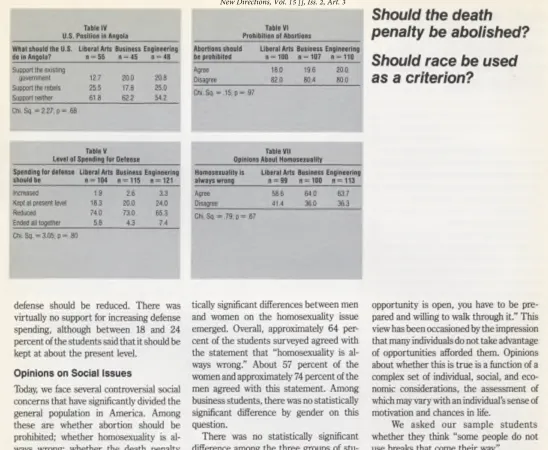
The students were less committal when asked about the proper U.S. government position in Angola. Their responses are in Table IV
In each college or school, the majority of the students indicated that neither the
existing government in Angola nor the rebel forces should be supported. In the College of Liberal Arts, 61.8 percent felt this way, while 62.2 percent in the School of Business and 54.2 percent in the School of Engineering took this position. There was greater support among business and engi neering students than among liberal arts majors for the current government. Ap proximately one-fifth of the students thought the government should be sup ported, while less than 13 percent of liberal arts students indicated so.
The students in each unit were unsure which side to support in the Angolan versus the South African conflict. This might be due to the fact that, unlike in South Africa, the Angola conflict involves primary com batants that are Black Africans. The ruling party, Popular Front for the Liberation of Angola (MPLA), is being contested by the Union for the Total Liberation of Angola (UNITA). UNITA is supported by the gov ernment of South Africa and the United States, while the MPLA has the backing of most African nations.
We asked the students one additional question related to foreign affairs—whether the level of spending for U.S. national defense should be increased or reduced.
There were no significant differences in student opinions about the appropriate level of spending for defense. Their re sponses are in Table V
More than two-thirds of the students in our survey indicated that spending for
Table IV U.S. Position in Angola What should the U.S.
do in Angola?
Liberal Arts Business Engineering n = 55 n = 45 n = 48
Support the existing
government 12.7 20.0 20.8
Support the rebels 25.5 17.8 25.0 Support neither 61.8 62.2 54.2
Chi. Sq. = 2.27; p = .68
Table VI Prohibition of Abortions
Abortions should Liberal Arts Business Engineering be prohibited n = 100 n = 107 n = 110
Agree 18.0 19.6 20.0
Disagree 82.0 80.4 80.0
Chi. Sq. — .15; p = .97
Table V
____________ Level ol Spending lor Delense____________ Spending for defense Liberal Arts Business Engineering should be n = 104 n = 115 n = 121
Increased 1.9 2.6 3.3
Kept at present level 18.3 20.0 24.0
Reduced 74.0 73.0 65.3
Ended all together 5.8 4.3 7.4
Chi. Sq. = 3.05; p = .80
Table VII Opinions About Homosexuality
Homosexuality is Liberal Arts; Business IEnqineerina always wrong n = 99 n = 100 n = 113
Agree 58.6 64.0 63.7
Disagree 41.4 36.0 36.3
Chi. Sq. = .79; p = .67
defense should be reduced. There was virtually no support for increasing defense spending, although between 18 and 24 percent of the students said that it should be kept at about the present level.
Opinions on Social Issues
Today, we face several controversial social concerns that have significantly divided the general population in America. Among these are whether abortion should be prohibited; whether homosexuality is al ways wrong; whether the death penalty should be abolished.
There was almost no difference between our student subsamples where the prohibi tion of abortion is concerned. Most Howard students disagreed with the notion that federal law should prohibit abortion. More than 80 percent of the students surveyed held this opinion. These data are in Table VI.
The majority of the students in our survey felt that homosexuality is always wrong. Approximately 59 percent of liberal arts students felt this way, while 64 percent and 63.7 percent of the business and engineering students, respectively, indi cated this opinion.
More of the liberal arts students (41.4 percent) than business (36.0 percent) and engineering (36.3 percent) disagreed with the proposition that homosexuality is al ways wrong. These relationships are in Table VII.
When we controlled for gender, statis
tically significant differences between men and women on the homosexuality issue emerged. Overall, approximately 64 per cent of the students surveyed agreed with the statement that “homosexuality is al ways wrong.” About 57 percent of the women and approximately 74 percent of the men agreed with this statement. Among business students, there was no statistically significant difference by gender on this question.
There was no statistically significant difference among the three groups of stu dents regarding the question of whether the death penalty should be abolished. Table VIII shows that the overwhelming majority of students interviewed, more than 67 percent, disagreed with the idea that the death penalty should be abolished.
The fact that more than two-thirds of the students in each of the three academic units indicated that the death penalty should not be abolished is interesting considering the fact that the death penalty is disproportion ately imposed on Blacks, the poor, the illiterate and other ethnic minorities.
Our data indicate that the Howard under graduate student, notwithstanding area of enrollment, is generally pro-abortion; is in favor of the death penalty; thinks homosex uality is always wrong (though opinion on this is somewhat divided by gender).
Opinions on Black Issues
The Rev. Jesse Jackson and other Black leaders are fond of saying “if the door of
Should the death
penalty be abolished?
Should race be used
as a criterion?
opportunity is open, you have to be pre pared and willing to walk through it.” This view has been occasioned by the impression that many individuals do not take advantage of opportunities afforded them. Opinions about whether this is true is a function of a complex set of individual, social, and eco nomic considerations, the assessment of which may vary with an individual’s sense of motivation and chances in life.
We asked our sam ple students whether they think “some people do not use breaks that come their way.”
There was a significant difference among the students regarding the idea that “some people just don’t use the breaks that come their way, and that if they don’t do well, it’s their own fault.” Among liberal arts stu dents, 66.7 percent disagreed with this proposition, while only 46.7 percent and 49.1 percent of business and engineering students, respectively, disagreed.
The students’ positions are outlined in Table IX. These data suggest that business and engineering students are far more likely to hold the individual accountable for his or her own failure to take advantage of oppor tunities than are liberal arts students.
We asked the students whether in an effort to compensate for past racial discrim ination, some graduate and professional schools should consider an applicant’s race in making admission decisions, i.e., affirma tive action. The question also asked whether such a practice should continue into the foreseeable future. We found no
More than
6 5
percent
of the students
interviewed said there
was a need for a Black
political party.
significant differences in the responses the students gave. Half of the students in liberal arts, and a majority of business and engi neering students said they agreed that race
should be used as a criterion into the
foreseeable future. Table X contains data showing their responses.
While there was no overwhelming op position to affirmative action in graduate and/or professional school admission among the students surveyed, we did not anticipate that so many students would be opposed to the use of race as a criterion for admission to graduate and professional schools.
We speculate that many students in each of the three units hold the opinion that the use of race in such a way stigmatizes and compromises the student involved and awards unwarranted educational benefits. There was also no significant disagreement among the students regarding the use of affirmative action in hiring and promotion. (See Table XI).
In each of our three sample units, there was an almost equal division between those who agreed with using race as one of a number of factors for hiring and promotion and those who disagreed with such a practice.
Business and engineering students were slightly more likely than liberal arts stu dents to endorse the use of affirmative action in hiring and promotion decisions. We should also point out that when one compares the responses in Tables X and XI, two possibilities, both of which are equally plausible, stand out: (1) In the case of graduate or professional school, Howard students appear ready to take advantage of an opportunity which might facilitate their entry, notwithstanding the fact that the opportunity may convey a racial stigma; and (2) In the case of gaining entry to the job market, or upward mobility within it, Howard students appear less willing to endorse an opportunity that may be seen as conveying a racial stigma.
Table VIII
Opinions About the Death Penalty Should the death
penalty be Liberal Arts Business Engineering abolished? n = 92 n = 104 n = 115
Agree 29.3 32.7 29.6
Disagree 70.7 67.3 70.4
Chi. Sq. = .34; p = .84
Table IX Opinions About Use of Breaks
Some people don’t Liberal Arts Business Engineering use breaks n = 90 n = 105 n = 114
Agree 33.3 53.3 50.9
Disagree 66.4 46.7 49.1
Chi. Sq. = 9.11; p = .01
In the job market, Howard students appear to be more concerned with gaining entry or upward mobility on the basis of individual merit rather than through affirm ative action.
The willingness of Howard undergradu ates to be independent of the two major political parties (Democratic and Re- pubican) was indicated by their support for the establishment of a Black independent political party. Table XII contains their opinions on this.
More than 65 percent of the students interviewed said there was a need for a Black political party. Many attempts have been made to form independent Black political parties, with the most recent one being the National Independent Black Polit ical Party (NIBPP). Before NIBPP, there were national parties like the Black Panther Party, National Liberation Party, Afro- American Party, Freedom Now Party, and the Peace and Freedom Party. In addition, between 1897 and 1970, there were several Black state parties, such as the Negro Progressive Party and the United Citizens Party.14
One final issue that we felt had an impact on the progress of Blacks in the United States is the integration of public schools. We asked the students whether they felt “racial integration of public schools had improved education for Black people, made it worse, or has not made any difference?”
Table X
Race as a Criterion for Admission to Graduate and Professional Schools
Should race be used Liberal Arts Business Engineering as a criterion? n = 90 n = 98 n = 110
Agree 50.0 56.1 55.5
Disagree 50.0 43.9 44.5
Chi. Sq. = 85; p = .65
Table XI
Race as a Criterion in Hiring Decisions Race as a Criterion Liberal Arts Business Engineering
Agree 48.9 51.0 54.5
Disagree 51.1 49.0 45.5
Chi. Sq. = .64; p = .72
There was no significant difference among the students in their responses to this question. The majority of them indi cated that racial integration of public schools had improved education for Black people. Fifty-nine percent of liberal arts students, 58.8 percent of business students and 63.1 percent of engineering students held this opinion. Less than 20 percent of the students indicated that public school integration had worsened the education of Black people. Table XIII contains these data.
Conclusion
The data indicated that there were signifi cant differences among Howard students (by area of enrollment) where self-identified ideological orientation is concerned, i.e., whether one sees him/herself as a liberal, conservative or moderate. Interestingly though, such differences were not readily seen in the responses to specific questions on foreign and domestic policy issues. Notwithstanding college or school of enroll ment, the students held similar positions on many of the controversial issues facing the United States in the late 1980s.
A possible explanation for this finding is that Howard undergraduate students in the three areas we surveyed may: (a) not have a clear understanding of the operational meaning of such terms as “liberal” and “conservative,” or (b) apply these terms
At the undergraduate
level, one’s field of study
appears to have little
bearing on the opinions
one holds on major
domestic and foreign
issues.
Table XII Need lor a Black Political Party Need tor a Black
Political Party Liberal Arts Business Engineering
Agree 71.1 69.6 70.9
Disagree 28.9 30.4 29.1
Chi. Sq. = .05; p = .97
Table XIII
_____________ Impact ol Racial Integration_____________ Effects of Public
School Integration
On Education Liberal Arts Business Engineering of Blacks n = 101 n = 114 n — 111
Improved it 59.4 58.8 63.1
Worsened it 7.9 13.2 15.3
Had no effect 27.7 24,6 17.1
No opinion 5.0 3.5 4.5
Chi. Sq. = 5.71; p = .45
differently depending on the issue involved. Thus it is plausible that an individual may view some issues through a liberal lens, while viewing others through a con servative lens.
At the undergraduate level, one’s field of study appears to have little bearing on the opinions one holds on major domestic and foreign issues. This finding also tends to hold when selected racial issues are in cluded in the analysis.
Our conclusion about Howard University students in the College of Liberal Arts, the School of Business and the School of Engineering can be clarified somewhat if we place the opinions they hold in the larger context of the experience of Black people in the United States. About the Black popula tion in general, it has been noted that “because of the systematic discrimination against blacks in American culture, blacks form a much more homogeneous group socioeconomically, as well as a more politi cally self-conscious one, than most other groups in American society.”15 One in ference that can be drawn from this is that the social and political opinions of Afro- Americans would also be more homoge neous than other less discriminated against
ethnic groups. □
REFERENCES
1. Annual Report of the Office of Records and Registration, Howard University, 1986-87. 2. The College Entrance Examination Board,
Equality and Excellence: The Educational S ta tus o f Black A m ericans (New York: 1985).
3. Gurin, Patricia and Edgar Epps, Black Con
sciousness: Identity and Achievement (New
York: John Wiley and Sons, 1975). 4. The College Board (1985).
5. Scarupa, Harriet J., “Business Education: Grooming for Success,” New Directions, Vol. 12, No. 2 (April 1985).
6. Allen, Walter, R., “Black Student, White Struc tural, Interpersonal, and Psychological Corre lates of Success,” Journal o f Negro Education, Vol. 54, No. 2 (1985).
7. Flanigan, William H., and Nancy H. Zingale,
Political Behavior o f the American Electorate
(New York: Allyn and Bacon, Inc., 1987). 8. Walton Jr., Hanes, Black Politics: A Theoretical
and Structural Analysis (Philadelphia: J.B.
Lippincott Company, 1972).
9. Longmeyer, Kenneth, “Black American D e mands,” Foreign Policy, No. 60 (Fall, 1985). 10. The New York Times (July 18, 1987). 11. Kamara, Michael and Selima Marriott, U.S.
Foreign Policy in Southern Africa (Baltimore,
Md: Morgan State Press, 1983). 12. Kamara (1983).
13. Longmeyer (1985). 14. Walton (1972). 15. Flanigan (1987).