Table of Contents
About This Journal ii-iv
Editorial 1-5
Peer Reviewed Articles
The Multi-Dimensional Issue of Culture and Christian Ministry 6-16
Rev Dr Philip Hughes
Cultural Differences between Australian Denominations on Coming
to Faith 17-29
Dr Juhani Ensio Tuovinen
Visual Technologies within a Consumerist Culture 30-45
Graeme Vincent Flett
With the Curiosity of an Oddity from a Bygone Era: The Gospel and 46-59 Our Culture Network (GOCN) conversation and its contribution to mission to the West
Ps Andrew A. Groza
Pastoral Reflection
In Praise of Pastors 60-65
Ps Jeremy Weetman
Student Article
What is the preferred/dominant leadership/authority style that can 66-80 be used as a tool that is both culturally appropriate and biblically
justifiable, to identify and develop emerging leadership of Sri Lankan Pentecostal/modern church?
Ps Asanga De Costa
Theses/Dissertation Listing
2013 81-83
2014 84-86
Book Reviews 87-105
About This Journal
Editorial Board
The Editorial Board of the Journal of Contemporary Ministry is comprised of: Professor Emeritus Gary D.
Bouma, AM - Monash University; former Chair of Harvest Bible College Academic Board; Sociologist; prolific author.
Rev Dr Peter Carblis - Conjoint lecturer for University of Newcastle; former principal Tabor NSW, Australia.
Rev A/Prof Darren Cronshaw - Mission Catalyst – Researcher, Baptist Union of Victoria; Pastor, AuburnLife Baptist Church; Head of Research, Australian College of Ministries (SCD); Honorary Research Fellow, Whitley College (University of Divinity); Adjunct Professor, Swinburne Leadership Institute Rev Dr Kevin Giles - Published author; retired Anglican minister; Adjunct lecturer for Harvest Bible College, Australia.
Rev Dr David Jakobsen - Academic Dean, Danish Pentecostal Bible College, Denmark.
Rev Dr Julie Ma - Research Tutor in Missiology, Oxford Centre for Mission Studies, UK.
Rev Dr Cheryl McCallum - Principal, Tabor College Victoria, Australia.
Dr Soong-Chan Rah - Associate Professor of Church Growth and Evangelism, North Park Theological Seminary, Chicago, USA.
Rev Dr Michelle Sanders - Adjunct lecturer for Harvest Bible College; Missional church planter and Pastor,
Kaleidoscope Community,
Melbourne, Australia.
Editorial Team
The Editorial Team of the Journal of Contemporary Ministry is comprised of:
Dr Jon Newton - (Head of Research & Dean of Postgraduate Studies, Harvest Bible College), Editor.
Ms Kerrie Stevens - (College Librarian, Harvest Bible College), Journal Manager, Layout Editor.
Ps Astrid Staley - (Adjunct faculty, Harvest Bible College; Doctoral candidate, Melbourne School of Theology). Section Editor for Pastoral Reflections and Student Articles; Layout Editor.
Rev Dr Clayton Coombs - (Academic Dean, Planetshakers College), Book Review Editor.
The Journal of Contemporary Ministry will act as a place for reporting research and discussing issues related to contemporary ministry, including related theological and biblical questions.
Its goals are to:
• Stimulate informed discussion regarding issues faced by contemporary Christian churches and ministries worldwide;
• Encourage research, including empirical research, into diverse forms and contexts of contemporary ministry and the practical, theological and biblical issues that arise from ministry practice;
• Enable students and graduates in postgraduate Ministry programs to speak to a wider audience;
The Journal of Contemporary Ministry will provide a specific forum for Harvest Bible College research students and faculty, and other interested people, to publish the results of their research.
It will also provide a potential publishing venue for paper presenters at Harvest’s annual research conference.
The Journal of Contemporary Ministry will contain these kinds of materials:
• Peer-reviewed articles based on scholarly research (empirical or theological) into diverse forms and contexts of contemporary ministry, and the practical, theological and biblical issues that arise from ministry practice;
• Pastoral reflections and articles that contribute viewpoints, based on personal experience or theological reflection, on contemporary ministry issues. These may be responses to articles from the Journal;
• Book reviews and/or notes of new publications related to contemporary ministry;
• Articles contributed by postgraduate students, which would also be refereed but may not come up to the level required in the first category;
• A list of recent doctoral research theses completed on contemporary ministry relevant to this journal’s focus.
The material we invite covers such topics as:
• Results of empirical research into aspects of contemporary Christian ministry, e.g. youth ministry, children’s ministry, pastoral counselling, pastoral leadership, intercultural ministry, etc;
• Theological and biblical reflection on issues that have arisen from the practices of contemporary Christian churches and ministries, e.g. manifestations of the Spirit, worship styles, leadership culture, interfaith matters, political and social engagement, etc;
• Underlying theological questions that lie behind Christian ministry issues, e.g. the role of women’s ministry in local churches, ethnic identity, ordination, apostleship, etc;
• Proposals for new expressions or forms of Christian ministry based on social analysis, e.g. how to reach specific sub-cultures.
Editorial
Dr Jon K. Newton
PhD(Deakin); MATheol(ACT); BA(Hons)(ICI); BA(Sydney); DipEd(Sydney) Head of Research & Dean of Postgraduate Studies, Harvest Bible College
Contact: [email protected]
Editor
I’m a Christian minister as well as a lecturer. As a pastor of a small suburban church, I’m always looking for answers. I want to know what’s going on in the world. Specifically, what’s going on that affects my life as a Christian and my work as a Christian minister? Where do I find out what God is doing today or about how His servants are “kicking goals” that we can all learn from? More importantly, where do I go to find out whether or not the events, achievements and projects I hear about constantly online, on Facebook or just “on the grapevine” are really as good as they are reported to be, and if so, why are they achieving good things in our world? How can I apply the lessons drawn from such analysis to my life and ministry? Where can I find stimulating responses from my peers about the issues I face? And how do I find the informed and
grounded thinking I need to get out of the rut I sometimes find myself in as a Christian leader?
Busy pastors get news about the latest trends, ideas and methods largely anecdotally or from conferences. When it comes to assessing why some churches and ministries are growing and succeeding and others are failing or declining, we often tend to fall back on one or more of these sources:
• The minister’s own interpretation of what’s happening: “my church has grown from 200 to 800 in one year because we introduced the … program from…”
• Denominational traditions: “our movement is growing steadily because we have the right interpretations of Scripture.”
• Second-hand theories: “every minister that God is using today has embraced a missional approach to church life.”
• Theological rationalisations: “my church split and has never recovered because I made a stand for the Truth and people don’t want to hear it.”
• Historical ignorance: “we’d see great revival today if only we followed the ways of the Puritans.”
• Prejudice: “the only reason that church is growing is because they compromise on the gospel.”
• Psychological copouts: “their church is growing because they have a level of ability or personality I could never reach.”
• Generalized accepted wisdom: “Christianity is in decline. Everyone knows that.”
Now of course no one reading this would ever base their ideas on such shallow foundations. But ask yourself, how do I assess ministry performance or church health? For example, to what do you attribute the incredible growth of the Hillsong phenomenon? Check to see if your immediate answer doesn’t fall into one of these categories.
Of course, all the reasons given above may be right, at least sometimes. But how would we ever know? How much research is done to find out?
In Kevin Ward’s stimulating book Losing Our Religion? (reviewed in this journal), he reports how data from late in the twentieth century challenged the “accepted wisdom” that secularism would inevitably displace religion in the modern world (Ward 2014, p. ix). He also probes the consensus in some circles that conservative churches are growing whereas “liberal” ones are declining, with a study of four different churches in New Zealand. We need to do the hard work in research (quantitative, qualitative, historical, theological, etc) if we want to help ministers, churches and other Christian organisation make well-informed decisions.
In some ways, our challenge is like that of the early empirical scientists. Breaking out from the traditional explanations of the natural world based on Aristotle, Ptolemy or even unreflective readings of Scripture, they went out into the natural world to find out for themselves how it worked. Christian researchers need to have the courage to do the same: to break out of the old paradigms, ask the hard questions, and thus develop new ministry models for the 21st Century.
Harvest Bible College in Australia is highly focused on preparing people for Christian ministry, as reflected in our mission statement “Training Effective Ministry Worldwide to Serve Local Churches.” The College has always insisted on maintaining this ministry focus in its degree programs. At Harvest, we’ve also been steadily building a research culture as we move increasingly into postgraduate courses. We’ve successfully run a Master of Arts in Ministry for 15 years. We’ve hosted a successful ministry research conference for several years. Now we’ve launched a Doctor of Ministry program, fully accredited through the Australian government’s tertiary education agency, TEQSA.
questions about real ministry today, and I discovered a real dearth. There are some good journals on Christian Ministry as a broad field, or on the related field of Practical Theology. There are journals with a great historical base. There are some broad-based, interdisciplinary, journals in which great individual articles on contemporary ministry have appeared. There are some good journals on highly specialized forms of ministry such as pastoral care. And of course, there are any number of great journals on theology and biblical studies. But there doesn’t appear to be a journal focused primarily on the field of contemporary ministry. Until now, that is.
This new journal seeks to go some way towards filling that gap. It builds on the presentations given at the Harvest Research conferences (though not exclusively) and hopefully provides a new avenue for research on contemporary ministry to be facilitated and broadcast to a wider audience.
Let me unpack what I as the Editor, and our editorial board and team, hope this journal will achieve.
1. We hope it will stimulate and report on solid research into aspects of Christian ministry. We are particularly focusing on the practice of ministry, though not neglecting its theological foundations and implications. We will interpret the word “ministry” fairly broadly but normally avoid ministry areas covered by their own specialist journals, such as school education and counselling. We will especially promote various kinds of empirical research on ministry.
2. We aim to focus on “contemporary” ministry. We define that not as a particular stream or style of ministry (cool, trendy, emerging, etc) but ministry as it looks and works NOW in whatever contexts or traditions it is found. We want to find out what Christian ministries are doing today for the Kingdom of God, and what they might do even more with the right analysis of their context and methods. I hope this will uncover some aspects of current ministry that are creative, innovative, impacting, unusual, Spirit-inspired and/or effective. We will sometimes explore what hasn’t worked (or is somehow flawed) and why, and how it might have been done better, but we aim to have a positive tone throughout.
3. We hope it will encourage more people to do research and report on it in a friendly setting. We will include contributions from serious researchers but also serving ministers and postgraduate students. I hope that these reports and articles will be widely read and will stimulate more thought and more research. I hope that this research will lead to positive changes in how we do ministry.
4. We hope it will help create a new kind of discussion about ministry that is biblically-informed, theologically sharp, spiritually alive and empirically grounded. A discussion that helps pastors and others break out of the lazy, shallow patterns of thought I listed above. As a result, I hope we will see a new generation of ministers rise up who have sharp minds, good research skills, an openness to new ideas and Spirit-filled hearts.
In order to achieve its goals, each issue of this journal will contain:
• Four strongly researched articles that have been through a process of “double blind” peer review.
• A pastoral reflection by an active Christian minister, one which will be thought-provoking and well informed by reading and praxis.
• A stand-out essay by one of our Harvest postgraduate students.
• A great collection of book reviews. This journal aims to be the go-to place for anyone looking for books that reflect the latest good thinking and praxis in contemporary ministry.
• A list of recent theses in the field of contemporary ministry. • And maybe something else surprising or unusual.
The material we invite will cover such topics as:
1. Results of empirical research into aspects of contemporary Christian ministry, such as youth ministry, children’s ministry, pastoral leadership, church planting, intercultural ministry, workplace ministry and healing ministries, just to name a few.
2. Theological and biblical reflection on issues that have arisen from the practices of contemporary Christian churches and ministries; for example, manifestations of the Spirit, worship styles, leadership culture, interfaith matters, political and social engagement, and so on.
3. Underlying theological questions that lie behind Christian ministry issues, such as the role of women’s ministry in local churches, ethnic identity, ordination, apostleship and others.
4. Proposals for new expressions or forms of Christian ministry based on social analysis, such as how to reach specific sub-cultures.
We have successfully recruited some great researchers to our Editorial Board, as you can see in ‘About This Journal’. We have also formed an active and enthusiastic working team that is responsible for the production of each issue. More important are those who write for the journal.
This issue’s four leading articles all relate to the question of how the contemporary church operates in the era we now find ourselves in, at least in countries like Australia, an era which is somewhat postmodern, Christian, but also post-secular.
Here is a brief introduction to the authors:
Dr Philip Hughes is the senior researcher with the Christian Research Association in Australia and now also the Chief Supervisor for Postgraduate Research at Harvest. He is one of the most experienced researchers on Australian Christianity and its social and cultural context. He is the author of several books and editor of Pointers, a regular bulletin on research findings from the work of CRA. Philip’s article explores the connections between the culture of churches and the surrounding social context, both as they are and as they should be. This will help ministers think about how much they should resist and/or embrace the changing culture we find ourselves in.
on different ways and understandings of coming to faith draws on two important research data bases associated with the National Church Life Survey. It’s a great contribution to an understanding of faith journeys and a good model of research based on existing data. Pastors will find suggestive thoughts about how they might seek to stimulate faith in their own context.
Pastor Graeme Flett is currently a member of the academic staff of Laidlaw College (Auckland campus), New Zealand, involved primarily with the development and implementation of the ministry internship program within their undergraduate degrees. He is studying towards a PhD through Otago University and is a credentialed Pastor with the Elim Churches of New Zealand. His article on “Visual Technologies within a Consumerist Culture” probes behind the image of the “happening” church to investigate how these images are produced. For a pastor, this article raises disturbing questions about how our love of new technologies may have unwanted side-effects.
Pastor Andrew Groza has been a youth and young adults pastor at a large Pentecostal church in Melbourne and is now a VET Trainer and Online Coordinator at Harvest Bible College, Melbourne, with a passion for reaching the younger generations with a relevant Christian message. His article “With the curiosity of a bygone era,” explores the work of the Gospel and Our Culture Network (GOCN) in the light of the post-Christian context the western church finds itself in. There are some useful thoughts here for pastors as we try to manage the interaction between the gospel and our current cultural settings in the context of the local church.
This Issue’s pastoral reflection comes from Pastor Jeremy Weetman, who is the pastor of Eikon Community on the Gold Coast, Queensland and currently a DMin student and adjunct lecturer with Harvest. It’s a very encouraging appreciation of the work of pastors.
The student essay has been written by Asanga De Costa, who recently completed the MA at Harvest and is now back in ministry in Sri Lanka, pastoring a local church and pioneering some new forms of Christian ministry. In his essay, he explores leadership and authority models in Sri Lanka from a cultural and biblical perspective. This essay raises important questions that all Christian leaders should consider.
I commend these articles and the other material in issue Number 1 to you and welcome your feedback via our Journal of Contemporary Ministry forum - http://journalofcontemporaryministry.blogspot.com.au/
I would also like to encourage you write for the journal and to present papers at this year’s Harvest Research Conference around the theme “Church and Ministry: a Contemporary Voice.” You’ll find the call for papers in this journal and here is a link to a presentation by Dr Ian Grant on “How to craft your Master’s Degree essays into a
brilliant conference presentation!”
Part 1 - https://www.youtube.com/watch?v=eyf3LGIWJyQ Part 2 - https://www.youtube.com/watch?v=zc5_-zlf3Qg
The Multi-Dimensional Issue of Culture and Christian
Ministry.
Rev Dr Philip Hughes
MA(University of Melbourne), MEd(University of Melbourne), BD(Hons)(Melbourne College of Divinity), DTheol(South East Asia Graduate School of Theology
Chief Supervisor for Postgraduate Research, Harvest Bible College Contact: [email protected]
Abstract
Introduction
Ministry and Culture
In 1951, H. Richard Neibuhr published his most famous work, Christ and Culture. In it, he reviews the history of Christian theology and outlines five ways in which theologians have identified faith in relation to culture. He summarised them under the headings of:
Christ against culture; Christ of culture; Christ above culture;
Christ and culture in paradox; and Christ transforming culture.
While Neibuhr described Christian theologies, these headings can also be applied to approaches to ministry. Indeed, the dilemma of how church life should be developed in relation to culture has confronted every cross-cultural mission: to what extent should ministry be developed in a way that absorbs patterns of culture, and to what extent should ministry involve patterns which are seen to transcendent every culture (see, for example, the discussions in Hesselgrave 1978 and Kraft 1979). Some approach ministry as if it is fundamentally 'against culture'. Ministry, in terms of the organisation of worship, pastoral care, and Christian guidance, is sometimes approached from a perspective which argues that the duty of Christian ministers is to ensure that the patterns of the New Testament, assumed to be the divine patterns, given by God, should be used in every aspect of personal life and the life of the church. Others, however, have argued either explicitly or implicitly that ministry must draw on the forms and processes of the receptor culture. Other approaches to ministry can be identified comparable to the other categories Neibuhr identified. The purpose of this paper is not to explore Neibuhr's categories in themselves but to demonstrate how ministry is multidimensional in relation to culture and how it may reflect both ends of the spectrum 'Christ against culture' and 'Christ in culture' at the same time. The contention of this paper is that a significant challenge in ministry is being both 'in the culture' and 'against culture' in appropriate ways.
caused by the alliance of state and church that began with the Roman Emperor Constantine.
There are many interpretations of what it has meant to restore New Testament patterns. For the Baptists, it meant rejecting infant baptism and adopting exclusively adult baptism. For the Brethren and the Churches of Christ, it meant the rejection of clericalism. For Frost and Hirsh (2003, p. 15), it has meant the adoption of a mission-oriented spirituality. In terms of practical ministry in churches, the maintenance of ministry patterns built on the New Testament has been interpreted in a great many ways. For the Presbyterian Church of Eastern Australia, for example, it means not using musical instruments in worship and singing only the Psalms and not celebrating Christmas because Christmas is not mentioned as a festival in the New Testament. For Protestant churches, it has meant that worship revolves around the hearing of the Word of God, through the reading of Scripture and listening to its exposition in the sermon.
However, there are others who have emphasised the need for ministry to be developed in the terms of the contemporary culture, perhaps reflecting a theology of the Christ of culture or the Christ above culture. They have argued that the theology, as an expression of faith, must be framed in terms that are meaningful in the contemporary culture. One of the most comprehensive statements of such views is that of Paul Tillich's systematic theology. He introduces his systematic theology as an attempt to adapt the Christian message to the modern mind through a method of correlation. He proposes a 'theological method in which message and situation are related in such a way that neither of them are obliterated' (Tillich 1968, p. 8).
In ministry, too, people have sought to use local cultural forms in their expression. This has often been most intentional in places in which the Christian faith has been planted within the last century or two. In Bali, for example, some churches have been intentional in building their churches using the patterns and forms of Balinese architecture and adorned with Balinese art. The Gospel has been proclaimed using Balinese dance and drama. The traditional black robe of the minister has been replaced by a white robe, symbolic of relations to good rather than evil spirits. It has been argued by Balinese church leaders that 'indigenization or contextualization is a tool for communicating the Gospel so that the Gospel message becomes relevant [and ..] to root itself in the soul of the society' (Mastra 1980, p. 272).
What would an outsider see if they observed Christian ministry in our Australian churches? Would they conclude that, in general, that ministry was counter-cultural, justified in terms of the patterns of the New Testament? Or would they see ministry as primarily reflecting contemporary Western culture?
Multiple Dimensions to Ministry
in Thailand
Many years ago, I had the opportunity to think in-depth about this issue while observing ministry in the Church of Christ in Thailand. Taking myself out of my own culture, away from the language and patterns of my own experience, gave me the opportunity to reflect on the issue at greater depth. I spent some time examining the northern Thai culture, including observing Buddhist festivals and weekly services of worship in northern Thailand. How did the Church of Christ relate, on the one hand to Thai culture, and on the other, to the patterns of the New Testament?
northern Thailand and led it for more than 40 years until his death in 1911 (McGilvary 2002). Presbyterian missionaries continued to come to Thailand and there were a number of American Presbyterian missionaries there in the late 1970s when I conducted my research there. Most of these people were teaching in the theological college and in advisory roles. Just a few were involved in rural churches and in practical ministry. Most ministry in the local churches was conducted by Thai people who had been trained in the theological college in Chiang Mai.
On the surface, many dimensions of ministry of the northern Thai churches reflected the patterns of the Presbyterian church from which the missionaries came. The architecture of the churches was similar, with rectangular buildings and usually a tower to house a bell, as can be seen in the picture of First Church, Chiang Mai. Some modifications had been made in more recent church buildings to allow the air to circulate more easily. Inside were wooden pews similar to those in poorer churches in the USA, very different from the mats in the Buddhist temples where people sat on the floor.
The Original First Church, Chiang Mai, Northern Thailand.
Ministers wore blue robes similar to those used by the ministers of the USA, despite the warmth of the Thai climate. They spoke from pulpits similar to those of Presbyterian churches in the USA, quite different from the pulpits in the Buddhist temples where Buddhist monks would sit to read their sermons.
Thai music is quite different from Western music, based on seven evenly spaced tones in an octave, compared with 8 unevenly spaced tones in Western music. However, Western music was always used in churches in Thailand, presumably because this was the music most familiar to the Western missionaries. The cultural patterns of ministry were predominantly Western, neither Biblical nor Thai.
Yet, at the heart of faith for many Thai Christians, as for many Thai Buddhists, is the affirmation of the popular Thai expression of the law of karma 'Do good, receive good; do evil, receive evil'. Interviews were conducted with pastors and elders of Thai churches as part of the research on culture and faith in northern Thailand. When they were asked what they thought about karma, most said that it was a Buddhist, not a Christian, term. Others said that it could be understood from a Christian perspective as what God ordains. Another part of the research involved surveys of university students in northern Thailand. When approximately 200 Thai Christian and Buddhist university students were asked whether the statement 'Do good, receive good; do evil, receive evil' was true, 81 per cent of the Christians and 71 per cent of the Buddhists affirmed it, most others saying they did not know whether it was true or not. The differences between the Christian and Buddhist affirmation were not significant (Hughes 1983, p. 171).
Content analysis of the sermons collected in northern Thai rural churches in 1980 demonstrated that the sermons had a strong Thai flavour. The content of the preaching reflected the major tenets of the Christian faith as they had been taught. Yet, the emphases were different. There was little attempt, for example, to deal with the message of Easter. In thirty sermons that were recorded in the research in northern Thai village churches, only in three were accounts given of Jesus' death. One described it as the struggle over the powers of darkness, another as a 'sacrifice for others' and the third as a supreme expression of God's love. The concept of atonement or sacrifice for sin was never mentioned in those sermons (Hughes 1983, p. 186). Easter was offensive in the Thai worldview. It did not fit easily with the Thai sense that being murdered must mean that one has 'bad karma' from previous lives, that it is something shameful and humiliating. Christmas, on the other hand, was celebrated with great enthusiasm. This enthusiasm might be seen as rooted in the idea of the 'coming of the great king'. The king's visit is always a time of great celebration among Thai people, for the king is the great patron of the people and, in some ways, a symbol of deity. The word used in Thailand to commonly describe the event celebrated by Christmas is the same as the word used for a royal visit: 'gan-saded-ma' (Hughes 1983, p. 194).
Many of the sermons reflected teaching about good moral behaviour and religious practices. The language was Christian and Thai Buddhist terms were rarely used. However, the underlying themes were often not so different from those of the sermons in the Buddhist temples. Certainly, the practical examples of the exhortation to religious practices were a little different. Many Buddhist sermons could be seen as expositions on the theme of 'Do good, receive good; do evil, receive evil'. This is the Thai formulation of the basic moral universal law: the law of karma. We receive the consequences of our actions. So most Christian sermons could be seen as expositions of that same basic moral law. If you do good (in terms of Christian behaviour, of course), you will receive good. If you do evil, you will receive evil.
message that was conveyed through the preaching, and in those aspects of the Christian faith that were emphasised, there was a Thai cultural flavour which had its origins in the Hindu-Buddhist tradition from India.
The importance of these observations is that it is necessary to look at ministry as multi-dimensional. One might make similar observations of the multi-dimensional way in which ministry relates to culture in Australia. Different dimensions of ministry may relate to culture in quite different ways.
Multiple Dimensions to Ministry
in Australia
Contemporary large charismatic churches in Australia often have seating patterns like those at a theatre: around a central stage. The music reflects contemporary styles, perhaps somewhere between a small folk band or a rock band. One might draw parallels between the form of presentation used by preachers with speakers at other events such as political rallies. The use of the data projector for songs and other information reflect contemporary teaching environments. Indeed, some charismatic and evangelical churches have been intentional in trying to develop a context in which people who do not have a history of church attendance feel at home. The context reflects the culture. In this regard, the context suggests a 'Christ of culture' pattern.
Entering a church of a mainstream denomination, however, one may well be struck by the distinctive architecture and patterns of seating. The architecture of most mainstream churches is dominated by the traditions of faith and particular theological expressions. There is nothing in contemporary culture quite like the cathedral with its rows of seats under a very high ceiling. The cross-formation of many churches is meant to be distinctively Christian. While some Catholic churches have moved to a semi-circular format since Vatican II, the dominance of the altar continues to set them apart from other contemporary buildings.
While there is some variation in the music in mainstream churches, many still use some form of organ and use classical styles of music that have their origins in earlier centuries. Many of the hymns were written in the 18th and 19th centuries, although there is a sprinkling of later hymns in the hymnbooks. The very fact of using a hymnbook suggests a style of gathering very different from most other gatherings of people in contemporary Western society. The National Church Life Survey reported that 70 per cent of Anglican and 71 per cent of Uniting Church attenders found traditional music helpful compared with just 17 per cent of attenders at the Assemblies of God (Kaldor et al. 1995, p. 35).
The dress used by the leader in a traditional church is also usually distinctive and bears little or no resemblance to the dress used in other contemporary contexts. According to the National Life Survey of 1991, 72 per cent of Anglican and 30 per cent of Uniting Church attenders preferred their clergy to wear robes, compared with just 1 per cent of attenders at the Assemblies of God and 1 per cent at Baptist Churches (Kaldor et al. 1995, p. 33).
While the expressions of worship in music, the architecture of the buildings and the dress of the pastor, in most Australian Pentecostal and charismatic churches reflects contemporary Australian culture, many beliefs and values that are maintained by most Australians Pentecostals and charismatics are 'counter-cultural'.
If one takes the area of permitted sexual expression and the relationship of sexuality to marriage, for example, it is evident that Pentecostals and Baptists hold very different views to the dominant views in the Australian population. Overall, 9 per cent of the Australian population believes that sexual relations before marriage are always wrong, compared with 42 per cent of Baptists, and 78 per cent of Pentecostals (Hughes and Fraser 2014, p. 88).
On the other hand, in mainstream churches where the music, architecture and dress of the leader of worship is 'counter-cultural', many beliefs and values are close to those found in the wider society. Thus, in contrast to the Baptists and Pentecostals, just 4 per cent of Anglicans, 8 per cent of those who identify with the Uniting Church, 12 per cent of Catholics and 14 per cent of Orthodox believe that sexual relations before marriage are always wrong (Hughes and Fraser 2014, p. 88).
These different views of sexuality before marriage correlate with the age of marriage. Among people in the 20 to 24 year age group, 15 per cent of Pentecostals and 13 per cent of Baptists were in a registered marriage, compared with just 4 per cent of Anglicans and Catholics, and 5 per cent of Orthodox and Uniting Church people, and 6 per cent of the total population (Hughes and Fraser 2014, p. 35). In this regard, then, the patterns of life among Pentecostals and Baptists reflect teaching which is quite different from the dominant patterns in Australian culture, while the patterns in the mainstream denominations are similar to those in the wider culture.
The Essential Dimension of Ministry
In their study of religion and spirituality, Heelas and Woodhead (2005) make some interesting observations. They argue that the major change in the nature of Western culture has been a re-defining of the goals of life. At its heart, they see a change in how the aims of life are conceived: from fulfilling duties associated with one's social roles (referred to as 'life-as') to the fulfilment of the individual in terms of knowing oneself and responding to one's inner deep desires (referred to as 'subjective-life'). While they argue that this change in culture initiated what they describe as the 'spiritual revolution', it also had a varied impact on different types of churches. They argued that those churches which were least open to the fulfilment of the subjectivity of individuals declined most rapidly while those churches most attuned to fulfilling the subjectivity of individuals experienced least decline, some even growing. In other words, they are suggesting that there is an 'essential' dimension of ministry which has to do to the ways in which ministry relates to how people approach the fulfilment of life. They argue that how this 'essential' dimension of ministry is developed will affect whether churches will attract or deter people from participating. In other words, if ministry is seen by people to correlate with how they see life being fulfilled, then people will be attracted to it. If it is not seen as correlated to that fulfilment, it will be seen as irrelevant to life.
terms of obedience to external authorities, such as church institutions, the Bible or God. Heelas and Woodhead argue that religion continues to be primarily about fulfilling ‘life-as’ roles well: about being a better mother, a more devoted follower of Jesus, a more obedient child (Heelas and Woodhead 2005, Chapter 4, Section 4, para.2). The spiritual practitioners do not demand commitment to particular doctrinal belief systems. The people who turn to them do not face the prospect of being ‘preached at or judged’ (Heelas and Woodhead 2005, Chapter 4, Section 2, para. 17). Rather, clients are invited to explore what works for them, what fits with their personal experience.
While Heelas and Woodhead argue that all churches see truth and goodness, not in terms of the cultivation of the unique self but in terms of obedience to God, they actually relate to ‘subjective-life’ differently. Heelas and Woodhead have developed a typology of churches reflecting these differences and they identify them as:
• churches of humanity • churches of difference
• churches of experiential difference, and • churches of experiential humanity.
The churches of humanity emphasise the worship of God through the service of humanity. Many of these churches, Heelas and Woodhead suggest, are mainline and liberal, both Protestant and Catholic. They are liberal in that they offer a level of freedom and tolerance and emphasise ethics over dogma and love over the law. However, Heelas and Woodhead (2005, Chapter 1, Section 2, para. 10) suggest that because of their strong emphasis on serving others, they are the least open to the exploration of the subjective self of all the church types. They pay little attention to the individual’s experiences, needs, desires and moods, directing attention to the service of others.
Indeed, according to Heelas and Woodhead, even personal faith is not often discussed in the churches of humanity. The repetition of set liturgies, responses and hymns, the use of the lectionary, they argue, encourages people to conform their subjectivities to the common life of the church and discourages people from thinking about their own lives. Heelas and Woodhead argue that while there is some interest among members of the ‘churches of humanity’ in subjective-life forms, such as in mysticism, meditation and so on, these churches focus on life-as duties to others. There has been a humanising of faith, but not a subjectivising.
The experiential form of churches of difference, Heelas and Woodhead (2005, Chapter 1, Section 2, para 14) argue, is found in the charismatic churches. Here, the ‘Word’ is not just the external body of Scripture but the living reality of God in people’s lives. There is less emphasis on external conformity in the ‘experiential churches of difference’ than on the Holy Spirit becoming the inner core of subjective life and guiding and directing it from within. Thus, worship is less regulated and more personally subjective, although Heelas and Woodhead argue that only a narrow range of emotions are able to be expressed in worship, in particular, gratitude, joy, love and celebration. Heelas and Woodhead also note that only certain forms of subjective life are permitted. For example, homosexual feelings are taught as being unacceptable. People are constantly reminded they must fix their eyes on Jesus.
Heelas and Woodhead (2005, Chapter 1, Section 2, para. 17) argue that churches which went furthest in ‘authorizing subjective-life’ were the churches of experiential humanity which include Unitarians and the Society of Friends. These churches, they suggested, encouraged individuals ‘to forge their own unique life paths’. They allowed people to disagree and to form their own opinions. They encouraged people to experiment with different types of spirituality, following their hearts. God is presented not as an external authority, but as the deepest, spiritual dimension of all life. Nevertheless, Heelas and Woodhead argue there remains in these churches a strong stress on the overriding duty of caring for others and for the whole planet.
In relation to the basic way of approaching life, then, Heelas and Woodhead have argued that the 'churches of humanity' are 'counter-cultural'. Despite their attitudes to some issues such as sexuality, their dominant patterns of ministry provide little space for the self-realisation of the individual.
In contrast, Heelas and Woodhead argue that the evangelical churches are predominantly 'churches of difference' and actually give greater space to personal feelings and to people's individual challenges in life in a way that, to some extent, provides some space for the subjectivity of the individual. On the other hand, Heelas and Woodhead argue, these churches place significant limits on realisation and self-expression in their stress of submission to God's will. If Heelas and Woodhead were using Neibuhr's terminology, they might be suggesting that in this fundamental dimension of ministry, the churches of difference are advocating a 'Christ as transformer of culture' approach.
The experiential form of churches of difference, predominantly the charismatic and Pentecostal churches, give greater space to personal feelings and to self-realisation than the evangelical churches, according to Heelas and Woodhead. They do this through their emphasis on the work of the Holy Spirit in the inner lives of individuals. Hence, while the language these churches use is often quite distinctive in its references to the Holy Spirit, rather than to the psychological terminology of expression and self-realisation, Heelas and Woodhead believe that ministry in these churches is more aligned than in most other churches with the ways people conceive of life within contemporary Western culture.
the assessment of Heelas and Woodhead is valid. The point is that the relationship between culture and Christian ministry is multi-dimensional. Three major dimensions of the relationship have been explored here. We will use three words to describe them:
• the contextual dimension: the environment and patterns of ministry, including, for example, the style of architecture of the church building, the dress of the leader and the style of music;
• the substantive dimension: which has to do with the 'substance' of ministry and includes the teaching about faith and about the values associated with faith, such as values associated with sexuality and marriage; and
• the essential dimension: which is the ways ministry seeks to address the meaning and fulfilment of life.
What has been observed is that the ministry in a church may relate to culture in several ways at the same time. In some aspects, the patterns of ministry may be counter-cultural, in other ways, they may reflect the culture, and in other ways again, may suggest they are seeking to transform the culture.
How Then Should Ministry Relate to Culture?
A major challenge for Christian ministry is working out in what ways ministry should relate to culture, noting that this is a multi-dimensional problem. Heelas and Woodhead argue that if the cultural pattern of contemporary Western society in which life is conceived in terms of the fulfilment of the subjective life of the individual, is ignored, people will simply ignore the churches. The very aims and objectives of the church will make little sense to them. In reality, it is probably not as simple as that. There are probably people who would prefer that the 'self' is presented to them in a concrete way rather than discovering it through 'self-realisation'. Nevertheless, the point that Heelas and Woodhead are making, that religious groups need to take some account of the basic conceptions of life that are rooted deep in the culture, is worth noting.
It is beyond the scope of this paper to draw firm theological conclusions as to how the contextual and substantive dimensions of ministry should relate to culture. Every aspect of ministry in those contextual, substantive and essential dimensions needs separate consideration. Many aspects of ministry, such as patterns of leadership, include both contextual and substantive dimensions. One might argue, for example, that at one level the processes of decision-making and the roles played by leadership in those are 'contextual'. At another level, the extent to which leadership seeks to develop patterns of either the 'big man' or 'the servant' come much closer to the very nature of what Christian communities are about, and thus may be considered 'substantive' (see, for example, the discussion in Roxburgh and Romanuk 2006). The point of this paper is not to resolve these issues, or to enter into theological debate about the details, but to point out that these issues of ministry are multi-dimensional. There is no simple choice between ministry which is 'counter-cultural' and ministry which accommodates to the cultural context. Rather, ministry can be, at the same time, both counter-cultural in some aspects and contextualised in others. All ministry must, in some respects, be counter-cultural and in other respects accommodate to the local culture in which it takes place.
accommodates to the cultural context are significant for effective communication with people. In very simple terms, in the processes of communication, there must be some accommodation to culture, or what is communicated will not be understood. On the other hand, unless there is something to communicate, and that content or substance offers something new or different, it is likely that the communication will be considered irrelevant.
In other words, ministry must take place within cultural contexts and forms and to that extent be 'of the local culture', if it is going to be understood. This is commonly noted in the desire that ministry be incarnational (see, for example, the discussion in Hughes 1982). At the same time, the incarnation was not simply the appearance of another human being. Through the difference in the way Jesus lived his life, people caught a glimpse of a God who transcends the boundaries of every culture.
Bibliography
Frost, M. & Hirsch A. (2003). The Shape of Things to Come: Innovation and Mission for the 21st Century Church. Peabody, MA: Hendrikson Publishers.
Heelas, P. & Woodhead, L. (2005). The Spiritual Revolution: Why Religion is Giving Way to Spirituality. Oxford: Blackwell Publishing. (Kindle DX Version). Retrieved from Amazon.com
Hesselgrave, D. J. (1978). Communicating Christ Cross-culturally. Grand Rapids, MI: Zondervan.
Hughes, P. (1982). The Incarnation and Communication in Thailand. The South East Journal of Theology, 23(2), 174-181.
. (1983). Christianity and Culture: A Case Study in Northern Thailand. (Doctoral thesis, South East Asia Graduate School of Theology, Manila, Philippines).
Hughes, P. & Fraser, L. (2014). Life, Ethics and Faith in Australian Society: Facts and Figures. Melbourne, VIC: Christian Research Association.
Kaldor, P., Powell, R., Bellamy, J., Castle, K., Correy, M. & Moore, S. (1995). Views from the Pews: Australian Church Attenders Speak Out. Adelaide, SA: Openbook.
Kraft, Charles H. (1979). Christianity in Culture. Maryknoll, NY: Orbis.
Mastra, I. W. (1980). 'Contextualization of the Church in Bali – A Case Study from Indonesia' in J. R. W. Stott, and R. Coote, (Eds.), Down to Earth: Studies in Christianity and Culture. Grand Rapids, MI: Eerdmans.
McGilvary, D. (1912 reprinted 2002). A Half Century among the Siamese and the Lao, Bangkok: White Lotus.
Neibuhr, H. R. (1951). Christ and Culture. New York: Harper and Row.
Owen, M. (1984). Witness of Faith: Historical Documents of the Uniting Church in Australia. Melbourne, VIC: Uniting Church Press.
Plass, E. M. (1958). What Luther Says. St Louis: CPH.
Roxburgh, A. J., and Romanuk, F. (2006). The Missional Leader: Equipping Your Church to Reach a Changing World. San Francisco: Jossey-Bass.
Tillich, P. (1968). Systematic Theology. (Combined volumes I, II and III). Welwyn, Herts:
Cultural Differences between Australian Denominations
on Coming to Faith.
Dr Juhani Ensio Tuovinen
Senior Research Fellow, Graeme Clark Research Institute Director of Teaching and Learning, Tabor Adelaide
Contact: [email protected]
Abstract
In 2001 and 2006 church attendees in many denominations across Australia were surveyed about various aspects of coming to faith. Many substantial similarities and differences were found, such as the importance of various factors in bringing them to faith and the ages at which they came to faith. The results indicate that there are important cultural differences in the way coming to faith is understood and acted on in the various denominations. In this paper the empirical evidence from two national surveys will be considered, highlighting what the various denominations can learn from each other.
Introduction
What are the cultural differences between Australian churches and denominations in the process of coming to faith? What did they find helpful for coming to faith? These are the questions this paper seeks to address on the basis of empirical evidence from two national surveys. An exploration of these questions may lead the Christian community in Australia, and beyond, to reconsider how we do evangelism, church practice and the religious education of young people.
churches and denominations have built up over time, and which they pass to new generations, with regard to coming to Christian faith. That is, how do they view the process of coming to faith? How do they provide means and mechanisms to assist people to come to faith in their congregations?
The national surveys discussed in this paper are the National Church Life Surveys (http://www.ncls.org.au), which are regularly conducted across most denominations in Australia in the same years as the Australian Census. The NCLS surveys commenced in 1991 and have been conducted every five years since then. This study draws on specific limited versions of the 2001 and 2006 Attender surveys. The NCLS survey process also includes surveys of the church leaders, but the Leaders
surveys were not considered in this study. The Leaders surveys would form a useful comparison with respect to what the leaders think they are doing, or what are their perceptions, and how do they match or disagree with the attendees’ views elicited in these attendee surveys.
In this study specialised smaller surveys are examined, rather than the large scale NCLS attendee surveys. These limited surveys asked more specific questions about coming to faith than the overall large common attendee surveys. Thus the information unearthed by these surveys is particularly pertinent to the questions posed for this study. The number of people responding to these surveys were 5,162 in 2001 (NCLS Survey C), and 6,913 in 2006 (NCLS Survey I) across Australia.
The denominations were grouped together as part of the NCLS survey methodology and the only single denomination that can be identified individually was the Catholic Church as shown below:
Denomination Group Denomination Names Frequency 2001
Frequency 2006
Catholic Catholic 1014 3157
Mainstream Protestant A Anglican
Uniting Church 2513 1956
Mainstream Protestant B Lutheran
Presbyterian 289 333
Large Protestant Baptist
Churches of Christ 885 770
Other Protestant
Reformed Congregational Vineyard Fellowship
Christian and Missionary Alliance Nazarene
Brethren
Seventh Day Adventist
Independent 145 201
Pentecostal A
Christian City Church Apostolic
Assemblies of God
Christian Revival Crusade 309 503
Pentecostal B
Christian Life Churches Four Square Gospel Bethesda
Other Pentecostal 7 4
Because of the low numbers of respondents in the Pentecostal B group, all Pentecostal respondents (Groups A and B) were grouped together in the following analysis and discussion.
Age of Coming to Faith
Survey C, 2001 Age when first became a Christian
Under 5 years of age 5-9 years old 10-12 years old 15-19 years old 20-29 years old 30-39 years old 40-59 years old 60 years or over Don't know/can't remember
Catholic 85.9% 5.5% 2.6% 1.0% 1.3% 1.4% 0.9% 0.7% 0.8%
Mainstream
Protestant A 23.6% 15.3% 19.6% 16.6% 8.8% 5.4% 3.4% 1.1% 6.2%
Mainstream
Protestant B 50.9% 9.0% 10.8% 10.4% 7.9% 3.2% 2.9% 1.4% 3.6%
Large Protestant 9.1% 18.9% 23.6% 20.8% 11.1% 6.8% 5.4% 1.1% 3.3%
Other Protestant 25.4% 10.4% 14.9% 18.7% 14.2% 5.2% 2.2% 0.7% 8.2%
Pentecostal 11.9% 17.5% 13.9% 15.9% 21.5% 9.6% 7.3% 0.3% 2.0%
Total 33.7% 13.7% 16.1% 14.0% 8.7% 5.0% 3.5% 1.0% 4.3%
At what age did people surveyed consider they came to faith? The vast majority of the Catholics (85.8%–85.6%) and Mainstream Protestant B (50.0%-50.9%) people became Christian before the age of 5 according to both surveys. This was also the age period when the largest number of Mainstream Protestant A people became Christians (26.9% & 23.6%) and Other Protestants in 2001 survey C (25.4%). Large percentages of people in the other three denominational groups also became Christians before 5, but larger percentages became Christians after this time period, up until the age beyond 19, when the coming to faith tapers off, except for a lower rate of tapering off for Pentecostals and to a lesser extent the Large Protestants.
The differences may be attributable to the different cultural meanings attached to the sense of “becoming Christian” in different sections of the Christian church. It might be that in the Catholic Church and the other denominations that registered large numbers of becoming Christians before the age of 5 (Mainstream Protestant B: Lutheran and Presbyterian churches, Mainstream Protestant A: Anglican and Uniting churches) the sense is identified with infant baptism. In contrast it may be that in the other churches that recorded a lower percentage of people becoming Christian before the age of 5 the sense of becoming Christian is understood more in the sense of a personal decision for Christ (Griffiths, 2009, pp. 154-155; Kling, 2014, pp. 599-602; Devenish, 2002, 169-170) whether at an early age or later in life. However, in either case it is apparent that, as Devenish (2002, p. 60) describes it, there is an entry into a Christian world-view which is characterised by ‘Christ-centeredness, its call for an exclusive commitment, and its rejection of a self and world-centred concern in matters of morality and personal self-gratification, in favour of a life which is pleasing to God.’
Figure 1 Age when became Christian in correlation to Denominations
remember (Tidball, 2006, pp.
faith could be expected to be seen in Australia, but at the same time because of the small size of the UK study and because it was conducted in a different coun
different denominational context it can only be expected to be weakly indicative of the Australian experience.
Thus it is not surprising that in the denominations that have a culture of emphasising both personal decisions with respect to sal
after such a conscious choice, e.g. Large Protestant grouping consisting of the Baptist and Church of Christ, and the Pentecostal churches, a lower number of “becoming Christian” events are attributed to the pre
conclusion needs some refinement, as for example Kay (2006, p.
Pentecostal ministers in UK came to faith in two main ways. Those who were brought up in the same faith community churches as where they ministered now
faith gradually, whereas those who came from outside those church groups, had come to faith in a much shorter time, often through more dramatic conversions.
The main conclusion we can draw from this analysis is that in all the non Catholic churches, the years before the age of 29 are critical in terms of people accepting the Christian faith, especially in terms of conscious personal conversions. The number becoming Christians beyond the age of 29 varies from 9.6% for the Mainstream Protestant churches to 20.8% for the Pentecostals.
evangelism happens during the younger period of people’s lives.
Figure 1 Age when became Christian in correlation to Denominations (Survey I, 2006)
remember (Tidball, 2006, pp. 88-89). Some similar patterns with regard to coming to faith could be expected to be seen in Australia, but at the same time because of the small size of the UK study and because it was conducted in a different coun
different denominational context it can only be expected to be weakly indicative of the
Thus it is not surprising that in the denominations that have a culture of emphasising both personal decisions with respect to salvation and subsequent baptism after such a conscious choice, e.g. Large Protestant grouping consisting of the Baptist and Church of Christ, and the Pentecostal churches, a lower number of “becoming vents are attributed to the pre-5 year old age group. However, this conclusion needs some refinement, as for example Kay (2006, p. 117) found that the Pentecostal ministers in UK came to faith in two main ways. Those who were brought up in the same faith community churches as where they ministered now
faith gradually, whereas those who came from outside those church groups, had come to faith in a much shorter time, often through more dramatic conversions.
The main conclusion we can draw from this analysis is that in all the non urches, the years before the age of 29 are critical in terms of people accepting the Christian faith, especially in terms of conscious personal conversions. The number becoming Christians beyond the age of 29 varies from 9.6% for the Mainstream churches to 20.8% for the Pentecostals. Thus, the vast majority of effective evangelism happens during the younger period of people’s lives.
Figure 1 Age when became Christian in correlation to Denominations
89). Some similar patterns with regard to coming to faith could be expected to be seen in Australia, but at the same time because of the small size of the UK study and because it was conducted in a different country within a different denominational context it can only be expected to be weakly indicative of the
Thus it is not surprising that in the denominations that have a culture of vation and subsequent baptism after such a conscious choice, e.g. Large Protestant grouping consisting of the Baptist and Church of Christ, and the Pentecostal churches, a lower number of “becoming group. However, this 117) found that the Pentecostal ministers in UK came to faith in two main ways. Those who were brought up in the same faith community churches as where they ministered now had came to faith gradually, whereas those who came from outside those church groups, had come to faith in a much shorter time, often through more dramatic conversions.
Comparative Importance of Church Activities (evangelistic and
educational) in Coming to Faith
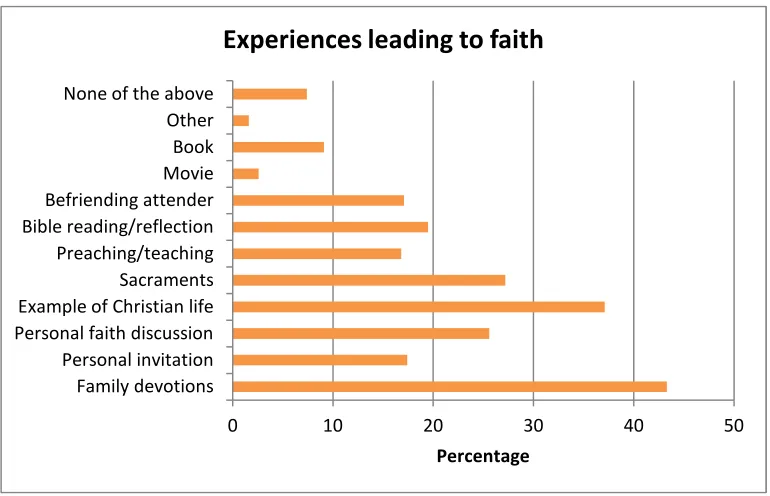
What church activities have been found to be most important for coming to faith? The most important one was church services or mass (28.2% in survey C
survey I), but three of the four most important coming to faith activities in the 2001 survey C were activities for children or youth, and of these the most important one was the Sunday school/Sabbath school or kid
indicated this as one of the two most important activities leading them to faith.
14.9% of all the responses to this question. Thus in terms of continuation of faith, the Sunday school is only second to the main church services as
living faith. In the 2006 survey I, the percentages of Sunday school education (scripture at school) have changed positions, but are very similar (11.9% vs. 13.1%). This again affirms the importance of both
developing youth spirituality and faith.
If we look at these figures a little more closely, to faith through the children’s and youth
themselves (28. 2%) according to the 2001 survey C. In the 2006 survey I the youth activities (32.9%) did not su
youth activities were demonstrably important for evangelism and church education. These obser-vations suggest that we should invest at least as much, or perhaps even more effort, resources and time into children’s and youth evangelistic, pastoral and educational work as we do into regular church services and adult evangelism.
Figure 2 Most important activities that led to faith (question 47, 2001 Survey C)
Church services/Mass Sunday school/Sabbath school or kids club Religious education (Scripture) at school Confirmation classes/Confirmation ceremony A church youth group A voluntary Christian group at school A series of introductory studies about the faith An adult prayer, discussiuon or Bible study group A church outreach activity A major evangelistic event The activities of a mission group or ogranisation Church camp, conference or spiritual retreat Another activity not mentioned above None of the above
Comparative Importance of Church Activities (evangelistic and
educational) in Coming to Faith
What church activities have been found to be most important for coming to faith? The most important one was church services or mass (28.2% in survey C
survey I), but three of the four most important coming to faith activities in the 2001 survey C were activities for children or youth, and of these the most important one was the Sunday school/Sabbath school or kid’s club. 1208 of the 5162 a
indicated this as one of the two most important activities leading them to faith.
14.9% of all the responses to this question. Thus in terms of continuation of faith, the Sunday school is only second to the main church services as the means for developing living faith. In the 2006 survey I, the percentages of Sunday school
education (scripture at school) have changed positions, but are very similar % vs. 13.1%). This again affirms the importance of both of these developing youth spirituality and faith.
If we look at these figures a little more closely, we can see that more people came to faith through the children’s and youth activities (35.4%) than due to church services 2%) according to the 2001 survey C. In the 2006 survey I the youth %) did not surpass the church services (36.9%) but again the
demonstrably important for evangelism and church education. uggest that we should invest at least as much, or perhaps even more effort, resources and time into children’s and youth evangelistic, pastoral and educational work as we do into regular church services and adult evangelism.
Most important activities that led to faith (question 47, 2001 Survey C)
0 500 1000 1500
Church services/Mass Sunday school/Sabbath school or kids club Religious education (Scripture) at school Confirmation classes/Confirmation ceremony A church youth group A voluntary Christian group at school A series of introductory studies about the faith An adult prayer, discussiuon or Bible study group A church outreach activity A major evangelistic event The activities of a mission group or ogranisation Church camp, conference or spiritual retreat Another activity not mentioned above None of the above
Frequency
Comparative Importance of Church Activities (evangelistic and
What church activities have been found to be most important for coming to faith? The most important one was church services or mass (28.2% in survey C, and 36.9% in survey I), but three of the four most important coming to faith activities in the 2001 survey C were activities for children or youth, and of these the most important one was s club. 1208 of the 5162 attendees in 2001 indicated this as one of the two most important activities leading them to faith. This was 14.9% of all the responses to this question. Thus in terms of continuation of faith, the the means for developing living faith. In the 2006 survey I, the percentages of Sunday school and religious education (scripture at school) have changed positions, but are very similar in effect of these activities in
we can see that more people came activities (35.4%) than due to church services 2%) according to the 2001 survey C. In the 2006 survey I the youth %) but again the combined demonstrably important for evangelism and church education. uggest that we should invest at least as much, or perhaps even more effort, resources and time into children’s and youth evangelistic, pastoral and educational work as we do into regular church services and adult evangelism.
Most important activities that led to faith (question 47, 2001 Survey C)
Church Activities Leading to Faith and Denominations
Church Services and coming
Church Services
Catholic
Mainstream Protestant A Mainstream Protestant B Large Protestant
Other Protestant Pentecostal
How did the various church activities compare among the different denominations in terms of bringing people to faith? The church services/mass activities were most important for the Catholic respondents, i.e. 77.2% (survey C) and 77.5% (survey I) vs. 48.9% and 47.6% (in survey C) for the next highest denominational groups (Other Protestant and Mainstream Protestant B) and 50.2% and 49.3% (Mainstream Protestant B and Pentecostal in survey I). There is not as much difference between the non-Catholic groups (a
smallest in survey C and 1% in survey I) as between the Catholics and the Protestant group (about 28%
Figure 3 Most important activities that led to faith (question 42, 2006 Survey I)
0 Church/mass Sunday school School scripture Confirmation Youth group School Christian group Introductory series Adult small group Church outreach Major evangelistic event Mission group or organisation Church camp Other None of these
Activities bringing to faith
Church Activities Leading to Faith and Denominations
Church Services and coming to faith
Survey C, 2001 Survey, I, 2006
77.2% 77.5%
41.7% 44.6%
47.6% 50.2%
37.0% 39.2%
48.9% 42.8%
39.3% 49.3%
How did the various church activities compare among the different denominations in terms of bringing people to faith? The church services/mass activities were most important for the Catholic respondents, i.e. 77.2% (survey C) and 77.5% and 47.6% (in survey C) for the next highest denominational groups (Other Protestant and Mainstream Protestant B) and 50.2% and 49.3% (Mainstream Protestant B and Pentecostal in survey I). There is not as much difference Catholic groups (about 12% difference between the largest and the smallest in survey C and 1% in survey I) as between the Catholics and the
(about 28% - 27%).
Figure 3 Most important activities that led to faith (question 42, 2006 Survey I)
500 1000 1500 2000 2500 3000 3500 4000
Frequency Activities bringing to faith
Survey, I, 2006
77.5% 44.6% 50.2% 39.2% 42.8% 49.3%
Sunday Schools and Denominations
Sunday Schools Survey C, 2001 Survey I, 2006
Catholic 6.0% 6.0%
Mainstream Protestant A 30.5% 31.3%
Mainstream Protestant B 33.1% 31.4%
Large Protestant 29.8% 30.9%
Other Protestant 28.6% 23.7%
Pentecostal 19.0% 22.9%
In the case of Sunday schools, the situation with respect to church services is reversed. Sunday schools have been of significantly less value for Catholics to come to faith (6%) compared to non-Pentecostal Protestants, where 28.6% – 33.1% (survey C) and 23.7% - 31.4% (survey I) found Sunday School helpful in leading them to faith, i.e. a third or just under Protestants found Sunday schools helpful in coming to faith. The Mainstream Protestant A and B groups and Large Protestant groups found the Sunday schools of the greatest value in coming to faith compared Other Protestant groups, and of the Pentecostals only 19% (survey C) to 22.9% (surve