A Proposed Internet of Everything Framework for
Disease Prediction
https://doi.org/10.3991/ijoe.v15i04.9834
Noura E. Maghawry (*), Samy Ghoniemy The British University in Egypt, Cairo, Egypt
Abstract—Social networks and Internet of things are two paradigms when integrated a new paradigm Internet of Everything is established that has its im-pact on revolutionizing various fields such as engineering, industry and healthcare. Social networks became nowadays of the most important web ser-vices on which people heavily rely, thus became a major source for information extraction for rational decision making considering individuals as social or socio sensors. Furthermore, people using sensors especially biological sensors enabled the use of internet of things technology in building intelligent healthcare systems. One of the challenges facing the design of such systems is the design of an intel-ligent recommender system that is able to deal with such big data. For that, this paper proposes a framework to develop an enhanced intelligent expert advisor-based health monitoring and disease awareness system. The proposed framework enables the researchers to design advisory systems that are able to observe phys-iological signals through the use of different biosensors and integrate it with his-torical medical data together with the massive data collected from social net-works to provide accurate alerts and recommendations for many ailments in-spected. The proposed Framework is designed to facilitate generic, dynamic and scalable process of integrating different types of social networks and biosensors.
Keywords—Internet of Things, Internet of Everything, biosensors, socio-sen-sors, Big data analytics, Healthcare.
1
Introduction
Online social networks dominated the majority of web services during the last dec-ade, and researchers became more interested in relying on social networks for infor-mation extraction. The big data generated from both the heavy reliance on social net-works, and data resulted from internet of things (IoTs) technologies make them very promising for valuable information extraction that could revolutionize various fields causing remarkable impact on the society.
The systems arising out from merging the two fields: social networks and IoTs allow the enrichment of both paradigms as the IoTs has its role on sensing the physical world whereas the social networks have its active contribution to the daily aspects of human world. Integrating IoTs with social networks composes a promising technology for add-ing the human experiences as sensors leadadd-ing to highly intelligent services [2, 3].
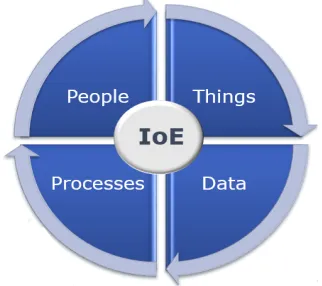
The intersection between connections among people, together with the things, big data and smart processes, emphasizes the true power of a new paradigm called Internet of Everything (IoE) as shown in figure 1. IoE is expected to revolutionize various fields including marketing, investments, healthcare, education, military, and taking people through a new era of smart and intelligent services.
Fig. 1. The major components of Internet of Everything.
One of the important and challenging applications revolutionized by the Internet of Everything is building a smart, connected healthcare system as networked sensors, ei-ther worn on the body or embedded in our living environments, aiming to gaei-ther useful and relevant information for physical health.
Healthcare historically has been provided mainly in a reactive manner. With pro-gress in the field of IoTs, the world has offered unique opportunities to better observe patients' physiological signals in order to provide healthcare in a more proactive man-ner. Adding human experiences supported by historical healthcare data ensure bringing personalized healthcare and intelligent monitoring systems to a challenging level.
To attain this intelligence level, it is essential to be able to analyze patient data in real time, and taking advantages of the social networks’ big data of interest to provide quality of experience to the medical data and then turn it into reactive awareness to patients.
IoTs paradigm aims at improving the quality of life for individuals, several frame-works for remote monitoring systems exist that use IoTs paradigm for healthcare mon-itoring, most of the frameworks proposed recently are designed for monitoring of el-derly people, the following highlights the work where frameworks involving IoTs were proposed to serve healthcare recently. The research of Hassan Alieragh M. et al. was interested in reviewing the current state and future directions for integration of remote health monitoring technologies into the clinical practice of medicine and highlighted several of the challenges in sensing, analytics of data from wearable devices [4]. A study from user centered perspective highlighted in general the opportunities and chal-lenges for IoTs in the future vision of healthcare remote monitoring systems, the re-search focused on studying IoTs enabled systems monitoring elderly people and trying to build a model that is user centric by taking into consideration the elderly require-ments at the center of attention [5]. An IoTs framework was proposed for monitoring human biomedical signals in activities, these activities focuses on physical exertion us-ing sensors from devices around the body area network of the user such as users’ mobile environments [6]. An architecture of the Patient Health Monitoring System using IoTs devices is proposed to collect the medical parameters of a patient and evaluate them, the system notifies the individual with possible precautionary measures to be practiced by them [7]. Another IoT architecture proposed to be used in healthcare for monitoring the patients’ ECG signals in an independent way, using a mobile tele-electrocardio-graph [8].
On the other hand, there are studies published to illustrate the impact and the effect of social networks and communities on the healthcare, as an example the case studies presented to show the impact of social networking for raising the awareness of healthcare, and sensitizing individuals to their need for health care [9]. Other studies investigated the impact of social media on healthcare services and its applicability in Romania [10], and another study was held for investigating the impact of the evolution of Social Network Services in the healthcare domain and focused on specific health-oriented social networks such as Patients Like Me [11].
The recent frameworks focused on either enabling IoT paradigm for healthcare sys-tems or investigating the beneficial impact of involving social networks in the healthcare field, which gives a solid background for building a framework, that involve both paradigms in one framework.
The major aim of this research is to develop an enhanced intelligent expert advisor-based health monitoring and disease awareness system; this will provide unique oppor-tunities for better observing patients’ physiological signals for reaching accurate alerts and recommendations for any ailments inspected. The research will involve adding hu-man experiences supported by historical data background to the personalized healthcare intelligent monitoring systems.
The system’s knowledgebase will be built on medical healthcare facts and user experi-ences captured from information extracted by analyzing social networks’ big data using big data analytics algorithms, in addition to relevant features extracted from processing sensors’ data using real time processing techniques and algorithms.
2
The Proposed Framework
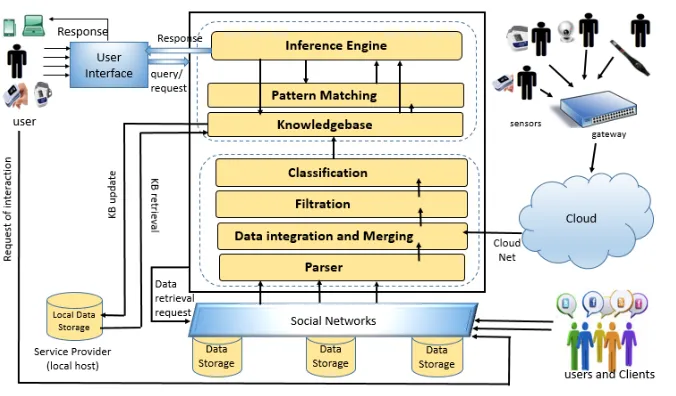
The proposed Framework is inspired from the fact that in the expected future, dif-ferent technological revolutions in the fields of social networks, Internet of things will have its great impact on revolutionizing healthcare. The proposed framework in this research is as shown in figure 2.
Fig. 2. The Proposed Framework.
Fig. 3. Analytic platform adopted by the framework.
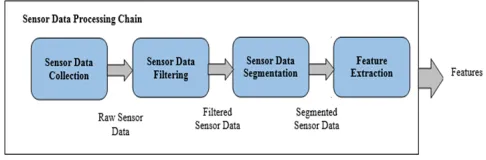
The first stage will benefit from gathering relevant sensor data through gateway available throughout the cloud and analyzing these data. The sensors' data gathered falls under the taxonomy of sensors stated in the work of Sow D. et al. used in medical informatics that involves physiological sensors measuring patient vital signs, wearable activity sensors measuring the gross of user activity that gives a wider aspect than the psychological sensors, contextual sensors embedded in the surrounding environment for measuring conditions like temperature and motion detection. The chain of pro-cessing sensor data as shown in figure 4 starts by sensor data collection for raw sensor data acquisition, filtration to filter data against outliers and noisy data, segmentation then feature extraction where the features relevant to the disease in context are ex-tracted.
The input to third stage - Modeling stage is the feature extracted from sensor data together with features and information extracted for social networks, the stage will face a challenge of implementing data integration and merging techniques between the information extracted from social networks, and the features extracted from sensor data, thus new reliable and robust techniques for data integration and merging will be investigated and applied, followed by filtration step where anomaly detection techniques will be implemented to identify statistically deviant data, followed by a classification model to classify the information and make it ready for the fourth stage.
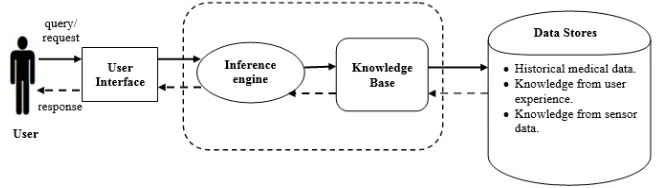
The fourth stage is building the predictive and awareness model through building the intelligent expert system as shown in figure 5. The three basic components for the expert system are the inference engine, pattern matcher, and knowledge base. The repository formulating the knowledge base of the expert systems will be built from factual and heuristics knowledge formulated by user experiences gathered from social networks and sensor data together with historical medical healthcare. The inference engine is the software program that infers the requests from the user interface with the knowledge available in the knowledgebase by using the pattern matcher which will adopt efficient pattern matching techniques and algorithms and accordingly arouse alerts and awareness according to the matching level of the user with the patients’ similarity.
Fig. 5. The intelligent Expert System.
3
Conclusion
There are many challenges facing the framework, the heterogeneity nature of the data gathered from social networks and sensor data makes reaching robust algorithm a challenging task, reaching the relevant features serving the disease in context from both resources and applying the data integration and merging techniques will need building of an evaluation model that will be capable of measuring the accuracy of the predictive model.
4
References
[1]Whitmore A., Agarwal A., and Da Xu L., "The Internet of things—a survey of topics and trends", Information Systems Frontiers, vol. 17(2), pp. 261-274, April 2015.
https://doi.org/10.1007/s10796-014-9489-2
[2] Ortiz A., Hussein D., Park A., Son N. Han and Crespi N., "The cluster between internet of things and social networks: Review and research challenges", Internet of Things Journal, IEEE, vol. 1(3), pp. 206-215, June 2014. https://doi.org/10.1109/JIOT.2014.2318835
[3]Atzori L., Iera A., Morabito G. and Nitti M., "The social internet of things (siot)–when social networks meet the internet of things: Concept, architecture and network characterization", Computer Networks, vol. 56 (16), pp. 3594-3608, November 2012. https://doi.org/1 0.1016/j.comnet.2012.07.010
[4]Hassanalieragh M. et al., "Health monitoring and management using Internet-of-Things (IoT) sensing with cloud-based processing: Opportunities and challenges" , Proceedings of IEEE International Conference on Services Computing, New York, NY, USA, pp. 285–292, July 2015.https://doi.org/10.1109/SCC.2015.47
[5]Azimi I., Rahmani AM., Liljeberg P., Tenhunen H., “Internet of things for remote elderly monitoring: A study from user-centered perspective”, Journal of Ambient Intelligence and Humanized Computing, vol. 8 (2), pp: 1-17, April 2017. https://doi.org/10.1007/s12652-016-0387-y
[6]Mora H., Gil D., Terol R.M., Azorín J., Szymanski J., “An IoT-Based Computational Framework for Healthcare Monitoring in Mobile Environments,” Sensors 2017 Journal, the special issue Smart Sensor Networks and Technology for Healthcare Monitoring and Deci-sion Making, vol. 17 (10), 2017.
[7]Arsand, E., Muzny M., Bradway M., Muzik J. and Hartvigsen G., “Performance of the first combined smartwatch and smartphone diabetes diary application study”, Journal of Diabetes Science and Technology, vol. 9 (3), pp. 556–563, May 2015. https://doi.org/10. 1177/1932296814567708
[8]Ungurean I., Brezulianu A., "An Internet of Things Framework for Remote Monitoring of the HealthCare Parameters", Advances in Electrical and Computer Engineering, vol.17(2), pp.11-16, May 2017. https://doi.org/10.4316/AECE.2017.02002
[9]Griffiths F. et al., “The Impact of Online Social Networks on Health and Health Systems: A Scoping Review and Case Studies.” Policy & Internet, vol. 7(4), pp. 473–496, September 2015 https://doi.org/10.1002/poi3.97
[10]Pentescu A., Cetină I., and Orzan G., “Social Media's Impact on Healthcare Services”, Pro-ceedings of Economics and Finance, vol. 27, pp. 646-651, 2015.
https://doi.org/10.1016/S2212-5671(15)01044-8
[12]Sow D., Turaga D.S., and Schmidt M., "Mining of Sensor Data in Healthcare: A Survey". In: Aggarwal C. editions Managing and Mining Sensor Data. Springer, Boston, MA, 2013.
https://doi.org/10.1007/978-1-4614-6309-2_14
[13]Hetal J.Thankil, et al. "Domain Specific Web Crawler: A Survey." International Journal of Innovative Research in Science, Engineering and Technology, vol. 4 (12), pp. 2319-8753, 2015.
5
Authors
Noura E.Maghawry was born in Cairo, Egypt. She received her Bachelor from
Faculty of Computer and Information Sciences, Ain Shams University and her master’s degree from Arab Academy for science and technology and maritime transport. She is currently pursuing her Ph.D. degree while working as an Assistant Lecturer in the Brit-ish University in Egypt.
Samy Ghoniemy received his Bachelor and Master of Engineering degrees in
computer and communication engineering, in 1990 and 1996 respectively. He attended two years condensed program studying optoelectronic diploma in 1991. From 1991 to 2000 he was a Junior Lecturer and research assistant in MOD. He received his PhD degree from the Department of Systems and Computer Engineering, Carleton Univer-sity, Ottawa, Canada. His primary research interests are, high performance computing, social networks analysis, deep learning for medical and healthcare applications, graph analytics, big data analytics, cloud computing, IoT, optical networks. AI, machine in-telligence and cognitive science. He is currently a professor of computer networks and director of Advanced Informatics and Business Intelligence (AIBI) research center. He is a member of IEEE. S. Ghoniemy published more than 75 research papers in the field of computer engineering and computer science.