Metropolitan YMCA of the Oranges
July 29, 2020
Relaunch Workplace Safety
Playbook
A Guide to Ensure Workplace Safety during COVID 19 Threat (Adapted
from SHRM Template Tool Provided by Lear Co.)
1
Branch Startup Checklist
Tuesday, May 26, 202010:30 AM
This Playbook is to be used as an Association resource and recommended practice guideline; it aligns with the Centers for Disease Control (CDC) and state and local regulations and recommendations to the greatest extent possible.
This is a working document and will be updated to reflect changes in directives and introduce new recommended practices as they become available.
The Relaunch Workplace Safety Playbook provides general recommendations for use in all Metro YMCA facilities. Because there may be circumstances unique to a location, there may be some cases in which a Branch facility must adapt the recommendations of the Playbook to address that facility’s specific
requirements. Such exceptions must be authorized by the Chief Operating Officer. Additionally, all facilities must comply with all applicable laws meaning that if there is a conflict between the
recommendations in the Relaunch Workplace Safety Playbook and the applicable local law, the facility must follow the applicable law.
Topic
Goals
1
Relaunch Workplace Safety
Team
Set up the Relaunch Workplace Safety Team Have a plan in place to adopt this Association-wide
framework and develop site-specific protocols
2
Preventative Material
Inventory
Confirm operation has an adequate supply of soap, disinfectant, hand sanitizer, paper towels and tissues Confirm stock of face masks, face shields, gloves, and
glasses on site and on order with lead time
Confirm "Non-Touch" thermometers on site for screening
3
Personal Protective
Equipment
Review and understand protocol
4
Disinfection Measures
Disinfect the Branch prior to anyone returning to work Replace HVAC air filters or clean/disinfect Implement the General Disinfection Procedures
Refer to Standard Operating Procedures for more detailed specific guidance on procedures
5
Deep Cleaning & Disinfection
Protocol
Review, understand, and prepare for the triggering of the Deep-Cleaning and Disinfection Protocol
2
7
Layered Audit Checklist
Implement Audit8
Transportation
Hold meetings with the transportation provider(s) to review protocols and implement the Transportation Disinfection Checklist protocol for buses if applicable9
Isolation Protocol &
Coordinator
Review and understand protocol
Isolation Coordinator (voluntary) identified and trained Protocol in place to isolate employees, members, and
volunteers if symptomatic on site
Print out forms and protocol to be available as needed
10
Social Distancing Protocol
Review and understand protocol Complete and continue to adhere to the Social Distancing checklist
11
On-Site Health Screening
Ensure protocol for pre-shift screening prior to Branch or site entry Ensure barriers are in place to prevent anyone from missing screening protocol
12
Daily Self-Screening Protocol
Daily Self-Screening protocol is distributed to all employees for voluntary, home self-screening The Self-Screening protocol may also be provided to members, program participants, and other guests prior to entry into the Branch
HR team prepared to receive inquiries or reports of symptomatic employees prior to shift
13
Self-Quarantining and Return
to Work Protocol
Review and understand protocol and adjust as necessary for local, legal and cultural environment
14
Visitors & Contractors
Self-Screening
Have a plan in place for screening members, visitors and contractors
Ensure Visitors & Contractor Self-Screening Checklist is printed and available as needed
15
Handwashing
Follow recommended CDC handwashing and sanitizing procedures Wash hands upon entering the workplace and frequently throughout the work shift
16
Return to Work Training
Plans
Host pre-return to work trainings:
o Review of Safe Workplace Playbook with exempt employees
o Arrange Training for Health Screeners & Isolation Coordinators
o Arrange Training for Disinfection Team o Arrange Training for Branch functional leads Host 1st Day trainings/orientation
3
consistent with facility
o Host first-day training orientation for all nonexempt branch staff
17
Health & Wellness
Have a plan in place for screening Visitors and Contractors
Ensure Visitors & Contractor Self-Screening Checklist is printed and available as needed18
Leave Options
Become familiar with leave options available for COVID19 related absences.19
Signage
Display signage throughout Branch Facilities as appropriate4
Relaunch Workplace Safety Teams
Tuesday, April 21, 2020 1:51pm
Tasks
Setup the Relaunch Workplace Safety Team
Have a plan in place to adopt this Association-wide framework and develop Branch specific protocols
The RWST is a cross functional team lead by a Branch Executive in the following categories/examples:
1. Branch Executive - Site manager who has overall responsible for the site’s relaunch safety preparedness & response plan, coordinating and aligning with the Association Relaunch Team. 2. Access Control Lead - Works with the site to manage social distancing logistics in regards to
arriving and departing employees, as well as members, visitors and contractors. Will further support the Prevention & Training Lead by providing site specific options regarding social distancing within the facility, including potential mitigation measures to manage the risk of employees and members required to interact less than six feet from others.
3. Prevention & Training Lead - Works to develop protocols to ensure the wellness of all employees, and the overall pandemic preparedness and response plan, ensuring alignment with regulations and the Relaunch Team. Manages the training function across the site related to pandemic safety preparedness and response, including employee, management and Relaunch Workplace Safety Team training, in accordance with the playbook and COVID-19 legal and policy guidelines and directives.
5
5. Communication Lead - Works to manage all pandemic related communications, in
accordance with Association Communications guidelines and HR and operational policy and protocol.
6. Personal Protective Equipment Lead - Works to secure all necessary supplies to implement and sustain the Branch’s relaunch safety preparedness & response plan, including direct procurement by the branch, as well as coordination with procurement related to accessing centrally located supplies or leveraging supplies from other Association facilities.
6
Preventive Material Inventory
Tuesday, May 26, 202010:35 AM
Tasks
Confirm facility has an adequate supply of soap, disinfectant, hand sanitizer, paper towels and tissues Confirm stock of face masks, face shields, gloves, and glasses on site and on order with lead time Confirm "Touchless" thermometers on site for screening.
Disinfectant Supplies:
Confirm facility has an adequate supply of soap, disinfection spray, hand gel and paper towels and tissues
Branch should keep a minimum quantity of a 30-day supply
Disinfection portable stations recommended for selected high traffic areas
PPE:
Confirm stock of face masks, gloves, and glasses/shields and gowns on site and on order with lead time
Branch should keep a minimum quantity of 30-day supply
Medical employees, screeners, and cleaning crew are required to wear gloves, masks, and glasses
1 Mask (surgical) Disposable surgical masks (1-day) Min 30 Day Supply
2 Gowns Disposable gowns Min 30
Day Supply
3 Nitrile Gloves Touchflex / Surgical Nitrile Glove Min 30 Day Supply
4 Infrared thermometer
Medical Infrared thermometer /Measure ranges 89.6° F to 108.5°F meets ASTM (International Standards) E965-1998 (2003)
1 per 50 employees / shift
5 Disinfectant 10% bleach (sodium hypochlorite) solution made fresh daily, or a hospital-grade disinfectant (To view the list of
EPA-registered disinfectant products,
visit
https://www.epa.gov/pesticide-
registration/list-n-disinfectants-use-against-sars-cov-2
7
6 Spray Bottles 1 liter plastic spray containers Min 5 Bottles
7 Sanitization Floor Stand
Hand Sanitizer Dispenser Floor Stand 1 available in work area per 50
employees
8 Hand Sanitizer (Refills)
Hands Free Sanitizer with Alcohol 70% /
Local Brand “Sanitizer” Min 30 Day Supply
9 Hand Soap Hands Free Soap Min 30
Day Supply
10 Paper Towels Hands Free Paper Towel Min 30
Day Supply
11 Glasses / Face shield
Safety glasses / Polycarbonate Min 30 Day Supply
12 Bio Hazard Container
Bags that can be sealed and tagged as contaminated material
Min 30 Day Supply
13 Clorox Total 360 (optional)
https://www.cloroxpro.com/products/clorox/tot al-360/ or similar equipment
1 per facility
14 Portable UV Cart
FSG Cello UV Cart 300W
1 per facility8
Personal Protective Equipment (PPE)
Tuesday, May 26, 2020 10:37 AM
Tasks
Review and understand protocol for PPE
About:
To protect Metro Y employees, we follow the top 3 protective measures as recommended by the CDC and WHO.
1. Personal hygiene 2. Social distancing
3. Frequent disinfection of common surfaces
Respective Branch Management and Team Leads are responsible for ensuring there is adequate PPE and Sanitization supplies required per our Workplace Safety Plans.
Personal Protective Equipment Protocol
Masks
Face masks are required for all staff. We will be using two types of masks:
N95 or KN95 surgical grade masks for use by:
1. Medical and isolation team members*
2. Health screeners*
3. Disinfection team members*
4. Health and Wellness Staff*
*Note: N95 or KN95 or equivalent protection must be prioritized for use by isolation and medical team members, given they may be directly exposed to employees or others who are COVID-19 symptomatic.
Cloth Masks for use by:
4. All staff when interacting with members, program participants, and the general public
5. All staff when interacting with other staff members
9
Face Shields
Face shields may be worn as a precautionary measure when employees such as medical and isolation team members or disinfection team members interface with symptomatic employees, members, or program participants or contaminated areas.
Gloves
Metro Y does not require or recommend that all our employees wear gloves except for: 1) Isolation Team Members and,
2) Those performing disinfection of common surfaces per the Playbook.
3) Those that may come into contact with bodily fluids such as childcare and first aid staff.
However, we will provide gloves if mandated by local regulations.
Note: If using gloves, employees should consider the following:
The COVID-19 virus does not harm your hands, so gloves provide no protection, and touching your face with contaminated hands, whether gloved or not, poses a significant risk of infection.
Gloves may create a false sense of security for the individuals wearing them; people are more likely to touch contaminated surfaces because they feel they are protected from the virus because of the gloves when in reality, they are not.
When wearing gloves, people are less inclined to wash their hands; this is counterproductive and puts others at higher risk; we want people to wash their hands because it is the number-one defense against any virus.
Proper removal of gloves takes training; if contaminated gloves are not removed properly, our employees are exposed to greater risk.
10
Disinfection Measures
Tuesday, April 21, 20202:38pm
Tasks
Disinfect Branch prior to anyone returning to work. Replace HVAC air filters or clean/disinfect.
Implement the Disinfection Measures (protocol on this page); the cleaning steps outlined should be taken routinely, based on frequency mentioned to disinfect work place surfaces, chairs, tables, etc. and protect employees, members, and visitors.
Refer to Standard Operating Procedures in designated functional areas for specific guidance on functionally specific protocols and parameters.
The goal is to establish a sanitary baseline before the Branch reopens. The Branch should be 100% disinfected prior to anyone returning to work.
Utilize Association, CDC, and Department of Health guidelines for specific guidance and take unique site-specific circumstances into consideration when sanitizing and disinfecting.
Contracted providers or employees should sanitize and disinfect all areas of the Branch with special attention to:
Exercise equipment
Workstations and equipment Restrooms and showers Kitchen and/or eating areas Lockers
Common surface areas
Computer screens and keyboards
Put tight controls on who enters and exits the site during shutdown: Vendors
Maintenance contractors Essential staff
Disinfection Measures Protocol
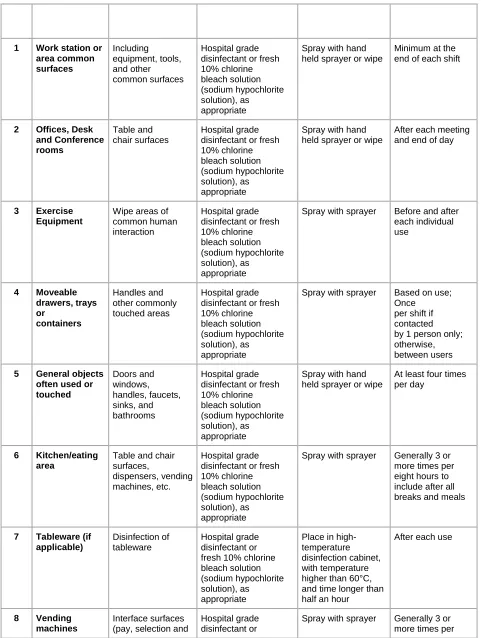
Disinfection Measures:
This checklist should be implemented in facilities to reduce the risk of spread of infection. Employees are not to perform disinfection unless trained on the specific chemicals used and
provided appropriate Personal Protective Equipment (PPE); employees will be provided specific instructions regarding disinfection processes they are allowed to perform, and how to safely use the chemical(s) selected for this use.
The cleaning steps outlined below should be taken routinely, based on frequency mentioned to disinfect workplace surfaces, chairs, tables, etc. and protect employees.
11
#
Area
Disinfection
Content
Disinfectant
Disinfection
Method
Frequency
1 Work station or area common surfaces Including equipment, tools, and other common surfaces Hospital grade disinfectant or fresh 10% chlorine bleach solution (sodium hypochlorite solution), as
appropriate
Spray with hand held sprayer or wipe
Minimum at the end of each shift
2 Offices, Desk and Conference rooms
Table and chair surfaces
Hospital grade disinfectant or fresh 10% chlorine bleach solution (sodium hypochlorite solution), as
appropriate
Spray with hand held sprayer or wipe
After each meeting and end of day
3 Exercise Equipment
Wipe areas of common human interaction
Hospital grade disinfectant or fresh 10% chlorine bleach solution (sodium hypochlorite solution), as
appropriate
Spray with sprayer Before and after each individual use 4 Moveable drawers, trays or containers Handles and other commonly touched areas Hospital grade disinfectant or fresh 10% chlorine bleach solution (sodium hypochlorite solution), as
appropriate
Spray with sprayer Based on use; Once
per shift if contacted by 1 person only; otherwise, between users
5 General objects often used or touched Doors and windows, handles, faucets, sinks, and bathrooms Hospital grade disinfectant or fresh 10% chlorine bleach solution (sodium hypochlorite solution), as
appropriate
Spray with hand held sprayer or wipe
At least four times per day
6 Kitchen/eating area
Table and chair surfaces,
dispensers, vending machines, etc.
Hospital grade disinfectant or fresh 10% chlorine bleach solution (sodium hypochlorite solution), as
appropriate
Spray with sprayer Generally 3 or more times per eight hours to include after all breaks and meals
7 Tableware (if applicable)
Disinfection of tableware
Hospital grade disinfectant or fresh 10% chlorine bleach solution (sodium hypochlorite solution), as
appropriate
Place in high-temperature disinfection cabinet, with temperature higher than 60°C, and time longer than half an hour
After each use
8 Vending machines
Interface surfaces (pay, selection and
Hospital grade disinfectant or
12
vending surfaces) fresh 10% chlorine bleach solution (sodium hypochlorite solution), as
appropriate
eight hours to include after all breaks and meals
9 Maintenance Equipment
Wipe areas of common human interaction
Hospital grade disinfectant or fresh 10% chlorine bleach solution (sodium hypochlorite solution), as
appropriate
Spray with sprayer After each use
10
Multi-user safety
vest and other PPE
All surfaces Hospital grade disinfectant or fresh 10% chlorine bleach solution (sodium hypochlorite solution), as
appropriate
Not applicable / Not allowed
Not applicable / Not allowed
11 Transport vehicles
Common surfaces (e.g. seat surfaces rails, belts, door and
window controls)
Hospital grade disinfectant or fresh 10% chlorine bleach solution (sodium hypochlorite solution), as
appropriate
Spray with sprayer Before and after each use
12 All floors and walls
All general floors and walls at site
Hospital grade disinfectant or fresh 10% chlorine bleach solution (sodium hypochlorite solution), as
appropriate
13
Deep-Cleaning and Disinfection Protocol
Tuesday, May 26, 202010:40 AM
Tasks
Review, understand, and prepare for the triggering of the Deep-Cleaning and Disinfection Protocol (protocol on this page)
Note: The General Disinfection Methods Protocol should be followed regularly whereas the Deep-Cleaning and Disinfection Protocol is triggered when an active employee, member or participant is identified as positive for COVID-19.
Deep-Cleaning and Disinfection Protocol
Corona Virus COVID-19 - Deep Cleaning and Disinfection
COVID-19 “deep-cleaning” is triggered when an active employee, member, or participant is identified or suspected of being COVID-19 positive by testing or medical assessments. Sites may opt to have a deep cleaning performed for presumed cases, at their discretion.
Current CDC recommendations advise close off of any areas used for prolonged periods of time by the sick person and waiting 24 hours before cleaning and disinfecting to minimize potential for other employees being exposed to respiratory droplets. If waiting 24 hours is not feasible, wait as long as possible. During this waiting period, open outside doors and windows to increase air circulation in these areas. Deep cleaning should then be performed as soon possible. If a delay is proposed, the branch is to gain approval from Human Resources and the Chief Operating Officer and take steps to perform an additional disinfection of potentially impacted common surfaces during the interim period.
While the scope of deep cleaning is presumed to be the full facility, sites may reduce the footprint to be deep cleaned if there is sufficient rationale to do so, and they gain concurrence from Human Resources and the Chief Operating Officer.
Notwithstanding the above, if an active employee, member or participant is confirmed to have a COVID-19 positive test; sites may in lieu of performing deep cleaning shut down for a period of 7 days to allow for natural deactivation of the virus, followed by site personnel performing a comprehensive disinfection of all common surfaces.
1. Identify an approved external company that should carry out the deep cleaning activity; this company must have the minimum requirements of:
Trained personnel to execute the process of cleaning, disinfection and disposal of hazardous waste Proper equipment and PPE to perform the task
All necessary procedures and local authorizations or permits to perform disinfection services and manage any wastes generated
14
2. The Branch Lead for Sanitation and Disinfection must coordinate and supervise the cleaning and disinfection process. They must ensure that:
There is a specific plan and strategy to clean all site, machinery / equipment, common areas, offices and any typical areas where employees, members, and participants interact
Only authorized people can access the site during the cleaning operation
All 3rd party team members are using any required PPE and that it is also properly disposed at the end of the process
Employees, members, and participants are made aware that the work areas have been disinfected
Note: For this purpose, deep cleaning is defined as more comprehensive cleaning using advanced technologies and more aggressive cleaning solutions that are administered by an external 3rd party.
3. Personal Protective equipment (PPE) requirements for the Deep Cleaning team:
The use of PPE is to be determined by the cleaning contractor based on the chemicals used to conduct the disinfecting process including proper wearing, storage, cleaning, decontamination and disposal of PPE as biohazard waste.
4. Disposal:
At the end of the process the Cleaning Company must follow the local regulations to dispose of all the PPE and cleaning material used in the proper manner.
15
Incoming Materials/Packages
Wednesday, May 13, 2020 12:21 PM
Tasks
Manage incoming supplies in accordance with playbook standards
Management of Incoming Materials and Packages Protocol
The World Health Organization advises it is safe to receive packages from areas where COVID-19 has been reported, advising that,
“The likelihood of an infected person contaminating commercial goods is low, and the risk of catching the virus that causes COVID-19 from a package that has been moved, travelled, and exposed to different conditions and temperature is also low.”
The virus does not survive for long on surfaces and the length of shipment time and other environmental factors should inactivate the virus. However, infected delivery personnel or handlers could contaminate a package in transit or delivery.
If packaged materials have been in transit and/or storage at the facility for greater than 48 hours from last human contact, no further action needs to be taken. While not necessary, where employee apprehension remains high, sites may suggest the following additional precautions:
Personal protective equipment usage, such as disposable nitrile gloves and/or the use of disposable surgical masks
Disinfection of surfaces with a 10% bleach (sodium hypochlorite) solution made fresh daily, or a hospital-grade disinfectant - as appropriate to the surface(s) being treated (noting these chemical agents should only be used by trained and authorized personnel)
In addition remember to:
Wash hands frequently with soap and water
Use hand sanitizer when soap and water are not available Avoid touching face, eyes, nose or mouth
Dispose of packaging immediately
16
Cleaning Audit Checklist
Tasks
Implement Audit
Inspection Conducted By:
Conforming Audit Card
Time:
Inspection Area:
General Disinfection Measures (as applicable)
1. Did the cleaning crew / employees receive training about the disinfection method and frequency?
2. Was hospital grade disinfectant or fresh 10% chlorine bleach solution (sodium hypochlorite solution) used as appropriate?
3. Did the team conduct a comprehensive cleaning in all equipment surface areas (control buttons, handles, safety switches, and screens)?
4. Did the team conduct a comprehensive cleaning in all offices, desk and conference rooms (cabinets, desk, table and chair surface)?
5. Did the team conduct a comprehensive cleaning of all general objects often used or touched (doors, windows, handles, faucets, sinks, bathroom fixtures)?
6. Did the team conduct a comprehensive cleaning in kitchen/eating areas (tables, chair surfaces, dispensers, coffee machines, vending machines, etc?)
7. Did the team conduct a comprehensive cleaning in all common surfaces of buses (seat surfaces, rails, belts, door, windows, and floor)?
8. Did the team conduct a comprehensive cleaning in floors, walls and multiuse areas (tables, chair surfaces, dispensers, vending machines, etc.)?
2nd Layer Audit
Audit of the above performed by a higher-level manager
9. Were non-conformities raised? Y/N
10. If yes, were they addressed?
11. If no, please provide reasons:
3rd Layer Audit
Audit of Layer 2 by Environment Health and Safety Team or a higher-lever manager
13. Were all non-conformities closed? Y/N
17
Transportation (if applicable)
July 14, 20202:00PM
Tasks
Hold meetings with the transportation provider(s) to review protocols and implement the Transportation Disinfection Checklist protocol for buses/vans.
Transportation Protocol
Service provider must disinfect the buses/vans multiple times following Metropolitan YMCA of the Orange’s requirements and as a minimum:
Right before starting a route to pick up Metro employees and program participants Right after Metro employees and program participants arrive at designated facilities
All surfaces seats, dashboards, door handles seatbelts etc., must be washed down with a
disinfectant solution between and in advance of transporting employees and program participants. Supply of antibacterial gel/hand sanitizer for employees and program participants to use upon
boarding the busses.
It is the supplier’s responsibility to ensure drivers are in good health condition. Bus drivers must always wear a mask while providing the service.
Temperature check of drivers must be done before the start of the route and must be documented. The use of masks is mandatory for all passengers
A bus driver is considered a contractor/visitor and must follow Metro’s policy on Visitors and Contractors Self-Screening Protocol.
Employees and Program Participants
Employees and adult members and program participants must adhere to the On-Site Health Screening Protocol before entering transportation.
Employees must not use buses if they suspect they are sick or if they have symptoms such as fever, or difficulty breathing, have visited a state on the New Jersey travel quarantine list, or have been in contact in the past 14 days with other people confirmed sick of any respiratory disease (reference the Daily Self-Screening Protocol for symptoms)
18
Date:Vendor:
Task Completed Action (in case it
applies)
Date Responsible
Before Starting Pick Up Yes No
Is there antibacterial gel?
Clean / Sanitize - Aisle
Clean / Sanitize - Stairs
Clean / Sanitize - Upper Rail
Clean / Sanitize - Seats & Armrests
After Employees Arrive to Plant
Is there antibacterial gel?
Clean / Sanitize - Aisle
Clean / Sanitize - Stairs
Clean / Sanitize - Upper Rail
Clean / Sanitize - Seats & Armrests
After Final Employee Drop-off
Is there antibacterial gel?
Clean / Sanitize - Aisle
Clean / Sanitize - Stairs
Clean / Sanitize - Upper Rail
Clean / Sanitize - Seats & Armrests
Auditor Name / Signature Driver Responsible
Name Name
19
Isolation Protocol & Coordinator
July 14, 20202:00 PM
Tasks
Review and understand protocol
Isolation Coordinator (volunteer) identified and trained (see Pre-Return to Work Trainings for training materials)
Protocol in place to isolate employees, members and program participants if symptomatic on site Must include: room to isolate the individual, PPE, communication with local health authorities
and transport based on their instructions, disinfection of the room Print out forms and protocol to be available as needed
Isolation Protocol
Isolation Protocol for employees, members, or adult program participants who become ill at work or while participating in branch activities.
Advise employees that if a person feels ill, or if someone observes that another person is exhibiting symptoms of COVID-19 at work, they are to contact an Isolation Coordinator as determined by each branch facility (see below).
Telephone communications are preferable, so the Isolation Coordinator can wear the appropriate PPE prior to aiding an ill employee.
Isolation Coordinators, determined by each branch facility, should be selected from the following employee roles, as appropriate:
Nurses
Health and Safety Leader Human Resources Staff Managers/Supervisors First Aid Leaders
If the Isolation Coordinator is directly contacted by an employee, member, or program participant with a suspected infection, they must ask the employee to go directly to the designated Isolation Room by the most direct route.
Procedure
1. Once the suspected infected employee, program participant, or member arrives in the Isolation Room, immediately provide them with a mask and nitrile gloves. Explain to them that it is to help protect other employees, members, and program participants and prevent the spread of a potential virus.
2. The Isolation Coordinator must complete a Suspected COVID-19 Case Form (see section below) and call the local health authority or medical office to seek advice regarding transportation and location.
20
4. The Isolation Coordinator should direct the ill employee, member, or program participant to leave the Branch facility and go home or to the nearest health center as advised by the local health authority. Public transportation should not be used.
If the infected person is well enough to drive their own vehicle, ask them to use it.
If the infected person is not well enough to drive their own vehicle, the Isolation Coordinator should contact the infected person’s emergency contact on file or local EMTs.
5. The Isolation Coordinator should work in coordination with Human Resources (HR) and the Branch Executive to:
Identify persons who may have been in contact with the suspected infected employee. Unless required by the local health authority, the name of the infected employee should not be provided. Advise employees or members and program participants that they may have been in contact with a
suspected infected employee. Employees or others may have been exposed if they are in “close contact” with someone who is infected, which is defined as being within approximately 6 feet (2 meters) of a person with COVID-19 for a prolonged period of time*:
Potentially exposed employees or others who have symptoms of COVID-19 should self-isolate and follow CDC recommended steps for someone who is sick.
Potentially exposed employees or others who do not have symptoms should remain at home or in a comparable setting and practice social distancing for 14 days.
All others should self-monitor for symptoms such as fever, cough, or shortness of breath. If they develop symptoms, they should stay at home and follow the CDC recommended steps above. Employees must notify their supervisor or HR if symptoms develop.
HR will advise impacted employees to contact a physician to obtain medical advice and return to work clearance.
6. Ensure that both the isolation area and suspected employee’s work station or office is thoroughly cleaned and disinfected, in addition to all other common surfaces recently touched by the infected employee. In the case of a member or program participant, ensure that all common surfaces recently touched by the infected person are cleaned and disinfected. All persons carrying out this cleaning must wear disposable nitrile (surgical type) gloves, KN95 masks, and gowns and all support persons’ PPE should be appropriately discarded prior to resuming normal work functions.
Location
Where possible, the isolation room should be an exterior room (building or tent structure). If not, then an enclosed area away from the general population can be used.
PPE
Although isolation workers are not expected to touch the virus, nitrile gloves as well as KN 95 masks/shields, and gowns are required in case a non-touchless scenario occurs.
*
Data are insufficient to precisely define the duration of time that constitutes a prolonged exposure.
21
COVID-19 Case Form
Report for employees, program participants, members, or visitors presenting symptoms in the
branch facility.
Name:
_______________________________________
Date:
____________________________________
Job title or Other (Member, Program Participant, Visitor, Contractor)
_____________________________________
Worksite:
_________________________________
Location of Isolation: ___________________________
Address: _____________________________________
Symptoms noticed:
o Shortness of breath, difficulty breathing o Cough
o Fever 100.4 or higher o Chills
o Repeated shaking with chills o Muscle pain
o Headache o Sore throat
o New loss of taste or smell o Congestion or runny nose o Nausea or vomiting o Diarrhea
Time of fever on-set: __________ Time of isolation: _____________
Symptoms and isolation periods will be updated periodically as information becomes available following the emergence of a pandemic virus strain.
Where referred to: _____________________________
Notes:
22
____________________________________________________________________________________
____________________________________________________________________________________
DETAILS OF REPORTER
Name:
_____________________________
Job title:
_____________________________________________
Telephone Number: __________________
23
Social Distancing Protocol
Monday, July 14, 20202:00PM
Tasks
Review and understand the Social Distancing Protocol
Complete and continue to adhere to the Social Distancing check-list
Social Distancing Protocol
Social distancing is a simple yet very effective mechanism to prevent potential infection based on maintaining physical distance and separation.
In practice this means:
Staying 6 feet away from others as a normal practice
Eliminating contact with others, such as handshakes or embracing coworkers, visitors, or friends Avoiding touching surfaces touched by others to the extent feasible
Avoiding anyone that appears to be sick, feverish or is coughing or sneezing
Immediate Coworkers
6 Feet
24
Note: In person staff meetings of more than 5 persons are prohibited until further notice, even when the meeting area is large enough to accommodate appropriate social distancing.
This practice of social distancing includes all common areas, program areas, entrance/exit areas of work locations, and offices. These are examples, but the principle of social distancing is universally applicable.
1. Off
Social distancing in office or meeting settings is intended to provide a safe environment, reducing risk of any potential person-to-person infection.
Guideline
Whenever possible, remote work such as telecommuting is encouraged. Maintain a social distance of at least 6 feet when interacting with coworkers.
Where a minimum distance cannot be maintained due to workplace design one or more mitigation strategies need to be implemented, including Plexiglas barriers, PPE and/or other administrative controls such as staggered shifts.
Refrain from in person inter-branch meetings and gatherings; utilize remote and virtual means of communication.
Work Stations
Whenever possible, work stations should be arranged to allow separation of 6 feet.
Clear signage about the desired position of coworkers may be placed in each work station but is not required.
Program areas and work stations need to have personal boundaries clearly marked on the floor. Participants and workers need to stay within their marked areas.
Workers are strongly encouraged to disinfect their own work space multiple times during the workday, giving special attention to common surfaces.
Employees must be reminded to avoid touching their face and must wash their hands thoroughly with soap and water several times during work hours to reduce risk and prevent person-to-person potential infections.
Office work should be organized to ensure social distancing to keep separation of employees at 6 feet.
Avoid face-to-face desk layouts.
Self-cleaning of the work space is encouraged multiple times during the shift with special attention to the most used surfaces such as keyboards, monitors, chair arm rest, desks, cubicle divider among others
Cubicles should be separated by partition barriers.
What to do if the work stations are less than the recommended spacing?
o Work designs should avoid face-to-face operations with less than the minimum requirement (6 feet); if this condition cannot be met, then employees could be required to implement alternative measures to mitigate their exposure.
Face Masks Body Orientation
25
the barriers must be cleaned multiple times a shift.
If symptoms of Illness are self-reported or reported via complaints – reference Isolation Protocol & Coordinator
2. Social Distancing during Shift Change
Social Distancing when entering and leaving the facility is intended to minimize high levels of traffic.
Recommended
Employees are to enter and exit at the designated entrances and exits – these locations will be easily identified and posted
Whenever possible, personal phones and HTML clocks should be utilized rather than community timeclocks. If timeclocks must be used for punch in and punch outs, sanitizer stations should be provided nearby, so that hands can be sanitized before and after interaction with the timeclock device. The device should also be wiped before and after each use.
Arrival and departure times must be managed thoughtfully to reduce infection risk and to leverage the opportunity to disinfect the workplace with changeover of personnel and participants.
Helpful Tips to communicate
Avoid gathering when entering and exiting the facility.
Remain in your car until your scheduled window of start time.
Ensure 6 feet of space between each person while you wait in line to enter the facility. When you talk to someone in line, make sure you do not face them directly.
Do not touch entry door handles with an exposed finger(s) or hand.
Do not touch your face before you have had a chance to wash your hands.
Things to consider Entrance monitoring
Waiting lines outside of facilities at high traffic times How and when to hand out PPE
Do you have the ability to minimize door handle touching or to install automatic opening?
Time clocks should be used only if other means of time entry are not available; they must be wiped off before and after each time they are touched by an employee
How will timeclock cleaning be monitored?
3. Shop Floor Information and/or Start-up Meetings
Social Distancing when Attending Meetings
Meeting rooms should be organized to hold no more than 5 chairs with the appropriate spacing and 5 employees at a time. Seating or standing positions should not exceed the minimum distance
required.
Communicate similar messages and arrange meetings in staggered groups when possible to help reduce the number of people in a meeting space at any given point in time.
Interaction to exchange information or quick meetings on the office floor space should respect the Social Distancing of at least 6 feet.
26
will be divided to meet the 5 employee maximum; remote meetings via videoconferencing may also be employed.
Several meeting spaces can be designated for one large area; for example, meetings may be held at the same time in different areas of large meeting spaces such as the theatre at Wayne.
Management of employee breaks and meal times should be staged to provide social spacing and proper hygiene.
4. Social Distancing during Breaks
Social Distancing in Break and Meal Areas Seating and Capacity
o Count the optimal number of allowable seats in the break or eating area considering the acceptable distances of 6 feet.
o Limit and/or space chairs appropriately.
o Place signage on table to ensure proper social distancing in each seat – sign says yes or no to sit.
o Post capacity of the break room.
o Consider allowing employees to sit only on one side of the table. o Remind employees not to arrive early to break.
Break times
o Separate break and meal times by enough time to wipe tables, seats, all surfaces, refrigerator, coffee makers, vending machines and microwave ovens after each use. Cleanliness & Sanitation
o Have a designated coordinator to monitor room usage for social distance and to ensure disinfection of the items noted above if they are inadvertently touched.
o Provide enough supplies for employees to clean up after themselves. Ex: wiping down tables, etc.
Food Storage
o Clean refrigerators used for food storage several times per day.
6. Bathroom usage during the work day and at break times
Social Distancing in Restroom and Locker-room Faculties
Adhere to minimum cleaning intervals as specified in this protocol to ensure a clean environment at all times and ensure social distancing is maintained.
Recommended
Establish maximum capacity for the facility that allows for social distancing.
Visibly mark non-use urinal and sink stations so that the distance between usable urinal and sink stations is at least 6 feet.
Post the maximum capacity.
27
Limit access to one person per locker. Cleanliness & Sanitation
o Post signage on proper handwashing.
o Provide enough supplies for users to clean up after themselves. Ex: wiping down tables, etc.
9. Communal Transportation
Social Distancing When Commuting to and From Work
Individual commuting to and from work is preferable; however, when using public transportation or transit provided by a third party the following guidelines shall be followed:
Buses - It is the supplier’s responsibility to ensure drivers are in good health condition.
Note: A bus driver is considered a contractor/visitor and must follow Visitors and Contractors Self-Screening Protocol.
Bus drivers should always wear a mask while providing the service.
Temperature check of drivers should be done before the start of the route and must be documented.
Service provider should disinfect the buses multiple times following Metro requirements and as a minimum:
o Right before starting a route to pick up riders o Right after dropping off riders
The mandatory use of masks is defined by local authorities for public transportation; the use of masks is encouraged for vulnerable people or people with pre-existing health conditions. Employees must not use buses if they suspect they are sick or if they have symptoms such as
fever, or difficulty breathing or have been in contact in the past 14 days with other people confirmed sick with any respiratory disease.
As of July 14, the State of New Jersey is advising individuals arriving from the following states to self-quarantine for 14 days and proactively get a COVID-19 test: Alabama; Arkansas; Arizona; California; Florida; Georgia; Iowa; Idaho; Kansas; Louisiana; Minnesota; Mississippi; North Carolina; New Mexico; Nevada; Ohio; Oklahoma; South Carolina; Tennessee; Texas; Utah; and Wisconsin. If you have traveled to states on the list, you are asked to refrain from coming to work and contact your supervisor and human resources.
28
On-Site Health Screening
Tuesday, May 26, 2020 2:30 PM
Tasks
Ensure protocol for screening prior to Branch entry
Ensure barriers are in place to prevent anyone from missing screening protocol
Overview of Health Screening Procedure
1. Temperature reading
2. Observation for overt symptoms
3. Verbal confirmation of daily self-screening
4. Log sheet confirmation that screening was conducted.
5. Permit entrance or refer back home or to isolation and medical follow-up.
Details
The Association Relaunch Safety Team Lead will advise Branches if changes are made in the on-site health screening protocol.
Screening is performed at Branch entry area. Ensure barriers are in place to prevent anyone from missing screening protocol.
A vehicle drive-thru location can be constructed in the parking lot for employee in-vehicle screening to ensure confidentiality and privacy where feasible and safe.
This is a pre work shift screening only; screening does not need to be completed between shift beginning and end.
The Branch Team Lead for Access Protocols will organize the process and identify additional team members to help.
Reference the Self-Quarantine and Return to Work Protocol for employees that are deemed positive for COVID-19 by a medical professional, testing, or presentation of symptoms.
On-Site Health-Temperature Screening Protocol
Metro Y will periodically update guidance on current recommendations from the Centers for Disease Control (CDC) and local Department of Health guidelines.
To help prevent the spread of COVID-19 and reduce the potential risk of exposure to our employees, members, program participants and visitors, temperature and health screenings will be implemented at all Branch sites.
29
On-site screenings to be completed daily by medical or site personnel (internal or external) of all incoming employees/members/program participants and guests before accessing branch facilities/offices:
If temperature is (100.4ºF) or higher, or the employee exhibits visible symptoms of illness consistent with COVID-19, the employee or other guest will be referred home or to isolation in accordance with county Health Department recommendations/guidelines. The temperature can be retaken within 5 minutes of arrival in the Isolation Area. If the temperature is normal and no other symptoms are present, the Isolation Coordinator will exercise discretion in permitting the employee to enter the work area.
Employees returning to work from an approved medical leave should be directed to contact their HR representative and to submit to that representative a medical certificate releasing them to return to work.
Note: Please refer to CDC and local health recommendation/guidelines to manage medical leaves due to COVID-19.
• If an employee does not accept the screening, Metro Y will request the employee depart work, obtain medical clearance and provide an official certificate prior to returning to the Metro Y premises.
• If an employee is confirmed to have COVID-19, Metro Y will inform employees in the immediate work area and others who had contact with the individual that they may have been exposed to COVID-19. The name of the infected employee should not be provided. Quarantine of any healthy employees will be determined upon consultation with local health officials. Employee personal data and confidentiality must be protected.
• Communication of current protocol to all employees needs to be delivered with the emphasis on the preventive nature of our approach to avoid alarm.
30
Daily Self-Screening Protocol
July 14, 20202:00 PM
Tasks
Daily Self-Screening protocol is distributed to all employees for voluntary, home self-screening
The Self-screening protocol may also be provided to members, program participants, and other guests prior to entry into the Branch.
HR team is prepared to receive inquiries or reports of symptomatic employees prior to their assigned reporting time
Note: Any adjustments made to the standard playbook protocol (below) should comply with local legal requirements and health authority direction
The Daily Self-Screening Protocol is in place to try and prevent sick or symptomatic employees from leaving their homes and increasing the likelihood of spreading the infection.
If the employee does not recognize symptoms in their Daily Self-Screening and
o If the employee is deemed symptomatic upon reporting to work, reference the On-Site Health Screening Protocol.
o If the employee is deemed symptomatic during their shift or after they have spent any time in the facility (after the On-Site Health Screening), reference the Isolation Protocol.
Reference the Self-Quarantine and Return to Work Protocol for employees that are confirmed positive or presumed positive for COVID-19 by a medical professional.
Daily Self-Screening Protocol
The COVID-19 screening form must be distributed to all employees for voluntary, home self-screening:
We are concerned for your safety and the safety of your co-workers. We are monitoring the development of Coronavirus. In the interest of ensuring a safe and healthy work environment, we recommend that you voluntary monitor your health status by carefully completing this self-assessment each day before coming to work.
To be completed daily by active employees before coming to work:
1. Have you had physical exposure to a person suffering from COVID-19 symptoms as noted below?
2. Have you been physically exposed to someone with positive test results for COVID-19?
If you answered yes, please contact your supervisor and Human Resources prior to coming to work so that a determination can be made whether you should remain offsite for 14 days following the last potential exposure to the COVID-19. You may be required to submit evidence of exposure to an infected person. Should you be required to remain offsite, you should keep in contact with an HR representative and receive clearance from HR before returning to the YMCA premises. You may also be required to have written clearance from a doctor.
31
Frequent unexplained cough
Unexplained shortness of breath or difficulty breathing Chills
Repeated shaking with chills Muscle pain
Headache Sore throat
New loss of taste or smell Congestion or runny nose Nausea or vomiting Diarrhea
If the answer to question 3 is YES, you may have symptoms of COVID-19. We ask you to please contact your supervisor and Human Resources representative, seek medical attention and remain off YMCA property until you are cleared to return to work. Please keep in continuous contact with your HR representative.
4. Have you visited a state on the New Jersey quarantine list? As of July 14, the State of New Jersey is advising individuals arriving from the following states to self-quarantine for 14 days and proactively get a COVID-19 test: Alabama; Arkansas; Arizona; California; Florida; Georgia; Iowa; Idaho; Kansas;
Louisiana; Minnesota; Mississippi; North Carolina; New Mexico; Nevada; Ohio; Oklahoma; South Carolina; Tennessee; Texas; Utah; and Wisconsin. If you have traveled to states on the list, you are asked to refrain from coming to work and contact your supervisor/human resources.
If the answer to all the above questions is NO:
32
Self-Quarantining and Return to Work Protocol
Wednesday, May 13, 20201:16 PM
Tasks
Review and understand protocol and adjust as necessary for local, legal and cultural environment
Note: Any adjustments made to the standard playbook protocol (below) should comply with local legal requirements and health authority direction
Guidance for Self-Quarantining and Return to Work: COVID-19
Clarification of “self-quarantine” requirement: Employees are requested to remain off the property for 14 days after last exposure if they are directly exposed to COVID-19. Employees who have COVID symptoms or who have tested positive for COVID 19 should self-quarantine and follow the return to work guidance below. Employees should avoid leaving the home if possible, but if necessary should practice exceedingly good hygiene and social distancing. Work while at home may continue where possible.
Additional Guidance
o Stay away from other people in your home as much as possible, staying in a separate room and using a separate bathroom if available.
o Avoid visitors unless the person needs to be in your home.
o If you need medical attention, call ahead to ensure you’re going to the right place and taking the necessary precautions.
o Wear a face mask if you must be around other people, such as during a drive to the doctor’s office.
o When you cough/sneeze: cover your mouth and nose with a tissue; immediately throw tissues in the garbage; wash your hands with soap and water for at least 20 seconds; if that’s not available, clean with hand sanitizer that has at least 60% alcohol.
o Avoid sharing household items, including drinking cups, eating utensils, towels or even bedding.
o Wash these items thoroughly after using.
o Clean high-touch surfaces daily using a household cleaner or wipe. These include: “counters, tabletops, doorknobs, bathroom fixtures, toilets, phones, keyboards, tablets and bedside tables,” the CDC says.
o Clean surfaces that may be contaminated with blood, stool or bodily fluids.
o Provide for good airflow for shared spaces in the home—use an air conditioner or open windows.
o Continue monitoring for any symptoms. If they worsen, such as if you begin to have difficulty breathing, call your health care provider.
33
well. In terms of getting laundry done for those without machines at home, ask health care providers for advice about that as well.
Returning to Work After Home Isolation
When you can be around others (end home isolation) and return to work depends on different factors for different situations.
If you think or know you had COVID-19 and had exhibited symptoms, you can end home isolation after:
You have had no fever for at least 24 hours without the use of fever-reducing medicine AND Other symptoms have improved AND
At least ten days have passed since symptoms first appeared
For patients with severe illness, duration of isolation for up to 20 days after symptom onset may be warranted. Consult with infection control experts.
If you tested positive for COVID-19 but had no symptoms, you can end home isolation after: Ten days have passed since the positive COVID test.
Depending upon your healthcare provider’s advice and availability of testing, you might get tested to see if you still have COVID. If you will be tested, you can be around others after you receive two negative test results in a row, at least 24 hours apart.
If you develop symptoms after testing positive, follow the guidance above for people who have exhibited symptoms.
34
Visitors and Contractors Self-Screening
July 14, 20202:00 PM
Tasks
Have a plan in place for screening Visitors and Contractors
Ensure Visitors & Contractor Self-Screening Checklist is printed and available as needed
Visitor/Contractor Protocol
VISITOR RESTRICTIONS
The Metro YMCA no longer allows non-essential outside visitation to our facilities, until further notice. Meetings should take place virtually going forward, to ensure the protection of employees, members, program participants and essential visitors.
Where business critical in-person visits do occur, such as to allow equipment or facilities to remain operational, they should be in accord with the Metro YMCA Relaunch Safety Plan.
Note that the Visitor Self-Screening Checklist forbids visits from persons who have had known exposure to persons with COVID-19 within the past 14 days, or who are exhibiting symptoms of illness consistent with COVID-19.
Visitors & Contractors COVID-19 Self-Screening Form
Visitors & Contractors COVID-19 Self-Screening Form
The safety of our employees, members, program participants and essential visitors remains our primary concern. As the coronavirus (COVID-19) outbreak continues to evolve, we are monitoring the situation closely and will periodically update guidance on current recommendations from the Centers for Disease Control and Prevention and local health authorities.
To help prevent the spread of COVID-19 and reduce the potential risk of exposure to our employees and visitors, we are conducting a simple screening questionnaire. Your participation is important to help us take precautionary measures to protect you and everyone in the building.
Thank you for your time and co-operation.
Survey to be completed by visitor before entering facility:
1. Have you had physical exposure to a person suffering from COVID-19 symptoms as noted below?
2. Have you been physically exposed to someone with positive test results for COVID-19?
3. Have you visited a state on the New Jersey quarantine list? As of July 14, the State of New Jersey is advising individuals arriving from the following states to self-quarantine for 14 days and proactively get a COVID-19 test: Alabama; Arkansas; Arizona; California; Florida; Georgia; Iowa; Idaho; Kansas; Louisiana; Minnesota; Mississippi; North Carolina; New Mexico; Nevada; Ohio; Oklahoma; South Carolina; Tennessee; Texas; Utah; and Wisconsin. If you have traveled to states on the list, you are asked to refrain from visiting our facilities.
35
Temperature > (100.4 0F) or higher Frequent unexplained cough
Unexplained shortness of breath or difficulty breathing Chills
Repeated shaking with chills Muscle pain
Headache Sore throat
New loss of taste or smell Congestion or runny nose Nausea or vomiting Diarrhea
Host Directions for Visitors and Contractors
Please adhere to our safety plan with respect to visitors and contractors. This means:
Visitation or contractor work is forbidden if there has been any YES response to the COVID-19 Self-Screening Checklist. If yes is checked for any response, please advise the visitor to refrain from visitation or leave the premises, notifying appropriate site personnel to disinfect any common surfaces touched by the visitor and advising Branch Executive and HR of the incident.
Visits or contractor work that do occur should limit exposure to employees to the extent feasible, by: o Ensuring visitors/contractors take a direct route to meeting or work areas and do not
unnecessarily interact with employees, members, or program participants.
o Practicing Social Distancing at all times, and instructing visitors regarding our expectations regarding social distancing (e.g. no handshakes or embraces, keeping 6 feet of distance when interacting, etc.).
o Practicing expected hygiene regarding washing hands and covering coughs/sneezes, pointing out or providing Metro Y guidance on this topic.
o Using dedicated meeting rooms where possible, which should have common surfaces disinfected between meetings.
36
Handwashing Protocol and Procedures
Tuesday, May 12, 2020 1:34 PM
Tasks
Follow recommended CDC handwashing and sanitizing procedures
Wash hands upon entering the workplace and frequently throughout the work shift
CDC Handwashing Recommendations
Germs are everywhere! They can get onto hands and items we touch during daily activities and make you sick. Cleaning hands at key times with soap and water or hand sanitizer is one of the most important steps you can take to avoid getting sick and spreading germs to those around you. There are important differences between washing hands with soap and water and cleaning them with hand sanitizer. For example, alcohol-based hand sanitizers don’t kill ALL types of germs, such as a stomach bug called norovirus, some parasites, and Clostridium difficile, which causes severe diarrhea. Hand sanitizers also may not remove harmful chemicals, such as pesticides and heavy metals like lead. Handwashing reduces the amounts of all types of germs, pesticides, and metals on hands. Knowing when to clean your hands and which method to use will give you the best chance of preventing sickness.
When Should I Use
Soap and Water
Hand Sanitizer
Before, during, and after preparing food
Before eating food
Before and after caring for someone who
is sick.
Before and after treating a cut or wound
After using the bathroom, changing
diapers, or cleaning up a child who has
used the bathroom
After blowing your nose, coughing, or
sneezing
After touching an animal, animal food or
treats, animal cages, or animal waste
After touching garbage
If your hands are visibly dirty or greasy
Before and after visiting a friend or a
loved one in a hospital or nursing home,
unless the person is sick with Clostridium
difficile (if so, use soap and water to
wash hands).
37
How Should I Use
Soap and Water
Hand Sanitizer
Wet your hands with clean running water
(warm or cold) and apply soap.
Lather your hands by rubbing them
together with the soap.
Scrub all surfaces of your hands,
including the palms, backs, fingers,
between your fingers, and under your
nails.
Keep scrubbing for 20 seconds. Need a
timer? Hum the “Happy Birthday” song
twice.
Rinse your hands under clean, running
water.
Dry your hands using a clean towel or air
dry them
Use an alcohol-based hand sanitizer that
contains at least 60% alcohol.
Supervise young children when they use
hand sanitizer to prevent swallowing
alcohol, especially in schools and
childcare facilities.
Apply.
Put enough product on hands to cover all
surfaces.
38
Return to Work Training Plans
May 12, 20202:02PM
Tasks
Host Pre-Return to Work Trainings
Host training for full time exempt and nonexempt employees while working remotely to review and ensure understanding of the Safe Work Playbook
Association Workplace Health and Safety hosts training for Isolation Coordinators Association Maintenance Leader hosts training for Disinfection Team
Individual Quality Team Leads host training for designated functional area specialty representatives from each branch: Camp, Childcare, Membership, Aquatics etc.
Host First-Day Trainings/Orientation
Individual Branch presentation materials to be consistent with facility environment and changes Host first-day training orientation run through for all Branch staff (COVID-19 Signs/Symptoms &
Isolation Protocol, Social Distancing, Personal Hygiene, COVID-19 Disinfection Procedures)
It is very important that ALL Branch employees understand the safety requirements, protocols, and expectations to ensure everyone and their communities stay safe and prevent the spread of COVID-19.
We structured this training plan to effectively disseminate this information to the Branch’s various teams and audiences.
Pre-Return to Work Trainings
To be presented remotely in order to ensure management’s understanding and preparedness in alignment with the Playbook.
First-Day Onsite Trainings/Orientation
To present the protocols and procedures to staff as aligned with the playbook but consistent with location.
Details
39
Pre-Return to Work Trainings
Tuesday, May 12, 20202:15 PM
Tasks
Deliver trainings on the topics detailed on this page so all management and supervisory employees are aligned with the Playbook protocols and guidelines.
Topic Audience Content
Overview of Metro YMCA’s Relaunch Workplace Safety Playbook protocols and resources Branch Managers and Supervisors
Virtual Overview of Safe Workplace Playbook
C
an be reviewed through Zoom VideoRelaunch Opening Protocols
Relaunch Workplace Safety Teams Preventative Material Inventory Personal Protective Equipment Disinfection Measures
Deep Cleaning and Disinfection Protocol Incoming Materials
Transportation (if applicable) Isolation protocol
Social distancing protocol On-site health screening Daily self-screening protocol Self-quarantining and return to work Visitors and contractors screening Handwashing
Training Signage
Next Steps
Functional Specific Trainings and Briefings First Day Branch Trainings
Other trainings (below)
Disinfection Team Training
Varies- internal cleaning crew or external vendor
In-depth review of the role, responsibilities and safety requirements for the disinfection team.
Personal Protective Equipment General Disinfection Methods
Deep Cleaning & Disinfection Protocol –
Understand protocol, but they will not be the ones practicing (
external group to perform)
40
Coordinator and Health Screening Leads
screeners and Isolation Coordinator(s)
requirements for the Isolation Coordinator and on-site health screeners
• Personal Protective Equipment • Isolation Protocol
• Self-Screening (at home and onsite) • Self Quarantine Procedures
HR/Attendance Policy
HR Team In-depth review of the protocols related to employee attendance
Isolation Protocol Leave and Paid Time
41
First Day Trainings/Orientation
May 12, 20202:33 PM
Tasks
Modify or create new training materials from the Playbook to be consistent with site specific requirements and functions
Deliver training on all core topics described on this page to all returning branch staff
Arrange for functionally specific training to be delivered by Quality Team Leads and/or Functional Managers