INTRODUCTION
Osmosis refers to the process of
movement of solvent
from lower
concentration of solute towards higher concentration of solute
across a semi permeable membrane till the equilibrium achieved.
Osmotic pressure
is the pressure which, if applied to the more
INTRODUCTION
Π = p c RT
Where,
p = Osmotic pressure Π = osmotic coefficient c = molar concentration R = gas constant
ADVANTAGES
The delivery rate of zero-order is achievable with osmotic systems. Delivery may be delayed or pulsed, if desired.
Higher release rates are possible with osmotic systems compared
with conventional diffusion-controlled drug delivery systems.
The release rate of osmotic systems is highly predictable and can be
programmed by modulating the release control parameters.
For oral osmotic systems, drug release is independent of gastric pH
and hydrodynamic conditions.
The release from osmotic systems is minimally affected by the
presence of food in gastrointestinal tract.
A high degree of in vivo- in vitro correlation (IVIVC) is obtained
DISADVANTAGES
CLASSIFICATION
Single osmotic pump Single osmotic pump Elemantary osmotic pump (EOP) Controlled porosity osmotic pump Osmotic bursting osmotic pump Multi-chamber osmotic pump Multi-chamber osmotic pump Push pull osmotic pump (PPOP) Sandwich osmotic tablets (SOTS) Oral osmotic capsules Oral osmotic capsules OROS- CT L- OROS Pelleted delayed release Assymetric membrane capsule Implantable osmotic system Implantable osmotic system DUROS osmotic pump ALZET osmotic pumpCRITERIA FOR SELECTION OF
A DRUG
Short biological Half-life (2- 6 hrs)
High potency
Required for prolonged treatment
(e.g: Nifedipine, Glipizide, Verapamil and Chlorpromazine
BASIC COMPONENTS
Drug
Osmotic agent
Semipermeable membrane
Coating material
Hyrophilic and hydrophobic polymers
Wicking agents
OSMOTIC AGENTS
Osmotic pressures for concentrated solution of soluble solutes
commonly used in controlled release formulations are extremely
high, ranging from 30 atm for sodium phosphate up to 500 atm for a lactose-fructose mixture.
These osmotic pressures can produce high water flows across
OSMOTIC AGENTS
The osmotic water flow across a membrane is given by the equation,
dv/dt = Aθ∆π
l
Where,
SEMIPERMEABLE
MEMBRANE
The membrane must possess certain performance criteria such as:
Sufficient wet strength and water permeability Should be biocompatible
Rigid and non-swelling
Should be sufficient thick to withstand the pressure within the
device.
Any polymer that is permeable to water but impermeable to solute
COATING MATERIAL
Different types and amount of plasticizers used in coating
membrane also have a significant importance in the formulation of osmotic systems. They can change visco-elastic behavior of polymers and these changes may affect the permeability of the polymeric films. Some of the plasticizers used are as below:
Polyethylene glycols
Ethylene glycol monoacetate; and diacetate- for low
permeability
Triethyl citrate
HYDROPHILIC AND HYDROPHOBIC
POLYMERS
These polymers are used in the formulation development of osmotic
systems containing matrix core.
The selection of polymer is based on the solubility of drug as well
WICKING AGENTS
The function of the wicking agent is to draw water to
surfaces inside the core of the tablet, thereby creating
channels or a network of increased surface area.
Examples are
colloidon silicon dioxide, kaolin, titanium
dioxide, alumina, niacinamide, sodium lauryl sulphate
(SLS), low molecular weight polyvinyl pyrrolidone
PORE FORMING AGENT
These agents are particularly used in the pumps
developed for
poorly water soluble drug
and in the
development of
controlled porosity or multiparticulate
osmotic pumps.
The pore formers can be inorganic or organic and
solid or liquid in nature. Like,
Alkaline metal salts such as sodium chloride, sodium
bromide, potassium chloride, etc.
Alkaline earth metals such as calcium chloride and
calcium nitrate
RECENTLY IN USE OSMOTIC PUMP
Drug solution leaving via delivery portal
Removable cap
Flow moderator
Semipermeable membrane
Osmotic agent
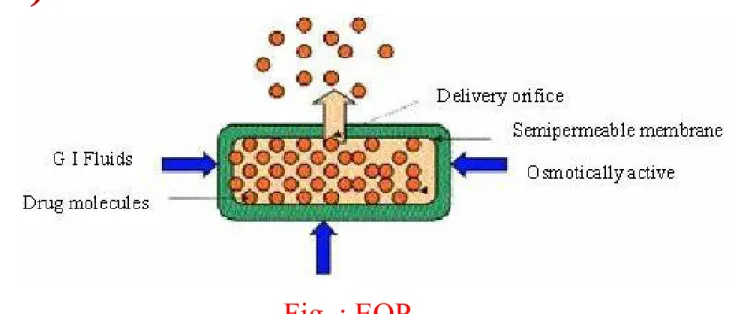
Fig. : EOP
Limitations:
• SPM should be 200-300μm thick to withstand pressure • Thick coatings lowers the water permeation rate
• Applicable mostly for water soluble drugs
CONTROLLED POROSITY
OSMOTIC PUMP
It is laser or micro driven orifice. When Controlled Porosity Osmotic
pump is placed in aqueous environment the water soluble component of
coating dissolves and forms micropores in membrane and water diffuses inside
the core through microporous membrane, setting up an osmotic gradiant and
OSMOTIC BURSTING OSMOTIC
PUMP
Core: API ± osmogents
Coat: Semi permeable membrane without delivery orifice
When placed in aqueous environment, water is imbibed and
hydraulic pressure is built up inside the system, then wall ruptures
and the contents are released.
PUSH-PULL OSMOTIC PUMP
(PPOP)
Core Tablet:
Layer 1: API ± osmogents
Layer 2: Polymeric osmotic agents
Coat: Semi permeable membrane with delivery orifice.
It is a bilayer tablet coated with semi permeable membrane.
The PPOP system consists of two compartments separated usually
SANDWICHED OSMOTIC TABLETS
(SOTS)
It is composed of polymeric push layer sandwiched between two
drug layers with two delivery orifices.
When placed in the aqueous environment the middle push layer
containing the swelling agents, swells and the drug is released from
the delivery orifices.
Advantage : the drug is released from the two orifices situated on
DUROS OSMOTIC PUMP
Design :
Implantable drug-dispensing osmotic pump, shaped as a small
rod with titanium housing.
Mechanism : Through osmosis, water from the body is slowly
drawn through the semi-permeable membrane into the pump by
osmotic agent residing in the engine compartment, which expands
the osmotic agent and displaces a piston to dispense small amounts
of drug formulation from the drug reservoir through the orifice.
ALZET OSMOTIC PUMP
Design: Empty reservoir within the core of the pump is filled with
the drug or hormone solution to be delivered and is surrounded by
salt chamber with impermeable layer between them.
Mechanism: Water enters into the salt chamber through
semipermeable membrane and causes compression of flexible
reservoir and delivery of drug solution.
Application: To deliver drugs, hormones, and other test agents
MARKETED
FORMULATIONS
Brand name
Efidac 24®
Efidac 24®
Acutrim ®
Acutrim ®
Sudafed 24®
Sudafed 24®
API
Chlorpheniramine Chlorpheniramine Phenylpropanolamine Phenylpropanolamine Pseudoephedrine PseudoephedrineManufacturer
Novartis / Pfizer / Alza
MARKETED
FORMULATIONS
Brand name
Ditropan XL ®
Ditropan XL ®
Glucotrol ®
Glucotrol ®
Procardia XL®
Procardia XL®
Covera HS ®
Covera HS ®
API
Oxybutynin chloride Oxybutynin chloride Glipizide Glipizide Nifedipine Nifedipine Verapamil HCl Verapamil HClManufacturer
Alza AlzaPfizer / Alza
Pfizer / Alza
Pfizer / Alza
Pfizer / Alza
Novartis / Alza
FACTORS AFFECTING THE PERFORMANCE OF
OSMOTIC DRUG DELIVERY SYSTEM
Physico-chemical properties of the drug
Solubility
Solid or liquid
Viscosity (Liquids)
Rheological properties
Properties of osmotic agent
Osmotic pressure difference generated by the agent which ultimately will decide the water influx and in turn the delivery of active.
Membrane type and characteristics
Wet strength
Water permeability
Size of delivery orifice
IN VITRO EVALUATION
The in vitro release of drugs from oral osmotic systems
has been evaluated by the conventional USP paddle and
basket type apparatus.
The dissolution medium is generally distilled water as
well as simulated gastric fluid (for first 2-4 h) and
intestinal fluids (for subsequent hours) have been used.
The standard specifications, which are followed for the
oral controlled drug delivery systems are equivalently
applicable for oral osmotic pumps.
In vivo evaluation
of oral osmotic systems has been
QUESTION BANK
What is ODDS? Why it is required? Enumerate recent advance in
controlled osmotic drug delivery system with their approaches.
What are ideal properties of semi permeable membrane? Suggest
few materials for this. Wright note on evaluation of osmotic pump.
Write a note on principle of osmotic drug delivery system.
Give advantage and disadvantage of osmotic drug delivery system.
Give name of osmotic pumps. Give detail on elementary osmotic
REFERENCES
Gupta Roop, Gupta Rakesh, Basniwal Pawan k, Rathore Garvendras,
Osmotically controlled oral drug delivery systems: a review, int. J. Ph. Sci., 2009, 1(2), 269-275.
Gohel M.C Parikh .R.K, Shah. N.Y Osmotic drug delivery- an update,
pharmainfo.net, 2009, 7(2).
Lachman L., Liberman H. A., Kanig J. L., The theory and practise
of industrial pharmacy. 2nd Edition 1991, Varghese publishing
house, Pg. 455.
Aulton M. E., pharmaceutics the science of dosage form design.
2nd Edition 2002, Churchill livingstone, Pg. 38, 39, 74, 304, 417.
Ajay Babu, M. Prasada Rao, Vijaya Ratna J, Controlled-porosity osmotic
pump tablets-an overview, jprhc.
Y. W. Chien, (2005), Novel Drug Delivery System,
2nd edition, Marcel Dekker,Inc., 1-3, 17-18, 33-36.
N. K. Jain and S. K. Jain, (1997), Controlled and
novel Drug Delivery, 1st edition, C.B.S. publishers
and distributors, 1-2.
M. C. Gohel, R. K. Parikh, N.Y. Shah, (2009),
Osmotic Drug Delivery: An Update.
R. K. Verma, D. M. Krishna and S. Garg, (2002),
Review article on Formulation aspects in the
development of osmotically controlled oral drug
delivery systems, J. Control. Release, 79, 7-27.
N. S. Parmar S. K. Vyas, N. Vaya, (2003),
S. P. Vyas, R. K. Khar, Controlled Drug Delivery
Concepts and Advances, (2001), Vallabh
Prakashan, 170.
A.G. Thombre, A.R. DeNoto and D.G. Gibbes,
(1999), Delivery of glipizide from asymmetric
membrane capsules using encapsulated excipients,
J. Control. Release, 60, 333-341.
Partha Gan Chaudhuri, Satya Prakash Singh, A
Review Of Hydrogel-A Novel Drug Delivery
System.
X. Li and B.R. Osmotic Controlled Drug Delivery
THANK YOU