Distributed Power Control Algorithm in
Orthogonal Frequency Division Multiple Cognitive
Radio Systems for Fading Channel
https://doi.org/10.3991/ijoe.v14i03.8416Lingling Chen!!"#
Jilin Institute of Chemical Technology, Jilin, Jilin, China Jilin University, Changchun, Jilin, China
cll807900@ 163.com
Qi Feng, Xingquan Gao, Huipeng Wang, Jiwen Liang
Jilin Institute of Chemical Technology, Jilin, Jilin, China
Abstract—In order to guarantee the quality of service (QoS) for primary us-ers (PUs) and secondary usus-ers (SUs) in fading channel, a distributed power con-trol algorithm is proposed based on convex optimization theory in underlay OFDM cognitive radio networks (CRNs). Our purpose obtains the maximum transmit data rate of each SU at all subcarriers under three constraints of the maximum allowable transmission power, the minimum signal to interference plus ratio (SINR) of each SU and the maximum allowable interference gen-erated from SUs to PU at each subcarrier. Simulation results show that the performance of the proposed algorithms (m2) are superior to the geometric programming algorithm (m1) in fading channel environment.
Keywords—Cognitive radio networks, distributed power control algorithm, convex optimization theory
1
Introduction
As the explosive growth of wireless communication services and applications, the limited spectrum resources becomes increasingly crowded and have not satisfied the growing needs of people [1]. In order to dynamically allocate and share spectrum, cognitive radio (CR) [2] is proposed to improve the efficiency of spectrum utilization. Currently, the underlay spectrum sharing mode is most effective where multiple SUs and PUs can use spectrum resource at the same time and satisfy the constraint of the interference temperature (IT) threshold [3]. Thus, we focus on underlay CRNs [4-5] with multiple PUs and multiple SUs to study resource allocation problem.
radio resource allocation based orthogonal frequency division multiple access (OFDMA) in cognitive radio networks is proposed to aim at maximizing secondary users throughput under the interference constraint of PUs in [7]. In [8], it consider the power efficiency optimization problem in the cognitive radio (CR) networks under both the average packet delay constraint of each CR transmitter (CR-Tx) and the interference constraint at primary receiver (PU-Rx). The authors propose a coopera-tive approach to make each CR-Tx know the interference level at the PU-Rx when there is no central control node in the network and no assistant sensors are deployed to do the interference measuring jobs. In [9], the resource allocation problem, which aims to maximize the weighted sum rate in orthogonal frequency division multiplex-ing based (OFDM-based) multi-cell cognitive radio networks (CRNs) with multiple description coding multi-cast (MDCM), is investigated. Network-wide optimization of transmit power with the goal of maximizing the total throughput, promises signifi-cant system capacity gains in interference-limited data networks, which was proposed in [10]. A large number of the aforementioned distributed power control algorithm are proposed based on perfect channel, and they may be not suitable to actual CR com-munication environment without taking into the near-far effect on the QoS of PUs and the minimum SINR at SU account.
Based on the above discuss, in this paper, a distributed power control algorithm is proposed to minimum the interference power from SU-Tx to PU-Rx based on convex optimization theory in underlay OFDM CRNs. In order to guarantee communication quality of PUs and SUs in fading channel, our proposed power control scheme not only considers that the transmit power of each SU at all subcarriers should not exceed its maximum power, but also takes the minimum SINR at secondary receivers (SU-Txs) and the interference temperature threshold in each subcarrier into account. The proposed algorithm is well adapt to practical dynamic communication environment. Simulation results show that the proposed algorithm is superior to algorithms (m2) are superior to the geometric programming algorithm (m1) [11] in fading channel envi-ronment.
2
System model and problem formulation
In this section, we consider
T
primary users (PUs) andM
secondary users (SUs) in OFDM cognitive network withK
subcarriers in underlay scenario.Owing to the battery capacity, the transmit power of each SU must be lower than is not above its maximum transmit power, i.e.,
max 1
K
i i
k k
p
P
=
!
"
(1)where
P
maxi is the threshold of the maximum power of the secondary useri
in allsubcarriers.
each subcarriers is lower than the bearable threshold of the PU. Thus, the weighting interference temperature is introduced. It can be defined as follows
!
i it it t
k k k k
p h
!
I
(2)where
h
kitis the interference gain from the PUt
to the SUi
at the subcarriersk
.t k
I
presents the maximum interference power level of subcarrierk
.!
itk is the weighting factor ,which is proportional to the distance between the SUi
and PUt
at subcarrierk
.In order to guarantee the reliable QoS of the SUs the signal to interference noise ratio (SINR) at each SU-Rx should exceed the threshold
min
i i
k
!
" !
(3)where
!
imin(
!
imin>
0)
is the minimum required SINR value at thei
SU.!
ikdenotes the SINR at thei
SU in thek
subcarrier.Our optimization objective is to maximize the transmit data rate of each SU at all subcarriers, and simultaneously meet constraints (1), (2) and (3). Thus, the optimiza-tion problem can be depicted as
(
)
{
}
{
}
2 1 max 1 minmax
log 1
0,
1, 2, ,
,
1, 2, ,
s.t.
K k K i k i ki it it t
k k k k
i k i k i i k
p
P
p
k
K i
M
p h
!
I
"
"
"
= =+
#
$ % &
&
$
#
'
(
((
)
(
(
(*
+
+
!
!
(4) where ii i k k it t k k ki k
g p
N
h T
!
+
=
.N
krepresents the background noise at thek
subcarrier.ii k
g
is the direct channel gain at thek
subcarrier.T
ktdenotes the PUt
’s transmit power at the subcarriersk
.
(
)
{
}
{
}
2 1 max 12 2 min
min log 1
0, 1, 2, , , 1, 2, ,
s.t.
(1 ) (1
log
log
)
/
K k K i k i k i k i it it tk k k k
i k i k i p P
p k K i M
p h I
! "
!
!
= = # + $% & ' '
+ % + $
(
)
))
*
)
)
)+
,
,
! ! (5)3
Distributed power control algorithm
In this section, the distributed power control algorithm is applied to solve the transmit data rate problem of each SU on all subcarriers in OFDM CRNs. The distrib-uted power control algorithm reveals the hidden convexity structure which can be resolved by Lagrange dual principle [13]. Therefore, the Lagrange function of (5) can be given by
(
)
(
)
2
1 1 max
2 2 min
log 1
( , , )
(
)
[log (1
) log (1
)]
/
K i k k K i i k k
i i i it it t
k k k k k k k
k k
L p
p P
p h
I
= =
!
+
"
# $
=
+
#
!
+
%
+
" !
+
"
+
$
& !
'
'
'
'
(6)
where
P
=
[
p
1, ,
!
p
M]
T is the transmission power vector.1 2
[ , , , ]
T0
M
!
=
! !
!
!
"
denotes vector of dual variable.!
k represents aLa-grange multiplier.
According to the dual decomposition theory, the Lagrange dual function for (6) is givenby
max 2 min
( , )
min ( , , )
ilog (1
i)
i)
k k k k k
k p k
D
! "
=
&
L p
! "
+(
!
p
#
&
$
+
%
#
&
"
I
(7) where(
)
2
( , , ) (
1)log 1
i i i it/
itk k k k k k k k
L p
! "
=
# $
+
%
+
!
p
+
"
p h
&
(8)And, the dual problem (6) is given as
min ( , )
subject to :
0,
0
D
! "
! # " #
(9) According to the KKT condition [14], the optimal transmit power of each SU at each subcarrier can be obtained by the following equation( , , ) 0
k k
i
L p
p
! "
=
And the solution is
(1
)
iti k k
k it it
k k k
ij j
k k k
i k
p
h
N
h T
g
!
+
"
=
#
! $
+
%
+
(11)The above problem can be solved by using subgradient method. Thus, we construct the subgradient iteration algorithm to update the Lagrange multipliers as follows
(
)
( )
+
max 1
1 max 0,
i K ik k
t
t
P
p
!
!
"
=
#
%
&
$
+ =
(
+
*
'
+
)
,
-.
0
/
(12)(
1 max 0,
)
(
( )
log (1
2 i) log (1
2 mini)
)
+k
t
kt
k!
+ =
!
+
"
$
'
+
#
&
+
#
%
(
(13)(
1 max 0,
)
(
( )
(
i it/
it t)
)
k
t
kt
p h
k k kI
k!
+ =
!
+
"
#
$
+ (14)where
[ ]
X
+=
max{0, }
X
,t
represents the iteration time and, ,
! " #
are step sizes. The step sizes and multipliers! "
,
kand!
k [15] should be carefully cho-sen to ensure the fast convergence rate.The distributed power control algorithm is below:
Step 1: Initialization: Set
t
=
0
,!
(0) 0
>
,!
k(0) 0
>
,!
k(0) 0
>
,!
imin>
0
,max
0
i(0)
ik
p
p
!
!
,!
>
0,
"
>
0,
#
>
0
.Step 2: Calculate at the SU-Rx of link
i
: Compute the sum of interference and noise powerN
k+
h T
k kij j. Update Lagrange multiplier!
by (12). Feedback infor-mationN
k+
h T
k kij j and!
to the SU-Tx of linki
.Step 3: Calculate at the SU-Tx of link
i
: ReceiveN
k+
h T
k kij j and!
, respective-ly. Update Lagrange multiplier!
kand
"
kby (13) and (14).Step 4: Calculate the transmit power value of SU-Tx by (10). Step 5: Go to step 2.
4
Simulation results
In this section, the computer simulations are presented to demonstrate the perfor-mance of the distributed power control algorithm(m2) by comparison with Geometric Programming algorithm(m1) [11].
(0,0.01)
mW. The power budgetsP
maxi and the background noise levelsN
kare ran-domly chosen from the intervals(
0.9,1.1)
and(
0.01,0.10)
respectively. The simula-tion results are shown from Figure 1 to Figure 5.
Fig. 1. The SINR of each SU
Fig. 2. The transmit power of each SU
0 5 10 15 20 25 30 0
0.05 0.1 0.15 0.2 0.25 0.3 0.35 0.4 0.45 0.5
iterative number
trans
m
it pow
er
(m
W
)
SU1,m1 SU2,m1 SU3,m1 SU1,m2 SU2,m2 SU3,m2
0 5 10 15 20 25 30
0 1 2 3 4 5 6
iterative number
S
IN
R
of
eac
h S
U
(dB
)
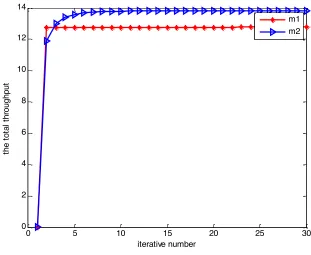
Fig.1 and Fig.2 present the transmit power and SINR of each SU for m1 and m2. We can clearly see that each SU satisfies the constrain of maximize allowable trans-mitting power and the minimum SINR in m1 and m2. Through comparing with m1and m2, the transmit power and SINR are larger of SU1 for m1 than that of the proposed algorithm m2. However, the total throughput of m2 is higher than 16.7% that of the m1 in the fading channel. The numerical simulation is given from Fig. 3
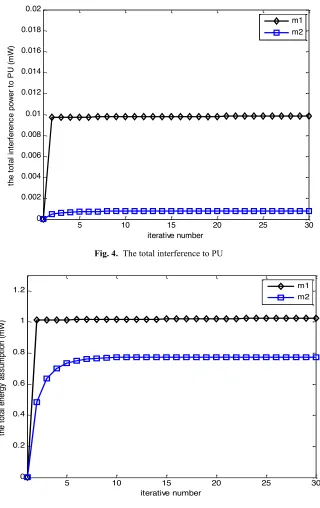
According to the principle of the total interference generated from SUs to PU, we can see that m2 is significantly smaller than m1 from Fig. 4. That means m2 has a lower badly effect on PU, which may affect QoS of primary user network.
In Fig.5, we analyze the system performance of the energy under multiple PUs and SUs in underlay CRNs. As expected, the total energy consumption of m2 is less than30% in m1. Thus, we can save a lot of energy in m2, which can improve energy efficiency.
From the above graphs, we can draw a conclusion that the performances of the proposed m2 algorithm is much superior to that of m1 given in [11].
Fig. 3. The total throughput
0 5 10 15 20 25 30
0 2 4 6 8 10 12 14
iterative number
the t
ot
al
thr
oughput
Fig. 4. The total interference to PU
Fig. 5. The total energy consumption
5 10 15 20 25 30
0 0.002 0.004 0.006 0.008 0.01 0.012 0.014 0.016 0.018 0.02
iterative number
the t
ot
al
int
er
fer
enc
e pow
er
to P
U (
m
W
)
m1 m2
5 10 15 20 25 30
0 0.2 0.4 0.6 0.8 1 1.2
iterative number
the t
ot
al ener
gy
as
sum
pt
ion (
m
W
)
5
Conclusions
In this study, we solve the transmit data rate of each SU at all subcarriers problem in OFDM cognitive network in underlay scenario. Specifically, considering near-far effect and three major constraints of the minimum accepted SINR, the maximum transmit power of each SU and the bearable threshold of the PU in each subcarrier, a distributed power control algorithm(m2) is proposed based on convex optimization theory. Finally, simulation results demonstrate the performances of the proposed algorithm and prove the performances in m2 is superior to m1 (geometric program-ming) in fading channel.
6
Acknowledgment
This work is supported in part by the National Natural Science Foundation of Chi-na under grant no. 61571209 and 61501059, Natural Science Foundation of Jilin (Grant No. 20180101336JC), scientific research fund of Jilin Provincial Education Department (Grant No. 2016134), outstanding youth fund of Jilin City Science and Technology Bureau (Grant No. 20166019), scientific research project of Jilin Institute of Chemical Technology (Grant No. 2015128(D)), and major scientific research pro-ject of Jilin Institute of Chemical Technology (Grant No. 2015010).
7
References
[1]Liang Y C, Chen K C, Li G Y, et al. Cognitive radio networking and communications: An overview[J]. IEEE Transactions on Vehicular Technology, 2011, 60(7): 3386-3407. https://doi.org/10.1109/TVT.2011.2158673
[2]Mitola J, Maguire Jr G Q. Cognitive radio: making software radios more personal [J]. IEEE Personal Communications, 1999, 6(4):13-18. https://doi.org/10.1109/98.788210 [3]S. Haykin, Cognitive radio: Brain-empowered wireless communications, IEEE J. Sel.
Are-as Commun 2005,23(2):201-220. https://doi.org/10.1109/JSAC.2004.839380
[4]Yongjun Xu, Xiaohui Zhao, Yingchang Liang. Robust power control and beamforming in cognitive radio networks: a survey[J]. IEEE Communications Surveys and Tutorials, 2015, 17(4): 1-1. https://doi.org/10.1109/COMST.2015.2425040
[5]Srinivasa, S. and Jafar, S.A., Cognitive radios for dynamic spectrum access the throughput potential of cognitive radio: A theoretical perspective, IEEE Communications zine ,2007, 45(5): 73-79. https://doi.org/10.1109/MCOM.2007.358852
[6]Taskeen Nadkar, Vinay Thumar, G.P.S. Tej, S.N Merchant and U.B. Desai, Distributed power allocation for secondary users in a cognitive radio scenario, IEEE Transactions on Wireless Communications 11(4) (2012) 1576-1586 https://doi.org/10.1109/TWC.2012. 020712.111502
[7]Lin X, Rasool S B. Distributed and provably efficient algorithms for joint channel-assignment, scheduling, and routing in multichannel ad hoc wireless networks[J]. , IEEE/ACM Transactions on Networking, 2009, 17(6): 1874-1887. https://doi.org/10.1109/ TNET.2009.2021841
[9]Yang K, Xu W, Li S, et al. Distributed multicast resource allocation in OFDM-based cog-nitive radio networks[C]//IEEE 2013 8th International ICST Conference Communications and Networking in China (CHINACOM), on. , 2013: 57-62.
[10]Kiani S G, Gesbert D, Gjendemsjo A, et al. Distributed power allocation for interfering wireless links based on channel information partitioning[J]. IEEE Transactions on Wire-less Communications, 2009, 8(6): 3004-3015. https://doi.org/10.1109/TWC.2009.080215 [11]Lingling Chen, Xiaohui Zhao, Distributed power control algorithm for cognitive radio
networks based on geometric programming[J]. Journal of Information and Computational Science,2014,11(13),4747-4757. https://doi.org/10.12733/jics20104997
[12]D. P. Bertsekas, Nolinear Programming 2nd ed, Belmont Mass: Althena Scienfific, 1999.
[13]Didem. Gozupek, F. Alagoz, Throughput and delay optimal scheduling in cognitive radio networks under interference temperature constraints[J]. Journal of Communications and Networks 2009,11(2): 148-156. https://doi.org/10.1109/JCN.2009.6391389
[14]S. Boyd and L. Vandenberghe, Convex Optimization, Cambridge University Press, 2004. https://doi.org/10.1017/CBO9780511804441
[15]LIU Xin, JIA Min and GU Xuemai, Joint optimal sensing threshold and subcarrier power allocation in wideband cognitive radio for minimising interference to primary user[J]. China Communications, 2013,10(11): 70-80. https://doi.org/10.1109/CC.2013. 6674212
[16]Didem. Gozupek, F. Alagoz. Throughput and delay optimal scheduling in cognitive radio networks under interference temperature constraints[J]. Journal of Communications and Networks. 2009,11(2): 148-156. https://doi.org/10.1109/JCN.2009.6391389
8
Authors
Lingling Chen received her Bachelor and PH.D degrees both in Communication Engineering from Jilin University, China, in 2004 and 2015 respectively. Currently, she is a associate professor of College of Information and Control Engineering, Jilin Institute of Chemical Technology, simultaneously she is a post-doctor in Computer science and technology from Jilin University. Her research interests are in nonlinear optimization, mobile computing and cognitive radio networks. E-mail: cll807900@ 163.com.
Qi Feng received his Bachelor degree in Control Science and Control Engineering from North China Electric Power University, China, in 2015. Currently, he is a stu-dent of College of Information and Control Engineering, Jilin Institute of Chemical Technology. His research interests are in robust control and cognitive radio networks. E-mail: [email protected].
Xingquan Gao received his Master and PH.D degrees both in Control Engineering from Jilin University, China, in 2003 and 2006 respectively. Currently, he is a profes-sor of College of Information and Control Engineering, Jilin Institute of Chemical Technology. His research interests are in nonlinear optimization, robust optimization and cognitive radio networks. E-mail: 113315903 @ qq.com.
Jiwen Liang will receive his Bachelor degree in Electronic Information Engineer-ing from Jilin Institute of Chemical Technology, China, in 2019. Currently, he is a student of College of Information and Control Engineering, Jilin Institute of Chemical Technology. His research interests are in robust optimization and cognitive radio networks. E-mail: [email protected]