Effect of conservation tillage systems on growth, yield and yield
components of soybean
Ahmad Sharifi
1*, Hamid Reza Sadeghnezhad
2, Abolfazl Faraji
2(1.Agricultural Engineering Research Institute, Agricultural Research, Education and Extension Organization (AREEO), Karaj, Iran;
2.Agricultural Engineering Research Department, Seed and Plant Improvement Research Department, Golestan Agricultural and Natural
Resources Research and Education Center, AREEO, Golestan, Iran)
Abstract: Conservation tillage systems have been used during recent years in many areas of Iran. In this study, the effect of conservation tillage on soybean yield, yield components and phenological characteristics was evaluated in Golestan province located at the northern Iran. Four different treatments including conventional tillage (CT), minimum tillage (MT), no- tillage with no-till planter (NT-Planter) and no-tillage with no-till grain drill (NT-Grain Drill) were considered. A randomized complete block design with four replications was designed for the experiment. Soybean yield and yield components and some phenological characteristics were measured. Data were analyzed using SAS software and Duncan’s multiple range tests was used to compare the means. The results of two year experiments showed that in year 2012, NT-Grain drill with mean yield of 3612 kg ha-1 had the highest yield while the treatment MT had the lowest yield of 2794 kg ha-1. In year 2013, NT-Planter had the highest yield of 3617 kg ha-1 whereas CT method had the lowest yield of 3054 kg ha-1. It was concluded that NT methods with respect to yield increase are appropriate alternative to replace conventional tillage method in soybean cultivation. Phenological characteristics gave promising response to conservation tillage especially to no tillage.
Keywords: conservation tillage, minimum tillage, no-till, soybean
Citation: Sharifi, A., H. R. Sadeghnezhad, and A.Faraji. 2016. Effect of conservation tillage systems on growth, yield and yield components of soybean. Agricultural Engineering International: CIGR Journal, 18(3):74-83.
1 Introduction
1More than 65% of the area sown to soybean in Iran
is located in the northern areas, Golestan province. Also,
in this province, the wheat-soybean production system
covers about 60000 ha, that is vital for rural development
and natural resources conservation in the areas. Despite
the availability of improved varieties of wheat and
soybean with increased yield potential, the potential
increase in production has not been attained because of
poor crop system management. In current agricultural
management systems, both crops are requiring large
amounts of water, labor, time, nonrenewable energy and
heavy farm machinery for their successful cultivation.
Received date: 2015-10-26 Accepted date: 2016-08-18
*Corresponding author: Ahmad Sharifi, Agricultural Engineering Research Institute, Agricultural Research, Education and Extension Organization (AREEO), P.O.Box: 31585-845, Karaj, Iran. Email address: [email protected]
Conservation tillage is defined by the Conservation Technology Information Center, USA as “any tillage and
planting system that covers 30% or more of the soil
surface with crop residue, after planting, to reduce soil erosion by water” (CTIC, 2015). Minimum and no-tillage
methods are important components of conservation
tillage systems. Conservation tillage improves soil and
water resources, saves energy and time, and reduces the
costs of farm operations. Serraj and Siddique (2012)
synthesized the recent research findings of conservation
agriculture (CA) in dry areas especially in smallholder
farming systems. They analyzed agronomic,
socio-economic, and agro-ecological factors leading to
its success or failure and identified potential points for
future research priorities on CA in dry areas.
Thiagalingam et al. (1991) investigated the effects
of no-till and conventional tillage methods in a
maize-soybean rotation on a clay loam soil during a four
yields were 20% higher under no-till compared to the
conventional tillage and the germination of soybean was
better than that of conventional tillage. Dibert et al.
(1989) stated that no-till method could cause higher yield
of soybean varieties with increase in soil moisture
content. Wilhelm and Wortman (2004) resulted that the
yield of soybean under no-till system was the same as
the conventional tillage method. While no-till method
decreased the yield of corn compared to the conventional
tillage. Romero et al. (2011) reported the response of
faba bean root growth and yield to no-tillage and
conventional tillage systems in a Vertisol under rainfed
Mediterranean conditions. They suggested that no-tillage
system had significantly higher values of the root
parameters studied including root diameter, root length
and root biomass than conventional tillage. Grain yield
and yield components of faba bean were higher under
no-tillage systems than conventional tillage. Fabrizzi et
al. (2005) evaluated the effect of conservation tillage on
corn yield and reported that no-till had lower corn yield
compared to the minimum tillage method.
Busari et al. (2015) reviewed the previous studies
done on the impact of conservation tillage on soil
properties, crop performance and environment. They
concluded that conservation tillage practices becomes
more and more important to reach the food security with
minimum effect on soil and environment in the present
world than before. Despite other studies, the results of
some previous work also indicated that using no-till
systems increased grain yield in soybean cultivation
(Grabau and Pfeiffer, 1990; Wagger and Denton, 1989a).
However, other investigations reported that the
application of no-tillage systems have been positively
affected on many parts of the USA (Smika and Unger,
1986; Unger et al., 1988). In contrast, there are a few
studies that reported conservation tillage may decrease
crop yield and attributed it to soil moisture, temperature
and nutrition (Wang et al., 2007; Su et al. 2007; Xie et al.,
2008).
Conservation tillage systems have been noticed and
used by governmental agricultural organizations and
farmers since 2007 in Iran. Although this system is
becoming popular and used by farmers but there is still a
need to study more on the use of such systems and
related machines in cultivation of agricultural crops like
soybean. Therefore, the study was conducted to evaluate
the effect of conservation tillage systems on soybean
yield and phenological characteristics in the northern
areas of Iran, Golestan province.
2 Materials and methods
2.1 Specification of research station
The study was conducted in Gorgan Agricultural
Research Station, Golestan province located at the
northern areas of Iran (20' 54° East Longitude and 36' 55°
North Latitude, 6 m above sea level and annual
precipitation of 450 mm). The area has temperate climate.
The soil texture was silt clay loam. Soil physical
properties of experimental field are given in Table 1. The
crop rotation was wheat-soybean.
2.2 Treatments and experimental design
Four tillage methods including conventional tillage
(CT) (Disk harrow+planting with planter), minimum
tillage (MT) (Chisel packer+planting with planter), no
tillage with no-till planter (NT-Planter) and no tillage with
no-till grain drill (NT-Grain drill) were used in the first
year 2012. Three tillage methods including CT, MT and
NT-Planter were considered in the second year 2013 in
Table 1 Soil physical properties of experimental field
Depth, cm
Soil particles
Texture
Field
capacity, Wilting point, Bulk density,
Clay Silt Sand % % g cm-3
0-15 32 50 18 Silt clay loam 27.7 13.1 1.44
this study. Experimental design was a randomized
complete block design (RCBD) with four treatments and
four replications. The size of plots was 8 m×20 m The
study was carried out for two years of 2012 and 2013.
2.3 Technical specification of machines
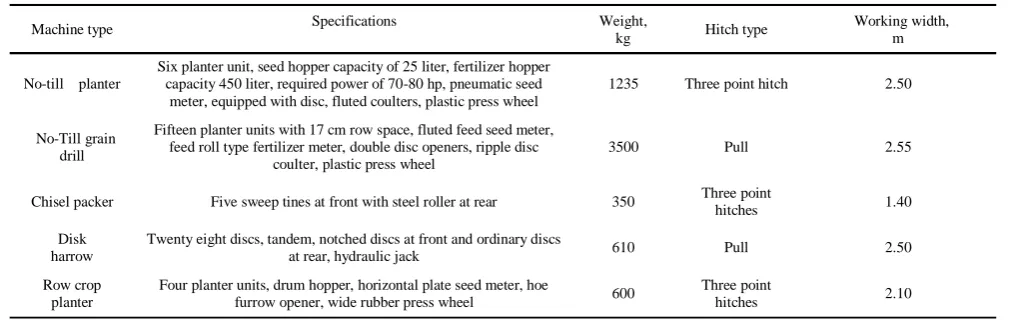
Technical specifications of used machines in the
study are presented in Table 2. Some of the machines are
imported and some are domestically manufactured.
2.4 Farm operations
In year 2012, the four treatments including CT, MT,
NT-Planter and NT-Grain drill were used. Seed gates were
closed to every other one for reaching to a 51 cm row
space in no-till grain drill. A soybean variety called DPX
with 60 kg ha-1 was planted in this study. Weed control
was done in the middle of summer by spraying of one liter
Persuit herbicide (100 g lit-1). There was a need to spray
with a mix of Supergalant and Bentazon herbicides due to
high density of weeds. Pest control was also performed by
spraying of 2 lit ha-1. An amount of 100 kg ha-1 fertilizer
(with a proportion of 15% K, 8% P, 15% N) during
planting below seed in no-till planter, within seed in no-till
grain drill and along with disk harrow in other treatments
were used. During the growth season, the field was
irrigated three times by sprinkler method and two times
raining happened.
In year 2013, the three treatments were used. An
amount of 80 kg ha-1 soybean planted. At the time of
sprinkler irrigation, an amount of 100 kg ha-1 fertilizer (46%
N) was used. The Gramaxon herbicide (4 lit ha-1) was used
for weed control and Somiton pesticide (1.5 lit ha-1) used
for pest control. During the growth season, the field was
irrigated three times by sprinkler method.
2.5 Measured parameters
Yield and yield components parameters were
measured in the experiments during years 2012 and 2013.
These parameters included plant height, number of pod per
plant, 1000-grain weight, grain yield, above ground dry
matter and harvest index of soybean. These are the most
important parameters of soybean which usually have been
noticed and measured in other research works (Liu et al.,
2005; Liu et al., 2010; Stipecevic et al., 2009). Some
phenological characteristics of soybean including number
of days to flowering, number of days to maturity, height to
first pod and number of sub branches were also measured.
3 Results and discussion
The results of variance analysis of yield and yield
components for year 2012 are shown in Table 3. As it is
shown in the table the grain yield, above ground dry matter
and harvest index of soybean obtained using different
tillage methods are significantly different at probability
level of 1%. Whereas other measured parameters
including plant height, number of pod per plant and
1000-grain weight are not significantly different.
The results of mean comparison of yield and yield
components parameters measured in year 2012 are shown
in Table 4. NT-Grain drill with yield of 3612 kg ha-1 had
the highest yield while the treatment MT had the lowest
Table 2 Technical specifications of used machines in the study
Working width, m Hitch type Weight, kg Specifications Machine type 2.50 Three point hitch
1235 Six planter unit, seed hopper capacity of 25 liter, fertilizer hopper
capacity 450 liter, required power of 70-80 hp, pneumatic seed meter, equipped with disc, fluted coulters, plastic press wheel No-till planter
2.55 Pull
3500 Fifteen planter units with 17 cm row space, fluted feed seed meter,
feed roll type fertilizer meter, double disc openers, ripple disc coulter, plastic press wheel
No-Till grain drill 1.40 Three point hitches 350
Five sweep tines at front with steel roller at rear Chisel packer
2.50 Pull
610 Twenty eight discs, tandem, notched discs at front and ordinary discs
at rear, hydraulic jack Disk harrow 2.10 Three point hitches 600
Four planter units, drum hopper, horizontal plate seed meter, hoe furrow opener, wide rubber press wheel
yield of 2794 kg ha-1 among the treatments. However, the
negative effect of minimum tillage on sorghum grain
yield and cowpea has been suggested in Southern Africa
(Mashingaidze et al., 2012). The highest value of plant
height, number of pod per plant, above ground dry matter
and harvest index belongs to NT-Grain drill.
Mean follows by the same letters in a column are not
significantly different at level of 5% by LSD test
The results of means comparison of some
phenological characteristics for different tillage methods
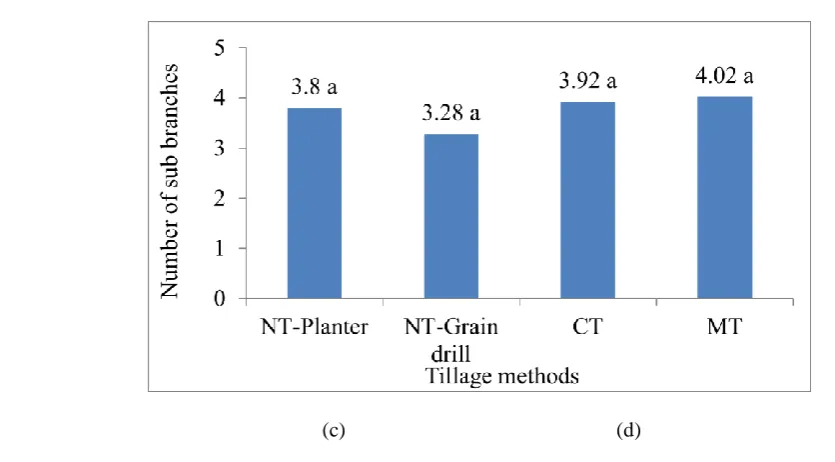
in year 2012 are shown in Figures (1, 2, 3 & 4). The
number of days to flowering is not significantly different
at probability level of 5% between all treatments. The
number of days to maturity of NT method is significantly
different compared to CT and MT. The mean of number of
days to maturity for both NT methods, 131.2 and 130.8
days, are smaller than CT and MT. Three days sooner is
taken for soybean to be matured in NT than CT with the
coefficient of variation of 0.26%. However, there is no
significant difference between CT and MT for the number
of days to maturity. The value of height to first pod of
NT-Grain drill is greater than the other tillage method and
significantly different at level of probability 5%. The value
of sub branches is not significantly different and has put in
the same group in all tillage systems. In overall,
phenological characteristics gave the good response to
conservation tillage systems especially to no tillage
systems. Moreover, it should be pointed out that the same
response was seen in yield and yield components of
soybean for no tillage systems. The results obtained are in
consistence to previous researchers’ suggestions
(Thiagalingam et al., 1991; Dibert et al., 1989; Wagger
and Denton, 1989a and 1989b, Mashingaidze et al., 2012)
Table 3 Mean squares of yield and yield components in year 2012
Source of variation df Plant height Number of pod per plant
1000 – grain
weight Grain yield
Above ground dry
matter Harvest index
Replication 3 104** 44.1 ns 10.0 ns 164562 ns 1509779* 1.75*
Tillage 3 3.85 ns 57.2 ns 4.5 ns 532694** 3158626** 2.92**
Error 9 1.21 30.8 5.2 43819 312588 0.42
CV. % 2.20 9.2 1.3 6.7 6.9 1.67
ns: not significant * , **: significant at level of 5 % and 1%, respectively, F test
Table 4 Mean comparison of yield and yield components in 2012
Treatment Plant height, cm
Number of pod per plant
1000 – grain weight, gr
Grain yield, kg ha-1
Above ground dry matter, kg ha-1
Harvest index, %
NT-Planter 50.0 a 60.0 a 182 a 3203 b 8264 b 38.8 ab
NT-Grain drill 51.8 a 65.8 a 182 a 3612 a 9223 a 39.2 a
CT 50.8 a 58.0 a 180 a 2909 bc 7319 c 39.8 a
Figure 1 Mean comparison of number of days to flowering, CV. = 3.59% in year 2012
Figure 2 Mean comparison of number of days to maturity, CV. = 0.26% in year 2012
The results of variance analysis of yield and yield
components for year 2013 are shown in Table 5. As it is
shown in the table the grain yield and harvest index of
soybean obtained using different tillage methods are
significantly different at probability level of 5%. Whereas
the other measured parameters including plant height,
number of pod per plant, 1000-grain weight and above
ground dry matter are not significantly different.
The results of mean comparison of yield and yield
components parameters measured in year 2013 are shown
in Table 6. NT-Planter with yield of 3617 kg ha-1 had the
highest yield whereas CT method had the lowest yield of
3054 kg ha-1. Our results confirm previous data on the
effect of conservation tillage methods on soybean yield
(Thiagalingam et al., 1991; Dibert et al., 1989; Grabau
and Pfeiffer, 1990; Wagger and Denton, 1989a; Opara,
2015; Farooq et al., 2011). However, the highest value of
number of pod per plant, above ground dry matter and
harvest index belongs to NT-Planter. (c) (d)
Figure 4 Mean comparison of number of sub branches, CV.= 15.6% in year 2012
Table 5 Mean squares of yield and yield components in year 2013
Source of variation df Plant height Number of pod per plant
1000 – grain weight, gr
Grain yield, kg ha-1
Above ground dry matter, kg ha-1
Harvest index
Replication 3 61.7** 151 ns 6.31 ns 252302 ns 1207270 ns 1.17 ns
Tillage 2 1.75 ns 90.6 ns 14.6 ns 319856* 639924 ns 9.4*
Error 6 4.1 95.2 14.1 56844 274532 1.81
CV. (%) 3.3 13.4 2.1 7.12 16.2 3.5
ns: not significant * , **: significant at level of 5% and 1%, respectively, F test
Table 6 Mean comparison of yield and yield components in year 2013
Treatment Plant height Number of pod per plant
1000 – grain weight, gr
Grain yield, kg ha-1
Above ground dry matter,
kg ha-1
Harvest Index, %
NT-Planter 60.2 a 75 a 182 a 3617 a 9077 a 39.8 a
CT 61.2 a 65 a 178 a 3054 b 8730 a 38.7 ab
MT 60.0 a 70 a 179 a 3377 ab 8280 a 36.8 b
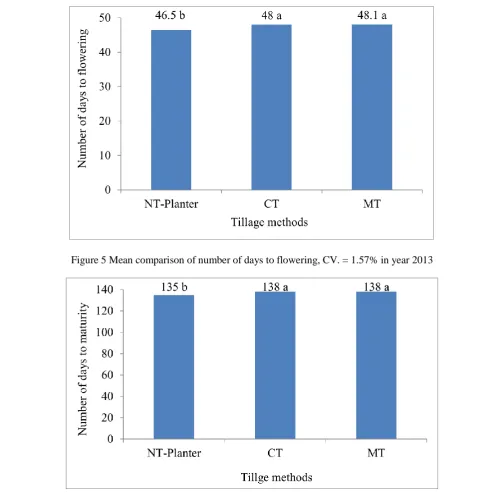
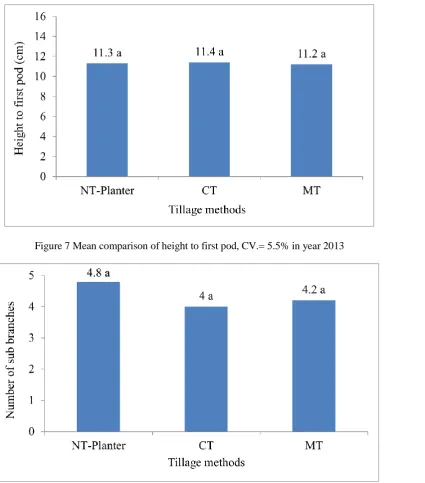
The results of means comparison of some
phenological characteristics for different tillage methods
in year 2013 are shown in Figures 5, 6, 7 & 8. As can be
seen from Figure 6, the number of days to flowering is
significantly different at probability level of 5% between
NT-Planter and other tillage methods. The number of days
to maturity of NT methods is significantly different
compared to CT and MT. The mean of number of days to
maturity for NT-Planter, 135 days, is smaller than that of
CT and MT. Three days sooner is taken for soybean to be
matured in NT-Planter than CT and MT with the
coefficient of variation of 0.41%. The same results
obtained in year 2102. However, there is no significant
difference between CT and MT for the number of days to
maturity the same as the results in year 2012. However,
there is no significant difference for the value of height to
first pod of all tillage methods at probability level of 5%
and included in the same group. The value of sub branches
is not significantly different and put in the same group in
all tillage systems.
Figure 5 Mean comparison of number of days to flowering, CV. = 1.57% in year 2013
As an overall discussion, numerous studies have
been carried out to assess the impact of conservation
tillage on crop yield. Many of them suggested increase in
yield (Haggblade and Tembo, 2003; Mazvimavi and
Twomlow, 2009; Thiagalingam et al., 1991; Dibert et al.,
1989; Grabau and Pfeiffer, 1990; Wagger and Denton,
1989a; Opara, 2015; Liu et al., 2013; Farooq et al., 2011)
as the present study shown the same results. Some of
them stated decrease in yield (Wang et al., 2007; Su et al.,
2007; Xie et al., 2008) in the use of conservation tillage
systems. However, the effect of conservation tillage
systems on the yield and yield components of different
crops should be studied for a long period of time with
considering the conditions of soil and climate and
appropriate use of tillage machines. Some previous works
did not indicate any differences in crop yield on the
influence of conservation tillage on soybean and grain
sorghum in dryland conditions in the first three years of
experiments. Whereas after the next thirteen years greater
yield was observed in no-till systems (Jasa et al., 1999). Figure 7 Mean comparison of height to first pod, CV.= 5.5% in year 2013
For farmers, maximizing yield and managing risk is a
complex challenge that is unlikely to be solved by a
single approach. There are three specific major challenges:
increasing yield potential (the maximum yield for a given
genotype under optimal conditions), protecting yield
potential, and increasing resource use efficiency to ensure
sustainability. Improved crop management practices will
undoubtedly increase yield in the future. The biggest
gains will come from combinations of improved crops
and improved agronomical practices (Fan et al., 2012).
Conservation agriculture is by no means a low output
agriculture and allows yields comparable with modern
intensive agriculture but in a sustainable way. Yields tend
to increase over the years with yield variations decreasing.
However, for the farmer, conservation tillage is mostly
attractive because it allows a reduction of the production
costs, reduction of time and labor, particularly at times of
peak demand such as land preparation and planting and in
mechanized systems it reduces the costs of investment
and maintenance of machinery in the long term.
4 Conclusions
A study was conducted to evaluate the effect of
conservation tillage methods on yield and yield
components of soybean. The results of two year
experiments showed that in year 2012, no-till grain drill
with mean yield of 3612 kg ha-1 had the highest yield
while the treatment minimum till with chisel packer and
planting had the lowest yield of 2794 kg ha-1. In year
2013, no-till with planter had the highest yield of 3617 kg
ha-1 whereas conventional tillage method had the lowest
yield of 3054 kg ha-1. Phenological characteristics gave
the good response to conservation tillage systems
especially to no tillage systems. Moreover, it should be
pointed out that the same response was seen in yield and
yield components of soybean for no tillage systems. In
overall, long term use of conservation tillage systems
should be noticed to reach the higher yield of different
crops. However some other important factors such as
appropriate use of conservation tillage machines and
conditions of soil and climate could be also considered.
Acknowledgements
The authors would like to acknowledge the supports
by Agricultural Engineering Research Institute and Seed
and Plant Improvement Institute for conducting the
national joint research project (NO: 03-14-1403-91007).
Technical supports from colleagues in the department of
Agricultural Engineering Research and department of
Seed and Plant Improvement Research of Golestan
Agricultural and Natural Resources Research and
Education Center during the experimental work are also
appreciated.
References
Busari, M. A., S. S. Kukal, A. Haur, R. Bhatt, and A. A. Dulazi. 2015. Conservation tillage impacts on soil, crop and the environment. International Soil and Water Conservation Research, 3(2): 119-129.
Conservation Tillage Information Center (CTIC). 2015. Tillage type definitions. USA. [Internet]. [Cited 2015 July 14];
Available from:
http://www.ctic.purdue.edu/resourcedisplay/322/.
Dibert, E. J., M. Bigercyo, and R. A. Olson. 1979. Utilization of N15 fertilizer by nodulating and nonnodulating soybean isolines. Agronomy Journal, 71(5): 715-723.
Farooq, M., K. C. Flower, K. Jabran, A. Wahid, and K. H. M. Siddique. 2011. Crop yield and weed management in rainfed conservation agriculture. Soil & Tillage Research, 117(6): 172-183.
Fan, M., J. Shen, L. Yuan, R. Jiang, X. Chen, and W. J. Davies. 2012. Improving crop productivity and resource efficiency to ensure food security and environmental quality in China. Journal of Experimental Botany, 63(1): 13-24.
Grabau, L. J., and T.W. Pfeiffer. 1990. Management effect on harvest losses and yield of double-crop soybean. Agronomy Journal. 82(4): 715-718.
Haggblade, S., and G. Tembo. 2003. Early evidence on conservation farming. International Workshop on Reconciling Rural Poverty and Resource Conservation: Identifying Relationships and Remedies. Cornell University, Ithaca, NY.
ASAE/CSAE-SCGR, Paper No. 99-1085. Toronto, Ontario Canada.
Liu, X., J. Jin, S. J. Herbertb, Q. Zhang, and G. Wang. 2005.Yield
components, dry matter, LAI and LAD of soybeans in Northeast China. Field Crop Research, 93(1): 85-93. Liu, B., X. B. Liu, C. Wang, Y. S. Li, J. Jin, and S. J. Herbert. 2010.
Soybean yield and yield component distribution across the main axis in response to light enrichment and shading under different densities. Plant Soil and Environment, 56(8): 384-392.
Liu, Y., Y. Sui, D. Gu, X. Wen, Y. Chen, C. Li., and Y. Liao. 2013. Effects of conservation tillage on grain filling and hormonal changes in wheat under simulated rainfall conditions. Field Crop Research, 144(144): 43-51.
Mashingaidze, N., C. Madakadze, S. Twomlowb, J. Nyamangara, and L. Hove. 2012. Crop yield and weed growth under conservation agriculture in semi-arid Zimbabwe. Soil & Tillage Research, 124(4): 102-110.
Mazvimavi, K., and S. Twomlow. 2009. Socioeconomic and institutional factors influencing the adoption of conservation farming by vulnerable households in Zimbabwe. Agricultural Systems, 101(1-2): 20-29.
Opara, O.A. 2015. FAO Book, Soil tillage in Africa, Needs and Challenges: Chapter 8, Conservation tillage for increased crop production.
Romero, V. M., L. L. Bellido, and R. J. L. Bellido. 2011. Faba bean root growth in a Vertisol: Tillage effects. Field Crop Research, 120(3): 338-344.
Serraj, R., and K. H. M. Siddique. 2012. Conservation agriculture in dry areas. Field Crop Research, 132: 1-6.
Smika, D. E., and P. W. Unger. 1986. Effect of surface residues on soil water storage. Advances in Soil Science, 5: 111-138. Stipecevic, B., D. Jug, I. Jug, I. Zugec, M. Stosic, and D. Kolar.
2009. Influence of different soil tillage systems on soybean yield and yield components. Tarim Makilanari Bilimi
Dergisi (Journal of Agricultural Machinery Science),5(3): 263-267.
Su, Z.Y., J. S. Zhang, W. L. Wu, D. X. Cai, J. J. Lv, G. H. Jiang, J. Huang, J. Gao, R. Hartmann, and D. Gabriels. 2007. Effect of conservation tillage practices on winter wheat water use efficiency and crop yield on the Loess Planteau, China. Agricultural Water Management, 87(3): 307-314.
Thiagalingam, K., N. Gould, and P. Watson. 1991. Effect of tillage on rainfed maize and soybean yield and the nitrogen fertilizer requirements for maize. Soil & Tillage Research, 19(1): 47-54.
Unger, P. W., G. W. Langdale, and R. I. Papendick. 1988. Role of crop residues - improving water conservation and use. In: Cropping Strategies for Efficient Use of Water and Nitrogen. W. L. Hargrove (ed.) pp. 69-100. American Society of Agronomy Special Publication, No.51
Wagger, M. G., and H. P. Denton. 1989a. Tillage effects on grain yield in wheat-soybean- corn crops rotation. Agronomy Journal, 79(6): 952-956.
Wagger, M., and H. Denton. 1989b. Tillage effects on grain yields in wheat, double crop soybean and corn rotation. Agronomy Journal, 81(3): 493-498.
Wang, X. B., D. X. Cai, W. B. Hoogmoed, O. Oenema, and U. D. Perdok. 2007. Developments in conservation tillage in rainfed regions of North China. Soil & Tillage Research, 93(1): 239-250.
Wilhelm, W., and C. Wortmann. 2004. Tillage and rotation interactions for corn and soybean grain yields as affected by precipitation and air temperature. Agronomy Journal, 96(2): 425-432.