Information Security Transmission Technology in
Internet of Things Control System
https://doi.org/10.3991/ijoe.v14i06.8707
Ying Zou!!"
SiChuan Judicial and Police Officers Professional College, DeYang SiChuan, China [email protected]
Jiezhuo Lv
Southeast University, NanJing JiangSu, China
Abstract—To solve the information security problem in Internet of things control system, the information security transmission technology was mainly discussed and studied, and the basic structure of networking control system was analyzed. From the main control equipment, communication equipment, control equipment, monitoring equipment, information storage device, connecting equipment and other aspects, the further research was carried out. Secondly, the structure of the Internet of things was studied, the security problems which may exist were discussed, and it was analyzed from the access security, transmission security and delays stability safety three aspects. Finally, the information secu-rity transmission technology based on the Internet of things control system was explored, and the encryption technology, authentication technology and isola-tion technology were analyzed in detail. The results showed that the networking control system not only had the advantages of transmission reliability, conven-ient interaction, and simple assembly, but also had the strengths of disperse structure, real-time data, remote monitoring and others. At last, it is summed up that the existing reliable communication resources are maximized in the trans-mission mechanism of the Internet of things.
Keywords—Internet of Things, control system, information security
1
Introduction
pro-vide rich opportunities for researchers to innovate and help control systems move to go towards new future. Therefore, the concept of IOT provides new opportunities and challenges for networked development of control system. The control system based on Internet of things will become one of the development directions of next genera-tion control system. The Internet of things control system can be said to be the exten-sion and expanexten-sion of modern network control system. It is similar to that the Internet of things is the extension and expansion of the Internet. This research will analyze the definition, basic structure and application advantages of the Internet of things control system, and profoundly discuss the technology of information security output.
2
State of the art
A closed loop control system generated through the network is called network con-trol system. The Internet of things concon-trol system refers to the system with Internet of things as the communication medium, to interconnect the control system elements so that the related information can be safely interacted and shared, so as to achieve the desired control objectives. In the Internet of things control system, the components of the control system include sensors, intelligent controllers, actuators, management equipment and so on. At the same time, the control relevant information refers to the sampling information, monitoring information, control decision results, control com-mand, control program, device parameter information, product parameter information, equipment state, control state, control rules, control decision, control objectives and other related information. As a result, the control goal means the ultimate control goal that the whole control system will realize.
The foreign scholars discussed information security transmission technology from various aspects. Kim, S. and Na, W. [1] proposed the safe data transmission architec-ture for the Internet of things ecosystems, which was a kind of software defined net-work base cloud and it could provide the safe data transmission. Budiyanto, S. et al. [2] evaluated the performance of various data transmission technique on IP over Ra-dio, so as to determine which data transmission that is the best for supporting the Internet of things system. Lee, J. H. et al. [3] proposed a fast intra-prediction unit decision method to reduce the computational complexity of the HEVC RExt encoder, which was closely related to Internet of things control system. Saha, A. et al. [4] put forward a context-aware adaptive pattern-based ME algorithm for multimedia Internet of things platform to improve video compression and performance of Internet of things control system. Yildirim, E. Y. et al. [5] discussed the major factors affecting information security management in small-and medium-sized enterprises to examine the performance of enterprise information security transmission.
infor-mation and improve the performance of Internet of things control system. He [8] introduced the basic concept and key technology of the Internet of things compared to the traditional environment of information technology. He also talked about the appli-cation of Internet of things of information collection, transmission and processing technology in environmental monitoring and other environmental supervision. Chen and Xu [9] made a self-developed production environment supervision and monitor-ing control system, includmonitor-ing environment collectmonitor-ing terminal, environment control-ler, embedded repeater and supervision and control server. Xia et al. [10] combined Internet of things and cloud computing to develop the control system of Internet of things and make information transmission more secure.
In conclusion, the safe data transmission architecture, the performance of various data transmission technique, the major factors affecting information security man-agement and so on are discussed. However, the information security problem in Inter-net of things control system is not effectively solved. To guarantee the information security, the information security transmission technology is mainly discussed and studied, and the basic structure of networking control system is analyzed. The struc-ture of the Internet of things is studied, the security problems which may exist are discussed, and it is analyzed from the access security, transmission security and de-lays stability safety three aspects. Finally, the information security transmission tech-nology based on the Internet of things control system is explored in detail. The net-working control system not only has the advantages of transmission reliability, con-venient interaction, and simple assembly, but also has the strengths of disperse struc-ture, real-time data, remote monitoring and others. At last, it is summed up that the existing reliable communication resources are maximized in the transmission mecha-nism of the Internet of things.
3
An overview of the Internet of things control system
3.1 Basic structure of the Internet of things control system
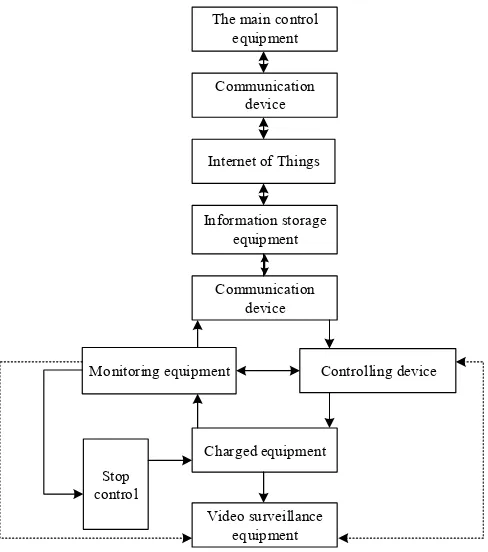
In order to achieve its control goal, the Internet of things control system should in-clude at least the following parts: the control part, the controlled part, the control link and the feedback link. From this concept, the building model diagram of the Internet of things (IOT) control system is shown in Figure 1. The main functions of each part are as follows.
Equipment 1: main control equipment, which mainly refers to the intelligent agent controlling whole process of control and entire control system, including intelligent controller, intelligent computer, intelligent industrial control computer, intelligent control software in intelligent PDA, hardware devices and people.
Equipment 2: communication equipment, including computer, PDA, mobile phone and embedded devices, to enable authorized users to remotely control and state moni-tor the control equipment through the Internet. In the control end, a separate set of control communication equipment, but not putting control equipment or monitoring equipment, intends to meet the requirements of real time of data transmission and security, so as to enhance the operation and processing speed.
Equipment 3: control device, which is usually embedded intelligent controller. It controls the operation of terminal devices by receiving control commands or control programs from communication devices.
Equipment 4: monitoring equipment, including temperature sensor, sound sensor, vibration sensor, pressure sensor and signal acquisition devices, used for collecting control terminal and control equipment required information, and giving feedback to the control terminal through communication equipment. The emergency stop control-ler is to ensure that when a fault occurs, a charged part can urgently stop operation, thus making the losses reduced to the minimum.
Equipment 5: information storage device, which is used for recording the interac-tion informainterac-tion between authorized users and control system. The video monitoring device is to store the actual running state of control system. The two devices are to analyze the accuracy and safety of the whole system in the initial stage. When it is confirmed that the whole system is mature, these two devices can be removed, so we use the dashed line to mark in Figure 1.
Information storage equipment The main control
equipment
Communication device
Monitoring equipment
Internet of Things
Charged equipment
Controlling device Communication
device
Stop control
Video surveillance equipment
Fig. 1. Model architecture of Internet of things control system
3.2 Advantages of the Internet of things control system
The control system of the Internet of things can be said to be a comprehensive ex-tension of the networked control system and the distributed control system rather than a simple addition of the two parts. Therefore, it has its own unique advantage based on the many advantages of the two control systems. The advantages of the Internet of things numerical control system are as follows:
Advantage one: reliable transmission. It mainly refers to that the information can be safely and reliably transmitted, which is the basic requirement of Internet of things implementation. The Internet of things control system depending on IOT can be fur-ther improved on the transmission protocol and transmission mode on this basis, so as to achieve the required goals of control system.
Advantage three: simple establishment. In the Internet of things control system, each control element may use the wired or the wireless way to carry on the establish-ment. It is easy to satisfy the information interaction and the coordination work re-quest, which has omitted the complex wiring implementation process.
Advantage four: structural decentralization. Because of the convenience of termi-nal devices into the network, it can make the whole control structure highly dispersed, instead of placing each control element in a unified geographical location.
Advantage five: real-time data. In the Internet of things control system, theoretical-ly, each device can communicate information between each other. It can also make the control information and production information to interact with the management system in a timely manner, so as to facilitate the establishment of a comprehensive and real-time data repository.
Advantage six: remote monitoring. Through Internet of things, information ex-change with remote terminal technical personnel can be conducted by the control system. Therefore, technical staffs can make remote monitoring and remote fault diagnosis, which can help to reduce maintenance costs and save a lot of manpower and financial resources.
4
Internet of things architecture and analysis of security
problems
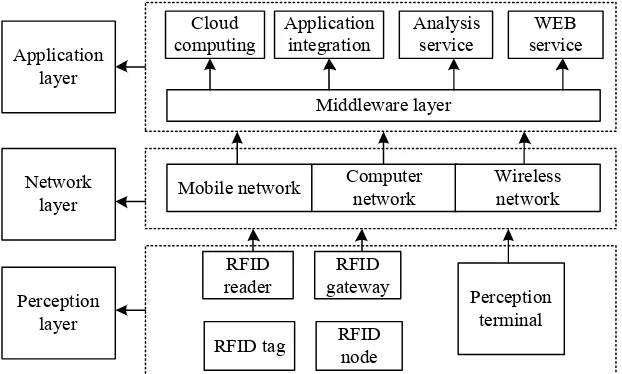
The Internet of things is a compound and complex system of diversified forms. The system and architecture of the Internet of things can be divided into three levels: the perception layer, the network layer and the application layer, and each level can in-volve a lot of relevant information technologies. The three-layer architecture diagram of the Internet of things is illustrated in Figure 2.
Cloud
computing Application integration Analysis service serviceWEB
Middleware layer
Mobile network Computer network Wireless network
RFID
reader gatewayRFID
RFID tag RFID node
Perception terminal Perception
layer Network
layer Application
layer
In terms of the structure of the control system of the Internet of things, attacks on it can be divided into the following categories: passive attack, active attack, physical proximity attack, internal personnel attack and hardware and software configuration attack. Because the control system of the Internet of things may be attacked by vari-ous kinds, it is necessary to discuss the safety objectives of the control system of the Internet of things. It aims at developing a security service strategy for them, so as to achieve the purpose of protecting the system security. The security goals of the IOT control system are mainly manifested in the security, integrity, reliability, availability, non-repudiation and controllability of the system.
The Internet of things control system security mainly includes three aspects. The first is access security. Due to the widespread of Internet of things, anyone, at any time and any place, can access to the control system of service providers through the Internet of things, and monitor and operate the bottom generating equipment, which is obviously not reasonable. This requires shielding of unauthorized users and only allowing authorized users to access security. The second is transmission security. In the communication process of control system of authorized users and service provid-ers, illegal attacker can monitor the transmission information of cable network and wireless network, and steel and tamper important information. It leads to a leakage and relief of trade secrets and decrease in manufacturers’ credit, which will bring a huge threat to authorized users and manufacturers. To solve this problem is one of the basic things to implement Internet of things control system. The last one is the stabil-ity and the safety of delay. In the process of Internet of things transmission, infor-mation will go through the wireless network and wired network. Therefore, it will bring the transmission delay and decision treatment time delay. As a result, it may cause a threat to the stability of the whole control system, which is one of the prob-lems that need to be solved for implementing Internet of things control system.
5
Information security transmission technology of Internet of
things
5.1 Encryption technology
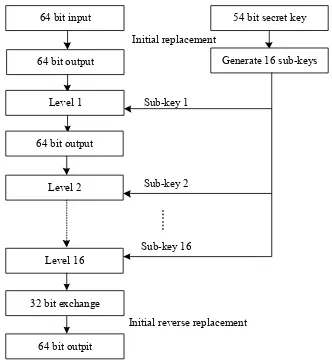
Encryption technology is the core of information security technology, and it has an irreplaceable position in the security of the entire Internet of things. Encryption tech-nology uses cryptographic algorithm to transform plain-text into cipher-text infor-mation and transmit to the receiving end. The legitimate receiver then uses the prior secret pin to restore the cipher-text into plain-text information by decryption algo-rithm. The encryption algorithm is also the key to the encryption technology. The commonly used encryption algorithms are symmetric encryption algorithm, asymmet-ric encryption algorithm, Hash algorithm and so on.
64 bit output
64 bit input
Level 1
Level 2
64 bit output
Level 16
32 bit exchange
64 bit outpit
54 bit secret key
Generate 16 sub-keys
Initial replacement
Initial reverse replacement
Sub-key 1
Sub-key 2
Sub-key 16
Fig. 3. The overall framework of guide teaching system
Generate secret key
Generate the initial value
Solve secret key
Enter text encryption
Generate public and private keys
Decrypt the original message
Start
End
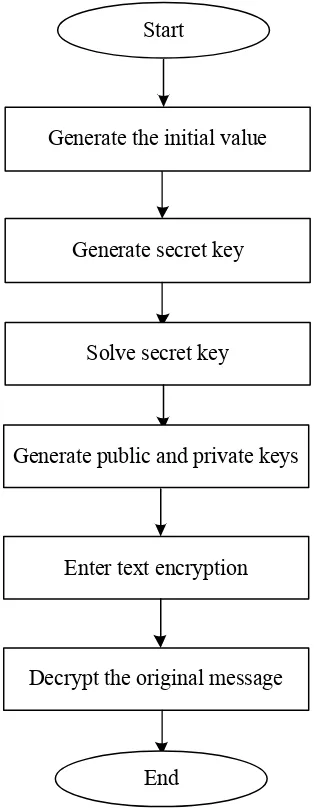
Fig. 4. RSA algorithm flow chart
The security of RSA depends on the large number decomposition. Both the public key and the private key are two large prime numbers. According to the analysis, the difficulty to deduce the plain-text from a key and cipher-text is equal to the decompo-sition of two large prime numbers, which is a difficult problem in the mathematical field. Therefore, the RSA algorithm has high security and reliability. Figure 5 shows the flow chart of the RSA algorithm implementation.
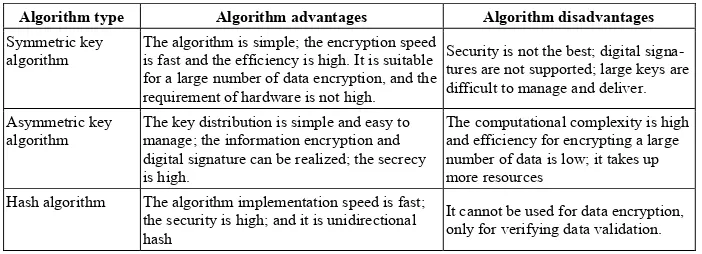
so on. Hash algorithm is an algorithm that maps any message of any length into a fixed length message, which is called an information summary or a hash value. The following Hash algorithm is unified as the Hash function. A Hash function must be strictly characterized by unidirectional and collision constraints, which can be consid-ered as a secure Hash function. Unidirectional feature is the irreversibility of its oper-ating direction. That is, the Hash function operation can only derive output from the input, and it is extremely difficult to push back. Collision constraint means that no input can be found, so that the output result is equal to another known output result, or two different inputs cannot be found at the same time to make the output result exact-ly the same. The advantages and disadvantages of symmetric and asymmetric encryp-tion algorithms and hash algorithms are compared, as shown in Table 1.
Table 1. Comparison of the advantages and disadvantages between symmetric and asymmetric encryption algorithms and Hash algorithm
Algorithm type Algorithm advantages Algorithm disadvantages Symmetric key
algorithm The algorithm is simple; the encryption speed is fast and the efficiency is high. It is suitable for a large number of data encryption, and the requirement of hardware is not high.
Security is not the best; digital signa-tures are not supported; large keys are difficult to manage and deliver. Asymmetric key
algorithm The key distribution is simple and easy to manage; the information encryption and digital signature can be realized; the secrecy is high.
The computational complexity is high and efficiency for encrypting a large number of data is low; it takes up more resources
Hash algorithm The algorithm implementation speed is fast; the security is high; and it is unidirectional hash
It cannot be used for data encryption, only for verifying data validation.
5.2 Authentication technology
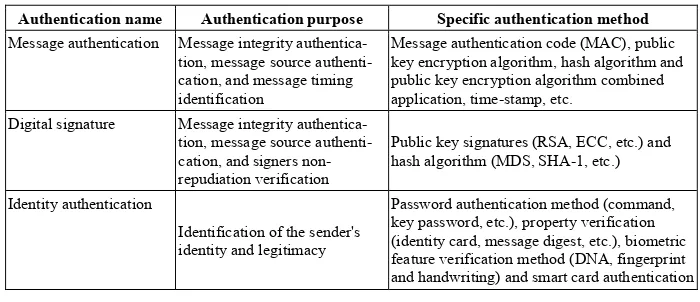
Table 2. Authentication technology explanation
Authentication name Authentication purpose Specific authentication method Message authentication Message integrity
authentica-tion, message source authenti-cation, and message timing identification
Message authentication code (MAC), public key encryption algorithm, hash algorithm and public key encryption algorithm combined application, time-stamp, etc.
Digital signature Message integrity authentica-tion, message source authenti-cation, and signers non-repudiation verification
Public key signatures (RSA, ECC, etc.) and hash algorithm (MDS, SHA-1, etc.)
Identity authentication
Identification of the sender's identity and legitimacy
Password authentication method (command, key password, etc.), property verification (identity card, message digest, etc.), biometric feature verification method (DNA, fingerprint and handwriting) and smart card authentication
5.3 Isolation
Nowadays, the vast majority of enterprises, military, government and other internal networks should be interconnected with the public network to achieve the purpose of information exchange. However, because of the widespread and complex public net-work, the network attackers are trying to invade the internal network nodes and obtain the internal network information. Once the invasion is successful, not only a large number of confidential information have been leaked, but also a joint attack may be produced, resulting in a greater range of internal losses. Therefore, a certain safety isolation measures are essential to the security of the internal and external network.
Network isolation technology actually refers to the security barrier set between networks in different security domains. The goal is to isolate harmful network attacks. The premise of such isolation is to ensure that the internal information is not leaked, and at the same time, secure data exchange between trusted network and untrusted network is realized. Network isolation technology originates from the original securi-ty technology, makes up for the shortcomings of the original securisecuri-ty technology, and has its own unique advantages. The general network isolation technology is based on the idea of access control as strategy and physical isolation as the basis, and it defines related constraints and rules to ensure the security strength of the network.
Firewall
Logical
isolation
Multiple security gateway
Exchange network
Distributed firewall
Protocol isolation
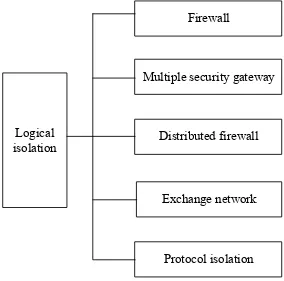
Fig. 5. Classification of logical isolation
Table 3. Logical isolation classification explanation
Logical isolation Explanation
Firewall The flow direction of the packet is controlled by controlling the network routing to control the communication lines. It includes a filter firewall, a state detection firewall and a proxy service firewall.
Multiple security gateways It is an upgraded version of the firewall that can make the entire check from the network layer to the application layer.
Distributed firewall It is made up of network firewall, host firewall and central management system. It can extend the firewall's security protection system to all hosts and terminal desktops in the network.
Switching network A data exchange area is established between two isolated networks, which is responsible for the exchange of business data (one-way or two-way).
6
Conclusions
At present, the research on the Internet of things and network control system is one of the research hot-spots in modern control field. Through the research and analysis on information security transmission technology in the control system, one of the new directions of development of the control system will be Internet of things control system. The Internet of things control system is based on cryptography, with network security system and control system as the framework, as well as various security basic technologies and application technologies as the foundation. Its means and methods are network security control, and its purpose is to reduce the control cost and security risk of control network as much as possible. The following main conclusions were drawn:
Firstly, the Internet of things technology ensures the confidentiality, integrity, availability, reliability, non-repudiation and timeliness of control information, and finally completes the control target.
Secondly, the information security transmission technology based on Internet of things control system has certain practical significance in optimization of information safety information transmission technology based on Internet of things control sys-tem.
Thirdly, the existing reliable communication resources are maximized in the transmission mechanism of the Internet of things.
7
References
[1]Kim, S., & Na, w. Safe data transmission architecture based on cloud for internet of things. Wireless Personal Communications, 2015, vol. 86.1, pp. 1-14.
[2]Budiyanto, S., Nugroho, A., Nugraha, B., & Sirait, F. Ip over radio: a performance evalua-tion for internet of things system with various data transmission technique. Advanced Sci-ence Letters, 2017, vol. 23(6), pp. 5581-5583. https://doi.org/10.1166/asl.2017.7426 [3]Lee, J. H., Jang, K. S., Kim, B. G., Jeong, S., & Jin, S. C. Fast video encoding algorithm
for the internet of things environment based on high efficiency video coding. International Journal of Distributed Sensor Networks, 2015, vol. 6, pp. 4. https://doi.org/10.1155/ 2015/146067
[4]Saha, A., Lee, Y. W., Hwang, Y. S., Psannis, K. E., & Kim, B. G. Context-aware block-based motion estimation algorithm for multimedia internet of things (iot) platform. Per-sonal & Ubiquitous Computing. 2017, vol. (7), pp. 1-10.
[5]Yildirim, E. Y., Akalp, G., Aytac, S., & Bayram, N. Factors influencing information secu-rity management in small-and medium-sized enterprises: A case study from Turkey. Inter-national Journal of Information Management, 2011, vol. 31(4), pp. 360-365. https://doi.org/10.1016/j.ijinfomgt.2010.10.006
[6]Li, F., Zheng, Z., & Jin, C. Secure and efficient data transmission in the internet of things. Telecommunication Systems, 2016, vol. 62(1), pp. 111-122. https://doi.org/10.1007/ s11235-015-0065-y
[8]He, G. M. Analysis of the application of the internet of things technology in environmental monitoring. Applied Mechanics & Materials, 2015, vol. 733(6), pp. 796-799. https://doi.org/10.4028/www.scientific.net/AMM.733.796
[9]Chen, C., & Xu, X. Design and application of traceability and supervision platform for broiler based on internet of things. Nongye Gongcheng Xuebao/transactions of the Chinese Society of Agricultural Engineering, 2017, vol. 33(5), pp. 224-231.
[10]Xia, M., Li, T., Zhang, Y., & Silva, C. W. D. internet of things and cloud computing. Computer Networks the International Journal of Computer & Telecommunications Net-working, 2016, vol. 101(c), pp. 5-18.
8
Authors
Ying Zou is with the SiChuan Judicial and Police Officers Professional College, DeYang SiChuan 618000, China.