Spectrum Sensing for Cognitive Radio
Using Genetic Algorithm
https://doi.org/10.3991/ijoe.v14i09.9064
Shewangi Kochar!!", Roopali Garg
Panjab University, Chandigarh, India
Abstract—Cognitive Radio has been skillful technology to improve the spectrum sensing as it enables Cognitive Radio to find Primary User (PU) and let secondary User (SU) to utilize the spectrum holes. However detection of PU leads to longer sensing time and interference. Spectrum sensing is done in spe-cific “time frame” and it is further divided into Sensing time and transmission time. Higher the sensing time better will be detection and lesser will be the probability of false alarm. So optimization technique is highly required to ad-dress the issue of trade-off between sensing time and throughput. This paper proposed an application of Genetic Algorithm technique for spectrum sensing in cognitive radio. Here results shows that ROC curve of GA is better than PSO in terms of normalized throughput and sensing time. The parameters that are evaluated are throughput, probability of false alarm, sensing time, cost and iter-ation.
Keywords—Cognitive Radio, Genetic algorithm, Particle Swarm Optimization, Probability of false alarm, Spectrum Sensing, Throughput.
1
Introduction
There are many evolutionary techniques like PSO (particle swarm optimization), ACO (ant-colony optimization). One of them is Genetic algorithm which is usually used for computing optimization problems. The concept of GA was introduced by JH Holland in 1960. GA can be related to many optimization problems like non-deterministic, machine learning and finite automata [6]. GA is a heuristic search and optimization technique that imitate the cycle of natural evolution. It is based on natu-ral selection which defines that “select the best, discard the rest”. It encourages the evolution of species through natural selection. [7]
Optimization is a technique of finding global minima or maxima of an objective function or problem statement and avoiding a local minima or maxima [8][9]. For computational problems like PSO and GA, an optimal solution is required but at the end of the cycle, individual particle is lost into local maxima or minima and may lead to computational problem. There are a lot of meta-heuristic techniques to find an optimal solution like greedy approach, tabu search, GA etc [10]. The main objective of meta-heuristic technique is to prevent search space from getting stuck into local maxima or minima [11]. Optimization refers to finding the ‘best’ solution and then it varies from problem to problem, but in statistical problem it refers to maximization and minimization objective function by taking different input parameter [12].
1.1 Genetic algorithm
Nature has always been a great source of inspiration to all mankind. In GA there is large search space which is very populated and has so many possible solutions to the given problem [13]. These solutions undergo many processes to produce new off-spring with the help of chromosome and this process is repeated over again and again until ‘fit’ particle is found. Genetic Algorithm is based on three techniques: selection, crossover and mutation. In selection method, the chromosomes are selected to give a better solution or fittest particle as compared to current population. Then crossover is done between two fittest particles to create the offspring and required information is exchanged between two particles. After crossover, mutation is done to replace the parental population with new offspring and continues the iteration.
1.2 Basic structure of GA
While (end of termination condition) For n=1
Initialize population
Evaluate fitness function n ++
For (c=1; check if chromosomes <2) Randomly choose x1 and x2 from given population
Produce two new chromosomes x1new and x2new by crossover operation of x1
and x2 ;
Execute mutation operation on x1new and x2new
Insert x1new and x2new into Xnew
End for End
1.3 Particle Swarm Optimization (PSO)
PSO is a population based optimization technique which is inspired by social be-havior of flock of birds or school of fish. In PSO, there are swarm particles which reside at a position in search space. Initially it has some position and velocity in search space which is represented by a vector. It is different from GA in a manner that it does not need any kind of filtering operation such as crossover and mutation. In PSO each particle is assigned with a random position and velocity in whole search space. As it is evolutionary algorithm, so the velocity and position of each particle is updated in every iteration. When the iterations are over, then the fitness function is used to measure the quality of the particle.
Each particle in PSO has its local best position and global best position. Global best is the position which position of particle which is closer towards the objective function or optimal function. All particles try to move towards closer to the optimal solution. It is updated every time when some other particles become more near to the optimal value. After one point of time, all particles will converge at an optimal solu-tion.
Veli,d(t+1) = !(t) veli,d(t) + randk(t) (pbesti,d – PSi,d(t)) + randq (t) (gbestd – PSi,d(t)) (i)
PSi,d (t+1) = PSi,d(t) + veli,d(t) (ii)
Where Veli,d(t+1) and PSi,d (t+1) is the velocity and position of the ‘i’ particle, at
dimension ‘d’ and iteration ‘t+1’. !(t) is the used to track the history of velocity, randk
and randq are the random factors . Pbesti,d is the personal best position and gbestd is
the global best position of the swarm at dimension ‘d’.
Genetic algorithm technique has been proposed to solve problems in many areas. However, this paper lays emphasis on improvement of spectrum sensing with the help of genetic algorithm as it provides best spectrum holes. Research is done on different parameters like sensing time, throughput and probability of false alarm. At time frame structure is fixed, there is need to optimize sensing time to obtain the trade-off be-tween transmission time and sensing time duration. So GA proves to be giving high throughput and less sensing time.
This paper is organized as follows. Section 2 provides the literature Review. Sys-tem Model is presented in Section 3. Section 4 discusses the simulation and result and in Section 5 draws the conclusion.
2
Literature review
author describes the primary user emulation attack in cognitive radio (CR). (PER) primary exclusive region is defined as the region in which primary user communicate with primary receiver. Author in [3] explains the concept of spectrum sensing in CR. It is explained that the co-operative sensing should be employed overcome the chal-lenges faced due to fading and shadowing. Author in [5] explains the optimization of throughput under different SNR values further note worthy conditions of maximum probability of false alarm and probability of detection is highlighted. In [6] author explains the spectrum allocation using genetic algorithm and gives an advantage of it over any other soft computing technique.
There is hybridization of PSO-GA based on feature selection. The proposed algo-rithm is implemented on Indian pine hyper spectral data sets in [7]. Network selection and allocation of spectrum is done in [8]. The author has formulated a problem to minimize the interference caused due to licensed user. In [9] author describes the different strategies for the hybridization of combinatorial optimization problem of PSO and new technique called adaptive genetic algorithm to overcome the drawback like pre-maturity. This algorithm can change the cross over probability and mutation probability. In [10] author optimize the sensing time in energy based detection meth-od. Optimization of sensing time is done using Human behavior based Particle Swarm Optimization (HBPSO). By doing this, the probability of collision between samples of secondary users is minimized and a high value of system throughput. In [11] hy-bridization of ACO and PSO is applied for spectrum sensing in cognitive radios.
3
System Model
The sensed signal M (n) of SU will have two hypotheses: Null hypothesis H0 and
alternate hypothesis H1.
M [n] = X[n]…… PU is inactive M [n] = hs[n] + w[n]…. PU is active Where n = 1, 2, 3……..N
N and h are the number of samples and channels gain respectively, ‘h’ 0 in hypoth-esis Ho and 1 in H1. X (n) is the noise which is equally distributed with zero mean and
variance E[x (n)]2 = "
w2 S(n) is PU signal.
In energy detection method the input samples M (n) are gathered for power estima-tion and gives output E
E = !
! !!!!!!!!!!! ) (1)
Pd is the probability of detection which is defined as probability of detecting PU
when it is actually present. Pf the probability of false alarm. It is defined as
probabil-ity of detecting PU when it is not present actually.
Pf = P(#> T$h0$ (2)
Pf = !!!!!!! !!!
!! (4)
Pd = !!!!!!!!
!! (5)
Where Q(.) is the tail function of the standard Gaussian. Number of samples to determine the target probabilities (Pf, Pd)
D = !
!"#! (L-1 (Pf) – L-1 (Pd) !!"# ! !!2 (6)
Considering the sampling time as S, Sensing time Ts
Ts = SN
Ts = !"#!! (Q-1 (Pf) – Q-1 (Pd) !!"# ! !!2 (7)
From equation 7 it is concluded that larger is the sampling numbers the larger will be the sensing time duration.
To transmit the SU, there are two scenarios when PU is absent and no false alarm is generated at SU, then throughput is given by
Q0 (TS) = !!!!!!!!!!!!!!
! !!! (8)
In second scenario, SU is not able to detect PU, when it is actually present then throughput is given by
Q0(TS) = !!!!!!!!!!!!!!
! !!! (9)
Where G0, G1 denote the throughput of SU, operating in both absence and presence
of PU respectively.
4
Simulation and result
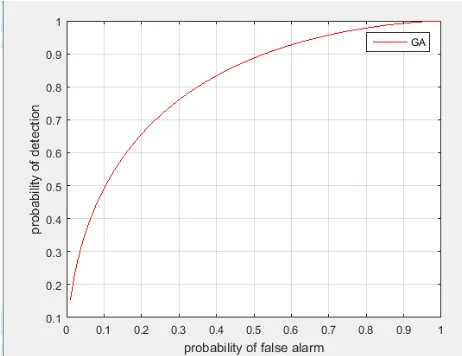
The implementation of proposed algorithm for spectrum sensing is carried out with the help of MATLAB tool. Fig 2 shows the graph of variation of probability of false alarm with probability of detection. The graph shows that probability of false alarm increases with the probability of detection in genetic algorithm. Fig 3 shows the graph normalized throughput (Rn) versus sending time (Ts) for both PSO and GA.
Through-put is a unimodal function. It increases with sensing time, reaches a maximum and then falls. The throughput curve for GA is better than PSO, explaining that GA results in better throughput than PSO. The maximum normalized throughput offered by GA and PSO are 0.831 and 0.723 respectively.
SNR decreases. When the SNR is 0.9dB the value of probability of false alarm is 0.531, sensing time is 36 and throughput is 0.810.
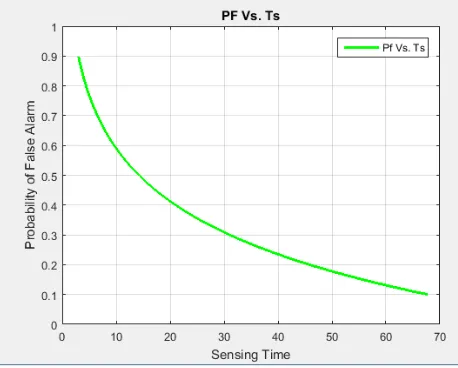
Fig 5 shows variation of probability of false alarm with sensing time. As the sens-ing time increases, the probability of false alarm falls. This means that SU has more opportunistic access to the spectrum. This will result in better throughput.
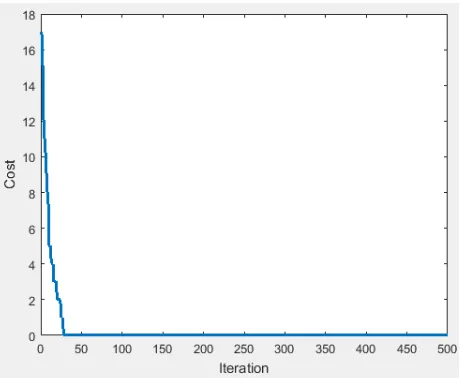
Fig 6 shows the curve between cost function and number of iterations. It can be seen from the graph that at third iteration cost function is maximum at 12. So GA has lower complexity. It requires less number of iteration to converge to an optimal point.
Fig. 1. Probability of false alarm Vs probability of detection
Fig. 3. Optimal throughput curve Vs sensing time and probability of false alarm at pd at 90%
Fig. 5. Cost function Vs iteration
5
Conclusion
Cognitive Radio is a paradigm of wireless industry as it helps in improving spec-trum sensing. In this paper two optimization approaches are discussed that is PSO and GA. PSO offers an advantage of early convergence but falls into premature conver-gence. The property of survival of fitness helps in achieving optimal result in GA. In this paper, different parameters are used to improve the Spectrum Sensing like throughput, probability of false alarm, sensing time, probability of detection, cost and iteration. Since tradeoff is required between sensing time and transmission time so that sensing would be better. High sensing time degrades the performance of SU so a good optimization technique is needed to cope this problem. Here results shows that ROC curve of GA is better than PSO in terms of normalized throughput and sensing time. Different SNR values are taken to calculate the sensing time, probability of false alarm and maximum throughput. In GA, iteration is done until fittest particle is not found. However it can be found in very less iteration.
6
References
[1] Ghosh.G, Das.P and Chatterjee.S (2014). Cognitive Radio and Dynamic Spectrum Ac-cess–A Study International Journal of Next-Generation Networks (IJNGN), vol 6, pp 650-653.
[3] Vijaykumar.F.A.P, Joseph.S.B.S.M.(2014).Energy Efficient Spectrum Sensing and Ac-cessing Scheme for Zigbee Cognitive Networks.International journal of online Engineer-ing,vol 10(3),pp 59-62.
[4] H.Prahan, S.S.Kalamkar, A.Banerjee. (2015).Sensing-throughput tradeoff in cognitive ra-dio with random arrivals and departures of multiple primary users, IEEE Communications Letters, vol 19(3), pp 415-418. https://doi.org/10.1109/LCOMM.2015.2393305
[5] Sahoo.A, Mishra.G., Jena. M.,Mangaraj. B.(2016).Optimal Design and Comparative Study of Circular Patch Antennas Using Different Feeds for WLAN and WiMAX Applica-tions.International journal on communications antenna and propogation
https://doi.org/10.15866/irecap.v6i3.9678
[6] Morabit.E.Y, Mrabti.F, Abarkan.E.H. (2016).Spectrum Allocation Using Genetic Algo-rithm in Cognitive Radio Networks, EURASIP Journal on Wireless Communications and Networking, pp 90-93, https://doi.org/10.1186/s13638-016-0620-6
[7] Ghamisi.P, Benediktsson,J.A,(2015).Feature Selection Based on Hybridization of Genetic Algorithm and Particle Swarm Optimization.IEEE geoscience and remote sensing letters, 12(2), pp 309-313. https://doi.org/10.1109/LGRS.2014.2337320
[8] Hasan.N.U, Elaz.W, Elaz.N, Kim.H.S, Anpalagan.A, Jo.A.M (2016).Network Selection and Channel Allocation for Spectrum Sharing in 5G Heterogeneous Networks,vol-4 pp 980-992,
[9] Chatterjee.S,Sircar.S, Dutta.S, Dutta.S, Roy.J.S, Majumder.S, Dutta.S ,Mitra.A.(2018).Throughput Optimization in Cognitive Radio Using Demand Based Adap-tive Genetic Algorithm.IEEE 8th Annual Ubiquitous Computing, Electronics and Mobile Communication Conference (UEMCON) pp 650-653, https://doi.org/10.1109/UEMCON. 2017.8249093
[10] Gogoi.A.J, Singh.C.L, Nath.S, Baishnab.K.L.(2011).Optimization of Sensing Time in En-ergy Detector Based Sensing of Cognitive Radio Network. International Journal of Ap-plied Engineering Research, vol 11(6), pp 4563-4568.
[11] Garg.R, Jhajj.H.k, Saluja.N.(2017).Efficient Spectrum Sensing in Cognitive Radio Net-works Using Hybridized Particle Swarm Intelligence and Ant Colony Algo-rithm.International Journal on Communications Antenna and Propagation (I.Re.C.A.P.), vol. 7(7), pp 586-593.
[12] Jian.F, Yi.W, Li.S, Zhu.B, Yu.W.(2017).Joint Optimization of Spectrum Sensing and En-ergy Harvesting for Cognitive Radio Network,Ubiquitous Computing and Communica-tions (ISPA/IUCC),IEEE International Symposium on Parallel and Distributed Processing with Application, https://doi.org/10.1109/ISPA/IUCC.2017.00068
[13] Ammar.S, Trigui.O, Senouci.M.(2018).Genetic and practical swarm optimization algo-rithms for patient-specific seizure detection systems,Advanced Technologies for Signal and Image Processing (ATSIP), 4th International Conference, IEEE, pp 1-4.
[14] Tahiri.N, Azouaoui.A, Belkasmi.M. (2018).A Novel Detector based on the Compact Ge-netic Algorithm for MIMO Systems.Advanced Communication Technologies and Net-working (CommNet), International Conference, IEEE, https://doi.org/10.1109/COMM NET.2018.8360279
[15] Sharma. D.K, Singh. A, Jain.A.(2017).Evaluation of Parameters and Techniques for Ge-netic Algorithm based Channel Allocation in Cognitive Radio Networks.Proceedings of Tenth International Conference on Contemporary Computing ( IC3),
https://doi.org/10.1109/IC3.2017.8284341
[16] Tragos, Elias Z., et al.(2013). Spectrum assignment in cognitive radio networks: A com-prehensive survey IEEE Communications Surveys & Tutorials 15.3, pp 1108-1135.
[17] Rashid.R.A,.Hamid A.H.F.B.A, Fisal.N, Yusof. S.K.S., Hosseini.H, Lo.A, Farzam-nia.A.(2015).Efficient in-band spectrum, sensing using swarm intelligence for cognitive radio network,Canadian Journal of Electrical and Computer Engineering, vol 38(2), pp 106-115. https://doi.org/10.1109/CJECE.2014.2378258
[18] Hawa, M., Darabkh, K.A., Al-Zubi, R. and Al-Sukkar, G.(2016).A self-learning MAC protocol for energy harvesting and spectrum access in cognitive radio sensor networks. J. Sens.pp 1-18, doi https://doi.org/10.1155/2016/9604526
[19] Peh E.C.Y., Liang.Y, Guan Y.L, Zeng.Y.(2009).Optimization of cooperative sensing in cognitive radio networks.A sensing throughput tradeoff view, IEEE Transactions on Ve-hicular technology, 58(9),pp 5294-5299. https://doi.org/10.1109/TVT.2009.2028030
[20] Zongo.O, Oonsivilai.A.(2015).Comparison between Harmony Search Algorithm, Genetic Algorithm and Particle Swarm Optimization in Economic Power Dispatch, International Review of Electrical Engineering (IREE), vol 10 (2), pp. 286-292.
[21] T.Yucek, H.Arslan.(2009).A survey of spectrum sensing algorithms for cognitive radio applications, IEEE Communications Surveys & Tutorials, vo1(1),Pages 116-130.
[22] Spencer.M, Ulaby.F.(2017).Spectrum Issues Faced by Active Remote Sensing Radio fre-quency interference and operational restrictions, IEEE Geosciences and remote sensing magazine, vol 4(1), pp 40-45.
[23] A.E. Omer.(2015).Review of spectrum sensing techniques in cognitive radio networks, IEEE International Conference on Computing, Control, Networking, Electronics and Em-bedded Systems Engineering, pp. 439-446, https://doi.org/10.1109/ICCNEEE.2015. 7381409
7
Authors
Shewangi Kochhar is a research scholar in UIET, Panjab university, Chandigarh, India in IT department ([email protected]).
Roopali Garg is a associate professor in UIET, Panjab University, Chandigarh, India in IT department. ([email protected]) ( [email protected]).