C
HAPTER5
HUMAN POPULATION AND ENVIRONMENT5.1 Objectives
To get a knowledge on human population and human rights.
To educate the students on value education.
To equip the students towards the modern technology with respect to environment and human health.
5.1.1 Population density
Number of individuals of the population per unit area or per unit volume.
5.1.2 Parameters affecting population size
Birth rate
Death rate or Mortality
Immigration
Emigration. 5.1.3 Population Growth
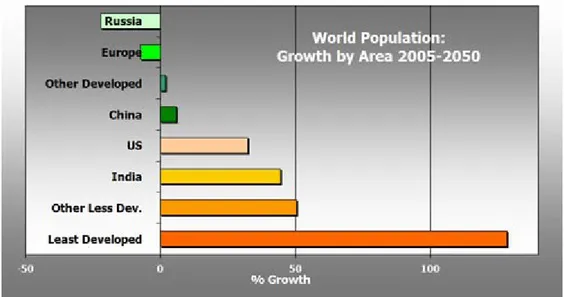
The rapid growth of the global population for the past 100 years from the difference between the rate of birth and death.
Table.5.1 Population statistics in India as on 2010
Rank State or unionterritory Population % Rural Pop. Urban Pop. Area km² (per km²)Density Area mi²
Density (per
mi²) Sex ratio 1 Uttar Pradesh 193,977,661 16.16% 131,658,339 34,539,582 240,928 690 93,022.8 1,787 898 2 Maharashtra 110,878,627 9.42% 55,777,647 41,100,980 307,713 315 118,808.7 815 922 3 Bihar 102,998,509 8.07% 74,316,709 8,681,800 94,163 881 36,356.5 2,283 921 4 West Bengal 90,176,197 7.79% 57,748,946 22,427,251 88,752 903 34,267.3 2,340 934 5 Andhra Pradesh 82,210,007 7.41% 55,401,067 20,808,940 275,045 277 106,195.5 718 978 6 Tamil Nadu 62,405,679 6.07% 34,921,681 27,483,998 130,058 480 50,215.7 1,243 987 7 Madhya Pradesh 60,348,023 5.87% 44,380,878 15,967,145 308,245 196 119,014.1 507 919 8 Rajasthan 56,507,188 5.49% 43,292,813 13,214,375 342,239 165 132,139.2 428 921 9 Karnataka 52,850,562 5.14% 34,889,033 17,961,529 191,791 276 74,050.9 714 965 10 Gujarat 50,671,017 4.93% 31,740,767 18,930,250 196,024 258 75,685.3 669 920 11 Orissa 36,804,660 3.58% 31,287,422 5,517,238 155,707 236 60,118.8 612 972 12 Kerala 31,841,374 3.10% 23,574,449 8,266,925 38,863 819 15,005.1 2,122 1,058 13 Jharkhand 26,945,829 2.62% 20,952,088 5,993,741 79,714 338 30,777.7 875 941 14 Assam 26,655,528 2.59% 23,216,288 3,439,240 78,438 340 30,285.1 880 935 15 Punjab 24,358,999 2.37% 16,096,488 8,262,511 50,362 484 19,444.9 1,253 876 16 Haryana 21,144,564 2.06% 15,029,260 6,115,304 44,212 478 17,070.3 1,239 861 17 Chhattisgarh 20,833,803 2.03% 16,648,056 4,185,747 135,191 154 52,197.5 399 989
18 Jammu and Kashmir 10,143,700 0.99% 7,627,062 2,516,638 222,236 46 85,805.8 118 892
22 Meghalaya 2,318,822 0.23% 1,864,711 454,111 22,429 103 8,659.9 268 972 23 Manipurβ 2,166,788 0.21% 1,590,820 575,968 22,327 97 8,620.5 251 974 24 Nagaland 1,990,036 0.19% 1,647,249 342,787 16,579 120 6,401.2 311 900
25 Goa 1,347,668 0.13% 677,091 670,577 3,702 364 1,429.4 943 961
26 Arunachal Pradesh 1,097,968 0.11% 870,087 227,881 83,743 13 32,333.4 34 893 27 Mizoram 888,573 0.09% 447,567 441,006 21,081 42 8,139.4 109 935
28 Sikkim 540,851 0.05% 480,981 59,870 7,096 76 2,739.8 197 875
UT1 Delhi 13,850,507 1.35% 944,727 12,905,780 1,483 9,340 572.6 24,189 821 UT2 Puducherry 974,345 0.09% 325,726 648,619 479 2,034 184.9 5,268 1,001 UT3 Chandigarh 900,635 0.09% 92,120 808,515 114 7,900 44.0 20,462 777
UT4 Andaman and Nicobar Islands 356,152 0.03% 239,954 116,198 8,249 43 3,185.0 112 846
UT5 Dadra and Nagar Haveli 220,490 0.02% 170,027 50,463 491 449 189.6 1,163 812
UT6 Daman and Diu 158,204 0.02% 100,856 57,348 112 1,413 43.2 3,658 710 UT7 Lakshadweep 60,650 0.01% 33,683 26,967 32 1,895 12.4 4,909 948 Total India 1,206,610,32 100.00 742,490,639 286,119,68 3,287,24 313 1,269,21 810 933
5.1.4 Causes of rapid population growth
The rapid population growth is due to decrease in death rate and increase in birth rate.
Availability of antibiotics, immunization, increased food production, clean water and air decreases the famine-related deaths.
In agricultural based countries, children are required to help parents in the field that is why population increases in the developing countries.
5.15 Characteristics of population growth
Exponential growth
Doubling time
Infant mortality rate
Total fertility rate
Replacement level
Male/female ratio
Demographic transition.
5.1.6 Variation of population based on age structure
1. Pyramid shaped – India, Bangladesh, and Ethiopia.
Fig. 5.1 Bell and Pyramid shaped Population structure
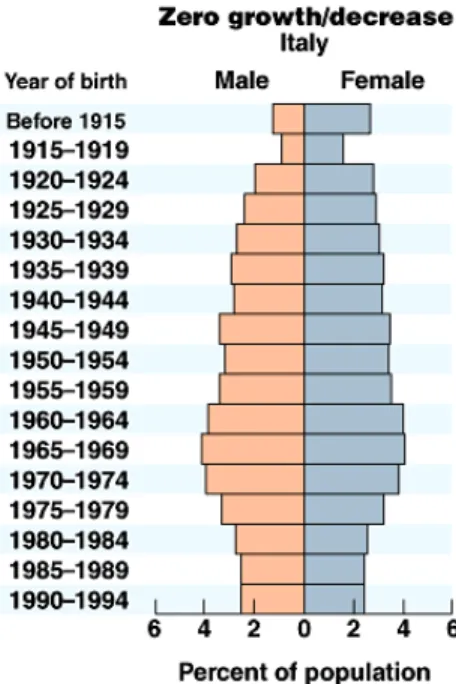
3. Urn shaped - Germany, Italy, and Japan.
5.1.7 Population Explosion
The enormous increase in population due to low death rate and high birth rate.
5.1.8 Causes
Modern medical facilities, life expectancy, illiteracy.
Fig. 5.3 World Population Growth
5.1.9 Effects
Poverty, Environmental degradation, over –exploitation of natural resources, threat, communal war.
5.1.10 Remedy
Through birth control programmes.
5.2 FAMILY WELFARE PROGRAMME
5.2.1 Objectives
o Slowing down the population explosion
o Over exploitation of natural resources 5.3 FAMILY PLANNING PROGRAMME
5.3.1Objectives
o Reduce infant mortality rate.
o Encourage late marriages.
o Control of communal diseases. 5.4 ENVIRONMENT AND HUMAN HEALTH
1. Physical Hazards – Radioactive and UV radiations, Global warming, Chlorofluro carbons, Noise etc.
2. Chemical Hazards – Combustion of Fossil fuels, industrial effluence, pesticides, heavy metals.
3. Biological Hazards- Bacteria, Viruses, Parasites. 5.5 HUMAN RIGHTS
Human right to freedom
Human right to property
Human right to freedom of religion
Human right to culture and education
Human right to constitutional remedies
Human right to equality
Human right against exploitation
Human right to food and environment
Human right to good health.
To promote interdependence among Asian countries in all areas of cooperation by identifying Asia's common strengths and opportunities which will help reduce poverty and improve the quality of life for Asian people whilst developing a knowledge-based society within Asia and enhancing community and people empowerment;
To expand the trade and financial market within Asia and increase the bargaining power of Asian countries in lieu of competition and, in turn, enhance Asia's economic competitiveness in the global market;
To serve as the missing link in Asian cooperation by building upon Asia's potentials and strengths through supplementing and complementing existing cooperative frameworks so as to become a viable partner for other regions;
To ultimately transform the Asian continent into an Asian Community, capable of interacting with the rest of the world on a more equal footing and contributing more positively towards mutual peace and prosperity.
5.6 VALUE EDUCATION
Education
It is nothing but learning about the particular thing through knowledge. We can identify our values and ourselves with the help of knowledge and experience.
5.6.1 Types
3. Value-based environment education- Based on environment. 5.6.2 Objectives
To improve the integral growth of human begins.
To create attitudes and improvement towards sustainable lifestyle.
To increase awareness about our national history our cultural heritage, constitutional rights, national integration, community develo9pment and environment.
To create and develop awareness about the values and their significance and role.
To know about various living and non- living organisms and their interaction with environment.
5.6.3 Types of values
Universal values-Importance of the human conditions.
Cultural values-Right, wrong, good and bad.
Individual values-Individual personality and experiences.
Global values-Human civilization.
Spiritual values-Self-restraint, discipline.
5.7 HIV /AIDS
AIDS is the abbreviated form for Acquired Immuno Deficiency Syndrome caused by a virus called HIV (Human Immune deficiency Virus).
5.7.1 Origin of HIV/AIDS
1. Through African Monkey
African monkey or Chimpanzees To human. 2. Through Vaccine Programme
(a)Polio, small pox vaccine from monkey’s kidney-Africa. (b) Hepatitis-B viral vaccine-Los Angles and New York.
5.7.2 Factors influencing modes of Transmission of HIV
1. Unprotected sex with infected person.
2. Using needles or syringes from HIV positive person.
3. During pregnancy, breast feeding HIV transmits from mother to infant babies. 4. Blood transfusion during accident and pregnancy.
5. Biologically the male to female transmission is 2 to 4 time more efficient than female to male transmission.
5.7.3 Factors not influencing transmission of HIV 1. Tears, food, air, cough, handshake and normal kissing. 2. Mosquito flies and insect bites.
3. Sharing of utensils, clothes, toilets and bathroom. 5.7.6 Effects
Death
Loss of labor
Inability to work
Lack of energy.
5.7.4 Functions of HIV in human body
White blood cells (WBC) are responsible for the formation of antibodies called T-helper cells’-helper cells are the key infection fighters in the immune system. Once HIV cells are enter into the boy they destroy the T-cells and cause many infection diseases.
5.7.5 Symptoms
I. Minor symptoms
Persistent cough for more than one month.
General skin disease.
Viral infection.
Fungus infection in mouth and throat.
Frequent fever, headache and fatigue.
II. Major symptoms
Diarrhea for more than one month.
TB for more than one month.
Fall of hairs.
Fig.5.4 Main Symptoms of HIV
5.7.6 Mechanism of Infection
5.7.7 Control and Preventive measures
1. Education.
2. Prevention of Blood borne HIV transmission. 3. Primary health care.
4. Counseling services. 5. Drug treatment. 5.7.8 Scenario in India
Large number of cases has been reported in Maharashtra and Tamil Nadu.
5.7.9 World Scenario
Nearly 90% of the HIV affected peoples live in developing countries.13% of world’s population live in Africa. About 3 million people so far died due to HIV in 2003.In the world AIDS ranking India is in 2nd place.
5.7.10 HIV symbol and World AIDS day
Fig.5.6 Symbol of HIV
5.8 WOMANS AND CHILD WELFARE
5.8.1 Objectives
To provide education
To impart vocational training
To generate awareness
To improve employment opportunities
Fig.5.7 International women’s day
5.9 ROLE OF INFORMATION TECHNOLOGY IN ENVIRONMENT
1. Remote sensing
Components - A platform, aircraft, a balloon, rocket and satellite.
Functions
Origin of electro magnetic energy
Transmission of energy
Interaction of energy
Detection of energy
Preprocessing of data
Data analysis and interpretation
Fig.5.8 Functions of remote sensing
Applications
In agriculture, forestry, land cover, water resources.
2. Data Base- Collection of inter related data on various subjects.
Applications
Ministry of environment and forest
National management information system
Fig.5.9 Applications of Database
3. Geographical information system (GIS)
It is a technique of superimposing various thematic maps using digital data on a large number of inter-related aspects.
Application
Thematic maps are super imposed using soft wares.
Interpretation of polluted zones
To check unplanned growth and related environmental problems. 4. Satellite data
Helps in providing reliable information and data about forest cover
Provide information about forecasting weather
Reserves of oil, minerals can be discovered.
Fig.5.11 Satellite data processing
5. World Wide Web
It provides Current data.
Applications
Online learning
5.10 ROLE OF INFORMATION TECHNOLOGY IN HUMAN HEALTH
The health service technology involves three systems
Finance and accounting
Pathology
Patient Administration – clinical system. Applications
Data regarding birth and death rates
To monitor the health of the people effectively
The information regarding the outbreak of epidemic diseases.
Online Consultation