68 June, 2020 AgricEngInt: CIGR Journal Open access at http://www.cigrjournal.org Vol. 22, No. 2
Performance evaluation of three coconut cracking devices and
comparison with conventional cracking technique
Bello Raphael Segun
*(Department of Agriculture & Bioenvironmental Engineering Technology, Federal College of Agriculture, Ishiagu, Nigeria)
Abstract: Performance of three coconut cracking devices; punch-split, impact-split, hydraulic-split were carried out and their comparison with conventional (hand cracking technique) evaluated. Each cracking technique was evaluated for capacity, efficiency, ergonomics, and time required to crack a unit of different coconut grades. The results showed that the average cracking efficiency for punch-split was 87.09 percent with a range of 86.76 to 95.00 percent, impact-split efficiency varied from 83.33 to 95.00 percent with the average of 90.08 percent while hydraulic-split varied from 90.00 to 95.00 percent. Comparing the performances of the three techniques with the conventional technique, the cracking efficiency varied from 86.67% to 100% with an average of 94.17 percent, indicating the devices compares favorably with the conventional technique. The convention cracking has the least output capacity of 110.09 kg hr-1
compared with the hydraulic-split with highest average capacity of 383.83 kg hr-1. The output capacity varied for different grades of coconut with the hydraulic-split having the highest capacity of 389.33 kg hr-1 for grade B coconuts, while the conventional method has the lowest for grade D coconuts. Ergonomically, the hydraulic-split device compared favorably with other devices in risk factors, loading, operation, product handling and management.
Keywords: coconut grade, cracking, punch-split, impact-split, hydraulic-split, sphericity, efficiency, roundness
Citation: Bello, R. S. 2020. Performance evaluation of three coconut cracking devices and comparison with conventional cracking technique. Agricultural Engineering International: CIGR Journal, 22 (2):68-75.
1 Introduction
The term coconut (Cocos nucifera) often refers to the
entire coconut palm, which include the seed, and the
fruit. The seeds which is said to be a drupe and
botanically not a true nut is the only accepted species in
the genus Cocos (World Wildlife Fund, 2010). Coconut
fruit is made up of a thin outer exocarp, a thick fibrous
fruit (mesocarp) known as husk, the hard protective
endocarp or shell and three depressions called “eyes”
located at one end of the nut. The coconut is one of the
world’s most useful and important perennial plants with
Received date: 2019-03-15 Accepted date: 2019-06-19
*Corresponding author: Bello, R. S., Ph.D. stud, Senior lecturer in the Department of Agricultural & Bio-Environmental Engineering Technology, Federal College of Agriculture, Ishiagu 840001 Nigeria. Email: [email protected]. Tel: +234-806-857-676-3.
multiple uses for thousands of years. As coconut enters
today’s world, people over the world are becoming aware
of its many health benefits and food uses in many facets
of daily life, in some instances even as currency. Coconut
has considerable significance in the national economy in
view of rural employment and income generation.
Despite the several uses of coconut products, a
common problem often faced by many coconut farmers in
developing countries including Nigeria is splitting or
cracking open of mature coconut. Cutting open a tender
coconut and separate the kernels from the shell is not an
easy task. However, it is still a tough nut to crack, in that
hard work is involved in breaking fresh coconuts in many
homes and restaurants for everyday cooking. There had
been in existence different devices and mechanisms for
splitting coconut, but involves direct human effort and
June, 2020 Performance evaluation of three coconut cracking devices Vol. 22, No. 2 69
hitting them on hard surface), to punch-splitting (using
the pointed end of the screw shaft (Bello, 2014), to
impact (using an impact blow from impact tools such as a
hammer), to more sophisticated devices as coconut
splitters (Beloin, 2008, 2009). Throughout the history of
mechanization of coconut, very few models are available
in the market today.
The present trends and tools in use are ergonomically
unsafe, unsustainable, and messy and often require skills
and training, as such, deterring housewives, chefs or
restaurant operators from using fresh coconuts in their
cooking more often. The functional evaluation of these
techniques and devices showed that most of these
crackers are still deficient in their operations and
evaluations. This work evaluats the performances of three
devices developed and comparative assessment with
conventional methods. Breaking the hard outer shell of
the coconut fruit is a tedious job in the micro scale food
processing enterprises. Several methods have been
identified in the splitting of coconut, but widely practiced
are the conventional techniques widely practiced using a
sharp knife (Vinay et al., 2016), meat cleaver, or wooden
mallet as well as hits it on a hard surface until it cracked.
When breaking the coconut by hitting on a hard surface,
put stress on the shoulders, hands, palms and upper back.
Apart from the drudgery, the process is not hygienic in
that most of the times fragments of the shattered coconuts
flies and dropped on the ground, which are eventually
picked up and added to the pile. This is a potential source
of contamination. To reduce this drudgery and clean
operations, mechanical splitting was developed.
Over the century, several devices had been developed
to split open coconut, so that the kernel can be easily
removed from the shell (Anitha and Shamsudeen, 1997;
Jippu, 1998; Shamsudeen et al., 1999; Roshni et al., 2009;
and Unnikrishnan, 2010). These devices varied in output
performance, ergonomic designs, cracking efficiencies
and the number of coconuts split per hour. For instance,
Food Innovation & Resource Centre, Singapore
developed the 1st ever coconut cutting machine that is
able to crack 450 coconuts per hour, a significant increase
in productivity by 435%. More importantly, the machine
is simple and safe to operate as the user presses a button
to activate the cutter to cut the coconut into half with
great precision in less than one minute. In 2009, Ketan et
al., (2014) developed a cocosplit nutcracker that splits
with one firm blow from a large hammer. Several other
research efforts identified different cracking mechanisms
to improve cracking performances, however this research
seek to provide a comparison of three device-mechanisms
for cracking coconuts. The objective of this work is to
evaluate the performances of three coconut cracking
device mechanisms; a punch-split, impact-split and
hydraulic-split and compare its performance with the
conventional craking technique and coconut dimensional
properties.
2 Materials and method
2.1 Materials
Materials required for this study include:
Cracking devices: Three experimental cracking
devices (Figure 1): Punch-split device, impact-split
device and hydraulic-split device fabricated in the
carpentry and metal fabrication workshops of the
department of Agricultural & Bio-Environmental
Engineering Technology, Federal College of Agriculture
Ishiagu was employed in the experimentation.
The punch-split device cracking mechanism
comprises of a circular drive wheel of 200mm diameter
centrally welded to a 350 mm long, 25.4 mm diameter
full threaded drive shaft, with a splitting head. The shaft
is simply supported by two 24 mm nuts forming a
channel through which the shaft travels. The distance
between the point at which the punching tool is connected
and the point at which effort is applied is 140 mm.
A G-shaped metal connecting the base plate to the
screw shaft offers structural support for the device. A
spring loaded wooden block attached to the shaft support
restricts the movement of the coconut placed within the
half-hollow wooden constrictor centrally positioned in
alignment with the screw shaft to hold the coconut in
place during cracking.
Impact-split device: The impact-split device splits
coconut with a firm blow from a 2000 g spring loaded
hammer. The mechanism consists of a lever supported by
70 June, 2020 AgricEngInt: CIGR Journal Open access at http://www.cigrjournal.org Vol. 22, No. 2
loaded hammer and a sliding support bearing for
translation movement of the lever, a base plate offers
support for the coconut and a pipe drain to collect the
water.
The load-pressure (hydraulic) device comprises of
four galvanized pipes reinforced with MS rod trusses
capped with 19mm bolt and nuts to lock the trusses in
place rigidly. Two 50mm wooden end plates (one at the
base and one at the top) provide the required solid frame
for the device. The device cracking mechanism comprises
of a 5 ton hydraulic jack (the main working unit of the
device), lever/handle, the coconut chamber and a pressure
bearing plate sliding within the metal frame. The coconut
chamber comprises of a constrictor cup, a coconut cage
and the pressure plate. The coconut constrictor is formed
of a half-hollow wooden material centrally positioned on
the lower movable pressure plate. The constrictor has a
hole drilled centrally to channel the coconut water into
the groove on the lower plate which is channeled through
a pipe into the receptacle cup beside the device.
Coconut samples: Coconut samples were sourced
from the local market and their geometric dimensions
noted for the determination of physical as well as
mechanical properties of coconut for this experimental
purpose.
Figure 1. Experimental cracking devices
2.2 Methodology
Instrumentation: To evaluate the performance of the devices and techniques, the following instruments were
required to measure different parameters tabulated in Table 1.
Table 1 Instrumentation for performance evaluation of coconut cracker S/No. Parameter Instrument Accuracy Range
1 Time Stop watch 0.5 Sec. 0-30 min
2 Weight Weighing balance 0.01g 0-5000 g
3 Length, width Steel rule 1mm 0-300 mm
4 Size Vernier caliper 0.01 mm 0 - 300 mm
5 Projected area Graph paper
2.2.1 Determination of physical properties of coconut
fruit
For t h e determination of physical properties of
coconut for this experimental purpose the coconuts were
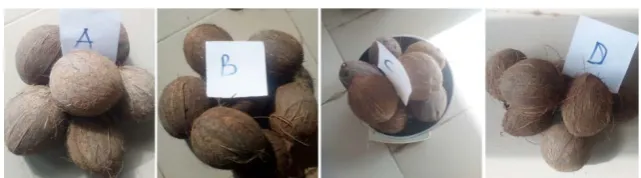
obtained from the local market. A total 30 coconuts were
randomly selected, sorted into four grades A, B, C, and D
by sizes (Figure 2).
June, 2020 AgricEngInt: CIGR Journal Open access at http://www.cigrjournal.org Vol. 22, No. 2 71
Physical properties like size, sphericity, roundness,
weight, moisture content, etc. of sample coconuts from
each grade were studied. The following physical
properties of coconut fruits were measured and some
derived parameters determined according to (Mohsenin,
1986).
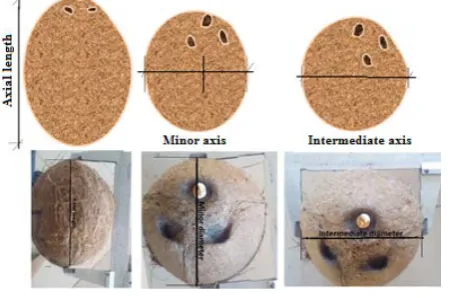
1. Coconut equivalent diameter: The coconut size
was determined by measuring the dimension of the
principal axis; major, intermediate and minor of
randomly selected coconut fruits using vernier calliper.
The major, minor and intermediate axes for coconuts are
shown in Figure 3. The dimensions of 6 selected coconuts
from each sample grades was measured and recorded.
Figure 3. The three principal dimensions of coconut
The equivalent diameter dp in mm considering a
prolate spheroid shape of each grain, was calculated using
the following expression (Varnamkhasti et al., 2007;
Dursun and Dursun, 2005):
𝑑𝑝= �𝑎 (𝑏+𝑐)
2
4
3
(1)
Where
a = Major axis/length of coconut (mm)
b = Minor axis/width of coconut (mm)
c = Intermediate axis/thickness of coconut (mm)
Sphericityof coconut: Sphericity (φ) is defined as the
ratio of the surface area of the sphere having the same
volume as that of the grain to the surface area of the
grain, was determined through equation (Varnamkhasti et
al., 2007; Al-Mahasneh and Rababah, 2007):
𝑆𝑝ℎ𝑒𝑟𝑖𝑐𝑖𝑡𝑦 (φ) =(𝑎×𝑏×𝑐)
1 3
𝑎 (2)
Surface area of coconut: Surface area (S) was
calculated using equations illustrated below
(Al-Mahasneh and Rababah, 2007; Varnamkhasti et al.,
2007):
𝑆=𝜋×𝑏×𝑐×(2𝑎−𝑏𝑎2 ) (3)
Roundness: The ratio of the projected area (𝐴𝑝) to the
area of circumscribing circle (𝐴𝑐) gives the roundness of
each seed.
𝑅𝑜𝑢𝑛𝑑𝑛𝑒𝑠𝑠=𝐴𝑝
𝐴𝑐 (4)
Where
𝐴𝑟𝑒𝑎 = 𝜋𝑟2 (5) r = radius of the circle, 𝑚𝑚
𝐴𝑝= Projected area of tracing coconut seed, 𝑚𝑚2
𝐴𝑐 = Area of the smallest circumscribing circle, 𝑚𝑚2
To determine the areas, a coconut was selected
randomly and placed on a graph sheet of paper on a
horizontal table. The projected area of a coconut in its
natural reset position was traced on the graph paper by
mean of a pencil (Figure 4). The projected area was
measured from the graph paper. The smallest
circumscribing circle was drawn on the tracing of
projected area.
Figure 4. Tracing the projected area of coconut
1. Volume of coconut fruit: Grain volume (V) was
calculated using Bello et al.. (2018) equation:
𝑉 =6𝜋𝑏(2𝑎−𝑏2𝑎2) (6)
2. Weight of coconut: The randomly selected 30
coconut samples were weighed on precision electronic
weighing scale (SF-400, capacity 5000g × 1g/177oz ×
0.1oz) and values recorded.
3. Cracking time: The cracking time is the total time
required to crack a coconut. It is measured by the time
lapse in cracking a nut.
4. Total operating time: This is the total time required
72 June, 2020 AgricEngInt: CIGR Journal Open access at http://www.cigrjournal.org Vol. 22, No. 2
2.3 Device performance indicators
The following tests were carried out to evaluate the
performance of these devices.
The time required to crack the coconut: The time
required for cracking each coconut was measured using
the stopwatch. The total time required for cracking
includes time for coconut fixing and splitting.
a. Splitting efficiency: Splitting efficiency is
expressed as the effect of splitting open a coconut
compare to known device performance:
𝑺𝒑𝒍𝒊𝒕𝒕𝒊𝒏𝒈𝒆𝒇𝒇𝒊𝒄𝒊𝒆=𝑫𝒊𝒂𝒎𝒆𝒕𝒆𝒓𝑳𝒆𝒏𝒈𝒕𝒉𝒐𝒇𝒐𝒇𝒄𝒐𝒄𝒏𝒖𝒕𝒐𝒃𝒆𝒓𝒗𝒂𝒃𝒍𝒆𝒂𝒍𝒐𝒏𝒈𝒄𝒓𝒂𝒄𝒌𝒕𝒉𝒆𝒂𝒙𝒊𝒔× 𝟏𝟎𝟎%
(7)
b. Device output capacity: The cracking capacity of
the device was determined from the average cracking
time required to crack the coconut. It is expressed as the
quantity of coconut split per unit time of measurement:
𝑀𝑎𝑐ℎ𝑖𝑛𝑒𝑐𝑎𝑝𝑎𝑐𝑖𝑡𝑦=𝑇𝑜𝑡𝑎𝑙𝑤𝑒𝑖𝑔ℎ𝑡𝑇𝑖𝑚𝑒𝑜𝑓𝑐𝑜𝑐𝑛𝑢𝑡𝑡𝑎𝑘𝑒𝑛 𝑠𝑝𝑙𝑖𝑡 (𝑘𝑔ℎ𝑟) (8)
Number of coconuts per hour: Total number of
coconut split per unit time of measurement:
𝑇𝑜𝑡𝑎𝑙𝑛𝑜𝑜𝑓𝑐𝑜𝑐𝑜𝑛𝑢𝑡𝑠𝑠𝑝𝑙𝑖𝑡=𝑀𝑒𝑎𝑛𝑢𝑛𝑖𝑡𝑀𝑎𝑐ℎ𝑖𝑛𝑒𝑤𝑒𝑖𝑔ℎ𝑡𝑐𝑎𝑝𝑎𝑐𝑖𝑡𝑦𝑜𝑓𝑐𝑜𝑐𝑛𝑢𝑡𝑠𝑝𝑙𝑖𝑡 (9)
3 Results and discussion
During the performance test, measured parameters
viz. weight of whole coconut, cracking efficiency, time
required to crack etc. were studied. The details of the
results obtained are given and discussed below.
3.1 Physical properties of coconut samples
a. Physical features of samples: The physical
properties (weight, axial length and diameters) of the
randomly selected coconut samples in each grade A, B,
C and D was carried out and the result shown in Table 2.
The average weights of coconut in each grade were
obtained in the range of 712.00 g for grade A, 511.67 g
for grade B, 467.20 g for grade C and 337.80 g for grade
D. The observed average dimensions of the major, minor
and intermediate axis for all grades of coconuts are: A
(130.74, 107.87, and 104.35mm), B (122.08, 95.71, and
94.18 mm), C (125.18, 91.10, and 93.81mm), D (103.06,
82.38 and 79.50 mm) respectively.
Table 2 Mean measured dimensional and weight properties of coconut samples
Samples Mean of measured parameters Roundness Sphericity
a(mm) b(mm) c(mm) Weight(g)
A 130.74 107.87 104.35 712.00 0.73 0.87
B 122.08 95.71 94.18 511.67 0.80 0.85
C 125.18 91.10 93.81 467.20 0.74 0.85
D 103.06 82.38 79.50 337.80 0.74 0.85
Mean 120.27 94.27 92.96 507.17 0.75 0.86
Coconut shape factors: The derived dimensions viz;
the projected area, area of circumscribing circle,
roundness and sphericity were measured for each grade
of sample coconuts. The mean measured projected areas
of the samples for A, B, C, and D respectively, are:
127.40, 117.00, 89.00, and 77.20 cm2. The mean
minimum a n d ma x imu m values of projected area
were 146 cm2 and of 282 cm2 respectively,while the
me an minimum and maximum value of the
circumscribing circle are 206 cm2 and 400 cm2
respectively. The average range of projected area and
area of circumscribing circle was 201 a n d 295.31 cm2
respectively. The roundness value ranged from 0.54 to
0.94 for the sample selected under this study was found
with a mean of 0.75 while the sphericity is 0.86.
3.2 Devices performance test characteristics
a. Crack propagation in coconut samples: The pattern
of propagation of the observed cracks in each coconut
sample at each impact using each technique is shown in
Table 3. On impact, hair pin/minor cracks appeared in
most of the coconut samples, at subsequent impacts, the
cracks developed progressively into major cracks and
subsequently shattered cracks.Table 3 Patterns of crack
propagations in coconut samples.
Samples Length of crack at impact by hand
1st 2nd 3rd 4th 5th 6th
A - Minor Major - -
B - Hair pin Major Shatter - -
June, 2020 Performance evaluation of three coconut cracking devices Vol. 22, No. 2 73
D Hair pin Minor Major - - -
Length of crack at impact by punch-split device
A - Hair pin Major Shatter - -
B - - Hair pin Major Shatter -
C Hair pin Minor Major Shatter - -
D - - Hair pin Minor Major Shatter
Length of crack at impact by impact-split device
A - Hair pin Major Shatter - -
B - - Hair pin Minor Major Shatter
C Hair pin Minor Major Shatter - -
D - Hair pin Minor Major Shatter -
Length of crack at impact by hydraulic-split device
A - - - Minor Major Shatter
B - - Minor Major Shatter -
C - - Hair pin Minor Major Shatter
D - - Minor Major Shatter -
b. Device performance, efficiency: The mean cracking
efficiency of different methods for different grades of
coconut is given in Table 4. The cracking efficiency of
conventional technique for different grades of coconut
varied from 86.67% to 100% with an average value of
94.17%, while average cracking efficiency for punch-split
was 87.09 percent with a range of 86.76% to 95.00%, and
for impact-split, it varied from 83.33% to 95.00% with
the average of 90.08% , while hydraulic-split varied from
90.00% to 95.00% .
Table 4 Mean cracking efficiency of each technique in coconut samples
Sample Cracking efficiency (%)
Conventional Punch-split
Impact-split Hydraulic
A 86.67 95.00 95.00 95.00
B 95.00 80.00 83.33 90.00
C 95.00 86.67 88.67 91.43
D 100.00 86.67 93.33 82.50
Mean 94.17 87.09 90.08 92.23
Also, from the table, gradually A coconuts have
higher cracking efficiencies for punch, impact-split and
hydraulic-split devices, the conventional method recorded
the highest efficiency of 100.00 percent for grade D
coconuts while grade C coconuts had the lowest
efficiencies for the devices. The differences in sizes of
coconuts affect the cracking efficiencies of the devices.
The relationships between different grades of coconut
and cracking efficiencies in each of the techniques is
shown in Figure 5.
Higher cracking efficiencies were obtained for
bigger-size coconuts and reduiced cracking efficiencies for
smaller-size coconuts throughout the experimentation.
The effect of human control in conventional cracking
technique is considered a critical factor responsible for
higher cracking efficiency, while machine factors such as
mechanical accuracies and component machining have
some influence on the lower cracking efficiency in the
three devices.
Figure 5. Cracking efficiency of each device on different coconut grades
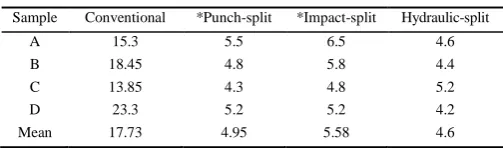
a. Cracking time: Table 5 shows the cracking time
in each of the techniques and the cracking time generally
varied from 15 to 23 seconds for conventional method,
while the devices varied from 4.2 seconds to 5.8 seconds
to crack various grades of coconut samples. The variation
in cracking time is obviously due to variation in size of a
coconut. The average cracking time varied from
maximum 17.73 seconds for conventional method to 4.6
seconds minimum time for hydraulic method.
Table 5 Time taken to crack different grades of coconut samples for each method
Sample Conventional *Punch-split *Impact-split Hydraulic-split
A 15.3 5.5 6.5 4.6
B 18.45 4.8 5.8 4.4
C 13.85 4.3 4.8 5.2
D 23.3 5.2 5.2 4.2
Mean 17.73 4.95 5.58 4.6
74 June, 2020 AgricEngInt: CIGR Journal Open access at http://www.cigrjournal.org Vol. 22, No. 2
For grade B coconuts, the cracking time varied from
22 to 33 seconds and average time was 28.28 seconds
while for grade C coconuts, the average cracking time
was 30.58 seconds with a range of 27 seconds to 39
seconds. The trend is shown graphically in Figure 6.
a. Cracking capacity: The cracking capacity of device
was determined from the time required to crack the
coconut. The result of output capacity of the evaluation
carried out is presented in Table 6. Conventional method
of cracking has the least output capacity of 110.09 kg hr-1
while hydraulic-split has the highest capacity of 385.83
kg hr-1. the capacity varies for different grades of coconut
with the hydraulic-split recording the highest capacity of
389.33 kg hr-1 for grade B coconut while the conventional
method recorded the lowest for grade D coconuts.
Figure 6. Time-based cracking performance of different methods on different grades of coconutTable 6 Output capacities of each
method
Table 6. Output capacities of each method
Samples Weight (g)
Conventional Punch-split Impact-split Hydraulic-split
Time (sec) Cap. (kg hr-1) Time
(sec) Cap. (kg hr
-1) Time
(sec) Cap. (kg hr
-1) Time
(sec) Cap. (kg hr
-1)
A 712.00 15.3 165.58 5.5 145.34 6.5 395.56 4.6 547.69
B 467.20 18.45 91.61 4.8 359.39 5.8 292.00 4.4 389.33
C 511.67 13.85 131.20 4.3 425.83 4.8 393.08 5.2 365.00
D 337.80 23.3 51.97 5.2 241.29 5.2 241.29 4.2 241.29
Mean 507.17 17.73 110.09 4.95 292.96 5.58 330.48 4.6 385.83
The average cracking capacity of each method was
evaluated by the total number of coconuts split per hour
and the result is presented in Table 7. Conventional
method recorded the all-time low and a mean average of
110 coconuts split per hour. The hydraulic device
recorded the highest number of coconut split per hour for
all grades of coconut with the highest at 833.33 coconuts
per hour. The variation in cracking time for different sizes
of coconut resulted in variation in the cracking capacities
of different grades of nuts. This indicated that the higher
cracking time resulted into low output capacity and vice
versa.
Table 7 Number of coconuts split per hour by each method
Samples Conventional Punch-split Impact-split Hyd-press
A 232.56 204.13 555.48 769.23
B 196.08 769.24 625.00 833.33
C 256.42 832.24 768.23 706.41
D 153.85 714.30 714.30 7i4.30
Mean 209.73 209.73 209.73 769.66
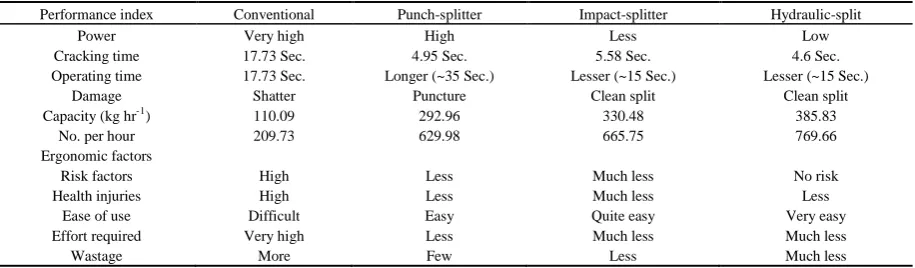
a. Comparative performance: Comparing the four different methods, the Table 8 below represents the operational
performance index for each method.
Table 8 Operational performance of cracking methods
Performance index Conventional Punch-splitter Impact-splitter Hydraulic-split
Power Very high High Less Low
Cracking time 17.73 Sec. 4.95 Sec. 5.58 Sec. 4.6 Sec.
Operating time 17.73 Sec. Longer (~35 Sec.) Lesser (~15 Sec.) Lesser (~15 Sec.)
Damage Shatter Puncture Clean split Clean split
Capacity (kg hr-1) 110.09 292.96 330.48 385.83
No. per hour 209.73 629.98 665.75 769.66
Ergonomic factors
Risk factors High Less Much less No risk
Health injuries High Less Much less Less
Ease of use Difficult Easy Quite easy Very easy
Effort required Very high Less Much less Much less
June, 2020 AgricEngInt: CIGR Journal Open access at http://www.cigrjournal.org Vol. 22, No. 2 75
4 Summary and conclusion
4.1 Summary
Based on the overall objective of evaluating three
coconut devices and comparing their performances with
the conventional technique, the following conclusions are
made;
1. The physical properties of coconut fruits, axial
dimensions and weights have been measured and mean
equivalent diameter, sphericity and roundness determined.
2. The cracking efficiency of conventional technique
for different grades of coconut varied from 86.67% to
100% with an average value of 94.17 percent,
punch-splitvaried from 86.76 to 95.00 percent with mean value
of 87.09 percent, impact-split varied from 83.33 to 95.00
percent with a mean value of 90.08 percent while
hydraulic-split varied from 90.00 to 95.00 percent with a
mean value of 82.50 percent.
3. The machine capacity varied for different grades
of coconut with the hydraulic-split having the highest
capacity of 389.33 kg hr-1 for grade B coconut and
conventional method having the least capacity of 110.09
kg hr-1 for grade D coconuts.
4. Ergonomically, hydraulic-split device is safer,
more hygenic and convenient in operation hence more
preffered.
4.2 Conclusion
In conclusion, the three cracking devices showed
improvement in material handling, cracking time,
capacity and efficiency, over the conventional technique.
Ergonomic assessment prefered hydraulic-split device
over other devices and methods. Conventional method of
cracking has the least cracking capacity measured per unit
time, highest cracking efficiency, while the
hydraulic-split has the highest number of coconut hydraulic-split per hour for
all grades of coconut with the highest handling capacity
of 833 coconuts per hour.
References
Al-Mahasneh, M. A., and T. M. Rababah. 2007. Effect of moisture content on some physical properties of green wheat. Journal of Food Engineering, 79(4): 1467–1473.
Anitha, J., and K. P. Shamsudeen. 1997. Development and testing of a tender coconut unch and splitter. Unpublished B. Tech
Project Report. Kerala. India: Kerala Agricultural University.
Bello, R. S., and A. Emmanuel. 2014. Development and Construction of punch-splitting device for coconut. Unpublished diplomat project in partial fulfilment of the requirements for the award of national diploma in agricultural and bio-environmental engineering. Ishiagu: Federal College of Agriculture.
Bello, R. S., S. J. Jauro, and M. B. Bello. 2018. Development, construction and technology adoption valuation of a dual mechanism coconut splitter. In Proceedings of the 3rd conference of the Nigeria Institution of Agricultural Engineers, 472-482. South East Region (NIAE-SER), UNN, Nsukka, 27-30, August..
Beloin, P. 2008. A coconut splitting device. United States Patent No.WO/2008/067653.
Beloin, P. 2009. Coconut splitting device. United States patient: US 200930139094A1 cultivars for tender nut waters for West Bengal. Indian Coconut Journal, 29(1): 3-4.
Dursun, E., and I. Dursun. 2005. Some physical properties of caper seed. Biosystems Engineering, 92(2): 237-245.
Jippu, J. 1998. KAU tender coconut punch. Indian Coconut Journal, 29(3): 9-10.
Ketan, K. T., V. P. Sakhare, and C. N. Sakhale. 2014. Design and performances of coconut de-shelling machine. International Journal of Engineering Research and Applications, 4(7): 39-44.
Mohsenin, N. N. 1986. Physical Properties of Plant and Animal Materials. New York: Gordon and Breach Science Publishers.
Roshni, T., J. Jippu, C. S. Ratheesh, J. Sachin, and K. L. Sreevisakh. 2009. Development of a household coconut punch-cum-splitter. CIGR Journal, 10(1): manuscript No. 1188.
Shamsudeen, K. P., J. Anitha, and J. Jippu. 1999. KAU tender coconut cutter. Indian Coconut Journal, 30(6): 9.
Unnikrishnan, N., 2010. Patent for coconut cutter., Science reporter, pp 17. 10 November.
Varnamkhasti, M. G., H. Mobli, A. Jafari, M. H. Soltanabadi, S. Rafiee, and R. Sadeghi. 2007. Some physical properties of rough rice (Oryza Sativa L.) grain. Journal of Cereal Science, 47(3): 496-501.
Vinay, M. J., J. James, J. Joy, S. Abin, and B. Chandy. 2016. Design and fabrication of coconut breaker extractor grater machine. International Journal for Innovative Research in Science and Technology (IJIRST), 2(11): 2349-6010. World Wildlife Fund. 2010. Petenes Mangroves, Encyclopedia of