Chapter 5
Technology and Economy among
the Earliest Prehistoric Foragers
in Interior Eastern Beringia
Ben A. Potter
1, Charles E. Holmes
1, and David R. Yesner
2ABsTrAcT
In the past decade, the archaeological record of eastern interior Beringia has seen a transformation in our understanding of the earliest foragers. This presentation focuses on new sites, data, and interpretations of technology and economy from the region, including emerging models of landscape use and settlement sys-tems. Patterns of technological continuity and discontinuity from adjacent regions are evaluated. Pre– and post–Younger Dryas occupations can be distinguished in eastern Beringia, although the signatures of these occupations relate more to changes in behavioral organization and land use than to stylistic changes in
tech-nology. Intrasite and intersite patterning in lithic assemblages appears to reflect seasonal or activity-specific variation. Regional variation (e.g., differences between interior and north Alaskan assemblages) may reflect
colonization patterns on a larger scale, including distinct populations and timing/direction of colonization, though with some inter-regional technological linkages (e.g., microblade technology). Clovis ancestors may be present in Beringia, but they are not easily distinguished through material culture patterns. Faunal analy-ses presented here indicate subsistence economic change through time, including (1) relatively broad diet breadth in the Bølling-Allerød period, (2) increased diet breadth during the Younger Dryas, and (3) narrow-ing diet breadth durnarrow-ing the post-Younger Dryas/early-Holocene period. This appears to be a Bernarrow-ingia-wide
phenomenon that reflects broad effects of climate change and possibly episodic colonization. These data
are used to evaluate technological and economic adaptations relating to the initial colonization of Beringia and subsequent expansion into different ecological niches during the Younger Dryas.
KEywords: Beringia, Younger Dryas, Faunal analysis, Paleoeconomy, Technological organization
set provides a counterpoint to Clovis complex analyses that tends to dominate the Paleoindian literature (Meltzer 2009; see also Hoffecker and Elias 2007). Given that many of the Beringian sites have been recently discovered and analyzed, these data have not been well integrated into a broader un-derstanding of colonization of the New World. Ongoing in-vestigations by Potter at Upward Sun River, Mead, and Gers-tle River (Potter 2005; Potter et al. 2011a, 2011b), by Holmes at Swan Point and Eroadaway (Holmes 2011, Holmes et al. 2010), and by Yesner and Easton at Little John and Broken Mammoth (Easton et al. 2011; Yesner et al. 2011) have
1 University of Alaska Fairbanks 2 University of Alaska Anchorage
Corresponding author e-mail: 1[email protected]
Introduction
data-vided substantial new information on technological and
sub-sistence strategies and paleoenvironments of the first Alas -kans. Recent work by Gelvin-Reymiller and Reuther (Wooller et al. 2012) has revealed multiple late-Pleistocene sites near Quartz Lake, central Tanana basin. Additional work in the upper Nenana basin at Owl Ridge and Dry Creek (Graf and Bigelow 2011, Graf and Goebel 2009) has largely substanti-ated and expanded upon earlier interpretations (Phippen 1988; Powers et al. 1983). In addition, a number of previously excavated sites have been re-analyzed, resulting in consider-ably older occupations: Teklanika West (Coffman and Potter 2011), Carlo Creek (Bowers and Reuther 2008), and Eroad-away (Holmes et al. 2010).
In this paper, we summarize the state of current research at several early components at Mead, Swan Point, and Bro-ken Mammoth sites, and offer our perspectives on subsis-tence economies and technological organization. We also offer a broad perspective on changes through time in these and other sites in central Alaska, with particular focus on the transition from the earliest components (pre-Clovis or Clovis-age) in the Bølling-Allerød interstadial (~14,700–12,900 cal yr BP) to later components associated with the Younger Dryas chrono zone (~12,900–11,500 cal yr BP) and post-Younger Dryas / early Holocene (~11,500–10,000 cal yr BP). While the effects of the Younger Dryas have been debated for central Alaska (see review in Kokorowski et al. 2008; see also Graf
and Bigelow 2011), these periods reflect changing environ -mental conditions for Beringian inhabitants.
Currently, interpretations of eastern Beringian assem-blage variability for these periods generally follow two pat-terns:
1) multiple traditions derived from technological-typolog-ical assignments (e.g., Nenana, Chindadn, Mesa, and
Denali complexes) (Goebel et al. 1991; Hoffecker 2011; Hoffecker et al. 1993), or
2) a single broad technological tradition where land use and mobility patterns structure assemblage variation (Holmes 2001; Potter 2011; West 1996).
The role of subsistence economy, land-use patterns, and seasonality generally remain poorly linked with technologi-cal datasets (Graf and Bigelow 2011; Potter 2008, Yesner 1996, 2006, 2007). We evaluate competing interpretations with new intrasite and intersite data from the lowest cultural zones (CZ4) at Mead, Swan Point, and Broken Mammoth, al-lowing for investigation of intrasite spatial patterning of lith-ics, fauna, and features to help elucidate conditioning factors of assemblage variability, and understand broader patterns of adaptation, including the initial colonization of Beringia.
Mead site
Archaeological investigations at Mead (totaling 128 m2) have
focused on understanding organizational properties, isolat-ing activity areas, and evaluatisolat-ing recurrisolat-ing modes of
orga-nization (Potter et al. 2011b). The site is well stratified with
a concordant suite of 37 radiocarbon dates, and the lowest components/cultural zones (CZ3b, CZ4, and CZ5) are relatively undisturbed by post-depositional disturbances (Potter et al. 2011b, see also Dilley 1998; Gilbert 2011). Cultural zones 4 and 5 date to the Bølling-Allerød interstadial (13,440–13,200 and 13,110–12,790 cal BP) while CZ3b dates to the Younger Dryas stadial (12,120–11,850 cal BP) (Potter et al. 2011b).
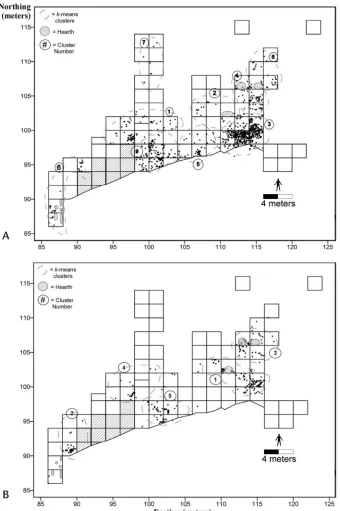
A plan view for all cultural materials associated with CZ4, i.e., directly associated with the lower paleosol complex, is illustrated in Figure 5.2. Three hearths yielded statistically similar ages at ~11,100 14C yr BP (13,100–12,800 cal yr BP)
(Table 5.2). Three lithic activity areas and four large but
Table 5.1 Late-Pleistocene and early-Holocene components in the Tanana basin.
site component Age, 14c yr1 No. 14c dates Age, cal yr BP2 Excavation area (m2) reference
Swan Point CZ4 12,160 ± 20 8 14,150–13,870 65 Holmes 2011; this paper Little John Sub–paleosol 12,020 ± 70 1 14,050–13,720 ~100 Easton et al. 2011
Mead CZ5 11,460 ± 50 1 13,440–13,200 156 Potter et al. 2011b; this paper
Broken Mammoth CZ4 11,440 ± 60 2 13,430–13,160 326 Holmes 1996
Upward Sun River C1 11,320 ± 30 3 13,300–13,120 12 Potter et al. 2011a
Walker Road C1 11,220 ± 90 3 13,310–12,850 200 Goebel et al. 1996
Moose Creek C1 11,190 ± 60 1 13,270–12,880 50 Pearson 1999
Linda’s Point 11,100 ± 40 2 13,120–12,780 13 Sattler et al. 2011
Dry Creek C1 11,120 ± 90 1 13,210–12,730 347 Powers et al. 1983
Owl Ridge C1 11,100 ± 60 2 13,140–12,750 27 Phippen 1988;
Graf and Bigelow 2011 Mead CZ4 11,080 ± 20 5 13,110–12,790 156 Potter et al. 2011b; this paper
Bachner C1 11,030 ± 70 1 13,100–12,700 <4 Wooller et al. 2012
Teklanika West C1 11,000 ± 40 2 13,070–12,700 12 Coffman and Potter 2011
Eroadaway 10,890 ± 40 1 12,910–12,630 8 Holmes et al. 2010
FAI–20433 11,600 ± 50 13,620–13,300 <4 Gaines et al. 2011;
10,730 ± 40 Esdale et al. 2012
Moose Creek C2 10,500 ± 60 1 12,730–12,560 50 Pearson 1999
Mead CZ3 10,270 ± 20 5 12,120–11,850 156 Potter et al. 2011b
Broken Mammoth CZ3 10,290 ± 70 1 12,400–11,780 326 Holmes 1996
Owl Ridge C2 10,490 ± 30 to 13 12,580–12,230 27 Phippen 1988;
10,020 ± 40 11,740–11,310 Graf and Bigelow 2011
Phipps 10,230 ± 70 1 12,380–11,630 ? West et al. 1996a
Upward Sun River C2 10140 ± 40 2 11,990–11,510 61 Potter et al. 2011a
FAI–2077 10,130 ± 50 1 12,010–11,410 ? Gaines et al. 2011;
Esdale et al. 2012
Swan Point CZ3 10,080 ± 40 3 11,960–11,400 60 Holmes 2008
XBD–308 10,050 ± 70 1 11,960–11,280 5 test pits Potter 2008
XBD–338 C1 Pre 10,0004 9 test pits Potter 2008
XBD–338 C2 10,000 ± 80 1 11,820–11,240 9 test pits Potter 2008
Upward Sun River C3 9990 ± 30 3 11,610–11,280 61 Potter et al. 2011a
Whitmore Ridge C1 9950 ± 40 3 11,600–11,250 40 West et al. 1996b
Little Delta River #3 9920 ± 60 1 11,610–11,220 4 Potter et al. 2007a Panguingue Creek C1 9890 ± 50 3 11,600–11,200 100 Powers and Maxwell 1986
Carlo Creek C1 9880 ± 20 6 11,320–11,230 45 Bowers and Reuther 2008
Gerstle River C1 9740 ± 40 1 11,240–11,100 175 Potter 2005
Dry Creek C2 9660 ± 30 9 11,190–10,810 347 Powers et al. 1983;
Bigelow and Powers 1994 Healy Lake Village Chindadn 9580 ± 110 2 hearths 11,200–10,590 409 Cook 1996
Little John Paleosol 9510 ± 20 6 11,070–10,700 ~100 Easton et al. 2011
Gerstle River C2 9450 ± 40 2 11,060–10,570 184 Potter 2005
XBD–303 9340 ± 80 1 10,740–10,280 6 test pits Potter 2008
XBD–312 9290 ± 50 1 10,650–10,290 4 test pits Potter 2008
Sparks Point 9170 ± 50 3 10,490–10,230 ? West et al. 1996c
Chugwater C2 9080 ± 90 2 10,500–9920 400 Maitland 1986; Lively 1996
XBD–306 8930 ± 90 1 10,240–9710 4 test pits Potter 2008
Gerstle River C3 8880 ± 20 9 10,160–9910 205 Potter 2005 Upward Sun River C4 8870 ± 30 2 10,170–9800 61 Potter et al. 2011a Teklanika West C2 8820 ± 40 1 10,150–9700 12 Coffman and Potter 2011
1 Average of securely associated C14 dates (based on Potter 2008 or more recent references). 2 Intcal09 curve, Calib 6.1.0.
3 FAI–2043 (Esdale et al. 2012) has two stratigraphically associated C14 ages in depth order, but it is unclear which of the two relates to the lithic and
faunal material (which includes bison, hare, and waterfowl). It is not included in these analyses.
other materials, suggesting that chert bifaces were removed from the site. Broken Mammoth CZ4 produced no complete bifacial tools, and the Swan Point CZ4 bifaces are microblade core preforms. Thus the Mead CZ4 bifaces are the earliest well-dated mid-Tanana basin bifacial projectile points/knives. One point is a convex-base point or knife with limited edge
1979) are absent at Mead CZ4, suggesting more of a forager pose (i.e., maintaining toolkits on an ad-hoc, as-needed basis) (Bousman 1993). Obsidian was present in both Mead CZ4 and CZ3b and all are from Wiki Peak, ~350 km southwest of the
site (Potter et al. 2013). This may indicate specific routes of
movement for these early populations—essentially east-west from the middle to upper Tanana River valley.
Mead CZ4 lithic patterns contrast with Gerstle River C3, a logistically organized hunting camp dominated by weap-ons technology (microblades inset in composite points) (Potter 2005). At Gerstle River, there is evidence of embed-ded procurement of a wide range of materials (~30 types) and similar late stages of bifacial and unifacial tool mainte-nance as well as microblade production. This contrasts with Mead CZ4 with < 10 material types that are very unevenly
distributed and reflect earlier stages of lithic reduction, par -ticularly the local quartz, and relatively lower mobility for site occupants.
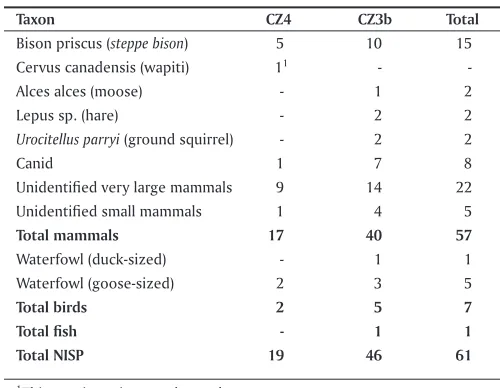
While hundreds of faunal fragments have been recovered at Mead CZ4, most are fragmented, but 19 NISP were
iden-tified (Table 5.3). Detailed faunal analyses are rare for this
period, but Mead CZ4 contrasts strongly with Gerstle River C3 patterns (Potter 2007). At Gerstle River, bison and wapiti were killed nearby, then taken to the site and processed; high meat-yield elements were taken from the site, presumably to a base camp, and low-yield elements were left at the site. Marrow was extracted in the contexts of small hearths, but only elements yielding the greatest marrow were processed, and 28% of NISP were complete elements (Potter 2007). At Mead CZ4, very large ungulate fauna (NISP = 13) exhibit a positive relationship between abundance and bison protein index (from Emerson 1990). Importantly, there is an absence of typically preserved low-yield elements, like metapodials,
commonly found in early field processing sites like Gerstle
River. The Mead CZ4 assemblage has higher abundance of ribs, approximately six times higher %MAU values compared with Gerstle River, and vertebrae and upper limbs are moder-ately well represented. At Mead CZ4, none of the very large ungulate elements were complete, and there is no articula-tion. Thus Mead fauna underwent more processing, likely occasioned by consumption events, and these patterns are consistent with residential camps. Given faunal and lithic pat-terns described above, Mead CZ4 is interpreted to be a mixed foraging camp with a varied subsistence base, where locally
available small game and waterfowl were exploited. Large ungulates like bison were transported to the site already pro-cessed to some extent, probably from logistically organized spike camps like Gerstle River.
The Mead CZ4 fauna is broadly similar to that recov-ered from Mead CZ3b, associated with 10 hearths, dating to ~10,270 14C yr BP (12,120–11,850 cal yr BP), which also
yielded a highly fragmented assemblage, including 46 NISP (Table 5.3). One important addition is a single vertebra of On-corhynchus sp. fish recovered in 2012 (the entire 2012 faunal
assemblages have not been fully analyzed). Smaller-bodied caribou and sheep-sized ungulates are notably absent in all early Mead assemblages. Steppe bison predominates the fau-nal record for CZ5, CZ4, and CZ3b, spanning multiple periods of climatic change. Faunal patterning is further discussed be-low in context with broader regional datasets.
Arcs of debris are evident surrounding Hearth feature 2011-6. Space maintenance is considered indicative for lon-ger-term occupation and re-occupation (Stevenson 1991). Lithic materials directly associated with Hearth 2011-6 in-dicate tool maintenance of non-local materials (Little 2013),
contrasting with the primary reduction of local (on-site) quartz elsewhere. The arcs of debris may border a residential structure (e.g., surface tent), and Hearth 2011-6 may repre-sent an indoor hearth. Faunal patterning also supports the interpretation of CZ4 as a residential base camp (see above). Coupled with the spatial data, the dispersed bone clusters
around this feature may reflect bone dumps after on-site con -sumption events. The space outlined by the arcs of debris is ~3.7 m x 4.3 m, with an estimated area of ~12.5 m2. This is
roughly comparable to the Upward Sun River C3 structure, fully excavated in 2011, also with a central hearth, with an area estimated at ~13.7 m2 (Potter 2012). Another potential
east Beringian residential structure (tent) may be present at
Walker Road, defined there by circular distribution of lithics
around a hearth (Goebel and Powers 1989; Higgs 1992).
swan Point
Swan Point excavations totaling 65 m2 have yielded
substan-tial technological and faunal information for components dating to both the Bølling-Allerød (CZ4) and Younger Dryas (CZ3) (see Holmes 2011). Radiocarbon dates associated with two hearths clearly indicate a Bølling-Allerød age of about 12,160 14C yr BP (14,150–13,870 cal yr BP) (Table 5.4), and along with extensive refits between hearths (see below), in -dicate contemporaneity of the CZ4 occupation. The CZ4 as-semblage has been assigned by Holmes (2001) to the East Beringian tradition, Diuktai phase, while the CZ3 assemblage has been assigned to the later Chindadn phase.
The Swan Point CZ4 lithic-tool assemblage was based almost entirely on microblade and burin technology. Micro-blades were made on cores prepared by the Yubetsu/Diuk-tai technique (Gomez Coutouly 2012) from bifacially shaped blanks (Figure 5.4). Burins of various styles (e.g., transverse
and dihedral) were produced on unifacially trimmed flakes.
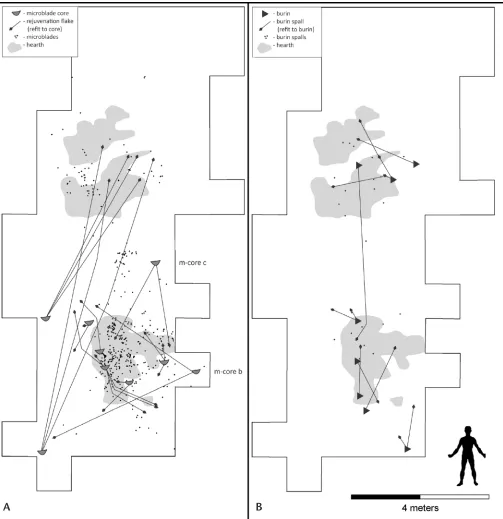
Burin use is apparent across the site, with discarded burins and burin spalls focused around hearths. Several burins have
been fitted to series of sequential spalls, demonstrating that
a burin was used and rejuvenated at one location but later discarded at another location (Figure 5.6B). CZ4 burins could be used a number of ways: to cut grooves or channels of vary-ing widths and depths; to carve or whittle; or to scrape or
Table 5.2 Mead CZ4 and CZ5 radiocarbon dates1.
Beta Lab no. Material Feature 14c yr BP cal yr BP (2σ)2 342930 Wapiti antler tool N/A 11,050 ± 40 13,100–12,740 337174 Hearth charcoal (Betula sp.) F2011-10 11,080 ± 50 13,120–12,750 337172 Hearth charcoal F2011-6 11,100 ± 50 13,130–12,770
(unknown, not Picea sp.)
264530 Hearth charcoal F2011-6 11,210 ± 60 13,220–12,970 337181 Hearth charcoal (Populus/Salix) F2012-13 11,030 ± 50 13,090–12,720 59121 Charcoal (stratigraphic) N/A 11,560 ± 80 13,630–13,250 59120 Charcoal (stratigraphic) N/A 11,600 ± 60 13,630–13,290 264522 Bone collagen (Bison sp.) N/A (CZ5) 11,460 ± 50 13,400–13,200
1 From Potter et al. 2011b, except Beta 342930, 337172, 337174, 337181, this paper. 2 Intcal09 curve, Calib 6.1.0.
Table 5.3 Mead CZ4 and CZ3b faunal summary, 2009-2011 (NISP).
Taxon cZ4 cZ3b Total
Bison priscus (steppe bison) 5 10 15 Cervus canadensis (wapiti) 11
-Alces alces (moose) - 1 2
Lepus sp. (hare) - 2 2
Urocitellus parryi (ground squirrel) - 2 2
Canid 1 7 8
Unidentified very large mammals 9 14 22
Unidentified small mammals 1 4 5
Total mammals 17 40 57
Waterfowl (duck-sized) - 1 1
Waterfowl (goose-sized) 2 3 5
Total birds 2 5 7
Total fish - 1 1
Total NIsP 19 46 61
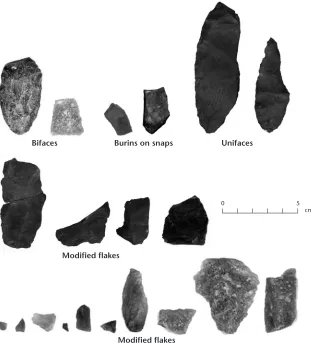
Bifaces Burins on snaps Unifaces
Modified flakes
Modified flakes
0 5
cm
plane. The application depends on the configuration of burin
facets and the bulk and thickness of the burin.
These tools were fundamental to the acquisition of antler- and ivory-bearing animals and the subsequent pro-cessing of these materials into useful objects. The produc-tion of microblades and the use of burins are evident in the distribution of lithic artifacts in and around hearths (Figure
5.6). Both antler and ivory would have played an important role in material culture, being substitutes for wooden han-dles, shafts, traps, etc., in an environment where wood was scarce. The absence of bifacial projectile points and the abun-dance of micro blades support the hypothesis that hunting weapons were made with microblades inset in bone, ivory, or antler projectiles. The dominant lithic material in CZ4 is
Figure 5.3 Mead CZ4 tools.
Table 5.4 Swan Point CZ4 radiocarbon dates1.
Lab no. Material (letter refers to Figure 5) Feature 14c yr BP cal yr BP (2σ)2 CAMS-17405 A Mammoth ivory tusk collagen 12,060 ± 70 14100-13750 AA-19322 B Soot/residue on microblade core tablet Hearth 1a 11,770 ± 140 13900-13330 Beta-175491 c Residue (carbonized fat/grease) Hearth 1a 12,110 ± 50 14120-13800 Beta-QA-619 d Hearth charcoal (Populus/Salix) Hearth 1b 12,040 ± 40 14020-13770 Beta-170457 E Residue (carbonized fat/grease) Hearth 1b 12,360 ± 60 14910-14050 AA-74249 F Horse molar collagen 11,950 ± 100 14030-13490 AA-74251 G Mammoth ivory tusk collagen 12,050 ± 120 14230-13500 Beta-209883 H Residue (carbonized fat/grease) 12,100 ± 40 14100-13800 Beta-209884 I Residue (carbonized fat/grease) Hearth 2 12,220 ± 40 14480-13870 Beta-209882 J Hearth charcoal (Populus/Salix) Hearth 2 12,290 ± 40 14850-13970 AA-74250 K Mammoth molar collagen Hearth 2 12,110 ± 120 14530-13680 AA-98488 L Mammoth ivory tusk collagen 12,500 ± 150 15160-14100
0 5 cm
A
B
C
grayish green basalt, but obsidian (all geochemically sourced to Group H, with an unknown source) is present in the form of microblades (Speakman et al. 2007).
A major activity at the site was reducing mammoth tusks into smaller pieces, presumably to manufacture tools and other objects. The site is littered with small, 5–25 cm long, unworked ivory fragments, e.g., as many as 80/m2. Rare
worked pieces and large broken tusk segments are present as well. One nearly complete tusk from a ~15-year-old fe-male (based on annual growth indicators along the exposed dentine surface) had had a long piece removed by the groove-and-splinter method (Figure 5.5): Burins were used to groove parallel longitudinal channels through the exterior cemen-tum of the tusk that allowed the piece to be removed. The presence of multiple mammoth remains (a ~15-year-old fe-male, a ~5-year-old juvenile, and a < 1-year-old baby) sug-gests selective hunting.
A scatter of mammoth molar plates associated with one of the hearth features appear to be from unfused molars
be-longing to a juvenile or young adult mammoth, perhaps re-sulting from breaking the maxilla to remove the tusks. Other mammoth remains include two crypt bones, a pair of molars from a 5-year-old, and several ribs belonging to a < 1-year-old (Holmes et al. 2012). What appears certain is that se-lected anatomical parts of several individual mammoths were brought to the site for further use.
Antler, likely wapiti, was also reduced for further treat-ment, possibly split apart by a wedge. The two matching pieces of antler appear to have been polished following their separation.
Horse is represented by dentition (Holmes 2011). At least two mandibular premolars that may not have been fully erupted were found between two hearth areas. The horse
evidence at Swan Point is significant in part because it is the
youngest dated occurrence of Pleistocene horse in Alaska. Faunal remains at the southeastern extent of the excavation
Figure 5.4 Yubetsu/Diuktai technique at Swan Point CZ-4: A, biface blank preform; B, microblade core with a refit platform rejuvenation ski spall and
a ridge spall; c, microblade core with two refit ski spalls. Illustrated by Yu
Hirasawa.
B A
suggest people were hunting waterfowl and upland birds (Figure 5.5). Other small mammals, e.g., hare, are likely repre-sented as well, but poor preservation and high fragmentation
render them difficult to identify. The fact that bones were used extensively to fuel the camp fires (Crass et al. 2011; Ked -rowski et al. 2009) is another variable in the taphonomy at
Swan Point, where both natural and cultural processes influ -ence the biotic record.
Unlike the microblade-dominated lithic technology of Swan Point CZ4, the Younger Dryas and later period in the
Tanana valley is based principally on bifacial tools, though microblades are found within the Swan Point CZ3 horizon (Holmes 2008, 2011). A broad range of small bifacial
projec-tile forms first appear at Swan Point and Broken Mammoth in
CZ3. These biface tools are often called or compared to Chin-dadn points (Cook 1969, 1996; Holmes 2001). Similar bifaces,
typically made on flakes without invasive retouch, have been
documented at other sites in the mid-Tanana valley (e.g., Healy
Lake) and the Nenana valley, defining along with the absence
of microblades, the Nenana complex. Microblade technology
in the Younger Dryas period, e.g., Moose Creek C2 (Pearson 1999), Tangle Lakes sites (West 1981), was transformed from Yubetsu/Diuktai technique to the Campus technique, and has been referred to as the Denali complex (West 1967, 1975).
Broken Mammoth
After the initial discovery of well-preserved archaeofaunas and hearths in the lower units of the Broken Mammoth site in 1989, and subsequent discovery of well-preserved organic tools, excavations (1990–93, 1998, 2000, 2002, 2005, 2010) focused on reconstructing late-Pleistocene/early-Holocene subsistence and behavioral organization at the site (Yesner 1996, 2001). A total of 408 m2 was excavated,
encompass-ing about 82% of the surface area of the terrace, allowencompass-ing for analysis of intrasite distributions of hearths, lithics, and fauna, and reconstructing subsistence economy (Krasinski
and Yesner 2008). The site is highly stratified, with four major
components, two of which date to the late-Pleistocene period (Table 5.1). A suite of seven radiocarbon dates is available for this unit, all of them in stratigraphic sequence (Table 5.5). The lower components are linked to paleosol complexes and are relatively free from post-depositional disturbance (Dilley
Despite the differences in lithic sources in CZ4 and CZ3,
reflecting a shift from a more expedient, highly local assem -blage to one derived from cherts, there are basic continuities in the overall lithic assemblage. These include unifacial tools (end- and sidescrapers), cobble tools, and the mammoth-ivory foreshafts. As at Mead, it is possible to argue that the lithic assemblage at Broken Mammoth temporally spans the Younger Dryas boundary. Whether or not there was regional site abandonment during the early part of the Younger Dryas (~12,800 to 12,100 cal yr BP), it appears that the occupations were closely related.
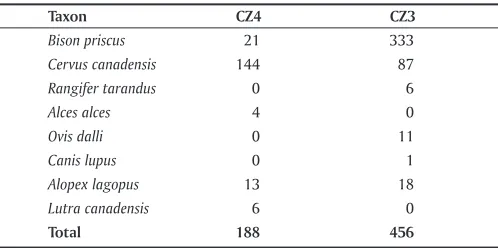
The faunal sample from Broken Mammoth makes the continuities more apparent. It is clear that the basic focus of human subsistence pre– and post–Younger Dryas was bi-son and wapiti, particularly the former. Bibi-son contributed 11% of the megafaunal assemblage from CZ4 and 73% of the much larger megafaunal assemblage from CZ3, based on NISP (Yesner 2013; see Table 5.6). Wapiti were also prevalent dur-ing the post–Late Glacial Maximum Poplar Rise, contributdur-ing 77% of the megafaunal assemblage from CZ4 and 19% from CZ3. Moose contributed slightly to the CZ4 assemblage,
and caribou to the CZ3 assemblage. The latter may reflect a
Table 5.5 Broken Mammoth CZ4 radiocarbon dates.
Lab no. Material cultural zone 14c yr BP cal yr BP (2σ)1 WSU-4265 Charcoal (stratigraphic) CZ4a 11,280 ± 190 13,490–12,690 CAMS-5358 Hearth charcoal CZ4b 11,420 ± 70 13,420–13,140 CAMS-5358 Bone collagen (swan) CZ4b 11,500 ± 80 13,560–13,170 WSU-4262 Hearth charcoal CZ4b 11,510 ± 120 13,650–13,140 AA-17601 Tusk collagen (mammoth) CZ4b 11,540 ± 140 13,720–13,140 WSU-4351 Charcoal (stratigraphic) CZ4c 11,770 ± 210 14,060–13,210 WSU-4364 Charcoal (stratigraphic) CZ4c 11,770 ± 220 14,100–13,180
1Intcal09 curve, Calib 6.1.0.
Table 5.6 Large-medium mammal diversity (NISP) at Broken Mammoth.
Taxon cZ4 cZ3
Bison priscus 21 333
Cervus canadensis 144 87
Rangifer tarandus 0 6
Alces alces 4 0
Ovis dalli 0 11
Canis lupus 0 1
Alopex lagopus 13 18
Lutra canadensis 6 0
Total 188 456
1998; Crossen et al. 1993). CZ4 dates reliably to ~11,440 14C
yr BP (~13,440–13,200 cal yr BP) based on several AMS dates, including two hearth dates. A distinct lower paleosol stringer, resting on the basal sand underlying the loess, has two dates of 11,770 14C yr BP (~14,060–13,210 cal yr BP).
Plan views for cultural materials associated with Broken Mammoth CZ4 from 1990–2005 are illustrated in Figure 5.7.
Three well-defined hearths were uncovered in CZ4, with at least 11 less well defined hearths and hearth smears. In ad -dition, 3 distinct lithic manufacturing areas were recovered in CZ4, all deriving from reduction of quartz ventifacts. A total of 802 lithics have been recovered from CZ4, including 13 uni-facial convex scraper-planes, 2 smaller uniuni-facial endscrapers,
2 unifacial sidescrapers, and 5 quartz flake cores. The higher
cortex frequency in CZ4 lithics (38% of a sample of 258 lithics), compared with CZ3 lithics (8% out of a sample of 1,234 lith-ics), supports the notion that local materials were being used for on-site tool production. Although the formal artifacts and workshops largely comprised quartz ventifacts, chert and ba-salt constitute 42% of the total lithic inventory at CZ4.
shift from more mesic to colder, more arid conditions in the
Younger Dryas, a fact reflected by the prevalence of water -fowl in CZ4, particularly tundra swans, white-fronted geese, and a variety of dabbling ducks. In addition, the presence of otter, muskrat, and beaver in CZ4 and marmot, pika, ground
A
B
terms of large game, the shift from a more diverse faunal strategy to a focal strategy on bison seems to be character-istic of the later Younger Dryas period, and is coupled with widening diet breadth, incorporating a more diverse array of
smaller mammals and fish (see below).
Taken together, these data suggest basic continuity in subsistence and settlement across the Younger Dryas bound-ary, coupled with shifts indicative of climatic effects and cul-tural responses. The single date on mammoth ivory in CZ4 of 11,540 14C yr BP is equivalent to charcoal hearth dates
and may indicate some mammoth survival later than at Swan Point (see below).
One confounding aspect of this analysis is potential
shifts in seasonality of site occupation reflected in CZ3 and
CZ4 at Broken Mammoth. To this end, Yesner (2013) analyzed annual structures in dental cementum from large-mammal dentitions from Broken Mammoth, focusing on loose teeth. These data showed very different patterns in annual quar-tiles from CZ3 and CZ4 (Figure 5.8). CZ4 showed a pattern of greater spring utilization for both bison and wapiti, along with some fall and early winter utilization, while CZ3 showed much more concentration in the fall and early winter peri-ods, with correspondingly less spring utilization. This fact may help explain the emphasis on waterfowl in CZ4. Thus
Figure 5.7 Broken Mammoth CZ4 plan views.
A, faunal distributions; B, flake distributions
A
B
the subsistence shifts seen at Broken Mammoth may reflect
changing climates and seasonality of site occupation.
Faunal Analysis and subsistence Economies
Substantial new faunal data from well-dated sites allow for synthetic treatment of paleoeconomy of the earliest Berin-gian foragers. These data include multiple components at Mead (Potter et al. 2011b, 2013), Broken Mammoth (Yesner 2013), Swan Point (Holmes 2011), Upward Sun River (Pot-ter et al. 2008), Little John (Yesner et al. 2011), Gerstle River (Potter 2012), and Teklanika West (Coffman and Potter 2011). Table 5.7 provides taxonomic data on 24 dated components, 8 from the Bølling-Allerød period, 5 from the Younger Dryas, and 11 from the early Holocene (to 10,000 cal yr BP).For the Bølling-Allerød interstadial, eight components
with identifiable fauna are present in eastern Beringia, all in
the Tanana River basin. Most of the associated radiocarbon ages cluster between 11,300 and 11,100 yr BP, but three components are older: Swan Point CZ4 (Holmes 2011), Little John subpaleosol unit (Easton et al. 2011), and Mead CZ5. Faunal data from these sites provide an avenue to evalu-ate potential transitions from an earlier period, associevalu-ated with the initial colonization of Beringia, with the later more
robust faunal record from the 11,300–11,100 yr BP period (Yesner 1996, 2001). While Little John, Mead CZ5, and Bro-ken Mammoth CZ4 (lowest paleosol stringer) provide evi-dence of bison exploitation, Swan Point CZ4 is unique in containing mammoth postcrania and horse remains dating to the occupation, though both are commonly found in western Beringia records (see below). As noted above, we have no evidence of later exploitation of either horse or mammoth in eastern Beringia, and these data may be inter-preted in two ways. One scenario posits a continuation of Diuktai-like subsistence activities focused on large-bodied grazers like mammoth, horse, and bison among the earli-est eastern Beringian populations. Climate-related habitat reduction associated with deglaciation may have allowed mammoth and horse to survive into the Bølling-Allerød in-terstadial, but not through the Poplar Rise toward the end of that period. These climate changes may have been linked to greater rainfall as low-pressure systems moved into the Gulf of Alaska after dissolution of the land bridge, creating more mesic habitat in areas like the central Tanana valley (Guthrie 2001). Simultaneously, as a result of these climate changes, human over-predation, or a combination of both, mammoth and especially horse became rare enough to lower encounter rates, pushing these prey out of optimal diets and forcing more reliance on bison and wapiti as well as small mammals and waterfowl, which were regionally abundant. Another scenario posits a wide-spectrum sub-sistence strategy among early foragers as they expanded into eastern Beringia. Mammoth and horse were already rare (owing to climate change associated with deglaciation) and did not form a stable component of subsistence econo-mies. The zooarchaeological data are too sparse to more rigorously test either scenario at present; however, Guthrie (2003, 2006) points out that although horse disappeared ~12,000 cal yr BP, mammoth overlapped with humans for another 500 years during the marked increase of bison and wapiti.
The early and continued importance of bison is dem-onstrated throughout multiple periods of climatic change (~14,000–8900 cal yr BP). Bison were probably the most prev-alent taxon on the landscape during the Last Glacial Maximum (Guthrie 1968). At the Mead and Little John sites, bison is the most abundant taxon through multiple components (Potter et al. 2013; Yesner et al. 2011). Bison also appears before and during/after the Younger Dryas within the same sites, thus controlling for local environment through periods of climate change: Mead, Broken Mammoth, Little John, and Teklanika West. Bison are represented through various ecological and physiographic regions (following Gallant et al. 1995), includ-ing interior bottomlands (most sites considered here), interior highlands (Little John), and Alaska Range (Teklanika West), though they are primarily found in lowland components, fol-lowing expectations from the ecological literature regarding bison habitat in Alaska (Stephenson et al. 2001).
Another significant pattern is the exploitation of fish,
likely salmonid, present in four sites, all dating to the latter
Figure 5.8 Broken Mammoth dental cementum annual quartiles: A, CZ4;
half of the Younger Dryas chronozone (~12,200–11,500 cal yr BP): Broken Mammoth CZ3 (Yesner 2001), Mead CZ3 (Pot-ter et al. 2013), Swan Point CZ3 (Holmes 2011), and Upward Sun River (Potter et al. 2011a). Fish remains are also present at Ushki Lake I, level 6 (Dikov 1979). While the small samples
suggest opportunistic use of fish, we do not suggest that
salmon were intensive exploited or stored.
When considering trends through time, there are several
novel patterns identified here. These trends include local ex -tinction of mammoth and horse during the Younger Dryas; the apparent increase in small game like hare and ground squirrel during the Younger Dryas in both upland and low-land sites; the absence of mammoth and horse during the Younger Dryas; and the apparent limited (i.e., with no evi-dence of storage) exploiting of salmon. Using these coarse-grained data as proxies for diet breadth, we can posit an increase in diet breadth during the Younger Dryas to
incor-porate more small game and fish. This probably represents
an adaptive response to regional climatic stress during the Younger Dryas. Lake-level data from the Tanana valley (Ed-wards et al. 2000) suggest that the Younger Dryas climatic effect in eastern Beringia was due more to increased aridity than decreased temperature, and this may correlate with a loss of mesic habitat for waterfowl. However, the dietary shift
toward small game and fish could also be due to patterns not
directly related to climate change, such as the loss of gregari-ous grazers like mammoth and horse. Conversely, there is a clear narrowing of diet breadth during the early Holocene, shifting from 13 to 7 (of 16 taxa groupings used here). Small
mammals and birds are less commonly represented among
components, and fish, moose and canids are absent. This
narrowing of diet breadth is also supported by the gourmet strategies employed by hunters at Gerstle River C3 (Potter 2007), indicating low nutritional stress in the early Holocene. In terms of economy and land-use patterns, in general, sites in the Alaska Range foothills, such as Dry Creek and Teklanika West, appear to represent narrower diet breadths (though this may be due to taphonomic bias) while bottom-land sites tend to have broader diets represented. In gen-eral, this is consistent given known ethnographic uses of bottomlands and highlands in the region (e.g., McKennan 1959), and consistent with more comprehensive databases on fauna within archaeological contexts (Potter 2008), indi-cating limited seasonal opportunities in the latter and mul-tiple resources that can be acquired on a multi-seasonal basis (Shinkwin et al. 1980).
These patterns offer new insights into Beringian econo-mies. Local land-use patterns are likely embedded in local ecology, and we can thus compare Upward Sun River, Mead, Swan Point, Broken Mammoth, and Gerstle River, which share a similar patch (interior bottomlands in the middle Tanana basin), but yet yield very different signatures in terms of suites of animals taken and processed. Variation among these assemblages is largely structured by site function and social groups represented at the site and associated foraging activi-ties, distance from large game kill and processing sites, and seasonality.
The occurrence of bison and wapiti as the major ungulate
Rangifer tarandus (caribou) 25 20 18
Alces alces (moose) 13 20 -
Ovis dalli (sheep) 25 20 18
Canidae (includes Canis sp. and Alopex sp.) 38 40 -
Lepus sp. (hare) 13 60 -
Urocitellus sp. (ground squirrel) 13 60 9
Lutra canadensis (river otter) 13 - -
Marmota sp. (marmot) 13 40 -
Castor sp. (beaver) - 20 -
Ursus sp. (bear) 13 20 9
Wapiti and/or bison 75 60 55
Caribou and/or moose 25 20 18
constituents of most faunal assemblages between ~14,000 and 9000 cal yr BP in interior Alaska suggests contempora-neity in similar environments. Bison and wapiti share many characteristics of diet and behavior (Geist 2004; Guthrie 1983; Kingery 1996; Singer and Norland 1994), and both may have occupied similar graminoid-rich patches in the Tanana lowlands during part of the summer and early fall, and per-haps overwintered in windswept areas. Although wapiti have a harem-like structure and bison are characterized by multi-sex herds of varying size (depending on season), methods of procuring bison and wapiti may have been similar, given the similarities between species in terms of large body size, gre-gariousness, and habitat overlap, as well as the archaeologi-cal correlations between microblade/composite points and large-bodied lowland ungulate fauna (Potter 2008). This con-vergence in animal behavior and linked hunting styles may have increased under more forested conditions, as agonis-tic competition between bison herds abated (Guthrie 1990).
Mortality profiles and economic utility analyses (Guthrie 1983; Potter 2007; Yesner 2013) suggest the use of efficient,
probably long-range (dart) weapons systems and either en-counter or ambush strategies (see Stiner 1990, 1994).
While there is disagreement about whether mid-latitude Paleoindian economies were more specialized (relying on large bodied terrestrial mammals) or more generalized (rely-ing on a broader spectrum of large and small game and plant resources) (Grayson and Meltzer 2003; Surovell and Wagues-pack 2009), high-latitude Paleoindian foragers would have been constrained by the relative lack of plant resources (Kelly and Todd 1988). The eastern Beringian faunal record shows a clear predominance of large ungulates in nearly all
assem-blages, though a wide range of mammals, birds, and fish (and
likely plants) were also exploited.
Kelly and Todd’s (1988) behavioral model for early Paleo-indians is consistent with the eastern Beringian faunal re-cord, namely, highly mobile groups with necessary reliance on megafauna, but generally opportunistic with respect to
regional/local variations of specific prey and small mam -mal, birds, and plant resources. Seasonal movements, local availability, and abundance of bison and wapiti were likely principal conditioning factors for scheduling tasks in east-ern Beringia, though seasonally available waterfowl could be important. Differences in faunal assemblages in habitation sites (Upward Sun River C3 and Mead CZ4) and short-term logistically organized hunting camps (Gerstle River C3) indi-cate the importance of both central-based foraging for locally
available small game, birds, and fish, as well as logistically
organized foraging for obtaining high-ranked bison and wa-piti. Kelly and Todd (1988) further suggest that the principal Paleoindian strategy for mitigating resource stress (e.g., lo-cal or regional variation in prey abundance) was movement into new territories, in other words, the emphasis was on residential patterns, logistical strategies, and range mobil-ity. Archaeological implications of this strategy appear to be met in eastern Beringia, including relatively undifferentiated technological traditions in different regions, at least for the
Younger Dryas and early-Holocene periods. Other expecta-tions consistent with the eastern Beringian record include short-term and redundant use of local resources, low di-versity of site types and few highly specialized locations or stations, lack of long-term storage facilities, and ephemeral, short-term residential camps.
Outside of the Tanana basin, there are few early sites with clearly associated faunal remains. Northern Alaska data associated with Mesa, Sluiceway, or Northern Fluted Point complexes, while sparse, suggest a separate ecoregion dur-ing the late Pleistocene and early Holocene. Early specula-tions include bison as a key resource (Loy and Dixon 1998; Kunz et al. 2003); however, caribou are the primary taxon represented at Raven Bluff and Serpentine Hot Springs, two
fluted-point sites dating to the Younger Dryas (Hedman
2010; Young and Young 2007). Bison became regionally ex-tinct about 12,000 cal yr BP in the Brooks Range (Rasic and Matheus 2007), suggesting at least two distinct ecoregions or megapatches that could explain contrasting technological and typological patterning for these areas. Interior eastern Beringia is characterized by conservative Diuktai-derived technology, which persisted throughout the late Pleistocene to middle Holocene, while northern/northwestern Alaska is characterized by potentially Plains-derived Paleoindian tech-nology (Kunz et al. 2003) that may have been amalgamated with existing regional technologies (e.g., microblades) after about 12,000 cal yr BP.
The eastern Beringian data can be compared with ante-cedent Diuktai subsistence economies in western Beringia and Siberia (see also Goebel and Potter in review). Faunal reviews indicate predominance of Arctic Steppe grazers, namely horse, bison, and possibly mammoth (Goebel 2002; Mochanov and Fedoseeva 1996; Basilyan et al. 2011), al-though bison and cervids are common (Lorenzen et al. 2011). Browsing ungulates like moose and red deer, and small game,
birds, and fish, are present, but rare. Fauna at Swan Point CZ4
may provide evidence of a transition from Diuktai economies based on grazers like mammoth, horse, and bison, to later eastern Beringian economies based on bison and wapiti,
sup-plemented by small game, birds, and fish.
conditioning Factors of Technological organization
Within eastern Beringia, our limited understanding of tech-nological organization has created considerable ambiguities. In the 1990s, a clear cultural historical sequence of Nenanacomplex (defined by the absence of microblade technology,
An alternative perspective is a broader Beringian or East Beringian tradition that encompasses assemblages in the region that date to both Bolling-Allerod and Younger Dryas (Holmes 2001; West 1996). Evidence from Mead, Swan Point, Broken Mammoth, Upward Sun River, and Gerstle River sites in the Tanana valley of central Alaska indicates that a com-plex adaptive strategy operated within a single cultural sys-tem. Specialized big-game hunting occurred in association with outdoor hearths and a narrow technological range of weapon-maintenance activities at Gerstle River, while broad-spectrum foraging in the context of a mixed-foraging group occurred at Upward Sun River (Potter 2007, Potter et al.
2011a). Broken Mammoth CZ3 and CZ4 reflect exploitation of
a wide range of taxa; widely diverse activities, including ani-mal butchery, tool manufacture, hide processing and cloth-ing manufacture, and cachcloth-ing of tools and animal parts; and
sufficiently dense occupation to warrant numerous hearths (Yesner 2013). This type of behavioral flexibility has also been
inferred in Paleo indian cultures in North America; e.g., Hill et al. (2011) showed that place-oriented and high-tech forager
models “reflect complementary structural poses within the
overall behavioral system.”
Our recent research has indicated that patterning of technology, subsistence, and site structure clearly exists in eastern Beringia, and we identify some factors that condi-tion technological organizacondi-tion and assemblage variability in eastern Beringia.
site structure and Function Lithic materials associated with a residential structure, part of a residential base camp at
Up-ward Sun River C3, include bifacial knives and modified flakes,
but no hunting weapons (e.g., projectile points or micro blade/ composite points), though it is situated temporally and geo-graphically in an area dominated by so-called “microblade-rich” Denali complex sites. In contrast, hunting camps have yielded widely divergent assemblages, even when dating to the same time period (e.g., Carlo Creek, Eroadaway, and Gerstle River [Bowers 1980; Potter 2005; Holmes et al. 2010]).
Technological Organization and Raw-material Availability
Reduction strategies, portions of reduction present at indi-vidual components, differential treatment of raw materials, technological indices (blank form, etc.), tool and toolkit de-sign are all expected to vary relative to raw-material
abun-taxonomic richness, diversity, and evenness, and this is asso-ciated with different assemblage characteristics. For example at Gerstle River C3, associated with primary processing of a narrow range of large-bodied ungulates (wapiti and bison), the lithic assemblage comprises two toolkits representing different on-site technological strategies:
1) maintenance of curated weapons technology and re-pair kit (microblades, composite points, and burins) as-sociated with very small debitage sizes, and a relatively even distribution of numerous raw materials; and 2) production and use of an expedient toolkit geared
to-ward processing large fauna (boulder spall scrapers and
lightly modified flakes) (Potter 2005).
In contrast, Mead CZ4 and Broken Mammoth CZ4 fauna data indicate later-stage processing and consumption, and the lithic assemblages contain few bifacial weapons and no micro blades, generally have larger debitage sizes (and higher percent of cortex), exhibit more diverse lithic behaviors, including biface
production and flake-core reduction, and contain largely expe -dient discarded tools (Little 2013; Potter et al. 2013).
social context of Technological and subsistence Activities Paleoindian residential features are very rare (only ~6 in North America), and this source of variability is only rarely
considered. With the confirmed presence of young children
and females at Upward Sun River C3 (Potter et al. 2011a), we can contrast technologies with Gerstle River C3 (a logisti-cally organized short-term hunting camp) (see above). Differ-ential association of weapon systems by gender (e.g., traps, nets, spear and dart points) should be further evaluated, but
mass harvesting technologies such as nets are reflected by
the large numbers of waterfowl remains in Broken Mammoth CZ4 (Yesner 2001).
There is a directional trend in microblade presence through time in interior Alaska: Microblades are found at one component (13% of total) during the Bølling-Allerød, 5 com-ponents (45%) during the Younger Dryas, and 10 comcom-ponents (63%) during the early Holocene. This may indicate:
1) increased reliance on composite implements as climate ameliorated;
2) differential presence of multiple technological tradi-tions;
3) a period of risk-prone technological choices during the initial colonization, followed by risk-averse, conserva-tive behavior during and after the Younger Dryas; or 4) sampling bias.
In terms of microcore morphology, Gomez Coutouly (2012) noted that the shift from the Yubetsu to Campus methods of core manufacture after the Bølling-Allerød
inter-stadial reflects a change to more efficient use of raw mate -rial, and could relate to toolstock scarcity in eastern Beringia with the onset of the Younger Dryas chronozone. It is clear from our perspective that microblade and burin technology
is not limited to a few specific complexes or traditions (see
Potter 2008; Yesner and Pearson 2002); it is found in tech-nological components throughout eastern Beringia in time, from Diuktai to Denali, even encompassing northern Alaskan
fluted-point assemblages like Raven Bluff and Serpentine Hot
Springs (Hedman 2010; Young and Young 2007) and probably the Mesa site as well (but see Bever 2008). This suggests that considerable technological variability exists for the late Pleis-tocene and early Holocene throughout eastern Beringia. We are in the early stage of evaluating the causes for this vari-ability, but initial analyses suggest relationships with hunting strategies, seasonal land-use strategies (Holmes 2001; Potter 2008), toolstone conservation (Wygal 2011) and/or climatic factors (Graf and Bigelow 2011). We agree with Shott (2003) that hybrid theory, taking into account models of forager
be-havioral strategies and regional historical configuration, is
needed to fully explicate the complex nature of microblade technology in eastern Beringia, in particular the loss of micro-blade technology in descendant Clovis-bearing populations as they adapted to mid-continental North American environ-ments in the terminal Pleistocene.
colonization of North America south of the
Glaciers: A View from Eastern Beringia
The data and interpretations presented above can be used to evaluate broad patterns of human occupation during and subsequent to the colonization of eastern Beringia. A series of maps from 14,000 to 10,000 cal yr BP showing all pub-lished components from eastern Beringia, Northwest Coast, and western Subarctic are illustrated in Figure 5.9 (and tabu-lated in Table 5.8). Glacial ice extent (Laurentide ice sheet and Cordilleran glacier complexes) is derived from Dyke et al. (2003), and sea level is derived from Manley (2002).
Only two sites are presently older than 13,300 cal yr BP:
Swan Point and Little John. For the period 13,300–13,000 cal yr BP, there are 12 interior components, one site at the southern end of the Ice-Free Corridor, and no sites on the
Northwest Coast. The northernmost limit in fluted-point dis -tribution (Ives 2006) coincides with the southern end of the Ice-Free Corridor. While there is still debate about when the corridor was passable, when it could sustain large game, and when it was able to support human habitation (Burns 1996; see also Dickinson 2011; Driver 2001; Mandryk 2000), the corridor opened by 13,850–13,750 cal yr BP (Dyke 2004), and large ungulates were present by 13,450 cal yr BP (Burns 1996, see also Zazula et al. 2009). In our view, this chronology eas-ily permits Beringian tradition populations to expand south,
innovating fluting technology and discontinuing microblades
(but not macroblade and burin technology; see also Yesner and Pearson 2002).
A total of 13 components are known for the period 13,000–12,000 cal yr BP, generally coinciding with the Younger Dryas chronozone. Most components are found in central Alaska and along the Ice-Free Corridor, while two sites (the earliest) are found along the Northwest Coast (K1 Cave and On-Your-Knees-Cave, bone point). The central Alaskan sites for this period (and subsequent periods in this sample, to 10,000 cal yr BP) are typically attributed to the Denali com-plex (Potter et al. 2011b; Holmes 2001, but cf. Dixon 1999, 2001). A total of 29 components are known for the period 12,000–11,000 cal yr BP, a period of ameliorating climate, present in central Alaska, Northwest Alaska, Ice-Free Corri-dor, and Northwest Coast. Northwest Alaskan sites continue the trend of Paleoindian complexes (generally referred to
fluted point, Mesa, or Sluiceway complexes, Bever 2001).
These data strongly suggest colonization that is primar-ily inland and terrestrially oriented, from western to eastern Beringia, by about 14,000 cal yr BP. Subsistence economies appear focused on large mammals, particularly bison, but in-clude a variety of small and medium mammals and waterfowl. Recent evidence at Upward Sun River C3, Broken Mammoth
CZ3, Mead CZ3, and Swan Point CZ3 suggest that fish (prob -ably salmonid) were also a part of the diet. Regarding routes of entry, these data suggest the presence of terrestrially ori-ented technological and economic systems from ~14,000 to 12,300 cal yr BP throughout interior Beringia, including sites along the Ice-Free Corridor.
While coastal and near-coastal sites have been found in the terminal Pleistocene, and early-Holocene sites provide evidence for coastal and maritime adaptations very early in the region (Mackie et al. 2011), none appear until 1400 radio-carbon years (~1100–1600 calendar years) after the earliest
Other known cultural constructs in the region with evi-dence for coastal and/or maritime adaptations (all dating to the mid-Holocene and later) have associated inland occupa-tions, including Choris, Norton, Ipiutak, Ocean Bay II, Kache-mak, and Koniag, and the absence of Bølling-Allerød near-coastal sites is notable, a point made by Surovell (2003). The widespread northeast Asian Diuktai culture, likely directly an-cestral to the East Beringian tradition, exhibits no coastal ad-aptations in terms of technology, subsistence economy, and/ or settlement system (Goebel 1999). There is no evidence of any coastal habitations or maritime economies in the Kurile Islands, Kamchatka, Chukotka, or north coast of the Sea of Okhotsk until the middle Holocene, with the emergence of Tarin (Tarya) and later Tokarevo cultures (Kuzmin 2000; Leb-edintsev 1990). Hypothetical early Holocene coastal
occupa-tions should be visible, regardless of sea level rise. For the 2000 km between the Alexander Archipelago and the Alaska Peninsula/Aleutian Islands, no sites have been discovered prior to Anangula, 9700–8000 cal yr BP (McCartney and Veltre 1996), though recent work has indicated that at least some of these areas were unglaciated by ~17,000 cal yr BP (Misarti et al. 2012) and that sea-mammal resources were available throughout the Gulf of Alaska/Bering Sea region as early as 15,000 cal yr BP (Pasch et al. 2013).
Technological and typological analyses from the earliest coastal complexes in south Alaska, Ocean Bay, and Anangula traditions indicate derivation from earlier interior traditions (Beringian/Paleoarctic) (Dumond and Knecht 2001; Fitzhugh
2004, but see Steffian et al. 2002). The earliest Northwest
Coast assemblages, Kinggi complex, contain foliate bifacial
Figure 5.9 Known site distributions in eastern Beringia, Northwest Coast, and interior northwest North America from 14,000 to 10,000 cal yr BP (refer
to Tables 5.1 and 5.6). Areas >2000 ft asl are shaded; glacial ice distributions derived from Dyke et al. (2003); and exposed continental shelf derived from
Table 5.8 Other late-Pleistocene/early-Holocene sites in northwest North America.
site 14c yr BP No. 14c dates1 Area reference
Tuluaq C1 11,160 ± 20 5 N Alaska Rasic 2000
Putu 10,490 ± 70 1 N Alaska Alexander 1987
Raven Bluff 10,280 ± 30 7 N Alaska Hedman 2010
Serpentine Hot Springs 10,150 ± 30 3 N Alaska Young and Young 2007
HAR-006 10,140 ± 90 1 N Alaska Reanier 2003
Irwin Sluiceway 10,050 ± 50 2 N Alaska Rasic 2011
Mesa 10,300–9700 51 N Alaska Kunz et al. 2003
Nat Pass 9960 ± 30 2 N Alaska Rasic 2008
NR-5 9570 ± 60 2 N Alaska Anderson 1972
Onion Portage Akmak 9570 ± 150 1 N Alaska Anderson 1988
K1 Cave 10,960–10,510 NW Coast Mackie et al. 2011
Gaadu Din 1 Cave 10,620–9930 6 NW Coast Fedje and Mathewes 2005
Gaadu Din 2 Cave 10,530–9490 12 NW Coast Fedje 2008
Cardinalis Creek 10,370–10,150 NW Coast McLaren et al. 2008
On-Your-Knees Cave 10,300 ± 50 1 NW Coast Dixon 2001
Hunter Island 9940 ± 50 1 NW Coast Cannon 2000
Namu 9700 NW Coast Carlson 1996
Kilgii Gwaay 9540-9230 12 NW Coast Fedje and Mathewes 2005
Hidden Falls 9500 NW Coast Davis 1996; Ackerman 1992
Arrow Creek 2 9500–9200 NW Coast Fedje et al. 1996
Ground Hog Bay 9200 ± 70 2 NW Coast Ackerman 1996
Richardson Island 9290–8700 8 NW Coast Fedje et al. 2011
Arrow Creek 1 8800 NW Coast Fedje et al. 1996
Wally’s Beach 11,210 ± 40 4 NW Interior Kooyman et al. 2006
Vermilion Lakes Loc A, C9b 10,770 ± 180 3 NW Interior Fedje et al. 1995
Lake Minnewanka 10,800–10,000 NW Interior Landals 2008
Charlie Lake Cave 10,470 ± 50 3 NW Interior Driver et al. 1996; Fladmark et al. 1988 Vermilion Lakes Loc A, C9a 10,330 ± 60 4 NW Interior Fedje et al. 1995 Vermilion Lakes Loc A, C6b 10,220 ± 110 2 NW Interior Fedje et al. 1995 Twin Pines Layer 2 10,140 ± 80 NW Interior Beaudoin et al. 1996 Vermilion Lakes Loc B, C4 9910 ± 100 3 NW Interior Fedje et al. 1995
Lindoe (EaOp9) 9900 ± 120 NW Interior Bryan 2000
Twin Pines Layer 3 9750 ± 80 NW Interior Beaudoin et al. 1996
Vermilion Lakes Loc A, C6a 9640 ± 100 2 NW Interior Fedje et al. 1995
Gap site (DlPo20) 9600 ± 240 NW Interior Reeves and Dormaar 1972
J-Crossing (DjPm-16) 9600–8580 2 NW Interior Van Dyke 1994
Saskatoon Mountain, Level 11 9380 ± 360 1 NW Interior Beaudoin et al. 1996
1Varying radiocarbon formats are due to inconsistencies in reporting and/or averaging. points and simple flake tools with a later transition (~9700
cal yr BP) to composite microblade points ultimately derived from either undetected coastal groups or from interior Berin-gia (Fedje et al. 2008:35). However, microblade technology is present at Namu, Ground Hog Bay, On-Your-Knees Cave, and Hidden Falls as early as 10,500 cal yr BP and perhaps earlier (Ackerman 1992, 2007). Fedje et al. (2008) observe that the motives for adopting bifacial points vs. microblade/compos-ite points are complex and may relate to differences in smicroblade/compos-ite function and toolstone availability, similar to the patterning in interior Beringia (Potter 2008, 2011; Rasic and Slobodina 2008).
While we agree with Erlandson and Braje (2011) and
graphic expansion of Siberian populations, geared toward exploiting a variety of large, medium, and small game, from interior northeast Asia to interior northwest North America during the episode of climatic amelioration associated with the Bølling-Allerød interstadial. Later geographic expansions (e.g., Northwest Coast and north Alaska) are associated with
the Younger Dryas period, and may reflect expansion of Berin -gian populations and exploitation of new ecological areas or responses to resource stress in interior eastern Beringia.
Acknowledgments
Funding support for Mead includes Denali, LLC workforce de-velopment grants and the National Science Foundation (grant #1223119). Funding support for Swan Point includes the Na-tional Science Foundation (grant #0540235) and the Alaska
Of-fice of History and Archaeology (Historic Preservation grant).
Funding support for Broken Mammoth includes the National Science Foundation (grant #9112174) and the National
Geo-graphic Society. We collectively thank the field archaeologists
who supported these investigations, including research
as-sistants and field school students. Obsidian sourcing support
was provided by Joshua Reuther (U Arizona and Northern Land Use Research, Inc.), and laboratory support included Phoebe Gilbert, Allie Little, and Crystal Glassburn. We thank Barbara Crass (U Wisconsin-Oshkosh) for access to the Mead site and her support of our investigations. We also thank two anony-mous reviewers who provided useful comments.
references cited
Ackerman, R. E. 1992 Earliest stone industries on the North Pa-cific coast of North America. Arctic Anthropology 29(2):18–27. ——— 1996 Ground Hog Bay, Site 2. In American Beginnings: The Prehistory and Palaeoecology of Beringia, edited by F. H. West, pp. 424–30. University of Chicago Press, Chicago.
——— 2007 The microblade complexes of Alaska and the Yu-kon: Early interior and coastal adaptations. In Origin and Spread of Microblade Technology in Northern Asia and North America, edited by Y. V. Kuzmin, S. G. Keates, and S. Chen, pp 147–70. Simon Fraser University Archaeology Press, Burnaby.
——— 2004 The Northern Archaic Tradition in Southwestern Alaska. Arctic Anthropology 41(2):153–62.
Alexander, H. L. 1987 Putu: A Fluted Point Site in Alaska. Depart-ment of Archaeology Publication 17, Simon Fraser University. Burn-aby, British Columbia.
activity. Journal of Archaeological Science 38:2461–74.
Beaudoin, A. B., M. Wright, and B. Ronaghan 1996 Late Quaternary landscape history and archaeology in the ‘Ice-Free Corridor’: Some recent results from Alberta. Quaternary International 32:113–26. Bever, M. R. 2001 An overview of Alaskan late Pleistocene ar-chaeology: Historical themes and current perspectives. Journal of World Prehistory 15:125–91.
——— 2008 Distinguishing Holocene microblades from a Paleo-indian component at the Mesa Site, Alaska. Journal of Field Archaeol-ogy 33:133–50.
Bigelow, N. H., and W. R. Powers 2001 Climate, vegetation, and archaeology 14,000–9000 cal yr B.P. in central Alaska. Arctic Anthro-pology 38(2):171–95.
Binford, L. R. 1979 Organization and formation processes: Looking at curated technologies. Journal of Anthropological Research
35:255–73.
Bousman, C. B. 1993 Hunter-gatherer adaptations, economic risk and tool design. Lithic Technology 18:1&2:59–86.
Bowers, P. M. 1980 The Carlo Creek Site: Geology and Archaeology of an Early Holocene Site in the Central Alaska Range. Anthropology and Historic Preservation Cooperative Park Studies Unit. University of Alaska Fairbanks, Alaska.
Bowers, P. M., and J. D. Reuther 2008 AMS Re-dating of the Carlo Creek site, Nenana valley, central Alaska. Current Research in the Pleis-tocene 25:58–60.
Bryan, A. 2000 The Lindoe Site, Southeastern Alberta. Non-Per-mit. Archaeological Survey of Alberta, Edmonton.
Buchanan, B., and M. Collard 2007 Investigating the peopling of North America through cladistics analyses of early Paleoindian pro-jectile points. Journal of Anthropological Archaeology 26:366–93. Burns, J. A. 1996 Vertebrate paleontology and the alleged Ice-Free Corridor: The meat of the matter. Quaternary International
32:107–12.
Cannon, A. 2000 Settlement and sea levels on the central coast of British Columbia: Evidence from Shell Midden Cores. American Antiquity 65:67–77.
Carlson, R. L. 1996 Early Namu. In Early Human occupation in Brit-ish Columbia, edited by R. L. Carlson and L. Dalla Bona, pp 83–102. University of British Columbia Press, Vancouver.
Coffman, S., and B. A. Potter 2011 Recent excavations at Teklan-ika West: A late Pleistocene multicomponent site in Denali National Park and Preserve, Central Alaska. Current Research in the Pleistocene
28:29–32.
dissertation, Department of Anthropology, University of Wisconsin, Madison.
——— 1996 Healy Lake. In American Beginnings: The Prehistory and Palaeoecology of Beringia, edited by F. H. West. University of Chi-cago Press, ChiChi-cago.
Crass, B. A., B. L. Kedrowski, J. Baus, and J. A. Behm 2011 Residue analysis of bone-fueled Pleistocene hearths. In From the Yenisei to the Yukon: Interpreting Lithic Assemblage Variability in Late Pleistocene/Early Holocene Beringia, edited by T. Goebel and I. Buvit, pp. 192–98. Texas A&M University Press, College Station.
Crossen, K. J., D. R. Yesner, and C. E. Holmes 1993 Archaeology and paleoecology of the Broken Mammoth site, central Tanana Val-ley, interior Alaska, USA. Current Research in the Pleistocene 9:53–57. Davis, S. 1996 Hidden Falls. In American Beginnings: The Prehistory and Palaeoecology of Beringia, edited by F. H. West, pp. 413–24. Uni-versity of Chicago Press, Chicago.
Dickinson, W. R. 2011 Geological perspectives on the Monte Verde archeological site in Chile and pre-Clovis coastal migrations in the Americas. Quaternary Research 76:201–10.
Dikov, N. N. 1979 Drevnje kul’tury severo-vostochnoi Azii [Early Cultures of Northeastern Asia]. Nauka, Moscow, 1979, translated by the National Park Service, Anchorage, 2004.
Dilley, T. E. 1998 Late Quaternary loess stratigraphy, soils, and environment of the Shaw Creek Flats Paleoindian sites, Tanana Val-ley, Alaska. Ph.D. dissertation, University of Arizona.
Dixon, E. J., Jr. 1999 Bones, Boats and Bison: Archaeology and the First Colonization of Western North America. University of New Mexico Press, Albuquerque.
——— 2001 Human colonization of the Americas: Timing, tech-nology and process. Quaternary Science Reviews 20:277–99.
Driver, J. C. 2001 Paleoecological and archaeological implica-tions of the Charlie Lake Cave fauna, British Columbia, 10,500 to 9500 B.P. In People and Wildlife in Northern North America: Essays in Honour of R. Dale Guthrie, edited by S. C. Gerlach and M. S. Murray, pp. 13–21. British Archaeological Reports International Series 944, Oxford.
Driver, J. C., M. Handly, K. R. Fladmark, D. E. Nelson, G. M. Sullivan, and R. Preston 1996 Stratigraphy, radiocarbon dating, and culture history of Charlie Lake Cave, British Columbia. Arctic 49(3):265–77. Dumond, D. E., and R. Knecht 2001 An early blade site in the eastern Aleutians. In Archaeology of the Aleut Zone: Some Recent Re-search, edited by D. E. Dumond, pp. 9–34. University of Oregon An-thropological Papers 58. University of Oregon, Eugene.
Dyke, A. S., A. Moore, and L. Robertson 2003 Deglaciation of North America. Geological Survey of Canada Open File, 1574. Easton, N. A., G. R. Mackay, P. B. Young, P. Schnurr, and D. R. Yesner 2011 Chindadn in Canada? Emergent evidence of the Pleistocene transition in southeast Beringia as revealed by the Little John site, Yukon. In From the Yenisei to the Yukon: Interpreting Lithic As-semblage Variability in Late Pleistocene/Early Holocene Beringia, edited by T. Goebel and I. Buvit, pp. 289–307. Texas A&M University Press, College Station.
Edwards, M. E., N. H. Bigelow, and B. P. Finney 2000 Single-core records as indicators of late-Quaternary Alaskan lake levels: A pre-liminary assessment. Journal of Paleolimnology 24:55–68.
Erlandson J. M., and T. J. Braje 2011 From Asia to the Americas by boat? Paleogeography, paleoecology, and stemmed points of the northwest Pacific. Quaternary International 239(1-2):28–37.
Erlandson, J., R. Walser, H. Maxwell, N. Bigelow, A. Higgs, and J. Wil-ber 1991 Two early sites of eastern Beringia: Context and chro-nology in Alaska interior archaeology. Radiocarbon 3(1):35–50. Esdale, J. A., E. P. Gaines, K. S. Yeske, W. E. McLaren, M. Shimel, and J. F. Kunesh 2012 Cultural resources survey and evaluation, Fort Wainwright and training lands. Report prepared for Center for Environmental Management of Military Lands, Colorado State Uni-versity, Ft. Collins.
Fedje, D. W. 2008 2007/08 Gwaii Haanas archaeology and pa-leoecology. Unpublished report on file, parks Canada Western and Northern Service Centre, Victoria.
Fedje, D. W., and R. W. Mathewes (eds) 2005 Haida Gwai, Human History and Environment from the Time of the Loon to the Time of the Iron People. UBC Press, Vancouver.
Fedje, D. W., J. B. McSporran, and A. R. Mason 1996 Early Hol-coene archaeology and paleoecology at the Arrow Creek sites in Gwaii Haanas. Arctic Anthropology 33:116–42.
Fedje, D., Q. Mackie, D. McLaren, and T. Christensen 2008 A pro-jectile point sequence for Haida Gwaii. In Projectile point sequences in northwestern North America, edited by R. L. Carlson and M. P. R. Magne, pp. 41–60. Simon Fraser University Archaeology Press, Burn-aby.
Fedje, D. W., Q. Mackie, N. F. Smith, and D. McLaren 2011 Func-tion, visibility, and interpretation of archaeological assemblages at the Pleistocene-Holocene transition in Haida Gwaii. In From the Yeni-sei to the Yukon: Interpreting Lithic Assemblage Variability in Late Pleis-tocene/Early Holocene Beringia, edited by T. Goebel and I. Buvit, pp. 323–42. Texas A&M University Press, College Station.
Fedje, D. W., J. M. White, M. C. Wilson, D. E. Nelson, J. S. Vogel, and J. R. Southon 1995 Vermilion Lakes Site: Adaptations and envi-ronments in the Canadian Rockies during the Late Pleistocene and Early Holocene. American Antiquity 60:81–108.
Fitzhugh, B. 2004 Colonizing the Kodiak Archipelago: trends in raw material use and lithic technologies at the Tanginak Spring Site.
Arctic Anthropology 41(1):14–40.
Fladmark, K. R. 1979 Routes: Alternate Migration Corridors for Early Man in North America. American Antiquity 44(1):55–69. Fladmark, K. R., J. C. Driver, and D. Alexander 1988 The Paleoin-dian component at Charlie Lake Cave (HbRf 39), British Columbia.
American Antiquity 53(2):371–384.
Gaines, E. P., K. S. Yeske, S. J. Shirar, W. C. Johnson, and J. F. Kunesh 2011 Pleistocene archaeology of the Tanana Flats, eastern Berin-gia. Current Research in the Pleistocene 28:42–44.
Gallant, A. L., E. F. Binnian, J. M. Omernik, and M. B. Shasby 1995 Ecoregions of Alaska. U.S. Geological Survey Professional Paper 1567.
Geist, V. 2004 Adaptive behavioral strategies. In North American Elk: Ecology and Management, edited by D. E. Toweill and J. W. Thom-as, pp. 389–433. Smithsonian Institution Press, Washington D.C. Gilbert, P J. 2011 Micromorphology, Site Spatial Variation and Patterning, and Climate Change at the Mead Site: A Multicomponent Archaeological Site in Interior Alaska. M.A. Thesis, Department of Anthropology, University of Alaska Fairbanks.
Goebel, T. E. 1999 Pleistocene human colonization of Siberia and the peopling of the Americas: An ecological approach. Evolution-ary Anthropology 8(6):208–27.