IJMGE
Int. J. Min. & Geo-Eng.
Vol.49, No.1, June 2015, pp.131-142
Joint Bayesian Stochastic Inversion of Well Logs and Seismic Data for
Volumetric Uncertainty Analysis
Moslem Moradi
1, Omid Asghari
1, Gholamhossein Norouzi
1, Mohammad Ali Riahi
2, Reza
Sokooti
31
Mining Engineering Department, University of Tehran, Iran 2
Institute of Geophysics, University of Tehran, Iran 3
NIOC Exploration Directorate, Iran
Received 7 Mar. 2014; Received in revised form 22 Jul. 2015; Accepted 22 Jul. 2015
* Corresponding author E-mail: [email protected], Fax: +98 21 88008838 Abstract
Here in, an application of a new seismic inversion algorithm in one of Iran’s oilfields is described. Stochastic (geostatistical) seismic inversion, as a complementary method to deterministic inversion, is perceived as contribution combination of geostatistics and seismic inversion algorithm. This method integrates information from different data sources with different scales, as prior information in Bayesian statistics. Data integration leads to a probability density function (named as a posteriori probability) that can yield a model of subsurface. The Markov Chain Monte Carlo (MCMC) method is used to sample the posterior probability distribution, and the subsurface model characteristics can be extracted by analyzing a set of the samples. In this study, the theory of stochastic seismic inversion in a Bayesian framework was described and applied to infer P-impedance and porosity models. The comparison between the stochastic seismic inversion and the deterministic model based seismic inversion indicates that the stochastic seismic inversion can provide more detailed information of subsurface character. Since multiple realizations are extracted by this method, an estimation of pore volume and uncertainty in the estimation were analyzed.
Keywords: Bayesian theory, geostatistics,stochastic seismic inversion, uncertainty.
1. Introduction
Stochastic seismic inversion is a combination of statistical inference process and inversion algorithm in which data from different sources with different scales are combined to yield a proper model of subsurface. In the early 1950’s, the Kriging algorithm was used to
model reservoir parameters. However, smoothness of the models extracted by Kriging algorithm made them not realistic. In 1989, the stochastic simulation idea was presented by Journal to overcome the smoothness of the final model [1]. Despite the
fact that the stochastic simulation provided multiple answers, the models were different from each other. In order to reduce modeling uncertainty, seismic data constraints entered into the simulation process whereby the model in which synthetic seismogram matched the seismic data was chosen as the final model. This idea formed the stochastic seismic inversion [2]. However, because of the randomness of path to visit all the points in the model, this stochastic seismic inversion still produced more than one result with no clarification on the relationship between the results. Tarantola viewed the stochastic seismic inversion from a different perspective when in his algorithm, the inverse problem was considered as a probability density function. In the first step, a posterior probability distribution is built based on a priori information and forward modeling theory and then the posterior probability distribution is sampled [3]. The combination of these two inversions appeared in Hansen et al.’s paper [4] where geostatistical information is used to construct prior probability distributions and in the case of a Gaussian posterior probability distribution, the distribution is sampled via Sequential Gaussian Simulation (SGS). Gunning and Glinski introduced a model-based Bayesian inversion algorithm using an open-source software called Delivery [5]. Sengupta et al. used Bayesian inversion to estimate a seismic-based pay volume [6]. Bosch et al. combined Bayesian inversion with rock physics to model reservoir property [7]. The inversion method herein is similar to Hansen, but the posterior probability distributions are not Gaussian. The Markov Chain Monte Carlo (MCMC) sampling method is used to sample the posterior probability distribution because MCMC can be used to sample any probability distribution [8].
2. Stochastic seismic inversion
By using the observed data and based on forward modeling theory, geophysical inversions produce subsurface models. Since data are always scarce and contaminated by noise, it is impossible for any inverse method to produce a unique correct subsurface geology model [8]. However, under some assumptions there is a probability that each
possible model generated from the data may be a real underground model. All these probabilities constitute a probability distribution on a defined model space. Stochastic seismic inversion attempts to understand subsurface situations by analyzing probability distribution. In this study probability distribution construction is discussed and analyzed. The paper mainly focuses on P-impedance and porosity models.
An initial probability distribution for the P-impedance model can be constructed and regarded as a conditional probability density function, PDF,
(
)
P z v
where z is the P-impedance model and
v
denotes the variogram of P-impedance. Generally, this PDF can be considered as a multivariate Gaussian distribution. Initial distribution that is not constrained by seismic data is called a prior probability distribution. Correspondingly, the probability distribution with seismic data constraints is regarded as a posterior probability distribution. According to Bayes’ theorem, the relationship between the prior and posterior probability distributions is:
(
, )
(
) (
)
P z v s
P s z P z v
(1)where
s
denotes the seismic data. Thelikelihood probability
P s z
(
)
signifies theprobability of acquiring seismic data
s
when the P-impedance model isz. In fact this term is a measurement of similarity between the model z synthetic seismogram and the seismic datas
in form of probability. Theposterior PDF,
P z v s
(
, )
, represents theprobability density function of the P-impedance model
z
, conditioned by the variogramv
and the seismic datas
.Equation (1) is used for the posterior probability ofz, while our goal is to build a joint PDF for porosity and P-impedance. As a result, Equation (1) is rewritten as:
( , , ) ( , ) ( , )
P z
v s P s z
P z
v (2)Moradi et al. / Int. J. Min. & Geo-Eng., Vol.49, No.1, June 2015
( ,
, , )
(
) (
, ) (
, )
P z
v s w
P s z P z v
P
v w
(3)where w is representative for well log data. Equation 2 states that the posterior probability of P-impedance and porosity constrained to seismic, geostatistics (variograms) and well logs is the product of two main components: likelihood function and prior information.
Joint posterior probability function of
porosity and P-impedance is a
multidimensional probability density function. Such a probability distribution contains all the subsurface information inferred from seismic data, well logs and other available data. For this reason, using a proper sampling algorithm is of great importance. Markov Chain Mont Carlo sampling method, which is from Metropolis sampling algorithms family, is employed to sample probability space to infer multiple realizations of subsurface that honors all the input data. The output of sampling is realizations (samples) of P-impedance with associated porosity realizations [9].
3. Dataset
A migrated full-stack 3D seismic volume with crosslines and inlines both spaced 25 meters and four wells, was available for seismic inversion. Seismic interpretation provided six horizons. Exploration wells showed oil presence in a layer. The main challenge in this layer was estimating porosity and pore volume. The idea is to use stochastic seismic inversion to provide multiple realizations of porosity and pore volume for analyzing estimation uncertainty [10, 11]. It should be noted that to decrease computational effort, our calculation is focused on the target layer.
4. Results
The first step in stochastic seismic inversion is constructing a priori model of properties in question, using hypothesis from geology and geostatistics [12]. In geostatistics, a priori model can be constructed based on variograms and histograms of observed data. To build porosity models from P-impedance, producing joint histogram of porosity and P-impedance is necessary [13]. Output realizations should reproduce these histograms. Figure 1 shows the individual and joint histograms of porosity and P-impedance from well log data. Summary statistics for porosity of target layer
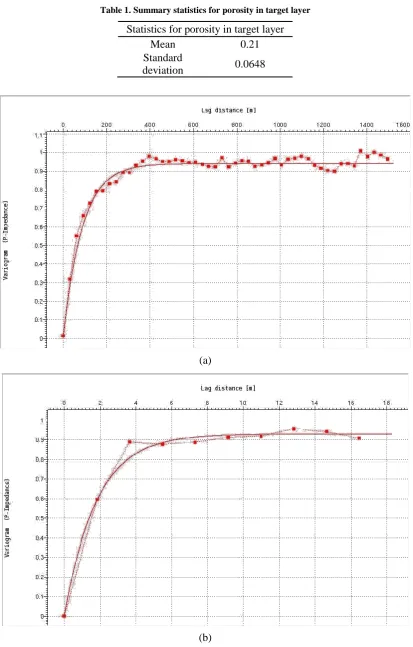
are inferred from the histograms and are shown in Table 1. These statistics should be produced in all output models of porosity. In addition to histograms, lateral and vertical variograms of P-impedance were also produced. To produce lateral variogram of P-impedance, a deterministic inversion using Constrained Sparse Spike method was done and the results were utilized for lateral variography [13]. -impedance log and the production of sonic and density well logs in were used for vertical variography. Figure 2 shows both vertical and lateral variograms and CDFs of P-impedance in target layer.
A stochastic seismic inversion in a Bayesian framework was applied on the target layer in the study area. To reduce edge effect, a non-reservoir layer over the reservoir layer was added to the study area. 50 realizations of P-impedance and porosity were extracted. Figure 3 shows three realizations of P-impedance and their associated porosity in a cross section. Target layer is distinguished from non-reservoir layer in both P-impedance and porosity cross sections by low P-impedance and high porosity.
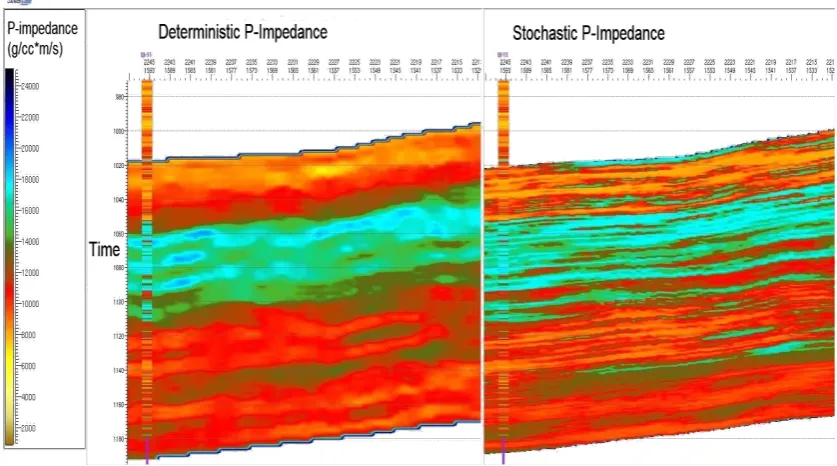
To compare resolution of P-impedance models obtained from both deterministic and stochastic inversion, these two models were compared in a cross section as shown in Fig. 4 shows that stochastic inversion results in models that show more detail than deterministic inversion.
5. Validation of results
Extracting correlation map of synthetic seismogram to seismic data is the first step in validating results in seismic inversion practices. Synthetic seismograms for all P-impedance realizations have been generated and correlation coefficient maps were extracted. Figure 5 shows the correlation maps for four realizations and it is obvious that the correlation coefficient in all realizations is high enough to validate the results.
(a)
(b)
(c)
Moradi et al. / Int. J. Min. & Geo-Eng., Vol.49, No.1, June 2015
Table 1. Summary statistics for porosity in target layer
Statistics for porosity in target layer
Mean 0.21
Standard
deviation 0.0648
(a)
(b)
Fig. 3. Three realizations of P-impedance (upper panel) and associated porosity of them (lower panel) in a cross section
Moradi et al. / Int. J. Min. & Geo-Eng., Vol.49, No.1, June 2015
Fig. 5. Seismic to synthetic seismogram correlation map for four realizations of P-impedance reveals good agreement between synthetic seismogram and seismic data
(a) (b)
Porosity models confirms prior hypothesis about mean and standard deviation of porosity in target layer as summarized in Table 1. Mean and standard deviation of porosity in all realizations are computed and shown in Figure 7. The results show that mean and standard deviation of all realization of porosity are propagated around prior values that are extracted from Table 1.
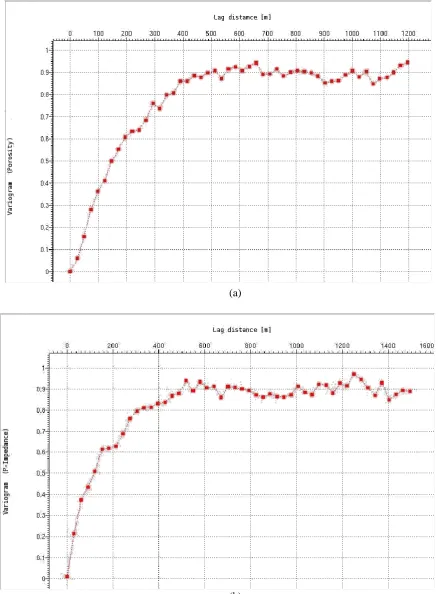
Variogram reproduction is another key factor that should be checked before using results for further analysis. Figure 8 shows lateral and vertical variograms of both porosity and P-impedance in one of the realizations. It is obvious that both variograms were reproduced.
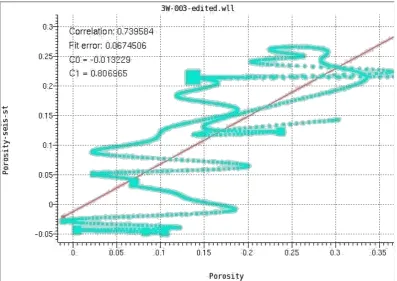
The final validation test is a blind well test. In this test, well 3W-003 was eliminated from the inversion process and the porosity model from stochastic inversion at the well location was compared to well porosity in this well. Figure 9 shows the cross correlation plot of porosity of well 3W-003 vs. porosity-seis-st (which stands for porosity obtained from stochastic seismic inversion). According to Figure 9 the correlation coefficient between porosity of the well and the porosity obtained from stochastic inversion is 74% which is high enough to justify utilization of the stochastic porosity model for further analysis.
(a)
(b)
Moradi et al. / Int. J. Min. & Geo-Eng., Vol.49, No.1, June 2015
(a)
(b)
Fig. 9. Cross correlation plot of the well porosity and stochastic porosity in the well 3W-003
6. Pore volume estimation and uncertainty analysis
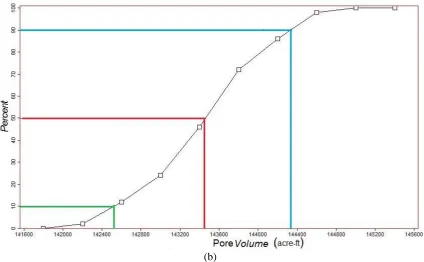
Pore volume is an important parameter in volumetric calculations of hydrocarbon reservoirs [14]. Stochastic inversion provided 50 realizations and consequently, 50 pore volumes. By applying fluid contacts in all realizations, 50 pore volumes for target layer
were extracted. Figure 10 shows the histogram and CDF of pore volumes derived from porosity realizations while pessimistic
(
P
10)
, most probable(P )
50 and optimistic(P )
90values are indicated in green, red and blue solid lines, respectively.
Moradi et al. / Int. J. Min. & Geo-Eng., Vol.49, No.1, June 2015
(b)
Fig. 10: Histogram (a) and cumulative frequency (b) of pore volumes derived from 50 realizations. P10, P50 and P90
are indicated by green, red and blue line, respectively.
7. Conclusion
Stochastic seismic inversion integrates well logs and seismic data to provide petrophysical property models away from well. Integration of data from different sources increases the details in the results. All primary hypotheses about the desired property were successfully accepted through the stochastic inversion algorithm while the input histograms and variograms were reproduced in output models. Stochastic inversion of 3-D post-stack seismic can not only be successfully applied to estimate elastic and engineering properties of subsurface, but can also be applied in analyzing uncertainty in volumetric calculations. In this paper, stochastic inversion was used to infer porosity and acoustic impedance and then an estimation of pore
volume and uncertainty were analyzed.
References
[1].Journel, A. (1989). Fundamentals of geostatistics in five lessons. Volume 8, Short Course in Geology, American Geophysical Union, Washington D.C.
[2].Haas, A. and Dubrule, O. (1994). Geostatistical Inversion –A Sequential Method for Stochastic
Reservoir Modelling Constrained by Seismic Data. First Break 12(11), 561-569.
[3].Tarantola, A. (1987). Inverse problem theory: methods for data fitting and model parameter estimation. Elsevier Science Publ. Co., Inc.
[4].Hansen, T.M., Journel, A.G., Tarantola, A. and Mosegaard, K. (2006). Linear inverse Gaussian theory and geostatistics. Geophysics, 71(6), 101 –111.
[5].Gunning, J. and Glinsky, M. (2004). Delivery: An open-source model-based Bayesian seismic inversion program. Computers & Geosciences, No. 30, P. 619–636.
[6].Sengupta, M. and Bachrach, R. (2007). Uncertainty in seismic-based pay volume estimation: Analysis using rock physics and Bayesian statistics. The Leading Edge, No. 26, P. 184–189.
[7].Bosch, M., Mukerji, T. and Gonzalez, E.F. (2010). Seismic inversion for reservoir properties combining statistical rock physics and geostatistics. A review: Geophysics. 5 (5), 165-176.
[9].Mosegaard, K., & Tarantola, A., (1995). Monte Carlo Sampling of Solutions to Inverse Problems. J. Geophys. 100 (12), 431-447.
[10]. Journel, A.G. and Huijbregts, C.J. (1978). Geostatistical Reservoir Characterization Constrained by 3D Seismic Data. 58th Annual International Meeting of the European Association of Exploration Geophysicists.
[11]. Pendrel, J.V. and Van Riel, P. (1997). Estimating Porosity From 3D Seismic Inversion and 3D Geostatistics. 67th Annual International Meeting of the Society of Exploration Geophysicists.
[12]. Hameed, M., Al-Khaled, O., Al-Qallaf, H., Edwards, K. and Dutta, P. (2011). Highly
detailed reservoir characterization through geostatistical inversion to assess porosity distribution in the Ratawi limestone, Umm Gudair field, Kuwait. SEG Annual Meeting.
[13]. Jason Company (2009), Basic interpretation techniques for seismic inversion (user manual for Fugro-Jason 8.1).