Original Article
Modulation of the Immune Response to DNA Vaccine Encoding
Gene of 8-kDa Subunit of Echinococcus granulosus Antigen B
Using Murine Interleukin-12 Plasmid in BALB/c Mice
Hakim AZIZI 1, 2, Bahram KAZEMI 3, 4, Mojgan BANDEHPOUR 4, Mehdi MOHEBALI 1, 5, Ali KHAMESIPOUR 6, Mojgan ARYAEIPOUR 2, Hajar YAGHOOBI 4,
*Mohammad Bagher ROKNI 2, 5
1. Dept. of Medical Parasitology, Zabol University of Medical Sciences, Zabol, Iran
2. Dept. of Medical Parasitology and Mycology, School of Public Health, Tehran University of Medical Sciences, Tehran, Iran
3. Cellular and Molecular Biology Research Center, Shahid Beheshti University of Medical Sciences, Tehran, Iran 4. Dept. of Medical Biotechnology, School of Medicine, Shahid Beheshti University of Medical Sciences, Tehran, Iran 5. Center for Research of Endemic Parasites of Iran (CREPI), Tehran University of Medical Sciences, Tehran, Iran
6. Skin and Leprosy Research Center, Tehran University of Medical Sciences, Tehran, Iran
Received 14 Feb 2016
Accepted 12 Aug 2016 Abstract Background: The current study was designed to evaluate immune responses induced by DNA vaccines encoding 8-kDa subunit of antigen B (HydI) of Echinococcus granulosus
and murine interleukin 12 (IL-12) as genetic adjuvants in BALB/c mice.
Methods: Expression plasmid pcDNA3.1 containing HydI (pcHyd1) as vaccine along with the murine interleukin 12 (pcMIL12) as adjuvant were used. Thirty-five mice in the five experimental groups received PBS, empty pcDNA3.1, pcHydІ, pcMIL-12, and pcHydІ+ pcMIL-12 in days zero, 14th and 28th. Two weeks after the last immunization,
evaluation of the immune response was performed by evaluating the proliferation of splenic lymphocytes, IFN-γ and IL-4, determination of IgG isotyping titer.
Results: Mice that received the pcHydI+pcMIL12 exhibited higher levels of lympho-cyte proliferation compared to mice that received the pcHydI alone (P<0.001), and Keywords:
Hydatid disease, Th1/Th2, Cytokines, Immunization, Genetic adjuvant, Antigen B
Iranian Society of Parasitology http:// isp.tums.ac.ir
Iran J Parasitol
Open access Journal at http:// ijpa.tums.ac.ir Tehran University of Medical
*Correspondence
Email:
produced significantly more IFN-γ in comparison to other groups (P< 0.001). In addi-tion, they produced significantly less IL-4 than mice receiving the PBS and the empty plasmid (P<0.023). The IgG2a levels were clearly higher in pcHydI+pcMIL12 group in comparison with the groups of pcHydI alone, empty plasmid, and PBS. In contrast, IgG1 was elevated in the group of pcHydI.
Conclusion: Co-delivery of IL-12 with DNA encoding 8-kDa subunit of antigen B was effective significantly in inducing the immune response in mice.
Introduction
ystic echinococcosis (CE), also known as hydatid disease, is a zoonotic and helminthic disease with worldwide dis-tribution caused by the larval stage of Echinococcus granulosus (1).It is found in sev-en continsev-ents, with the highest prevalsev-ence in parts of Eurasia (especially Mediterranean and Middle Eastern countries and China), north and east Africa, Australia, and South America, where human incidence rates are as high as 50 per 100,000 person-years (2-4). This disease has a significant impact on both human and animal health and causes important public health-economic problem with annual esti-mated cost around three billion US dollars in endemic areas (5, 6).
Echinococcosis is preventable (7). Even al-though hydatid control programs have been successful in some countries but the world-wide distribution and the important socio-economic problem of hydatid cyst has not se-riously changed (8). Unfortunately, in many regions hydatid control programs is not appli-cable and available for some reason such as the budget deficit, foreign and domestic wars, mismanagement, the issues of security and political-social-environmental changes (9, 10).
Vaccination is the most effective and effi-cient manner for diseases prevention caused by infectious agents (11). Mathematical mod-els show approaches to control and preven-tion of hydatidosis, including an effective vac-cine for intermediate host and more effective anti-parasitic treatments in definitive host (11, 12). Genetic/DNA vaccines are the new gen-eration of vaccines that have high potential to stimulate both cellular and humoral immune
response as well as to polarize T-cell helper toward type 1 or type 2 by direct injection plasmid expressing the DNA sequence of an-tigen(s) into appropriate tissues of animal (13).
Antigen B (AgB), major antigen in hydatid cyst fluid, is a thermo-stable lipoprotein with a molecular mass of 160 kDa that separate in SDS-PAGE into three bands of 8-12, 16, and 24-kDa; in fact AgB is a combination of mo-nomers 8-kDa. AgB is encoded by at least five main gene clusters, EgAgB1-5 (14, 15).
The current study was designed to evaluate of induced immune responses by DNA vac-cines encoding 8-kDa subunit of antigen B (HydI) of E. granulosus and mouse interleukin-12 (IL-interleukin-12) as genetic adjuvants in BALB/c mice.
Materials and Methods
Mice
Thirty-five female BALB/c mice of 6-8
week age were purchased from Razi Institute (Karaj, Iran). Mice were maintained under specific-pathogen-free, feeding and rearing standard conditions. All experiments were performed according to the Animal Care and Use Protocol of Tehran University of Medical Sciences (Tehran, Iran) and the Ethical Com-mittee of the university approved the study.
Plasmid construction
The eukaryotic expression plasmid pcDNA/Hyd1(pcHydI) has been previously constructed and expressed in eukaryotic cells successfully in our laboratory (16).
Mouse IL-12 was synthesized and sub-cloned into the dual promoter IL-12p70 ex-pression vector pcDNA3.1 (pcMIL-12) (Cin-nagen, Tehran, Iran). The mouse IL-12 p35 subunit (accession number NM_001303244.1) is expressed under control of the human CMV promoter and bovine growth hormone (BGH) polyadenylation signal, while the mouse IL-12
p40 subunit (accession number
NM_001159424.2) is expressed under control of the simian CMV promoter and simian virus 40 (SV40) polyadenylation signal.
The NIH 3T3 cells, mouse embryonic fi-broblast cell line, transfected with plasmid pcM12 were tested for the presence of IL-12 protein by antibody capture ELISA. The plasmid DNA was prepared using the Qiagen Plasmid DNA Purification Kit (Qiagen, USA) according to the manufacturer’s protocol.
DNA immunization
Five groups of mice (seven per group) were
bilaterally inoculated intramuscularly in the
thigh skeletal muscle with 100 μg of plasmid DNA suspended in 100 μl sterile PBS, whe-reas control mice received PBS alone. Group I was injected with PBS as control, group II with empty pcDNA3.1 vector also as control, group III with pcHydI, group IV with pcMIL12, group V with pcHydI plus pcMIL12 (50 μg each). Every mouse was in-jected with same protocol on days zero, 14th and 28th. At two weeks post the last vaccina-tion, blood samples were collected from the heart for serological tests and the spleens of the mice were removed under sterile condi-tions for lymphocyte proliferation assay and cytokine measurements.
Lymphocyte proliferation assays
The lymphocyte proliferation rate was
measured using an MTT
(3[4,5-dimethylthiazol-2-ml]-2,5-diphenyltetrazolium bromide; thiazolyl-blue, Sigma, Germany) dye assay, two weeks after the last immunization.
Briefly, splenocyte suspensions were prepared
from each group of mice by squishing the spleens through a wire mesh under sterile conditions. After the red blood cells was re-moved using ammonium chloride. Splenocytes were resuspended in RPMI 1640 medium supplemented with 10% FCS. One hundred ml of diluted cell suspensions were then plated in 96-well flat-bottom culture plates at a densi-ty of 1×10¹⁰ cells per ml in each well and cul-tured with concanavalin A (Con A; 5 μg/ml; Sigma; positive control), or medium alone (negative control) or 10 μl of the Ag B at
37 °C with 5% CO2 (17).
After 72 h, cell proliferation was determined using an MTT assay (17). Briefly, each well was added with 20 μl of MTT and the plates were further incubated at 37 ◦C for 4 h. then, the supernatant was harvested from each well and formazan crystals were solubilized by add-ing 100 ml of dimethyl sulfoxide (DMSO). After 20 min, the absorbance of each well was measured at a wavelength of 540 nm. Stimula-tion indices were determined and expressed as differences between the absorbance of treated and untreated wells.
Cytokine assays
To evaluate cytokines levels, splenocytes from immunized mice were cultured and res-timulated in vitro with 10 μl of the Ag B sus-pension as described for the lymphoprolifera-tion assay. Cell-free supernatants were re-moved and assayed for interleukin-4 (IL-4), and for gamma-interferon (IFN-γ) activity at 72 h. IFN-γ and IL-4, were measured using ELISA kits according to the manufacturer’s instructions (eBscience, USA). Cytokine con-centrations were determined by reference to standard curves constructed with known amounts of mouse recombinant IFN-γ and IL-4. All assays were performed in triplicate.
Antibody assays
measured by ELISA using 96-well micro-titer plates (18). In brief, following coating micro-titer plates at 4 °C overnight with 100 µl Ag B (with the concentration of 10 µg/ml) in 0.05 M bicarbonate buffer, pH 9.6, the plates were washed with PBS containing 0.05% Tween 20 (PBST-20), pH 7.4, 2 times and non-specific binding sites were blocked with PBS contain-ing 5% FCS for 2 h at 37 °C. After washing the plates with PBST, sera were diluted in 1% PBST-20 (1:100) and added to each well. Plates were incubated for 2 h at room temper-ature, washed three times and incubated with HRP-conjugated rabbit anti-mouse IgG2a, IgG1. After sufficient washes, the reaction was developed by adding 200 ml of TMB/H2O2 substrate. The reaction was ter-minated by the addition of 50 ml of 2.0N H2SO4 and the optical density (OD) was read at 450 nm in a microplate reader (Thermo Scientific Multiskan FC, USA). All assays were performed in triplicate.
Statistical analysis
The lymphocyte proliferation assay and cy-tokine and antibody levels were analyzed by one-way analysis of variance (ANOVA) tech-nique followed by Tukey’s post-test. Signific-ance was set at P<0.05. Using SPSS 16 (SPSS Inc., Chicago, IL, USA).
Results
Lymphocyte proliferation
Lymphocyte proliferation is generally consi-dered a measure of cell-mediated immunity; therefore, Ag B-specific lymphocytic prolifera-tion was evaluated using an MTT assay in two weeks after the last immunization. As shown in Fig. 1, the two groups immunized with
pcHydI plus pcMIL12, and pcHydI alone, in-creased lymphocyte response, compared with the negative control (which received only PBS) (P<0.001). Mice that received the pcHy-dI plus pcMIL12 exhibited higher levels of lymphocyte proliferation compared to mice that received the pcHydI alone (P< 0.001).
Cytokine pattern
We investigated the effect of pcHydI with and without co-injection of pcMIL12 on changes in Th1 and Th2 phenotypes. As shown in Fig. 2, immunized mice with the
pcHydI plus pcMIL12 produced significantly more IFN-γ (Th1-type) in comparison to mice that received either PBS, the pcHydI alone, the pcMIL12 alone or empty plasmid (for all P<0.001).
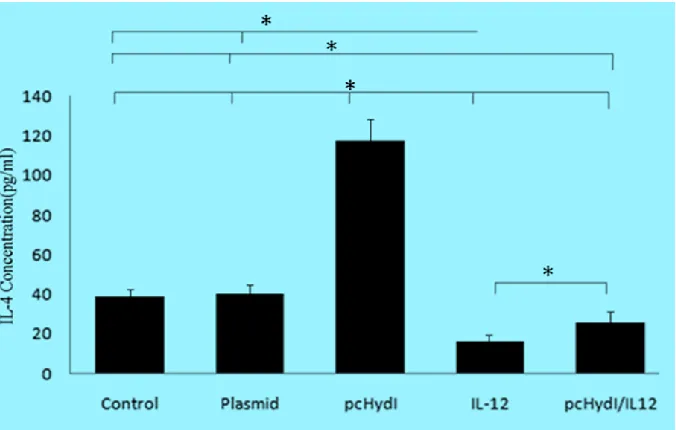
In contrast, lymphocytes from vaccinated mice with the pcHydI alone produced larger amounts of IL-4 (Th2-type) than mice that received PBS, the pcHydI plus pcMIL12, the
Fig. 1: Splenocyte proliferation assay, spleens from individual mice (seven per group) was removed and lym-phocyte proliferation was evaluated by the MTT method. Values represent the mean ± SE. SI=Stimulation Index. Statistically significant differences (P<0.05) are indicated by (*) compared with control, plasmid, pcHydӏ, IL-12 or pcHydӏ/IL-12 group
Immunized mice with the pcHydI+ pcMIL12
produced significantly loss IL-4 than mice re-ceiving the PBS and the empty plasmid (for both P<0.023). The results show that the IL-4 cytokine levels were decreased in the presence of IL-12.
Antibody titer
Considering that IFN-γ and IL-4 are impor-tant to conduct immunoglobulin class switch-ing for IgG2a and IgG1, respectively, the pro-duction of antigen-specific immuneglobulin isotypes were evaluated in the mice at two weeks after final immunization.
Fig. 3:Comparison ofproduction levels of IL-4 from splenocytes in groups control (PBS and empty plasmid), pcHydI+pcMIL12 and pcHydI and pcMIL12. Values are shown as the mean± SE. Statistically significant dif-ferences (P < 0.05) are indicated by (*) compared with control, plasmid, pcHydӏ, IL-12 or pcHydӏ/IL-12 group
The IgG2a levels, as shown in Fig. 4, were clearly higher in the sera of mice treated with the pcHydI plus pcMIL12 in comparison with mice that received the pcHydI alone, empty plasmid and PBS (P<0.002, P<0.001, P<0.001, respectively). The vaccinated mice with the
pcHydI plus pcMIL12 had more IgG2a
com-pared to the mice that received the pcMIL12;
however, the differences were not statistically significant.
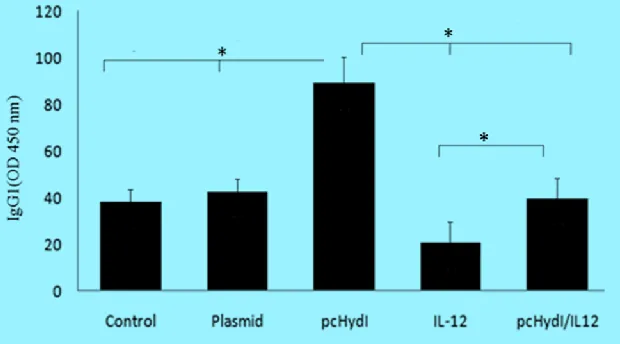
In contrast, antigen-specific IgG1 was ele-vated in the group of mice that received the
Fig. 4: The levels of IgG2a antibody in the sera obtained two weeks after the last immunization were deter-mined. Values represent the mean ± SE. Sera were used at 1/100 dilutions. O.D., optical density at 450 nm. Statistically significant differences (P < 0.05) are indicated by (*) compared with control, plasmid, pcHydӏ, IL-12 or pcHydӏ/IL-12 group
Fig. 5: The levels of IgG1 antibody in the sera obtained two weeks after the last immunization were deter-mined. Values represent the mean ± SE. Sera were used at 1/100 dilutions. O.D., optical density at 450 nm. Statistically significant differences (P < 0.05) are indicated by (*) compared with control, plasmid, pcHydӏ, IL-12 or pcHydӏ/IL-12 group
Discussion
Vaccination of intermediate host is one of the main ways to control of hydatid cyst dis-ease (19). In order to access an appropriate vaccine against hydatid cyst, many studies were performed on various-parasite antigens alone or in combination with different adju-vant such as genetic adjuadju-vant (20-22).
DNA vaccines have several interesting fea-tures for researchers, such as long-lasting im-munity, priming both cellular and humoral specific immune responses, and production of the native form of a given antigen. In addition, the production costs are low and they are easy and quick to product (23). After the first re-port of successful DNA immunization (24), great efforts have been done in developing DNA vaccines for parasitic infections.
In hydatid cyst disease, immunity induced is complex and containing both antibody and cellular components. However, protective outcome is corresponding to Th1 responses, while Th2 responses not only non-protective
but also are associated with progress of the disease (25). Therefore, the potency of the antigen to shift the immune response to spe-cifically the T helper (Th) subtype is important in vaccine design against hydatid cyst agent. Here, for the first time the potential of Ag B (pcHyd1) alone and in compound with murine interleukin (pcMIL-12) to induce protective immune response was investigated in mouse models.
ap-proved that antigen B is immunogenic but has potential to direct the immune system towards Th2 type.
Due to lack of available research on the DNA vaccine of antigen B, our findings were compared to other studies that had been car-ried out on parasitic antigens with same condi-tions including; the amount of vaccine, labora-tory animals, site of injection, repeated injec-tion number and interval time. Comparisons showed that depending on the type epitope(s) into antigen, different results (cellular immuni-ty, humoral or a combination of both) might be obtained (26-29).
Although DNA vaccines have many advan-tages, their ability in inducing immune res-ponses in the absence of suitable adjuvants is poor (23). Enhancing and shifting immune response of vaccinated animal into Th1 or Th2 regulated profiles by the co-administration of genetic adjuvants is one of the advantages of DNA vaccines (23). In this regard, numerous studies have been per-formed on the effectiveness of co-administration of Th1 cytokine-encoding plasmids, such as IL-2, IL-15, IL-18, IL-23, and IFN-γ (30-32). IL-12 is produced by acti-vated antigen-presenting cells such as dendrit-ic cells and macrophages. It facilitates the de-velopment of Th1 responses and is a powerful inducer of IFN-γ production by T and NK cells (33). Hence, in this study IL-12 was used as genetic adjuvant to enhance immune re-sponse to Ag B.
Our observations indicated mice vaccinated with composed pcHydI plus pcMIL12 pro-duce higher IFN-γ. The amount of IFN-γ in
pcHydI-vaccinated mice certified that simul-taneous injection of IL-12 with the pcHydI increased and expanded the Th1 cytokines responses but not Th2 cytokines like IL-4.
IFN-γ promotes isotype switching towards IgG2 in mouse. Our results show that vacci-nated mice with pcMIL12 with pcHydI signif-icantly increased IgG2a production than im-munized mice with pcHydI alone. This results show a shift toward a Th1 immune response.
This finding is in accordance with other studies where co-administration of IL-12 and antigen-encoding plasmid augmented the ability of vac-cine to induce the production of IFN-γ and IgG2a against Toxoplasma gondii (34, 35).
These results clearly indicate that pcMIL12 is a powerful adjuvant that along with vaccine develops a strong Th1 polarization in the im-mune response in mice. Other studies used murine IL12 as genetic adjuvant reported similar findings (36-39).
Conclusion
Co-delivery of IL-12 with DNA encoding the 8-kDa subunit of antigen B hydatid cyst was effective in inducing Th1 type immune response. The higher titers of anti-antigen B IgG2a class antibodies plus the Th1 polarization response may be effective for protecting mice. Therefore, is complementary studies are suggested towards the use of Ag B-DNA vaccines combined with IL12 plasmid to protection against oncosphere of Echinococcus granulosus.
Acknowledgements
The study was supported financially by a grant from Tehran University of Medical Sciences No. 21780. The authors declare that there is no conflict of interests.
References
1. Pakala T, Molina M,Wu GY. Hepatic Echinococcal Cysts: A Review. J Clin Transl Hepatol. 2016; 4(1):39-46.
2. Qingling M, Guanglei W, Jun Q, Xinquan Z, Tianli L, Xuemei S, et al. Prevalence of hydatid cysts in livestock animals in Xinjiang, China. Korean J Parasitol. 2014; 52(3):331-4.
3. Dakkak A. Echinococcosis/hydatidosis: a severe threat in Mediterranean countries. Vet Parasitol. 2010; 174(1):2-11.
5. Torgerson P. Economic effects of echinococcosis. Acta Tropica. 2003; 85(2):113-18. 6. Torgerson P, Budke C. Echinococcosis–an international public health challenge. Res Vet Sci. 2003; 74(3):191-202.
7. Heath D, Yang W, Li T, Xiao Y, Chen X, Huang Y, et al. Control of hydatidosis. Parasitol Int. 2006; 55:47-52.
8. Lightowlers MW,Gauci CG. Vaccines against cysticercosis and hydatidosis. Vet Parasitol 2001; 101(3):337-52.
9. Lightowlers MW. Vaccines against cysticercosis and hydatidosis: foundations in taeniid cestode immunology. Parasitol Inte. 2006; 55:39-43. 10. Craig PS, McManus DP, Lightowlers MW,
Chabalgoity JA, Garcia HH, Gavidia CM, et al. Prevention and control of cystic echinococcosis. Lancet Infect Dis. 2007; 7(6):385-94.
11. Torgerson PR. Mathematical models for the control of cystic echinococcosis. Parasito Inte. 2006; 55(2):53-58.
12. Torgerson P. The use of mathematical models to simulate control options for echinococcosis. Acta Tropica. 2003; 85(2):211-21.
13. Khan KH. DNA vaccines: roles against diseases. Germs. 2013; 3(1):26-35.
14. Chow C, Gauci CG, Cowman AF, Lightowlers MW. A gene family expressing a host-protective antigen of Echinococcus granulosus. Mol Biochem Parasitol. 2001; 118(1):83-88.
15. Mamuti W, Sako Y, Bart J-M, Nakao M, Ma X, Wen H, et al. Molecular characterization of a novel gene encoding an 8-kDa-subunit of antigen B from Echinococcus granulosus genotypes 1 and 6. Parasitol Inte. 2007; 56(4):313-16.
16. Azizi H, Kazemi B, Bandehpour M, Mohebali M, Khamesipour A, Aryaeipour M, et al. Molecular Cloning and Expression an 8-kDa Subunit of Antigen B from G1 strain of Echinococcus granulosus. Iran J Public Health. 2015; 44(7):962-8.
17. Mosmann T. Rapid colorimetric assay for cellular growth and survival: application to proliferation and cytotoxicity assays. J Immunol Meth. 1983; 65(1-2):55-63.
18. Bansal A, Paliwal PK, Sagi SS,Sairam M. Effect of adjuvants on immune response and protective immunity elicited by recombinant Hsp60 (GroEL) of Salmonella typhi against S. typhi infection. Mol Cell Biochem. 2010; 337(1-2):213-21.
19. Woollard DJ, Gauci CG, Heath DD,Lightowlers MW. Protection against hydatid disease induced
with the EG95 vaccine is associated with conformational epitopes. Vaccine. 2000; 19(4):498-507.
20. LI ZJ, WANG YN, Qi W, Wei Z. Echinococcus granulosus 14-3-3 protein: a potential vaccine candidate against challenge with Echinococcus granulosus in mice. Biomed Environ Sci. 2012; 25(3):352-58.
21. Chow C, Gauci CG, Vural G, Jenkins DJ, Heath DD, Rosenzvit MC, et al. Echinococcus granulosus: variability of the host-protective EG95 vaccine antigen in G6 and G7 genotypic variants. Exp Parasitol. 2008; 119(4):499-505.
22. Pirestani M, Dalimi A, Sarvi S, Khoramabadi N. Evaluation of Immunogenicity of Novel Isoform of EG95 (EG95-5G1) From Echinococcus granulosus in BALB/C Mice. Iran J Parasitol. 2014; 9(4):491-502.
23. Wedrychowicz H. Antiparasitic DNA vaccines in 21st century. Acta Parasitol. 2015; 60(2):179-89. 24. Ulmer JB, Donnelly JJ, Parker SE, Rhodes GH,
Felgner PL, Dwarki V, et al. Heterologous protection against influenza by injection of DNA encoding a viral protein. Science. 1993; 259(5102):1745-49.
25. Zhang W, Wen H, Li J, Lin R,McManus DP. Immunology and immunodiagnosis of cystic echinococcosis: an update. Clin Dev Immunol. 2011; 20(12):1-9.
26. Smooker PM, Kennedy NJ, Steeper KR, Christopoulos H,Spithill TW. Fasciola: kinetics and quality of humoral responses to fatty acid binding protein and cathepsin l following delivery as DNA vaccines in mice. Exp Parasitol. 2001; 97(3):154-60.
27. Lança ASC, de Sousa KP, Atouguia J, Prazeres DMF, Monteiro GA,Silva MS. Trypanosoma brucei: immunisation with plasmid DNA encoding invariant surface glycoprotein gene is able to induce partial protection in experimental African trypanosomiasis. Exp Parasitol. 2011; 127(1):18-24.
28. Yan H-K, Yuan Z-G, Petersen E, Zhang X-X, Zhou D-H, Liu Q, et al. Toxoplasma gondii: protective immunity against experimental toxoplasmosis induced by a DNA vaccine encoding the perforin-like protein 1. Exp Parasitol. 2011; 128(1):38-43.
and GRA2 against Toxoplasma gondii. Parasitol Int. 2008; 57(4):424-29.
30. Wozniak TM, Ryan AA, Triccas JA,Britton WJ. Plasmid interleukin-23 (IL-23), but not plasmid IL-27, enhances the protective efficacy of a DNA vaccine against Mycobacterium tuberculosis infection. Infect Immun. 2006; 74(1):557-65.
31. Calarota SA,Weiner DB. Enhancement of human immunodeficiency virus type 1‐DNA vaccine potency through incorporation of T helper 1 molecular adjuvants. Immunol Rev. 2004; 199(1):84-99.
32. Liu Q, Shang L, Jin H, Wei F, Zhu X-Q,Gao H. The protective effect of a Toxoplasma gondii SAG1 plasmid DNA vaccine in mice is enhanced with IL-18. Res Vet Sci. 2010; 89(1):93-97.
33. Wolf SF, Sieburth D,Sypek J. Interleukin 12: a key modulator of immune function. Stem Cells. 1994; 12(2):154-68.
34. Letscher-Bru V, Villard O, Risse B, Zauke M, Klein J-P,Kien TT. Protective effect of vaccination with a combination of recombinant surface antigen 1 and interleukin-12 against toxoplasmosis in mice. Infect Immun. 1998; 66(9):4503-06.
35. Xue M, He S, Zhang J, Cui Y, Yao Y,Wang H. Comparison of cholera toxin A2/B and murine interleukin-12 as adjuvants of Toxoplasma multi-antigenic SAG1-ROP2 DNA vaccine. Exp Parasitol. 2008; 119(3):352-57.
36. Cui Yl, He Sy, Xue Mf, Zhang J, Wang Hx,Yao Y. Protective effect of a multiantigenic DNA vaccine against Toxoplasma gondii with co‐delivery of IL‐12 in mice. Parasite Immunol. 2008; 30(5):309-13.
37. Chen G, Chen H, Guo H, Zheng H. Protective effect of DNA-mediated immunization with a combination of SAG1 and IL-2 gene adjuvant against infection of Toxoplasma gondii in mice. Chin Med J (Engl). 2002; 115(10):1448-52.
38. Schadeck EB, Sidhu M, Egan MA, Chong S-Y, Piacente P, Masood A, et al. A dose sparing effect by plasmid encoded IL-12 adjuvant on a SIVgag-plasmid DNA vaccine in rhesus macaques. Vaccine. 2006; 24(21):4677-87.