Analysis of resistant mutations in reverse
transcriptase domain of hepatitis B virus
from patients from Islamabad, Pakistan
Majid Mahmood1, Muhammad Asim Anwar21Department of Zoology, The University of Poonch Rawalakot Azad Kashmir, Rawalakot 12130, Pakistan.
2Department of General Medicine, Pakistan Atomic Energy Commission (PAEC) General Hospital, Islamabad 44000, Pakistan.
Correspondence to: Dr. Majid Mahmood, Department of Zoology, The University of Poonch Rawalakot Azad Kashmir, Rawalakot 12130, Pakistan. E-mail: [email protected]
How to cite this article: Mahmood M, Anwar MA. Analysis of resistant mutations in reverse transcriptase domain of hepatitis B virus from patients from Islamabad, Pakistan. J Unexplored Med Data 2017;2:60-4.
Aim: To explore nucleoside/nucleotide analogues resistance mutations in hepatitis B virus (HBV) reverse transcriptase (RT) domain from non-responder Pakistani patients. Methods:
Blood samples were taken from 20 chronic HBV patients who were non-responders to different nucleoside/nucleotide analogues. HBV DNA was extracted and a fragment of genome including RT domain was sequenced. The sequence was aligned with wild type HBV sequences and compared with resistant mutations in the RT domain. Results: Resistant mutations were detected in samples of 13 (65%) patients who were non-responders to more than one drug. The mutations were found at amino acid positions rt80, rt135, rt169, rt173, rt180, rt181, rt184 and rt204 and rt248. Mutations rtY135S and rtN248H were detected from 13 (65%) and 12 (60%) samples respectively. Mutations rtL180M and rtA181V were present in 6 (30%) samples, rtM204V and rtV173L in 5 (25%) samples while rtI169P, rtL80G and rtT184Y
were identified from 3 (15%), 2 (10%) and 1 (5%) sample respectively. Conclusion: Nucleoside /Nucleotide analogues resistant mutations rt135, rtL180M, rtA181V, rtM204V, rtV173L and rtN248H are frequent in HBV strains isolated from non-responder Pakistani patients while mutations rtI169P, rtL80G and rtT184Y are also present in low proportion.
Key words:
Hepatitis B virus, resistant mutations, reverse transcriptase, nucleos(t)ide analogues, Pakistan
ABSTRACT
Article history:
Received: 31 May 2017 Accepted: 17 Jul 2017 Published: 31 Oct 2017
Quick Response Code: Original Article
This is an open access article licensed under the terms of Creative Commons Attribution 4.0 International License (https://creativecommons.org/licenses/by/4.0/), which permits unrestricted use, distribution, and reproduction in any medium, as long as the original author is credited and the new creations are licensed under the identical terms.
For reprints contact: [email protected]
Open Access Mahmood et al. J Unexplored Med Data 2017;2:60-4
DOI: 10.20517/2572-8180.2017.13
Journal of
Unexplored Medical Data
www.jumdjournal.net
INTRODUCTION
Six nucleotide/nucleoside analogues (NAs) are so far used for treatment of chronic hepatitis B virus (HBV) infection. These are: lamivudine (LAM), adefovir dipivoxil, entecavir (ETV), telbivudine and tenofovir disoproxil fumarate. All of these drugs act on the
reverse transcriptase region of the viral genome and inhibit its replication[1,2]. Treatment using NAs is not
only more convenient than interferon therapy but also is associated with less side effects[2]. With the passage
diagnostic purposes. All the available data of clinical and demographic importance were collected at the time of sample collection by filling a questionnaire. All the samples were carried to the Hepatology Laboratories, University Hospital of Pisa, Italy, where they were further processed.
DNA extraction
HBV DNA extraction was performed using the QIAamp MinElute Virus Spin Kit (Qiagen, Germany) following the manufacturer’s instructions. DNA was purified from 200 µL of serum and eluted in 60 µL elution buffer.
Sequencing of RT domain
Two fragments of HBV DNA from Polymerase gene including RT domain were amplified. The primer pair LAMes (5’-GGATGTGTCTGCGGCGTTT-3’) and POL181as (5’-GACCCACAATTCKTTGACATACTTT CC-3’) was used to amplify first fragment and the primer pair S_1-2 (5’-CGAACCACTGAACAAATGGC-3’) and P_1 (5’-TCACCATATTCTTGGGAACAAGA-3’) was used to amplify the second fragment. For each fragment, 5 µL of extracted HBV DNA was amplified in a polymerase chain reaction (PCR) mix including Tris hydrochloride buffer, 2 mmol/L Magnesium Chloride, 0.1 mmol/L dNTPs, 2 units of DreamTaq polymerase (Fermentas) and 0.25 µmol/L of each of the respective primer pair. The PCR thermal cycling profile was 3 min at 94 ºC then 35 cycles including 30 s at 94 ºC, 30 s at 55 ºC and, 30 s at 72 ºC, and then 7 min at 72 ºC. After confirming by gel electrophoresis, the products were purified by ethanol precipitation protocol (Beckman Coulter, USA) and subjected to sequencing by chain termination method using commercially available Kit (BeckmanaCoulter, USA). Briefly, 2 µL of purified DNA was mixed with 8 uL of DTCS Quick Start Master Mix, 4 µL of 1.6 µmol/L primer and 6 µL of water. The thermal profile used was 30 cycles of 20 s at 96 ºC; 20 s at 50 ºC and 4 min at 60 ºC. The instrument CEQ 8000 XL Analysis System (Beckman Coulter, USA) was used for sequencing.
Analysis of the sequences
Sequences were initially observed and corrected manually in Chromas-Lite, Version 2.1.0. Initial alignment, editing and joining of both the fragments were performed by Bio-edit and Multalin online tool. The sequences were finally aligned with two wild type HBV genotype D sequence from China and India, obtained from GenBank (accession numbers FJ899792 and AY161159) to detect amino acid substitutions. The sequences were also analyzed for HBV resistance drugs[3-5]. Since the HBV genome does not have a
proofreading ability, the mutations occur with a very high frequency of occurrence[6]. This antiviral resistance is
the most significant factor causing treatment failure in chronic HBV infections[7].
The mutations in the RT domain of polymerase gene have been given specific names according to the nomenclature introduced by Stuyver et al.[8] There are
many mutations in the RT domain which are responsible for primary or secondary resistance against NAs in treatment of chronic HBV. Primary resistant mutations are those which cause an amino acid substitution resulting in resistance to a nucleos(t)ide nucleoside/ nucleotide analogues while secondary mutations, often called compensatory mutations, are those which cause amino acid substitutions to restore the replication capability of viral polymerase[2]. The mutations at
positions rt181, rt204 and rt236 are classified as primary resistant mutations and the mutations at rt173, rt180 and rt250 are classified as compensatory mutations[9]. The
patterns of resistance in the HBV polymerase can be classified into five pathways which includes L-nucleoside pathway (rtM204I/V), the acyclic phosphonate pathway (rtN236T), the shared pathway (rtA181T/V) of both L-nucleoside and acyclic phosphonate, ETV resistance pathway (rtL180M + rtM204V with mutation in one of rtT184, rtS202 or rtM250) and multidrug resistance pathways (rtA181T + rtI233V + rtN236T + rtM250L)[10-12].
Mutations rtY135S and rtN248H have also been found to have role in resistance to Lemivudine and Adefovir respectively[13,14].
In Pakistan, an estimated population of 3-5% are HBV carriers and the response rate of chronic HBV patients ranges from 25.8% to 47.9%[15]. According to published
literature, the response rate is low against nucleos(t) ide nucleoside/nucleotide analogues as compared to interferon treatment in Pakistan[15]. Still there is no
study reporting the mutations responsible for treatment resistance in Pakistan. This study was designed to explore the mutations present in treatment resistant viral strains in Pakistan.
METHODS
Patients and samples
et al.
profile in Geno-2pheno (HBV) online drug resistance tool (Genafor, Bonn, Germany; http://hbv.bioinf.mpi-inf. mpg.de/index.php).
RESULTS
The study included a total of 20 patients who were non-responders to different nucleus(t)ide nucleoside/ nucleotide analogues out of which, 15 were male and 5 were female. Mean age of the patients was 39 years ranging from 23 to 60 years. Genotype D was detected by analysis of S gene sequence in all the 20 samples. RT mutations, well known for their role in resistance were found along with some mutations which do not have a known role in drug resistance. The resistance t mutations were found in 13 out of 20 (65%) samples. These patients were non-responders for more than one treatment including lemivudine, telbivudine, adefovir and entecavir. The mutations were detected at positions rt80, rt135, rt169, rt173, rt180, rt181, rt184, rt204 and rt248 but not at positions, rt194, rt202, rt236 and rt250
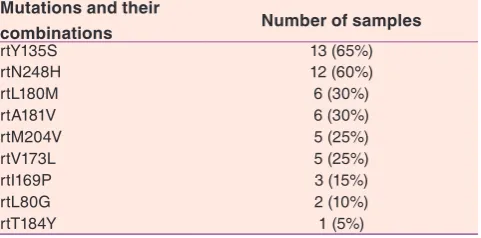
[Table 1]. The most frequent mutations were rtY135S and rtN248H which were detected from 13 (65%) and 12 (60%) samples respectively. The mutations rtL180M and rtA181V, were found from 6 samples (30%) each. Following them were rtM204V and rtV173L, which were found from 5 samples (25%) each. Resistant mutations rtI169P, rtL80G and rtT184Y were identified from 3 (15%), 2 (10%) and 1 (5%) samples respectively. The mutation rtM204I was not found in any of the samples, so on position rt204, all the mutations found were M204V.
Five types of combinations with resistance mutations were found from the study [Table 2]. The most frequent of the combinations was rtY135S + rtN248H which was found from 9 samples. Other combinations were less frequent. Each of the mutations rtY135S, rtN248H, rtA181V and rtM204V was involved in three out of five
combinations while each of the mutations rtL180M and rtI169P was involved in 2 of the combinations [Table 2].
Among the patients initially treated with lemivudine (n = 7), and then switched to adefovir, telbivudine or entecavir, mutations rtY135S, rtA181V and rtL180M were detected from 5 (71%) while rtM204V and rtN248H were found from 3 (43%) patients and mutations rtI169P, rtV173P, rtT184Y from 1 (14%) patient. Among the patients treated with adefovir (n = 8), either as first treatment or second, mutations rtN248H, rtA181V, rtL180M, rtM204V and rtV173P were detected from 4 (50%), rtY135S and rtI169P from 2 (25%) and rtT184Y from 1 (12.5%) sample. In telbivudine treated patients (n = 9), either as first treatment or second, rtA181V and rtL180M were detected from 4 samples (44%), rtY135S, rtA181V, rtM204V and rtN248H from 3 samples (33%) while each of the mutations rtI169P and rtV173P were detected from 2 (22%) patients. Among the patients treated with entecavir (n = 6), either as first or second treatment, the mutations rtY135S, rtI169P, rtV173P, rtL180M, rtA181V, rtM204V and rtN248H were detected from 2 (33%) samples while rtT184Y was detected from one (17%).
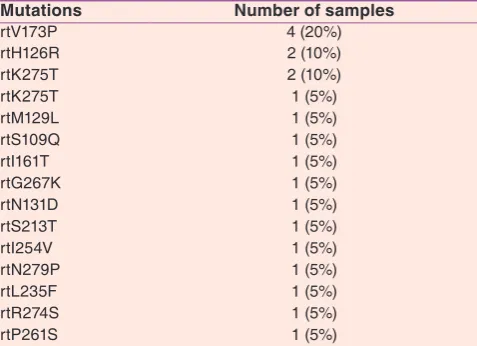
Along with the mutations well known for resistance, 15 mutations with different frequencies were also found in the study which are not yet known for their role in nucleoside/nucleotide analogues resistance. Among them, mutations rtV173P, rtH126R and rtK275T were detected from 4 (20%), 2 (10%) and 2 (10%) samples respectively. Other mutations found from 1 sample each were rtK275N, rtM129L, rtS109Q, rtI161T, rtG267K, rtN131D, rtS213T, rtI254V, rtN279P, rtL235F, rtR274S and rtP261S [Table 3].
DISCUSSION
This is the first study from Pakistan which reveals the presence of resistant mutations in the HBV RT region. In this study, the mutations in the HBV RT region were Table 1: Known resistance mutations found in the study
with their percentages Mutations and their
combinations Number of samples
rtY135S 13 (65%)
rtN248H 12 (60%)
rtL180M 6 (30%)
rtA181V 6 (30%)
rtM204V 5 (25%)
rtV173L 5 (25%)
rtI169P 3 (15%)
rtL80G 2 (10%)
rtT184Y 1 (5%)
Table 2: Combinations of resistance mutations found in the study
Combination of mutations Number of samples
rtY135S + rtN248H 9 (45%)
rtY135S + rtN248H + rtL180M +
rtA181V + rtM204V 3 (15%)
rtL180M + rtA181V + rtM204V +
rtI169P + V173L 2 (10%)
rtY135S + rtI169P + rtA181V 1 (5%)
analyzed in 20 non-responder patients who were under treatment for chronic HBV at the PAEC general hospital in Islamabad, Pakistan. Among those, 65% were detected with drug-resistant mutations indicating the existence of resistance to nucleoside/nucleotide analogues in Pakistani non-responder patients. The resistance due to mutations has already been categorized as the most significant factor in treatment failure in chronic HBV patients[7].
Surprisingly, the mutations rtY135S and rtN248H which are reported in only a few studies previously, were found from the highest number of samples in the present study. Out of these, rtN248H was recently reported and confirmed for its role in adefovir resistance[13].
The mutation rtY135S was also found from treatment resistant strains in high frequency but was not confirmed for its role in resistance[14]. Our results support both of
the studies reporting these mutations as we find them in highest frequency from our treatment resistant patients.
A recently published study[12] reported a little different
results. They also found much of the mutations found by us in lemivudine, adefovir and telbivudine treated patients but in different proportions. In addition, the study authors reported mutations at codon rt236 and rt250 which were not found in our study probably due to a smaller sample size compared with their study. Moreover, the most frequent mutation reported by the study authors was at codon rt204 which is a frequent mutation in our study [Table 1]. They found two types of substitutions at codon rt204, i.e. M204V and M204I but we have traced only the M204V substitution. Similarly at position rt80, they found L80I and L80V mutations instead of L80G found in our study. The difference may
be because of genotypes as we had all samples of genotype D while they had genotype B and C. Overall, our results were to a great extent consistent with their findings, however, our findings need to be confirmed by a study involving a larger sample size.
We did not find the mutation rtA194T which was proposed to be associated with tenofovir resistance by Amini-Bavil-Olyaee et al.[16] The result of another large
study from China[17] also supports our findings in this
regard as they did not find this mutation. Our data is also consistent with another recent study by Chen et al.[18]
who found the mutations rtA181T and rtN236T from lemivudine and adefovir resistant patients, although we did not find rtN236T and rtA181T from our samples.
In addition to common mutation rtV173L, we also detected another variant rtV173P at this position. This mutation is needed to be confirmed for resistance. We did not detect the mutations rtI233V and rtS213T related to adefovir and entecavir/lemivudine respectively which were reported by Ismail et al.[6] from treatment naive
Indian patients. Again, the small sample seize may be the reason for this discrepancy. Thus, more studies with large a sample size are recommended to detect and confirm the mutations related to different nucleoside/ nucleotide resistance from non-responders as well as treatment-naive patients from this region.
The new mutations found in this study were not reported previously to have any role in viral resistance. As these are found from nucleoside/nucleotideanalogues non-responder patients, they may have some role in resistance. Their role in this regard needs to be studied.
In conclusion, nucleoside/nucleotide analogues resistant mutations rtY135S, rtN248H, rtL180M, rtA181V, rtM204V and rtV173L are frequent in the genome of HBV isolated from non-responder Pakistani patients. Mutations rtI169P, rtL80G and rtT184Y are also present. A number of mutations are also present which are as of yet not known for their role in drug resistance.
DECLARATIONS Acknowledgments
Authors acknowledge Dr. Francesco Moriconi, Hepatology Laboratories, University Hospital Pisa, Pisa, Italy, who not only supervised the sequencing and mutational analysis but also revised the manuscript critically. Authors also acknowledge Professor Dr. Ferruccio Bonino, University Hospital Pisa, Italy, who Table 3: Mutations found in the study which are not
known for resistance
Mutations Number of samples
rtV173P 4 (20%)
rtH126R 2 (10%)
rtK275T 2 (10%)
rtK275T 1 (5%)
rtM129L 1 (5%)
rtS109Q 1 (5%)
rtI161T 1 (5%)
rtG267K 1 (5%)
rtN131D 1 (5%)
rtS213T 1 (5%)
rtI254V 1 (5%)
rtN279P 1 (5%)
rtL235F 1 (5%)
rtR274S 1 (5%)
et al.
provided the opportunity of working in his laboratories for all the analysis.
Authors’ contributions
Enrolled and selected the patients for study, collected the clinical data, kept the patients under observation for complete duration of treatment and reviewed the manuscript critically: M.A. Anwar
Extracted and amplified the viral DNA, performed sequencing, analyzed the reverse transcriptase domain for mutations and prepared the initial draft of the manuscript: M. Mahmood
Read and approved the final manuscript: M. Mahmood, M.A. Anwar
Financial support and sponsorship
The study was partially funded by Higher Education Commission of Pakistan in the form of PhD Indigenous Scholarship.
Conflicts of interest
There are no conflicts of interest.
Patient consent
All patients have signed a written informed consent before their participation in the study.
Ethics approval
The study was approved by the institutional ethics committee of PAEC general hospital, Islamabad, Pakistan.
REFERENCES
1. Fung J, Lai CL, Seto WK, Yuen MF. Nucleoside/nucleotide analogues in the treatment of chronic hepatitis B. J Antimicrob Chemother 2011;66:2715-25.
2. Lok AS, Zoulim F, Locarnini S, Bartholomeusz A, Ghany MG, Pawlotsky JM, Liaw YF, Mizokami M, Kuiken C; Hepatitis B Virus Drug Resistance Working Group. Antiviral drug-resistant HBV: standardization of nomenclature and assays and recommendations for management. Hepatology 2007;46:254-65.
3. Salpini R, Alteri C, Cento V, Pollicita M, Micheli V, Gubertini G, De Sanctis GM, Visca M, Romano S, Sarrecchia C, Andreoni M, Angelico M, Parruti G, Svicher V, Perno CF. Snapshot on drug-resistance rate
and profiles in patients with chronic hepatitis B receiving nucleos(t)
ide analogues in clinical practice. J Med Virol 2013;85:996-1004.
4. Lapiński TW, Pogorzelska J, Flisiak R. HBV mutations and their
clinical significance. Adv Med Sci 2012;57:18-22.
5. Hongthanakorn C, Chotiyaputta W, Oberhelman K, Fontana RJ, Marrero JA, Licari T, Lok AS. Virological breakthrough and resistance in patients with chronic hepatitis B receiving nucleos(t)ide analogues in clinical practice. Hepatology 2011;53:1854-63. 6. Ismail AM, Samuel P, Eapen CE, Kannangai R and Abraham P.
Antiviral resistance mutations and genotype-associated amino acid substitutions in treatment-naïve hepatitis B virus-infected individuals from the Indian subcontinent. Intervirology 2012;55:36-44.
7. Locarnini S, Mason WS. Cellular and virological mechanisms of HBV drug resistance. J Hepatol 2006;44:422-31.
8. Stuyver LJ, Locarnini SA, Lok A, Richman DD, Carman WF, Dienstag JL, Schinazi RF. Nomenclature for antiviral-resistant human hepatitis B virus mutations in the polymerase region. Hepatology 2001;33:751-7.
9. Deng L, Tang H. Hepatitis B virus drug resistance to current nucleos(t)ide analogues: mechanisms and mutation sites. Hepatol Res 2011;41:1017-24.
10. Sayan M, Akhan SC, Senturk O. Frequency and mutation patterns of resistance in patients with chronic hepatitis B infection treated with nucleos(t)ide analogs in add-on and switch strategies. Hepat Mon 2011;11:835-42.
11. Locarnini S. Primary resistance, multidrug resistance, and cross-resistance pathways in HBV as a consequence of treatment failure. Hepatol Int 2008;2:147-51.
12. Lei J, Wang Y, Wang LL, Zhang SJ, Chen W, Bai ZG, Xu LY. Profile
of hepatitis B virus resistance mutations against nucleoside/nucleotide analogue treatment in Chinese patients with chronic hepatitis B. Virol J 2013;10:313.
13. Marrone A, Zampino R, Karayannis P, Cirillo G, Cesaro G, Guerrera
B, Ricciotti R, del Giudice EM, Utili R, Adinolfi LE, Ruggiero G.
Clinical reactivation during lamivudine treatment correlates with mutations in the precore/core promoter and polymerase regions of hepatitis B virus in patients with anti-hepatitis B e-positive chronic hepatitis. Aliment Pharmacol Ther 2005;22:707-14.
14. Bo Q, Juan PR, Ting HT, Hui HZ, Shao PG, Yu TC, Ji LM, Wen CX. Polymerase mutations rtN238R, rtT240Y and rtN248H of hepatitis B virus decrease susceptibility to adefovir. Chin Sci Bull 2013;58:1760-6.
15. Ali M, Idrees M, Ali L, Hussain A, Ur Rehman I, Saleem S, Afzal S, Butt S. Hepatitis B virus in Pakistan: a systematic review of prevalence, risk factors, awareness status and genotypes. Virol J 2011;8:102.
16. Amini-Bavil-Olyaee S, Herbers U, Sheldon J, Luedde T, Trautwein C, Tacke F. The rtA194T polymerase mutation impacts viral replication and susceptibility to tenofovir in hepatitis B e antigen-positive and hepatitis B e antigen-negative hepatitis B virus strains. Hepatology 2009;49:1158-65.
17. Liu Y, Wang CM, Cheng J, Liang ZL, Zhong YW, Ren XQ, Xu ZH, Zoulim F, Xu DP. Hepatitis B virus in tenofovir-naive Chinese patients with chronic hepatitis B contains no mutation of rtA194T conferring a reduced tenofovir susceptibility. Chin Med J (Engl) 2009;122:1585-6. 18. Chen CH, Wang JH, Lu SN, Hu TH, Hung CH, Chang MH,