© Strojniški vestnik 47C200138,501 -505 ISSN 0 0 3 9 -2 -4 8 0
UDK 5 3 6 .2
Izvirni znanstveni članek C1,01 3
© Jcxjmsl of Mechanical Engineering 4 7 ( 2 0 0 136,50"l -505 ISSN 0 0 3 9 -2 -4 8 0
UDC 5 3 6 .2
O rig in a l s c i e n ti f ic p a p e r C1.0 1 3
ANALYTICAL AND NUMERICAL STUDY OF DOUBLE
DIFFUSIVE PARALLEL FLOW INDUCED IN A
VERTICAL POROUS LAYER SUBJECTED TO
CONSTANT HEAT AND MASS FLUXES
Abdelkhalk Amahmid, Mohammed Hasnaoui and Samira Douamna
Physics Departm ent, LM FE, Faculty o f Sciences Semlalia, B.P.2390
M arrakech M OROCCO.
ABSTRACT
Multiplicity o f solutions induced by opposing thermal and solutal buoyancy forces in a vertical porous layer subject to horizontal fluxes o f heat and mass is studied analytically and numerically using the Darcy model. The governing parameters for the problem are the Rayleigh number, RT, the Lewis number, Le, the buoyancy ratio, N and the aspect ratio o f the porous matrix, A. The analytical solution developed is based on the parallel flow approximation. The effect o f the parameters Le and N on the multiplicity o f solutions is studied. It is demonstrated, in this study, that numerical multiple steady state solutions, that agree very well with the analytical ones, are possible when the aspect ratio o f the porous layer is large enough. It is also found that the heat and mass transfer depend strongly on the solution considered when multiple steady states are existing. 1
1. INTRODUCTION
Double-diffusive natural convection induced in a fluid- saturated porous medium is widely encountered in engineering applications. This phenomenon is o f importance in many situations like the migration o f moisture through air contained in fibrous insulations, food processing, contaminant transport in ground water, electrochemical processes, etc.
Past studies on double diffusive convection in a vertical porous enclosure indicate that the resulting flows can be very different from those driven by the temperature field solely, especially when the buoyancy forces are opposite. The literature review shows that a limited number o f investigations were concerned with opposing double-diffusive natural convection in rectangular porous enclosures. Trevisan and Bejan (1985) used numerical methods to study heat and mass transfer in a square cavity subjected to temperature and concentration gradients in the horizontal direction. They observed that the Nusselt and Sherwood numbers were minimum in the vicinity o f N = -1. It was demonstrated numerically by Alavyoon et al. (1994) that there is a domain o f N (< 0) in which oscillating convection is
obtained for a given set o f the governing parameters. Outside this domain, the solution approaches steady-state convection. Also, for opposing forces, the existence o f multiple steady solutions has been demonstrated analytically and numerically by Mamou et al. (1995a) and Amahmid et al. (1999a). For a given value o f N, it was demonstrated by Mamou et al. (1995b) that both Lewis and Rayleigh numbers have an influence on the domain o f existence o f these multiple steady state solutions. For the case o f opposing and equal buoyancy forces (N = -1) the rest state, in a vertical cavity with constant temperature and concentration on the vertical walls, is an exact solution o f the problem. However it was demonstrated by Mamou et al. (1998a) and Charrier-Mojtabi et al. (1998), by mean o f linear stability theory, that the onset o f convection occurs when the Rayleigh number exceeds a critical value which depends on the aspect ratio o f the cavity and the Lewis number. The case o f a vertical cavity with constant gradients o f temperature and concentration prescribed on the vertical walls o f the enclosure has been also considered by Mamou et al. (1998b). A linear stability analysis was carried out to describe the oscillatory and the stationary instability in terms o f the governing parameters o f the problem. By using the parallel flow approximation it was demonstrated that there exists a subcriticai Rayleigh number at which a stable convective solution bifurcates from the rest state through finite amplitude convection.
The objective o f the present investigation is to study the effect of the Lewis number and the buoyancy ratio on the mulitiplicity o f solutions in the case o f opposing double diffusive natural convection in a vertical porous layer subject to horizontal gradients o f heat and mass.
2. M ATHEMATICAL M ODEL
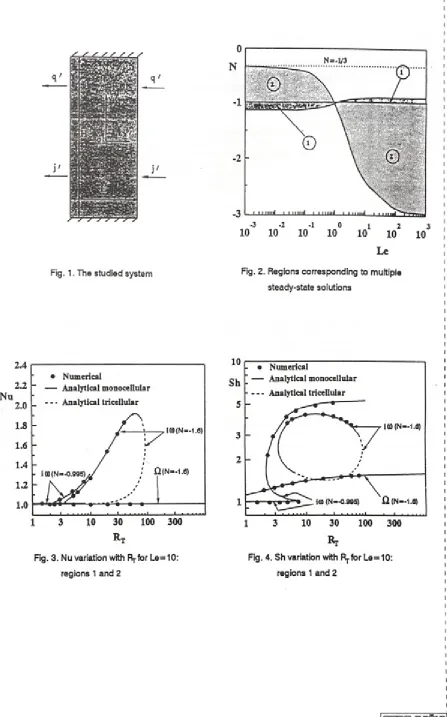
The studied configuration is a two dimensional rectangular porous matrix o f height H' and width L ' . The geometry o f the enclosure is sketched in Fig. 1. The vertical sides o f the
enclosure are submitted to constant fluxes o f h e a t,q ', and
mass, j ' , while its horizontal sides are insulated and impermeable. The fluid saturated porous medium is assumed isotropic and homogeneous and the Darcy model is considered. Using the Boussinesq approximation and assuming constant properties, the dimensionless equations governing this problem are:
V 24 - - R t( 3 I +n^ )
dx dx (1)
9T ^ 5T w2t u ---1- v — = V T
dx dy (2)
as
dS _ 2c,dx dy (3)
The velocity components are related to the stream function by
dV
dy ' dx (4)
where 'T is the stream function, T the temperature, S the concentration, RT the thermal Darcy-Rayleigh number, N the buoyancy ratio and Le the Lewis number. These parameters are defined as:
Rt - g / W L '2
l a v N = I s J ’/D/JTq7 A and Le = A
where ßT and ßs are the thermal and solutal expansion coefficients, a and D are the thermal and solutal diffusivities and K is the permeability o f the porous medium.
The boundary conditions for Eqs. (l)-(3) are:
^ = 0; dT / dx = d S / dx = I for x = ± l / 2 (5)
' V=f f T/ dy = d S / d y = 0 for y = ± A /2 (6)
where the aspect ratio o f the enclosure is defined by A= H' / L'
The heat and mass transfers are evaluated in terms o f the Nusselt and Sherwood numbers which are given respectively by:
Nu ------- ; Sh = ---l---- (7) T(—, 0 ) - T ( —- , 0) S ( - , 0 ) - S ( - - , 0)
2 2 2 2
Note that, according to the boundary conditions (Eqs. (5) and (6)), the thermal buoyancy forces tend to induce a counterclockwise fluid circulation while the solutal buoyancy forces tend to induce a clockwise fluid circulation for N<0 (case o f opposing flows) and a counterclockwise fluid circulation for N>0 (case o f cooperative flows).
3. RESULTS AND DISCUSSION
For large aspect ratio (A » 1) it has been demonstrated in the past by Alavyoon et al. (1994) that the present problem can be significantly simplified by the approximation o f the parallel flow. With this approximation u = 0 and v = v(x) in the central part o f the cavity, i.e., outside the end regions. The approximation allows the following simplifications:
^ (x .y ) = 'T(x), T = C Ty + 0T(x) and S = Cs y + 0s (x) (8)
where CT and Cs are unknown temperature and concentration gradients respectively in y direction. Those gradients are determined by imposing zero heat and mass transfer across any transversal section o f the cavity. Using these approximations, together with the boundary conditions (5) and (6), Eqs. (1) to (4) are reduced to a set o f ordinary differential equations which can be solved to yield a closed analytical solution. Depending on the sign o f the parameter T defined by
r = R T (NLeCs + CT ) (9)
two solutions are possible.
For T>0, we set T=f22 and the solution o f the simplified governing equations (denoted fi-solution), satisfying the boundary conditions in x-direction, is:
'F = Acosh(f2x) + a (10)
T = CTy + (1 - a C T)x - C T A'sinh(Qx) (11)
S = C s y + (l-a L e C s ) x - LeCs A 'sinh(fìx) (12)
where A=-a/cosh (H/2), A '=AJCl and a=RT(N +l)/ Q2
The expressions o f CT and Cs can be established by imposing zero heat and mass transfer across any transversal section which yields:
CT = A ,/(1 + A 0); Cs = L e A ,/(l + Le2A0) (13)
Then, Nu and Sh are given by:
Nu = 1 /(1 — CT A , ); Sh = l/ ( l - L e C s A [) (14)
where
Ao -^3- - — (tanh(Q / 2))2 a 3 and A[ = 1- -3t-tanh(n/2)
To compute the value o f ST, an equation o f this parameter is established by combining Eqs. (9) and (13):
aA2n 4 - R T2(N + 1)2 (A0Le2 +
1 + N -)A ,= 0 15)
where A 2 = 1 + A0 + A 0Le2 + A 02Le2
Note that the Q-solution consists o f a unicellular flow circulating in counterclockwise direction for N>-1 and in clockwise direction for N<-1.
I B E ^ i = n n ° i f ö w i i ^ ^
For r <0, we set F =-co2 and the resulting solution (denoted i(o-solution) can be deduced by setting fJ=ico in the above solution. Since sinh(im)=isin(co) and cosh(ico)=cos(co) it is readily found that the solutions are similar to those given by Eqs. ( 10)-( 12) with the hyperbolic functions replaced by circular functions. The parameter to can be computed from the following equation
bB2tu4 - R T2(N + l)2(B0Le2 + 1 + N^ 2 )B ,= 0 (16) 1 + N
where
B 2 = 1 + B0 + B0 Le 2 + B02 Le 2
Bo = h2 “ “ (tan(ca / 2))2
2 b 3
Bi = b(l —— tan(ft)/2)) and b = - R x (N +l)/cu2
CO
Analytical and numerical treatment of Eqs.(15) and (16) showed that the domain where multiple steady state solutions are possible in the plane (Le, N) is represented by regions 1 and 2 o f Fig. 2. It is clear that these regions correspond to opposing thermal and solutal buoyancy forces and are included in the domain -3<N<-l/3.
By solving Eq. (16) it is found that three monocellular ito- solutions can be obtained for the same governing parameters in the small domain represented by region 1 in Fig. 2 when RXmil <RX ^ RXmax. The limits RXmin and RXmax depend on Le and N. They can be determined numerically by solving Eq. (16). For example, these three solutions are possible when -l<N<-0.8922 for Le=10 and when -l<N<-0.8897 for Le>1000. Note that the fluid circulations corresponding to these three solutions are in the same direction (clockwise for Le<l and counterclockwise for Le>l). The values o f RXmin and RXmax that delimitate the range o f Rx for which multiple solutions exist are functions ofN and Le (not presented here). It is found that RXmil changes slightly with N while RXmax tends towards infinity when N approaches -1.
The presence o f multiple monocellular ito-solutions in the region 1 o f Fig. 2 is also demonstrated numerically by solving the full governing equations (l)-(4). The numerical technique used in this study is similar to that described by Amahmid et al. (1999b). The numerical results obtained are illustrated in Figs. 3 and 4 in terms o f Nu and Sh as functions o f RT for Le=10 and N=-0.995. The computations were performed with aspect ratios A in the range 6<A<9. It can be seen from these figures that three analytical solutions are observed for 2.22<RX<7.8. Two of these solutions were obtained numerically. Let coi, to2 and co3 denote the values o f co corresponding to these solutions such that co1<co2<coj. It is noted that the two solutions obtained numerically correspond to co, and co3. That corresponding to co2 was not obtained numerically despite the multiple favourable initial conditions tested. The difference between the two solutions obtained numerically in terms o f Nu remains less than 25%. However, the Sherwood number changes considerably from one solution to the other. At RT =7, for example, the solution co, leads to Sh=1.002, while that corresponding to co3 leads to Sh=4.51, i.e., four times higher than the first value.
Multicellular ico-solutions consisting o f (2m +l) cells (m =1, 2, 3,...), are also possible for values o f N very close to -1 inside region 1 o f Fig. 2. But these solutions could not be obtained numerically in the present work. It is noted that even when N is very close to -1, the changes observed in the number o f existing solutions are extremely different from those found for N=-l when Rt is increased. For example, for Le=10 and N—0.995, there is a unique monocellular solution for Rt <2.22, the number o f solutions passes to three monocellular solutions for 2.22<RX<7.8, drops to a single monocellular solution for 7.8< Rx <67.5, passes again to three solutions (one monocellular and two three-cells solutions) for 67.5< Rx <459, rises to five solutions (one monocellular, two three-cells solutions and two five-cells solutions) for 459< Rx <3958, drop to three solutions (one monocellular and two three-cells solutions) for 3958< Rx <6385 then to a single monocellular solution for Rx >6385. It is clear then that the number o f ico-solutions undergoes increases and decreases when Rx increases. However, the number o f solutions can only increase with Rx for N=-l (Amahmid et al., 1999a). Also, when a flow mode m (i.e a flow consisting o f (2m+l) cells) appears, it does not disappear by further increasing Rx for N = -1.
For region 2 it is found that an Q-solution is always existing regardless o f the value o f Rx. Furthermore, for adequate ranges o f Rx, multiple ico-solutions (two or more) are possible in this region. It is found that this region satisfies the following equation:
- 1 < N < N 0 for L e< l and N0 < N ^ - 1 for L e>l
where N0 is given by
3Le2 +2-/3Le + l
N o = — 5---r
---Le2 +2V3Le + 3
For any couple (Le, N) in region 2, it can be demonstrated analytically that there exist two values o f Rx for which the velocity is zero on the vertical boundaries and the opposing effects o f thermal and solutal buoyancy forces act such that the Darcy model satisfies the no-slip boundary conditions on the vertical boundaries. This condition is satisfied nowhere in the rest o f the (Le, N) plane. The values o f Rx for which this behavior is obtained are:
- d ±W - 12Le2
3Le2(N + l)2
where
[(l + 3Le2 + N (3+Le2)] N + l
Also it can be verified that the flow direction for any monocellular ico-solution depends only on the sign o f (Le-1) (clockwise for Le<l and counterclockwise for Le>l). While it is noted that the flow direction for the fi-solutions depends on the sign o f (N+l). This implies that the direction o f the flow is imposed by the component (temperature or concentration) with the highest diffiisivity in the case o f ico-solutions and by the one with the highest buoyancy forces in the case o f Q-solutions.
The multiplicity o f steady state solutions in region 2 is illustrated in Figs. 3 and 4 in terms o f Nu and Sh variations with Rt for N=-1.6 and Le=10. The solutions presented in these figures are constituted by one Q-solution and two ita-solutions. It can be seen from Figs. 3 and 4 that the Q-solution is analytically possible for any given value o f RT while the io>- solutions are possible only in the range 3.49<RT <92.7. Furthermore, there exist values o f RT at which the io-solutions pass from monocellular pattern to three-cells pattern. Numerically, it was demonstrated that it is possible to obtain only two monocellular solutions (one Q-solution and one ico- solution) for 5<Rt <60. If we focus our attention only on the solutions obtained numerically, it can be noted that the best heat and mass transfers are generated by the ico-solution for which Nu and Sh pass through maximum values when RT increases. This means that, for this kind o f opposing flow, the increase o f Rt may lead to a decrease o f Nu or Sh. For the Q-solution, Nu and Sh have asymptotic evolutions (Nu«1.006 and Sh«1.609 at large RT) and the heat transfer is always dominated by diffusive effects regardless o f the value o f RT. It is noted that the analytical monocellular Q and ica-solutions consist o f clockwise and counterclockwise rotating cells, respectively. It should be noted that for 5<RT <20, it was found that an aspect ratio A=4 was sufficient to predict numerically the analytical results for both Q and io-solutions. For this range o f RT, a secondary flow consisting o f two small vortices confined inside the main cell are induced in the case o f the numerical Q-solution. The secondary cells are located in the upper and lower parts o f the enclosure. However, for the same range o f RT, the secondary flow is not observed for the numerical ico-solution. It appears only when RT >20 and consists o f two secondary clockwise rotating cells located in the upper right and lower left comers of the enclosure. The expansion o f these cells in the vertical direction, when Rx increases, is found to affect gradually the parallel nature o f the flow in the core region. In this case, higher values o f A are required to predict the analytical results. Note that the parallel nature o f the flow was not affected by the presence o f the secondary cells in the case o f Q-solutions even at large values o f RT.
The above discussion shows that in region 2, up to three monocellular solutions are possible for the same set o f the governing parameters (one Q-solution and two im-solutions). The flow rotation for the ico-solutions is opposite to that for Q- solution. However, for region 1 the cells are rotating in the same direction for all the monocellular solutions
Analytically, it can be demonstrated in region 2 that there exists values o f RT for which the flow consists o f n vertical cells rotating in the same direction (clockwise for Le<l and counterclockwise for Le>l). 4
4. CONCLUSION
Double-diffusive natural convection in a vertical porous layer submitted to constant fluxes o f heat and mass on its vertical sides is studied analytically and numerically. It is found that multiple steady state solutions are possible when the thermal and solutal buoyancy forces have opposing effects. The values of the buoyancy ratio for which this phenomenon is observed are always included in the range -3<N<-l/3 for any value o f the Lewis number. This means that the multiplicity o f solutions is possible only when the thermal and solutal buoyancy forces have opposing effects and are o f the same order o f magnitude. The analytical study shows that, for adequate ranges o f RT, three analytical monocellular ico-solutions, rotating in the same direction, are possible in region 1 (Fig. 2). While in region 2
two monocellular ico-solutions, rotating in the same direction, and one Q-solution, rotating in the opposite directions, are possible. The rotation direction corresponding to monocellular ico-solutions is imposed by the component (temperature or concentration) having the highest diffusivity (i.e depends on Le) while that corresponding to Q-solutions is imposed by the component having the highest buoyancy forces (i.e depends on N). Numerically, two o f the three monocellular solutions were obtained. Also for the same set o f governing parameters, two different solutions (when these exist) can induce considerable differences in terms o f Nu and Sh. For region 2 there are values o f Rt such that the flow velocity is zero on the vertical boundaries for the ico-solutions meaning that the opposing buoyancy forces act as though the Darcy model satisfies the no slip condition on the vertical boundaries.
REFERENCES
Alavyoon, F., Masuda, Y. and Kimura, S., On natural convection in vertical porous enclosures due to opposing fluxes o f heat and mass prescribed at the vertical walls, Int. J. Heat Mass Transfer, voi. 37, pp. 195-206, 1994.
Amahmid, A., Hasnaoui, M. and Vasseur, P., Etude analytique et numérique de la convection naturelle dans une couche poreuse de Brinkman doublement diffusive, Int. J. Heat Mass transfer, vol. 42, pp. 2991-3005, 1999a.
Amahmid, A., Hasnaoui, M. Mamou M. and Vasseur, P., Boundary layer flows in a vertical porous enclosure induced by opposing buoyancy forces, Int. J. Heat Mass transfer, voi. 42, pp. 3599-3608, 1999b.
Charrier-Mojtabi M.C., Karimi-Fard M., Azaiez M. and Mojtabi A., Onset o f a double-diffusive convection regime in a rectangular porous cavity, J. Porous Media, 1, 107-121, 1998.
Mamou, M., Vasseur, P., Bilgen, E. and Gobin, D., Double diffusive convection in an inclined slot filled with porous medium, European Journal o f Mechanics B/Fluids, voi. 14, 29- 652, 1995a.
Mamou, M., Vasseur, P. and Bilgen, E., Multiple solutions for double-diffusive convection in a vertical porous enclosure, Int. J. Heat and Mass Transfer, voi. 38, 1787-1798, 1995b.
Mamou, M., Vasseur, P. and Bilgen, E., A Galerkin finite element study o f the onset o f double-diffusive convection in an inclined porous enclosure, Int. J. Heat and Mass Transfer, voi. 41, 1513-1529, 1998a.
Mamou, M., Vasseur, P. and Bilgen, E., Double-diffusive convection instability in a vertical porous enclosure, J. Fluid Mech., 368, 263-289, 1998b.
Fig. 1. The studied system
L e
Fig. 2. Regions corresponding to multiple
steady-state solutions
1 3 10 3 0 100 3 0 0
Fig. 3. Nu variation with Rffor Le=10:
regions 1 and 2
Rr
Fig. 4. Sh variation with Rr for Le=10: