Page 460
ON STUDENTS’ MOTIVATION FOR TRAINING AT UNIVERSITY OF RUSE TRACKED IN THE CONTEXT OF THE MAIN FUNCTIONS OF EDUCATION
Boryana Todorova
University of Ruse, 8 Studentska Str., Ruse 7017, Bulgaria
Abstract
The article deals with the main functions of education and related tasks. They are separated into groups stemming from the three aspects of education, viewed as a form, content and sense. At their base, also in three groups, the most likely motivating factors that young people are expected to share when applying for a certain university specialty, are brought out. So are the students who are already studying in the university.
A questionnaire study has been held among the students from different specialties of Ruse University - engineering, health and humanitarian, so that their motivation for scholastic education may be studied. A correlation has been sought between the basic motives, brought forward by the students, and those ones, deduced on the basis of theoretical research.
Key words: functions of education, education as form, content and sense, students’ motivating factors, motivation for education, questionnaire study
1. STUDIES ON THE MOTIVATION OF STUDENTS IN BULGARIA
The motivation of candidate students, as well as students themselves, for training in various specialties of higher education in Bulgaria in recent years, has been the subject of analysis and research in a number of documents and publications. We will note only a fraction of them.
The Strategy for Development of the Higher Education in the Republic of Bulgaria for the period 2014-2020 (2015) was ratified by a Decision of the National Assembly on February 26, 2015. The document reports a reduction of interest among potential candidates to pursue a higher education in Bulgaria. T. Kotseva and others, within the project study, investigated the attitudes of students and their opinions on motivated attendance at classes (Kotzeva, Baltadjieva & Mineva 2013b, 2013a). The methods used include: focus group with students, a questionnaire to study the causes of attendance and absenteeism of classes, semantic differential and a self-estimating questionnaire about life plans of students in the short and long run.
A contribution to research is "A questionnaire to assess the level of academic motivation" of A. Velichkov (Radoslavova & Velichkov 2005) containing eleven statements. Through the answers to seven of them the high motivation of the students is sought for. These relate to: striving to obtain permanent knowledge, seeking additional information on an interesting problem, pursuit of high success, attendance of lectures, seeking information from teachers, in libraries and internet, taking down notes during lectures. The other four are proven low motivation. They report: learning for minimum knowledge, a lack of interest in theoretical details, cutting lectures and seminars due to lack of interest in school material, a lack of interest in learning and its meaning.
Page 461
D. Nikova (2011) considers the long-term motivation as a psychic dimension of students’ innovation activity. In the empirical study there was used a questionnaire to explore the long-term motivation and a test study of innovation activity.
A. Rashidov (2011) applies another approach. He uses statistical methods to rank the preferences of candidates for training in various specialties. The study is based on the arrangement of the majors by the applicants.
B. Broadbent (2003), through the view point of the manager, reveals the accompanying conditions that create situations of high motivation, namely: a positive attitude of other people, experienced pleasure, a sense of self-importance, the achieved success, personal benefit, the clarity of the problem thus raised. The question of personal motivation excites students themselves. In March 2014 Faculty of Engineering and Pedagogy of Sliven, a branch of Technical University of Sofia (2014), conducts Internet Youth Conference "Young People and Modern Europe". A significant part of the materials of the conference discussed the motivation of students to study engineering. In 2010 Varna Free University "Chernorizets Hrabar" (2010) held a contest on writing an essay entitled "Motivation for Higher Education".
The present study uses a different approach. The motivation of candidate students to pursue higher education in a specific field, is assessed according to the seriousness they impart to the pre-formulated motivating factors, the latter are submitted to be reviewed in the questionnaire. Those factors stem from the inherent functions of education, considered as an element of the social system. On the other hand, the motivating factors indicate a close relationship with congenial values. This outlines the triangle of mutual penetration and conditioning: value system - motivating factors - functions of education.
2. MAIN FUNCTIONS OF EDUCATION, CONSIDERED AS A FORM, CONTENT AND SENSE
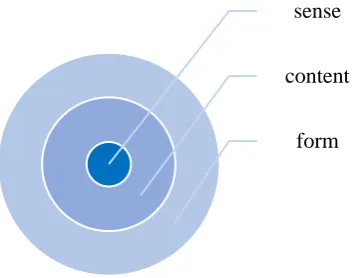
The main functions and tasks of education resulting from its essence (Todorova 2009), stand out in three areas - education, considered as a form, content and sense (Figure 1).
Figure 1. Three aspects of education
2.1. Education as a form
In form education is a universal transfer of accumulated human experience from one generation to the next one. Experience is expressed in the attained knowledge, practical skills and accepted beliefs, the result of centuries-old human activity. This aspect is manifestation of the living universal memory of mankind, of stored knowledge and dissemination of ideas.
Education as a form finds expression in all, really revealed, educational structures and processes. It is represented by the educational system itself, taken in its wholeness and specific structure. An essential
sense
content
Page 462
element is the unified teaching- learning process, its organization, goals and objectives, curricula, educational contents, methods and means of training. It organizes and puts in synergy various educational institutions of different levels, teachers and teaching staffs, students from different levels of education, all necessary equipment, training aids, didactic materials, etc.
2.2. Education as content
In content education is a preparation of the younger generation through the acquisition of knowledge, skills and attitudes to participate in the development and prosperity of a more harmonious society. This harmony is being sought as in the structure, relations and hierarchical relationships, in the manifestation and the development of society as a whole, also in the co-links that it builds in terms of the separate individual and in social and natural environment in its comprehensiveness. A main factor for the achievement of the harmonious development is the value system both of society itself and of each individual.
The content is sought, in the opportunities, which allow for the acquired knowledge and skills to be transformed into new methods to achieve new knowledge and skills in the process of practicing the acquired profession. In this sense, education as content, means a transition of the acquired knowledge into a new quality of methodological kind. Thus, the preparation of young people of today is not only directed towards the development of economics, to meeting the needs of the labor market and to its specific requirements at present, to the existing professions of nowadays. It is known how quickly some of them become obsolete and disappear, and how quickly and unexpectedly new ones arise. The focus here is laid on the system of a lifelong learning, as well as on a broad-scaled and flexible professional training.
2.3. Education as sense
The sense of education is the full realization of talents, abilities and potentials of every member of society with the purpose of a maximum developing of one’s personality. With this approach, everyone is encouraged, at any instant, to give the best of oneself. This is respect to each gift, to the beautiful and to the good that everyone carries within. Making the best of all potentials of the members of a community guarantees its active development and prosperity. This should be both an aspiration of the individual and a subject of public concern.
As determined in this way, the sense of education correlates with the sense of human life. Such an approach creates active, accomplished and happy members of society and it is an expression of the highest ethics in the system of education.
In the process of training these three aspects of education develop simultaneously and they are in a constant interaction on each other. Such education continues throughout one’s life as in its various stages an individual’s views, attitudes, aspirations and beliefs change, he/she develops new skills, revises one’s priorities, shows different qualities of the self.
Based on the formulated form, content and sense of education, a system of criteria and indicators can be developed both to assess its quality, and to seek approaches for its improvement.
3. FACTORS IN THE MOTIVATION OF CANDIDATE STUDENTS IN THEIR CHOICE OF SPECIALTY FOR TRAINING IN HIGHER EDUCATION
Page 463 First group motivating factors "Professional Community"
I-1 Acquiring relevant specialized knowledge and skill. I-2 Becoming part of a particular social/professional group. I-3 Becoming part of a tradition.
I-4 Joining the family business.
Second group motivating factors "Professional Realization"
II-1 Finding a job more easily. II-2 Securing higher incomes.
II-3 Securing a higher standard of life. II-4 Being useful/helpful to others. II-5 Securing a successful career abroad.
Third group of motivating factors "Personal Development"
III-1 Working in a place that corresponds to your inner inclinations. III-2 Entering into an intriguing and exciting experience.
III-3 Developing one’s talents and abilities to the utmost.
III-4 Finding and developing new qualities of one’s personality, unsuspected even by your own self. III-5 Feeling oneself most satisfied.
4. MATERIAL AND METHOD
An inquiry among 197 first-year students from 12 specialties of the University of Rousse, immediately after being matriculated in 2015, was held. The questionnaire included 14 motivating factors, mentioned above. The students were asked to mark them with points from 0 to 10 based on their personal motivation in choosing a specialty. An opportunity was given for the list of motives to be supplemented by the individual students according to their inclinations. A few questions about demographic markers of students’ gender and age were also included.
Those students are of the following specialties (the ciphers and professional fields are according to the Classifier of areas of higher education and professional fields (2002), approved by Decree No 125 of the Council of Ministers of 24.06.2002, the SG. 64 of 2.07.2002):
Professional fields and specialties: 1.2. Pedagogy
Primary School Pedagogy with a Foreign Language /PSPFL/ - 12 students Pre-school and Primary School Education /PPSE/ - 13 students
4.5. Mathematics
Financial Mathematics /FM/ - 9 students
4.6. Informatics and Computer Sciences Computer Science /CS/ - 13 students
5.1. Mechanics
Page 464 5.5. Transport, Navigation and Aviation
Transport Vehicles and Technologies /TVT/ - 19 students Technology and Management of Transport /TMT/ - 17 students
7.4. Public Health
Physiotherapy /PT/ - 25 students
Occupational Therapy /OT/ - 17 students
7.5. Health Care
Midwifery /M/ - 34 students Nursing Care /NC/ - 24 students
5. RESULTS OF THE INVESTIGATION
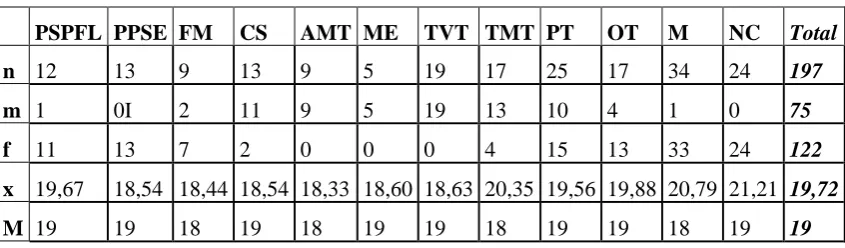
The results of the inquiry into the distribution of the students in majors and the demographic indicators are presented in Table 1.
PSPFL PPSE FM CS AMT ME TVT TMT PT OT M NC Total
n 12 13 9 13 9 5 19 17 25 17 34 24 197
m 1 0I 2 11 9 5 19 13 10 4 1 0 75
f 11 13 7 2 0 0 0 4 15 13 33 24 122
x 19,67 18,54 18,44 18,54 18,33 18,60 18,63 20,35 19,56 19,88 20,79 21,21 19,72
M 19 19 18 19 18 19 19 18 19 19 18 19 19
Table 1. Distribution in majors and demographic indicators of gender and age with the inquired students
The meaning of symbols in Table 1 is: n – number of students;
m - number of male students; f - number of female students; x – applicants’ age average;
M – mode (most frequently occurring or repetitive age of applicants).
Page 465
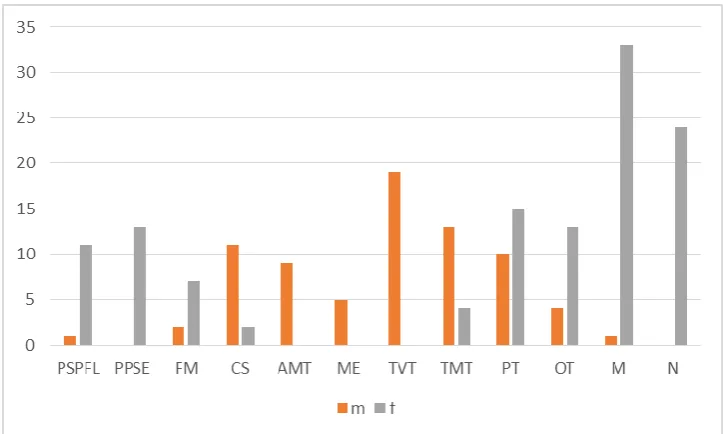
Figure 2. Distribution of the inquired students in majors
The gender distribution is highly uneven in different specialties. In three of the engineering majors the inquired are only men, while with two other kindred specialties - Computer Science and Technology and Management of Transport, women represent a very small part of all participants. So the total number of the involved in the study, about those five majors, was 57 men and 6 women.
The ratio, by gender, in pedagogical and health fields, is just the opposite. From the pedagogical specialties in the inquiry only 1 man and 24 women took part, and from the health ones - 15 men and 85 women. Beside the expected full feminization of specialties Midwifery and Nursing Care, similar results in pedagogical majors cannot be considered positive.
Page 466
The age of the inquired students in specialities is represented by the arithmetic mean and the mode of the distribution. It was found that the majority of applicants are 18 and 19 years old, which means that they have completed their secondary education in the year of application or one year before that. Only 25 students, of all included in the study, were of age 20 to 49. Most of them have chosen specialties Technology and Management of Transport, Midwifery and Nursing Care.
The proposed motivating factors in the questionnaire list were marked differently by the admitted students into various disciplines. With 188 of the inquired, at least one of the motives is marked with maximum score 10. Among the marking of the remaining 9 students there is, at least, one mark 9. This result shows that all inquired students have a high motivation to pursue a higher education in their chosen specialty.
It should be noted that only one student of all the inquired added one additional motive to the proposed evaluation list when filling up the questionnaire. The student is majoring Transport Vehicles and Technologies, and the motive he pointed out was, "to gain experience through practice and probation work abroad." The fact, that all other students were able to articulate their motivation through the proposed motives, points to two possible conclusions. The first one is that the derived motivating factors are sufficiently comprehensive; they express the whole range of attitudes, expectations and values which in the ongoing research become motives. Another possible explanation may be, that the students do not comment on personal and additional grounds, due to the lack of interest for the most accurate presentation of their own motivation for learning or simply to sloth.
The average scores for the importance of the motivating factors in different specialties are presented in Table 2.
PSPFL PPSE FM CS AMT ME TVT TMT PT OT M NC Total I-1 6,83 8,15 8,89 6,85 8,67 9,00 8,26 7,29 8,64 5,71 8,29 5,04 7,50 I-2 5,67 7,23 5,56 3,62 6,78 5,20 4,89 6,35 5,32 4,35 6,85 5,00 5,62 I-3 3,17 4,85 1,44 1,92 5,22 5,20 2,37 4,18 1,76 2,12 2,15 4,08 2,94 I-4 1,08 4,00 1,11 1,46 6,11 2,60 2,37 3,59 1,32 2,41 2,00 3,46 2,50 II-1 7,08 5,38 7,00 6,92 8,11 5,60 4,84 6,35 5,32 4,76 7,41 5,46 6,12 II-2 3,92 5,15 7,89 8,08 7,33 5,80 6,63 7,18 7,52 5,76 5,32 4,75 6,16 II-3 5,67 6,62 8,89 8,31 6,67 4,60 6,84 7,65 8,04 6,53 6,71 6,04 6,95 II-4 6,08 6,77 3,89 3,92 5,67 4,20 3,32 4,24 7,80 6,94 7,06 5,96 5,84 II-5 5,17 4,38 7,11 5,15 5,89 4,40 4,58 5,41 6,68 6,53 6,29 5,38 5,71 III-1 4,33 5,85 4,89 4,62 6,33 4,40 6,89 7,12 5,88 5,59 5,88 6,21 5,86 III-2 5,92 4,92 4,44 4,46 5,44 3,60 4,53 5,06 4,20 4,82 2,97 6,04 4,59 III-3 5,50 4,77 5,44 5,62 5,56 4,40 7,42 6,65 7,12 6,06 5,26 5,08 5,88 III-4 5,83 6,08 4,67 5,15 5,56 1,80 6,21 5,59 6,24 6,12 6,32 4,50 5,65 III-5 5,42 7,54 3,78 6,23 7,56 4,00 7,11 8,06 6,56 7,47 7,38 5,38 6,64
Total 5,12 5,84 5,36 5,16 6,49 4,63 5,45 6,05 5,89 5,37 5,71 5,17 5,57
Page 467
According to them, the most highly motivated students are those from two engineering specialties - Agricultural Machinery and Technologies and Technology and Management of Transport, which are followed by some health and pedagogical majors - Physiotherapy, Pre-school and Primary School Education and Midwifery. The lowest motivation is with Mechanical Engineering, which, in recent years, has emerged as an issue of national significance (Figure 4).
Figure 4. The average score on the motivating factors in majors
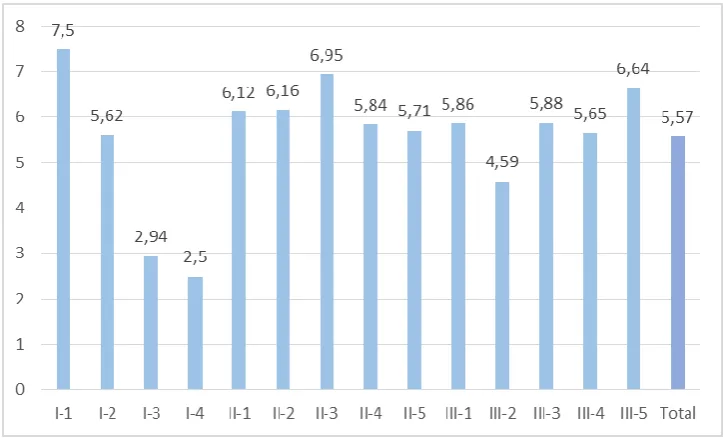
If the results in the groups of motivating factors, set out on the list (Figure 5), are discussed, the following can be noted:
Page 468
The majority of students study for knowledge - the highest average score is obtained for Motivating factor I-1. With the exception of this motive, the other factors in Group 1 “Professional Community" do not rank high. It is here that the motives have got the lowest score - Motivating factors I-3 and I-4. This means that the importance of traditionalism in professional areas, the role of professional communities and especially family professional traditions is not great. The importance of professional communities is highly appreciated by the students of Pre-school and Primary School Education, Midwifery, and Agricultural Machinery and Technologies, which are among the subjects with a high average motivation, quoted above. These professional communities, however, are well organized and have a role and appearances in society at a national or regional level. The conclusion, about the importance of professional organizations in motivating young people to study definite subjects, is obviously prevailing. The motivating factors of Group 2 "Professional Realization" are rated higher than the other two groups - the first one and the third one. It is here that motive II-3, with its second highest rating of all 14 factors, stands out. We understand that young people expect a higher education to provide them with a better standard of life, as they rely on higher salaries, on finding a job more easily, and last but not least, on being useful to other people and eventually, on finding a professional realization abroad. It is only with specialty Agricultural Machinery and Technologies that finding a job is associated, in the assessment, with including the family business. However, many students from almost all specialties expect a better realization on the labor market.
Page 469 REFERENCES
Andonova, A 2010, ‘Comparative research for “The professional motivation” of the students from different specialties and educational institutions’, Management and Education, vol. VI, no. 4, рр. 294-298.
Bayrakova, S 2015, ‘Professional values and motivation with students’, PhD thesis, South-West University “Neofit Rilski”, Blagoevgrad.
Broadbent, B 2003, ‘Motivating Others’, in M Silberman (ed.), The Active Manager's Tool Kit, Editeur: Mc Graw Hill, pp. 35-40.
‘Classifier of areas of higher education and professional fields’ 2002, State Gazette, no. 64, 2 July,
<http://www.mon.bg/?go=page&pageId=7&subpageId=58>.
Faculty of Engineering and Pedagogy of Sliven, a branch of Technical University of Sofia 2014, Internet Youth Conference "Young people and modern Europe."
<http://www.tu-sliven.com/DistanceEducation/KonferenciqInternet2014.html>.
Kotzeva, TI, Baltadjieva, YS & Mineva, KH 2013a, ‘Academic motivation through students’ and lecturers’ opinions’, Annual of Burgas Free University, Burgas, vol. 29, pp. 160-167.
Kotzeva, TI, Baltadjieva, YS & Mineva, KH 2013b, ‘Students’ attitudes towards higher education and academic achievement motivation’, Proceedings of the Scientific conference with international participation “Knowledge – traditions, innovations, perspectives”, Burgas Free University, Burgas, vol. 1, рр. 190-202.
Nikova, D 2011, ‘A long-term motivation – personal-psychical aspect of the University of National and World Economy students’ innovation activity (empirical study)’, Economic Alternatives, no. 5, pp. 79-94.
Radoslavova, M & Velichkov, A 2005, Methods of psychodiagnosis, Pandora Prim, Sofia.
Rashidov, A 2011, ‘Method for ranking of specialties in higher education’, Conference paper of International scientific conference Unitech`11, Gabrovo, vol.1, pp. 513-518.
‘Strategy for development of the higher education in the Republic of Bulgaria for the period 2014-2020’ 2015, State Gazette, no. 18, 10 March, <http://www.mon.bg/?h=downloadFile&fileId=6523>
Todorova, B 2009, ‘The education quality - an element of the quality of society’, Proceedings of the Second national conference with international participation “The quality of higher education in Bulgaria - problems and prospects”, Ruse, vol. 2, pp. 108-114.