Page 530
A LANDSCAPE ARCHITECTURE PROGRAM FOR ALBANIA Zydi Teqja1, Samuel F. Dennis Jr 2
1
Agricultural University of Tirana, Koder Kamez, Tirana, Albania 2
Department of Landscape Architecture and Nelson Institute for Environmental Studies, University of Wisconsin, 42A Agricultural Hall, 1450 Linden Drive, Madison, WI 53706, USA
Abstract
Landscape architecture is a new discipline. It was significantly present in Western European university education programs just after World War2. A new wave of Landscape architecture programs was verified during ’90 in former “Eastern Europe” and some other countries like Spain, Island and Austria. The European Landscape Convention gave new stimulus to these developments. More than 200 Landscape architecture programs around world are analyzed in this study. The history of Landscape architecture programs shows that the approaches to this discipline are very diverse. While in some countries the roots of landscape architecture go back to horticulture, in other countries it is grown out of ecology and environmental sciences and moreover from architecture and planning. Albania still doesn’t have an accredited program for landscape architecture. The aim of this paper is to propose a Landscape architecture curriculum for Albania based on international experience and the actual situation of the country.
Key words: landscape architecture, curriculum, horticulture, architecture
1. INTRODUCTION
In September 1990, President Bush awarded to Ian McHarg, the founder of the department of landscape architecture at the University of Pennsylvania in the United States, the national medal of art. His book “Design with Nature” pioneered the concept of landscape ecological planning. It continues to be one of the most widely celebrated books on landscape architecture and land-use planning. In this case he stated: “I hope that in 21st century the largest accomplishment of art will be to restore the earth.” Actually at the second decade of 21st
century, as the global population rapidly grows and as global environmental problems bring an array of challenges to planning our built environments, landscape is becoming critically important (McHarg I. (1969; McHarg I. (1996).
After 1990 Albania experienced tremendous changes, as it applied a rapid model of transition to market economy. Population started to move freely and to settle themselves in other parts of the country, which were either close to the sea or to urban centers, job opportunities and other services. This flux of population was not possible to be managed because of the lack of knowledge and experience on modern urban and land management policies. The most damaged areas from this process where public green spaces.
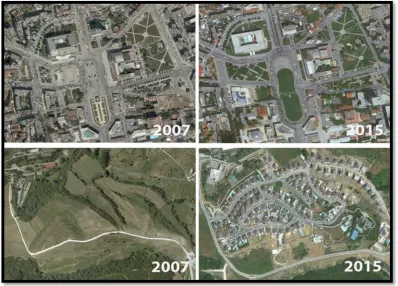
During last decade a lot of changes happened in urban areas: In 2007 for the first time the majority of Albanian population lives in urban areas; there is a national program aiming to normalize the situation of illegal constructions; there are public investments to improve the situation of urban parks and green areas; there are private investments in suburban areas to build residential gated communities for high income people (Figure 1). But though there are improvements, the situation is far from being normal. Urban green space continues to be under strong pressure. Policy makers tend to view green space more as a luxury good than as a basic necessity, and appear to overlook the potentially important effects of landscape and green space on health, well-being, and safety. How Albania will face the existing illegal and informal development as well as addressing how best to prevent in the future such development will depend on several factors but among them preparing of a new generation of experts that could deal successfully with land use, landscape design and environmental problems is crucial.
Page 531
Established on November 1st, 1951 as the Higher Agricultural Institute with the status of a university, in 1991 it was given the name Agricultural University of Tirana (AUT). Actually, the university offers studies in the areas of: Agro-environment and Ecology, Biotechnology, Horticulture and Landscape architecture; Plant Protection; Plant Genetic Improvement, Veterinary Public Health, Animal Clinic, Farm Management, Agrarian Policy, Animal Husbandry, Forest Exploitation and Wood Processing, etc. Since the year 2001, AUT has been involved with a new restructuring process according to the "Bologna Declaration". Starting from the academic year 2005-2006, AUT has started organizing studies in conformity with the 3+2+3 schedule (Bachelor, Master and PhD).
Figure 1. Views of Tirana landscape changes during the period 2007-2015. (Above center of Tirana; down the suburban area of Tirana)
Source: www.geoportal.asig.gov.al
2. A GENERAL OVERVIEW OF UNIVERSITIES AND DEPARTMENTS WITH
LANDSCAPE ARCHITECTURE DEGREE PROGRAMS
Page 532
– August 28, 1903) is considered to be the father of American landscape architecture. The first study program at graduate level was established at Harvard University in March 1900. So for once, the “New World” has an older academic history than Europe (Motloch, 2001; Murphy, 2005; Waterman, (2009).
Landscape architecture has since become a worldwide profession, recognized by the International Labor Organization and represented on a world-wide basis by the International Federation of Landscape Architects. However, landscape architecture is a new discipline. It was significantly present in Western European university education programs just after World War2. A new wave of Landscape architecture programs was verified during ’90 in former “Eastern Europe” and some other countries like Spain, Island and Austria. The European Landscape Convention gave new stimulus to these developments (Jørgensen, 1999; Anagnostopoulos et al. 2000).
244 universities from North America, Europe, Asia and Australia were analyzed in this study regarding their profile and the profile of the departments that offer a landscape architecture program. Table 1 shows the structure of the universities analyzed in this study.
Table 1. General data on the universities analyzed in this study
World area No. of Universities Private Public Before WW II After WW II After 1990
North America 80 13 67 75 5 0
Europe 83 7 76 37 46 19
Asia &Australia 81 27 54 37 44 6
Total 244 47 197 149 95 25
From the table we can see that the universities that offer degree programs of landscape architecture in USA are established mainly before World War 2, while in the rest of the world they are mainly new universities established after World War 2. Even more, in Europe a significant number of universities are quite new, they are established after the fall of the communist bloc in the beginning of ’90.
Page 533
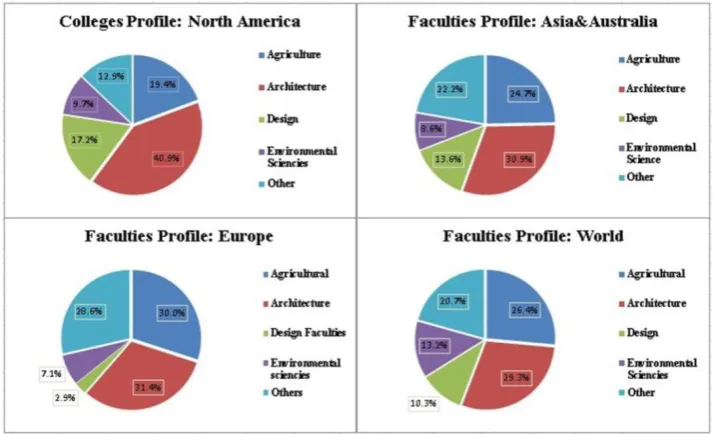
Figure 2 clearly shows that the profile of the most faculties/colleges that offer landscape architecture degree is related with two fields; agriculture and architecture. In Europe there is almost equilibrium between these two fields, while in USA there is a clear supremacy of architectural schools.
Figure 3. The profile of departments that offer landscape architecture degree
When we come at department level, most of the departments that provide landscape architecture degrees have a clear profile of landscape architecture (Figure 3). This is more evident in USA and less in Asia and Australia.
3. LANDSCAPE ARCHITECTURE EDUCATION IN NORTH AMERICA
In most of the land grant universities in the United States, landscape architecture began in the College of Agriculture. Instruction in landscape design and planning dates back to 19th century, when courses incorporating principles of ornamental planting and the art of laying out gardens and pleasure grounds were offered in different horticulture programs. During twentieth century the profession in USA was grown very rapidly, as Ian McHarg quotes: “No other profession has achieved as rapid a transformation from oblivion to social significance as has landscape architecture” (McHarg, (1996).
Actually in USA there are different institutions that manage and guide the process of education/training in landscape architecture. Some of them are: The Landscape Architectural Accreditation Board (LAAB), The American Society of Landscape Architects (ASLA), The Landscape Architecture Body of Knowledge Study (LABOK), the Council of Educators in Landscape Architecture (CELA), and the Council of Landscape Architectural Registration Boards (CLARB) ASLA (2008); ASLA (2016).
Page 534
removed. It is possible that the definition of baseline landscape architecture education will slowly shift and diversify as more and more content is added and/or shifted.
The Landscape Architecture Accreditation Board (LAAB) accredits professional degree programs in landscape architectural. To do that, the Board creates and applies Standards and Procedures. In addition to assessing how well a program meets its own specific and institutional educational mission and objectives, LAAB evaluates each program against standards that define the essential educational components leading to entry-level professional competence. These standards are developed by consensus of the community of interest and are regularly reviewed and assessed. LAAB is composed of landscape architecture practitioners and academicians, representatives from landscape architecture collateral organizations, and representatives of the public. The collateral organizations are: American Society of Landscape Architects (ASLA); Council of Landscape Architectural Registration Boards (CLARB); Council of Educators in Landscape Architecture (CELA).
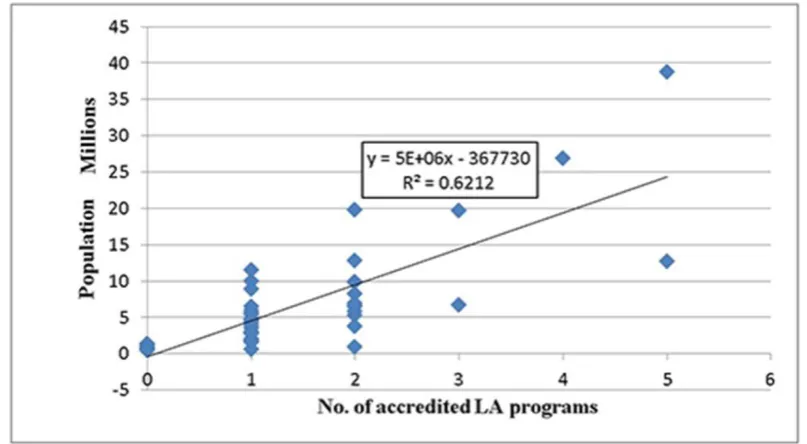
Actually there 69 accredited landscape programs in USA. Figure 4 shows that there is a good relationship between state population and the number of accredited landscape architecture programs.
Figure 4. The relationship between US states population and accredited landscape architecture programs
Accreditation is a nongovernmental, voluntary system of self-regulation and self-evaluation. Accreditation can be sought at both institutional and specialized levels. Institutional accreditation is concerned with an institution as a whole, specialized accreditation with a specific degree program. Recently (March 2016), LAAB published the updated accreditation standards for First-Professional Programs in Landscape Architecture.
3.1 Minimum Requirements for Achieving and Maintaining Accredited Status
In its publication “Accreditation Standards” (March 2016), LAAB has formulated the minimum requirements for achieving accredited status for first-professional programs in landscape architecture as follows:
Page 535
3. A graduate first-professional program must be a master's program equivalent to at least three academic years' duration.
4. Faculty instruction full-time equivalence (FTE) requirements are as follows:
a. An academic unit that offers a single first-professional degree program at the emerging or Initial Accreditation status has at least three FTE instructional faculties who hold professional degrees in landscape architecture, at least one of whom is full-time.
b. An academic unit that offers a first-professional degree program at both the bachelor’s and master’s levels at the emerging or Initial Accreditation status has at least six FTE instructional faculty, at least five of whom hold professional degrees in landscape architecture, at least two of whom are full-time in the department.
c. An academic unit that offers a single first-professional degree program at the continuing full accreditation status has an FTE of at least five instructional faculty, at least four of these faculty members hold a professional degree in landscape architecture, at least three of whom are full-time in the department.
d. An academic unit that offers first-professional degree programs at both the bachelor’s and master’s levels with continuing full accreditation status has an FTE of at least seven instructional faculty, at least five of whom hold professional degrees in landscape architecture and are full-time in the department.
5. The parent institution must be accredited by a recognized institutional accrediting agency (such as the U.S. Department of Education or CHEA).
6. There must be a designated program administrator responsible for the leadership and management functions for the program under review.
7. The program must provide a comprehensive public information disclosure about the program’s status and performance within a single-click link from the program’s website.
8. The program must:
• Continuously comply with accreditation standards, • Pay the annual sustaining and other fees as required, and • Regularly file complete annual and other requested reports.
LAAB recommends seven standards to be achieved by any higher education institution that asks to have accredited programs in landscape architecture: 1) Program Mission and Objectives. The program shall have a clearly defined mission supported by goals and objectives appropriate to the profession of landscape architecture and shall demonstrate progress toward their attainment; 2) Program Autonomy, Governance, and Administration. The program shall have the authority and resources to achieve its mission, goals and objectives; 3) Professional Curriculum. The first-professional degree curriculum shall include the core knowledge, skills, and applications of landscape architecture; 4) Student and Program Outcomes. The program shall prepare students to pursue careers in landscape architecture; 5) Faculty. The program shall advance its academic mission and objectives by means of promoting the qualifications, academic position, professional activities, and individual professional development of its faculty and instructional personnel; 6) Outreach to the Institution, Communities, Alumni, and Practitioners. The program shall have a plan for and a record of interaction with its alumni, the larger institution, the professional community, the local community, and the public at large; 7) Facilities, Equipment, and Technology. The program shall provide faculty, students, and staff access to facilities, equipment, libraries, and other resources necessary for achieving the program’s mission and objectives.
Page 536
also. The Standards are reviewed and updated every five years through a process articulated in Board Procedures.
4. LANDSCAPE ARCHITECTURE EDUCATION IN EUROPE
The history of landscape education in Europe starts with a program established at the Norwegian University of Life Sciences in 1919. In Berlin it was established in 1929, in Lisbon in 1941 and Wageningen in 1947 (Jørgensen, 1999). The British Landscape Education Group was set up in the early 1970s, while the German University Landscape Conference dates from the later part of the decade. The first pan-European meeting of landscape schools was convened by Berlin Technical University in 1989 under the title European Conference on Landscape Higher Education. At the 2000 Conference in Dubrovnik, Croatia, a decision was taken to change the name of the organization to the European Council of Landscape Architecture Schools (ECLAS). In 2006 ECLAS was incorporated as a not-for-profit member organization, and it is a corporate member of IFLA Europe (International Federation of Landscape Architects-Europe). IFLA Europe and ECLAS are two of most influential non-governmental landscape institutions in Europe (Maniglio-Calcagno, A. et al, 1992; Jørgensen, 1999).
According to IFLA and ECLAS publications landscape architecture education in Europe has the following brief history:
1. 1919–1948: This period saw the development of courses in landscape architecture in a small number of countries, with one university in the country beginning to offer landscape architecture education. The pioneering phase ended in about 1948/9. In this period the first university courses were set up in a number of European countries.
2. 1949–1973: This period produced several new landscape architecture programs in many countries in Europe. A period of significant growth in new degree programs took place from 1949/50 until the early 1970s. This growth period was driven by the social needs of post-war reconstruction, together with a growing environmental concern. Again, a gradient is visible in the establishment of landscape architecture programs between North-West Europe, where the discipline developed strongly, and the east and south of Europe, where fewer landscape architecture programs were established.
3. 1974–1991: During this period, few new programs were established, but existing programs increased their numbers of staff members and students. During this time the interest of young people in choosing landscape architecture as their field increased significantly, and numbers of enrolled students increased, as did the scope and scale of landscape issues.
4. 1991–2003: During this time, new landscape architecture programs were established, after the fall of the Iron Curtain. The fall of the Iron Curtain, in 1989, resulted in the (re)establishment of several new countries and beginning in 1991, several new university degree programs were established. While most of these are located in East and South-East Europe, including the Baltic, some new programs were also set up, for the first time, in Western European countries, including in the Republic of Ireland, Austria, Italy, Spain and Iceland.
5. 2003- Current period: Further consolidation and coordination. Landscape architecture schools are implementing policies of the Bologna Agreement and, since 2008, of the European Qualification Framework (EQF), of the Council of Europe and the European Union. They are encouraged to implement policies of the European Landscape Convention also.
Page 537
graduated in these faculties were practically horticulturists, urban planners or environmental engineers with some knowledge on landscape architecture.
To support Bologna process and to address the problem of wide diversity and trying to encourage understanding and cooperation between different landscape architecture schools, EU financed different projects. Among them are: LE: NOTRE and EU-teach. LE: NOTRE stands for: New Opportunities for Teaching, Research and Education, while EU-teach is the project titled “Implementation of Relevant European Teaching Contents in the Studies of Landscape Architecture” (LE: NOTRE, 2010; 2011). LE: NOTRE was organized by the European Council of Landscape Architecture Schools, ECLAS. The document “Tuning Landscape Architecture Education in Europe” produced by this project provides terms of reference for teaching and learning at institutes of higher education in the field of landscape architecture. It describes the field of landscape architecture and its areas of knowledge and expertise. A central theme of research into landscape architectural education has been on the definition of core disciplines and advanced disciplines.
The EU-Teach project provided a full and comprehensive review of the education requirements and of the curriculum required. The lists are to be used as a practical framework and a recommendation for teachers and students of landscape architecture underlying the importance of the diversity of course curricula.
4.1 Professional Recognition and Accreditation of Landscape Architecture Degrees
Professional recognition and accreditation for landscape architecture degrees exists on a European level and a national level. On the European level there are two processes: the principles of professional recognition laid out in the Professional Qualifications Directive (Directive 2005/36/EC) of the EU and the professional educational recognition by IFLA Europe. On the national level recognition and accreditation differ according to the rules and regulations in each country.
The Professional Qualifications Directive came into force in October 2005. Article 47 of the EU treaty specifies that directives shall be issued for the mutual recognition of diplomas. Based on the fact that the profession of landscape architecture is regulated in some of the EU countries landscape architecture can be seen as a regulated profession. Professional recognition aims to allow a holder of a diploma awarded in one member state to be entitled to practice the profession in any of the other countries; what counts are the qualifications specified in the diploma.
If a profession is regulated it is up to each member state; whether and how it regulates a profession / professional activity or not. If a member state has not made special regulations for the profession of landscape architecture, then all EU citizens can carry out professional activities on the same conditions as the citizens of the member state, unless the activities are regulated as part of another profession. IFLA Europe recognizes programs for landscape architecture from a professional point of view. For this it has developed a set of guidelines for the content of programs and a procedure for recognition. The content of programs was presented as a list of relevant European teaching contents in the studies of landscape architecture by EU-Teach project. Core competences of landscape architecture center on the process of intervention in landscapes to create new or revitalized places, by means of landscape planning, design and management, as well as by project implementation. The core competences are organized in 6 groups: 1) European basics; 2) Theory and methodology in Landscape architecture; 3) Different fields of landscape architecture; 4) Participatory planning; 5) Information technologies in landscape architecture and, 6) Professional practice of landscape architecture in Europe.
Page 538
One recommendation that comes from EU-Teach project is to establish European-wide teaching clusters where European universities could focus on their core competences and, at the same time, offer students courses with relevant European contents at a high professional level all over Europe. Recognition is possible for first cycle programs as well as for second cycle programs. Regarding the procedure for recognition, the most important requirements are (ECLAS, 2010):
A minimum duration of 4 years for a full time landscape architecture program; Making sure that the content of the program relates to defined areas of knowledge;
A minimum of 50% of studio teaching in which students in an integral way work on design and/or planning projects.
Although there is no direct formal effect of the professional recognition by EFLA, this recognition is important for degree programs because it has an effect on formal accreditation and validation. In many countries one of the criteria of the evaluation of the programs is whether the program is recognized within the international context. The aim of EFLA in collaboration with ECLAS is to develop a Common Education Platform based on a comparison of two thirds of the countries in which the profession of landscape architect is regulated (ECLAS, 2010).
The title landscape architect in Europe varies in its acceptance and its legal status. Generally, in North West Europe, landscape architecture is well established and recognized de facto by both public and private sector. In some countries, for instance Germany and The Netherlands, the title is protected while in Scandinavia and the UK anyone can use the title, but in fact the profession is well recognized. In Russia the usual title is “green engineer” and landscape architect has a lesser currency. In some countries, where the title landscape architect is not officially recognized, support for future recognition is needed, including international organizations (ECLAS, 2010).
Kühnau C. (2012), prepared a list of relevant European teaching contents, developed during the EU-teach project, rated as “very important” for bachelor or master programs by either participating universities or EFLA members, but that are underrepresented in the current curricula at the universities involved. Part of this list are: History of European societies/cultural development; Landscape narratives; Diversified meanings of landscape; Need-based assessments (socio-geographical) and scenario approach; Scenario prognosis and SWOT-analysis; Different design approaches; International and world-wide networks in the field of landscape planning and environmental protection which are related to the discipline landscape architecture; European networks in the field of landscape planning and Environmental protection which are related to the discipline of LA; Basic European and exemplarily national standards for building regulations/building codes; Protection of cultural heritage and historic towns/villages and settlement areas; examples for detailed funding programs to clarify the structure and demands of funding proposals etc.
5. FIRST PROFESSIONAL MASTER DEGREE FOR LANDSCAPE ARCHITECTURE IN ALBANIA
Based on the above mentioned developments Albania is facing, it is clear that there is a market demand for experts that could deal both with landscape design problems of normalizing the situation in illegal buildings areas and in new planned development areas also. This is why three years ago the former Department of Horticulture took the initiative to start e professional master program in Landscape architecture.
Page 539 Objectives:
Fulfil the increasing market demand for professional experts in the areas of landscape planning, design, constuction and maintenance of green areas of both private and public realm..
Redimenssion of the concepts of horticulture as a science that integrates theoritical fundamental sciences aimind exploration of plants not just for consumtion but for creating recreative environments also.
Update the curricula of Horticulture Department in line with similar departments of universities in Europe and USA, reflecting recent trends in these departments.
Increase the competitivenes of the department of Horticulture of Agricultural University of Tirana in attracted high quality students from other departments.
Apply the recomandations of Landscape European Landscape Convetion (Florence, 2000) article 6–B, Training and education: Each Party undertakes to promote: a) training for specialists in landscape appraisal and operations; b) multidisciplinary training programs in landscape policy, protection, management and planning, for professionals in the private and public sectors and for associations concerned; c) school and university courses which, in the relevant subject areas, address the values attaching to landscapes and the issues raised by their protection, management and planning.
The structure of the program is shown in Tables 2-4.
Page 540
Right after the approval of this master by the Ministry of education the Department of Horticulture was named Department of Horticulture and Landscape Architecture. Given the fact that the Department of Horticulture and Landscape Architecture does not have studio capacities, this program is accomplished in cooperation with the Department of Architecture from Polytechnic University of Tirana. At any case if we see the structure it can be understood that the studio studies proportion is not according to international standards.
Table 3. The structure of professional master in Landscape architecture, Agricultural University of Tirana; Second semester.
Page 541
This is the second year that Agricultural University of Tirana is offering professional master diplomas in landscape architecture. Though it is a good beginning in the right direction, if we compare it to other USA and European programs, it is clear that this program doesn’t reach the accreditation standards. A lot of work should be done especially in extending studio studies, employing qualified staff, graduated in landscape architecture and following all other guidelines presented by international institutions. Meanwhile the graduated students will start addressing the market demand and serve as an important nucleus to promote landscape architecture profession in Albania.
6. CONCLUSIONS
The universities that offer degree programs of landscape architecture in USA are established mainly before World War 2, while in the rest of the world they are mainly new universities established after World War 2. Even more, in Europe a significant number of universities are quite new, they are established after the fall of the communist bloc in the beginning of ’90.
In most of the land grant universities in the United States, landscape architecture began in the College of Agriculture. Landscape architecture education in Europe is more diversified compared to North America. In Europe we find from universities specialized in the fine arts to those dedicated to agriculture and forestry, and technical universities as well. This diversity was even broadening during 90’ when new faculties of Horticulture, Urbanism or Ecology started to incorporate in their courses Landscape architecture also. In some cases, the students graduated in these faculties were practically horticulturists, urban planners or environmental engineers with some knowledge on landscape architecture.
Albania is one of very few countries in Europe without a complete university program in landscape architecture. Meanwhile the very dynamic development of Albanian landscape needs qualified landscape architects. In developing landscape architecture programs Albania should follow the best examples of other countries and, as a candidate country; it should try to be in line with European Union developments. The experience of North America and Europe provide a lot of useful lessons and guidelines. Being so late in developing such a program gives the opportunity to better learn from the experiences of others.
REFERENCES
Anagnostopoulos H, Dorn L, Downing M. F., Rodel. H. (2000): IFLA Past, Present, Future. International Federation of Landscape Architects. Versailles.
ASLA (2008): Models of Landscape Architecture Education. A white paper prepared by the ASLA Council on Education. Washington DC.
ASLA (2016): ACCREDITATION PROCEDURES for First-Professional Programs in Landscape Architecture American Society of Landscape Architects. ASLA Washington, March 2016. Available at:
https://www.asla.org/uploadedFiles/CMS/Education/Accreditation/LAAB_ACCREDITATION_PRO CEDURES_March2016.pdf. [Accessed 3 April 2016]
ASLA (2016): ACCREDITATION STANDARDS for First-Professional Programs in Landscape
Architecture March 2016. Available at:
https://www.asla.org/uploadedFiles/CMS/Education/Accreditation/LAAB_ACCREDITATION_STA NDARDS_March2016.pdf [Accessed 3 April 2016]
DeVries. J and Bruns D. (2006): Advice for Bachelor and Masters Education in Europe. LE NOTRE Publication.
Page 542
ECLAS: Tuning Landscape Architecture Education in Europe (2011). LE: NOTRE Version 27. EFLA/IFLA (2008). Charter for Landscape Architecture Education.
EFLA/IFLA(2009). Guidance Document for Recognition or Accreditation.
EU-Teach, (2011). List of relevant European teaching contents in the studies of landscape architecture Jørgensen, K. (1999) Om etableringen av landskapsarkitektutdanningen i Norge og Sverige, in: Eggen, M., A.K.Geelmuyden, K.Jørgensen: Landskapet vi lever i, (Norsk arkitekturforlag)
Kühnau C., Reinke M, Seidel J, Herman K, (2012) EU-Teach – implementation of relevant European teaching contents in the studies of landscape architecture. Results and perspectives. In: The Power of Landscape: Peer Reviewed Proceedings of ECLAS 2012 Conference at Warsaw University of Life Sciences.
Maniglio-Calcagno, A. et al, (1992). EFLA Education Committee Report. (EFLA Blue Book), IFLA Europe (EFLA) Archives, Brussels.
McHarg I. (1969). Design with nature. 1-st ed. USA: John Willy & Sons.
McHarg I. (1996) A Quest for Life: An Autobiography. New York: John Willy & Sons.
Motloch, L. J. (2001). Introduction to Landscape design. 2nd ed. New York: John Willy & Sons. Murphy, M (2005). Landscape Architecture Theory: An Evolving Body of Thought. Long Grove, Illinois: Waveland Press.