www.nonlin-processes-geophys.net/14/503/2007/ © Author(s) 2007. This work is licensed
under a Creative Commons License.
Nonlinear Processes
in Geophysics
Representative elementary area for multifractal analysis of soil
porosity using entropy dimension
F. San Jos´e Mart´ınez1, F. J. Caniego1, C. Garc´ıa-Guti´errez1, and R. Espejo2
1Dept. of Applied Mathematics to Agriculture Engineering, E.T.S.I Agr´onomos, Technical University of Madrid (UPM),
28040 Madrid, Spain
2Dept. of Pedology, E.T.S.I Agr´onomos, Technical University of Madrid (UPM), 28040 Madrid, Spain
Received: 2 February 2007 – Revised: 3 August 2007 – Accepted: 3 August 2007 – Published: 14 August 2007
Abstract. The notion of representative elementary area
(REA) developed to address heterogeneity and scale prob-lems in quantitative soil pedology comes from the notion of representative elementary volume of fluid dynamics in porous media. The REA allows the identification of the min-imum area of a soil block section that is required to represent the pedofeature of interest based on its distribution in soil space. In this paper eight samples were imaged with two dif-ferent techniques: the confocal microscope and the conven-tional film camera. These techniques provided information about pore sizes between 3.62µm and 161.98µm, and be-tween 39.72µm and 1776.34µm, respectively. Sixteen of the resulting digital images were then analyzed to investigate the representative elementary area of the multifractal patterns of the spatial distribution of voids related to the micro and macroporosity by means of the entropy dimension. Our re-sults permit the location of the REA region over the domain of the microstructures rendered by the analysis of the micro-scope images. They also suggest that this region seemingly spans scales of the macrostructures as revealed by the analy-sis of the camera pictures.
1 Introduction
Soil heterogeneity and complexity at several scales have been extensibility reported during recent decades. New mathemat-ical tools based on fractals and multifractals have been put forward to capture these complex and highly irregular be-haviors (see for instance Martin et al., 2005 and Martin et al., 2006, and the references therein). Soil porosity has been recognized as one of the pedofeatures that follows extremely irregular patterns which can be assess through multifractal analysis. Muller and McCauley (1992) were the first to char-acterize the multifractal behavior of the spatial arrangements
Correspondence to: F. San Jos´e Mart´ınez
of pore space in sedimentary rocks. Caniego et al. (2001) observed the same pattern for the soil pore size distribution.
Soil heterogeneity has been acknowledged as one of the main factors that hamper the ability of models based on Fick’s law to describe transport phenomena in soil (Berkowitz et al., 2006). It has been suggested that water and solute migration through soil and aquifers exhibits features of anomalous or non-Fickian diffusion (Metzler and Klafter, 2004). In order to capture this behavior, new models based on continuous time random walks (Berkowitz et al., 2006) and fractional derivatives (Benson et al., 2000; Pachepsky et al., 2000) have been proposed. The aim of this work was to explore the notion of representative elementary area (REA) in this new context.
The notion of “representative elementary volume” (REV) introduced by Bear (1972) was the first step in passing from a microscopic level to a macroscopic one in order to develop a description of transport phenomena in multiphase porous media. It was defined as the minimum volume of a soil sam-ple required from which a given soil parameter measurement becomes independent of the size of the sample. This volume is the representative elementary volume (REV). By analogy to the REV a “representative elementary area” (REA) may be also defined in order to deal with notions like fluxes or stresses that are associated with area in the context of trans-port phenomena in porous media. Bear and Bachmat (1984) concluded that for isotropic porous media the REV is well represented by the REA.
et al., 1995; Woods et al., 1995). Lin (2003) has showed how the REA and the REV appear to be key concepts in facil-itating multiscale bridging when connecting pedology, soil physics and hydrology to integrate the pedon and landscape notions and to link phenomena at different scales: pores and aggregates, pedons and catenas and, watershed and regional scales.
Several works have explored the complex nature of soil porosity with multifractal analysis and they have established the suitability of this mathematical tool to characterize this highly irregular feature of soil with binarized images of sec-tions of soil blocks (Muller and McCauley, 1996; Caniego et al., 2001; Posadas et al., 2003; Tarquis et al., 2003; Garc´ıa-Gutierrez and San Jos´e, 2004). Different techniques have been developed to acquire digitalized 2-D images. Scan-ning electron micrographs have been used by Muller and McCauley (1992). Tarquis et al. (2003) and Posadas et al. (2003) follow the procedure established by VandenBy-gaart and Protz (1999). Caniego et al. (2001) and Garc´ıa-Gutierrez and San Jos´e (2004) used an ultraviolet photo-graphic technique that in the last cited work was refined with a confocal microscope. This list does not claim to be an ex-haustive one.
The goal of this work was to identify a REA that would assess soil pore complex structure through the multifractal analysis of the voids of images of soil block sections us-ing the entropy diemension. It has been suggested that the entropy dimension, one of the multifractal parameters, pro-vides useful information when characterizing the irregular behavior of complex pedofeatures as the particle size or pore size distributions (Martin and Taguas, 1998; Caniego et al., 2001). It is also a physically meaningful parameter for its im-plications in measure, chaos and information theory (Mart´ın and Taguas, 1998; Caniego et al., 2003). The entropy dimen-sion has a twofold interpretation. From the point of view of information theory, it provides a way of quantifying the het-erogeneity present in the distribution by the scaling pattern of the growth of the Shannon entropy as the scales shrink. From the point of view of the mathematical measure theory, it alludes to the geometrical size of pores where the distribu-tion concentrates, in contrast with the box-counting dimen-sion that gauges the geometric size of the spatial distribution of voids without considering the possible different concen-trations (Caniego et al., 2003).
Two consecutive overlapping ranges of pore sizes were ex-plored to identify the REA for soil block sections through the entropy dimension of the spatial arrangements of voids. We employed two different techniques of imaging sections of soil blocks hardened with fluorescent resins. One uses a confocal microscope and the other a digital camera. The con-focal microscope provided information about pores which equivalent diameter (i.e. the diameter of a circle with the same area) lay between 3.62µm and 161.98µm while the camera rendered an interval which bounds were 39.72µm and 1776.34µm.
This paper is organized as follows. The following section introduces the elements of the multifractal theory needed for the identification of a REA. Section 3 is devoted to the no-tion of REA. In Sect. 4 we overview the procedure for the preparation of samples, the image acquisition and binariza-tion techniques, the estimabinariza-tion of the entropy dimension and the REA identification. We discus the results in Sect. 5 and present our conclusions in Sect. 6.
2 Multifractal parameters and entropy dimension
The multifractal analysis of a probability distribution on a rectangular region of the plane requires a set of different grids with rectangular cells. A common choice for the grids is to consider dyadic scaling down (Evertsz and Mandelbrot, 1992; Kravchenko et al., 1999): i.e., successive partitions of characteristic linear sizes ε=2−kL, being k=0,1,2, ... andL the linear size of the region. At each size scale ε, a number N (ε)=22k of cells are considered and their re-spective measuresµi(ε) are found from data. The number αi(ε)=log µi(ε)/log εis the singularity or H¨older expo-nent of thei-th cell of sizeε, i.e. the coarse singularity expo-nents. This exponent may be interpreted as a crowding index or a degree of concentration ofµ: the greater this value the smaller the concentration of the measure and vice versa. It is, in fact, the logarithmic density of thei-th cell of the partition of characteristic sizeε. Typically, coarse singularity expo-nents of multifractal distributions show a great variability, in such a way that in the limit (ε → 0)becomes a continuum filling up a whole interval [αmin, αmax]. In order to
char-acterize the different scalings of the measure, the setIα of points with singularity exponent equal toαis considered and its Hausdorff dimension dimHIα computed. The function f (α)=dimHIαis called the singularity spectrum of the dis-tributionµand quantifies in geometrical and statistical sense the singular behavior of the measure. It gives the “sizes” of the sets where singularity exponents are located and it is re-lated to the probability distribution of these exponents (see Evertsz and Mandelbrot (1992) for details).
The entropy dimension of the distribution may be defined by the expression
DI ≈
Pn(ε)
i=1µi(ε) logµi(ε)
log ε . (1)
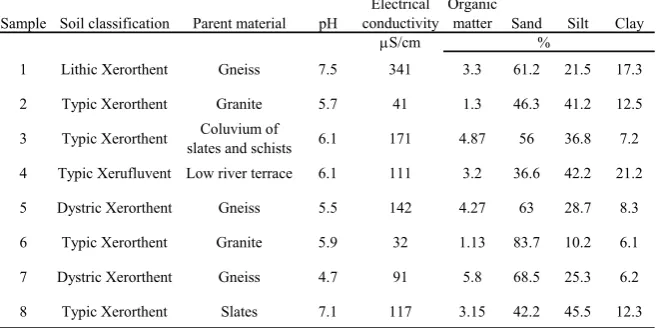
Table 1. Soil classification and selected properties of the studied soil samples.
Table 1. Soil classification and selected properties of the studied soil samples.
Sample Soil classification Parent material pH
Electrical conductivity
Organic
matter Sand Silt Clay
µS/cm %
1 Lithic Xerorthent Gneiss 7.5 341 3.3 61.2 21.5 17.3
2 Typic Xerorthent Granite 5.7 41 1.3 46.3 41.2 12.5
3 Typic Xerorthent slates and schistsColuvium of 6.1 171 4.87 56 36.8 7.2
4 Typic Xerufluvent Low river terrace 6.1 111 3.2 36.6 42.2 21.2
5 Dystric Xerorthent Gneiss 5.5 142 4.27 63 28.7 8.3
6 Typic Xerorthent Granite 5.9 32 1.13 83.7 10.2 6.1
7 Dystric Xerorthent Gneiss 4.7 91 5.8 68.5 25.3 6.2
8 Typic Xerorthent Slates 7.1 117 3.15 42.2 45.5 12.3
17 weighted byµ. It suggests thatDI may be viewed as the ex-pected value of the different concentrations when the distri-bution itself is taking into account. Then the right hand side of the above expression defines a singularity exponent, say β. It turns out thatDI=f (β)=dimHIβ (Beck and Schl¨ogl, 1995). Therefore, it may be said that the entropy dimension gauges the geometrical size of the set where the “main part” of the distribution concentrates.
3 Representative elementary area
In order to identify a REA for the pedofeature of interest the following conditions should be considered (Bear and Bach-mat, 1984; Wood et al., 1988).
1. Three different domains should be distinguished on the length scales corresponding to the size of the soil matrix where the considered pedofeature is evaluated, i.e.l<<D<<L, wherel is the length scale character-istic of significant variation of the considered pedofea-ture,Lis the length scale of the slow variation or of the gross inhomogeneities andDis the length scale of the REA.
2. The average values obtained over the REA must be in-dependent of its size or vary only smoothly with increas-ing size of REA to ensure that they are statistically rep-resentative.
3. The REA should be indifferent with respect to the field property and should remain invariant or at least smoothly varying with time and location.
4. The average values should constitute continuous and differentiable fields over the temporal and spatial do-mains.
This work primarily focuses on the existence of the REA in accordance with points 1 and 2 above. We will consider the entropy dimension as a physically meaningful parameter to characterize the irregular patterns of soil porosity by imag-ing sections of soil blocks. In this investigation,l,DandL will correspond to the areal extend of the rectangular frames cropped from the digital images of the soil blocks to evaluate the entropy dimension.
4 Overview of digital image acquisition and
identifica-tion of the REA
4.1 Sampling procedure and preparation of soil block sec-tions
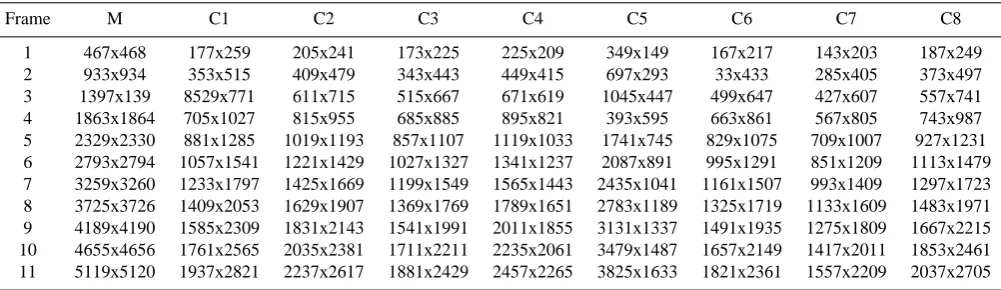
Table 2. Sizes (pixels) of the frames cropped from the digital images; M – microscope images (they have all the same size); C1, . . . , C8 – camera images.
Frame M C1 C2 C3 C4 C5 C6 C7 C8
1 467x468 177x259 205x241 173x225 225x209 349x149 167x217 143x203 187x249
2 933x934 353x515 409x479 343x443 449x415 697x293 33x433 285x405 373x497
3 1397x139 8529x771 611x715 515x667 671x619 1045x447 499x647 427x607 557x741
4 1863x1864 705x1027 815x955 685x885 895x821 393x595 663x861 567x805 743x987
5 2329x2330 881x1285 1019x1193 857x1107 1119x1033 1741x745 829x1075 709x1007 927x1231
6 2793x2794 1057x1541 1221x1429 1027x1327 1341x1237 2087x891 995x1291 851x1209 1113x1479
7 3259x3260 1233x1797 1425x1669 1199x1549 1565x1443 2435x1041 1161x1507 993x1409 1297x1723
8 3725x3726 1409x2053 1629x1907 1369x1769 1789x1651 2783x1189 1325x1719 1133x1609 1483x1971
9 4189x4190 1585x2309 1831x2143 1541x1991 2011x1855 3131x1337 1491x1935 1275x1809 1667x2215
10 4655x4656 1761x2565 2035x2381 1711x2211 2235x2061 3479x1487 1657x2149 1417x2011 1853x2461
11 5119x5120 1937x2821 2237x2617 1881x2429 2457x2265 3825x1633 1821x2361 1557x2209 2037x2705
Figure 1. Digital image of sample 1 obtained with camera, before (left) and after (right) binarization.
20
Fig. 1. Digital image of sample 1 obtained with camera, before (left) and after (right) binarization.
4.2 Imaging of soil sections and binarization
Two different instruments were used to image each soil sec-tion: a confocal microscope and a conventional film camera. In both cases, ultraviolet light was used when acquiring the pictures. The resulting digital pictures were 8-bit gray scale images.
Photographs were taken with a 100 ISO sensibility film with a frame size of 6 cm×6 cm. The camera was 25 cm away from the sample. Digital images were ob-tained by scanning the film. The resulting resolution was 15.7µm/pixel. The resulting area of the rectangular im-ages cropped from the pictures varied between 8.52 cm2and 15.47 cm2.
The microscope used was a Leica TCS SP2 attached to a computer. The confocal technique permits the detection of light from the sample emitted by a single focal plane, exclud-ing the light that comes from above or under that focal plane.
The pinhole from the microscope discriminates the light from the focal planes and the image obtained is not distorted by the adjacent planes. Ultraviolet light from two Argon lasers was adjusted to enhance the pore space domain taking into account the absorption spectrum of the Uvitex OB dye. A re-gion of 3.75 mm×3.75 mm was chosen randomly from each soil section and it was imaged as a regular mosaic of 10×10 square tiles merged by the computer attached to the micro-scope. The resolution was 0.732µm/pixel.
As pointed out by Baveye et al. (1989) choosing of a threshold is a critical step in the binarization process, i.e. the operation performed on digital gray scale images to produce a binary image where each pixel is assigned one of two val-ues, 0 for black and 1 for white. We used the method de-veloped by Moran et al. (1989) based on the work of Serra (1982) on mathematical morphology. Figure 1 depicts the original digitalized picture (left) and the binarized one from the conventional film camera of one of the samples. Fig-ure 2 corresponds to one of the images from the microscope. The left image is the original one and the right one is the binarized image. White colored regions correspond to pore space. These operations were performed with a macro devel-oped for Inspector 4.1, imaging software of Matrox.
4.3 Estimation of entropy dimension and REA identifica-tion
Table 3. Identification of the REA with the microscope images (M) with the size of the smallest frame of the REA region and the correspondingj-step in the series of cropped frames, and porosity of the images of the microscope (M) and the camera (C).
Image j-step REA (mm2) Porosity (%) Image Porosity (%)
M1 9 9.400 23.890 C1 24.477
M2 9 9.400 7.048 C2 15.454
M3 9 9.400 10.269 C3 19.087
M4 5 2.900 15.726 C4 15.063
M5 8 7.425 24.033 C5 28.265
M6 9 9.400 25.576 C6 26.138
M7 4 1.857 25.500 C7 23.316
M8 10 11.608 10.340 C8 19.830
The entropy dimension given by Eq. (1) was estimated by the linear fitting in a log-log plotting for decreasing values of ε. Points with coordinates log ε and Pn(ε)
i=1µi(ε) logµi(ε) were fitted to a line and coefficients of determinationR2were recorded.
To establish the variation of the entropy dimension with scale, a sequence of eleven increasingly larger frames were cropped from each of the sixteen digital binarized images. The frame sequence was selected as follows. Ten points equally distant from each other were selected on the line connecting one corner with the center of the image. Each of these points was one of the corners of one frame which center was the center of the image. They were rectangular for the pictures of the camera and squared in the case of the microscope. Table 2 gathers the information about the sizes of these frames. Following the procedure established above the entropy dimension was estimated for each of the eleven frames on the sixteen images. They were estimated with four partitions for the smallest frames and seven for the largest ones of the microscope images. In the case of the pictures of the camera the smallest frames provided three or four parti-tions while the larges ones facilitated between five and seven. A series of valuesDIj, forj=1,2, . . . ,11, were obtained for each image corresponding to entropy dimensions. The last value corresponds to the full image. We had considered the relative incrementRIjin the entropy dimension of thej-step of each series, i.e. forDjI the relative increment to the previ-ous smaller frame area isRIj=
(D
j I −D
j−1
I )/D j−1
I
×100.
And we had compared them with the coefficient of variation CV of the series, i.e. ifµandσ are the mean and the stan-dard deviation of the series it isCV=(σ/µ)×100. For each image, the REA was identified by the triplel,DandL(see Sect. 3). Then, the regionDbounded bylandLcorresponds to the range of scales where the relative increments of the val-ues of the seriesDIjof the entropy dimensions were less than 20% of theCV, i.e.RIi ≤0.2CV.
Figure 2. Digital image of sample 1 obtained with microscope, before (left) and after (right) binarization.
21
Fig. 2. Digital image of sample 1 obtained with microscope, before (left) and after (right) binarization.
5 Results and discussion
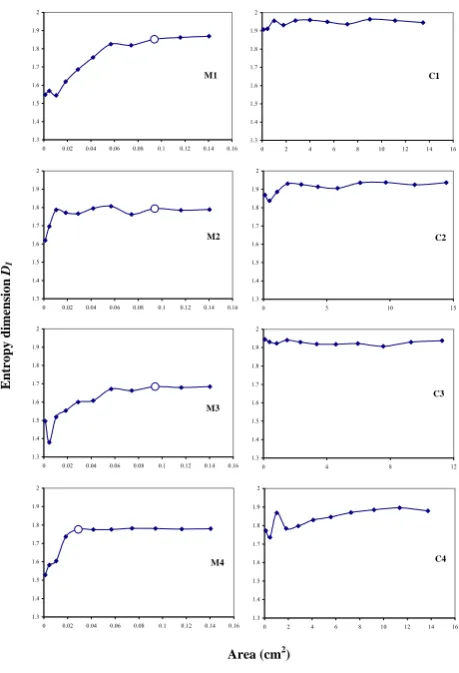
The coefficients of determination of the entropy dimension R2were greater than 0.99 (data not shown). Figsures 3 and 4 depict the series of the eleven estimated values of the entropy dimension against the area (cm2)of the corresponding frame cropped from each image.
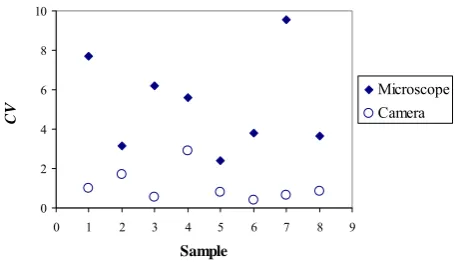
Two different regions in the microscope series can be dis-tinguished (see Figs. 3 and 4), i.e. a range of scales with ap-parently significant variation followed by a plateau like re-gion (see Figs. 3 and 4). In contrast, there is seemingly only one kind of plateau like range of scales when the camera im-ages are considered. In fact (see Fig. 5), the coefficient of variation is always smaller for the series of entropy dimen-sions corresponding to the camera images. Moreover, while the relative increments of the macroporosity series (camera images) is always less than the 20% of coefficient of varia-tion, this is only verified by the relative increments of the mi-croporosity series (microscope images) from the terms with an open circle in Figs. 3 and 4. Table 3 gathers information about the lower bound of the REA regionD: the correspond-ing location in the series (j-step), its entropy dimension and areal size (in all cases the upper boundLwere greater than the size of the image), and the image porosity as the per-centage of white pixels. Therefore, it might suggest that in the microporosity domain there is a range of scales charac-teristic of rapid variation of its entropy dimensions followed by a region of scales with slowly varying quantities corre-sponding to the REA domain. Moreover, this domain also spans macroporosity scales. Taking one sample or soil block section, the graphic of the porosity entropy dimensions as a function of the areal frames for the two images (micro-scope image and camera image) seems to indicate that they compose a sequence of consecutive overlapping domains of different scales.
M1 1.3 1.4 1.5 1.6 1.7 1.8 1.9 2
0 0.02 0.04 0.06 0.08 0.1 0.12 0.14 0.16
M2 1.3 1.4 1.5 1.6 1.7 1.8 1.9 2
0 0.02 0.04 0.06 0.08 0.1 0.12 0.14 0.16
M3 1.3 1.4 1.5 1.6 1.7 1.8 1.9 2
0 0.02 0.04 0.06 0.08 0.1 0.12 0.14 0.16
M4 1.3 1.4 1.5 1.6 1.7 1.8 1.9 2
0 0.02 0.04 0.06 0.08 0.1 0.12 0.14 0.16
C1 1.3 1.4 1.5 1.6 1.7 1.8 1.9 2
0 2 4 6 8 10 12 14 16
C2 1.3 1.4 1.5 1.6 1.7 1.8 1.9 2
0 5 10 15
C3 1.3 1.4 1.5 1.6 1.7 1.8 1.9 2
0 4 8 12
C4 1.3 1.4 1.5 1.6 1.7 1.8 1.9 2
0 2 4 6 8 10 12 14 16
Entropy dimension
DI
Area (cm2)
Figure 3. Entropy dimensions DI for samples 1, 2, 3 and 4 plotted against the area (cm2)
of the frames for the images of the microscope (M) and the camera (C). The left bound of the REA region is identify with an open circle.
22
Fig. 3. Entropy dimensionsDI for samples 1, 2, 3 and 4 plotted
against the area (cm2)of the frames for the images of the micro-scope (M) and the camera (C). The left bound of the REA region is identify with an open circle.
the bimodal structure of soil porosity that has been reported when fractal scaling of soil porosity has been investigated (Anderson et al., 1996; Bartoli et al., 2005; Men´endez et al., 2005). As far as we know, such an effect has not been reported in the context of multifractal analysis of soil poros-ity. It is possible that this lack on previous analysis is due to the fact that, depending on the imaging technique, the mi-crostructures and mami-crostructures that have been investigated with this mathematical tool have always been treated sepa-rately. Another explanation for the different values of the averages of entropy dimensions is that, due to the lower res-olution of the of the camera images, the smallest scale ranges were not considered and, thus, finer structures of soil poros-ity were hidden. Thus, it could be assumed that these finer and complex patterns would render a lower entropy dimen-sion than the one estimated with the camera images. In these images only the macrostructures of the porosity can be as-sessed. Contrast of this hypothesis would imply the imaging of the full soil section with a resolution similar to the reso-lution of the confocal microscope. The microscope images
M5 1.3 1.4 1.5 1.6 1.7 1.8 1.9 2
0 0.02 0.04 0.06 0.08 0.1 0.12 0.14 0.16
M6 1.3 1.4 1.5 1.6 1.7 1.8 1.9 2
0 0.02 0.04 0.06 0.08 0.1 0.12 0.14 0.16
M7 1.3 1.4 1.5 1.6 1.7 1.8 1.9 2
0 0.02 0.04 0.06 0.08 0.1 0.12 0.14 0.16
M8 1.3 1.4 1.5 1.6 1.7 1.8 1.9 2
0 0.02 0.04 0.06 0.08 0.1 0.12 0.14 0.16
C5 1.3 1.4 1.5 1.6 1.7 1.8 1.9 2
0 4 8 12 16
C6 1.3 1.4 1.5 1.6 1.7 1.8 1.9 2
0 4 8 12
C7 1.3 1.4 1.5 1.6 1.7 1.8 1.9 2
0 3 6 9
C8 1.3 1.4 1.5 1.6 1.7 1.8 1.9 2
0 2 4 6 8 10 12 14 16
Entropy dimension
D
I
Area (cm2)
Figure 4. Entropy dimensions DI for samples 5, 6,7 and 8 plotted against the area (cm2)
of the frames for the images of the microscope (M) and the camera (C). The left bound REA region is identify with an open circle.
23
Fig. 4. Entropy dimensionsDI for samples 5, 6,7 and 8 plotted
against the area (cm2)of the frames for the images of the micro-scope (M) and the camera (C). The left bound REA region is iden-tify with an open circle.
are squares of 3.75 mm with a resolution of 0.734µm/pixel composed by merging of 10×10 frames. The total size that the computer needed to handle was about 400 megabytes and the time needed to acquire a single image was about 40 min plus the time for the location of the sample and the adjust-ment of the imaging software. To obtain an image with a linear size ten times larger (3.75 cm) with the same resolu-tion these numbers should be multiplied by a factor of 100. For the moment there is a clear limitation to the acquisition of images of this size at this higher resolution.
F. San Jos´e Mart´ınez et al.: REA and multifractal features of soil porosity 509 separate them from the image background, i.e. the soil matrix
in this case. As stated by Moran et al. (1989) and Gim´enez et al. (1997) class III pores are related to the image resolution or poor resin penetration but this does not result in a method-ology deficiency when characterizing pores at meso/macro scale (Gim´enez et al., 1997). We have used a different tech-nique to characterize pores at micro scale. The confocal mi-croscope allows the acquisition of images that do not display class III pores. Then, even if there is no method that will re-sult in resin-penetration of all soil pores, our rere-sults suggest that, at the resolution of the microscope, the pores with in-complete resin penetration are separated from the soil matrix (the image background).
Bird et al. (2006) has studied the constraints that the image porosity imposes on the values of the fractal and multifractal parameters. In this context the porosity of a digital binarized image is understood as the proportion of white pixel on the image; in this study white pixels correspond to pore space. In particular, when the porosity of the image isf, Bird et al. (2006) showed that for the grid sizeεthe Shannon entropy for this partition is bounded by
2 ln
L
ε
+lnf≤−Xn(ε)
i=1µi(ε) logµi(ε)≤2 ln
L
ε
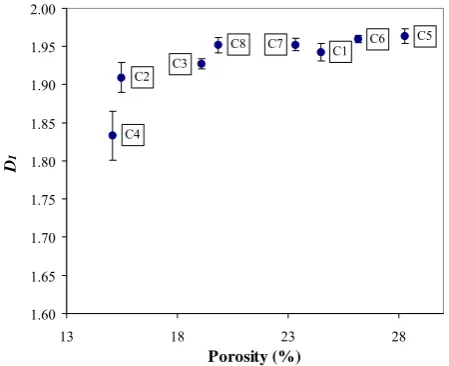
.(2) Thus, the value of the Shannon entropy of each partition size belongs to a band delimited by two lines with slope equal to two and vertical width equal to−lnf. Let us examine ex-pression (2). There are two extreme cases: when the porosity is 1 the bandwidth is zero and the Shannon entropy attains its maximum. In fact what we have here is the uniform distribu-tion. In this situation there is only one way to spread the mass of the distribution, i.e. there is only one possible arrange-ment of voids within the image because the whole image is white. When the porosity decreases the bandwidth increases (it goes to infinity as the porosity goes to zero) with “speed” equal to−1/f. This reflects the fact that when the porosity decreases there are more ways that the mass distribution of the pore space can be spread over the image, and thus the en-tropy dimension is one way to gauge these different types of spreading. In this investigation images have an intermediate or low porosity (see Table 3). Image C5 has the largest value with a porosity of 0.28 and M2 the lowest with a porosity of 0.07. Porosity was larger for the camera images, except for sample seven. Therefore the bandwidth that constrains the Shannon entropy for each partition will be smaller for the camera images with the exception mentioned above and it should be expected that the slope of the fit would be more likely to be closer to two for the camera images than for the images from the microscope. These comments suggest that the higher entropy dimension of the camera images could be ascribed to its higher image porosity. But, Figs. 7 and 8 seem to support the fact that there was not any pattern that re-lates entropy dimension and porosity in theses cases, neither for microporosity nor for macroporosity. Figure 8 suggests that the entropy dimension of the camera images with lower
CV
0 2 4 6 8 10
0 1 2 3 4 5 6 7 8 9
Sample
Microscope Camera
Figure 5. CV for the eleven frames of the images from the microscope and the camera.
24
Fig. 5.CVfor the eleven frames of the images from the microscope and the camera.
1,65 1,70 1,75 1,80 1,85 1,90 1,95 2,00 2,05
0 1 2 3 4 5 6 7 8 9
Sample
D
I Microscope
Camera
Figure 6. Mean entropy dimension, DI, on the REA region identified with the
microscope images and with the camera images.
25
Fig. 6. Mean entropy dimension,DI, on the REA region identified
with the microscope images and with the camera images.
porosity were significantly different while they were more similar when the porosity was higher. On the contrary, there was not any clear trend in the case of the microstructures (see Fig. 7). As a consequence, there was no evidence that the re-sults of Bird et al. (2006) could affect the conclusions of this investigation.
Following VandenBygaart and Protz (1999), our results would imply that the size of the microscope images used to represent the multifractal pattern of soil microporosity, as well as the size of the camera images used to assess macro-porosity, is sufficiently satisfactory, when the hypothesis of bimodal behavior is assumed. If this hypothesis is not as-sumed, further investigations with powerful instruments are required to perform the multifractal analysis of the full scales of soil porosity to estimate its entropy dimension through im-age analysis of soil block sections.
6 Conclusions
1.65 1.70 1.75 1.80 1.85 1.90 1.95 2.00
5 10 15 20 25
Porosity (%)
D
I
M1
M2
M3
M4 M5
M6
M7
M8
Figure 7. Mean entropy dimension, DI, with standard error barsof the REA region identified with the microscope images (M) and porosity (%).
26
Fig. 7. Mean entropy dimension,DI, with standard error bars of the
REA region identified with the microscope images (M) and porosity (%).
1.60 1.65 1.70 1.75 1.80 1.85 1.90 1.95 2.00
13 18 23 28
Porosity (%) DI
C2 C3
C4
C5 C6 C7
C8 C1
Figure 8. Mean entropy dimension, DI, with standard error bars of the camera images (C) and porosity (%).
Fig. 8. Mean entropy dimension,DI, with standard error bars of
the camera images (C) and porosity (%).
microscope provided information about pores with an equiv-alent diameter between 3.62µm and 161.98µm, whilst the camera rendered an interval of pore diameters whose bound-aries were 39.72µm and 1776.34µm. Sixteen digital images were analyzed to investigate the representative elementary area of the multifractal patterns of the spatial distribution of voids related to the microporosity and to the macroporosity.
The entropy dimension was selected as a physically mean-ingful parameter to assess the REA of the multifractal scal-ing of soil porosity. The REA was identified as the domain of scales of slow variation of the porosity entropy dimension. Our results allow location of the REA region within the domain of the microstructures rendered by analysis of
the images acquired with the confocal microscope. They also suggest that this region seemingly spans scales of the macrostructures explored by the analysis of the pictures of the camera. Then, the graphic of the porosity entropy dimen-sion as function of areal frame for the two images seem to indicate that they compose a sequence of consecutive over-lapping domains of different scales for each sample.
Two significantly different averaged values of the porosity entropy dimension were obtained for the REA domain. The entropy dimension of the macroporosity was higher. This difference might reflect the bimodal structure of soil porosity that has been reported when scaling analysis of soil porosity has been investigated. Such an effect does not seem to be reported in the context of multifractal analysis of soil poros-ity through image analysis of soil sections. This omission is probably due to the fact that, depending on the imaging tech-nique, microstructures and macrostructures had previously been separately investigated with this mathematical tool. An-other possible explanation of the differences between the av-erage values of the estimated entropy dimensions over the REA domain could be related to the fact that the smallest scales were absent in the images from the camera. Thus, it could be assumed that these finer and complex patterns would render a lower entropy dimension than the one esti-mated with the camera images.
Bird et al. (2006) have considered how the image porosity imposes constraints on the values of the entropy dimension. The Shannon entropies used to estimate the entropy dimen-sion must lie within a band delimited by two lines with slope equal to 2 and vertical width equal to the absolute value of the logarithm of the porosity. Thus, it should be expected that the slope of the fit to estimate the entropy dimension from the Shannon entropies would be more likely to be closer to 2 for images with high porosity. It suggests that the higher en-tropy dimension of the camera images could be ascribed to its higher porosity.
From the point of view of VandenBygaart and Protz (1999) the size of the images of the microscope permit the represen-tation of the multifractal pattern of soil microporosity and the same is true for the size of the camera images with respect to soil macroporosity, when the hypothesis of the bimodal be-havior is assumed. If this hypothesis is not assumed further investigations with powerful instruments are required to per-form the multifractal analysis of the full scales of soil poros-ity to estimate its entropy dimension through image analysis of soil block sections.
Acknowledgements. This work was partially supported by Plan
Nacional de Investigaci´on Cient´ıfica, Desarrollo e Investigaci´on Tecnol´ogica (I+D+I) under ref. AGL2004-04079 AGR. Spain and DGUI (Comunidad de Madrid) and UPM (project ref.: M0700204135). We would like to express our gratitude to M. A. Mart´ın Mart´ın for enlighten and stimulating discussions.
Edited by: A. Tarquis
References
Anderson, A. N., McBratney, A. B., and FitzPatrick, E. A.: Soil mass, surface, and spectral fractal dimensions estimated from thin section photographs, Soil Sci. Soc. Am. J., 60, 962–969. 1996.
Bartoli, F., Genevoise-Gomendy, V., Royer, J. J., Niquet, S., Vivier, H., and Grayson, R.: A multiscale study of silty soil structure, European J. Soil Sci., 56, 207–223, 2005.
Baveye, P., Boast, C. W., Ogawa, S., Parlange, J.-Y., and Stenhuis, T.: Influence of image resolution and thresholding on the appar-ent mass fractal characteristics of preferappar-ential flow patterns in field soils, Water Resour. Res., 34, 2783–2796, 1998.
Bear, J.: Dynamical of fluids in porous media. Dover Pub. Inc, New York, 1972.
Bear, J. and Bachmat, Y.: Transport in porous media. Basic equa-tions, in: Fundamentals of transport phenomena in porous media, edited by: Bear, J. and Corapeioglu, M. Y., NATO ASI series, M. Nijhoff, Dordrecht, 3–61, 1984.
Beck, C. and Schl¨ogl, F.: Thermodynamics of chaotic systems. An Introduction. Cambridge University Press, New York, 1995. Benson, D. A., Wheatcraft, S. W., and Meerschaert, N. M.:
Applica-tion of a fracApplica-tional advecApplica-tion-dispersion equaApplica-tion, Water Resour. Res., 36(6), 1403–1412, 2000.
Berkowitz, B., Cortis, A., Dentz, M., and Scher, H.: Model-ing non-fickian transport in geological formations as a con-tinuous time random walk, Rev. Geophys., 44, RG2003, doi:10.1029/2005RG000178, 2006.
Bird, N., D´ıaz, M. C., Saa, A., and Tarquis, A. M.: Fractal and multifractal analysis of pore-scale images of soil, J. Hydrol., 322, 211–219, 2006.
Bl¨oschl, G., Grayson, R. B., and Sivapalan, M.: On the representa-tive elementary area REA. Concept and its utility for distributed rainfall–runoff modelling, in: Scale Issues in Hydrological Mod-elling, edited by: Kalma, J. D. and Sivapalan, M., Advances in Hydrological Processes. Wiley, Sussex, England, 71–88, 1995. Buchter, B., Hinz, C., and Fl¨uhler, H.: Sample size for
determi-nation of coarse fragment content in stony soil, Geoderma, 63, 265–275, 1994.
Caniego, F. J., Mart´ın, M. A., and San Jos´e, F.: Singularity features of pore– size soil distribution: singularity strength analysis and entropy spectrum, Fractals, 6, 305–316, 2001.
Caniego, F. J., Mart´ın, M. A., and San Jos´e, F.: R´enyi dimensions of soil pore size distribution, Geoderma, 112, 205–216, 2003. Everstz, C. J. G. and Mandelbrot, B B.: Multifractal measures.
In Peitgen, H., H. J¨urgens, and D. Saupe. Chaos and Fractals, Springer, Berlin, 921–953, 1992.
Garc´ıa-Gutierrez, C. and San Jos´e Mart´ınez, F.: Quality image ac-quisition and processing for multifractal characterization of soil porosity. International workshop on fractal mathematics applied to soil and related heterogeneous systems. El Barco de Avila, Spain, July 2–6, 2004.
Gim´enez, A., Allmaras, R. R., Nater, E. A., and Huggins, D. R.: Fractal dimension for volume and surface interaggregate pores – scale effects, Geoderma, 77, 19–38, 1997.
Kravchenko, A. N., Boast, C. W., and Bullock, D. G.: Multifrac-tal analysis of soil spatial variability, Agron. J., 91, 1033–1041, 1999.
Lin, H.: Hydropedology: Bridging Disciplines, Scales, and Data, Vadose Zone Journal 2, 1–11, 2003.
Mart´ın, M. A. and Taguas, F. J.: Fractal modelling, characterization and simulation of particle-size distribution in soil, Proc. R. Soc. Lond. A, 454, 1457–1468, 1998.
Martin, M. A., Perfect, E., and Pachepsky, Y. (Eds.): Scaling frac-tals and diversity in soil and ecohydrology, Ecological Mod-elling, 182, 217–384, 2005.
Martin, M. A., Perfect, E., and Pachepsky, Y. (Eds.): Fractal ge-ometry applied to soil and related hierarchical systems. Fractals, complexity and heterogeneity, Geoderma, 134, 237–456, 2006. Men´endez, I., Caniego, J., Gallardo J. F., and Olechko, K.: Use of
fractal scaling to discriminate between and macro- and meso-pore size in forest soil. Ecological Modelling, 182, 323–335, 2005.
Metzler, R. and Klafter, J.: The restaurant at the end of the random walk: recent developments in the description of anomalous trans-port by fractional dynamics. J. Phys. A: Math. Gen., 37, R161– R208, doi:10.1088/0305-4470/37/31/R01 J, 2004.
Moran, C. J., McBratney, A. B., and Koppi, A. J.: A rapid method for analysis of soil macropore structure. I. Specimen preparation and digital binary image production, Soil Sci. Soc. Am. J. 53, 921–928, 1989.
Muller, J. and McCauley, J. L.: Implication of fractal geometry for fluid flow properties of sedimentary rocks, Transport in Porous Media, 8, 133–147, 1992.
Murphy, C. P.: Thin section preparation of soils and sediments. AB Academic Pub., Berkhmasted, UK, 1986.
Pachepsky, Y. A., Benson, D. A., and Rawls, W.: Simulating scale-dependent solute transport in soils with the fractional advective-dispersive equation, Soil Sci. Soc. Am. J., 64, 1234–1243, 2000. Posadas, A. N. D., Gim´enez, D., Quiroz, R., and Protz, R.: Multi-fractal characterization of soil pore systems, Soil Sci. Soc. Am. J., 67, 1361–1369, 2003.
Serra, J.: Introduction to mathematical morphology. Academic Press, London, 1986.
Tarquis, A. M., Gim´enez, D., Saa, A., D´ıaz, M. C., and Gasc´o, J. M.: Scalings and multiscalings of soil pore systems determine by image analysis. In: Pachepsky, Y., D.E. Radcliffe and H. M. Selim (Editors). Scalings methods in soil physics. CRC Press, Boca Raton, Florida, USA, 19–33, 2003.
VandenBygaart, A. J. and Protz, R.: The representative elemen-tary area (REA) in studies of quantitative soil micromorphology, Geoderma, 89, 333–346, 1999.
Wood, E. F., Sivapalan, M., Beven, K., and Band, L.: Effects of spatial variability and scale with implications to hydrologic mod-eling, J. Hydrol., 102, 29–47, 1988.