2017, Vol. 5, No. 2 DOI: 10.15678/EBER.2017.050204
Modelling Energy Security and International
Competitiveness: The Export Perspective
Honorata Nyga-Łukaszewska, Eliza Chilimoniuk-Przeździecka
A B S T R A C T
Objective: The objective of this paper is to investigate the link between energy securi-ty and international competitiveness captured by export.
Research Design & Methods: To fulfil the goal, we employed the panel data linear regression model with fixed effects. The study includes 23 countries denoted by one of the world’s biggest energy consumption levels between 1995 and 2014.
Findings: The study confirms the existence of the relationship between energy security and export in the defined and examined groups of goods. Energy security influences exports of capital goods most. While the environmental and economic aspects of energy security gain importance in all tested categories of goods, energy imports lose it.
Implications & Recommendations: The research results suggest that the energy secu-rity concept is not a coherent phenomenon as the environmental aspect had the greatest influence on international competitiveness. Such a result calls for a broader empirical investigation with a greater sample size divided upon GDP performance. Contribution & Value Added: The originality of this work lies in studying the link between energy security and international competitiveness from the export per-spective. The identified research gap in this area shows a relative lack of theoreti-cal and empiritheoreti-cal studies.
Article type: research paper
Keywords: international competitiveness; energy security; supply capacity; regression; panel data
JEL codes: Q37, F14
Received: 21 November 2016 Revised: 3 March 2017 Accepted: 20 March 2017
Suggested citation:
INTRODUCTION
Energy has always been a significant production factor, but nowadays its importance is increasing. It is true for both developing and developed countries. However, the role of energy for these groups of countries is different. While continuous economic growth in developing regions surges global energy demand, energy conservation efforts in advanced economies aim at a decrease in energy consumption. Adding to this global strives for climate protection with stringent GHG emission allowances, volatile energy prices and concerns about the security of energy supply, we arrive at the world energy landscape of the 21st century.
Due to the fact that energy security constitutes the scenery foreground since energy consumption centres are located far from energy production centres energy imports and consumption arouses a number of concerns. Initially, these doubts referred to fuel availa-bility and its volatile prices. It reminds oil crises in the 1970’s when due to energy shortages and its volatile prices, the world community was driven into the recession path. The mix-ture of energy concerns changed over time. Because of rising environmental awareness, the world community took efforts aimed at reducing energy consumption. However, it is a difficult task to bring the hunger for energy growth from developing/emerging economies together with the climate protection goals. Reconciling these goals is even harder in the environment of expanding globalisation and trade liberalisation.
In the world of open economies and free trade, countries are strongly focused on gaining and maintaining the ability to compete with their products/services successfully on the international market. Therefore, the goal of the article is an attempt to answer the question whether energy security influences the ability of a country to compete with export in the international market. It is important to understand this relationship be-cause it can enhance our understanding of the energy security phenomenon. It enables us to verify whether energy security is only a goal in itself or it can be a factor determin-ing economic performance more broadly than only GDP. Initially, energy security re-search focused only on macroeconomic activity depicted by GDP performance (e.g. Leiby, Jones & Curlee, 1997). The identified research gap, considering energy security linked to international competitiveness, strengthens the research need.
LITERATURE REVIEW AND THEORY DEVELOPMENT
Energy Security
Energy security is one of interdisciplinary concepts. There are a number of research describing energy security stemming from engineering as well as social sciences. The main focus in our case is its economic perception. Therefore, we concentrate on the literature with economic background.
There are a number of works explaining “energy security” and discussing numerous definitions (Winzer, 2012; Ang, Choong & Ng,2015). Since there is no common under-standing what energy security really is, scientists agree that “energy security” or its extension, namely “security of energy supply” is a “blurred concept” whose vagueness does not enable a coherent theoretical analysis (Loeschel et al., 2010, p. 1665). One of the most popular literature strings on energy security refers to external costs. This way of handling the phenomenon dates back to the oil crises. The majority of works in this stream focus on the macroeconomic dimension of energy security, usually visible in the form of the vulnerability of economy to supply disruptions (Barsky & Kilian, 2004; Bec-cue & Huntington, 2005; Leiby et al., 1997; Arnold & Hunt, 2009; Gupta, 2008; Constan-tini, Gracceva, Markandya & Vicini, 2007). Some works, if not directly referring to the vulnerability to supply disruptions, use indicators which show this perspective, such as oil or gas vulnerability index (Roupas, Flamos & Psarras,2011, p. 353). Such perception of the phenomenon has been also adopted by international organisations, such as the World Bank, in assessing the impact of higher natural gas and oil prices for the Ukraini-an economy (Davis, Piontkivsky, Pindyyuk & Ostojic, 2005). The central idea in this ap-proach reflects externalities associated with energy security which include (Hunt & Markandaya, 2004, p. 3; Arnold & Hunt, 2009, pp. 1-2):
− monopsony wedge externality – when additional imports of a fuel cause price to rise. The importing country ignores that additional cost and in turn it makes an external cost, − incomplete rent capture – when a supplier is not able to capture full rent from the
consumers through differentiated pricing. That is why any change in the country’s fuel mix (like importing more fuels) leads to a change in the level of the supplier’s rent and in consequence it constitutes an externality,
− macroeconomic externalities – when the international energy market changes influ-ence macroeconomic performance. That excludes externalities stemming from indi-vidual decisions. Examples of global energy market changes include: increased fuel prices or any changes on different markets which spill over the energy market.
market shows an influence of prices on GDP (Arnold & Hunt, 2009; Davis et al., 2005; Roupas et al., 2011; Leiby et al., 1997; Sauter & Awerbuch, 2003; Huntington, 2004).
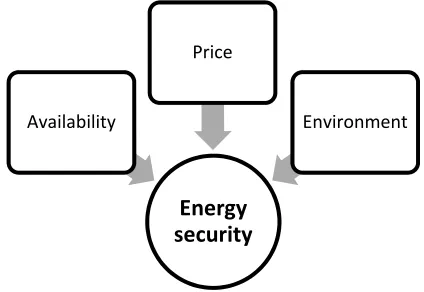
The International Energy Agency (IEA) and the European Commission (EC) pro-vide a different understanding of energy security. Both of the institutions focus more on the practical approach to the problem. The IEA and the EC show the multidimen-sional energy security perspective which includes:
− availability (physical) – which refers to having uninterrupted energy supply at disposal, − prices – which refer to the affordability of energy to consumers, and
− environmental aspects – which refer to external costs connected with the energy use. The last dimension is particularly highlighted by the European Commission that sets the European Union at the front of the global climate-energy discussion and action. Pric-es and supply availability are equally important. The former are often discussed with reference to price volatility, which in 1970s laid foundations for the creation of the IEA. The latter gained on importance at the turn of the twentieth and twenty-first century with various physical energy supply disruptions. The usefulness of such a triangular ap-proach consists in its easy translation into the policy actions. To distinguish between immediate and prospective measures, both institutions stipulate short- and long-term policy actions. Short-term energy security focuses on the ability of the energy system to include supply interruptions. On the other hand, long-term energy security pertains to the adequate level of investments which guarantee energy supply and comply with sus-tainable development rules (IEA, EC). In our view, the long-term measures offset the market power of energy suppliers and bring balance to the energy market, while the temporary security helps a community resume energy supplies immediately.
Figure 1. Energy security in the triangular approach Source: own elaboration based on the IEA and the EC.
Time-dependent energy security perspective is also visible in the selection of measures used to assess the phenomenon. Short-term measures of energy security focus on the risk of supply disruption (like REES Indicator – Risky External Energy Supply, Coq, 2009, pp. 37-38), while long-term measures – on import’s diversification (Vivoda, 2009, p. 4616). Just like in the case of the problem of defining energy security, it is also difficult to highlight one method of its measurement. It is an effect of the missing
con-Energy
security
AvailabilityPrice
ceptual agreement on what energy security really is. There have been numerous re-search efforts summarising the existing measuring methods (Sovacool, 2011; Mansson, Johansson & Nilsson, 2014), however, no single methodology has been developed so far. Clearly, scientists focused on research into energy security favour a mixed approach aimed at using different simple or complex measures (Sovacool, 2011). Indicators can be categorised into a few groups (Kisel, Hamburg, Haerm, Leppiman & Ots,2016): − technical – including, for example, the ability of the energy system to transport and
distribute energy, the availability of energy resources,
− economic – including, for example, prices volatility or dependency on energy imports, − environmental – including, for example, energy efficiency or intensity and CO2
emission levels,
− political – including, for example, political stability of an exporter or its relations with importing countries.
We took into account all the above limitations of the energy security definition, and we decided to follow internationally recognised perception of the phenomenon. There-fore, in our work we apply the triangular approach described by the IEA and the EC. We believe that the same importance has to be attached to energy availability, prices and its environmental effects. Firstly, we link energy availability to energy imports as, according to the literature, it poses greater threats to energy security than domestic production. Secondly, we refer to energy prices as a cost for individual customers. And thirdly, we describe the environmental aspect by energy intensity and energy consumption.
Energy Security and International Competitiveness
Energy security and the ability to compete on international markets are often treated as parallel goals in the energy policy (IEA, 2014, p. 5; Keppler, 2009, p. 2). However, there are scientific works indicating a different direction of this relation. According to researchers (Lieber, 1980; Klein, 1988), energy influences the ability to compete at the international level.
The literature review revealed a research gap within the topic of the relationship be-tween energy security and international competitiveness with reference to exports. Energy is usually treated as an input determining industrial costs in these studies (Lieber, 1980). Its negative influence was observed mainly in 1970s as a consequence of oil crises. Western communities, such as France, were concerned about their export competitive-ness which had been affected by higher industrial costs (Lieber, 1980). A similar line of reasoning is provided by Klein (1988) who convinces that after the first oil shock in 1970s, the American competitiveness, measured by export unit values, declined (except for the periods when the US dollar depreciated) (Lieber, 1980 p. 311).
competitiveness (McKinsey, 2009, p. 13). McKinsey study shows that industries or econ-omy sectors can use energy to create their competitive advantage (McKinsey, 2009, p. 7).
Similarly to McKinsey, Głowacka (1996, p.28) stresses the role of energy efficiency as a demand condition which shapes competitive industries and in consequence national competitive advantage. She refers to the Porter’s idea of the competitive advantage of nations by describing Central/Eastern European economies in transition.
Following that logic, we shall consider energy as a determinant shaping the ability of a country to compete successfully in international markets. Zachmann and Cipollone (2013, pp. 139-168) refer to this phenomenon as “energy competitiveness”. Energy is included in the analysis of sectoral competitiveness as an input on the supply side. The supply side determinants of sectoral competitiveness include: cost, quality and the avail-ability of sector-specific production factors (Zachmann & Cipollone, 2013, p. 145). Zach-mann and Cipollone investigated the impact of electricity prices on the competitiveness of the manufacturing industry in Europe. Their quantitative study was based on data from 27 OECD countries and ranges from 1996 to 2011. According to their findings, en-ergy prices do not determine whether a country becomes a competitive exporter of manufactured products, but they do have an influence on which sectors the country becomes a competitive exporter in (Zachmann & Cipollone, 2013, p. 158).
MATERIAL AND METHODS
The theoretical framework of the investigation of the problem how energy security influ-ences the ability of a country to compete with export on the international market was identified in the standard new trade theory model which formed the basis for the export performance analysis in the UNCTAD report (UNCTAD, 2005). The model refers to differen-tiated product supplied by producers1 which operate under increasing returns to scale and manufacture goods derived from the constant elasticity of substitution demand structure.
Moreover, three elements make up exports from country to country – product supply capacity, trans-border transport costs and the market capacity of country . For the purpose of assessing the impact of energy security on the export abilities of coun-tries, solely the supply capacity function was used for further investigations.
The following formula of the regression equation investigates the determinants of supply capacity of country at time :
= + ln + + + + ln _ +
+ ln !" + #ln $%&"$ + 'ln & + ( + ) (1)
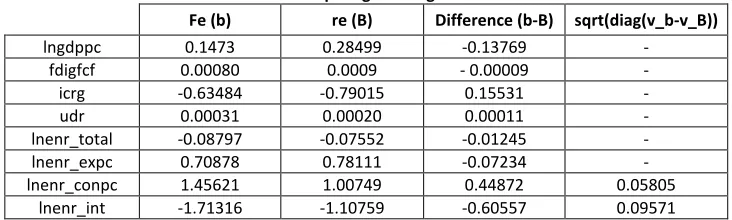
We used fixed-effects regression model with panel data analysis. We estimated the influence of each exogenous variable on the endogenous (explained) variable in the regression function. While proceeding calculations, we expected the fixed effect in the model due to the fact that each analysed country has its individual characteristics which may or may not influence the predictor variables (the export of goods in the assumed groups), and it should be controlled. In order to confirm the above expectations, we conducted the Hausman test in three regressions (one for each exporting good), and indicated the fixed effect for capital and intermediate goods. In terms of consuming
goods, while Hausman test had not brought the result in the decision of the usage of an appropriate effect, we implemented the solution of the artificial regression approach described by Arellano (1993) and Wooldridge (2002, pp. 290-91), in which a random effects equation is re-estimated by being augmented with additional variables consisting of the original regressors transformed into the deviations-from-mean form. The rejection implies that the fixed effect model is more reasonable or preferred. Under conditional homoskedasticity, this test statistic is asymptotically equivalent to the usual Hausman fixed-vs-random effects test. Unlike the Hausman test, the xtoverid test by Stata extends straightforwardly to heteroskedastic- and cluster-robust versions.
Below we present the Hausman test results of regression functions for: 1. consumption goods:
Number of clusters = 20,
Cross-section time-series model: xtivreg2 fe robust cluster (id), Sagan Hansen statistic = 0.000,
2. intermediate goods:
Table 1. The Hausman test results of the intermediate goods regression
Fe (b) re (B) Difference (b-B) sqrt(diag(v_b-v_B))
lngdppc -0.16795 0.39997 -0.56793 0.07295
fdigfcf 0.00470 0.0042 0.00050 -
icrg -0.45594 -0.91123 0.45529 -
udr 0.00046 0.00038 0.00008 -
lnenr_total -0.04813 -0.02152 -0.02662 0.00860
lnenr_expc 1.07215 1.24593 -0.17378 0.03347
lnenr_conpc 0.40275 -1.04080 1.44355 0.26789
lnenr_int -2.32545 -0.09279 -2.23265 0.39201
b = consistent under Ho and Ha; obtained from xtreg; B = inconsistent under Ha, efficient under Ho; obtained from xtreg; Test: Ho: difference in coefficients not systematic chi2(8) = (b-B)'[(V_b-V_B)^(-1)](b-B) = 54.62; Prob > chi2 = 0.0000 (V_b-V_B is not positive definite).
Source: own calculations.
3. capital goods:
Table 2. The Hausman test results of the capital goods regression
Fe (b) re (B) Difference (b-B) sqrt(diag(v_b-v_B))
lngdppc 0.1473 0.28499 -0.13769 -
fdigfcf 0.00080 0.0009 - 0.00009 -
icrg -0.63484 -0.79015 0.15531 -
udr 0.00031 0.00020 0.00011 -
lnenr_total -0.08797 -0.07552 -0.01245 -
lnenr_expc 0.70878 0.78111 -0.07234 -
lnenr_conpc 1.45621 1.00749 0.44872 0.05805
lnenr_int -1.71316 -1.10759 -0.60557 0.09571
b = consistent under Ho and Ha; obtained from xtreg; B = inconsistent under Ha, efficient under Ho; obtained from xtreg; Test: Ho: difference in coefficients not systematic chi2(8) = (b-B)'[(V_b-V_B)^(-1)](b-B) = 35.29; Prob>chi2 = 0.0000 (V_b-V_B is not positive definite).
The regression model refers to manufactured goods grouped according to the BEC classification (Broad Economic Categories), which presents end-use categories which are meaningful within the framework of the System of National Accounts (SNA). There are categories approximating the three basic classes of goods in the SNA: capital goods, intermediate goods and consumption goods. The composition of the three basic classes of goods in the SNA in terms of the basic categories of the BEC is as follows:
− capital goods include the following categories: 41 – Capital goods (except transport equipment), 521 – Transport equipment, industrial,
− intermediate goods include the following categories: 111 – Food and beverages, prima-ry, mainly for industry; 121 – Food and beverages, processed, mainly for industprima-ry, 21 – Industrial supplies not elsewhere specified, primary; 22 – Industrial supplies not else-where specified, processed; 31 – Fuels and lubricants, primary; 322 – Fuels and lubri-cants, processed (other than motor spirit); 42 – Parts and accessories of capital goods (except transport equipment); 53 – Parts and accessories of transport equipment, − consumption goods include the following categories: 112 – Food and beverages,
prima-ry, mainly for household consumption; 122 – Food and beverages, processed, mainly for household consumption; 522 – Transport equipment, non-industrial; 61 – Consumer goods not elsewhere specified, durable; 62 – Consumer goods not elsewhere specified, semi-durable; 63 – Consumer goods not elsewhere specified, non-durable.
Thus, the following groups of goods were considered in the analysis: − lnexp_consump – export of consumption goods,
− lnexp_intrm – export of intermediate goods, − lnexp_capital – export of capital goods.
The dependent variable (where is a group of goods: consumption goods, inter-mediate goods, capital goods) is the export of goods from country at time over the period from 1995 to 2014. The export data come from COMTRADE database.
In terms of the explanatory variables, the model includes GDP per capita (lngdppc) as standard variable indicating the market size (and consumers’ preferences). It enables the esti-mation of the effect of the market size and common preferences on exports in various groups of goods. It is expected that countries reveal larger volumes of trade as long as they are similar in the economic size. This variable data were obtained from the OECD database and are meas-ured in current PPP (in USD). Foreign direct investment as a percentage of gross fixed capital formation ( ), as the second independent variable, is assumed to capture the state’s technological environment. The data come from the World Bank database. Moreover, institu-tional quality ( ) and the labour market ( ) flexibility are used to for portray the eco-nomic framework and business environment in a country. The institutional quality is measured by the ICRG index (International Country Risk Guide) which precisely reflects an established framework (and quality) for business conditions in a given country. The mean value of the ICRG index reflects ”Corruption”, ”Law and Order” and ”Bureaucracy Quality” in the scale of values from 0 to 1 – higher values correspond to the better quality of institutions. The second indica-tor reflects the labour market flexibility, and union density rates – the value of net union membership as a proportion of wage and salary earners in employment.
security. In order to make the energy security concept operational for empirical stud-ies, we decided to follow the IEA and the EC logic breaking down the phenomenon into three different aspects. The data availability of these variables is our major concern in this estimation, and therefore it determines the period used in the model – years 1995-2014. The data were sourced from the U.S. Chamber of Commerce Institute for 21st Century Energy (2016 database of the International Energy Security Risk). Indica-tors are given in the form of indexes with the 1980 base.
The analysis covers 23 economies which have been selected by the U.S. Chamber of Commerce Institute for 21st Century Energy as world leading energy consumers2. First of all, we included total energy import exposure (lnenr_total) into the model in order to es-tablish the connection with the prime focus of energy security studies, namely supply dis-ruptions (e.g. Leiby et al., 1997). This variable defines the relation of energy import value to total primary energy supply (TPES). The second aspect pertains to energy cost affordability and is expressed by energy expenditures. We use the total real dollar energy expenditures divided by the number of population in each of the analysed countries (lnenr_expc). This dimension shows a price or cost effect of energy security calculated per capita.
The last element of the function refers to the environmental aspect, which is cap-tured by energy consumption (lnenr_conpc) and energy intensity (lnenr_int). The energy consumption variable controls the population size. The energy intensity variable is given in million British Thermal Units of the total primary energy supply (TPES) used in the domestic economy for each 1 000 USD of the real GDP of a country.
All energy input data are used in the original form offered by the U.S. Chamber of Commerce Institute for 21st Century Energy (e.g. dividing each variable by the popula-tion of the country). Applying such an approach allows to control the scale size effects as it includes population size in energy expenditures and consumption.
The fixed-effects model controls for all countries – ( ) and time-invariant (( ) dif-ferences among the countries (Kohler et al., 2009).
Table 3. Regression results
(1) lnexp_consump
(2) lnexp_intrm
(3) lnexp_capital lngdppc 0.286* (2.34) -0.168 (-0.95) 0.147 (1.61) fdigfcf -0.00435* (-2.37) 0.00470 (1.63) 0.000804 (0.54) icrg -0.915* (-2.34) -0.456 (-0.90) -0.635* (-2.40) udr 0.00121 (0.61) 0.000457 (0.25) 0.000308 (0.32) lnenr_total -0.0777* (-2.16) -0.0481 (-0.74) -0.0880* (-2.59) lnenr_expc 0.640*** (4.61) 1.072*** (7.32) 0.709*** (9.31) lnenr_conpc 0.134 (0.37) 0.403 (1.10) 1.456*** (7.62) lnenr_int -1.036* (-2.41) -2.325*** (-4.64) -1.713*** (-6.56) constant 24.85*** (9.36) 33.90*** (8.85) 21.12*** (10.60)
N 344 343 343
R^2 0.6418 0.5911 0.8383
Note: t-statistics in parentheses; * p<0.05, ** p<0.01, *** p<0.001 Source: own calculations.
2 Australia, Brazil, Canada, China, Denmark, France, Germany, Indonesia, Italy, Japan, Mexico, the Netherlands,
RESULTS
By analysing the results of the estimations, our first impressions lead us to the conclusion that, to some extent expected, the export of goods is mostly driven by other variables than market characteristics or business environment. We indicated that GDP per capita, as well as FDI as % of GFCF, and the quality of institutions are statistically significant solely in terms of the export of consumption goods. However, the results revealed rather weak relation-ships between the export of consumption goods and GDP per capita or FDI. Nevertheless, the impact of GDP per capita is positive, but FDI affects export slightly negatively. The qual-ity of institutions plays a negative role in the exports of consumption and capital goods. It is even more statistically significant when compared to economic indicators such as GDP per capita and FDI, and it affects export performance much more strongly.
It is noteworthy that previous studies identified a positive impact of an institu-tional quality on export performance (Rodrik, Subramanian & Trebbi, 2002). Thus, we expected the same results in the model of supply capacity. However, our calcula-tions revealed exactly the opposite results – the better quality of an institution, the lower value of export in the group of consumption and capital goods. The result was statistically insignificant for intermediate goods. To look for an explanation, we went back to the raw data package and it turned out that in our 23-country group, large exporters were ranked low in terms of the quality of institutions (e.g. Russia, China).
In spite of the fact that in the case of capital goods the model fits the best, the evi-dence for consumption and intermediate goods were also indicated. Our empirical analy-sis sheds some light on the impact of energy variables on supply capacity. First, surprising-ly, the variable referring to energy import exposure stands weak statistical significance in the group of consumption goods and capital goods. The model revealed no statistical significance in assessing the impact of energy import exposure on the export of interme-diate goods. Concurrently, we expected this variable to be one of the major export de-terminant on the basis of the literature review. One of the reasons for that might be the sample composition of a country. In the group we had energy exporters such as: Norway, Russia, Australia, and countries relying heavily on domestic energy production in their energy mix, such as: India, USA or Brazil. For such economies energy import exposure is not an issue. Secondly, we observed a statistically significant, positive impact of energy expenditures on supply capacity in all the considered groups of goods. In fact, a higher level of energy expenditures translates into a greater volume of export – the most im-portant impact was found in the group of intermediate goods. Correspondingly, energy intensity was indicated as statistically significant, however, if energy intensity grows, the supply capacity of the country decreases. It means that the attractiveness of export is greater whenever a country uses energy more efficiently. Our model indicated the strongest negative effect of the above variable within the group of intermediate goods.
CONCLUSIONS
To sum up, the effect of energy variables on the supply capacity of a country is observed in the three estimated models, but statistical significance of all energy variables was noted only for capital goods. This result confirms the established hypothesis that energy security affects the export of capital goods in the analysed period.
Surprisingly, it turns out that out of all variables depicting energy security, it is not en-ergy availability that plays a crucial role. Environmental and cost aspects of enen-ergy security have been found as much more important. This conclusion sheds a new light on energy security, both in terms of the methodological and practical approach. Firstly, the analysis proves that energy security is indeed a complex and multidimensional phenomenon. Therefore, doing any research in this field has to be preceded by an extensive literature review revealing the complexity of energy security. Only then it is possible to include its multidimensional perspective which covers the economic and environmental aspects. Our analysis proves that the following triangular energy security definition brings rich conclu-sions. Firstly, even though in our investigation energy import exposure did not play any role, we are convinced that different country composition might bring opposite results. Probably, including only net energy importers lacking sustainable indigenous energy pro-duction might prove the significance of energy import exposure. This idea confirms that energy security is also a country-specific phenomenon, though any panel-data investigation needs careful interpretation. Secondly, we believe that our analysis shows that energy security experiences changes in the internal structure. It is visible that on average there is a shift from the availability aspect towards the cost-environmental perspective. Such find-ings deny putting energy import exposure at the forefront of the energy security investiga-tion. The study results confirm that the ability to perform successful export depends rather on aspects which can be easily measured in money terms. While in the case of energy ex-penditures this link is expected, for energy intensity – it is not that obvious. A decrease in energy intensity translates indirectly into energy savings or an increase in energy efficiency. Looking at energy security from such perspective leads us to the conclusion that this is not a blurred or elusive concept but a down to earth cost-benefit analysis.
show any possible time-delay effects. Therefore, we recommend including lagged energy variables (e.g.: t-1 and/or t-2), as in our opinion that would facilitate measuring energy security changes and their influence on export within one and/or two years. Allowing for all of the mentioned research limitations requires to establish a comprehensive model of international competitiveness with broader energy security variables.
REFERENCES
Ang, B.W., Choong, W.L., & Ng, T.S. (2015). Energy security: Definitions, dimensions and indexes. Renewable and Sustainable Energy Reviews, 42, 1077-1093, doi: 10.1016/j.rser.2014.10.064 Arnold, S., & Hunt, A. (2009). National and EU-Level Estimates of Energy Supply Externalities. CEPS
Policy Brief, 186, April.
Barsky, R., & Kilian, L. (2004). Oil and the Macroeconomy since the 1970s.(NBER Working Paper Series 10855). Cambridge: The National Bureau of Economic Research. Retrieved on June 5, 2012 from: http://www.nber.org/papers/w10855
Beccue, P., & Huntington, H. (2005). Oil Market Disruption Risk Assessment, Energy Modelling Forum Special Report 8. Stanford, CA: Stanford University.
Coq, Ch. (2009). Russian gas supply and common energy policy. Baltic Rim Economies, 2, 37-38. Costantini, V., Gracceva, F., Markandya, A., & Vicini, G. (2007). Security of energy supply:
Compar-ing scenarios from a European perspective. Energy Policy, 35(1), 210-226, doi: 10.1016/j.enpol.2005.11.002
Davis, M., Piontkivsky, R., Pindyyuk, O., & Ostojic, D. (2005). Ukraine – The impact of higher natural gas and oil prices. Washington, DC: World Bank. Retrieved on November 7, 2016 from:http://documents.worldbank.org/curated/en/796741468309269171/Ukraine-The-impact-of-higher-natural-gas-and-oil-prices
European Commission (2014). Energy security strategy. Retrieved on November 7, 2016 from https://ec.europa.eu/energy/en/topics/energy-strategy/energy-security-strategy
Głowacka, A. (1996). Governments And Competitiveness in Central & Eastern Europe. Competi-tiveness Review: An International Business Journal, 6(2), 27-30, doi: 10.1108/eb046334 Gupta, E. (2008). Oil Vulnerability Index of oil importing countries. Energy Policy, 36(3), 1195-1211,
doi: i:10.1016/j.enpol.2007.11.011
Hunt, A.S.P., & Markandaya, A. (2004). Final Report on Work Package 3: The Externalities of Energy Insecurity, ExternE-Pol Research Project for European Commission. Retrieved on November 10, 2016 from: http://www.externe.info/externe_2006/expolwp3.pdf
Huntington, H.G. (2004). Shares, gaps and the economy’s response to oil disruptions. Energy Eco-nomics, 26(3), 415-424, doi: 10.1016/j.eneco.2004.04.013
International Energy Agency (2014). What is energy security?. Retrieved on November 7, 2016 from: http://www.iea.org/topics/energysecurity/subtopics/whatisenergysecurity/
Keppler, J.H. (2009). Climate Change, Security of Supply and Competitiveness: Does Europe Have the Means to Implement its Ambitious Energy Vision?. Retrieved on November 10, 2016 from: https://www.researchgate.net/publication/304616362
Kisel, E., Hamburg, A., Haerm, M., Leppiman, A., & Ots, M. (2016). Concept for Energy Security Matrix. Energy Policy, 95, 1-9, doi: 10.1016/j.enpol.2016.04.034
Leiby, P.N., Jones, D.W., Curlee, T.R., & Lee, R. (1997). An Oil Imports: An Assessment of Benefits and Costs. Oak Ridge National Laboratory, Retrieved on April 25, 2015 from: http://www.esd.ornl.gov/eess/energy_analysis/files/ORNL6851.pdf
Lieber, R.J. (1980). Energy, Economics and Security in Alliance Perspective. International Security, 4(4), 139-163.
Loeschel, A., Moslener, U., & Ruebbelke, D.T.G. (2010). Indicators of energy security in industrial-ised countries. Energy Policy, 38, 1665-1671, doi: 10.1016/j.enpol.2009.03.061
Mansson, A., Johansson, B., & Nilsson, L.J.(2014). Assessing energy security: An overview of com-monly used methodologies. Energy, 73, 1-14, doi: 10.1016/j.energy.2014.06.073
McKinsey. (2009). Energy: A key to competitive advantage. New sources of growth and productivi-ty. Frankfurt: A. Hartman, W. Huhn.
Rodrik, D., Subramanian, A., & Trebbi, F. (2002). Institutions rule: the primacy of institutions over geography and integration in economic development (NBER Working Paper Series 9305). Cambridge: The Nationa Bureau of Economic Research. Retrieved on November 7, 2016 from: http://www.nber.org/papers/w9305.pdf
Roupas, Ch., V., Flamos, A., & Psarras, J. (2011). Comparative analysis of EU member countries vulnerability in oil and gas. International Scientific Journal, Part B:Planning and Policy, 6(4), 348-356, doi: 10.1080/15567240802706742
Sauter, R., & Awerbuch, S. (2003). Oil price volatility and economic activity: A survey and literature review. Paris: IEA.
Winzer, Ch. (2012). Conceptualizing energy security. Energy Policy, 46, 36-48, doi: 10.1016/j.enpol.2012.02.067
Sovacool, B., & Mukherjee, I. (2011). Conceptualizing and measuring energy security: A synthesized approach. Energy Policy, 36, 5343-5355, doi: 10.1016/j.energy.2011.06.043
UNCTAD (2005). Developing countries in International trade. Trade and development index. New York, Geneva: United Nations.
Vivoda, V. (2009). Diversification of oil import sources and energy security: A key strategy or an elusive objective?. Energy Policy, 37, 4615-4623, doi: 10.1016/j.enpol.2009.06.007
Authors
The contribution share of authors is equal and amounted to 50% each of them.
Honorata Nyga-Łukaszewska
PhD in economics (Warsaw School of Economics, Poland). Her main research interests include international economics with a strong focus on international energy markets and energy security.
Correspondence to: Honorata Nyga-Łukaszewska, PhD, Warsaw School of Economics,
Al. Niepodległości 162, 02-554 Warsaw, Poland, e-mail: [email protected]
Eliza Chilimoniuk-Przeździecka
Associate Professor of Warsaw School of Economics since 2007. Her research interests include FDI, offshoring of innovation and economic instruments in legal advocacy.
Correspondence to: Eliza Chilimoniuk-Przeździecka, PhD, Warsaw School of Economics,
Al. Niepodległości 162, 02-554 Warsaw, Poland, e-mail: [email protected]
Acknowledgementsand Financial Disclosure
The article came into being within the project no. KGS/S16/13/2016 entitled ‘Selected trends in the world economy’ financed by funds allocated to the Collegium of World Econ-omy, Warsaw School of Economics.
Copyright and License
This article is published under the terms of the Creative Commons Attribution – NoDerivs (CC BY- ND 4.0) License
http://creativecommons.org/licenses/by-nd/4.0/
Published by the Centre for Strategic and International Entrepreneurship – Krakow, Poland