www.soil-journal.net/1/47/2015/ doi:10.5194/soil-1-47-2015
© Author(s) 2015. CC Attribution 3.0 License.
SOIL
Quantifying soil and critical zone variability in a forested
catchment through digital soil mapping
M. Holleran1,*, M. Levi2, and C. Rasmussen1
1Department of Soil, Water and Environmental Science, Univ. of Arizona, Tucson, Arizona, USA 2USDA-ARS Jornada Experimental Range, New Mexico State Univ., Las Cruces, New Mexico, USA
*now at: Geosyntec Consultants, San Francisco, California, USA Correspondence to: C. Rasmussen ([email protected])
Received: 1 May 2014 – Published in SOIL Discuss.: 14 May 2014 Revised: – – Accepted: 4 August 2014 – Published: 6 January 2015
Abstract. Quantifying catchment-scale soil property variation yields insights into critical zone evolution and
function. The objective of this study was to quantify and predict the spatial distribution of soil properties within a high-elevation forested catchment in southern Arizona, USA, using a combined set of digital soil mapping (DSM) and sampling design techniques to quantify catchment-scale soil spatial variability that would inform interpretation of soil-forming processes. The study focused on a 6 ha catchment on granitic parent materials un-der mixed-conifer forest, with a mean elevation of 2400 m a.s.l, mean annual temperature of 10◦C, and mean annual precipitation of∼85 cm yr−1. The sample design was developed using a unique combination of iterative principal component analysis (iPCA) of environmental covariates derived from remotely sensed imagery and topography, and a conditioned Latin hypercube sampling (cLHS) scheme. Samples were collected by genetic horizon from 24 soil profiles excavated to the depth of refusal and characterized for soil mineral assemblage, geochemical composition, and general soil physical and chemical properties. Soil properties were extrapolated across the entire catchment using a combination of least-squares linear regression between soil properties and se-lected environmental covariates, and spatial interpolation or regression residual using inverse distance weighting (IDW). Model results indicated that convergent portions of the landscape contained deeper soils, higher clay and carbon content, and greater Na mass loss relative to adjacent slopes and divergent ridgelines. The results of this study indicated that (i) the coupled application of iPCA and cLHS produced a sampling scheme that captured the greater part of catchment-scale soil variability; (ii) application of relatively simple regression models and IDW interpolation of residuals described well the variance in measured soil properties and predicted spatial correla-tion of soil properties to landscape structure; and (iii) at this scale of observacorrela-tion, 6 ha catchment, topographic covariates explained more variation in soil properties than vegetation covariates. The DSM techniques applied here provide a framework for interpreting catchment-scale variation in critical zone process and evolution. Future work will focus on coupling results from this coupled empirical–statistical approach to output from mechanistic, process-based numerical models of critical zone process and evolution.
1 Introduction
The spatial complexity of soils presents a significant hur-dle to predicting and modeling critical zone (CZ) processes and characteristics, where the CZ is defined as the earth sur-face system that extends from the top of the canopy down to groundwater (NRC, 2001). Developing robust data-driven methods that provide accurate, reliable, and high-resolution
at high spatial resolution (∼2 m pixels). The analyses de-scribed herein provide one means to unravel the catchment-scale soil complexity that is central to CZ function and evo-lution.
The coupled use of DSM and statistically based sam-pling designs has greatly improved the quality and resolu-tion of predicted soil variability (McBratney et al., 2000, 2003; Park and Vlek, 2002; Kempen et al., 2012; Goovaerts, 2000). These approaches build from traditional methods of conceptualizing soil variability (Dokuchaev, 1967; Jenny, 1941) and soil survey (Soil Survey Staff, 1999) using ancil-lary data, such as remotely sensed imagery and digital ele-vation data, as spatially extensive measures and proxies of soil-forming factors that may be used to develop predictive models of soil properties and spatial variability (Buchanan et al., 2012; Scull et al., 2005). A core principle of DSM may be derived from the classic statement of soil-forming factors (Jenny, 1941) restated as SCORPAN (McBratney et al., 2003):S=f (c, o, r, p, a, n), where a soil property or soil type (S) is a function of the external factors of climate (c), organisms (o), relief (r), parent material (p), age (a), and its location in space (n). Recent advances in environmental sensing, ancillary data production, and modeling facilitate quantifying these external factors, or what have been termed “environmental covariates”, as digital spatial data sets. For example, remotely sensed data provide proxies for organisms and density of vegetative cover in addition to mineralogy of soils and parent materials (Sullivan et al., 2005; Saadat et al., 2008), whereas digital elevation data provide proxies for relief and local-scale variation in climate, namely solar radi-ation and surface water redistribution (Ziadat, 2005; Moore et al., 1993).
These quantitative environmental covariates may then be used to predict soil property spatial distribution using spa-tial soil prediction models. For example, remotely sensed reflectance has been quantitatively related to soil properties such as particle size (Dematte and Nanni, 2003; Salisbury and Daria, 1992; Ben-Dor et al., 2002), mineralogy (Ben-Dor et al., 2003; Dematte et al., 2004; Galvao et al., 2008), solu-ble salts (Howari et al., 2002), organic matter, and extractasolu-ble iron (Ben-Dor, 2002) in both laboratory and field settings. Similarly, digital terrain models and terrain attributes, such as slope, aspect, surface curvature and roughness, and wet-ness indices, have been used to predict surface redistribution of water and sediment as well as variation in solar energy inputs to the soil surface (Moore et al., 1991; Irvin et al., 1997; Florinsky, 1998). These models include a wide range of methods, including but not limited to regression analyses, principal component analyses, supervised and unsupervised classification techniques, and geostatistical methods (Eldeiry and Garcia, 2010; Hengl et al., 2007a; McKenzie and Ryan, 1999).
Developing sampling schemes from a set of geospatial data that captures the greater part of landscape variance can improve the efficiency and effectiveness of the sampling and
modeling process (Brus and Heuvelink, 2007; Vasat et al., 2010). Here we apply a data-driven approach that combines an iterative principal component analysis (iPCA) data reduc-tion with a condireduc-tioned Latin hypercube sampling (cLHS) sampling scheme to develop a sample and model framework for soil property prediction. The iPCA approach selects the covariate data that account for the greatest range of landscape variability, whereas the cLHS approach is used to design a sample set that effectively captures the geographic space and the feature space of covariate layers (Mulder et al., 2013; Hansen et al., 2012; Van Camp and Walraevens, 2009; Mi-nasny and McBratney, 2006). Levi and Rasmussen (2014) applied similar iPCA–cLHS techniques to characterize soil– landscape variability and predict soil physical properties for a 6250 ha area in southern Arizona. The iPCA reduced an initial set of 13 environmental covariates to 4 that accounted 95 % of the variance in covariate data. Soils were then sam-pled in real geographic space based on the cLHS approach. Field data were coupled with covariate data using a re-gression kriging approach to predict soil physical properties which exhibited good agreement with vector-based soil sur-vey maps and captured internal map unit spatial variability. Regression kriging includes using regression models to ex-tract information from sampled locations using covariate lay-ers and then interpolating model residuals with ordinary krig-ing (Odeh et al., 1994) or other geostatistical approaches.
The objective of this study was to apply a coupled iPCA– cLHS routine to build robust statistical models for predict-ing high-resolution soil physical and chemical properties as measures of critical zone structure and function for a forested catchment in southern Arizona, USA. Similar methods have been successfully applied over larger areas with diverse soils, parent materials, relief, and vegetation (Levi and Rasmussen, 2014); however, these techniques have not yet been tested on smaller areas, such as a single first-order catchment with lim-ited variability in soil-forming factors. We hypothesized that (i) the coupled method of iPCA and cLHS modeling would efficiently quantify landscape variability in a small-forested catchment and (ii) that it would facilitate the use of relatively simple statistical methods to predict soil chemical and phys-ical properties throughout the catchment.
2 Methods
2.1 Study site
38 1
2
Figure 1. Location of study catchment in the (a) Santa Catalina Mountains in southern 3
Arizona, USA, the (b) Marshall Gulch watershed, and (c) sample locations in the study 4
catchment located in Marshall Gulch. 5
6
Figure 1.Location of study catchment in the (a) Santa Catalina Mountains in southern Arizona, USA, the (b) Marshall Gulch watershed,
and (c) sample locations in the study catchment located in Marshall Gulch.
regime (Soil Survey Staff, 1999) that receives an average of ∼85–90 cm of annual precipitation split evenly between a combination of cold rain and snow during winter months and convective summer thunderstorm rainfall. Mean annual temperature at MG is 10◦C, with a mesic soil temperature regime (Soil Survey Staff, 1999). The catchment is bounded by ridgelines to the east and west, with very steep slopes, ex-ceeding 45 % slope gradient in some areas, and several small ephemeral drainages that only flow following extreme pre-cipitation events or during snowmelt.
The Santa Catalina Mountains encompass a metamorphic core complex system (Arca et al., 2010) that yields a com-plex array of bedrock materials proximal to the MG field site, including Tertiary-aged granitic rocks and Paleozoic-aged meta-sedimentary (Dickinson, 1992). The 1:250 000 geologic map of the area indicates the study catchment is situated on the Wilderness granite suite that consists of an Eocene-aged two-mica granite; however, detailed field inves-tigation indicated the roughly 20 % of the catchment was un-derlain by a combination of a hornblende-rich amphibolite, in addition to areas underlain by quartzite (Figs. 2 and 3).
2.2 Environmental covariates
Covariate layers included remotely sensed 1 m pixel reso-lution four-band aerial imagery from the National Agricul-ture Imagery Program (NAIP) collected in June 2010, and topographic covariates derived from a 2 m resolution lidar-derived bare earth digital elevation model. Derived covariate
layers included NAIP band ratios as well as topographically derived annual solar radiation, slope, regolith depth, and wet-ness. All covariate layers were clipped using 5 m buffer poly-gon around the selected catchment, resampled to a 2 m pixel resolution to match the lidar data, and projected to a common datum, NAD83 UTM zone 12N.
The NAIP imagery includes four bands that span red (1), blue (2), green (3), and near-infrared (4) bands. All pos-sible band ratios were derived from these data, including B3 : B1, B2 : B1, B3 : B2, B4 : B1, and B4 : B2. Addition-ally, the normalized difference vegetation index (NDVI) was derived from these data as an index of surface greenness: NDVI=(NIR−R)(NIR+R), where NIR is the near-infrared band andRis the red band (Huete et al., 1985).
39 1
2
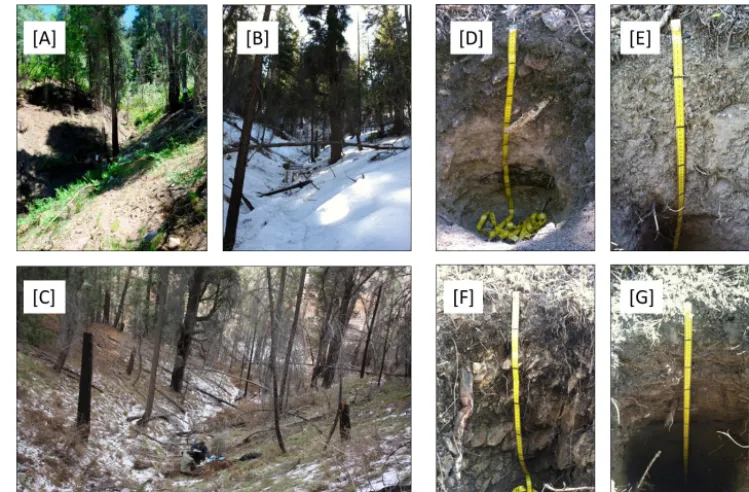
Figure 2. Study catchment seasonal cover and vegetation for (a) summer, (b) winter, and (c) 3
early spring and typical soil profiles on (d) a granite hillslope, (e) a granite divergent summit, 4
(f) quartzite profile, and (g) amphibolite profile. 5
6 7
Figure 2.Study catchment seasonal cover and vegetation for (a) summer, (b) winter, and (c) early spring and typical soil profiles on (d) a
granite hillslope, (e) granite divergent summit, (f) quartzite profile, and (g) amphibolite profile.
40 1
Figure 3. Modeled spatial distribution of parent materials in the study catchment and 2
examples of typical rocks sampled from the soil profiles sampled on each parent material. 3
4
Figure 3. Modeled spatial distribution of parent materials in the
study catchment and examples of typical rocks sampled from the soil profiles sampled on each parent material.
with an exponential soil production function (Pelletier and Rasmussen, 2009).
2.3 Data reduction
A data-driven iterative principal component analysis (iPCA) was used to determine those layers dominating soil– landscape variance based on Nauman (2009) and Levi and
Rasmussen (2014). Similar methods have been used with multivariate soil prediction mapping (Hengl et al., 2007b; Vasat et al., 2010) to optimize sample locations and to ensure landscape variability is captured in the sampling scheme. Here we used iPCA coupled with a factor loading analysis to select the final set of covariate layers used for soil predic-tion models. All covariate layers were standardized using az
score prior to iPCA:
Zij=
xij−µj
σj
, (1)
whereZij is thezscore of pixeli in layerj,xij is the
un-transformed value of pixeli of layerj,µj is the mean of
layerj, andσj is the standard deviation of layerj prior to
iPCA. The standardized data were grouped into topographic and NAIP indices, and each group was handled separately for the initial step of the data reduction. The iPCA eigenmatrix and eigenvalues were used to calculate loading factors (Rkp)
of each input band using the degree of correlation:
Rkp=
akp·pλp
√
Vark
, (2)
whereakpis the eigenvector for bandkand componentp,λp
ispth eigenvalue, and Varkis the variance of bandkin the
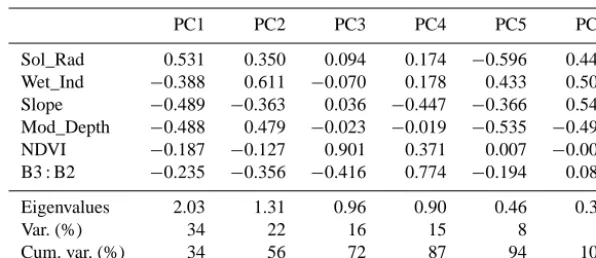
variance of the data set. The number of principal compo-nents required to reach 95 % cumulative explained variance in the data set determined the number of covariate layers to retain for subsequent iterations. The covariate layers retained were those with the greatest absolute summed loading fac-tors. This was repeated until all principal components were needed to achieve 95 % of cumulative variance. After pro-cessing topographic parameters and NAIP reflectance ratios separately, the final layers from each group were merged and reduced in the same manner. The covariate layers determined in the final PCA included NAIP B3:B2, NAIP NDVI, solar radiation, SAGA wetness index, slope, and modeled regolith depth. This set of covariates was used for field sample design and modeling of soil properties.
2.4 Sample design
A conditioned Latin hypercube sampling (cLHS) scheme was used to develop a sampling design to sample loca-tions that were randomly distributed in geographic space throughout the catchment and that captured the distribution of the selected covariate layers (Minasny and McBratney, 2006). We implemented cLHS using the z-scored layers of the six covariate layers determined from the iPCA to en-sure landscape variability was accounted for with the chosen sample sites. The cLHS was performed using open source code from Minasny and McBratney (http://www.iamg.org/ CGEditor/index.htm, downloaded 16 February 2011) using MATLAB version 7.11.0 (The MathWorks Inc. 2010). We ran the cLHS model using 40 000 iterations to randomly de-termine sample site locations (n) within the study site us-ing an=5,n=10,n=15,n=20, andn=30. It was con-cluded that n=20 best captured the distribution of the en-vironmental covariates using the least number of sample lo-cations based on comparison of sample site covariate statis-tics (mean, range, skewness, etc.) with the original covariate layers. Four supplemental sample points (sample ID 21–24) were also included from Lybrand et al. (2011). The additional samples were incorporated where it was subjectively deter-mined that the cLHS had missed key landscape positions, such as in the middle of the main drainage flowing out of the catchment and divergent summit positions.
2.5 Field methods and sample characterization
A rugged Trimble Yuma outdoor tablet and GPS unit was used to locate the sample sites in the field to sub-meter ac-curacy. At each of the 24 sample sites, soil pits were dug with a spade to the depth of refusal that coincided with the saprolite–saprock interface. Each pit was described and sam-pled by genetic horizons following standard protocols and soil morphological and physical properties including color, structure, consistence, root abundance, and rock fragment content were described in the field (Schoeneberger et al., 2002) (Fig. 2). In general, five horizons per pedon were
described, resulting in a total of 100 collected samples. Fol-lowing field sampling, it was determined that five locations were underlain by different parent materials. Specifically, pits 1 and 17 were underlain by quartzite; pits 5, 12, and 20 were underlain by a hornblende-rich amphibolite; and all re-maining sample locations were underlain by granite (Fig. 3). Soil bulk density measurements were collected at each pedon using a simple core and hammer method (Blake and Hartge, 1986). Assuming parent material homogeneity within the soil profile, representative samples of the par-ent material was collected at the saprolite–saprock bound-ary at each pedon for chemical and mineralogical analy-ses. All soil samples were air-dried and sieved to isolate the<2 mm fine-earth fraction and all soil characterization conducted on this fraction unless otherwise stated. Soil pH was measured on all samples at weight to volume ratios of 1:2 (soil : water) solution, 1:2 (soil : 1 M KCl) solution, and 1:4 (soil : 0.02 M CaCl2)solution (Soil Survey Staff, 2004). Soil electrical conductivity (µS cm−1)was determined for all samples using a 1:2 (soil : water) extract (Burt, 2004).
Soil organic matter content was determined by loss on ig-nition (Konen et al., 2002) for all collected samples. Samples (20 g) were placed in a furnace at 105◦C for 24 h, weighed, and then placed in a muffle furnace at 360◦C for 2 h, with the change in weight as a proxy for organic matter. Total car-bon and nitrogen content (wt/wt %) and stable isotope sig-nature (δ15N andδ13C) were measured for all samples on a continuous-flow gas-ratio mass spectrometer (Finnigan Delta PlusXL) coupled to an elemental analyzer (Costech) at the University of Arizona, Environmental Isotope Laboratory. The samples did not contain carbonates and it was assumed that total carbon was equivalent to total organic carbon.
Particle size was determined by laser diffraction using a Beckman Coulter LS 13 320 laser diffraction particle size analyzer at the University of Arizona, Center for Environ-mental Physics and Mineralogy. Following pretreatment to remove organics using NaOCl adjusted to pH 9.5, roughly 0.2 and 0.1 g of sample were weighed and put into tubes and then mixed for 24 h with 5 mL of deionized water using a Thermo Scientific Labquake®shaker/rotator, followed by the addition of 5 mL of 5 % sodium hexametaphosphate solution for an additional 24 h to ensure dispersion of soil particles prior to particle size analysis.
(EDXRF – SPECTRO XEPOS, Kleve – Germany) at the University of Arizona, Arizona Laboratory for Emerging Contaminants.
For mineralogical analyses, samples were pretreated to re-move organic matter (Jackson, 2005) with a 100 mL solution of 6 % NaOCl adjusted to a pH of 9.5, rinsed with deion-ized water, centrifuged, dried, and mixed. Mineral phases for soil and rock samples were identified by quantitative X-ray diffraction. A known amount of internal standard (corun-dum) was added to each sample to allow for quantitative in-terpretation of diffraction peaks. Samples were ground us-ing a McCrone micronizus-ing mill (Eberl, 2003). All sam-ple preparation steps were intended to maximize random orientation and to increase the exposed surface area of the included minerals. Samples were run as random powder mounts, measured from 5 to 65◦2θ, with a step size of 0.02◦ 2θ at the University of Arizona, Center for Environmental Physics and Mineralogy, using a PANalytical X’Pert PRO-MPD X-ray diffraction system (PANalytical, Almelo, AA, the Netherlands) generating Cu–Kαradiation at an acceler-ating potential of 45 kV and current of 40 mA. The result-ing diffractograms were analyzed usresult-ing Rietveld analyses to identify mineral phases and mineral abundance (Moore and Reynolds, 1997).
2.7 Elemental mass transfer and elemental mass flux Soil chemical denudation was determined using the loss of Na relative to the parent material. Sodium serves as a proxy of plagioclase feldspar weathering in granitic terrain as Na is for the most part biologically inert, and plagioclase min-erals are often the first minmin-erals to chemically decompose in granite bedrock weathering to regolith (Brantley and White, 2009). We used a dimensionless mass transfer coefficient,τ, as a measure of soil Na loss and chemical denudation relative to the parent material (Chadwick et al., 1990):
τj,w= C
j,wCi,p
Ci,wCj,p
−1, (3)
whereC is the concentration of an immobile elementi, in this case the element zirconium, and a mobile elementj, here Na, in the parent bedrock p and the weathered soil w to calcu-late relative elemental loss or gain. Values ofτ =0 indicate no change from parent material, whereasτ >1 is equivalent to elemental gain, andτ <1 equivalent to elemental loss.
In addition, the volumetric strain, ε, associated with soil formation was calculated as (Brimhall and Dietrich, 1987):
εi,w= ρ
pCi,p
ρwCi,w
−1, (4)
whereρpis the bulk density of the parent bedrock andρwis the bulk density of the soil. The total mass flux of Na [mj,flux; M L−2] was calculated for individual soil horizons (Egli and
Fitze, 2000; Heckman and Rasmussen, 2011):
mj,flux=ρpCj,pτw[zw(1−ηw)]
1
εi,w+1
, (5)
wherezwis horizon thickness andηwis the fractional volu-metric rock fragment content. The summation ofmj,fluxfor all horizons in a single pedon yields the total Na elemental flux from the pedon that has occurred during pedogenesis:
mflux,total=
k
X
w=1
n
X
j=1
mj,flux, (6)
wheren is the total number of elements of interest, in this case simply Na, andkis the total number of horizons in the profile.
2.8 Statistical analyses and parent material spatial modeling
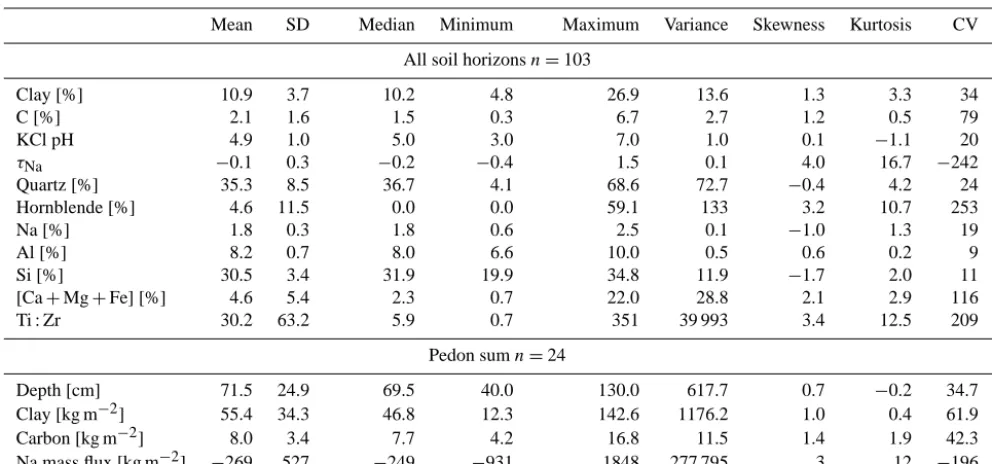
Summary statistics of measured soil properties were per-formed on all collected soil horizons (n=103) and for pedon summed values reported on a mass per area basis (n=24) (Table 1). Simple means comparison of soil physicochemi-cal properties among the different parent materials were con-ducted using unequal variancettests given the unequal sam-ple number per parent material: quartziten=7, amphibolite
n=10, and graniten=86, wherenis the number of hori-zons per parent material (Table 2).
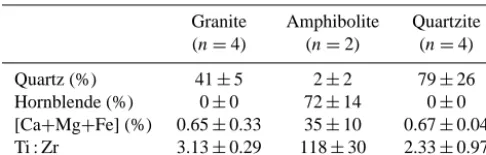
Analysis of parent rock geochemistry and mineral com-position indicated substantial variation of several key pa-rameters among the three parent materials, including Ti : Zr, [Ca+Mg+Fe], and weight percent hornblende and quartz (Table 3). To define the spatial extent of the various parent materials, the lowermost C or Cr horizon values for these pa-rameters from each sample pit were interpolated across the catchment using an inverse distance weighting (IDW) rou-tine. Specifically, the IDW power was set equal to 2, with a circular search radius of 250 m, a maximum of 23 neigh-bors, and 1 search sector. The interpolated values for each parameter were then exported, standardized, and categorized into three classes using a hierarchical clustering routine us-ing Ward’s minimum variance method for computus-ing the dis-tance between clusters (Milligan, 1979). The resulting three clusters summarized the variation in C and Cr horizon geo-chemistry and mineral composition of the three parent mate-rials and provided a spatial estimation of the extent and loca-tion of the different parent materials (Fig. 3).
2.9 Regression modeling
Table 1.Summary statistics of soil variables.
Mean SD Median Minimum Maximum Variance Skewness Kurtosis CV
All soil horizonsn=103
Clay [%] 10.9 3.7 10.2 4.8 26.9 13.6 1.3 3.3 34
C [%] 2.1 1.6 1.5 0.3 6.7 2.7 1.2 0.5 79
KCl pH 4.9 1.0 5.0 3.0 7.0 1.0 0.1 −1.1 20
τNa −0.1 0.3 −0.2 −0.4 1.5 0.1 4.0 16.7 −242
Quartz [%] 35.3 8.5 36.7 4.1 68.6 72.7 −0.4 4.2 24
Hornblende [%] 4.6 11.5 0.0 0.0 59.1 133 3.2 10.7 253
Na [%] 1.8 0.3 1.8 0.6 2.5 0.1 −1.0 1.3 19
Al [%] 8.2 0.7 8.0 6.6 10.0 0.5 0.6 0.2 9
Si [%] 30.5 3.4 31.9 19.9 34.8 11.9 −1.7 2.0 11
[Ca+Mg+Fe] [%] 4.6 5.4 2.3 0.7 22.0 28.8 2.1 2.9 116
Ti : Zr 30.2 63.2 5.9 0.7 351 39 993 3.4 12.5 209
Pedon sumn=24
Depth [cm] 71.5 24.9 69.5 40.0 130.0 617.7 0.7 −0.2 34.7
Clay [kg m−2] 55.4 34.3 46.8 12.3 142.6 1176.2 1.0 0.4 61.9
Carbon [kg m−2] 8.0 3.4 7.7 4.2 16.8 11.5 1.4 1.9 42.3
Na mass flux [kg m−2] −269 527 −249 −931 1848 277 795 3 12 −196
Table 2.Unequal variancettests – all horizons with parent material as the main effect.
Granite Amphibolite Quartzite Fratio P value
(n=86) (n=10) (n=7)
Clay (%) 10.83±3.73 12.34±3.88 9.03±1.88 3.41 0.063
C (%) 2.1±1.57 1.53±1.59 2.86±2.46 0.91 0.432
KCl pH 4.87±0.96 5.15±1.17 4.98±1.03 0.27 0.770
Rock fragment (wt %) 50.24±14.93 33.81±9.32 58.18±13.02 13.85 0.001
τNa −0.19±0.07 −0.19±0.14 0.83±0.55 11.58 0.003
Quartz (%) 36.29±4.66 17.87±6.81 47.6±12.71 35.54 0.000
Hornblende (%) 0.98±3.48 30.53±16.35 1.15±1.47 15.53 0.000
Na (%) 1.88±0.25 1.2±0.16 1.45±0.56 68.61 0.000
[Ca+Mg+Fe] (%) 2.85±2.81 16.79±4.15 4.2±0.87 51.30 0.000
Ti : Zr 11.99±24.42 158.92±101.57 13.33±3.81 10.05 0.001
Fratio andPvalue are result of unequal variancettests for each soil variable by parent material.
models for measured soil depth. These target variables were chosen to represent a range of important chemical, physical, and biological soil properties. The variables clay %, KCl pH, andτNa were modeled as depth-weighted averages for each profile where individual horizon values were weighted ac-cording to their relative fraction of total soil and saprolite depth, whereas soil depth, clay content, organic carbon con-tent, and sodium mass flux data were calculated as profile sums. Logit transformations were performed on all values prior to regression modeling (Hengl et al., 2004):
z+= z−zmin
zmax−zmin
;zmin< z < zmax, (7)
where the raw valueszwere standardized to the min and max of the raw dataz+. Logit transformations normalize distribu-tions of non-normal data sets and ensure that predicted soil
values remained within the range of the target variable val-ues, making prediction more efficient and statistically robust. Thez+values were then standardized from 0 to 1 (Hengl et al., 2004):
z++=ln
z+
1−z+
;0< z+<1, (8)
wherez++are the logit values used in soil property predic-tion models. After the predicpredic-tion models were constructed and interpolated residuals were added to the regression pre-dictions (see below) using logitz++values, predicted z++
values were back-transformed (Hengl et al., 2004):
zbt=
ez++
1+ez++
!
Table 3.Summary of key parent material mineral and geochemical parameters.
Granite Amphibolite Quartzite
(n=4) (n=2) (n=4)
Quartz (%) 41±5 2±2 79±26
Hornblende (%) 0±0 72±14 0±0
[Ca+Mg+Fe] (%) 0.65±0.33 35±10 0.67±0.04
Ti : Zr 3.13±0.29 118±30 2.33±0.97
for displaying results and to ensure that back-transformed values,zbt, represent the scale of the original data,z.
Two sets of multiple linear regressions were developed using either thez-scored environmental covariate layers or the principal components (PCs) resulting from the final iPCA iteration as the independent variables, and the logit-transformed soil data as the dependent variables. The total number of data points for developing regression models was
n=24. This represents a relatively limited number of data points for model development. We set a minimum cutoff of 17 degrees of freedom for each model, with the goal of max-imizing model degrees of freedom and minmax-imizing the num-ber of independent variables used in each model. We further limited interaction terms among independent variables to a maximum of two-way interactions to reduce model complex-ity and the risk of over-fitting the data. For regression models developed using the environmental covariate data we calcu-lated the variance inflation factor (VIF) for each model com-ponent to determine whether any possible independent vari-able colinearity exerted undue influence on model fit and pa-rameter estimation. A VIF value of>5 indicates colinearity (Freund et al., 2003); all measured VIF values were<3, in-dicating colinearity did not affect model fit and parameter estimation (Table 6).
Multivariate stepwise linear regression models were con-structed using JMP (JMP v11, SAS Institute Inc., Cary, NC, 2012). Regression modeling was performed using a combi-nation of forward and backward stepwise least-squares re-gression including all independent variables and their in-teraction terms. Model and independent variable parameter selection was based on a combination of metrics including maximizing thek-fold cross validationR2, wherekwas set to 24 and therefore equivalent to a leave-one-out cross val-idation (LOOCV). We also calculated the prediction resid-ual sum of squares (PRESS) statistic (Freund et al., 2003): PRESS=
n
P
i=1
yi− ˆyi
2
, whereyi is the value at theith
lo-cation, andyˆiis the value predicted for theith location when
removed from the model, providing a measure of model fit based on LOOCV. From this parameter, we calculated the PRESS root-mean-square error (PRMSE) as
PRMSE=q2PRESS
n, (10)
which may be compared to model RMSE; large differences between the two indicates the model is sensitive to the pres-ence/absence of specific observations. In addition to calcu-lating regression modelR2andP value, we also calculated the PRESSR2or
RPredicted2 =1−PRESSSST, (11)
where SST is total sums of squares. TheR2Predictedis similar to modelR2in that it ranges from 0 to 1, with values of 1 in-dicating that the model explains 100 % of the variance of the predicted data. These values were calculated for all models, and the final model selection for soil property prediction was based on comparison of these values among regression mod-els using the set ofz-scored covariate data or the PC data.
During model selection we also calculated Cook’sD for each location to determine whether any point was exerting undue influence on model parameters (Freund et al., 2003). A Cook’sD value>1 indicates a specific point exerts un-due influence on model fit. Only one soil variable, Na mass flux [kg Na m−2], exhibited locations with Cook’sDvalues
>1 for regression models developed using either the envi-ronmental covariates or the PCs. Specifically, one location, pit 17, underlain by quartzite, exerted undue influence on model fit. This point was excluded from model development and parameter estimation for the Na mass flux model.
Finally, we calculated the normalized mean square er-ror (NMSE) to compare the relative goodness of model fits among models with different units and to deal with compar-ing models developed uscompar-ing logit-transformed variables as dependent variables:
NMSE=
1
n n
P
i=1
(pi−oi)2
s2 , (12)
wherenis the number of observations,pi is the predicted
value at locationi,oi is the observed value at locationi, and
s2 is the variance of the observed samples (Park and Vlek, 2002; Hengl et al., 2004).
2.10 Residual spatial analysis
performed using a search radius ranging from 75 to 250 m and varying number of neighbors and final parameter selec-tion based on the combinaselec-tion that best minimized RMSE of LOOCV and provided an error mean that approached zero. The interpolated values were then added back to the values predicted using the regression model and the resulting sum back-transformed from logit units to the units of the pre-dicted dependent variable for “final” maps of prepre-dicted soil properties.
3 Results
3.1 General soil properties
The observed soil profiles exhibited consistent taxonomic and morphologic soil properties, despite differing parent ma-terial and a relatively broad range of soil physicochemical properties (Table 1). Taxonomically, all MG soils were clas-sified as Ustorthents or Haplustolls, with umbric or mollic epipedons and no subsurface diagnostic horizons (Holleran, 2013). The average soil profile included a surface Oi horizon consisting of pine litter and partially decomposed organic materials and several A horizons darkened by organic matter accumulation that transition to multiple AC and C horizons grading towards saprolite and saprock (Fig. 2).
Soil depth ranged from 40 to 130 cm, with an average of 72±25 cm. Soils averaged 2.1±1.6 % organic C with en-richment of C in surface horizons. Surface A horizons av-eraged organic C content of 4.3±1.6 %, which decreased roughly linearly with soil depth to organic C values averag-ing 0.9±0.4 % for C and Cr horizons. Soil carbon stocks av-eraged 8.0±3.4 kg m−2, with the maximum and minimum values of 16.8 and 4.2 kg m−2located in convergent and di-vergent portions of the landscape, respectively. Soil pH in general was moderately acidic, with KCl pH values averag-ing 4.9±1.0, ranging from acidic at KCl pH of 3.0 to a near-neutral pH of 7.0 (Table 1). Higher pH values were gener-ally associated with the organic-matter-rich surface horizons and the convergent portions of the landscape, with the most acidic values in saprolite and saprock horizons. The major-ity of MG soils were texturally classified as sandy loams, with some loams and sandy clay loams. Clay and sand weight percentages averaged 11±4 and 58±8 %, respectively. De-spite substantial variation in parent material composition, none of these soil physicochemical properties exhibited sig-nificant variation among the three parent materials (Table 2; all P values>0.05). Rock fragment abundance increased with depth, from a range of 2–10 % in surface A horizons to>50 % in the deepest C and Cr horizons. Rock fragment content was significantly greater in the quartzite soil horizons (P <0.001, Table 2).
3.2 Elemental composition and mineral assemblage Elemental and mineral composition of parent material sam-ples from each profile indicated the catchment was domi-nantly underlain by granitic materials with small intrusions of quartzite and a mafic, hornblende-enriched amphibolite (Fig. 3). There was large variation in quartz content, rang-ing from∼2 % by weight in the amphibolite to nearly 80 % in the quartzite (Table 3). The amphibolite was dominantly hornblende, averaging >70 % hornblende by weight, with ferropargasite as the other dominant amphibole. The min-eralogical differences were also expressed in variation in rock geochemical composition, with much greater values for [Ca+Mg+Fe] and Ti : Zr in the amphibolite (Table 3).
The elemental and mineral composition of the MG soils was relatively heterogeneous, following the variation in par-ent material (Table 2). The 21 profiles on granitic and quartzitic bedrock were relatively uniform in chemical com-position, with a limited range of values for each element. In contrast, profiles located on the amphibolite exhibited significant differences in elemental and mineral compo-sition relative to the other soils. Specifically, the gran-ite and quartzgran-ite soils exhibgran-ited Si concentrations that av-eraged 32±1.3 g Si kg−1, relative to the mafic soils that averaged 24±2.9 g Si kg−1 (P <0.0001). The mafic soils were enriched in Ca, Mg, and Fe, with [Ca+Mg+Fe] values that averaged 17±4 %, compared to the quartzite and granite soils that averaged [Ca+Mg+Fe] of 4.2±0.9 and 2.9±2.8 %, respectively (P <0.001). Additionally, the soils on amphibolite exhibited Ti : Zr of 159±101 rela-tive to granite and quartzite soils where values were<14. Quantitative XRD analyses indicated hornblende content of 31±16 % in the amphibolite soils, relative to the granite and quartzite soils that averaged<1.0 % (P <0.001). The quartzite soils exhibited a greater concentration of quartz, with an average of 48±13 % compared to the granite soils that averaged 36±5.7 %, and the mafic soils with average quartz concentration of 18±7 % (P <0.001).
Sodium mass transfer,τ, and total Na mass flux values,
41 1
Figure 4. Depth profiles of fine earth fraction Ti:Zr in the profiles location on quartzite 2
relative to average Ti:Zr of soils derived from granite in the study catchment. 3
4
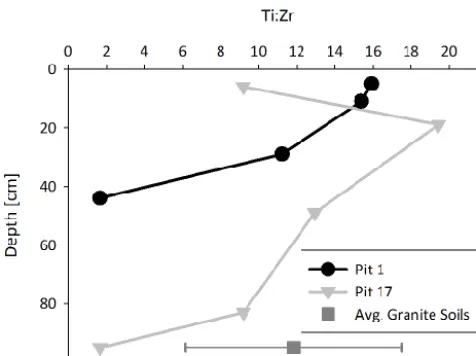
Figure 4.Depth profiles of fine-earth fraction Ti : Zr in the profiles
location on quartzite relative to average Ti : Zr of soils derived from granite in the study catchment.
compared to an average of 1.4 % in the soils putatively de-rived from quartzite. Greater Na concentration of Na in the quartzite profile and the variation in Ti : Zr indicates the ad-dition of granitic and/or mafic materials via colluvial trans-port from neighboring soils. This supposition is suptrans-ported in that the relative Na concentration in the quartzite soils was equivalent to the Na concentrations noted in the surrounding granite and mafic soils.
3.3 Principal component analysis and regression modeling
The iPCA and factor loading analyses indicated that six en-vironmental covariates accounted for 95 % of the variance in the landscape (Table 4). The selected environmental co-variates included solar radiation (Sol_Rad), SAGA wetness index (Wet_Ind), slope, NDVI, NAIP B3 : B2, and numer-ically modeled soil depth (Mod_Depth) from Pelletier and Rasmussen (2009), with the largest amount of variance at-tributed to slope, solar radiation, SAGA wetness index, and B3 : B2 (Table 4).
The final set of PCs from the final iPCA were strongly correlated with distinct sets of environmental covariates (Ta-ble 5). Specifically, PC1 and PC2, which accounted for 56 % of cumulative variance (Table 4), were strongly correlated to topographic variables where PC1 was most strongly re-lated to modeled soil depth, slope, and wetness index, and PC2 was strongly correlated with wetness index, modeled soil depth, and solar radiation. In contrast, PC3 and PC4 were dominantly weighted towards NDVI and B3 : B2, re-spectively. PC5 exhibited significant correlation with all of the environmental covariates, whereas PC6 was only signif-icantly correlated to wetness index and slope. Environmen-tal covariates exhibited relatively few significant correlations
with each other, with the strongest correlation of r=0.73 between modeled soil depth and wetness index.
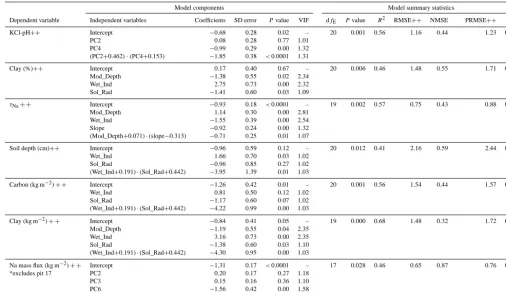
The final set of soil prediction models for the soil vari-ables of KCl pH, clay [%],τNa, soil depth [cm], carbon and clay stocks [kg m−2], and Na mass flux [kg m−2] varied in terms of prediction parameters, the relative strength of model fit, and model predictive capability (Table 6). The variables of KCl pH,τNa, and Na mass flux exhibited the best pre-diction models using PCs. Specifically, prepre-diction parame-ters for KCl pH included PC2 and PC4 that were strongly correlated to topographic parameters and vegetation indices (Table 5). Similarly, prediction parameters for Na mass flux included topography-related components PC2 and PC6, and the vegetation-related component PC3. The prediction model forτNawas comprised of topography-related components of PC1, PC2, and PC6. In contrast, the prediction models for clay %, soil depth, and carbon and clay stocks all exhibited the strongest fits with environmental covariate layers related to topography including wetness index, solar radiation, and modeled soil depth (note that modeled soil depth was ex-cluded from models developed for measured soil depth) (Ta-ble 5).
All of the prediction models, except for clay %, included one two-way interaction term and all models had 19–20 de-grees of freedom for the model error term. The exception was the model for Na mass flux that only had 17 error term de-grees of freedom. As indicated previously, the Na mass flux models were developed excluding pit 17 as Cook’sDvalues indicated this location exerted a large effect on model pa-rameter estimation and model fit. All variance inflation fac-tors were<5, indicating that colinearity among independent variables was not an issue, even for those models that in-cluded both modeled soil depth and wetness index that were significantly correlated.
The best regression models based on modelR2, NMSE, andRp2were the models for clay and carbon stocks, KCl pH, andτNa (Table 6). These models exhibited the lowest rela-tive NMSE values, ranging from 0.32 to 0.44, and explained between 56 and 68 % of variance in the dependent variable values, and between 42 and 52 % of variance in predicted values based on LOOCV. In comparison, while the models developed for clay %, soil depth, and Na mass flux exhibited a reasonable fit to all dependent variables used in the model, explaining 41 to 46 % of variable variation, they explained a relatively small fraction, only 16 to 21 %, of the variance for predicted variables using LOOCV. The worst model fit was for Na mass flux, with the greatest NMSE of 0.87 and model
P value of only 0.028. All models exhibited near-equivalent values for RMSE and PRMSE.
3.4 Residual interpolation
Table 4.Eigenvectors, variance, and cumulative variance for final PCA.
PC1 PC2 PC3 PC4 PC5 PC6
Sol_Rad 0.531 0.350 0.094 0.174 −0.596 0.449
Wet_Ind −0.388 0.611 −0.070 0.178 0.433 0.502
Slope −0.489 −0.363 0.036 −0.447 −0.366 0.542
Mod_Depth −0.488 0.479 −0.023 −0.019 −0.535 −0.495
NDVI −0.187 −0.127 0.901 0.371 0.007 −0.003
B3 : B2 −0.235 −0.356 −0.416 0.774 −0.194 0.086
Eigenvalues 2.03 1.31 0.96 0.90 0.46 0.34
Var. (%) 34 22 16 15 8 6
Cum. var. (%) 34 56 72 87 94 100
τNa and carbon stock with power values roughly equivalent to 2 (Table 7). The LOOCV mean errors approached zero for all variables. Further, we observed no consistent correla-tion of model residuals to landscape posicorrela-tion (Fig. 5). The IDWoptresults indicated the coupled iPCA and cLHS gener-ated randomly distributed model errors. Interpolgener-ated model residuals were then added back to values predicted using the regression models.
3.5 Predicted soil properties
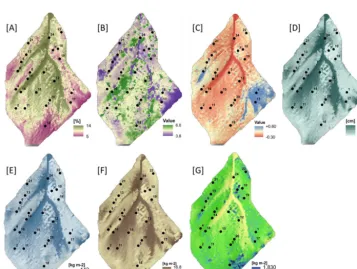
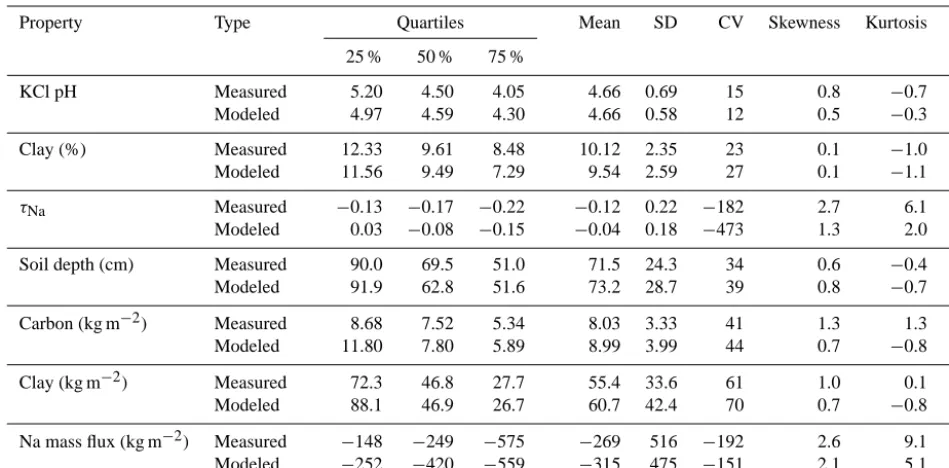
The final sets of values from the regression modeling and residual interpolation were back-transformed to the relative scale of each soil variable and expressed as maps of soil physicochemical properties (Fig. 6). The final maps indicated clear spatial variation in soil properties that were largely re-lated to topographic variation, with a general trend of greater depth, clay and carbon content, and Na loss in the conver-gent drainages. Final predicted value summary statistics were comparable to those of the locations used to develop the prediction models (Table 8). Measured and predicted values generally exhibited similar median and quartile values and summary statistics. The largest deviations between measured and predicted values were observed forτNaand Na mass flux. This deviation was driven by the area of the catchment under-lain by quartzite parent material (Fig. 3) that exhibited posi-tive values forτNaand Na mass flux (Fig. 5) due to the vari-ation in chemistry between the quartzite rock and the overly-ing soil material (Fig. 4).
4 Discussion
4.1 Factors controlling soil property spatial variation The observed and modeled data indicated that water and en-ergy, represented by the topographically derived variables of wetness index and solar radiation, were central factors for predicting soil properties across the catchment. Solar ra-diation and wetness index were included directly as envi-ronmental covariates or principal components in all of the regression models developed for soil property prediction
(Table 6). The significance of solar radiation and wetness in-dex is also apparent in the final PCA, where the dominant eigenvectors of PC1 and PC2, which accounted for a com-bined 56 % of landscape variability, were strongly correlated to solar radiation and wetness index (Table 4). These findings agree with other studies at this scale of observation that note significant correlations of soil properties to solar radiation, wetness index, and slope (Moore et al., 1993; Gessler et al., 2000; Ashtekar and Owens, 2013). Solar radiation is a pri-mary control on soil water availability, serving as a metric of radiative energy transfer to the soil system that drives soil heating, evaporative transpiration, photosynthesis, and soil water availability (Beaudette and O’Geen, 2009). The degree of soil wetness drives primary production, weathering rates, and biological activity, and has previously been reported as an important topographic index for predicting soil proper-ties at scales ranging from 100to 103ha (Bodaghabadi et al., 2011; Levi and Rasmussen, 2014; Browning and Duniway, 2011).
Remotely sensed NDVI and NAIP bands B3 : B2 charac-terizing vegetation variability were only included in the mod-els for KCl pH and Na mass flux, and in those cases only indi-rectly through their contribution to PC3 and PC4. In the final output from the iPCA, vegetation layers only accounted for
∼14 % of landscape variance (Table 4). The lack of stronger relationships of soil properties to vegetation was most likely a function of the relative homogeneity of the vegetation as-semblage in the observed catchment and the relatively small catchment area, 100ha, encompassed by this study. These re-sults contrast with those of previous DSM studies at larger spatial resolutions spanning areas on the order of 104 to 106ha that identified strong relationships between soil varia-tion and remotely sensed vegetavaria-tion indices (Ballabio et al., 2012; Dobos, 2003).
4.2 Soil property variation with topography
42 1
Figure 5. Spatially interpolated logit transformed regression model residuals for (a) clay 2
percent (b) KCl pH (c) τNa (d) soil depth (e) clay stocks (f) carbon stocks (g) Na mass flux.
3
Residuals were interpolated using an optimized inverse distance weighting. 4
5
Figure 5.Spatially interpolated logit-transformed regression model residuals for (a) clay percent, (b) KCl pH, (c)τNa, (d) soil depth, (e)
clay stocks, (f) carbon stocks, and (g) Na mass flux. Residuals were interpolated using an optimized inverse distance weighting.
1
Figure 6. Final maps of predicted soil properties including (a) clay percent (b) KCl pH (c) τNa
2
(d) soil depth (e) clay stocks (f) carbon stocks (g) Na mass flux for the study catchment. Final 3
maps are the back transformed summation of logit transformed regression estimations and 4
interpolated residuals. 5
6
Figure 6.Final maps of predicted soil properties including (a) clay percent, (b) KCl pH, (c)τNa, (d) soil depth,(e) clay stocks, (f) carbon
stocks, and (g) Na mass flux for the study catchment. Final maps are the back-transformed summation of logit-transformed regression estimations and interpolated residuals.
T ab le 5. Correlation matrix of en vironmental co v ariates and principal components. Mod_Depth W et_Ind Sol_Rad Slope ND VI B3 :B2 PC1 PC2 PC3 PC4 PC5 PC6 KCl-pH Clay τNa Soil depth Carbon Clay Na mass (%) (cm) (kg m − 2) (kg m − 2) flux (kg m − 2) Mod_Depth 1.00 W et_Ind 0.73*** 1.00 Sol_Rad − 0.13 0.09 1.00 Slope 0.28 − 0.03 –0.59** 1.00 ND VI − 0.01 − 0.10 − 0.19 0.24 1.00 B3 :B2 0.07 0.17 − 0.04 − 0.07 0.17 1.00 PC1 0.76**** 0.54** –0.58** 0.67*** 0.35 0.31 1.00 PC2 0.66*** 0.77**** 0.41* − 0.32 − 0.37 − 0.28 0.10 1.00 PC3 − 0.09 − 0.20 − 0.11 0.23 0.93**** − 0.19 0.17 − 0.30 1.00 PC4 0.02 0.23 0.22 − 0.39 0.35 0.89**** 0.12 − 0.11 0.05 1.00 PC5 0.66*** 0.24 0.16 0.44* 0.11 0.28 0.54** 0.19 0.00 0.14 1.00 PC6 − 0.31 0.30 0.01 0.12 0.00 − 0.03 − 0.02 − 0.04 0.01 − 0.02 –0.43* 1.00 KCl-pH 0.38 0.16 − 0.18 0.52** 0.19 − 0.07 0.46* 0.05 0.19 − 0.18 0.43* − 0.03 1.00 Clay (%) 0.11 0.45* − 0.24 0.03 0.01 0.01 0.24 0.19 − 0.03 0.03 − 0.32 0.49* 0.22 1.00 τNa 0.02 − 0.25 0.19 − 0.30 − 0.03 − 0.16 − 0.26 0.09 0.04 − 0.04 0.07 –0.56** − 0.14 − 0.27 1.00 Soil depth (cm) 0.24 0.34 − 0.23 0.05 − 0.30 − 0.10 0.19 0.28 − 0.30 − 0.18 − 0.13 0.16 − 0.17 0.16 − 0.14 1.00 Carbon (kg m − 2) 0.01 0.14 − 0.36 0.05 − 0.24 0.06 0.13 − 0.01 − 0.28 − 0.06 − 0.26 0.19 0.06 0.32**** − 0.66*** 1.00 Clay (kg m − 2) 0.23 0.45* − 0.26 0.13 − 0.19 0.09 0.31 0.21 − 0.26 − 0.01 − 0.11 0.36 0.03 0.37 − 0.25 0.89*** 0.73**** 1.00 Na mass flux (kg m − 2) 0.03 − 0.16 0.32 –0.44* − 0.01 − 0.02 − 0.28 0.15 0.02 0.15 0.09 –0.52** − 0.07 − 0.27 0.62** − 0.38 –0.43* –0.49* 1.00 P airwise correlation coef ficients. Bold v alues are significant at P < 0.05*, P < 0.01**, P < 0.001***, P < 0.0001****.
amount of landscape variance accounted for by topographic variables and the inclusion of these parameters in all of the derived soil prediction models (Table 5). At the scale of the catchment studied here, variation in relief/topography was the primary variable accounting for soil variability, with min-imal variation in other soil-forming parameters, including climate, organisms, landscape age, and parent material. The observed significant variation in parent material appeared to exert minimal control on spatial soil property variation and model residuals, further highlighting the dominant role of to-pographic control on soil variation at this scale. In particular, the geochemical signature of the soils located on the quartzite parent material indicated mixing with adjacent granitic and mafic parent materials, likely via topographically driven pro-cesses of colluviation and bioturbation. All modeled soil properties exhibited strong trends related to the convergent portions of the landscape. Specifically, in the convergent ar-eas we observed deeper soils, greater concentration of clay and clay stocks, increased Na depletion and Na mass flux, and greater soil organic C stocks (Fig. 5); much of this vari-ation may be attributed to topographic controls on water and sediment redistribution.
Table 6.Summary statistics of regression models for predicting logit-transformed soil physicochemical properties.
Model components Model summary statistics
Dependent variable Independent variables Coefficients SD error Pvalue VIF dfE Pvalue R2 RMSE++ NMSE PRMSE++ R2P KCl-pH++ Intercept −0.68 0.28 0.02 – 20 0.001 0.56 1.16 0.44 1.23 0.46
PC2 0.08 0.28 0.77 1.01 PC4 −0.99 0.29 0.00 1.32 (PC2+0.462)·(PC4+0.153) −1.85 0.38 <0.0001 1.31
Clay (%)++ Intercept 0.17 0.40 0.67 – 20 0.006 0.46 1.48 0.55 1.71 0.21 Mod_Depth −1.38 0.55 0.02 2.34
Wet_Ind 2.75 0.73 0.00 2.32 Sol_Rad −1.41 0.60 0.03 1.09
τNa+ + Intercept −0.93 0.18 <0.0001 – 19 0.002 0.57 0.75 0.43 0.88 0.34
Mod_Depth 1.14 0.30 0.00 2.81 Wet_Ind −1.55 0.39 0.00 2.54 Slope −0.92 0.24 0.00 1.32 (Mod_Depth+0.071)·(slope−0.313) −0.71 0.25 0.01 1.07
Soil depth (cm)++ Intercept −0.96 0.59 0.12 – 20 0.012 0.41 2.16 0.59 2.44 0.19 Wet_Ind 1.66 0.70 0.03 1.02
Sol_Rad −0.96 0.85 0.27 1.02 (Wet_Ind+0.191)·(Sol_Rad+0.442) −3.95 1.39 0.01 1.03
Carbon (kg m−2)+ + Intercept −1.26 0.42 0.01 – 20 0.001 0.56 1.54 0.44 1.57 0.50
Wet_Ind 0.81 0.50 0.12 1.02 Sol_Rad −1.17 0.60 0.07 1.02 (Wet_Ind+0.191)·(Sol_Rad+0.442) −4.22 0.99 0.00 1.03
Clay (kg m−2)+ + Intercept −0.84 0.41 0.05 – 19 0.000 0.68 1.48 0.32 1.72 0.52 Mod_Depth −1.19 0.55 0.04 2.35
Wet_Ind 3.16 0.73 0.00 2.35 Sol_Rad −1.38 0.60 0.03 1.10 (Wet_Ind+0.191)·(Sol_Rad+0.442) −4.30 0.95 0.00 1.03
Na mass flux (kg m−2)+ + Intercept −1.31 0.17 <0.0001 – 17 0.028 0.46 0.65 0.87 0.76 0.16 *excludes pit 17 PC2 0.20 0.17 0.27 1.18
PC3 0.15 0.16 0.36 1.10 PC6 −1.56 0.42 0.00 1.58 (PC2+0.525)·(PC6−0.018) 0.88 0.32 0.01 1.68
Table 7.IDW of residuals – optimized modeling parameters.
Variable Power Search radius # of sectors Mean++ RMSE++
Clay % 1.00 250 1 0.07 1.39
KCl pH 1.00 250 1 0.00 1.10
τNa 1.62 250 1 0.00 0.64
Depth 1.00 250 8 −0.05 2.26
Carbon 1.99 150 1 −0.12 1.29
Na−flux 1.00 250 1 −0.06 2.85
Clay 1.00 250 1 −0.03 1.46
IDW performed with a minimum of 10 neighbors and maximum of 24. Circular search radius.
Convergent portions of the landscape typically exhibit deeper soils than adjacent ridges as a result of the localized accumulation of soil and sediment produced in upslope posi-tions (Dietrich et al., 2003), consistent with the patterns ob-served here (Fig. 5). Based on obob-served soil morphology in convergent areas, these soils represent cumulic profiles with a series of deep A and AC horizons that exhibit some parti-cle size stratification, suggesting individual packets of sedi-ment accumulated from episodic physical deposition events (Dickinson, 1992). Soils located on summit/ridgetop posi-tions were generally shallow and rocky, with morphology indicative of in situ soil production, whereas hillslope soils contained colluvial surface horizons darkened by organic matter over soil derived from bedrock weathering in place
(Fig. 2). Soil production rates, i.e., the physical conversion of bedrock to potentially mobile soil material, typically present an inverse relation with soil depth in that rates decrease expo-nentially with increasing soil depth (Heimsath et al., 1997). For the catchment observed here, this translates into localized variation in soil production, with the lowest potential rates in convergent areas where soil production rates would be lim-ited due to the deep accumulation of sediment from adjacent landscape positions.
Table 8.Comparison of measured and modeled soil property summary statistics.
Property Type Quartiles Mean SD CV Skewness Kurtosis
25 % 50 % 75 %
KCl pH Measured 5.20 4.50 4.05 4.66 0.69 15 0.8 −0.7
Modeled 4.97 4.59 4.30 4.66 0.58 12 0.5 −0.3
Clay (%) Measured 12.33 9.61 8.48 10.12 2.35 23 0.1 −1.0
Modeled 11.56 9.49 7.29 9.54 2.59 27 0.1 −1.1
τNa Measured −0.13 −0.17 −0.22 −0.12 0.22 −182 2.7 6.1
Modeled 0.03 −0.08 −0.15 −0.04 0.18 −473 1.3 2.0
Soil depth (cm) Measured 90.0 69.5 51.0 71.5 24.3 34 0.6 −0.4
Modeled 91.9 62.8 51.6 73.2 28.7 39 0.8 −0.7
Carbon (kg m−2) Measured 8.68 7.52 5.34 8.03 3.33 41 1.3 1.3
Modeled 11.80 7.80 5.89 8.99 3.99 44 0.7 −0.8
Clay (kg m−2) Measured 72.3 46.8 27.7 55.4 33.6 61 1.0 0.1
Modeled 88.1 46.9 26.7 60.7 42.4 70 0.7 −0.8
Na mass flux (kg m−2) Measured −148 −249 −575 −269 516 −192 2.6 9.1
Modeled −252 −420 −559 −315 475 −151 2.1 5.1
nfor measured is 24;nfor modeled is 20 910.
ridgetop positions that contained only∼5–6 % clay on aver-age (Fig. 5a). Thus greater clay stocks in the convergent areas were not only a function of deeper soils but also increased concentration of fine-grained materials. The enrichment of clay in these areas is likely due to a combination of sediment transport, particularly surface wash processes that preferen-tially transport fine-grained materials (Pelletier, 2008), and enhanced weathering and in situ transformation of primary minerals to secondary phases (Maher, 2010).
The largest carbon stocks, on the order of 17 kg m−2, were observed in the convergent landscape positions (Fig. 5f). To-pographic variation in C stocks may be related to localized variation in primary production and C inputs, greater fre-quency of soil saturation and anaerobic conditions, and accu-mulation of C-rich surface material from adjacent landscape positions via physical transport (Berhe and Kleber, 2013; Harden et al., 2008). We did not observe a significant dif-ference in canopy cover and vegetation density in the con-vergent areas relative to other portions of the catchment, so local variation in primary production likely does not account for increased C stocks. The convergent areas do tend to have longer and more frequent occurrence of saturated conditions (Heidbuchel et al., 2013) such that localized and temporally variably saturation and water table rise may limit aerobic de-composition of C inputs in these areas. However, in contrast to clay percent, the average profile percent C did not exhibit any significant relationship to topography or other environ-mental covariates that would be expected if localized chem-ical processes were enhancing C accumulation. Thus, given the cumulic nature of the convergent area soil profiles, and
the lack of topographic variation in C percent, enhanced C storage in the convergent areas is most likely the product of physical transport and accumulation of C-rich sediments from upslope positions.
5 Conclusions
Digital soil mapping methods were applied to model soil property spatial variation in a 6 ha forested catchment in southern Arizona. The process included use of an iterative data reduction technique to isolate those environmental co-variates that accounted for the greater part of landscape vari-ance and that were then coupled with a conditioned Latin hypercube sample design focused on capturing the overall numeric and spatial distribution of the selected environmen-tal covariates. The key conclusions drawn from this work in-clude the following:
– The coupled iPCA and cLHS routine produced a
sam-pling scheme that captured much of the soil variability in the catchment, demonstrating the utility of this ap-proach for establishing robust sample designs for soil and geomorphic studies.
– Simple linear regression models and IDW interpolation
of residuals captured the variance in measured soil prop-erties and predicted spatial correlation of soil propprop-erties to landscape structure.
– For the catchment-scale observation studied here,
properties than reflectance variables, a function of the relatively small scale of observation and uniform vege-tation cover in this forested system.
– The modeled spatial distribution of soil properties
pro-vides a framework for interpreting catchment-scale vari-ation in critical zone process and evolution.
Future work will focus on coupling results from this cou-pled empirical–statistical approach to output from mechanis-tic, process-based numerical models of critical process and evolution.
Acknowledgements. This work was supported through the
Critical Zone Observatory Network and NSF EAR #0724958, NSF EAR/IF #0929850 and Arizona Agricultural Experiment Station #ARZT-1367190-H21-155. We thank Rebecca Lybrand, who provided supplemental samples, and S. Mercer Meding, who supervised x-ray diffraction and particle size analysis.
Edited by: D. Dunkerley
References
Ashtekar, J. M. and Owens, P. R.: Remembering Knowledge: An Expert Knowledge Based Approach to Digital Soil Mapping, Soil Horizons, 54, doi:10.2136/sh13-01-0007, 2013.
Ballabio, C., Fava, F., and Rosenmund, A.: A plant ecology ap-proach to digital soil mapping, improving the prediction of soil organic carbon content in alpine grasslands, Geoderma, 187, 102–116, doi:10.1016/j.geoderma.2012.04.002, 2012.
Beaudette, D. E. and O’Geen, A. I.: Quantifying the Aspect Ef-fect: An Application of Solar Radiation Modeling for Soil Survey (vol 73, pg 1345, 2009), Soil Sci. Soc. Am. J., 73, 1755–1755, doi:10.2136/sssaj2008.0229er, 2009.
Ben-Dor, E.: Quantitative remote sensing of soil properties, Adv. Agronomy, 75, 173–243, doi:10.1016/S0065-2113(02)75005-0, 2002.
Ben-Dor, E., Patkin, K., Banin, A., and Karnieli, A.: Mapping of several soil properties using DAIS-7915 hyperspectral scanner data – a case study over clayey soils in Israel, Int. J. Remote Sens., 23, 1043–1062, doi:10.1080/01431160010006962, 2002. Ben-Dor, E., Goldlshleger, N., Benyamini, Y., Agassi, M., and
Blumberg, D. G.: The spectral reflectance properties of soil struc-tural crusts in the 1.2- to 2.5-mu m spectral region, Soil Sci. Soc. Am. J., 67, 289–299, 2003.
Berhe, A. A. and Kleber, M.: Erosion, deposition, and the per-sistence of soil organic matter: mechanistic considerations and problems with terminology, Earth Surf. Process. Landf., 38, 908– 912, doi:10.1002/Esp.3408, 2013.
Beven, K. J. and Kirkby, M. J.: A physically based,
vari-able contributing area model of basin hydrology/Un
modèle à base physique de zone d’appel variable de l’hydrologie du bassin versant, Hydrol. Sci. Bull., 24, 43– 69, doi:10.1080/02626667909491834, 1979.
Blake, G. R. and Hartge, K. H.: Bulk Density, in: Methods of soil analysis. Part 1- Physical and Mineralogical Methods, edited by: Klute, A., ASA and SSSA, Madison, WI, 1986.
Bodaghabadi, M. B., Salehi, M. H., Martinez-Casasnovas, J. A., Mohammadi, J., Toomanian, N., and Borujeni, I. E.: Using Canonical Correspondence Analysis (CCA) to identify the most important DEM attributes for digital soil mapping applications, Catena, 86, 66–74, doi:10.1016/j.catena.2011.02.009, 2011. Boehner, J., Koethe, R., Conrad, O., Gross, J., Ringeler, A., and
Selige, T.: Soil Regionalisation by Means of Terrain Analysis and Process Parameterisation, in: Soil Classification 2001, edited by: Micheli, E., Nachtergaele, F., and Montanarella, L., European Soil Bureau, Research Report No. 7, EUR 20398 EN, Luxem-bourg, 213–222, 2002.
Brantley, S. L. and White, A. F.: Approaches to Modeling Weath-ered Regolith, in: Thermodynamics and Kinetics of Water-Rock Interaction, edited by: Oelkers, E. H. and Schott, J., Rev. Miner-alogy Geochem., 70, 435–484, 2009.
Brimhall, G. H. and Dietrich, W. E.: Constitutive Mass Bal-ance Relations between Chemical-Composition, Volume, Den-sity, PoroDen-sity, and Strain in Metasomatic Hydrochemical Sys-tems – Results on Weathering and Pedogenesis, Geochim. Cos-mochim. Acta, 51, 567–587, 1987.
Browning, D. M. and Duniway, M. C.: Digital soil mapping in the absence of field training data: A case study using terrain attributes and semiautomated soil signature derivation to dis-tinguish ecological potential, Appl. Environ. Soil Sci., 2011, 421904, doi:10.1155/2011/421904, 2011.
Brus, D. J. and Heuvelink, G. B. M.: Optimization of sample patterns for universal kriging of environmental variables, Geo-derma, 138, 86–95, doi:10.1016/j.geoderma.2006.10.016, 2007. Buchanan, S., Triantafilis, J., Odeh, I. O. A., and Subansinghe, R.: Digital soil mapping of compositional particle-size fractions us-ing proximal and remotely sensed ancillary data, Geophysics, 77, Wb201–Wb211, doi:10.1190/Geo2012-0053.1, 2012.
Burt, R.: Soil Survey Laboratory Methods Manual, Soil Survey In-vestigations Report No. 42, Version 4.0, United States Depart-ment of Agriculture, Natural Resources Conservation Service, National Soil Survey Center, Lincoln, NE, 2004.
Chadwick, O. A., Brimhall, G. H., and Hendricks, D. M.: From a black to a gray box – a mass balance interpretation of pedogene-sis, Geomorphology, 3, 369–390, 1990.
Conrad, O.: SAGA – Program Structure and Current State of Im-plementation, in: SAGA – Analysis and Modeling Applications, edited by: Böhner, J., McCloy, K. R., and Strobl, J., Verlag Erich Goltze GmbH, 39–52, 2006.
Dematte, J. A. M. and Nanni, M. R.: Weathering sequence of soils developed from basalt as evaluated by laboratory (IRIS), airborne (AVIRIS) and orbital (TM) sensors, Int. J. Remote Sens., 24, 4715–4738, 2003.
Dematte, J. A. M., Genu, A. M., Fiorio, P. R., Ortiz, J. L., Mazza, J. A., and Leonardo, H. C. L.: Comparison between soil maps obtained by spectral remote sensing and conventional method, Pesqui Agropecu Bras, 39, 1219–1229, doi:10.1590/S0100-204x2004001200009, 2004.
Dickinson, W. R.: Geologic Map of Catalina Core Complex and San Pedro Trough: Arizona Geological Survey Contributed Map CM-92-C, Arizona Geological Survey, 1992.
edited by: Wilcock, P. R., and Iverson, R. M., American Geo-physical Union, Washington, DC, 103–132, 2003.
Dobos, E.: The application of remote sensing and terrain modeling to soil characterization, Innovative Soil-Plant Systems for Sus-tainable Agricultural Practices, 328–348, 2003.
Dokuchaev, V. V.: Selected works of V. V. Dokuchaev, Israel Pro-gram for Scientific Translations, available from the U.S. Dept. of Commerce, Clearinghouse for Federal Scientific and Technical Information, Jerusalem, Springfield, Va., 1967.
Eberl, D. D.: User Guide to RockJock – A program for determin-ing quantitative mineralogy from x-ray diffraction data, USGS Open-File Report: 2003-78, 2003.
Egli, M. and Fitze, P.: Formulation of pedologic mass balance based on immobile elements: A revision, Soil Science, 165, 437–443, doi:10.1097/00010694-200005000-00008, 2000.
Eldeiry, A. A. and Garcia, L. A.: Comparison of Ordinary Kriging, Regression Kriging, and Cokriging Techniques to Estimate Soil Salinity Using LANDSAT Images, J. Irrigat. Drain. Eng.-Asce, 136, 355–364, doi:10.1061/(asce)ir.1943-4774.0000208, 2010. Florinsky, I. V.: Combined analysis of digital terrain models and
remotely sensed data in landscape investigations, Prog. Phys. Geog., 22, 33–60, doi:10.1177/030913339802200102, 1998. Freeman, T. G.: Caclculating catchment-area with divergent flow
based on a regular grid, Comput. Geosci., 17, 413–422, doi:10.1016/0098-3004(91)90048-i, 1991.
Freund, R. J., Littell, R. C., and Creighton, L.: Regression Using JMP, SAS Institute Inc., Cary, NC, 2003.
Galvao, L. S., Formaggio, A. R., Couto, E. G., and Roberts, D. A.: Relationships between the mineralogical and chemical composition of tropical soils and topography from hyperspec-tral remote sensing data, Isprs J. Photogramm, 63, 259–271, doi:10.1016/j.isprsjprs.2007.09.006, 2008.
Gessler, P. E., Chadwick, O. A., Chamran, F., Althouse, L., and Holmes, K.: Modeling soil-landscape and ecosystem properties using terrain attributes, Soil Sci. Soc. Am. J., 64, 2046–2056, 2000.
Goovaerts, P.: Estimation or simulation of soil properties? An opti-mization problem with conflicting criteria, Geoderma, 97, 165– 186, doi:10.1016/S0016-7061(00)00037-9, 2000.
Hansen, C. W., Helton, J. C., and Sallaberry, C. J.: Use of repli-cated Latin hypercube sampling to estimate sampling variance in uncertainty and sensitivity analysis results for the geologic dis-posal of radioactive waste, Reliab. Eng. Syst. Safe, 107, 139–148, doi:10.1016/j.ress.2011.12.006, 2012.
Harden, J. W., Berhe, A. A., Torn, M., Harte, J., Liu, S., and Stal-lard, R. F.: Soil erosion: Data say C sink, Science, 320, 178–179, doi:10.1126/science.320.5873.178, 2008.
Heckman, K. and Rasmussen, C.: Lithologic controls on regolith weathering and mass flux in forested ecosys-tems of the southwestern USA, Geoderma, 164, 99–111, doi:10.1016/j.geoderma.2011.05.003, 2011.
Heidbuchel, I., Troch, P. A., and Lyon, S. W.: Separating phys-ical and meteorologphys-ical controls of variable transit times in zero-order catchments, Water Resour. Res., 49, 7644–7657, doi:10.1002/2012wr013149, 2013.
Heimsath, A., Dietrich, W., Nishiizumi, K., and Finkel, R. C.: The soil production function and landscape equilibrium, Nature, 388, 358–361, 1997.
Hengl, T., Heuvelink, G. B. M., and Stein, A.: A generic frame-work for spatial prediction of soil variables based on regression-kriging, Geoderma, 120, 75–93, 2004.
Hengl, T., Heuvelink, G. B. M., and Rossiter, D. G.: About regression-kriging: From equations to case studies, Com-put. Geosci., 33, 1301–1315, doi:10.1016/j.cageo.2007.05.001, 2007a.
Hengl, T., Toomanian, N., Reuter, H. I., and Malakouti, M. J.: Methods to interpolate soil categorical variables from profile observations: Lessons from Iran, Geoderma, 140, 417–427, doi:10.1016/j.geoderma.2007.04.022, 2007b.
Holleran, M. E.: Quantifying catchment scale soil variability in Marshall Gulch, Santa Catalina Mountains Critical Zone Obser-vatory, University of Arizona, University of Arizona, 101 pp., 2013.
Howari, F. M., Goodell, P. C., and Miyamoto, S.: Spectral properties of salt crusts formed on saline soils, J. Environ. Qual., 31, 1453– 1461, 2002.
Huete, A. R., Jackson, R. D., and Post, D. F.: Spectral response of a plant canopy with different soil backgkrounds, Remote Sens. Environ., 17, 37–53, doi:10.1016/0034-4257(85)90111-7, 1985. Irvin, B. J., Ventura, S. J., and Slater, B. K.: Fuzzy and iso-data classification of landform elements from digital terrain data in Pleasant Valley, Wisconsin, Geoderma, 77, 137–154, doi:10.1016/S0016-7061(97)00019-0, 1997.
Jackson, M. L.: Soil Chemical Analysis: Advanced Course, 2nd Edn., UW-Madison Libraries Parallel Press, Madison, WI, USA, 2005.
Jenny, H.: Factors of soil formation; a system of quantitative pedol-ogy, 1st Edn., McGraw-Hill book company, inc., New York, Lon-don, 281 pp., 1941.
Jensen, J. R.: Introductory digital image processing: A remote sens-ing perspective, 3rd Edn., Prentice Hall, Upper Sadder River, NJ, 2005.
Kempen, B., Brus, D. J., Stoorvogel, J. J., Heuvelink, G. B. M., and de Vries, F.: Efficiency Comparison of Conventional and Digital Soil Mapping for Updating Soil Maps, Soil Sci. Soc. Am. J., 76, 2097–2115, doi:10.2136/sssaj2011.0424, 2012.
Konen, M. E., Jacobs, P. M., Burras, C. L., Talaga, B. J., and Mason, J. A.: Equations for predicting soil organic carbon using loss-on-ignition for north central US soils, Soil Science Society of America Journal, 66, 1878-1881, 2002.
Levi, M. R. and Rasmussen, C.: Covariate selection with iterative principal component analysis for predicting physical soil proper-ties, Geoderma, 219, 46–57, 2014.
Lybrand, R., Rasmussen, C., Jardine, A., Troch, P., and Chorover, J.: The effects of climate and landscape position on chemical de-nudation and mineral transformation in the Santa Catalina moun-tain critical zone observatory, Appl. Geochem., 26, S80–S84, 2011.
Maher, K.: The dependence of chemical weathering rates on fluid residence time, Earth Planet. Sci. Lett., 294, 101–110, 2010. McBratney, A. B., Odeh, I. O. A., Bishop, T. F. A., Dunbar, M. S.,
and Shatar, T. M.: An overview of pedometric techniques for use in soil survey, Geoderma, 97, 293–327, 2000.