CROWDSOURCING – A BRIDGE BETWEEN ACADEMIA AND COMMERCE Evgeniya Rakitina-Qureshi
Varna Free University, Bulgaria
Abstract
Crowdsourcing is a type of participative online activity in which an individual, an institution, a non-profit organization, or company proposes to a group of individuals of varying knowledge, heterogeneity, and number, via a flexible open call, the voluntary undertaking of a task. In other words, by using the crowdsourcing it is possible to engage a large number of people, from various fields of knowledge on the development of creative solutions for the problems displayed.
Within the project “UCCrowd” a web-based crowdsourcing platform is developed and put into operation. The purposes of it are to connect Higher Education Institutions with the European business. Not only current students but students who have already graduated (alumni) can register on the platform. The students can form teams and these teams must gain confirmation and be accepted by the supervising professor who must be on the same field of study. The professor will guarantee and ensure the business that the project will be completed within the fixed deadlines. The current projects which are being solved by the students can turn into diploma works and/or PhD thesis.
Key words: Crowdsourcing, online platform
1. OPEN INNOVATION
Open innovation is a paradigm that companies can benefit from the use of external ideas as well as internal ideas, to innovate. The boundaries between a company and its environment have become more permeable; innovations can easily transfer inward and outward. The use of open innovation platforms represents a benefit for both parts involved because it provides innovative solutions for the problems posed and gives the opportunity to the solvers to get in touch with the real world problems and challenges.
1.1. Crowdsourcing Vs Open Innovation
Jack Hughes, on an article called The Evolution of Crowdsourcing: Open Innovation, published online on Top Coder (http://www.topcoder.com/blog/the-evolution-of-crowdsourcing-open-innovation/) defines Crowdsourcing as “the practice of engaging someone to do a task for you through access to external people (the “crowd”) while Open Innovation is the practice of finding a way to do something new through access to people you normally wouldn’t be engaged with”. According with the same author Open innovation is a larger concept and a “superset of Crowdsourcing – when the process and platform include finding a way to create something new”.
1.2. Collective Intelligence and Crowdsourcing to strengthen Research Value Chain
An important added value related to crowdsourcing has come from the article of Thierry Buecheler et al, about the Crowdsourcing, Open Innovation and Collective Intelligence applied in the Scientific Method. The article has stressed the importance to enlarge the process of research innovation to think up new inventions. Crowdsourcing can be defined in fact as occurrences of Collective Intelligence which involves “groups of individuals collaborating to create synergy, something greater than the individual part (Castelluccio 2006). Crowdsourcing applied to fundamental research and private sector is described as a more effective research collaboration “that radically enlarges the pool of (potential) scientific collaborators”.
UC-CROWD/Universities-Companies Crowdsourcing is aimed at strengthening linkages between Companies and Higher Education Institutions (HEI) by mean of the reinforcement of an alternative way of dialogue focused on company’s needs. Core aim of the project is to contribute to “new learning and teaching methods” by creating a crowdsourcing platform to match company needs and academic
innovative solutions. The platform will highlight all the “challenges” (problems to solve) provided by companies specialized, in this pilot version, in the energy sector. University professors and students will further reply to the challenges suggesting their “solutions”. The international “crowd” is the real protagonist of this innovative project venture. An European and International base of enterprises’ and universities’ stakeholders will contribute to the empowerment of the UC-CROWD Platform to create a unique network oriented towards energy efficiency and sustainable growth.
In order to strengthen the knowledge triangle between education, research and business, the survey has been designed to investigate the actual expectations and needs related to the crowdsourcing platform stressed by the main project actors: Companies, Professors and Students. In particular through the survey it will be possible to tailor the platform matching the real needs and expectations. As an example, responses will highlight services should the platform offer to be attractive, what benefits companies could have from being closer to the HEI’s and vice versa.
2. SURVEY BACKGROUND
UC-CROWD survey has been designed and developed to identify and process data about Crowdsourcing competence, background motivations, obstacles, incentives or relevant functionalities witnessed by entrepreneurial target group.
The report furthermore highlights the emerging strengths or threats that could positively or negatively influence the project’s success.
As previously mentioned, one of the most important project stakeholders’ group is represented by the professors which will supervise the quality of the provided solutions to the real life projects in the Crowdsourcing Platform.
A suitable involvement in the project will influence the next success of the project. Through responses professors have pointed out actual competencies in the field, perceptions on how the platform should be to cope with their needs and expectations.
The Survey has been designed and developed by WP3/WP4/WP5 leader partners. In order to facilitate the management and the administration of the questionnaire a unique survey has been designed addressed to all 3 target groups: companies, university professors and university students.
Although there was a unique survey, specific questions were directed to investigate the specific needs of professors.
Survey has been uploaded into online survey software in order to facilitate the collection and the elaboration of data.
As concerns the statistic research strategy, the questions with rank responses (1-7) have been analysed providing:
- the visual representation of row data related to each option which allows you to understand the amount of responses for each option;
- the visual representation of means related to each option which allows to point out immediately the most important options chosen by participants
- Finally, the visual representation of the confidence intervals related to each option, a type of interval used to indicate the reliability of an estimate.
Beside that, a grid for each matrix question provides all the aforementioned values including the standard deviations which show how much variation or dispersion from the average exists.
3. ANALYSIS
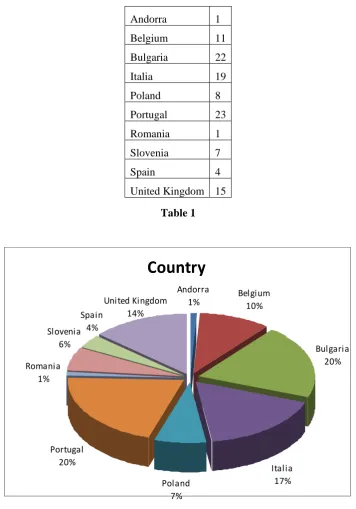
After approximately one month March 2014, we have reached a cluster of 111 professors coming from European and Third Countries:
3.1. European Countries Questionnaires
Table 1
Country
Andorra1% Belgium10%
Bulgaria 20%
Italia 17% Poland
7% Portugal
20% Romania
1% Slovenia
6% Spain
4%
United Kingdom 14%
Figure 1
3.2. Section Motivations
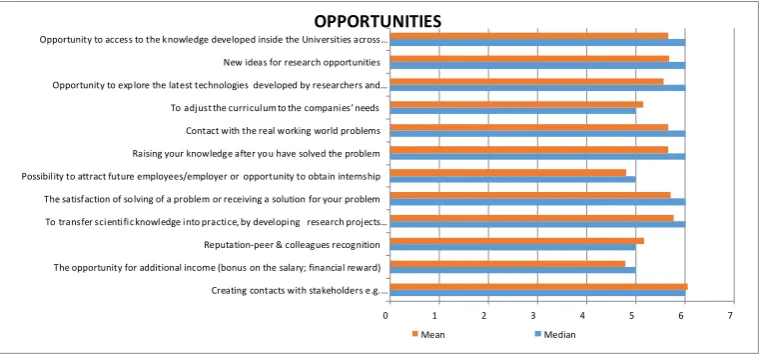
Purpose: Matrix Question was addressed to understand the factors that could mostly motivate the professors to actively participate to a Crowdsourcing platform.
Andorra 1
Belgium 11
Bulgaria 22
Italia 19
Poland 8
Portugal 23
Romania 1
Slovenia 7
Spain 4
United Kingdom 15
Analysis: as concern motivation factors the most relevant motivation engines are represented by
Creating contacts with stakeholders e.g. companies/academics/communities/students/research centres.
To transfer scientific knowledge into practice, by developing research projects based on the companies’ problems
The satisfaction of solving of a problem or receiving a solution for your problem New ideas for research opportunities
The responses provided witness that the professors representatives have very clear priorities. The first is to create new contacts and maintain relationships with relevant stakeholders. The second is to transfer scientific knowledge into practice, by developing research projects based on the companies’ problems. The third important motivation for professors is the satisfaction of solving of a problem, using their knowledge and experience.
According to these important lessons acquired it is necessary for the UCCROWD project that its CS Platform will be highly diffused and benefit from many participants. Academic and business Professionals need to join the platform in order to enrich the level of scientific exchange.
The second important lesson relevant for the project is that the level of qualification of participants needs to be high to be able to provide successful solutions of real life problems and to transfer scientific knowledge into practice.
In general, all the participants have chosen high rates witnessing that, on average all the responses have been considered relevant. Very few have chosen from 1-3 of the rank.
Confidence intervals related to each option indicate the reliability of the estimate.
0 1 2 3 4 5 6 7 Creating contacts with stakeholders e.g.…
The opportunity for additional income (bonus on the salary; financial reward) Reputation-peer & colleagues recognition To transfer scientific knowledge into practice, by developing research projects … The satisfaction of solving of a problem or receiving a solution for your problem Possibility to attract future employees/employer or opportunity to obtain internship Raising your knowledge after you have solved the problem Contact with the real working world problems To adjust the curriculum to the companies’ needs Opportunity to explore the latest technologies developed by researchers and…
New ideas for research opportunities Opportunity to access to the knowledge developed inside the Universities across…OPPORTUNITIES
Mean Median
Figure 2
3.3 Section Obstacles
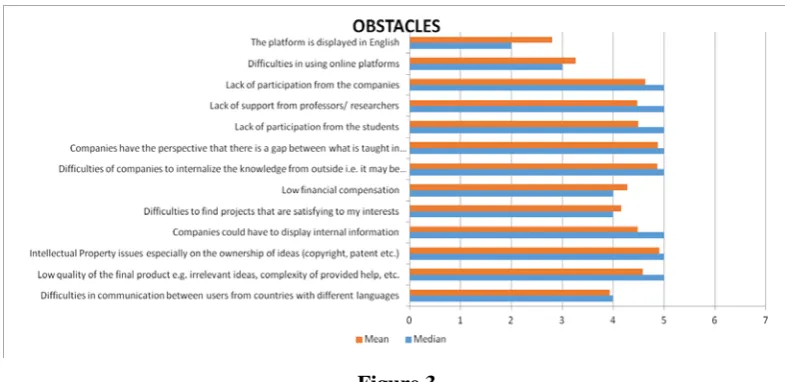
Purpose: Matrix Question was addressed to point out the factors that could damage and negatively influence the development of a crowdsourcing platform.
Analysis: as concern obstacles the most relevant threats were represented by
Intellectual Property issues especially on the ownership of ideas (copyright, patent etc.)
Companies have the perspective that there is a gap between what is taught in universities and what is useful for companies.
Difficulties of companies to internalize the knowledge from outside i.e. it may be difficult for companies to implement external help/ideas/assistance/etc.
Lack of participation from the companies
The responses provided witness that the professors representatives have a main concern related to the Intellectual Property issues especially on the ownership of ideas. According to this information UCCROWD platform needs to provide solutions to protect copyright owners in order to encourage professors to share their intellectual property.
Beside that, the professors’ concerns are that companies have the perspective that there is a gap between what is taught in universities and what is useful for companies. This could be based on professors’ previous experiences with the business.
Academic is concerned that it may be difficult for companies to implement external help/ideas/assistance which could create possible threats for project success. Professors’ workshops could be a profitable ground to establish linkages and contrast the aforementioned perspective. Face to face communication during such events could change the past experiences.
Professors are also concerned that there could be lack of participation from the companies, which would be a significant obstacle for the success of the platform.
Finally it is interesting underline that the less relevant obstacles were that the platform was in English and the exchange ground was through an online platform. The basic knowledge related to English language and familiarity with platform represents positive aspects for the widespread use of such environment.
Confidence intervals related to each option indicate the reliability of the estimate.
Figure 3
3.4. Section Incentives
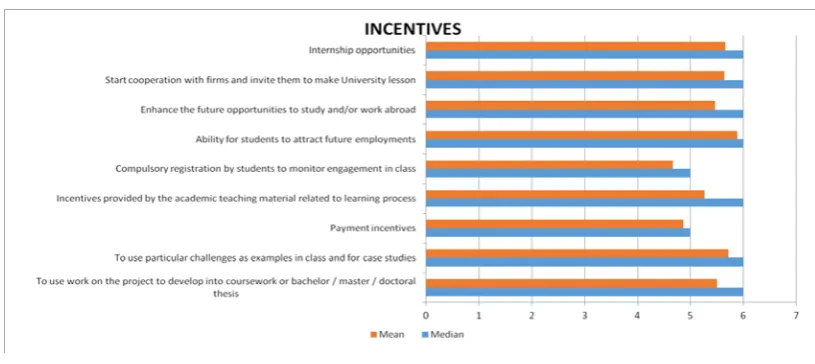
Purpose: Matrix Question was addressed to point out the incentives (in particular academic) that could be used to encourage professors to participate with the crowdsourcing platform.
Analysis: as concerns incentives the most relevant opportunities are represented by Ability for students to attract future employments
To use particular challenges as examples in class and for case studies Internship opportunities
Start cooperation with firms and invite them to make University lesson
Responses witness that professors believe that the biggest incentive is the ability for the students to attract future employments.
Professors believe that the projects provided through the crowdsourcing platform could be used as examples in class and for case studies, which eventually will increase the practical side of the lessons. Professors also find important the Internship opportunities and the opportunity to start cooperation with firms and invite them to make University lesson.
Confidence intervals related to each option indicate the reliability of the estimate.
Figure 4
3.5. The Crowdsourcing platform
3.5.1. Basic information of users
Purpose: To understand the proposed functions that were suggested and preferred by the respondents so that we can incorporate it into the platform.
Analysis:
Most of the information mentioned in the questionnaire related to the Student, Professor and University profiles has been assessed as relevant; they only recommended not including were i.e. the title, the address. .
The same, in general, was for the company profile where they only recommend not i.e. including the title, the amount of transactions.
We suggest including in the registration some “compulsory” information, the other as optional.
The other suggestion is to exploit the university page of the department/professor for the academic staff.
3.5.2. Functionality
Purpose: To understand which are the most important functions suggested and preferred by the respondents so that we can incorporate it into the platform.
Analysis: as concerns the platform functions, in general, all the functions have been considered relevant and necessary. In particular the first places underlined as the most important have been the following:
Option to view stakeholders (universities/companies) with the same area of interests Projects that are satisfying my scientific fields
Receive notifications when new problems are displayed
Option for creating a team composed by students from the same/different universities Profile search options
According to the professors opinion the most important Functionality of the platform is the option to view stakeholders with the same area of interests. Projects that are satisfying their scientific fields, which express their interest to form teams to work on different challenges.
Also very important Functionality for professors is to receive notifications when new problems are displayed. This means they want to be informed on any new challenge, which could provide them an opportunity to use their knowledge to solve the real-life problems.
Professors feel that the option for creating a team composed by students from the same/different universities has significant value and also a profile search options included would improve their benefits from the platform.
Figure 5
4. CHALLENGE ACADEMY
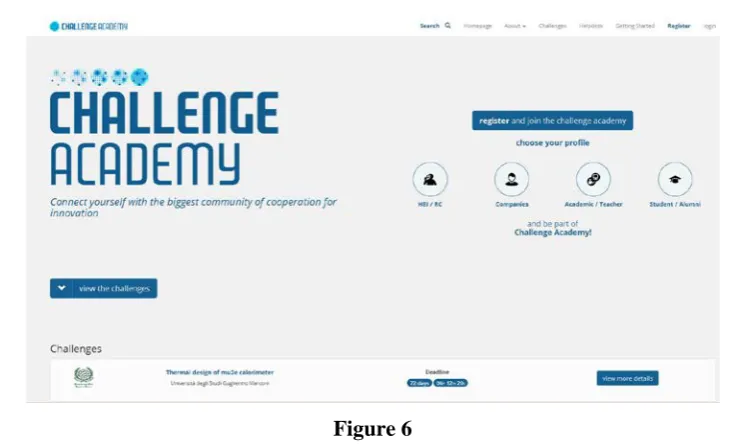
Challenge Academy (Figure 6 ) aims to build links between companies and public or non-profit organizations and higher education institutions by offering a crowdsourcing platform that connects these different worlds. Challenge Academy is essentially a website that offers a place for academics or students to share their research and apply it to a company’s non-mission critical business problems. These challenges are considered and selected by students and their supervisors for developing creative solutions to these real problems. It is expected that the best solution presented had an award.
In Challenge Academy companies and public or non-profit organizations share their business problems with higher education institutions and this enables academics and students from all around Europe (and potentially the rest of the world) to offer - in return - innovative solutions. This is a platform to match companies and public or non-profit organizations needs and academic projects. Through Challenge Academy - and the use of crowdsourcing - higher education institutions can become more innovative in how they engage their students. At the same time companies and public or non-profit organizations can become more competitive, be profitable and extend their sustainability.
Figure 6
The Challenge Academy’s vision is to create closer links between companies and public or non-profit organizations and higher education institutions, to enable each to be innovative and to innovate. Bringing real world challenges into the higher education institution environment will improve student’s employability.
To achieve this vision Challenge Academy has these main objectives: To bring crowdsourcing into productive use in academic environments;
To more closely align academic curricula with the needs of the companies and public or non-profit organizations;
To reinforce communication and knowledge transfer between employers and educators.
The current situation of the subscribed users at the UC-Crowd platform is shown on Table 2.
Results by Partner Country
Companies Universities Professors Students Portugal - “ISCTE - University Institute of Lisbon” 33 32 74 434
United Kingdom - University of Salford 6 5 9 147
Poland – Akademia Humanistyczno-ekonomiczna w Lodzi 6 3 11 156
Italy - Università degli Studi Gugliemo Marconi 6 4 34 69
Slovenia - Inštitut za razvojne in strateške analize 20 10 25 17
Bulgaria – Varna Free University 6 1 32 256
Belgun - Plantijn Hogeschool van de Provincie Antwerpen 9 1 23 171
United Kingdom - University of Wolverhampton 6 5 9 147
Current General Results
Companies Universities Professors Students
86 61 208 1250
5. CONCLUSIONS
The major benefits of the UC-Crowd – Challenge Academy Platform could be concluded as follows:
5.1. Benefits to academics:
Supporting the collaboration of Academia with companies and public or non-profit organizations and public or non-profit organizations partners;
Supporting Academia to focus on real life research problems that are currently faced by companies and public or non-profit organizations and public or non-profit organizations;
Bringing real world insights into teaching materials;
Helping students to recognise the current needs of companies and public or non-profit organizations and public or non-profit organizations;
5.2. Benefits to companies and public or non-profit organizations and public or non-profit organizations:
Finding potential solutions to non-mission critical business challenges; Gaining inspiration from the answers and solutions that are pitched;
Identifying potential employees – employ the person who created the solution, benefit from their skills and develop their knowledge;
Developing closer links with higher education institutions locally and internationally;
5.3. Benefits for students:
Opportunity to find a dissertation topic or an open case study assignment – Challenge Academy will offer inspiration and guidance for topics needed by companies and public or non-profit organizations and public or non-profit organizations;
Showcase solutions to challenges;
Opportunity to see how others have already solved similar problems;
Opportunity to identify future employers – if they like your solution they will probably like you too;
Opportunity to start a business inspired by a challenge that they have worked on.
REFERENCES
http://challengeacademy.eu/