UNDERSTANDING AND CREATION OF AN ARTISTIC IMAGE AS MEANS OF ART AND CREATIVE TRAINING OF FUTURE TEACHERS IN THE CONDITIONS OF
INTEGRATION OF ARTS
Irina Direktorenko, Daiga Kālēja- Gasparoviča
Riga Teacher Training and Educational Managament Academy, Imantas 7 līnija 1, Riga, Latvia
Abstract
With a view to improving pedagogical education new demands to teachers are made. Of vital importance is the need for integrated training of future teachers who have to be capable of continually developing their professional and personal qualities to be creative in all the fields of their activity. Therefore in the course of artistic and creative training of teachers a compulsory prerequisite is an integration of arts (music, painting, movements and dance). Such integration demands from students an understanding and creation of artistic images on the basis of interaction of different means of artistic expressiveness in the creative activity. This process depends on individual artistic and creative abilities which our students have yet to develop and the availability of a technology for producing artistic images.
Research objective: to prove and approve the technology of artistic and creative training of future teachers in the course of understanding and creating of artistic images on the basis of interaction of means of artistic expressiveness in the creative activity by integrating different arts.
Key words: artistic image, means of artistic expressiveness, artistic and creative training of future teachers, integration of arts
INTRODUCTION
The topicality of researching artistic and creative training of future teachers can be explained by the fact that contemporary improvements in education have placed greater demands on the future teacher. The problem of enhancing the teacher’s individuality in terms of their professionalism, an integrated approach to teacher training to enable them to tackle creative pedagogical tasks in real life should be addressed. A growing demand for innovative education in primary and nursery schools requires a revision of teacher training theory and methodology. Future teachers face a challenge of acquiring deep professional knowledge and skills in order to provide esthetic education to children.
Professional training of future teachers in higher educational establishments should equip them with a general pedagogical knowledge along with practical skills. While studying at a higher educational establishment it is important for students to gain knowledge and analyze their professional capabilities, which will help them develop a program for their further professional career in pedagogic practice. Professional training of future teachers is oriented towards the formation of their professional qualities. However, this is not enough because to date there is an important requirement for the teacher not only to be well versed in professional knowledge and skills with regard to specific subject teaching but it is also necessary for the teacher to develop their artistic and creative capabilities which will enhance their pedagogical performance. To solve this problem emphasis should be laid on the use of scientifically viable approach to defining the content and organization of artistic and creative training of would-be teachers.
of an individual (Direktorenko, Kalēja-Gasparoviča, 2012,2013), development of student creativity in visual arts on the basis of an integrated approach (Kalēja-Gasparoviča,2012), development of student creativity in musical pedagogy (Direktorenko, Poikane, 2006). The appraisal of artistic and creative abilities of future teachers to conduct arts classes (music and visual arts) has been carried out with a view to developing the basic competences of an individual of the XXI century in education (Briška, Direktorenko, Kalēja-Gasparoviča,2013).
Scientists in Latvia and from abroad maintain that to date new approaches and technologies enabling people to continuously enrich their individual creative experience in diverse walks of life will help them to realize their full potential in an ever-changing world. (Bebre,1987). Thus, professional training of future teachers (primary and nursery school teachers) faces new challenges in the sphere of creativity.
Art is an indispensable part in the course of artistic and creative training of future teachers. The tendencies of contemporary education in Europe provide for the necessity of incorporating arts into educational programs. This helps students develop their creative capacities in all age groups (Arts and Cultural Education at School in Europe, 2010).
As has already been mentioned in our research, one of the most efficient means of artistic and creative training of future teachers is the integration of different forms of art helping to synthesize artistic images into some harmonic wholeness on the basis of an interreaction of means of artistic expressiveness of different arts (music, dance, visual arts, cinematography, literature, theatrical arts). The present paper considers the awareness of students and their abilities to produce artistic images by integrating different arts in the training process. The creative application of expressive means of different forms of art is key to developing a product of creativity. Such creative process becomes a means of mastering artistic and creative skills for future teachers as a result of which they will be able to fully realize themselves in providing guidance to children’s creativity.
In the course of studying the production of artistic images is performed within the framework of the programs of study at Riga Teacher Training and Educational Management Academy– “Creative self-realization of students in music and dance” and “Creative self-self-realization of students in visual arts”. We have gained a lot of methodological experience which has yet to be analyzed from the pedagogical point of view. It involves a theoretical study of raising awareness and developing artistic images by integrating different arts as a means of artistic and creative training of future teachers. This problem has not yet been given much attention in pedagogical literature so far. As a result a series of contradictions have emerged between:
- the demand of the society for highly qualified pedagogical staff and the underdeveloped standards of their artistic and creative training;
- the possibility of arts integration in the course of artistic and creative training of future teachers and the lack of technology to achieve it.
The problem of the present research is how to effectively carry out the artistic and creative training of future teachers enabling them to produce artistic images by integrating arts in the course of their creative activity.
The purpose of research: provide a theoretical basis and develop a technology for artistic and creative training of future teachers with a view to promoting their understanding and creation of artistic images by integrating arts in the course of their creative activity.
The object of research: artistic and creative training of future teachers within the system of higher pedagogical education.
1.ANALYSIS OF THE CONCEPT OF AN ARTISTIC IMAGE. AWARENESS OF THE ARTISTIC IMAGE VIA MEANS OF ARTISTIC EXPRESSIVENESS.
Since future teachers (students) have to become aware of artistic images and subsequently produce them in the course of their artistic and creative practice, it is necessary to consider the concept of an artistic image and means of artistic expressiveness in arts.
„ Artistic image” is an esthetical category characterizing a particular, intrinsic quality of art, a way and form of cognition and transformation of reality. (New Encyclopedia of Philosophy, 2001).
„ Artistic image” as a term in its contemporary meaning was formulated in the work on esthetics by Hegel: “Art represents reality in general or an idea in the form of sensuous existence of an image”1. The formula of art as a way of “thinking in images” lays emphasis on the cognitive function of creativity and its social mission. The ability of man to create and present images is a precondition indicative of the talent and value of the artist’s creativity. According to Belinsky: “He who is not endowed with creative imagination, ability to transform ideas into images, contemplate, judge or feel in images will never become a poet irrespective of his mind, senses, the strength of conviction or faith…”2 .
Empirical reality is reflected in the images of art however they do not copy certain characters, events and phenomena although these may definitely serve as prototypes. Artistic images belong to the internal imaginative world of the produced work of art, they represent the act and effect of creative transformation of reality. This is neither thought nor feeling taken separately or on its own, but as accurately noted by the poet A.S. Pushkin – this is “a perceptible thought” (A.S. Pushkin) containing in itself a moment of understanding, a moment of evaluation and a moment of activity.
„ Artistic image” can be defined as an artistic idea represented in the form of an artistic notion. An art of producing images assumes the role of creative notions changing everything that can be found around the human being and within him. Artistic images live their independent lives and therefore not infrequently are conceived as really existent, often becoming paragons to be sympathized with or imitated.
Various types of artistic images can be referred as belonging to a particular art; they follow some internal rules of their development and means of artistic expressiveness of each of these arts. Therefore images in literature, music, plasticity, arts, etc. differ greatly from one another. Genre differences, the originality of artistic images can be expressed via „the material” or „language” they are made of. In the hands of a talented artist „the material” he is carving his image from becomes not only alive but obtains the strength of artistic expressiveness enabling the finest and deepest thoughts and emotions to be expressed. Simply words, sounds, colors and movements give birth to poems, melodies, paintings, dance and compositions – this is a secret of art, which can never be fully unraveled.
Thus, artistic images help life to be reproduced in its completeness thereby broadening and deepening the real life experience of those people who are not indifferent to art.
It is important to understand how artistic images are produced.
An artistic image is concrete, it has traces of ideas that have been enriched by cogitation activity. Notions or ideas can be characterized as a transitory stage between perception and awareness. In order to bring an artistic idea home to the general public it is necessary to „objectivize” it. The content of the work of art consists of notions and ideas that are revealed („objectivized”) in an image. The production of an artistic image is based on an artistic idea, which by uniting real phenomena, gives birth to a new being epitomizing all the traits of its foster-parents. For example, the ancient Egyptian Sphinx is neither a lion nor a human being, but a human being represented as a lion or a lion embodying a
1
Hegel, GVF, “Aesthetics in 4 volumes”, vol. 4. (Russian), M., Publishing House "Аrt"(1968-1973): 412.
human being. An eerie unification of a human being and the of king of beast enables man to better comprehend both nature and himself.
The Centaur and the Sphinx both visually represent the model of an artistic image.
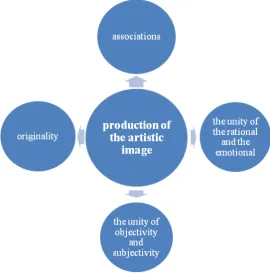
In the course of training while students engage in producing artistic images it is necessary to take into account several components. The first one is associations. Building associations is one of the peculiarities of the psychological mechanism of artistic creativity. Not infrequently artistic images are built on the relationship of some rather remotely related ideas or phenomena, however this may help to bring out some obscure realities.
Making associations is crucial for creativity. For example, a child who is drawing „music” is apparently doing it on the basis of some concrete association. The nature of associations is both concrete and sensuous. This develops a close affinity between the images of art and forms of life, although this affinity should not be understood verbatim because in real life there cannot be or indeed are such forms as an artistic word, musical sound, dance or artistic painting. It is of importance to find essential and characteristic features in the phenomena. Not detaching himself from the concrete and sensuous nature of phenomena, the artist is capable of making massive generalizations and producing artistic images.
The second component of producing artistic images is the unity of the rational and the emotional. Emotions are a historically earliest primary source of artistic images. The sculptor A. Rodin was well aware of the true meaning of thought and emotion for artistic creativity. He wrote: „Art is ... the working of an idea seeking to understand life and making life understood..., this is an expression of an artist’s heart on all the subjects he touches upon.”3.
The third component of producing artistic images is the unity of objectivity and subjectivity. Artistic images are built on the basis of objective reality, which is transformed by the creator showing his attitude to the image to be developed, as well as on the basis of his inner feelings and the richness of his own artistic personality.
The final component is originality. The image should be unique, principally original. Even when acquiring one and the same life experience, describing one and the same theme, different artists would create different works of art. They all would bear the impact of the artist’s own individuality. The creator of a masterpiece can be recognized by the peculiarities of his creative manner. „Let the copying go through our heart before our hands are set on it, then irrespective of ourselves, we shall be original”4.
Thus, the production of artistic images can be presented in terms of the relationship of all the above mentioned components.
3
Rodin, A, “A collection of articles about creativity”.(Russian), M.(1960): 123.
Diagram 1. Production of the artistic image
In the course of instruction the understanding and production of artistic images take place through student involvement in artistic and creative activities. According to Briška, an artistic and creative activity can be characterized by a novelty of social and individual significance, the external result of which being a work of art (Briška, 2011). In teaching such a result is termed as a creative product developed by integrating a variety of arts. The creative product is based on producing artistic images involving the means of artistic expressiveness.
Let us take a look at the distinctive features of the means of artistic expressiveness.
Art tends to express ideas of surrounding reality via artistic images. Each of the arts is notable for its particular means of expression. They can substantially add to the impact of artistic perception and influence the attitude of human beings by evoking certain images, associations and memories. However, each of the arts can be characterized by its own specific means shown in Table 1.
Table 1. Means of artistic expressiveness in arts
music melody, rhythm, metrics, dynamics, scale, timbre, harmony, etc.
fine arts line, point, stroke of the brush, form, proportions, silhouette, texture, colour, tone, colour dab, area, etc.
movement and dance
synthesis of movement, choreographic pattern, stage design, costumes, musical accompaniment, light, artistic performance, pantomime
theatrical art artistic performance, stage design, costumes, noise and musical accompaniment, light, scenic effects
cinematography photographic reproduction, montage (continuity of development), rhythm, climax, artistic performance, light and musical accompaniment
In music artistic images are expressed by means of sound, in fine arts – by colours, in choreography – by movement, etc. Nevertheless there is so much common in artistic expressiveness. For example, the common features of music and literature comprise metre and rhythm, the likeness of images in different works of art (an opera composed by P. Tchaikovsky Eugene Onegin and A. Pushkin’s novel in verse Eugene Onegin et al); music and fine arts share melody and line, harmony and colour, rhythm (Spring by A. Vivaldi and Spring by S. Botticelli); music, literature and choreography have melody, metre and choreographic pattern in common (W. Shakespeare’s tragedy Romeo and Juliet and S. Prokofiev’s ballet Romeo and Juliet et al.). Artistic images of cinematography and theatrical arts can synthesize musical and light accompaniment, together with the elements of fine arts such as stage design and costumes. The ability to understand artistic images via the means of artistic expressiveness of different arts forms the basis for producing artistic images by students themselves.
2. TEHNOLOGY OF ARTISTIC AND CREATIVE TRAINING OF FUTURE
The research into the technology of artistic and creative training of future teachers in the course of studies focused on developing the content of training and ways of organizing artistic and creative activities of students in addition to the procedure of assessment and self-assessment. The content was based on the above-mentioned (preceding the Introduction) courses as well as arts workshops at conferences dedicated to creativity and the Days of Creativity. Additionally, the integration of different arts served to lay the foundation for creative activities.
In the course of instruction included by turns were the following arts: music, movement and dance, literature, fine arts, cinematography, theatrical art. Moreover, the production of artistic images involving the means of artistic expressiveness of different arts was based on the practical interest demonstrated by students with regard to creative activity. The studying of means of artistic expressiveness of each of the arts provided for both the informative and creative aspect.
We assumed that the artistic and creative training of future teachers within the framework of higher pedagogical education would be efficient if the integration of arts was viewed as a synthesis of artistic images of different types.
The technology embraced the formation of an artistic image and its realization as a creative product. Furthermore, this product (compositions, collages, films, scenic sketches, improvisations, etc.) was developed by way of an interaction of different means of artistic expressiveness of various arts.
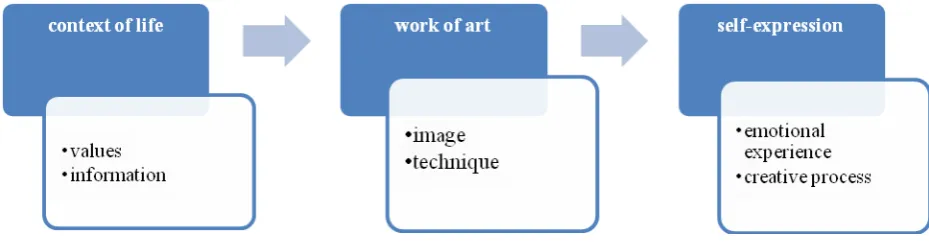
Diagram 2. Technology of producing artistic images by integrating different arts
The key to producing original artistic images includes the following:
- use of adequate means of artistic expressiveness in conformity with the general idea; - blending of impressions, associations to achieve a common emotional background; - vividness and meaningfulness of characters to be created and perceived;
Students impart esthetic information in which they try to express their ideas, emotions and attitudes via artistic images in a concrete creative product. The themes of their creative activity reflect the students’ awareness of such cultural values as, for example, justice, harmony, faith, love, hatred, etc. In this way, a student-to-art interaction takes place as a meaningful communication, with an emphasis on the “language of art”, i.e. the means of artistic expressiveness.
To enable a finished creative product to be better perceived by other people a major role is played by the expressiveness of artistic images, which can be viewed as students’ ability to artistically convey their thoughts, emotions, associations in a creative product.
From all of the above said it is possible to bring out the criteria for expressiveness of artistic images.
Diagram 3. Criteria for expressiveness of artistic images
Ways of organizing students’ artistic and creative practice comprised such methods as individual work, pair work and group work (small and large groups) as well as presentations, performances based on compositions, activities involving electronic resources, creative workshops and Creative Days.
Diagram 4. Content of studies of artistic creativity in producing artistic images
(Source: Compiled from Briška ’Development of Student Teachers’ Professional Values in Artistic Creativity, 2011, 56.p.)
Diagrams 1 and 4 are interrelated and supplement one another. In the course of creative activity students are apt to form their artistic and creative skills. Let us take a look at this process in greater detail.
Firstly, the artistic and creative activity resulting in the development of an artistic image is based on life experience composed of students’ esthetical experience which includes information sources (information, knowledge, facts), an understanding of artistic values and their significance for human beings. This in a way provides for both objective and rational elements in producing artistic images. The complexity and wealth of information in the modern world require a special way of organizing students’ artistic and creative activities. Consideration should be given to the ways students’ knowledge is built up to the level of personal sensibilities. It requires adequate pedagogical methods to be employed and an integration of a variety of arts can prove to be an optimum means in this respect. A specific function of arts integration is “disclosing tasks in terms of meaningfulness”. As noted by Leontyev, “…aesthetic activities, be it aesthetic creativity and aesthetic appreciation, there is a conscious activity, there is work of consciousness…”. 5
The artistic image of one or the other work of art is capable of broadening the dimension of meaning in terms of understanding, changing the perspective of perception and evaluation, strengthening the student’s position. Besides any work of art is a product of its time, a witness of an epoch, which may become a major source of information as well as a pedagogical means enabling the peculiarities of the period to be studied to be better conveyed.
For students’ artistic and creative activity, the sources of information and an understanding of artistic values form the basis for the awareness of artistic images in works of art facilitating the development of their own products of art. This is shown in Table 2.
Table 2. Objective and rational elements in producing the images of art
Forms of art Sources of information (acquiring of knowledge) and values in art music Perception and evaluation of artistic images in music of various periods,
understanding of regularities of music, knowledge and understanding of the essence of means of musical expressiveness; awareness of the nature of personal musical abilities and possibilities; orientation to musical creativity
fine arts Perception and evaluation of artistic images of visual arts of various periods; understanding of regularities of visual arts, knowledge and understanding of the essence of means of artistic expressiveness; awareness of the nature of personal abilities and possibilities; orientation to visual creativity
Movement and
dance
Perception and evaluation of artistic images of dance of various periods; understanding of regularities of dance and musically rhythmic movements, knowledge and understanding of the nature of movement, awareness of own personal abilities to dance rhythmically to music; orientation to creativity in dance and movement
theatrical art Perception and evaluation of theatrical art of various periods, understanding of regularities theatrical art (artistic skills of actors and directors); awareness of personal skills in performing arts; orientation to scenic creativity, improvisation
cinematography Perception and evaluation of cinematographic art of various periods, understanding of regularities cinematography; awareness of personal skills and abilities to make video compositions, photomontage; orientation to creativity, improvisation
literature Perception and evaluation of esthetical values of literature; awareness of personal abilities and to write screen scripts and literary compositions
The second component affecting the artistic and creative activity is the personal component which encompasses the esthetical artistic experience leading to associations and direct creative process. In this respect, students’ experience, emotional impulse and imagination may prove vital. This forms the basis for subjective and emotional element in the process of producing artistic images.
A content-based feature of art is first and foremost its orientation towards the inner world of man (subjective reality) with its entire wealth and variety of states of mind, emotions, feelings and experience. In students’ artistic and creative activity via the integration of different forms of art this provides an opportunity to live through the things they have not experienced, to contemplate different models of behavior, to understand and assess the moral and social consequences of particular actions. Students learn to identify the character of the work of art, which shapes their esthetical experience. Thus, diverse associations, feelings and ideas evoked as a reaction to the work of art (or the product of their own creative activity) help enrich the students’ artistic and creative activity through the individual experience.
The subjective and emotional element of producing artistic images may directly emerge in the creative activity in the following way: an idea of developing a concrete artistic image may take shape, along with its embodiment and interpretation. This calls for students’ manifestation of such personal qualities as concentration, freedom, thinking (divergent, associative, imaginative), fantasy, open-mindedness, problem-solving capacity, ability to perform, express emotions and experiment, the choice of right decisions (Briška, Direktorenko, Kalēja-Gasparovicha, 2013).
In the course of training students realize the developed artistic images via an independently chosen artistic technique (e.g. fine arts can be represented by a drawing, music – by a composition for a musical instrument or singing, selection of corresponding background music, movement – by elements of folk dance or modern hip-hop, cinematography – by a selection of video material or photography, etc.).
3. DEVELOPMENT OF STUDENTS’ ARTISTIC AND CREATIVE SKILLS BY INTEGRATING ARTS
The artistic and creative training of future teachers is based on both professional and personal qualities as well as artistic and creative skills of the students.
Artistic and creative skills are not only the key factor for producing artistic images but they also enable the students to generalize their conceptions about a concrete creative product (a collage, an artistic or musically literary composition et al.). Artistic images help to accumulate students’ achievements in very different fields and encourage them to apply all their knowledge and skills which bear distinctive creatures in various forms of art (See Table 2).
Table 3. Students’ artistic and creative skills in the production of artistic images
Artistic and creative skills
Forms of Art
music fine arts movement and dance theatrical arts cinemato-graphy literature perfor-ming skills practical skills in singing, playing a musical instrument, ability to give an emotional and expressive performan-ce ability to reproduce, ability to artistic representa- tion and decora- tive design technical skills in movement and dance, ability to shape a musical image and express it in rhythmic movement ability to impersonate ability to graceful movement, ability to express emotions technical expertise in electronic resources, ability to making a montage ability to express emotions, experiences verbally, ability to produce literary composition s, screen scripts, poems composing skills
ability to employ the means of artistic expressiveness of various arts to produce a single a composition, ability to combine different items of the composition, ability to spell out one’s associations, ability to juxtapose and select the most applicable versions of artistic images, ability to gear the detail to the general conception of the artistic image, ability to adequately employ electronic educational resources in producing artistic images, ability to give good presentations and public address
assessment skills
artistic images and present a generalization of the creative product, ability to adequately assess the process and result of an individual or collective effort in producing compositions.
As shown in Table 2, performing skills have certain distinctive features in various arts. Composition-producing and assessment skills have a common basis as the creative products made by the students are presented as single compositions embracing the elements of different forms of art.
The technology for artistic and creative training of future teachers includes the assessment of the creative product and creative activity. In our case assessment was provided for literary musical compositions, music and dance, theatrical performance, musically artistic and other products and compositions.
RESULTS OF THE RESARCH
30 students - future primary school teachers of the Pedagogical Faculty took part in the research. During one semester the students carried out a series of tasks which mainly focused on the production of artistic images in various compositions. To evaluate the expressive power of the compositions the given criteria for evaluating artistic images were applied. The students were given an opportunity to express their creative abilities both individually and in pairs or groups.
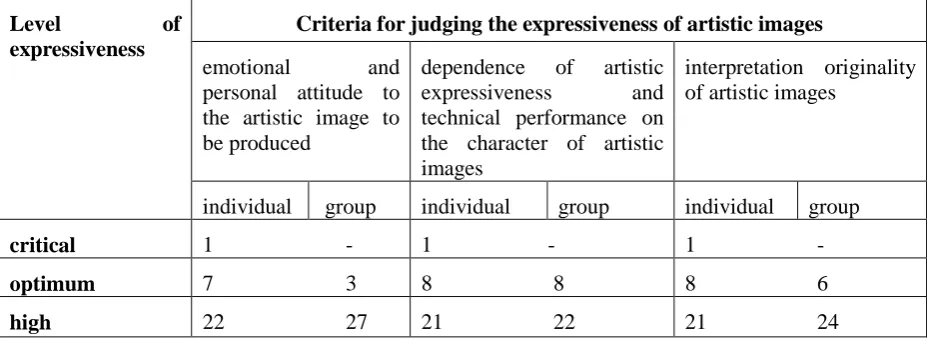
The individual tasks covered: 1) the choice of musical background for a film episode, 2) the production of a literary musical composition. When working individually, the students were allowed to choose the themes for their compositions by themselves. While working on the task, it became quite evident that personal attitude to the image about to be created played a major role. The majority of students (27 people) demonstrated an emotional involvement while presenting their work. These students had chosen such themes that appealed to them and they felt emotionally attracted to. For instance, the categories like betrayal and forgiveness, love and hatred.
The means of artistic expressiveness appeared to be carefully and adequately selected. The images of literary musical compositions, in which the students acted as performers, sound producers and artists, proved to be extraordinarily impressive. The images they created were vivid and original. Only a small minority of the students (7 people) displayed a somewhat formal attitude to their work and a lack of interest for the chosen theme which in its turn affected the character of the artistic images and randomly chosen means of expressiveness. Under these circumstances the first group of students in contrast to the second one could boast imagination, the power of emotions, a desire to experiment. This confirms that the theoretical premise about the display of personal qualities in the course of creativity holds true (Briška, Direktorenko, Kalēja-Gasparoviča, 2013, 134- 135).
The work in pairs covered the following: 1) making a drawing/collage associated with a particular musical accompaniment. The work in groups was dedicated to 1) improvisation on movement (dance) to musical accompaniment, 2) producing a joint composition on a particular theme including such arts as music, theatrical performance, visual art, movement and dance.
students added to their knowledge forming a basis for understanding the crux of artistic images, as was rightly pointed out by A.N.Leontyev.
This is what our students said about their group work:”…as soon as we started discussing our performance, several questions appeared: What message do we want to bring across? How are we going to do it? Will it not be trivial?”
In the course of their group work the students were able to develop their skills of making artistic compositions because they were learning how to produce a single piece of composition by integrating arts.
The conception of the composition on a specified theme was then assessed in terms of interpretation originality of artistic images, the student skills to integrate various arts into a meaningful whole and the expressive power of their performance. The creative products were made both individually and in groups of six. We decided to define three levels of expressiveness of artistic images for each of the students – critical, optimum and high levels.
Table 4. Criteria for judging the expressiveness of artistic images in assessing creative compositions of students (individually and in groups)
Level of expressiveness
Criteria for judging the expressiveness of artistic images emotional and
personal attitude to the artistic image to be produced
dependence of artistic expressiveness and technical performance on the character of artistic images
interpretation originality of artistic images
individual group individual group individual group critical 1 - 1 - 1 - optimum 7 3 8 8 8 6 high 22 27 21 22 21 24
The creative process proper and the presentations of different creative products revealed that the students had developed not only good performing and composition-producing skills but had also acquired assessment skills. The formation of assessment skills included:
- Reflections of the participants on the joint composition, presentation, performance, etc.; - Self-assessment of the individual work;
- Discussions between the students and teachers on the expressiveness of artistic images in their compositions and the process of creativity as such.
So, when asked about the experience gained on the course, the students gave the following answers: “I learnt to play the synthesizer, I was able to express myself in a great many of ways”, “I understood that various music could change the mood of a plot or thought”, likewise in relation to dance and movement the answers of the students showed that “in a short time it is possible to design an attractive and interesting dance with an idea” and what is vital – “you don’t necessarily have to be a professional dancer, you can just try to freely express yourself and it would look great.”
The students became well aware of their skills and personal qualities they were able to develop in the course of creative activities. Many students (25 people) noted an important element of creativity to be -freedom of expression- “I have developed an ability to freely express myself in all arts”. Step by step the students heightened the awareness of their creative potential since all the necessary conditions helped the students express themselves both individually and in joint projects without fear of being criticized. “All the fears and insecurity that things might not work out vanished because in fact there are no wrong things” or “everyone can sing- even me!”, or “Nothing is perfect in art just like in life, … sometimes you just have to let things drift”. And yet another revelation from a student – “I did not know I was creative. It turned out I could sing, dance and even draw!”
CONCLUSIONS
1. The process of artistic and creative training of future teachers becomes effective provided the integration of arts is viewed as a synthesis of artistic images of various arts on the basis of interaction of the means of artistic expressiveness in the course of creative activity.
2. The technology for artistic and creative training of future teachers by way of integrating arts involves the modeling of the creative product on the basis of understanding and creating artistic images via adequate means of artistic expressiveness of different arts.
3. The criteria for judging the expressiveness of artistic images are – emotional and personal attitude to the creative product, dependence of the means of artistic expressiveness and technical performance on the character of the image and the originality of its interpretation.
4. In the course of creative activity the following artistic and creative skills required by future teachers can be developed: performing skills, composition-producing and assessment skills.
REFERNCES
Belinsky, VG 1956, The complete works, (Russian) vol. 6.,M., с. 591—92.
Briška, I 2011, ”Development of Student Teachers’ Professional Values in Artistic Creativity”, PhD thesis, Latvian University of Riga, 75.lpp.
Briška, I, Direktorenko, I, Kalēja- Gasparoviča, D 2013, “The development of key competences of 21th century in visual art and music curriculum: theoretical study’’, ATEE Spring Conference proceedings Quality education for quality teaching. Rīga, Latvia, pp.130–144, viewed 10 april 2013, // http://www.ppf.lu.lv/pn/files/ATEE%20Spring%202013_proceedings.pdf// ISBN 9789081563963. Bebre, R 1987,”Artist's personality, its development”.(Latvian). Riga, Ministry of culture, methodical Cabinet.
Direktorenko, I , Poikāne, N 2006,” Students ' musical-creative self-expression ability development studios in the process”(Latvian). Proceedings of the RPIVA III International Scientific Conference, The theory of practice in modern society education, Rīga, p. 11.
Direktorenko, I, Kālēja-Gasparovica, D 2012,’ Theoretical model of the development of the creative potential of prospective teachers by means of the arts’, Journal of International Scientific Publications: Educational Alternatives, Volums 10, Part 3, pp. 43-58.,viewed 20may 2014, //http: www.scientific-publications.net.// ISSN 1313-2571, 2012, Eiropean Union,Bulgaria.
Direktorenko, I , Kālēja-Gasparoviča, D 2013,’ Pedagogical conditions and criteria for development of student creativity during integrated classes in aesthetic subjects’, Journal of International Scientific Publications: Educational Alternatives, Volume 11 Part 3, pp. 24.-35., viewed 15.may2014,//http: www.scientific-publications.net// ISSN 1313-2571 Eiropean Union, Bulgaria.
Kalēja-Gasparoviča, D, Direktorenko, I 2013, ‘ Experimental trial of student creativity forming techniques during aesthetics lessons’, Journal of International Scientific Publications: Educational Alternatives, Volume 11, Part 2, pp/319.- 331., viewed 13 may 2014, // http: www.scientific-publications. ISSN 1313-2571,Eiropean Union, Bulgaria.
Kālēja-Gasparoviča, D 2012, ”Faciliation of Students’ Creativity in Visual Arts Education”, PhD thesis, Latvian University of Riga, 78lpp.
Leontyev A.N 1983, Some problems of psychology of art, viewed 29 may 2014,:// http://www.anleontiev.smysl.ru/pervoist/230.htm//.
Lieģeniece , D 2010, ’’ Creativity as an expression of personality and behavioral disorders: West research analysis for behavioral issues 6-10 year olds’’.(Latvian). Proceedings of the 15th international conference Creativity research and development for the human resource development. Riga, Latvia.
Arts and Cultural Education at School in Europe 2010. EACEA P9 Eurydice, ISBN 978-92- 9201- 068-3, (Latvian), viewed 27 may 2014,
http://eacea.ec.europa.eu/education/eurydice/documents/thematic_reports/113LV.pdf.
New philosophical encyclopedia: in 4 volumes, 2001, (Russian). М: Thought. Edited by V.S. Stëpina. Rodin, A.,1960, A collection of articles about creativity.(Russian), M.