DIDACTIC MODEL OF DESCRIPTIVE GEOMETRY STUDIES
Olaf Vronsky
Faculty of Engineering, Latvia University of Agriculture, Cakstes blvd 5, Jelgava, LV-3001, Latvia
Abstract
The didactic model reflects the learning process and specifies the contents of the pedagogical concepts and their interaction: learning objectives and tasks, learning content and principles, teaching – learning aids and methods, and organization forms of studies. The article determines and motivates the didactic model of descriptive geometry studies. To substantiate the didactic model of descriptive geometry studies the cognitive constructivist learning approach was analysed. The didactic model is necessary for organization of the educational process of descriptive geometry and contributes to the development of the graphic competence of the students of engineering sciences.
Aim of the research: to substantiate the didactic model of descriptive geometry based on the cognitive constructivist learning approach.
Objectives of the research:
• To analyse scientific literature on the cognitive constructivist learning approach.
• To elaborate the didactic model of descriptive geometry studies based on the cognitive constructivist learning approach.
Key words: descriptive geometry, didactic model, constructive and cognitive constructivist learning approach
1. INTRODUCTION
H. Gudjon (Gudjons 1998) states that a didactic model is a construction of the scientific theory of pedagogics that generally analyses and models, i.e., helps plan the didactic processes at higher schools and outside them. The model gives wide theoretical information on the preconditions, possibilities and confines of the pedagogical process, including the process of studies.
H. Gudjon (Gudjons 1998) has described 5 didactic models:
• Volfgang Klafki critical constructive model – the basis of an independent process of studies should be creative, heuristic as well as practically oriented and actually useful acquisition of the learning material;
• Volfgang Schulz learning theoretical (Hamburg) model– basically based on experience, practically oriented theory as well as including of the interests of students in the general study aims;
• Felix von Cube cybernetic model – pedagogical aims are requirements, the basis of the learning process is feedback;
• Kristin Möller aim – oriented model is based on critical investigations in developing of the study plan, the scientific theoretical basis of this model is behaviorism;
• Rainer Winkel critical communicative model recognises that the existing reality is to be continuously developed systematically analysing the structure of studies.
I. Žogla (Žogla 2001a, 2001b) stresses that a model is a unity of learning, medium between the theory and practice; therefore it is necessary to balance the theory and practice in the model covering in it the multi-sided process of higher education. The didactic model reflects the mutual interrelations of the pedagogical notions: learning aims, content of studies, study methods and results.
I. Žogla (Žogla 2001b) differentiates between the following didactic models:
• Pragmatic practical model that is based on the theories of William James and John Dewey. The model is based on the practical result of orientation, student skills to perform definite activities; • Idealistic theoretical model is based on enrichment of culture, maintenance of values with the aim
to make coexistence in society easier, to promote the qualities of specialists necessary for the corresponding profession. An essential component of the content of studies is qualitative knowledge and formation of experience in activities protecting the living environment;
• Individualised model is focused on autonomy of an individual in taking responsibility, daring, risking and finding solutions. It is oriented on education of the teachers;
• Co-operation, group and team model implements the idea of decentralisation and democratisation in the conditions of the education reform. Teamwork is real and direct means of enrichment of mutual relations in the process of studies;
• The basis of the constructivism didactic model is the idea that a student constructs new knowledge and skills based on the experience. Student activity is acknowledged to be the main driving force for learning, but the process of studies is characterised by exchange of thoughts and discussions. The student purposefully organises independent learning as well as assesses his/her achievements. In turn, the teacher has an expressed role of a helper and a position to promote independent learning.
• I. Maslo (Maslo 2001) in the relation to the situation in Latvia writes that the didactic models in Latvia in the aspect of personal development and socialisation theories can be classified:
• In the task-oriented model the students by help of the teachers plan their studies independently that gradually passes over to self-education.
• In the pragmatic model the standard requirements are achieved according to a definite pedagogical technology, but the study material is selected in compliance with the principle of usefulness and reduction of the volume giving the preference to practical activities.
• The communicative model is oriented to formation of human relations in the process of exchange of information, communication and activities.
• The process-oriented model is based on a dialogue between the student and the teacher – in the process of studies the student and the teacher are equally interested learners.
• The basis of the cognitive model is teaching as it shows the way to transfer and to receive knowledge, the main attention is paid to the selection and structuring of the teaching material. After the analysis and evaluation of the definitions and structure of the didactic models the author makes a conclusion that any didactic model should be based on some educational theory or their totality as well as the models should include the process of education and didactics together. Every teacher chooses a didactic model that best suits his/her requirements. As it is important today that students in the process learn and asses independently, the author of the research considers that in the process of studies it is necessary to choose a didactic model based on the cognitive constructive education theory that is based on the constructivism approach, and in turn, the choice of the study aims, tasks, content, principles, methods, organization and control forms is based on it.
2. MATERIALS AND METHODS
The didactic model of descriptive geometry studies is formed based on the personal experience of the author working at school and also at university, the basic principles of the cognitive constructivism approach and general didactic principles. These principles are considered stating the study aims, tasks, content and selecting the corresponding learning principles and methods as well as developing the teaching aids. The learning approach based on multimedia is integrated in the course of lectures and in e-studies environment, but the cognitive constructivism approach is used in the process of studies of descriptive geometry. In the didactic model of the studies of descriptive geometry also all study stages are included – methodological part, organizational part and control part (See Fig. 1).
Most essential principles of the cognitive constructivism approach (J. Piaget):
• Key words: knowledge, understanding, prognosticating, receiving and procession of information, activity, independence and correspondence to the interests of students
• Priciples: learning is an active process; learning should be whole, authentic, and "real"; knowledge is actively constructed by students.
Cognitive Theory of Multimedia Learning approach principles (R. Mayer): Coherence Principle, Signaling Principle, Redundancy Principle, Spatial Contiguity Principle, Temporal Contiguity Principle, Segmenting Principle, Pretraining Principle, Modality Principle, Multimedia Principle, Personalisation Principle.
Most essential didactic principles in descriptive geometry studies:
Purposefulness, understanding, scientific value, consistency, regularity, sequence, objectivity,
links with real life, visuality, development, conscientiousness,
stability of knowledge
Descriptive geometry study process: Most essential descriptive geometry study aims:
• development of visual dimensional perception, understanding, imagination and creative abilities without which creativeness in engineering sciences is not possible;
• development of dimensional and logical thinking and prognosticating skills;
• deepening of understanding on application of descriptive geometry regularities in different branches;
• development of dimensional form and their mutual position analysis and synthesis abilities;
• acquisition of descriptive geometry theoretical knowledge;
• development of graphical task independent solution skills;
• development of graphical competence;
• development of graphical communication skills;
• development of dimensional form description regularities;
• development of dimensional form analysis skills;
• active learning mutual co-operation skills;
• development of attitude and responsibility.
Most essential descriptive geometry study tasks:
• formation of
understanding on means of graphical language and norms of arrangement of graphical documents,
• deepening of knowledge and development of skills for depicting of dimensional objects graphically,
• deepening of understanding on the importance of graphical language as means of communication in designing and project implementation in different branches of economics and in everyday life.
Descriptive geometry study content is determined by:
• compliance of the study methods with the essence of human thinking and perception processes, age peculiarities;
• learning of new technologies and application for acquisition of the study content;
• explanation, acquisition and application of scientific terms of the branch;
• logical sequence in acquisition of the content;
• sequence of the content of the program, text books, methodical aids;
• recognition of analogues corresponding to the theme in the nearest environment;
• technical drawings of recognizable objects.
Forms of study organisation:
• practical lessons;
• e-studies;
• consultations;
• Should be taken into account:
• individual learning pace of every student,
• development dynamics,
• necessary support.
• To be used: tasks of different degrees of complexity.
Essential study methods and aids:
• active study methods;
• lectures;
• natural visual aids;
• graphical visual aids;
• audiovisual aids; IKT;
• text books;
• calendar plan of the teaching content and independent tasks to be acquired;
• e-environment study materials;
• mutual emotional relations;
• physical environment (light, temperature, ergonomics of the working place);
• stock-in-trade environment. Teacher
Control:
Introductory, present, periodical, final, intermediate results
Result:
Definite student graphical competence development levels
Student group
Student Student
Fig. 1. Didactic model of descriptive geometry studies
In the process of descriptive geometry studies control of the development of graphical competence is necessary starting the study course as well as at the end of it. The same it is necessary to control the development of graphical competence during the whole process of studies what is ensured by means of the present and periodical control.
At the Latvia University of Agriculture, Faculty of Engineering the students of engineering sciences are studying the course of descriptive geometry within several study programs – landscape planning and architecture, environment and water management, building, forest engineering, forest science, wood processing, food production technology, agricultural engineering, agricultural energetics, machine design and manufacturing, and home environment in education. Descriptive geometry is one of the fundamental engineering science courses that give the students a definite competence development level that is necessary in future studies in different courses and projects.
The model is necessary for organising the study process in descriptive geometry and it promotes the formation of the graphical competence for engineering students.
3. RESULTS
The didactic model of descriptive geometry is implemented at the Faculty of Rural Engineers in the study programs of building, landscape planning and architecture, environment and water management in the study course descriptive geometry and technical drawing, at the Forest Faculty in the study program wood processing in the course technical graphics, at the Faculty of Engineering in the program home environment and education in the course of technical drawing as well as at Jelgava Technological secondary school, Form 10, Jelgava secondary school No.5, Forms 11 and 12 and Jelgava Spidola gymnasium, Form 12 in the lessons of technical graphics, and it has completely justified itself.
The study process in descriptive geometry is organized in the forms of lectures, practical lessons, e-studies and consultations. At lectures and practical lessons as well as in the e-study environment the cognitive constructive approach principles are applied, incl. the cognitive multimedia study approaches that are based on the dual coding theory and possibilities to use the visualisation possibilities in the process of studies and the principles of active learning. The result of the studies in descriptive geometry is a definite level of student graphical competence.
In the center of the didactic model of descriptive geometry there are mutual interrelations between the students, the students and teachers using different teaching aids and organization forms of studies, incl. the e-study environment developed by the author of the promotion theses.
Success in the descriptive geometry study course is related to such fundamental engineering subjects as mathematics and physics as well as the knowledge in languages as in descriptive geometry there are many terms that should be acquired and correctly used discussing engineering issues.
The author of the research, based on his work experience and investigations in the time necessary for fulfillment of the work, considers that the most optimal distribution of time between lectures, practical lessons and independent work with different study aids, incl. e-studies would be 16:32:72; it means that for acquisition of the study course 3CP would be needed, but, unfortunately, in many study programs the time devoted to the studies of descriptive geometry is only 2CP, i.e., 16:16:48. Starting the studies the level of the student graphical competence is different, therefore only the most able students can do with the allotted time, but the others need to have time in the amount of 3CP.
Success in the descriptive geometry study course depends on the level of knowledge, skills and competences in such secondary education subjects as physics and mathematics, so an introductory control is performed to state the assessment of the student enrollment competition.
The present control is implemented using the heuristic study method – asking the students questions on every theme that make the dimensional imagination of the students more active.
The periodical control is performed using specially developed control work by help of which the student graphical competence level in the acquisition of a chapter in the study course of descriptive geometry can be stated.
The final control is the total sum of all previous kinds of control or the level of graphical competence after assessment of all graphical competence criteria.
The descriptive geometry study course is the base for all study courses where it is necessary to use graphical knowledge, skills and competences.
4. DISCUSSION
4.1. Constructivism approach
In the constructivism theory learning does not mean acquisition of knowledge but their construction. The main precondition is that students interpret the new information only in relation to their previous experience what means that learning should be oriented to solution of definite problems of students. One of the main principles of the constructivism theory is mutual operation of students and co-operation with the teacher who in the constructivism theory is an advisor or consultant.
J. Brooks and M. Brooks (Brooks JG & Brooks MG 1999) have defined five principles of constructivism:
• First, teachers seek and value students' points of view. Knowing what students think about concepts helps teachers formulate classroom lessons and differentiate instruction on the basis of the students' needs and interests.
• Second, teachers structure lessons to challenge students' suppositions. All students come to the classroom with life experiences that shape their views about how their worlds work. When the teacher permits students to construct knowledge that challenges their current suppositions, learning occurs. Only through asking students what they think they know and why they think they know it they are able to confront their suppositions.
• Third, teachers recognize that students must attach relevance to the curriculum. As students see relevance in their daily activities, their interest in learning grows.
• Fourth, teachers structure lessons around big ideas, not small bits of information. Exposing students to wholes first helps them determine the relevant parts as they refine their understanding of the wholes.
• Finally, teachers assess student learning in the context of daily classroom investigations, not as separate events. Students demonstrate their knowledge every day in a variety of ways. Defining understanding as only that which is capable of being measured by paper-and-pencil assessments administered under strict security perpetuates false and counterproductive myths about academia, intelligence, creativity, accountability, and knowledge.
K. Taber (Taber 2006) has especially stressed such basic statements of constructivism:
• Knowledge is actively constructed by the student, not passively received from the outside. Learning is something done by the student, not something that is imposed on him.
• Students come to the learning situation with existing ideas about many phenomena. Some of these ideas are ad hoc and unstable; others are more deeply rooted and well developed.
• Students have their own individual ideas about the world, but there are also many similarities and common patterns in their ideas. Some of these ideas are socially and culturally accepted and shared and are often part of the language, supported by metaphors. They also often function well as tools to understand many phenomena.
• These ideas are often at odds with accepted scientific ideas and some of them may be persistent and hard to change.
• Knowledge is represented in the brain as conceptual structures and it is possible to model and describe these in some detail.
• Teachers have to take the student’s existing ideas seriously if they want to change or challenge these.
• Although knowledge in one sense is personal and individual, the students construct their knowledge through their interaction with the physical world, collaboratively in social settings and in a cultural and linguistic environment.
4.2. Cognitive constructivism approach
The basis of cognitive constructivism is J. Piaget’s (Пиаже 1969) cognitive developmental theory with conceptions of assimilation and accommodation, and construction of knowledge through experience considering learning as an active and adaptive process. Knowledge is in external reality and an individual has a capacity to get to know it.
There are two key Piagetian principles for teaching and learning:
Learning is an active process: direct experience, making errors and looking for solutions are vital for the assimilation and accommodation of information. How information is presented is important. When information is introduced as an aid to problem solving, it functions as a tool rather than an isolated arbitrary fact.
Learning should be whole, authentic and "real": Piaget helps us understand that meaning is constructed as children interact in meaningful ways with the world around them. Thus, that means less emphasis on isolated "skill" exercises that try to teach something like long division or end of sentence punctuation. Students still learn these things in Piagetian classrooms, but they are more likely to learn them if they are engaged in meaningful activities (such as operating a class "store" or "bank" or writing and editing a class newspaper). Whole activities, as opposed to isolated skill exercises, authentic activities which are inherently interesting and meaningful to the student, and real activities that result in something other than a grade on a test or a "Great, you did well" from the computer lesson software, are emphasized in Piagetian classrooms.
J. Piaget (Пиаже 1969) sees a link between formation of intellect logical and perceptual skills as well as intellectual abilities that relate in engineering sciences, incl. construction and structurising that are necessary in the descriptive geometry study course. Therefore, the cognitive constructivism theory stresses the processes of knowledge, understanding, prognosticating, reception and processing of information.
Dž. Djūijs (Дьюи 2000) acknowledges that studies according to the cognitive constructivism theory should be active, independent and responding to the students’ interests.
University of California Berkeley (cognitive constructivism, online) online resources show four basic statements of the cognitive constructivism theory:
View of Knowledge. Cognitive constructivists argue that knowledge is actively constructed by students and that any account of knowledge makes essential references to cognitive structures. Knowledge comprises active systems of intentional mental representations derived from past learning experiences.
View of Learning. Because knowledge is actively constructed, learning is presented as a process of active discovery. The role of the teacher is to facilitate discovery by providing the necessary resources and by guiding students as they attempt to assimilate new knowledge to old and to modify the old to accommodate the new. Teachers must thus take into account the knowledge that the learner currently possesses when deciding how to construct the curriculum and to present, sequence, and structure new material.
View of Motivation. The cognitive constructivist learning approach sees motivation as largely intrinsic, because it involves significant restructuring of existing cognitive structures, successful learning requires a major personal investment on the part of the student. Students must face up to the limitations of their existing knowledge and accept the need to modify or abandon existing beliefs.
Implications for Teaching. Cognitive constructivist teaching methods aim to assist students in assimilating new information to existing knowledge, and enabling them to make the appropriate
modifications to their existing intellectual framework to accommodate that information. Thus, while cognitive constructivists allow for the use of “skill and drill” exercises in the memorization of facts, formulae, and lists, they place greater importance on strategies that help students actively assimilate and accommodate new material.
4.3. Cognitive theory of multimedia learning approach
The cognitive theory of multimedia learning centers on the idea that learners attempt to build meaningful connections between words and pictures and that they learn more deeply than they could have with words or pictures alone (Mayer 2001).
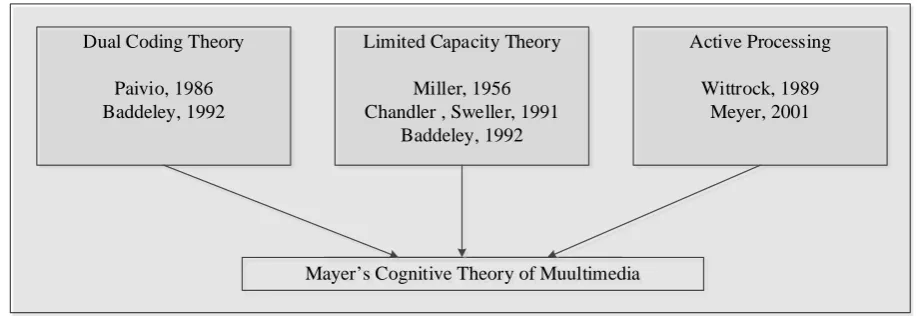
According to Mayer and Moreno (1998) and Mayer (2003), Cognitive Theory of Multimedia Learning is based on three assumptions (See Fig. 2):
• The dual-channel assumption, the limited capacity assumption, and the active processing assumption. The dual-channel assumption is that working memory has auditory and visual channels based on Baddeley’s (1992) theory of working memory and Paivio’s (Clark & Paivio, 1991; Paivio 1986) dual coding theory.
• The limited capacity assumption is based on the cognitive load theory (Chandle & Sweller, 1991; Miller 1956) and states that each subsystem of working memory has a limited capacity.
• The active processing assumption (Wittrock 1989) which suggests that people construct knowledge in meaningful ways when they pay attention to the relevant material, organize it into a coherent mental structure, and integrate it with their prior knowledge (Mayer 2001).
Mayer’s Cognitive Theory of Muultimedia Dual Coding Theory
Paivio, 1986 Baddeley, 1992
Limited Capacity Theory
Miller, 1956 Chandler , Sweller, 1991
Baddeley, 1992
Active Processing
Wittrock, 1989 Meyer, 2001
Fig. 2. Cognitive theory of multimedia learning substantiation (Mayer 2001)
Mayer’s cognitive theory of multimedia learning contends that words and pictures presented to the learner via a multimedia presentation are processed along two separate, non-conflicting channels (Figure 3) (Clark & Mayer 2007). They enter the sensory memory through the ears and eyes. Words and images are actively selected by the learner from the sensory memory and enter the working memory where they are organized into a verbal model and a pictorial model. Each channel can process only a few “chunks” of information at a given time in the working memory. The two models are then integrated with prior knowledge retrieved from the long-term memory. This integration occurs within the working memory following each segmented portion of instruction offered to the learner in the multimedia presentation.
words
pictures
ears
eyes
prior knowledge
sounds verbal
model
images pictorial
model Multimedia
Presentation
Sensory Memory
Working Memory Long-Term
Memory
integrating
m
ed
ia s
el
ect
io
n
me
d
ia
o
rg
an
iz
atio
n
Fig. 3. Cognitive theory of multimedia learning (Mayer, 2005)
The author of the cognitive theory of multimedia learning R. Mayer (Mayer 2008; Moreno & Mayer 2004; Mayer, Fennell, Farmer & Campbell, 2004; Mayer, Sobko & Mautone 2003; Mayer & Johnson, 2008) has determined also 10 principles that should be considered in this approach:
Five Principles for Reducing Extraneous Processing:
1. Coherence Principle: Students learn better when extraneous material is excluded from a multimedia lesson.
2. Signaling Principle: Students learn better when essential words are highlighted.
3. Redundancy Principle: Students learn better from animation with narration than from animation with narration and text except when the onscreen text is short, highlights the key action described in the narration, and is placed next to the portion of the graphic that it describes. In 2008, Mayer revised this principle to include the exception noted here.
4. Spatial Contiguity Principle: Students learn better when corresponding words and pictures are presented near rather than far from each other on the page or screen.
5. Temporal Contiguity Principle: Students learn better when the corresponding narration and animation are presented simultaneously rather than successively (i.e., the words are spoken at the same time they are illustrated in the animation).
Three Principles for Managing Essential Processing:
1. Segmenting Principle: Students learn better when a narrated animation is presented in learner-paced segments rather than as a continuous presentation.
2. Pretraining Principle: Students learn better from a narrated animation when they already know the names and characteristics of essential components.
3. Modality Principle: Students learn better from graphics with spoken text rather than graphics with printed text.
Two Principles for Fostering Generative Processing:
1. Multimedia Principle: Students learn better from words and pictures than from words alone. This allows people to build connections between their verbal and pictorial models.
2. Personalization Principle: Students learn better from a multimedia lesson when words are in conversational style rather than formal style. If people feel as though they are engaged in a conversation, they will make more effort to understand what the other person is saying.
The author of the research has implemented R. Mayer’s cognitive theory of multimedia learning in the process of descriptive geometry studies – lectures, practical lessons, consultations and also e-studies.
5. CONCLUSIONS
The didactic model of descriptive geometry studies is substantiated by the theory of cognitive constructivism and multimedia learning approach. The elements of the didactic model of descriptive geometry are interrelated implementing them in the process of studies: stating the study principles, aims, methods, aids, kinds and content of control, stressing the principle of visualisation and demonstration in the process of studies. The didactic model can be used teaching the study courses where it is necessary to visualise the phenomena, relations and interrelations of the surrounding environment.
6. ACKNOWLEDGMENT
Publication of the research results is done within the ESF financed project Support for implementation of LUA Doctoral studies. Agreement No. 2009/0180/1DP/1.1.2.1.2/09/IPIA/VIAA/017.
7. REFERENCES
• Baddeley, A 1992, Working memory. Science, no. 255, pp.556-559.
• Brooks, JG & Brooks, MG 1999, In Search of Understanding: The Case for Constructivist Classrooms. Alexandria, VA: ASCD.
• Chandler, P & Sweller, J 1991, Cognitive load theory and the format of instruction, Cognition and Instruction, no. 8, pp. 293-332.
• Clark, JM & Paivio, A 1991, Dual coding theory and education, Educational Psychology Review. No 53(2), pp. 445-459.
• Clark, RC & Mayer, RE 2007, E-learning and the science of instruction. San Francisco, Pfeiffer. • University of California Berkeley, Learning: Theory and Research, Cognitive constructivism,
viewed 25 January 2014, <https://gsi.berkeley.edu/teachingguide/theories/cognitive.html>. • Gudjons, H 2007, Pedagoģijas pamatatziņas, Rīga,Zvaigzne ABC (Latvian).
• Maslo, I 2001, Kognitīvā, pragmatiskā, komunikatīvā, uzdevumorientētā un procesorientētā didaktiskā modeļa salīdzinājums: “Par” un “Pret”, LU zinātnisko rakstu krājums “Vispārīgā didaktika un audzināšana”, Rīga, SIA Izglītības soļi, 15. – 22. lpp (Latvian).
• Mayer, R.E 2001, Multimedia learning, New York, Cambridge University Press.
• Mayer, RE 2008, Applying the science of learning: Evidence-based principles for the design of multimedia instruction, American Psychologist, no. 63(8), pp. 760-769.
• Moreno, R & Mayer, RE 2004, Personalized messages that promote science learning in virtual environments, Journal of Educational Psychology, no. 96, pp. 165-173.
• Mayer, RE, Fennell, S, Farmer, L & Campbell, J 2004, A personalization effect in multimedia learning: Students learn better when words are in conversational style rather than formal style, Journal of Educational Psychology, no. 96, pp. 389-395.
• Mayer, RE, Sobko, K & Mautone, PD 2003, Social cues in multimedia learning: Role of speaker's voice, Journal of Educational Psychology, no. 95, pp. 419-425.
• Mayer, RE & Johnson, CI 2008, Revising the redundancy principle in multimedia learning, Journal of Educational Psychology, no. 100, pp. 380-386.
• Taber, KS 2006, Beyond Constructivism: the Progressive Research Programme into Learning Science, Studies in Science Education, no. 42, pp. 125-184.
• Miller, G 1956, The magic number of seven plus or minus two, Some limits on our capacity for processing information, Psychological Review, vol. 63, pp. 31-97.
• Paivio, A 1986, Mental representations: A dual coding approach, England, Oxford, Oxford University Press.
• Žogla, I 2001a, Didaktikas teorētiskie pamati, Rīga, RaKa (Latvian).
• Žogla, I 2001b, Pedagoģiskā paradigma un didaktiskais modelis, Vispārīgā didaktika un
audzināšana: zinātnisku rakstu krājums, LU Pedagoģijas un psiholoģijas institūts, Rīga, Izglītības soļi, 28.-33. lpp (Latvian).
• Wittrock, MC 1989, Generative processes of comprehension, Educational Psychologist, no. 24, pp. 345-376.
• Дьюи, Д 2000, Демократия и образование (Democracy and Education), Москва, Педагогика-Пресс (Russian).
• Пиаже, Ж 1969, Психология интелекта (The Psychology of Intelligence), Избранные психологические труды, Москва, Просвещение (Russian).