www.ocean-sci.net/11/33/2015/ doi:10.5194/os-11-33-2015
© Author(s) 2015. CC Attribution 3.0 License.
Modelling of underwater light fields in turbid and eutrophic waters:
application and validation with experimental data
B. Sundarabalan and P. Shanmugam
Ocean Optics and Imaging Laboratory, Department of Ocean Engineering, Indian Institute of Technology Madras, Chennai-600036, India
Correspondence to: P. Shanmugam ([email protected])
Received: 18 August 2014 – Published in Ocean Sci. Discuss.: 15 September 2014 Revised: 17 November 2014 – Accepted: 2 December 2014 – Published: 9 January 2015
Abstract. A reliable radiative transfer (RT) model is an es-sential and indispensable tool for understanding the radiative transfer processes in homogenous and layered waters, ana-lyzing measurements made by radiance sensors and devel-oping remote-sensing algorithms to derive meaningful phys-ical quantities and biogeochemphys-ical variables in turbid and productive coastal waters. Existing radiative transfer mod-els have been designed to be applicable to either homoge-nous waters or inhomogeneous waters. To overcome such constraints associated with these models, this study presents a radiative transfer model that treats a homogenous layer as a diffuse part and an inhomogeneous layer as a direct part in the water column and combines these two parts appro-priately in order to generate more reliable underwater light-field data such as upwelling radiance (Lu), downwelling ir-radiance (Ed) and upwelling irradiance (Eu). The diffuse model assumes the inherent optical properties (IOPs) to be vertically continuous and the light fields to exponentially de-crease with depth, whereas the direct part considers the water column to be vertically inhomogeneous (layer-by-layer phe-nomena) with the vertically varying phase function. The sur-face and bottom boundary conditions, source function due to chlorophyll and solar incident geometry are also included in the present RT model. The performance of this model is as-sessed in a variety of waters (clear, turbid and eutrophic) us-ing the measured radiometric data. The present model shows an advantage in terms of producing accurateLu,EdandEu profiles (in spatial domain) in different waters determined by both homogenous and inhomogeneous conditions. The fea-sibility of predicting these underwater light fields based on the remotely estimated IOP data is also examined using the present RT model. For this application, vertical profiles of
the water constituents and IOPs are estimated by empirical models based on our in situ data. The present RT model gen-eratesLu,EdandEuspectra closely consistent with the mea-sured data. These results lead to a conclusion that the present RT model is a viable alternative to existing RT models and has an important implication for remote sensing of optically complex waters.
1 Introduction
1993; Haltrin, 1998a, b). Lee and Liou (2007) developed a radiative transfer model for a coupled atmosphere–ocean system using the analytic four-stream approximation. Holl-stein and Fischer (2012) provided radiative transfer solutions for coupled atmosphere–ocean systems using the matrix op-erator technique. These RT models developed based on nu-merical as well as analytical solutions perform well in clear oceanic waters but have limitations in turbid coastal and pro-ductive waters. The key problems associated with some of the above models include the assumption of flat or randomly chosen slope of the sea surface, the treatment of material re-flectance instead of the effective bottom rere-flectance (taking into account the material reflectance and configuration of the seabed), the constant phase function along the depth and the inadequate source function (especially for turbid and pro-ductive waters often optically shallow, vertically stratified, or vertically mixed) which introduce significant errors in the simulated underwater light fields (Sundarabalan et al., 2013). Conversely, the radiative transfer models developed for a in-homogeneous medium do not account for diffuse radiance in the water column, where the influence of inherent optical properties (IOPs) from a particular (adjacent) layer is not the only factor affecting underwater light fields in that layer but the subsequent layers (with non-uniform IOPs) would have potential contributions to modifying the underwater light-field environment. Moreover, the assumption of the homoge-nous water column in some of the RT models is not valid in many coastal waters where the water constituents would vary with depth (e.g. an increasing trend of turbidity with depth in many coastal regions). Thus, a reliable RT model is needed accounting for the vertically varying IOPs and treat-ing the surface and bottom boundary conditions adequately in order to provide accurate underwater light-field data in tur-bid coastal waters.
Ocean colour data provided by modern day sensors (e.g. NASA’s SeaWiFS on board its SeaStar satellite and MODIS on board its Aqua satellite, ESA’s MERIS on board its En-visat satellite, Ocean Colour Monitor (OCM) from the Indian Space Research Organisation (ISRO) on board its Indian Re-mote Sensing (IRS) satellite and more recently Geostationary Ocean Colour Imager (GOCI) from the Korea Aerospace Re-search Institute (KARI) onboard its Communication, Ocean and Meteorological Satellite (COMS) satellite) are a vital resource for a wide variety of operational forecasting and oceanographic research, and related applications. With the advent of these new sensors, the prospects of better algo-rithms to enable the interpretation of ocean colour in coastal oceanic waters have improved vastly. Some of the potential applications of these sensors include monitoring and assess-ment of the spatial and temporal variability of algal blooms (instrumental in characterising variability of marine tems and is a key tool for research into how marine ecosys-tems respond to climate change and anthropogenic perturba-tions), coastal marine pollution, river plumes, global carbon budgets, ocean radiant heat budgets and climate change
im-pacts. Many of these applications can be achieved by estimat-ing IOPs from the remote-sensestimat-ing data, since light transmis-sion in the water column is determined by these properties that depend mainly on the contents of chlorophyll (Chl), sus-pended sediments (SS) and coloured dissolved organic mat-ter (CDOM). In most oceanic wamat-ters IOPs are demat-termined primarily by phytoplankton and its associated detrital matter, which in turn determine the distribution and spectral qual-ity of the underwater light fields (Morel, 1988; Hoepffner and Sathyendranath, 1992). Though several inversion models have been developed to estimate IOPs from remote-sensing data, they are often reported to yield large uncertainties in turbid coastal waters. Similar problems also exist with the re-trieval of the water constituents’ concentrations from satellite observations in these waters (O’Reilly et al., 1998; O’Reilly et al., 2000; Shanmugam, 2011a). The errors of more than 10 % in retrieval of IOPs (Stramski, 2001) and even much higher (20 times higher than measurements) in retrieval of chlorophyll are reported (Wozniak and Stramski, 2004).
It is well known that the underwater radiometric parame-ters directly depend on IOPs of the water body (Shanmugam et al., 2010, 2011). The IOPs are mainly absorption (a), at-tenuation (c), scattering (b) and backscattering (bb) coeffi-cients which are generally derived as a function of the chloro-phyll concentration in oceanic waters. Over the past decades, several models have been developed to estimate IOPs in case 1 waters (Prieur and Sathyendranath, 1981; Ahn, 1990; Bricaud et al., 1995; Babin et al., 2003; Matsuoka et al., 2011). However, the overly simplified parameterisations do not account for much of the optical variability observed in natural waters, leading to large uncertainties in case 2 waters (Babin et al., 2003; Dmitriev et al., 2009). The variations in these parameters can be attributed to three water constituents, such as phytoplankton, yellow substances (CDOM) and non-algal particles (both organic and inorganic). The particulate absorption (ap) is mainly dominated by the non-algal parti-cles, but phytoplankton becomes the dominant contributor in algal bloom waters (Wang et al., 2011). Stramski et al. (2001) explain that the mineral particles could be important for scat-tering and backscatscat-tering. Recently, Gokul et al. (2014) have developed models to predict IOPs and their vertical profiles using the remote-sensing reflectance data.
This work intends to derive a generalised radiative transfer model for predicting the underwater light fields in a variety of waters (including turbid coastal waters and eutrophic wa-ters). The model is run with the in situ IOP data and predicted IOP data from remote-sensing data and its results are com-pared with the measured radiometric data. The results of the present RT model are further discussed for a variety of waters around southern India.
2 Data and methods
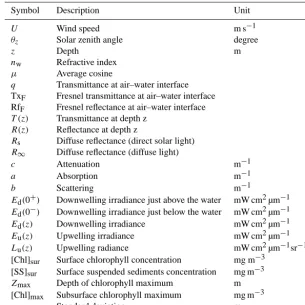
In situ measurements of the various optical and physical properties together with the water sampling were conducted in relatively clear and turbid coastal waters off Point Cal-imere, Chennai and eutrophic (lagoon) waters around Chen-nai during August 2012 and August, November and De-cember 2013. The nature and characteristics of these waters have been investigated in a recent study by Pravin and Shan-mugam (2014). For each station, water samples were col-lected from discrete depths and filtered and analysed for the determination of Chl, SS and CDOM contents (Gokul et al., 2014). Table 1 summarises some important symbols and no-tations used in this paper. The data used for this study and the sampling stations are described in Table 2. The vertical pro-files of IOPs and other properties were measured with WET-Labs AC-S, BB9 and FLNTU sensors. Necessary corrections (for temperature, salinity and scattering effects) were applied to the AC-S data to obtain more reliable absorption and at-tenuation data (Pegau et al., 1997). Physical properties of the seawater such as conductivity, temperature and depth were
measured by a SBE-CTD sensor to support the above data processing and analysis.
Field radiometric measurements were carried out us-ing RAMSES (TriOS) hyperspectral radiometers; RAMSES ARC and ACC were used to measure the upwelling radi-ance (Lu), upwelling irradiance (Eu) and downwelling irra-diance (Ed) in the water column. The irradiance sensor has an inbuilt pressure sensor which provides the correspond-ing depth in the water column. Both these sensors measure the radiance signal in the visible and near-infrared (0.350– 0.950 µm) with a field of view of 7◦and spectral accuracy of 0.0033 µm. Since the radiance sensor was immersed in wa-ter, the immersion factors (wavelength-dependent correction factors) were used to correct the measured radiance signal (Pravin and Shanmugam, 2014). Similarly, the above-surface measurements were made with another set of TriOS sensors that provided the sky radianceLsky, downwelling irradiance
Ed(0+)and total radianceLt. The desired water-leaving radi-ances were determined after eliminating the surface-reflected light contributions to the total radiance signal (Pravin and Shanmugam, 2014).
3 Modelling
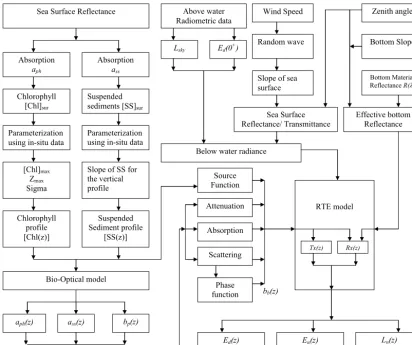
Figure 1 shows the schematic flow diagram of the present RT model. It can simulate the underwater light fields based on the measured IOPs (right part) or predicted IOPs from the remote-sensing data (left part) for the same solar incident ge-ometry and surface and bottom boundary conditions. For the second part, surface Chl and SS are estimated from remote-sensing reflectance data and their vertical profiles are subse-quently predicted using the known functions. These vertical profiles are used to derive the IOPs (hereafter referred to as Pred IOP). Finally, the Pred IOPs are used along with the other input parameters to simulate the underwater light fields. The step-by-step procedure is detailed in what follows. 3.1 Radiative transfer model
Radiative transfer is the physical phenomenon of energy transfer in the form of electromagnetic radiation. The propa-gation of radiation through a medium is affected by absorp-tion, emission and scattering processes. The equation of ra-diative transfer describes these interactions mathematically. The basic RT equation that connects the radiance and IOPs is expressed as follows:
cosθdL(z, θ, φ, λ)
dz = −c(z, λ)L(z, θ, φ, λ)
+
Z
4π
L(z, θ0, φ0, λ)
×β(z;θ0, φ0→θ, φ;λ)d0
Sea Surface Reflectance
Absorption
ass
Suspended sediments [SS]sur Absorption
aph
Chlorophyll [Chl]sur
Parameterization using in-situ data Parameterization
using in-situ data
Slope of SS for the vertical profile [Chl]max
Zmax Sigma
Suspended Sediment profile
[SS(z)] Chlorophyll
profile [Chl(z)]
bp(z)
ass(z)
Bio-Optical model
aph(z)
Lu(z)
Eu(z)
Ed(z)
RTE model
Ed(0+)
Zenith angle Wind Speed
Lsky
Absorption
Phase function Attenuation
Scattering
Bottom Material Reflectance R(λ) Random wave
Slope of sea surface
Sea Surface Reflectance/ Transmittance
Bottom Slope
Effective bottom Reflectance Above water
Radiometric data
Below water radiance
Source Function
bb(z)
Tx(z) Rx(z)
Figure 1. The schematic block diagram indicates the overall system for the simulation of underwater light fields using the present RT model with the in situ IOP (right) or predicted IOP from remote-sensing data (left) along with other input parameters.
The scattering angle ψin the volume scattering function (VSF) is the angle between the incident direction (θ0, ϕ0) and the scattered direction (θ, ϕ). The source termS (z, θ, ϕ, λ) describes either an internal light source such as biolumines-cence or inelastically scattered light from other wavelengths. Figure 2 shows the schematic representation of the water radiative transfer technique for homogenous and in-homogeneous waters with the direct and diffuse terms. For practical applications, it is important to consider the influ-ences of homogenous (diffuse term) and inhomogeneous (di-rect term) layers of the water column on the underwater light-field parameters. The homogenous and inhomogeneous ef-fects are included in the present RT model (by taking the average of these two terms) to simulate the underwater light fields in a wide variety of waters (including relatively clear, turbid and eutrophic waters). The downwelling irradiances along the depth for both homogenous (HEd) and inhomoge-neous waters (Ed) can be calculated using
Ed(z)=
1
2
(HEd(z)+Ed(z)) . (2)
Homogenous layer Diffuse term
Inhomogeneous layer Direct term
Homogenous layer Diffuse term
Inhomogeneous layer Direct term
Table 1. Symbols and notations.
Symbol Description Unit
U Wind speed m s−1
θz Solar zenith angle degree
z Depth m
nw Refractive index
µ Average cosine
q Transmittance at air–water interface
TxF Fresnel transmittance at air–water interface
RfF Fresnel reflectance at air–water interface
T (z) Transmittance at depth z
R(z) Reflectance at depth z
Rs Diffuse reflectance (direct solar light)
R∞ Diffuse reflectance (diffuse light)
c Attenuation m−1
a Absorption m−1
b Scattering m−1
Ed(0+) Downwelling irradiance just above the water mW cm2µm−1
Ed(0−) Downwelling irradiance just below the water mW cm2µm−1
Ed(z) Downwelling irradiance mW cm2µm−1
Eu(z) Upwelling irradiance mW cm2µm−1
Lu(z) Upwelling radiance mW cm2µm−1sr−1
[Chl]sur Surface chlorophyll concentration mg m−3
[SS]sur Surface suspended sediments concentration mg m−3
Zmax Depth of chlorophyll maximum m
[Chl]max Subsurface chlorophyll maximum mg m−3
σ Standard deviation m
From the downwelling irradiance and reflectance at differ-ent depths, the upwelling irradiance (for both homogenous, HEu, and inhomogeneous,Eu) can be calculated from
Eu(z)=
1
2
[HEu(z)+Eu(z)]+
S(z)
4π
. (3)
These equations provide more accurate upwelling irradi-ances along the depth. The upwelling radiance along the depth (for homogenous and inhomogeneous) can be calcu-lated from
Lu(z)=
E
u(z) 2π µ
. (4)
Using the above equations one can generate the underwa-ter light fields and study their fluctuations in both clear and turbid waters. The inhomogeneous or direct term includes the phase function, source term and surface and bottom bound-ary conditions which are solved in equal interval along the water column. The homogeneous term or diffuse term is di-rectly calculated from the IOPs for any arbitrary depth (Hal-trin, 1998b).
3.1.1 Boundary conditions Surface transmittance
The propagation of light through the sea surface is calculated from the reflected and transmitted angles using the Fresnel function (Gjerstad et al., 2003). Since the resulting under-water light fields strongly depend on the exact shape of the wave, the slope of the sea surface plays an important role in determining the transmitted and reflected angles. In this study, the shape of the irregular sea surface is generated based on the wind speed using the Pierson and Moskowitz (PM) spectrum (Pierson and Moskowitz, 1964) which is ob-tained from the field data. The slope is calculated based on the generated irregular sea surface. From this slope, the tilt angle is calculated based on Snell’s law. The equation used to determine the tilt angle (γ) of the sea surface from the slope is expressed as follows:
γ=tan−1
1z
1x
, (5)
the titled angle in the above equation, the transmitted angle for the sea surface is calculated from
θt=sin−1
n1
n2
sin(θi+γ )
−γ . (6)
The modified transmitted and incident angles are applied in the Fresnel equation as follows:
RfF= 1 2
"
sin(θi−θt) sin(θi+θt)
2
+
tan(θ
i−θt) tan(θi+θt)
2#
, θi6=θt
=
n
w−1
nw+1
2
, θi =θt
TxF=1−RfF. (7)
The transmittance calculated from the above equation is used as the interface between the air and water for the down-welling irradiance (notations given in Table 1).
Bottom reflectance
The effective reflectanceReff of the bottom (considering the bottom material and morphology) is calculated according to Zaneveld and Boss (2003):
Reff(λ)
Rb(λ)
=0.5×cos[θz+θb] +0.5×cos[θz−θb], (8) whereθb=atan(4Ab/Lb)the angle of the bottom slope (due to ripples on the sea bed), and θz is the zenith angle of the
irradiance.AbandLbare the amplitude and wavelength, spectively, for the triangular shaped bottom. The effective re-flectance spectra of the sea bottom are not same for different materials since the reflectance is about to vary for different materials.
3.1.2 Optical properties in the water column Phase function
The angular distributions of scattered radiance are mainly ex-plained in terms of the phase function, which plays an im-portant role in coastal waters. The characteristic of phase functions in natural volumetric media is sharply peaked in the forward scattering direction, with only a few percent of backscatter in the total angular redistribution of a single scat-tering event (Sundarabalan et al., 2013). Of several phase function models developed in the past, the Fournier–Forand (FF) model is an analytic form of the phase function giving better results when compared to other models (Mobley et al., 2002). The FF phase function is given by
β(θ )= 1
4π(1−δ)2δv v(1−δ)−(1−δ v)
+
δ(1−δv)−v(1−δ)sin−2
θ
2
+ 1−δ
v
180 16π(δ180−1)δ180v
3cos2θ−1
v=3−µ
2 , δ=
4 3(n−1)2sin
2
θ
2
. (9)
Hereµis the slope of the Junge particle distribution,nis the real index of refraction andδ180is calculated by consider-ingθ=180◦. Based on previous studies (Twardowski et al., 2001; Freda and Piskozub, 2007; Sundarabalan et al., 2013), the parametersµandnare modelled using the IOPs, atten-uationc(520) and scatteringb(520). Finally, the backscatter-ingbbcoefficients are computed from the phase function for scattering angles between 90 and 180◦,
bb(520)=
π Z
π 2
β(θ )dθ. (10)
The spectral variation of the backscatteringbbcoefficients can be expressed as (Haltrin, 2002)
bb(λ)=bb(520)×
520
λ 1.1
. (11)
This phase function is mainly used to determine thebb coefficients along the depth, which are more compatible for turbid coastal waters.
Transmittance along the depth
Haltrin (1998b) derived the transmittance as a function of depthT (z)based on the self-consistent method, which de-pends on the IOPs of seawater. The transmittance function
T (z)is expressed as
T (z)=1+q{µsε(z)+hRsFs(z)[(2+µ)µs+1]} 1+qµs
. (12)
Several important parameters that depend on the IOPs are used to calculateT (z).µsis the cosine function related to the solar angle which is calculated based on the refractive index of seawater (n) and the solar elevationhs.µis the average cosine that connects with Gordon’s parameterg, which de-pends on the absorption and backscattering coefficients. The result obtained by solving the RT equation isα∞which is
found by dividing absorption (a) by the average cosine (µ).
µ0is another cosine function which depends on the average cosineµ. The reflectance parameters involved in the calcu-lation ofT (z)are the diffuse reflectance (Rs) of a deep sea layer optically illuminated by direct solar light and the dif-fuse reflectance (R∞) of the optically deep sea illuminated
by the diffuse light. Both are calculated as a function of the cosine functions as follows:
Rs=
(1−µ)2
1+µµs(4−µ2)
, R∞=
1−µ
1+µ
2
The average cosine function used in the above equation is defined as
µ=
1−g
1+2g+ [g(4+5g)]1/2
1/2 ,
µ0=
1+µ2 µ(3−µ2),
µs=
"
1−
cosh
s
nw
2#1/2
, (14)
wherec=a+bis the beam attenuation coefficient,q=E
⊥ s Ed0
is the transmittance at air–sea interface, α=a+2bbis the re-normalised attenuation coefficient, α∞=aµ is the
inter-mediate parameter which depends on IOPs andg= bb a+bb is
the Gordon’s parameter (Gordon et al., 1975; Haltrin, 2003) which depends on absorption and scattering.
The IOP-dependent intermediate parameters are defined as
ε(z)=exp
−αz
1
µs − 1
µ0
, h= (1+µ)
2 2(1+µ2), Fs(z)=
1−exp
−αz
1
µs − 1
µ0
1
µs − 1
µ0
,
µs6=µ0,
Fs(z)=αz, µs=µ0. (15)
The above parameters, ε(z),h, and Fs(z), are the func-tions calculated based on the IOPs and solar elevation (Hal-trin, 1998b).
Reflectance along the depth
The reflectance along the depthR(z)is generally calculated based on the IOPs (bb/(a+bb)), but it is also highly influ-enced by the bottom material and solar zenith angle (Lee et al., 1998, 1999). Thus, the reflectance along the depth is cal-culated from Lee et al. (1998), which takes into account the bottom material effect and the IOPs of the water column. The model parameters are defined as follows:
R(z)=Riop(z)+Rbtm(z). (16)
The reflectance influenced by the IOPs and bottom effect are calculated from the following equations:
Riop(z)=
rrs(z)×
1−exp
−κ(z)H
Dcu+
1
cosθw
,
Rbtm(z)=
Reffbtm×
−exp
−κ(z)H
Dbu(z)+
1
cosθw
, (17)
whereDucis the path-elongation factor for scattered photons from the water column which varies with the IOPs. The opti-cal path-elongation factorDbufor the bottom mainly depends
on the bottom reflectance. These factors are defined as
Duc=1.03p(1+(2.4×u)), (18)
Dbu=1.04p(1+(5.4×u)). (19)
rrs is the subsurface remote-sensing reflectance which is a function of the IOPs at a given depth and expressed as
rrs=u×[(u×0.170)+0.084]. (20)
Also,θwis the subsurface solar zenith angle,H is the bot-tom depth,Reffbtm is the effective bottom reflectance andκ anduare the inherent optical parameters which can be ob-tained from
u= bb(z)
a(z)+bb(z)
, (21)
κ=a(z)+bb(z). (22)
Based on the IOPs along the depth and effective re-flectance of the bottom, the rere-flectance functions along the depthR(z)can be calculated from these equations.
Source function
Since the source function affects the underwater light fields (by way of re-emitting photons by phytoplankton at longer wavelengths after absorption at shorter wavelengths), it is also included in the present RT model. The source function can be computed as follows (Gower et al., 2004):
Fl(λ)= 0.15×Chl
1+0.2×Chl. (23)
The source function is calculated as a function of the chlorophyll fluorescence as follows:
S(λ)=Fl(λ)×h(λ), (24)
whereh(λ) is the fluorescence emission function per unit wavelength calculated based on the Gaussian distribution,
h(λ)=√ 1
2π σ2exp
−(λ−λ0) 2 2σ2
. (25)
The wavelength of maximum emission isλ0=0.685 µm and the standard deviationσ =0.011 µm.
3.1.3 Inhomogeneous term: underwater light-field parameters
The downwelling irradianceEd(0−)just below the water for the inhomogeneous (or layer by layer) condition can be cal-culated from the downwelling irradianceEd(0+)just above the water along with the transmittance derived from the Fres-nel equation (Eq. 7),
Once the downwelling irradiance is transmitted through the water surface, the intensity of the downwelling irradiance based on the transmittance is purely dependent on the IOPs. The downwelling irradiances for the first and subsequent lay-ers of the depth are calculated from
Ed(z1)=Ed(0−);Ed(z2)=Ed(z1)×Tx(z2). (27) The downwelling irradiance along the depth can be calcu-lated from an explicit method with the corresponding depth transmittance Tx(z). The common equation for calculating
Ed(z)along the depth is given as
Ed(z)=Ed(z−1)×Tx(z). (28)
The upwelling irradiances below the water along the depth are calculated from
Eu(z)=(Ed(z)×R(z)) , (29)
whereEd(z) is downwelling irradiance andR(z) is the re-flectance for the corresponding depth which includes the ef-fect of the bottom reflectance and IOPs from the bottom boundary condition.
3.1.4 Homogeneous term: underwater light-field parameters
The downwelling irradiance equation developed by Hal-trin (1998b) for the homogenous water column takes the fol-lowing expression,
HEd(z)=Ed0exp(−α∞z)+Es⊥exp(−αz/µs) (30) +E⊥s hRs{1+µs(2+µ)}Fs(z)exp(−α∞z). (31)
The upwelling irradiance for the homogenous water col-umn can be calculated with the equation of Haltrin (1998b): HEu(z)=
Ed0R∞exp(−α∞z)+µsE⊥s R∞exp(−αz/µs) (32)
+Es⊥hRs{µs(2−µ)−1}Fs(z)exp(−α∞z). (33)
The input parameters used in the calculation of HEdand HEu are explained in the transmittance section. Here,Es is the diffuse term of the above-water irradiance which is ob-tained from the sky radianceLsky. The total underwater light-field parameters (Ed, EuandLu)can be obtained by applying Eqs. (26)–(29) in Eqs. (2)–(4). The model presented in this study is much easier to implement when compared to the ex-isting RT models.
3.2 Prediction of remotely sensed IOPs along the water column
3.2.1 Bio-optical model
This section presents methods to estimate the surface chloro-phyll [Chl]sur and suspended sediments [SS]sur (concentra-tions) from the normalised water-leaving radiance (nLw).
The slope values (SnLw) required for fixing the threshold limit (i.e., scenarios in Table 3) for different waters are cal-culated as follows:
SnLw=100×
nL
w(0.443)−nLw(0.547) 0.443−0.547
. (34)
Since the normalised water-leaving radiance values are larger than the remote-sensing reflectance, the former quan-tity is used to better determine the used scenarios (Ahn and Shanmugam, 2006; Shanmugam, 2011b). Based on theSnLw and nLwdata, three scenarios are found adequate for the vari-ous water types. The first scenario represents the open-ocean waters whereSnLwis less than 0.5 and [Chl] is based on the ratio of Rrs (0.488) andRrs (0.547) (Table 3). The second scenario indicates turbid coastal waters where the same band ratio is used for the [Chl] parameterisation. The [SS] param-eterisations are different for both these scenarios. The third scenario is developed for inland and eutrophic waters based on the exponential function that uses theRrs values at three different bands (0.690, 0.700 and 0.760 µm) (Zhang et al., 2009). The coefficients of the exponential equation are ob-tained based on the IRrsvalue which is defined as follows:
IRrs=
1
Rrs(0.690)
− 1
Rrs(0.700)
×Rrs(0.760). (35)
For the [SS] parameterisation, there is a shift of peak be-tween 0.547 and 0.488 µm in clear waters (first scenario) and the ratio ofRrs(0.620) to the maximum value ofRrs(0.488) andRrs (0.547) is found to be suitable for these waters. In turbid coastal waters (second scenario), the reflectance peak at 0.547 µm dominates theRrsvalues at 0.488 µm and the rel-ative change of these values is used in terms of the ratio to estimate [SS] in turbid waters. Considering inland and eu-trophic waters (third scenario), the ratio ofRrsat 0.620 and 0.720 µm is used for the estimation of [SS] in these waters. 3.2.2 Vertical profiles of chlorophyll and suspended
sediments
Table 2. Station details and the observed environmental parameters used for this study.
Station Date Time (LT) Latitude Longitude θz Depth U [Chl] [SS] aCDOM(490) (m) (ms−1) (mg m−3) (mg m−3) (m−1)
St-1 31/08/2013 13:00 13◦08.715 N 80◦21.041 E 21.9 19.8 7.7 0.2–1.1 7.9–17.7 0.181 St-2 31/08/2013 15:00 13◦08.715 N 80◦21.041 E 43.6 19.8 7.7 0.3–0.5 8.2–11.1 0.175 St-3 26/08/2013 15:00 10◦20.714 N 80◦08.604 E 43.2 17.7 5 1.0–6.7 7.0–15.8 0.83 St-4 26/08/2013 11:45 10◦22.103 N 79◦57.720 E 4.55 6.3 7.7 0.8–2.3 33.8–41.9 1.15 St-5 17/08/2012 15:10 10◦20.992 N 80◦05.573 E 44.9 17.9 4 6.2–18.5 10.9–15.7 0.92 St-6 17/08/2012 15:55 10◦20.714 N 80◦08.604 E 55.9 22 3 5.3–20.4 8.4–16.6 0.85 St-7 08/11/2013 14:00 13◦07.408 N 80◦17.565 E 42.8 5 0.25 18.3–18.5 21.6–24.0 0.98 St-8 10/11/2013 14:50 12◦48.474 N 80◦14.204 E 53.2 1 0.25 52.5 70.4–71.6 1.48 St-9 10/11/2013 15:10 12◦48.321 N 80◦14.239 E 59.5 1 0.25 54.1 68.2–87.3 1.51 St-10 16/12/2013 13:15 12◦48.474 N 80◦14.204 E 42.5 1 0.25 72.1 63.6–65.5 1.34 St-11 16/12/2013 13:30 12◦48.321 N 80◦14.239 E 43.8 1 0.25 73.8 62.1–64.8 1.25
Table 3. Empirical relationships between the in situRrsand in situ surface concentration ([Chl]surand [SS]sur)in a variety of waters for three
different scenarios. Note that S.No. 3 will have another expression [Chl]sur=17.128×exp(0.888×IRrs)if one intends to useRrs(0.680)
instead ofRrs(0.690) in Eq. (37). The empirical coefficients presented in this table are derived based on our in situ data.
[CHL]sur [SS]sur Scenario
1.123×
Rrs(0.488) Rrs(0.547)
−3.7144
21.503×
Rrs(0.620)
max[Rrs(0.488),Rrs(0.547)]
0.3998
SnLw<0.5
0.409×
Rrs(0.488) Rrs(0.547)
−7.567
34.01×
Rrs(0.547) Rrs(0.488)
−1.2615
SnLw>0.5
18.267×exp(1.9913×IRrs) 38.685×
R
rs(0.620) Rrs(0.720)
−0.554
Rrs(0.547) > Rrs(0.488)&
Rrs(0.680) < Rrs(0.690)
is given below:
Chl(z)=Chlsur+Chlmax×exp
−(z−zmax) 2 2σ2
. (36)
The chlorophyll profile parameters calculated from the surface [Chl] are shown in Table 4 and the basic equations are taken from Gokul et al. (2014). The equations were de-veloped based on a large number of in situ data. Conversely, the SS profile is estimated using the power-law function,
SS(z)=SSsur×
z
zsur
0.0383
. (37)
The slope is calculated based on the mean slope values from a number of measured SS profiles. Here, the SSsurof the concentration of suspended sediments at the near surface and
Zsuris the depth at which the SSsuris measured (Zsur=1 m). 3.2.3 IOP model
Clear and turbid coastal waters
A simplified model is used to estimate the vertical profiles of IOPs using chlorophyll and suspended sediment profile data. Though the IOPs may be determined by more than three
sub-0
5
10
15
20
25
30
0 1 2 3 4
σ
De
pt
h [
m
]
Chl [mg m-3]
Zmax
Chlmax
Chl0
Table 4. Empirical relationships of the chlorophyll profile parameters ([Chl]max,Zmaxandσ )for the various ranges of surface chlorophyll
[Chl]surfrom different stations.
Chlsur Chlmax Zmax 6
1.0<Chlsur<10 2.019×Chlsur−0.2328 0.7595×Chlsur+4.082 0.3456×Chlsur+4.104
0.5<Chlsur<1 −8.288×Chlsur+8.3628 −12.247×Chlsur+15.479 3.1606×Chlsur−0.199
0<Chlsur<0.5 −8.288×Chlsur+2.6628 −12.247×Chlsur+15.479 3.1606×Chlsur−0.199
stances, it is assumed that the absorption and scattering co-efficients in clear and turbid coastal waters are mainly de-termined by water itself, suspended sediment particles and phytoplankton (both living and non-living). Thus, the to-tal absorption coefficient of seawater, a(λ, z), is the sum of the absorption of seawater aw(λ, z), dissolved organic
aCDOM(λ, z), and particulate matter ap(λ, z). The total
ab-sorption coefficient observed at any given wavelength can be expressed as
a(λ, z)=aw(λ, z)+aCDOM(λ, z)+ap(λ, z), (38)
ap(λ, z)=aph(λ, z)+ass(λ, z). (39)
Here the total absorption (pure water, chlorophyll, sus-pended sediments and coloured dissolved organic matter) is estimated from Morel (1991) and the absorption coeffi-cient of suspended sediments is calculated from Gokul et al. (2014):
a(λ, z)=
aw(λ)+0.06aC∗(λ)[Chl(z)]0.65
×1+0.2 exp(−0.014(λ−0.400)×10−3)
+ass(λ, z). (40)
The seawater absorption coefficients were taken from Pope and Fry (1997). The absorption coefficient of suspended sed-iments is estimated as follows:
ass(λ, z)=ass(λr)×exp(−0.0104(λ−λr)), (41)
where the absorption at a reference wavelength 0.443 µm is calculated from the power fit shown in Fig. 4a and the equa-tion is given as
ass(0.443)=0.0007[SS(z)]1.7653, [R2=0.9]. (42)
Similarly, the total scattering coefficient of sea water is the sum of the scattering due to pure seawaterbw(λ,z)and par-ticulate matterbp(λ,z)(due to phytoplankton and suspended sediments). The pure sea water scattering coefficients were taken from Smith and Baker (1981). Since the contribution of CDOM is negligible, it is omitted leading to the total scat-teringb(λ,z),
b(λ, z)=bw(λ, z)+bph(λ, z)+bss(λ, z). (43)
R2
= 0.8465
0 5 10
0 20 40 60
SS (g m-3
)
b(41
2) (m
-1) R
2
= 0.8832
0 20 40 60
0 25 50 75
Chl (mg m-3)
b
p
(532)
(
m
-1)
R2
= 0.9302
0 1 2 3
0 25 50 75 100
SS (g m-3)
a
ss
(443) (m
-1) a
b c
Figure 4. (a) Relationship between the suspended sediment
concen-tration and absorption by suspended sedimentass(443), used to
cal-culate the absorption coefficient of suspended sedimentsass(443).
(b) Relationship between the suspended sediment concentration and
scatteringb(412), used to calculate the scattering (bss)coefficient of
suspended sediments. (c) Relationship between the Chlorophyll and
particulate scatteringbp(532) which is used to calculate the
partic-ulate scattering directly from the chlorophyll concentration. This is
applicable only for surface Chl should it be greater than 15 mg m−3.
The scattering due to phytoplankton (bph)depends on the chlorophyll concentration which is derived from Gordon and Morel (1983):
bph(λ, z)=
0.550 λ
S
×
0.3[Chl(z)]−0.3
, (44)
whereSis the slope which is calculated based on the chloro-phyll concentration (Huot et al., 2008). When the Chl is greater than 2 mg m−3,S is considered to be zero. If Chl is less than 2 mg m−3, the slope will be calculated from the fol-lowing equation:
S=0.5×(log([Chl(z)])−0.3). (45)
The scattering due to suspended sediments is estimated us-ing the power-law model (Fig. 4b) which is expressed as
bss(λ, z)= 1 2
0.412 λ
0.88
Table 5. New spectral absorption coefficients of water particles de-rived from the in situ data, which are used only when the
concen-tration of [Chl]suris greater than 15 mg m−3, for the calculation of
the particulate absorption.
Wavelength a∗p Wavelength ap∗
(µm) (µm)
0.401 0.195342 0.575 0.038799
0.425 0.208779 0.601 0.044386
0.451 0.168103 0.625 0.056005
0.475 0.129094 0.651 0.053105
0.501 0.098007 0.675 0.080339
0.525 0.061625 0.701 0.019868
0.551 0.042149 0.725 0.002783
Eutrophic and phytoplankton-dominated waters
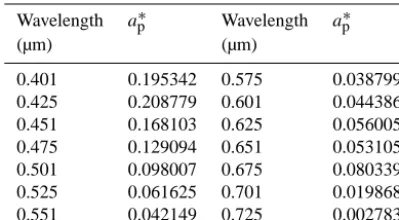
For eutrophic and phytoplankton-dominated waters, the vari-ations in absorption and scattering coefficients are poorly documented as most of the previous studies on IOPs were conducted in relatively clear and open-ocean waters. In this study, absorption and scattering by particles are estimated us-ing separate models for these waters. In the previous studies, phytoplankton absorption aph(λ) was generally calculated based on the specific phytoplankton absorptiona∗ph(λ). Here the specific particulate absorption coefficientsap∗(λ)are used to calculate the particulate absorption coefficientsap(λ). The values of newa∗p(λ)are given in Table 5. The particulate ab-sorption coefficients are then derived as a function of chloro-phyll as follows:
ap(λ, z)=ap∗(λ)× [Chl(z)] ×
[Chl(z)]
54
. (47)
Similarly, the particulate scattering is calculated directly based on the exponential function of chlorophyll (Fig. 4c) as follows:
bp(λ, z)=
1.4×exp(0.0525× [Chl(z)])×
λ
0.532
−0.3
. (48)
This equation is derived from the relationship between in situ chlorophyll and particulate scattering (c–a from Wet-Labs AC-S). Both particulate absorption and scattering coef-ficients are added with the respective pure water coefcoef-ficients to obtain the total absorption and scattering coefficients.
4 Results and discussion
Results are categorised into four parts: (1) comparison of the model versus measured IOP profile data, (2) effects of homogeneous and inhomogeneous water column conditions, (3) comparison of the underwater light fields predicted by the
4000 500 600 700
2 4 6
8x 10
-3
Wavelength (x10-3m) Wavelength (x10-3m)
R rs Rrs
4000 500 600 700
0.005 0.01
4000 500 600 700
0.005 0.01 0.015 0.02
4000 500 600 700
0.01 0.02 0.03 0.04
a b
d c
Figure 5. The typical remote-sensing reflectance spectraRrs(λ)
measured at four stations in the study area during 2012 and 2013. (a) Relatively clear waters off Chennai, (b) moderately turbid ters off Point Calimere, (c) phytoplankton-dominated harbour wa-ters of Chennai and (d) eutrophic wawa-ters.
RT model, based on the measured and estimated IOP profiles from remote-sensing data, and (4) apparent optical properties from underwater light fields. Figure 5 shows the examples of measured remote-sensing reflectances from different waters (clear, turbid and eutrophic waters) used for construction of the vertical profiles of IOPs and simulation of the underwa-ter light fields. The specific spectral features of IOPs for these waters have already been described in a recent study (Pravin and Shanmugam, 2014). It should be mentioned that the un-derwater light-field parameters are simulated from the RT model using MATLAB 2007 with a 4 gigabyte RAM com-puter. The run time for this model is 8 milliseconds for the entire wavelength at one depth for a given sample. In fact, this can be reduced if the model is implemented in FOR-TRAN with a high performance computer. The performance of the model in simulating the underwater light-field parame-ters is assessed using the mean relative error (MRE=(model −in situ)/in situ).
4.1 Prediction of the IOP profiles from remote-sensing data
This section is focused on the determination of the vertical profiles of IOPs based on the seawater constituents (chloro-phyll and suspended sediments at the surface level) that are estimated from the above-water remote-sensing reflectance (Rrs)data.
4.1.1 Retrieval of the seawater constituents
wa-0.1 1 10 100 500 0.1
1 10 100 500
Insitu - Chl [mg m-3]
M
od
el
Ch
l [
m
g m
-3 ]
0 25 50 75 100
0 25 50 75 100
Insitu - SS [mg m-3]
M
odel
S
S
[m
g m
-3]
a b
Figure 6. (a) Scatter plot showing the comparison of the estimated
chlorophyll concentration from the remote-sensing reflectanceRrs
with the in situ chlorophyll from different waters. (b) Scatter plot showing the comparison of the estimated suspended sediment
con-centration from the remote-sensing reflectanceRrswith the in situ
suspended sediment concentration from different waters.
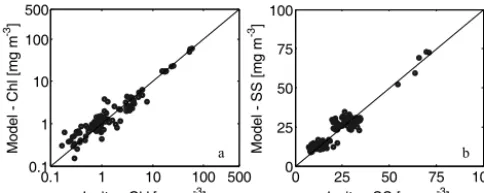
ters off Point Calimere and Chennai. Since the models are based on the different spectral slopes of Rrs, different sce-narios were used to estimate these water constituents ac-curately. The estimated [Chl] and [SS] show good agree-ment with measured data from different waters (Fig. 6a), where [Chl] ranged from 0.1 to 100 mg m−3. The statis-tics analyses indicate low errors and high slopes and corre-lation coefficients (MRE=0.17, RMSE=0.18, slope=1.0, bias= −0.031,R2=0.91, N=98). Similarly, the estimated [SS] agree closely with the in situ [SS] (Fig. 6b), with good statistics (MRE=0.01, RMSE=0.09, slope=0.98, bias= −0.01, R2=0.84, N=98). These results clearly demonstrate consistency between the estimated and mea-sured data for a wide range of waters.
4.1.2 Vertical profiles of chlorophyll and suspended sediments
On the basis of surface chlorophyll [Chl]surf and [SS] es-timated from remote-sensing data, the vertical profiles of [Chl(z)] and [SS(z)] were constructed in relatively clear and turbid coastal waters. It is observed that the modelled and measured chlorophyll profiles agree well in relatively clear waters off Chennai (31 August 2013 at 13:00 and 15:00 LT) (Fig. 7a and b). The Chl concentration is low in surface wa-ters (0.3 mg m−3)and gradually increases along the depth. For relatively clear waters off Point Calimere in August 2013 (Fig. 7c), the surface chlorophyll is very low (0.8 mg m−3)
and the depth of chlorophyll maximum (Zmax)shifts to the seabed exponentially. This profile is the indication of more light attenuation towards the sea bed. The subsurface chloro-phyll maximum [Chl]maxmight occur due to the influences of benthic resuspension caused by tides and currents. Though the modelled chlorophyll profile typically follows the mea-sured chlorophyll profile at this station, there is a slight de-viation of the modelled chlorophyll profile observed at the intermediate depth. The [Chl]surfin surface waters off Point Calimere is relatively high (5 mg m−3)during August 2012
0 10 20
0
5
10
15
20
0 10 20
0
5
10
15
20
0 20 40
0
5
10
15
20 0 20 40
0
5
10
15
20 0 20 40
0
5
10
15
20
Dept
h [
m
]
SS [mg m-3] SS [mg m-3] SS [mg m-3] SS [mg m-3] SS [mg m-3]
0 2 4
0
5
10
15
20
0 2 4
0
5
10
15
20 0 5 10
0
5
10
15
20
0 10 20 30 0
5
10
15
20
0 10 20 30 0
5
10
15
20
De
pt
h [
m
]
Chl [mg m-3] Chl [mg m-3] Chl [mg m-3] Chl [mg m-3] Chl [mg m-3]
a b c d e
In-situ Model
In-situ Model
Figure 7. The examples of the modelled and measured vertical
pro-files of [Chl(z)] for five different cases (top row). (a and b) St-1 and
St-2 from relatively clear waters off Chennai, (c) St-4 from moder-ately turbid water with chlorophyll settled at the bottom of seabed. (d and e) St-6 and St-5 from the chlorophyll-dominated regions. The second row shows the modelled and measured vertical profiles
of [SS(z)] for the same locations. The [SS(z)] modelled profiles are
almost uniform along the depth.
(Fig. 7d). As the depth increases, [Chl] increases with a max-imum value ([Chl]max)around 7 m depth (20 mg m−3)and then decreases following the surface [Chl]surf. This trend typ-ically follows the Gaussian distribution function, and thus there is better consistency between the modelled and mea-sured Chl profiles (Fig. 7e). Another station towards the coast of Point Calimere during the same period was found to have a similar Gaussian profile indicating that the euphotic zone lies horizontally at a depth of 7 m. The corresponding measured and modelled SS profiles [SS(z)] are shown in Fig. 7a–c for these stations. Generally, the measured [SS] profiles are uni-form along the depth and the power-law function captures their depth variations adequately.
4.1.3 Modelling of IOPs based on the Chl and SS profiles
0.001 0.01 0.1 1 10
0.001 0.01 0.1 1 10
Mode
l - b
b
(440)[
m
-1]
Insitu - bb(440)[m-1]
0.001 0.01 0.1 1 10
0.001 0.01 0.1 1 10
Model - bb (5 55)[ m -1]
Insitu - bb(555)[m-1]
0.001 0.01 0.1 1 10
0.001 0.01 0.1 1 10
Mo
de
l - b
b
(6
76)
[m
-1]
Insitu - bb(676)[m-1]
0.01 0.1 1 10 100
0.01 0.1 1 10 100
Insitu - bp(440)[m-1]
M odel bp (440)[m -1] 0.01 0.1 1 10 100
0.01 0.1 1 10 100
Insitu - bp(555)[m-1]
Mode l - bp (555 )[ m -1] 0.01 0.1 1 10 100
0.01 0.1 1 10 100
Insitu - bp(676)[m-1]
Model - b p (6 76) [m -1] 0.01 0.1 1 10 100
0.01 0.1 1 10 100
Model ap (4 40 )[ m -1]
Insitu - ap(440)[m-1]
0.001 0.01 0.1 1 10
0.001 0.1 10
Insitu - ap(676)[m-1]
Mode l - ap (676 )[ m -1] 0.001 0.01 0.1 1 10
0.001 0.01 0.1 1 10
Insitu - ap(555)[m-1]
Mode l ap (555 )[ m -1]
-Data from clear waters -Data from turbid coastal waters -Data from eutrophic lagoon waters
Model results based on the predicted concentration data Model results based on the measured concentration data
Figure 8. Comparisons of the modelled and in situ IOP data
(partic-ulate absorptionap, particulate scatteringbp, and backscatteringbb)
at three wavelengths: 0.440, 0.555 and 0.676 µm. Black colour
rep-resents model results based on the in situ concentrations ([Chl(z)]
and [SS(z)]) and grey colour represents model results from the
pred-icated profile data (from the estimated Chl and SS concentrations using remote-sensing reflectance data).
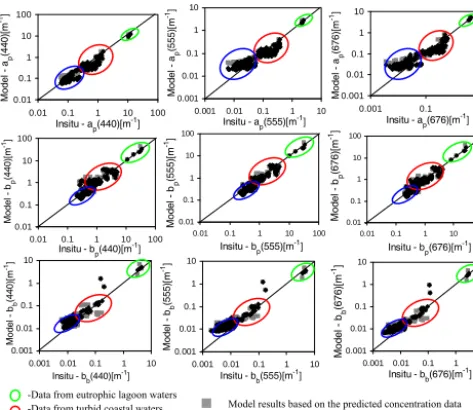
(top row), the model provides good estimates of particulate absorption ap across the entire visible wavelengths (MRE −0.06–0.0774), although there is a slight overestimation (at higher wavelengths) especially in low-Chl waters. The pre-dictedapvalues are also well consistent with in situapdata. Figure 8 (second row) presents the comparison of modelled and measured particulate scatteringbpvalues (at 0.440, 0.555 and 0.676 µm). Interestingly, the model performs well in dif-ferent waters with a wide range of chlorophyll concentra-tions. The MRE values associated with this model are very low (0.1169 at 0.440 µm, 0.5816 at 0.555 µm, and 0.2316 at 0.676 µm). Similarly, bp predicted by the model has low MRE values (−0.1473 at 0.440 µm, 0.3152 at 0.555 µm and 0.0726 at 0.676 µm). Comparison of the modelled backscat-tering (bb)with in situbbdata (at 0.440, 0.555 and 0.676 µm as shown in third row of Fig. 8) shows that the model works slightly better in relatively clear, turbid and eutrophic wa-ters but slightly overestimatesbbvalues in clear waters. This problem could be attributed to measurement errors in very clear waters. The MRE values are −0.0735 at 0.440 µm, −0.1309 at 0.555 µm and −0.0876 at 0.676 µm for the es-timated bb using in situ Chl and SS data and −0.0604 at 0.440 µm,−0.1194 at 0.555 µm and−0.0763 at 0.676 µm for the predictedbbusing estimated Chl and SS data.
4000 500 600 700
1 2 3
4000 500 600 700
20 40 60 80
4000 500 600 700
10 20 30 40
4000 500 600 700
5 10 15
4000 500 600 700
0.5 1
4000 500 600 700
1 2 3
4000 500 600 700
0.2 0.4 0.6 0.8
4000 500 600 700
0.05 0.1 0.15 0.2 Just below the surface
Near to the sea bed
Wavelength (x10-3m)
Ed
(m
W
/cm
2/
m) Eu (m W /c m
2/
m)
Direct term Diffuse term Direct and Diffuse
a1 b1 a2 b2 a3 b3 a4 b4
Figure 9. Spectral representation of the direct and diffuse terms of
the underwater light fields for four discrete depths (a1–a4 forEd
and b1–b4 forEu)in moderately turbid waters off Point Calimere.
The red colour represents the direct term, the green colour indicates the diffuse term and the black colour represents the contribution of both direct and diffuse terms in the underwater light fields.
4.2 Spectral and depth variations of diffuse and direct terms
This section examines the spectral and depth variations of diffuse and direct terms of the underwater light fields for moderately turbid waters off Point Calimere. As shown in Fig. 9, the magnitude of the direct term (red) is high when compared to the diffuse term (green), especially in the upper and middle layers of the water column. However, as the light propagates through the air–water interface, the contribution of direct term makes a significant change in the downwelling irradiance at consequent depths. The contribution of the dif-fuse component is less since it is mainly influenced by the water column. Note that the direct and diffuse terms have a large variation in the blue-green region. Thus, considering either one of these terms in RT models is not appropriate in shallow/coastal waters and may lead to large errors along the depth (see Fig. 9a1–a4). To arrive at an approximate solution, the present study considers that both the terms weigh equally. Results of the combined effect of these terms are shown in Fig. 9a1–a4. The diffuse and direct terms are not significantly affected in upwelling irradiance (Fig. 9b1–b4) as compared to those observed in downwelling irradiance. Slight variation is noticed in the direct and diffuse terms of upwelling irradi-ance at near-surface depths due to the effect of downwelling irradiance. As the depth increases, both these terms generate the spectrum with almost the same magnitude of upwelling irradiance. Results of the combined effect of these two terms on underwater light fields are validated with in situ data and further discussed in the subsequent section.
4.3 Underwater light-field parameters
4000 500 600 700 0.05
0.1 0.15 0.2
4000 500 600 700 0.5
1 1.5
400 500 600 700 0
0.2 0.4 0.6 0.8
400 500 600 700 0
0.5 1 1.5
400 500 600 700 0 5 10 15 cp [m -1] cp [m -1] cp [m -1] cp [m -1] cp [m -1]
400 500 600 700 0
0.2 0.4 0.6 0.8
400 500 600 700 0
0.5 1 1.5 2
4000 500 600 700 2
4 6 8
4000 500 600 700 1
2 3 4
400 500 600 700 0 20 40 60 bb [m -1] bb [m -1] bb [m -1] bb [m -1] bb [m -1]
4000 500 600 700 0.005
0.01 0.015 0.02
4000 500 600 700 0.005
0.01 0.015 0.02
4000 500 600 700 0.05
0.1 0.15 0.2
4000 500 600 700 0.02
0.04 0.06
4000 500 600 700 2
4 6
Wavelength (x10-3m) Wavelength (x10-3m) Wavelength (x10-3m)
(a)
(b)
(c)
(d)
(e)
Figure 10. Spectral plots of the in situ IOPs (particulate absorption
ap, particulate attenuation cp, and particulate backscattering bb)
from different waters. (a) Relatively clear waters off Chennai (St-1), (b) moderately turbid waters off Point Calimere (St-5), (c) turbid waters off Point Calimere (St-4), (d) phytoplankton-dominated har-bour waters off Chennai (St-7) and (e) Eutrophic waters off Chennai (St-8–11).
and predicted IOP profile data are evaluated by compar-ison with measured underwater radiometric data such as downwelling irradianceEd(λ,z), upwelling irradianceEu(λ,
z) and upwelling radiance Lu(λ, z). The predicted (from remote-sensing reflectance data) in situ IOP profile data were used as inputs for the present RT model. The IOP data mea-sured from different waters (Fig. 10) include the particulate absorption (ap), particulate attenuation (cp) and backscatter-ing (bb).
4.3.1 Clear ocean waters
Figure 11 shows the comparisons of simulated and measured underwater light fields (Ed,EuandLu) for four discrete wa-ter depths in relatively clear wawa-ters off Chennai. Looking at the Ed spectra (orange colour – present RT model using in situ IOP data and blue colour – present RT model using Pred IOP data from remote-sensing reflectance), the max-imum value is seen at 0.490 µm throughout the water col-umn. As the depth increases, Ed becomes attenuated in the blue region (0.400–0.500 µm) but progressively more atten-uated in the red region (>0.600 µm). TheEd values from
400 500 600 700
0 50 100 150
400 500 600 700
0 50 100
400 500 600 700
0 50 100
400 500 600 700
0 20 40 60 80
4000 500 600 700
2 4 6
4000 500 600 700
2 4 6
4000 500 600 700
1 2 3 4
4000 500 600 700
1 2 3 4
4000 500 600 700
0.5 1 1.5
4000 500 600 700
0.5 1 1.5
4000 500 600 700
0.2 0.4 0.6 0.8
4000 500 600 700
0.2 0.4 0.6 0.8 Eu (m W /c m
2/
m)
Lu
(mW
/c
m
2/
m/s r) Ed (m W /cm
2/
m) Just below Sea surface Just above Sea bed In-situ data RTE In-situ IOP RTE Pred IOP
z = 2 m
z = 6 m
z = 10 m
z = 14 m
Wavelength (x10-3m) Wavelength (x10-3m) Wavelength (x10-3m)
Figure 11. Spectral comparisons of the simulated and measured
underwater light fields (Ed, Eu and Lu)for four discrete depths
in clear waters off Chennai (St-1). The black colour represents the measured data, orange colour represents results from the present RT model using in situ IOP data and the blue colour represents re-sults from the present RT model using the predicted IOPs from the remote-sensing reflectance data.
the present RT model using the in situ and predicted IOP data are closely consistent with measuredEdacross the en-tire visible wavelengths. The simulatedEd yields very low MRE (at 0.555 µm), 0.03 and −0.01 for the present RT model using in situ IOP data and predicted IOP data, re-spectively. Conversely, the spectral pattern ofEu is differ-ent from that ofEd(second column) displaying two peaks – one at 0.490 µm (primary) and another at 0.520 µm (sec-ondary). TheEufrom the present RT model using the in situ IOP data closely matches with measuredEu at most wave-lengths, except in the region of secondary peak at 0.520 µm. The MRE (at 0.555 µm) is very low (−0.3) for the present model using the predicted IOP data. Similar peaks – primary peak around 0.500 µm and secondary peak around 0.550 µm – are also seen in theLu spectrum. As the depth increases the secondary peak becomes more pronounced due to an in-crease in turbidity level. The deviation inLu is very small for the present RT model as its predictedLuspectra are well consistent with the measuredLuspectra, because of the in-clusion of the effective bottom reflectance instead of the ma-terial reflectance.
4.3.2 Moderately turbid waters
400 500 600 700 0
0.02 0.04 0.06
400 500 600 700
0 0.05 0.1
400 500 600 700
0 0.05 0.1 0.15 0.2
4000 500 600 700
0.1 0.2 0.3 0.4
400 500 600 700
0 0.1 0.2 0.3 0.4
400 500 600 700
0 0.2 0.4 0.6 0.8
400 500 600 700
0 0.2 0.4 0.6 0.8
400 500 600 700
0 1 2 3
4000 500 600 700
20 40 60 80
4000 500 600 700
10 20 30
4000 500 600 700
5 10 15
4000 500 600 700
1 2 3 Eu (m W /c m 2/ m) Lu (mW /c m
2/
m/s r) Ed (m W /cm
2/
m) Just below Sea surface Just above Sea bed In-situ data RTE In-situ IOP RTE Pred IOP
z = 3 m
z = 5 m
z = 7 m
z = 12 m
Wavelength (x10-3m) Wavelength (x10-3m) Wavelength (x10-3m)
Figure 12. Spectral comparisons of the simulated and measured
underwater light fields (Ed,Eu andLu)for four discrete depths
in moderately turbid waters off Point Calimere (St-5). The black colour represents the measured data, orange colour represents re-sults from the present RT model using in situ IOP data, and the blue colour represents results from the present RT model using the pre-dicted IOPs from the remote-sensing reflectance data.
the surface chlorophyll 6.2 mg m−3 and maximum chloro-phyll 18.5 mg m−3at 7 m. The range of suspended sediments varied from 10.9 to 15.3 g m−3. The solar zenith angle mea-sured was 44.9◦. Thus, the spectral pattern of E
d (first col-umn) just below the surface resembles that of clear waters. As the depth increases, the pattern changes following the tur-bid water case with a major peak at 0.555 µm. TheEdspectra simulated from the present RT model using in situ IOP data have fairly good agreement with the measuredEd. Since the predicted IOPs are low at the surface, the magnitude of the predictedEdis relatively high when compared to the mea-sured and simulatedEd. The spectral pattern ofEu(second column) is slightly different for these waters as the primar-ily peak is located around 0.555 µm and a secondary peak around 0.685 µm due to the chlorophyll fluorescence. Simi-lar features are also observed in the Lu spectra. The shape and magnitude of theEuandLufrom the present RT model based on the in situ IOP data agrees well with measured data (with MRE values 0.1 and 0.04, respectively). By contrast, theEuandLuspectra generated from the present RT model using the predicted IOP data are improved although showing a slight overestimation in the green domain.
4.3.3 Turbid coastal waters
Figure 13 shows the spectral comparisons of simulated and measured underwater light fields (Ed,Eu andLu)for four discrete depths in turbid coastal waters off Point Calimere during August 2013. This station is in the vicinity of the coast with a depth of 6.3 m, where the in situ measurements of
ap-4000 500 600 700
5 10
15400 500 600 700
0 10 20
30400 500 600 700
0 20 40
60400 500 600 700
0 20 40 60 80
4000 500 600 700
0.5 1 1.5 2
4000 500 600 700
2 4 6 8
4000 500 600 700
2 4 6
4000 500 600 700
1 2 3
4000 500 600 700
0.2 0.4 0.6 0.8
4000 500 600 700
0.2 0.4 0.6 0.8
4000 500 600 700
0.5 1
4000 500 600 700
0.5 1 1.5 Eu (m W /c m
2/
m)
Lu
(mW
/c
m
2/
m/s r) Ed (m W /cm
2/
m) Just below Sea surface Just above Sea bed In-situ data RTE In-situ IOP RTE Pred IOP
z = 2 m
z = 3 m
z = 4 m
z = 5 m
Wavelength (x10-3m) Wavelength (x10-3m)
Wavelength (x10-3m)
Figure 13. Spectral comparisons of the simulated and measured
un-derwater light fields (Ed,Euand Lu)for four discrete depths in
turbid coastal waters off Point Calimere (St-4). The black colour represents the measured data, orange colour represents results from the present RT model using in situ IOP data, and the blue colour represents results from the present RT model using the predicted IOPs from the remote-sensing reflectance data.
parent optical properties (AOPs), IOPs and other parameters were made when the solar zenith angle was 4.55◦. At this station, the benthic resuspension and sediment transport no-ticeably increased the magnitude of the IOPs and turbidity. The measuredEdspectra (first column) show the maximum values at green wavelengths (0.555 µm) and minimum values at blue and red wavelengths throughout the water column, which are the characteristic features of turbid waters. Note that the magnitude ofEdspectra from the present model us-ing the in situ and predicted IOP data is closer to the mea-suredEdspectra, with low MRE values of 0.006 and 0.03, respectively. TheEuandLuspectra produced by the present RT model based on the in situ and predicted IOP data also match well with the measuredEuandLuspectra (with rela-tively low MRE values of−0.06 to 0.1 and−0.1 to−0.09, respectively). Better results associated with the present RT model are due to the modified boundary conditions and new phase function which varies along the depth.
Inter-4000 500 600 700 20
40 60 80
4000 500 600 700
10 20 30 40
4000 500 600 700
5 10 15 20
4000 500 600 700
2 4 6 8
400 500 600 700
0 0.5 1 1.5
400 500 600 700
0 0.5 1 1.5
400 500 600 700
0 0.2 0.4 0.6
400 500 600 700
0 0.2 0.4 0.6
4000 500 600 700
0.05
0.1400 500 600 700
0 0.05 0.1
4000 500 600 700
0.05 0.1 0.15
0.2400 500 600 700
0 0.05 0.1 0.15 0.2 Eu (m W /c m
2/
m)
Lu
(mW
/c
m
2/
m/s r) Ed (m W /cm
2/
m) Just below Sea surface Just above Sea bed In-situ data RTE In-situ IOP RTE Pred IOP
z = 1 m
z = 2 m
z = 3 m
z = 4 m
Wavelength (x10-3m) Wavelength (x10-3m)
Wavelength (x10-3m)
Figure 14. Spectral comparisons of the simulated and measured
un-derwater light fields (Ed,Euand Lu)for four discrete depths in
phytoplankton-dominated harbour waters off Chennai (St-7). The black colour represents the measured data, orange colour represents results from the present RT model using in situ IOP data, and the blue colour represents results from the present RT model using the predicted IOPs from the remote-sensing reflectance data.
estingly, theEd,EuandLuspectra of the present RT model from the in situ IOP data are well consistent with measured data across the entire visible wavelengths. As a result, its MRE values are reduced to 0.04 forEd, 0.029 forEuandLu. Slight deviations are observed in theEd,EuandLuspectra generated by the present RT model, which could be attributed to errors associated with the predicted IOPs and the assump-tion of the vertically homogenous water column (i.e., con-stant IOPs along the depth). This would eventually increase the MRE values to 0.3 forEd, 0.2 forEuand 0.26 forLu. 4.3.5 Eutrophic waters
The performance of the RT models is also examined in highly complex eutrophic waters, which exhibit much higher mag-nitudes in IOP spectra compared to other waters (Fig. 10). Figure 15 provides the spectral comparisons of simulated and measured underwater light fields from four different dis-crete stations (profile data not collected due to shallow water body). At these stations, both Chl and SS reached beyond 73 and 71 g m−3, respectively (in addition to high CDOM) ultimately reducing the magnitude ofEd(more at station St-11) in the blue wavelength region and shifting the position of the red peak towards 0.715 µm (by the combined effect of fluorescence and backscattering by the phytoplankton cells). Thus, the RT models failed to generate the measuredEdin the blue wavelength region although their results are reason-ably good in the green and red regions. The mean MRE val-ues (forEdat 0.555 µm) are 0.003 and 0.016 for the present RT model using the predicted IOPs and in situ IOPs,
respec-4000 500 600 700
20 40 60 80
4000 500 600 700
20 40 60
4000 500 600 700
20 40 60
4000 500 600 700
20 40 60 80
4000 500 600 700
5 10 15
4000 500 600 700
2 4 6
4000 500 600 700
2 4 6
4000 500 600 700
2 4 6
4000 500 600 700
1 2 3
4000 500 600 700
0.2 0.4 0.6 0.8
4000 500 600 700
0.2 0.4 0.6 0.8
4000 500 600 700
0.2 0.4 0.6 0.8 Eu (m W /c m
2/
m)
Lu
(mW
/c
m
2/
m/s r) Ed (m W /cm
2/
m)
In-situ data RTE In-situ IOP RTE Pred IOP
St-8
St-9
St-10
St-11 z = 0.1 m
z = 0.1 m
z = 0.1 m z = 0.1 m
Wavelength (x10-3m) Wavelength (x10-3m) Wavelength (x10-3m)
Figure 15. Spectral comparisons of the simulated and measured
un-derwater light fields (Ed,EuandLu)just below the surface in
eu-trophic waters off Chennai (St-8–11). The black colour represents the measured data, orange colour represents results from the present RT model using in situ IOP data, and the blue colour represents re-sults from the present RT model using the predicted IOPs from the remote-sensing reflectance data.
tively. Interestingly, the present RT model based on the pre-dicted and in situ IOP data gives accurateEuandLuin terms of magnitude and shape at all four stations. The shifted red peaks are also better captured by the present RT model due to the inclusion of the appropriate source function. The MRE values (at 0.555 µm) are 0.07 and−0.06 for theEuandLu (from the predicted IOP data) and 0.08 and−0.05 for theEu andLu(from the in situ IOP data). These results suggest that the present RT model can be used combined with remote-sensing data to simulate the underwater light fields in a wide variety of waters.

![Table 4. Empirical relationships of the chlorophyll profile parameters ([Chl][Chl]max, Zmax and σ) for the various ranges of surface chlorophyllsur from different stations.](https://thumb-us.123doks.com/thumbv2/123dok_us/58476.1506266/10.612.308.548.100.337/empirical-relationships-chlorophyll-prole-parameters-chlorophyllsur-different-stations.webp)