doi:10.5194/se-2-245-2011
© Author(s) 2011. CC Attribution 3.0 License.
An open ocean record of the Toarcian oceanic anoxic event
D. R. Gr¨ocke1, R. S. Hori2, J. Trabucho-Alexandre1, D. B. Kemp3, and L. Schwark4
1Department of Earth Sciences, Durham University, Science Laboratories, South Road, Durham, DH1 3LE, UK 2Department of Earth Sciences, Faculty of Science, Ehime University, Matsuyama 790-8577, Japan
3Department of Earth Sciences, University of Cambridge, Downing Street, Cambridge, CB2 3EQ, UK
4Christian-Albrechts-University–Kiel, Institute for Geosciences, Ludewig-Meyn-Str. 10, 24118 Kiel, Germany Received: 4 April 2011 – Published in Solid Earth Discuss.: 7 April 2011
Revised: 6 October 2011 – Accepted: 12 October 2011 – Published: 11 November 2011
Abstract. Oceanic anoxic events were time intervals in the Mesozoic characterized by widespread distribution of marine organic matter-rich sediments (black shales) and significant perturbations in the global carbon cycle. These perturbations are globally recorded in sediments as carbon isotope excur-sions irrespective of lithology and depositional environment. During the early Toarcian, black shales were deposited on the epi- and pericontinental shelves of Pangaea, and these sedi-mentary rocks are associated with a pronounced (ca. 7 ‰) negative (organic) carbon isotope excursion (CIE) which is thought to be the result of a major perturbation in the global carbon cycle. For this reason, the lower Toarcian is thought to represent an oceanic anoxic event (the OAE). If the T-OAE was indeed a global event, an isotopic expression of this event should be found beyond the epi- and pericontinen-tal Pangaean localities. To address this issue, the carbon iso-tope composition of organic matter (δ13Corg)of lower Toar-cian organic matter-rich cherts from Japan, deposited in the open Panthalassa Ocean, was analysed. The results show the presence of a major (>6 ‰) negative excursion inδ13Corg that, based on radiolarian biostratigraphy, is a correlative of the lower Toarcian negative CIE known from Pangaean epi-and pericontinental strata. A smaller negative excursion in
δ13Corg(ca. 2 ‰) is recognized lower in the studied succes-sion. This excursion may, within the current biostratigraphic resolution, represent the excursion recorded in European epi-continental successions close to the Pliensbachian/Toarcian boundary. These results from the open ocean realm sug-gest, in conjunction with other previously published datasets, that these Early Jurassic carbon cycle perturbations affected the active global reservoirs of the exchangeable carbon cycle (deep marine, shallow marine, atmospheric).
Correspondence to: D. R. Gr¨ocke
1 Introduction
Over the past decade, there has been an increased effort to unravel the cause(s) and consequences of the early Toar-cian oceanic anoxic event (T-OAE). The presence of a pro-nounced, transient negative carbon isotope (δ13C) excursion is of diagnostic significance. The excursion has been recog-nized in marine inorganic and organic matter (Jenkyns and Clayton, 1986; Schouten et al., 2000; Kemp et al., 2005; Suan et al., 2008), and terrestrial plant material (Hesselbo et al., 2000, 2007). Associated with the T-OAE is concomi-tant evidence for: a threefold increase in atmospheric CO2 levels (McElwain et al., 2005), a rise in seawater palaeotem-peratures (Rosales et al., 2004; van de Schootbrugge et al., 2005), an increase in silicate weathering rates (Cohen et al., 2004; Waltham and Gr¨ocke, 2006) and a biotic crisis affect-ing marine invertebrates and biocalcifyaffect-ing microorganisms (Little and Benton, 1995; Mattioli et al., 2004; Tremolada et al., 2005).
Hesselbo et al. (2000) suggested that the cause of the neg-ative carbon isotope excursion concurrent with the T-OAE was the dissociation, release and consequent oxidation of methane derived from continental slope hydrates: subse-quently modelled by Beerling et al. (2002). More recently, a high-resolutionδ13Corgrecord across the T-OAE obtained from mudstones exposed in northeast England was generated by Kemp et al. (2005). These data suggest that the nega-tiveδ13C excursion was not a single event but three rapid events, the timing of which was interpreted as having been paced by astronomically forced climate/ocean cycles. An alternative hypothesis recently put forward for the cause of the T-OAE is that 12C-enriched thermogenic methane was released into the ocean-atmosphere system due to an igneous intrusion into coaly organic matter-rich facies in the Karoo Basin, South Africa (McElwain et al., 2005; Svensen et al., 2007). This mechanism has been questioned by Gr¨ocke et al. (2009), who showed that both the physical nature of the contacts between intrusions and organic matter-rich facies, and the geochemical pattern within these facies suggest little or no thermogenic methane generation in the Karoo Basin.
Localities where the negativeδ13C excursion that defines the T-OAE has been found are chiefly restricted to epicon-tinental sections in Europe. Moreover, the negative δ13C excursion is absent in data generated using belemnite cal-cite from NW Europe (van de Schootbrugge et al., 2005; Wignall et al., 2006; McArthur et al., 2008). The excur-sion is, however, present in bulk calcite; additionally, Suan et al. (2008) recently reproduced the negative δ13C excur-sion in brachiopod calcite across the T-OAE from a section in Peniche, Portugal. Nevertheless, the absence of a nega-tive excursion in belemnite calcite prompted speculation that the isotope perturbation affected only the shallow marine en-vironment (i.e.<200 m water depth) and that it was driven by local phenomena (van de Schootbrugge et al., 2005). Re-cently, however, Al-Suwaidi et al. (2010) documented evi-dence for the lower Toarcian negativeδ13C excursion from strata in the Neuqu´en Basin, Argentina. This record revealed the onset of the excursion, although the main excursion inter-val was not documented owing to the presence of an uncon-formity that truncates the succession. Caruthers et al. (2011) have also documented the lower Toarcian negativeδ13C ex-cursion from strata in the Queen Charlotte Islands, Canada, where the record is more complete. Although both records represent deposition in relatively shallow marine environ-ments, they demonstrate that the carbon isotope excursion (CIE) associated with the T-OAE is not only present in the Neotethyan realm.
In this study, the specific issue of the global extent of the lower Toarcian negativeδ13C excursion, as well as the physical expression of the T-OAE in the open ocean, are addressed by analysing a chert succession from Katsuyama, Japan (Fig. 1), which was located in the middle of the palaeo-Pacific (Panthalassic) Ocean during the Early Jurassic.
2 Geological setting
The studied samples were obtained from Katsuyama in the Inuyama area, Mino Terrane, which is one of the Mesozoic accretionary complexes presently exposed in Japan, extend-ing to the north of Tokyo (Ashio Terrane) and lithostrati-graphically corresponding to the Chichibu Terrane (Fig. 2). These Mesozoic complexes consist of seamount-related se-quences of volcanic rocks, limestones and pelagic sedi-ments (bedded chert and siliceous mudstone) associated with trench-fill sediments. The former sediments were deposited on the seafloor of the Izanagi Plate from Carboniferous to Early Cretaceous and were subsequently accreted to the mar-gin of Far East Asia during the Jurassic to Early Cretaceous (Matsuda and Isozaki, 1991).
The sedimentary succession in the Inuyama area mainly consists of bedded cherts spanning the Early Triassic– Early/Middle Jurassic, which have been well constrained us-ing conodont and radiolarian biostratigraphy (e.g., Yao et al., 1982; Hori, 1990, 1993; Matsuoka, 2004). The sedi-mentary complex of this area was formed by accretionary processes at shallow depths (Kimura and Hori, 1993), and underwent low-grade metamorphism (diagenetic zone of il-lite crystallinity index; Otsuka and Watanabe, 1992). There-fore, it is considered that the cherts retain a primary record of the Late Triassic and Early Jurassic depositional environ-ments. The studied pelagic sediments in the Inuyama area are typical distal, open ocean sediments characterized by sed-imentation rates of 1 m to 7 m Myr−1 and long sequences (>50 Myr) (Hori et al., 1993; Wignall et al., 2010). Al-though such sediments are generally considered analogous to present-day deep-sea radiolarian ooze (>3 km water depth), similar Meso-Cenozoic sequences were interpreted as having been deposited at much shallower water depths (e.g. Iijima et al., 1979; Wilson et al., 1998; Jenkyns and Wilson, 1999; Robinson et al., 2004).
Palaeomagnetic studies reveal that the studied cherts of the Inuyama area were deposited at low Southern Hemisphere latitudes during the Middle Triassic and migrated to the Northern Hemisphere during the Late Triassic–Early Jurassic (Shibuya and Samejima, 1986; Ando et al., 2001), crossing the equatorial regions of the palaeo-Pacific (Fujii et al., 1993; Ando et al., 2001).
2.1 Biostratigraphy of the Katsuyama section
Toarcian Palaeogeography ~183 Ma Karoo-Ferrar
LIP
Japan
FIGURE 1 (two columns)
Fig. 1. Palaeogeographic map of the Early Jurassic showing the distribution of organic matter-rich facies (filled circles) dated as early
Toarcian (modified from Jenkyns et al., 2002). The star indicates the approximate palaeogeographic location of Japan during the deposition of the Toarcian succession. The large circle represents the location of the Karoo-Ferrar large igneous province.
136˚E
138˚E
140˚E
38˚N
36˚N
34˚N
134˚E 132˚E
130˚E
Ashio Terrane Mino Terrane Chichibu Terrane
PACIFIC OCEAN
SEA OF JAPAN
TOKYO
Inuyama
Median
Tectonic Line
FIGURE 2 (two columns)
Fig. 2. Geographic map of Japan showing the three accretionary complexes presently exposed – Ashio Terrane, Mino Terrane and Chichibu
Terrane – and the position of the Inuyama area.
Parahsuum simplum Subzones I to IV, and the Mesosatur-nalis hexagonus (=HexasaturMesosatur-nalis hexagonus) Zone (in
as-cending order) (Hori, 1990, 1997). The samples for the present isotope study were obtained from the interval span-ning the upper part of the P. simplum IV (Ps IV) Subzone to the lower part of the H. hexagonus (Hh) Zone, which comprises a ca. 340 cm-thick sequence of bedded chert. On the basis of a 1 m Myr−1 sedimentation rate for the Lower Jurassic cherts of the Inuyama area (Hori et al., 1993), the
studied interval is calculated to have lasted a maximum of ca. 3.5 Myr (Fig. 4). This equates to the radiolarian zones in Carter et al. (2010) of Eucyrtidiellum nagaiae –
Praepar-vicingula tlellensis to Elodium pessagnoi – H. hexagonus
(Fig. 4). The radiolarian zones were constrained by am-monite data from Queen Charlotte Islands, Canada and other areas from North America (Carter et al., 2010). According to their radiolarian zonation, and considering the presence of
A
C
B
D
FIGURE 3 (two columns)
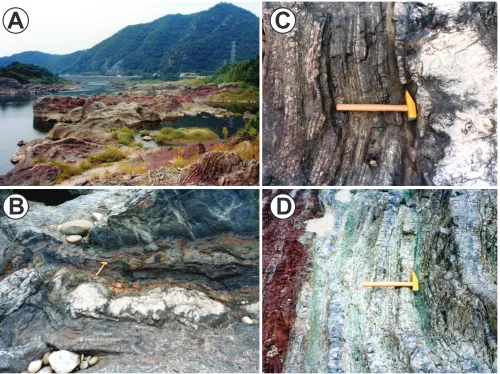
Fig. 3. (A) Katsuyama section on the Kiso River, Inuyama, Japan. (B) View of the Pliensbachian–Toarcian interval showing the organic
matter-rich cherts beneath the continuous white bedded-chert horizon. (C) Close-up from photograph B of the T-OAE organic matter-rich cherts above the white bedded-chert horizon. (D) Upper interval of the Toarcian section showing the change between red-grey and green and red-green bedded cherts: the Toarcian Radiolarian Event occurs between the contact of the green to red-green bedded cherts. Note: hammer in photographs is approximately 30 cm in length and the head of the hammer is in the direction of the base of the stratigraphic section (see Fig. 4 for stratigraphic positions).
zone (ca. 100 cm level in Fig. 4) is equivalent to the H. fal-ciferum/Hildoceras bifrons ammonite Zone boundary of NW
Europe. However, this tie-point in the biostratigraphic frame-work is based on the presence of a single species (H.
ex-iguum). The other two species at ca. 100 cm level are
Parahsuum longiconicum and P. simplum, which have
lit-tle stratigraphic significance because they have long age ranges. Therefore, we provide two possible biostratigraphic schemes: Carter et al. (2010) and Carter et al. (2010 sensu Hori, 2011, unpublished) (Fig. 4). Hereafter, we use the bios-tratigraphic scheme of Carter et al. (2010) as shown in Fig. 3. A distinct change in lithology is observed within the upper part of the Lower Jurassic succession (Fig. 3b, c; 240–250 cm). This interval is further characterized by a
remarkable faunal change at the E. pessagnoi – H. hexagonus Zone, termed the Toarcian Radiolarian Event (Hori, 1997). Prior to the Toarcian Radiolarian Event, organic matter-rich black chert beds occur in two distinct intervals (ca. 40–90 cm and ca. 180–210 cm: Napora relica – Eucyrtidiellum
dispar-ile Zone, Fig. 4) that are separated by a massive white chert
0.41
-0.41 0 0.83
-0.83 1.24 1.65 2.07 2.48
Grey chert
Black chert
Black-white chert White chert
Black-grey chert Red-grey chert Red chert
Height (cm)
Photo B Photo
C Photo
D Estimated
Duration (Myr)
Litho-stratigraphy
Red-green chert
Green chert Green-grey chert
0 20
-20
-40
-60 40 60 80 100 120 140 160 180 200 220 240 260 280 300 320 340
Parahsuum ovare
Parahsuum simplum
Parahsuum vizcanioense
Parahsuum longiconicum
Hsuum exiguum
Hsuum busuangaense
Hsuum altile
Hsuum philippinense
Hexasaturnalis hexagonus
Parvicingula nanoconica
Elodium pessagnoi
Radiolarian taxa
Hori (1990)
P. sim. IV
H. hexagonus
T
o
arc
ia
n
Pliens.
(part)
?
?
?
Eucyrtidiellum nagaiae
Carter et al. (2010)
E. pessagnoi - H. hexagonus
Napora relica - Eucyrtidiellum disparile
E. nagaiae Prae.tlellensis upper
middle - upper
lower
T
o
arc
ia
n
Pliens.
(part)
Carter et al. (2010: sensu Hori, 2011)
E. pessagnoi - H. hexagonus
Napora relica
Eucyrtidiellum disparile
E. nagaiae Prae.tlellensis upper
middle - upper
lower
FIGURE 4 (two columns)
Fig. 4. Detailed lithostratigraphic log and biostratigraphy of the Katsuyama section, Inuyama, Japan. The stratigraphic positions of the
photographs depicted in Fig. 3 are indicated beside the section. Radiolarian biostratigraphy is from Hori (1997) and modified according to Carter et al. (2010). There are two possible biostratigraphic zonation schemes used here: Carter et al. (2010) and Carter et al. (2010 sensu Hori, 2011, unpublished). See text for discussion. The major difference between these two zonations is based on the presence of only one
species (Hsuum exiguum) to define to the middle Toarcian. On the basis of a 1 m Myr−1sedimentation rate for the Lower Jurassic chert
succession at Inuyama, the studied interval is calculated to be ca. 3.5 Myr in duration (see Hori et al., 1993).
ambiguous. The log presented by Wignall et al. (2010; their figure 7) shows a studied interval spanning 90 cm, whereas 340 cm were studied here (Fig. 4). Wignall et al. (2010) do not present biostratigraphic data in their study; however, it appears that their studied interval roughly corresponds to the interval between 20–120 cm (Fig. 4; Wignall, 2011; personal communication).
3 Analytical methodology
0 20 40 60 80 0.41
0 0.83 1.24 1.65 2.07 2.48
100 120 140 160 180 200 220 240 260 280 300 320 340
Height (cm) Estimated
Duration
(Myr) stratigraphyLitho- -34 -32 -30 -28 -26 -24 -22 -20
-32
-34 -30 -28 -26 -24 -22 -20
δ
13C
org
(‰ VPDB)
Total Organic Carbon (wt %)
0.1 1 10
0.01
0.1 1 10
0.01
Toarcian Radiolarian Event
FIGURE 5 (two columns)
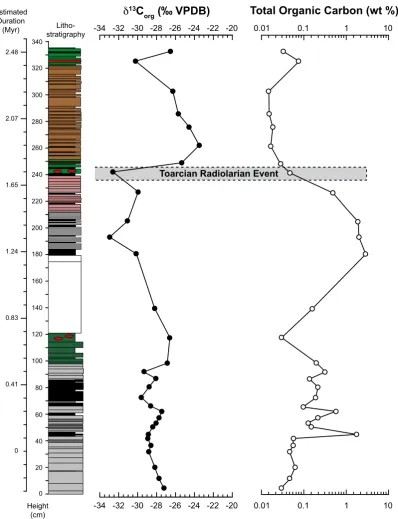
Fig. 5. Organic carbon isotope record (δ13Corg)of the Katsuyama section, Inuyama, Japan. Total organic carbon (TOC) as weight percent (wt %) was determined during stable isotope measurements. Note that the scale for TOC is logarithmic. The chert sample at ca. 212 cm has
aδ13Corgvalue of−57 ‰: whilst this value has been replicated, it is possible that this particular sample is somehow contaminated. The
Toarcian Radiolarian Event is also depicted at ca. 240 cm. See Fig. 3 for lithostratigraphic and biostratigraphic details.
reported in standard delta (δ)notation in per mil (‰) rel-ative to VPDB. Data accuracy is monitored through rou-tine analyses of international and in-house standards: the latter are stringently calibrated against the international
Table 1. Isotope and total organic carbon (TOC) results from the
Katsuyama section, Inuyama, Japan.
Sample ID Height (cm) δ13Corg TOC (wt %)
INTO-32 333 −26.58 0.03
INTO-31 325 −30.22 0.07
INTO-30 304 −26.36 0.01
INTO-29 286 −25.77 0.01
INTO-28 277 −24.60 0.02
INTO-27 262 −23.55 0.02
INTO-26 249 −25.39 0.03
INTO-25 242 −32.60 0.05
INTO-24 227 −29.95 0.48
INTO-23 212 −57.93 1.41
INTO-22 205 −31.07 1.93
INTO-21 193 −32.91 1.93
INTO-20 180 −30.17 2.75
INTO-19 140 −28.24 0.16
INTO-18 118 −26.64 0.03
INTO-17 99 −26.92 0.20
INTO-16 92 −29.37 0.31
INTO-15 87 −28.09 0.14
INTO-14 80 −28.83 0.22
INTO-13 73 −29.65 0.19
INTO-12 66 −28.62 0.09
INTO-11 62 −27.43 0.57
INTO-10 58 −27.79 0.21
INTO-9 53 −28.14 0.13
INTO-8 50 −28.36 0.16
INTO-7 45 −28.87 1.77
INTO-6 42 −29.00 0.06
INTO-5 36 −28.63 0.06
INTO-4 32 −28.86 0.05
INTO-3 20 −28.18 0.07
INTO-2 12 −27.81 0.05
INTO-1 5 −27.29 0.03
TOC contents of the studied chert samples, the tin capsules used contained up to 100–120 mg of powdered chert, and the Costech was set to Macro-O2in order to deliver more oxygen and make certain that complete combustion of the silicate occurred to liberate all organic carbon. The isotope analy-ses were done in “no dilution mode” so that the maximum amount of CO2 gas is delivered to the source of the mass spectrometer and all results produced more than 1000 mV.
4 Results and discussion
4.1 Correlation of the Pliensbachian–lower Toarcian δ13C curve
At Katsuyama, theδ13Corgrecord reveals two negative shifts – the first between ca. 60 cm to ca. 100 cm and the sec-ond between ca. 180 cm to ca. 240 cm (Fig. 5; Table 1).
The excursion between ca. 60 cm and ca. 100 cm involves a change in δ13Corg of ca. 2 ‰, whereas the excursion from ca. 180 cm to ca. 240 cm represents a more pro-nounced perturbation with values shifting from ca.−30 ‰ to−33 ‰. Within this negativeδ13Corg excursion one sam-ple (at ca. 212 cm) records aδ13Corgvalue of−57 ‰. Whilst this value has been replicated, it is possible that this partic-ular sample is somehow contaminated. For this reason, it is not included in Fig. 5 or discussed hereafter. At ca. 250 cm, coinciding with the Toarcian Radiolarian Event,δ13Corg val-ues markedly increase from ca.−33 ‰ to ca.−25 ‰. This increase to less negative values, a positive excursion, is also coincident with a return to lower TOC values (Fig. 5; Ta-ble 1).
Coupling of the age constraints of the Katsuyama succes-sion (Fig. 4) toδ13Corgvariations shows that the negative CIE occurring between ca. 180 cm and ca. 250 cm height in the succession (Fig. 5) is the lower Toarcian negative CIE. The Katsuyama succession can be correlated with lower Toar-cian successions in Europe using radiolarian biostratigraphy in combination with the carbon isotope record from various sites (Fig. 6).
Hawsker Bottoms, UK Mochras FarmBorehole, UK
Katsuyama, Japan
Peniche, Portugal
exaratum
falciferum
falciferum
tenuicostatum
T
OARCIAN
Zone
Stage Subzone
exarat.
falcif.
falciferum
tenucos.
spinatum
PLIEN.
spinatum
PLIEN.
T
OARCIAN
bifrons
variabilis
Zone
Stage Subzone δ13C
org ‰ (VPDB)
-30
-32 -28 -26 -24
δ13C
org ‰ (VPDB)
-30
-32 -28 -26 -24
δ13C
carb ‰ (VPDB)
-3
-4 -2 -1 0 1 2 3 4 5
-32 -30 -28 -26 -24 -22 -20 ?
? δ13C
org ‰ (VPDB)
FIGURE 6 (two columns or landscape)
Fig. 6. Comparison ofδ13C profiles for the Plienbachian–Toarcian time interval. Bulk-sediment data are compiled from Whitby (dataset is from both Port Mulgrave and Hawsker Bottoms) (Kemp et al., 2005; Littler et al., 2009), Katsuyama (this study), Peniche (Hesselbo
et al., 2007) and Mochras Farm Borehole (Jenkyns et al., 2001). Theδ13C profiles have been correlated using the negative excursion
at the Pliensbachian/Toarcian boundary, positive values in the lower Toarcian, the negative values in the T-OAE, the subsequent positive excursion after the T-OAE, and finally the negative trend in the bifrons ammonite Zone between Mochras Farm Borehole and Katsuyama. Note that Peniche is the only carbonate carbon isotope record. This chemostratigraphic correlation of Toarcian successions suggests that the biostratigraphic scheme using Carter et al. (2010) is more relevant when not considering the presence of H. exiguum at ca. 100 cm (sensu Hori, 2011) and the lack of other key species indicative of the middle Toarcian.
in determining whether and when sediments at a particular location become enriched in organic matter.
Using the timescale adopted by Hori et al. (1993), the duration of the negative excursion across the Pliens-bachian/Toarcian can be calculated at ca. 290 kyr, with the T-OAE covering a period of ca. 535 kyr. The latter value is somewhat similar to the recent estimate by Suan et al. (2008), who assigned a value of 600 kyr for the duration of the T-OAE negative excursion in the Lusitanian Basin. Suan et al. (2008) further suggested that the entire excursion (nega-tive and posi(nega-tive excursion) lasted 900 kyr. If the end of the T-OAE excursion at Katsuyama is taken to occur between ca. 300–325 cm (Fig. 5), then a duration of ca. 1 Myr is esti-mated.
4.2 The Katsuyama T-OAE record: global carbon cycle signals and local oceanographic processes
PX IZ FA
FA—Farallon Plate Siliceous ooze Oxypelite Carbonate ooze IZ—Izanagi Plate
PX—Phoenix Plate
Equa
tor
aeolian dust
CCD
inc
reasing depth
increasing age of crustplate motion
O2 min
Legend
FIGURE 7 (two columns or landscape)
Fig. 7. (A) Present-day map of the Pacific region with Early Jurassic plate tectonic elements. The red dashed line shows the position of the
cross-sections shown in panels B and C. Movement of tectonic plates indicated by arrows. The equatorial divergence zone is shown in grey. Base map modified from Robinson et al. (2004) and plate tectonic elements from M¨uller et al. (2008). (B) Schematic cross-section across the Early Jurassic Panthalassa showing the abyssal seafloor hypothesis for the formation of organic matter-rich chert. Izanagi Plate on the left. CCD stands for calcite compensation depth. The dotted pattern represents particulate matter. (C) Schematic cross-section across the Early Jurassic Panthalassa showing the mesopelagic/upper bathyal seamount hypothesis for the formation of organic matter-rich chert. The seamount is transported by seafloor spreading from right to left in the figure, i.e. towards the northwest in panel A.
The T-OAE is therefore defined (and the sediments deposited during the T-OAE associated with) by a negative excursion in the carbon isotope record that is recorded globally regard-less of facies (Fig. 1). In the open ocean Katsuyama succes-sion, the T-OAE interval is characterized by dysoxic, organic matter-rich biosiliceous facies, with periodic anoxia and eu-xinia intervening (Wignall et al., 2010).
The presence of abundant radiolarian tests, which are the precursory sediments for chert, in ooze is mainly limited to zones of high primary productivity. Moreover, higher pro-ductivity beyond a critical threshold results in higher propor-tions of biosiliceous surface production reaching the seafloor (Dewever et al., 1994). After death, the mineral skeletons are exposed to seawater, and dissolution is more pronounced in surface seawater. Indeed, contrary to general intuition, bio-genic silica dissolution in the water column is greatest within the uppermost 500 m due to elevated temperature (e.g. Sei-bold and Berger, 1996). Due to these productivity and preser-vation requirements this would indicate that the sedimen-tary rocks at Katsuyama were probably deposited within the equatorial divergence zone at water depths in excess of 500 m (Fig. 7a).
In the Katsuyama succession, TOC contents range be-tween 0.01–2.75 %. Two marked increases in TOC occur
at ca. 45–100 cm and ca. 180–210 cm, where the colour of the cherts changes from grey to black (Fig. 5). The pres-ence of organic matter-rich sediments in the Katsuyama sec-tion can be explained by two alternative hypotheses, which mainly differ from each other in terms of depositional wa-ter depth. The open ocean Katsuyama cherts may be inwa-ter- inter-preted as having been deposited on the abyssal seafloor of the Izanagi Plate (Fig. 7b), or as having been deposited on the mesopelagic to upper bathyal seafloor of a volcanic seamount (Fig. 7c). In either case, the seafloor, which was originally created in the Southern Hemisphere (Fujii et al., 1993; Ando et al., 2001), migrated north-westwards across the equator (Fujii et al., 1993; Ando et al., 2001) to its current position by seafloor spreading (cf. Wilson et al., 1998). This is con-sistent with the idea that the seafloor was covered by pelagic sediments during its journey and, within the equatorial diver-gence zone, biosiliceous black shales were deposited as part of the pelagic sequence.
of surface temperature and salinity, and stirring by wind and tides (e.g. Ledwell et al., 2000), promotes an effective ventilation of the water column; in combination with the longer settling times of particulate material from the euphotic zone to the seafloor, preservation of organic matter is very low. The seamount hypothesis is the most probable expla-nation since it accounts for the presence of organic matter-rich sedimentary rocks in the studied succession (Fig. 7c). The seafloor of a seamount would have been closer to the euphotic zone and would have perhaps protruded the upper bathyal oxygen minimum layer, which is formed in layers of minimal advection of oxygen. As a result, export paths for organic matter would have been reduced, and the preserva-tion of organic matter in the sediment favoured. No volcanics can be directly assigned to the chert succession as comprising the basement of the inferred seamount hypothesis. However, the volcanics may not have accreted.
The presence of black shales in open ocean settings needs not necessarily to represent a spread of anoxia in the oceans, but rather the passage of an ideal substrate for the preserva-tion of organic matter through a zone in the ocean charac-terized by enhanced primary productivity in surface waters. The model in the seamount hypothesis helps to reconcile the presence of black shales in open ocean settings with evidence for upwelling in the open marine environment, for enhanced ocean overturning and with high C/S ratios in pelagic set-tings during such events (Kajiwara et al., 1994; Suzuki et al., 1998; Trabucho-Alexandre et al., 2010), which cannot be easily explained by ocean anoxia and stable stratification.
The studied black shales are organic matter-rich radiolar-ian cherts and, therefore, attest to conditions of high produc-tivity in the euphotic zone and of low oxygen at the seafloor. Whereas low oxygen conditions are a characteristic feature of the global oxygen minimum layer in the ocean, high pro-ductivity within the equatorial divergence zone would have resulted in a higher export of organic matter towards the seafloor. Due to the palaeogeographic setting of the Kat-suyama section in the Early Jurassic, the T-OAE not only records the excursion in the carbon isotope record that is characteristic of this time interval from sections worldwide (Fig. 1) irrespective of setting (but cf. van de Schootbrugge et al., 2005), but it is also characterized by organic matter-rich open ocean lithologies. If this interpretation is correct, the enrichment in organic matter is largely accidental, i.e. if the Katsuyama section were not located within the equatorial di-vergence zone during the T-OAE, the lithological expression of this event (organic matter-rich cherts) would have been ab-sent. The presence of the carbon isotope excursion in these open ocean sedimentary rocks, however, proves univocally that the T-OAE represents a perturbation in the global carbon cycle.
4.3 Global forcing mechanisms behind the T-OAE CIE
The seemingly localized nature of the lower Toarcian neg-ative δ13C excursion, apparently confined to epicontinen-tal successions of the Neotethyan realm (Europe), prompted a number of workers to question whether a global mecha-nism is capable of explaining the lower Toarcian excursion (e.g. Wignall et al., 2006; McArthur et al., 2008). Moreover, the lack of a negativeδ13C excursion in the belemnite calcite record has been used by some authors to support the claim that isotopically light carbon did not dominate the ocean– atmosphere system during the T-OAE (van de Schootbrugge et al., 2005; Wignall et al., 2006). An alternative hypothe-sis for the event has been offered which invokes local over-turn of12C-enriched dissolved CO2 from deeper waters to the surface, where photoautotrophic uptake of this carbon would consequently lead to a regional negativeδ13C excur-sion (K¨uspert, 1982; R¨ohl et al., 2001; van de Schootbrugge et al., 2005; Wignall et al., 2006). This view is countered by evidence for a coeval negative CIE in terrestrial plant mate-rial (Hesselbo et al., 2000, 2007) and by the record presented in this study, outside of the Neotethyan realm (Europe) and in the open ocean. The overturn hypothesis was also ques-tioned by van Breugel et al. (2006) who analysed isorenier-atene abundances and δ13C across the record of the event in the Paris Basin (France) and concluded that respired CO2 could not have contributed significantly to the negative CIE. Indeed, in light of the data presented here, and those of the recent Al-Suwaidi et al. (2010) and Caruthers et al. (2011) studies from Argentina and Western Canada, respectively, the overturn scenario is improbable to have occurred syn-chronously at all these sites.
5 Conclusions
The palaeogeography of black shale depositional environ-ments during OAEs is a matter of discussion. All previously known examples of Toarcian black shales were deposited on epi- and pericontinental shelves in environments proximal to Pangaea. In this study, a truly pelagic, open ocean setting is documented. The Katsuyama black shales are here inter-preted as having been deposited on the seafloor of a volcanic seamount due to its passage under the highly productive wa-ters of the equatorial divergence zone of Panthalassa. The shorter export path for organic matter resulting from the pres-ence of a submarine topographical high, in association with the expansion of the oxygen minimum layer due to high oxy-gen demand, favoured the preservation of organic matter and led to biosiliceous black shale formation. Thus, it appears that the palaeogeographic distribution of black shales during the T-OAE is similar to that of other Mesozoic OAEs and to that of PETM black shales (cf. Thomas, 2007), i.e. mostly restricted to shelf environments.
The perturbation in the carbon cycle during the T-OAE was a global phenomenon that affected all active carbon reservoirs, which is recorded by a negative CIE in terres-trial and marine sediments (both shallow and deep ocean settings). Therefore, the forcing mechanism(s) behind the T-OAE must have been capable of driving global environ-mental change. These mechanisms may have included: the eruption of the Karoo-Ferrar continental flood basalts and/or the massive dissociation of continental margin clathrates with a resulting increased hydrological cycle and a transient greenhouse climate with increased CO2concentrations and palaeotemperatures. Apart from the T-OAE CIE, the Pliens-bachian/Toarcian CIE is also recorded in the Katsuyama cherts also suggesting it is global. These CIEs are important for understanding the Early Jurassic carbon cycle, as well as a tool for stratigraphic correlation between diverse palaeo-geographic realms.
Acknowledgements. The authors thank Michael Arthur, Hugh Jenkyns and Guillaume Suan for insightful and helpful comments
on this dataset. This project was funded by a JSPS Research
Fellowship, a NSERC Discovery Grant (# 288321) and NERC Standard Grant (NE/H020756/1) to DRG. JTA is funded by the NERC Standard Grant (NE/H020756/1) to DRG. DBK acknowl-edges receipt of a Girton College, Cambridge, Junior Research Fellowship. Joanne Peterkin provided assistance with the stable isotope measurements, and the facility was financially supported by TOTAL UK. The authors thank the editors, Poppe de Boer and Stuart Robinson, and the reviewers, Gerald Dickens, J´oszef P´alfy and Bas van de Schootbrugge, for their comments and suggestions that greatly improved the manuscript.
Special Issue: “Phanerozoic black shales and oceanic anoxic events: geochemistry, sedimentology and stratigraphy”
Edited by: J. Trabucho-Alexandre, P. L. de Boer, and D. R. Gr¨ocke
References
Al-Suwaidi, A. H., Angelozzi, G. N., Baudin, F., Damborenea, S. E., Hesselbo, S. P., Jenkyns, H. C., Mance˜nido, M. O., and Riccardi, A. C.: First record of the Early Toarcian Oceanic Anoxic Event from the Southern Hemisphere, Neuqu´en Basin, Argentina, J. Geol. Soc. London, 167, 1–4, 2010.
Ando, A., Kodama, K., and Kojima, S.: Low-latitude and Southern Hemisphere origin of Anisian (Triassic) bedded chert in the In-uyama area, Mino terrane, central Japan, J. Geophys. Res., 106, 1973–1986, 2001.
Beerling, D. J., Lomas, M. R., and Gr¨ocke, D. R.: On the nature of methane gas dissociation during the Toarcian and Aptian oceanic anoxic events, Am. J. Sci., 302, 28–49, 2002.
Bjerrum, C. J., Surlyk, F., Callomon, J. H., and Slingerland, R. L.: Numerical paleoceanographic study of the Early Jurassic transcontinental Lausarian seaway, Paleoceanography, 16, 390– 404, 2001.
Carter, E. S., Gori`ean, Guex, J., O’Dogherty, L., de Wever, P., Du-mitrica, P., Hori, R. S., Matsuoka, A., and Whalen, P. A.: Global radiolarian zonation for the Pliensbachian, Toarcian and Aale-nian, Palaeogeogr. Palaeocl., 297, 401–419, 2010.
Caruthers, A. H., Gr¨ocke, D. R., and Smith, P. L.: The signifi-cance of an Early Jurassic (Toarcian) carbon-isotope excursion in Haida Gwaii (Queen Charlotte Islands), British Columbia, Canada, Earth Planet. Sc. Lett., 307, 19–26, 2011.
Cohen, A. S., Coe, A. L., Harding, S. M., and Schwark, L.:
Os-mium isotope evidence for the regulation of atmospheric CO2by
continental weathering, Geology, 32, 157–160, 2004.
Cohen, A., Coe, A., and Kemp, D.: The Late Palaeocene Early Eocene and Toarcian (Early Jurassic) carbon isotope excursions: a comparison of their time scales, associated environmental changes, causes and consequences, J. Geol. Soc. Lond., 164, 1093–1108, 2007.
Dewever, P, Azema, J., and Fourcade, E.: Radiolarians and
radiolarites–primary production, diagenesis and palaeogeogra-phy, B. Cent. Rech. Expl., 18, 315–379, 1994.
Dickens, G. R.: Down the Rabbit Hole: toward appropriate dis-cussion of methane release from gas hydrate systems during the Paleocene-Eocene thermal maximum and other past hyperther-mal events, Clim. Past, 7, 831–846, doi:10.5194/cp-7-831-2011, 2011.
Fujii, J., Hattori, I., and Nakajima, T.: A study of radiolarian bios-tratigraphy and magnetosbios-tratigraphy of early Mesozoic red bed-ded chert, central Japan: News Osaka Micropaleontology, 9, 71– 89, 1993. (in Japanese with English translation).
Gr¨ocke, D. R., Rimmer, S. M., Yoksoulian, L. E., Cairncross, B., Tsikos, H., and van Hunen, J.: No evidence for thermogenic methane release in coal from the Karoo-Ferrar large igneous province, Earth Planet. Sc. Lett., 277, 204–212, 2009.
Hallam, A.: Sedimentology and palaeogeographic significance of certain red limestones and associated beds in the Lias of the Alpine region, Scot. J. Geol., 3, 195–220, 1967.
Hesselbo, S. P., Gr¨ocke, D. R., Jenkyns, H. C., Bjerrum, C., Farri-mond, P., Morgans Bell, H., and Green, O.: Massive dissociation of gas hydrate during a Jurassic oceanic anoxic event, Nature, 406, 392–395, 2000.
(Lusitanian Basin, Portugal), Earth Planet. Sc. Lett., 253, 455– 470, 2007.
Hori, R. S.: Lower Jurassic radiolarian zones of SW Japan, Trans-actions, P. Palaeontol. Soc. Japan, 151, 543–563, 1990. Hori, R. S.: Toarcian Oceanic Event in deep-sea sediments, B. Geol.
Surv. Japan, 44, 555–570, 1993.
Hori, R. S.: The Toarcian radiolarian event in bedded cherts from southwest Japan, Mar. Micropaleontol., 30, 159–169, 1997. Hori, R. S., Cho, C.-F., and Umeda, H.: Origin of cyclicity in
Triassic-Jurassic radiolarian bedded cherts of the Mino accre-tionary complex from Japan, Isl. Arc, 3, 170–180, 1993. Iijima, A., Inagaki, H., and Kakuwa, Y.: Nature and origin of the
Pa-leogene cherts in the Setogawa Terrain, Shizuoka, Central Japan, J. Fac. Sci. U. Tokyo, 20, 1–30, 1979.
Jenkyns, H. C.: The Early Toarcian and Cenomanian-Turonian anoxic events in Europe: comparisons and contrasts, Geol. Rund-sch., 74, 505–518, 1985.
Jenkyns, H. C. and Clayton, C. J.: Black shales and carbon isotopes in pelagic sediments from the Tethyan Lower Jurassic, Sedimen-tology, 33, 87–106, 1986.
Jenkyns, H. C. and Wilson, P. A.: Stratigraphy, paleoceanography, and evolution of Cretaceous Pacific guyots; relics from a green-house Earth, Am. J. Sci., 299, 341–392, 1999.
Jenkyns, H. C., Gr¨ocke, D. R., and Hesselbo, S. P.: Nitrogen-isotope evidence for watermass denitrification during the Early Toarcian (Jurassic) Oceanic Anoxic Event, Paleoceanography, 16, 593–603, 2001.
Jenkyns, H. C., Jones, C. E., Gr¨ocke, D. R., Hesselbo, S. P., and Parkinson, D. N.: Chemostratigraphy of the Jurassic System: ap-plications, limitations and implications for palaeoceanography, J. Geol. Soc. Lond., 159, 351–378, 2002.
Kajiwara, Y., Yamakita, S., Ishida, K., Ishiga, H., and Imai, A.: Development of a largely anoxic stratified ocean and its tempo-rary massive mixing at the Permian/Triassic boundary supported by the sulphur isotopic record, Palaeogeogr. Palaeocl., 111, 367– 379, 1994.
Kemp, D. B., Coe, A. L., Cohen, A. S., and Schwark, L.: Astro-nomical pacing of methane release in the Early Jurassic period, Nature, 437, 396–399, 2005.
Kimura, K. and Hori, R.: Offscraping accretion of Jurassic chert-clastic complexes in the Mino-Tamba Belt, central Japan, J. Struct. Geol., 15, 145–161, 1993.
K¨uspert, W.: Environmental changes during oil shale deposition as deduced from stable isotope ratios, in: Cyclic and Event Stratifi-cation, edited by: Einsele, G. and Seilacher, A., Springer, Berlin, Germany, 482–501, 1982.
Ledwell, J. R., Montgomery, E. T., Polzin, K. L., Laurent, L. C. S., Schmitt, R. W., and Toole, J. M.: Evidence for enhanced mixing over rough topography in the abyssal ocean, Nature, 403, 179– 182, 2000.
Little, C. T. S. and Benton, M. J.: Early Jurassic mass extinction: a global long-term event, Geology, 23, 495–498, 1995.
Littler, K., Hesselbo, S. P., and Jenkyns, H. C.: A carbon-isotope perturbation at the Pliensbachian–Toarcian boundary: evidence from the Lias Group, NE England, Geol. Mag., 147, 181–192, 2009.
Matsuda, T. and Isozaki, Y.: Well-documented travel history of Mesozoic pelagic chert in Japan: From remote ocean to subduc-tion zone, Tectonics, 10, 475–499, 1991.
Matsuoka, A.: Jurassic and Lower Cretaceous radiolarian zonation in Japan and in the western Pacific, Island Arc, 4, 140-153, 1995. Matsuoka, A.: Toarcian (Early Jurassic) radiolarian fauna from the Nanjo Massif in the Mino Terrane, central Japan, News Osaka Micropaleontology, 13, 69–87, 2004.
Mattioli, E., Pittet, B., Bucefalo Palliani, R., R¨ohl, H.-J., Schmid-R¨ohl, A., and Morettini, E.: Phytoplankton evidence for timing and correlation of palaeoceanographical changes during the early Toarcian oceanic anoxic event (Early Jurassic), J. Geol. Soc. Lond., 161, 685–693, 2004.
McArthur, J. M., Donovan, D. T., Thirwall, M. F., Fouke, B. W., and Mattey, D.: Strontium isotopic profile of the early Toarcian (Jurassic) oceanic anoxic event, the duration of ammonite bio-zones, and belemnite palaeotemperatures, Earth Planet. Sc. Lett., 179, 269–285, 2000.
McArthur, J. M., Algeo, T., van de Schootbrugge, B., Li, Q., and Howarth, R.: Basinal restriction, black shales, Re-Os dating, and the Early Toarcian (Jurassic) oceanic anoxic event, Paleoceanog-raphy, 23, PA4217, doi:10.1029/2008PA001607, 2008.
McElwain, J. C., Wade-Murphy, J., and Hesselbo, S. P.: Changes in carbon dioxide during an oceanic anoxic event linked to intrusion into Gondwana coals, Nature, 435, 479–482, 2005.
M¨uller, R. D., Sdrolias, M., Gaina, C., and Roest, W.
R.: Age, spreading rates, and spreading asymmetry of the world’s ocean crust, Geochem. Geophy. Geosy., 9, Q04006, doi:10.1029/2007GC001743, 2008.
Otsuka, T. and Watanabe, K.: Illite crystallinity and low-grade metamorphism of Pelitic rocks in the Mino Terrane, central Japan, Mem. Geol. Soc. Japan, 38, 135–145, 1992. (in Japanese with English abstract).
P´alfy, J. and Smith, P. L.: Synchrony between Early Jurassic ex-tinction, oceanic anoxic event, and the Karoo-Ferrar flood basalt volcanism, Geology, 28, 747–750, 2000.
Robinson, S. A., Williams, T., and Bown, P. R.: Fluctuations in biosiliceous production and the generation of Early Cre-taceous oceanic anoxic events in the Pacific Ocean (ODP Leg 198, Shatsky Rise), Paleoceanography, 19, PA4024, doi:10.1029/2004PA001010, 2004.
R¨ohl, H. J., Schmid-R¨ohl, A., Oschmann, W., Frimmel, A., and Schwark, L.: The Posidonia Shale (Lower Toarcian) of SW-Germany: an oxygen-depleted ecosystem controlled by sea level and palaeoclimate, Palaeogeogr. Palaeocl., 165, 27–52, 2001. Rosales, I., Quesada, S., and Robles, S.: Paleotemperature
varia-tions of Early Jurassic seawater recorded in geochemical trends of belemnites from the Basque–Cantabrian basin, northern Spain, Palaeogeogr. Palaeocl., 203, 253–275, 2004.
Schouten, S., van Kaam-Peters, H. M. E., Rijpstra, W. I. C., Schoell, M., and Sinninghe Damst´e, J. S.: Effects of an oceanic anoxic event on the stable carbon isotopic composition of early Toarcian carbon, Am. J. Sci., 300, 1–22, 2000.
Seibold, E. and Berger, W. H.: The sea floor: an introduction to marine geology, Springer-Verlag, Berlin, 1996.
Shibuya, H. and Sasajima, S.: Paleomagnetism of red cherts: A case study in the Inuyama area central Japan, J. Geophys. Res., 91, 14105–14116, 1986.
doi:10.1029/2007PA001459, 2008.
Suzuki, N., Ishida, K., Shinomiya, Y., and Ishiga, H.: High pro-ductivity in the earliest Triassic ocean: black shales, Southwest Japan, Palaeogeogr. Palaeocl., 141, 53–65, 1998.
Svensen, H., Planke, S., Chevallier, L., Malthe-Sorenssen, A., Corfu, F., and Jamtveit, B.: Hydrothermal venting of greenhouse gases triggering Early Jurassic global warming, Earth Planet. Sc. Lett., 256, 554–566, 2007.
Takeuchi, M.: Morphologic study of multicyrtid Nassellaria (Ra-diolaria) from the Lower Jurassic bedded cherts in the Inuyama Area, Mino Terrane, Central Japan, News Osaka Micropaleon-tology, 12, 181–189, 2001.
Thomas, E.: Cenozoic mass extinctions in the deep sea: what per-turbs the largest habitat on Earth?, in: Large Ecosystem Pertur-bations: Causes and Consequences, edited by: Monechi, S., Coc-cioni, R., and Rampino, M. R., Geol. S. Am. S., 424, 1–23, 2007. Trabucho-Alexandre, J., Tuenter, E., Henstra, G. A., van der Zwan, K. J., van de Wal, R. S. W., Dijkstra, H. A., and de Boer, P. L.: The mid-Cretaceous North Atlantic nutrient trap: black shales and OAEs, Paleoceanography, 25, PA4201, doi:10.1029/2010PA001925, 2010.
Trabucho-Alexandre, J., van Gilst, R. I., Rodr´ıguez-L´opez, J. P., and de Boer, P. L.: The sedimentary expression of oceanic anoxic event 1b in the North Atlantic, Sedimentology, 58, 1217–1246, 2011.
Tremolada, F., van de Schootbrugge, B., and Erba, E.: Early Juras-sic schizosphaerellid crisis in Cantabria, Spain: implications for calcification rates and phytoplankton evolution across the Toarcian oceanic anoxic event, Paleoceanography, 20, PA2011, doi:10.1029/2004PA001120, 2005.
Tsikos, H., Jenkyns, H. C., Walsworth-Bell, B., Petrizzo, M. R., Forster, A., Kolonic, S., Erba, E., Premoli Silva, I., Baas, M., Wagner, T., and Sinninghe Damst´e, J. S.: Carbon-isotope stratig-raphy recorded by the Cenomanian-Turonian Oceanic Anoxic Event: correlation and implications based on three key localities, J. Geol. Soc. Lond., 161, 711–719, 2004.
van Breugel, Y., Baas, M., Schouten, S., Mattioli, E., and Sinninghe Damst´e, J. S.: Isorenieratane record in black shales from the
Paris Basin, France: Constraints on recycling of respired CO2
as a mechanism for negative carbon isotope shifts during the Toarcian oceanic anoxic event, Paleoceanography, 21, PA4220, doi:10.1029/2006PA001305, 2006.
van de Schootbrugge, B., McArthur, J. M., Bailey, T. R., Rosenthal, Y., Wright, J. D., and Miller, K. G.: Toarcian oceanic anoxic event: An assessment of global causes using belemnite C isotope records, Paleoceanography, 20, PA3008, doi:10.1029/2004PA001102, 2005.
Waltham, D. and Gr¨ocke, D. R.: Non-uniqueness and interpretation
of the seawater87Sr/86Sr curve, Geochim. Cosmochim. Ac., 70,
384–394, 2006.
Wignall, P. B. and Newton, R.: Black shales on the basin margin: a model based on examples from the Upper Jurassic of the Boulon-nais, northern France, Sed. Geol., 144, 335–356, 2001.
Wignall, P. B., Newton, R. J., and Little, C. T. S.: The timing of pa-leoenvironmental change and cause-and-effect relationships dur-ing the Early Jurassic mass extinction in Europe, Am. J. Sci., 305, 1014–1032, 2005.
Wignall, P. B., McArthur, J. M., Little, C. T. S., and Hallam, A.: Methane release in the Early Jurassic period, Nature, 441, E5, doi:10.1038/nature04905, 2006.
Wignall, P. B., Bond, D., Kuwahara, K., Kakuwa, Y., Newton, R. J., and Poulton, S. W.: An 80 million year oceanic redox his-tory from Permian to Jurassic pelagic sediments of the Mino-Tamba terrane, SW Japan, and the origin of four mass extinc-tions, Global Planet. Change, 71, 109–123, 2010.
Wilson, P. A., Jenkyns, H. C., Elderfield, H., and Larson, R. L.: The paradox of drowned carbonate platforms and the origin of Cretaceous Pacific guyots, Nature, 392, 889–894, 1998. Yao, A., Matsuoka, A., and Nakatani, T.: Triassic and Jurassic