Abstract— The mechanical behavior of metal matrix composites is dependent on matrix alloy and reinforcement. The presence of reinforcement elements significantly affects the nature of matrix microstructure. Extrusion process is preferred to produce aluminum alloy at a maximum production rate and a minimum scrap. The extrusion pressure requirement and the maximum temperature of the extrudate depend on the alloy and its metallurgical conditions. In this paper, characteristics of Al 2124/SiCp composites during hot working (extrusion) have been investigated. Extrusion tests have been conducted on composites with different volume fraction of SiCp (0%, 10%, and 20%). Also tensile tests were carried out to investigate the yield strength and ultimate strength of the extruded samples. The results showed that extrusion pressure decreased with increasing extrusion temperature because of the decrease in plastic flow stress. The extrusion pressures of the composites were much higher than those of 2124 Al Alloy because the silicon carbide particles act as hard inclusions. For extrusion pressure, empirical models have been developed. Also the extrusion pressure of 2124 Al composites have been predicted by using the constitutive equations obtained from the experimental results.
Index Term-- Al/SiCp, Constitutive Equations, Hot Extrusion,
Metal matrix composites.
I. INTRODUCTION
P
ARTICLE reinforced metal matrix composites are the engineering materials that possess exceptional physical, mechanical, and thermal properties. Major applications of metal matrix composites are in aerospace and non-aerospace industries such as automobiles, and electronics components [1-3]. Reinforced metal matrix composites are currently being used in commercial applications because of their desirable properties and the ability to use standard metal forming methods such as forging, rolling, drawing, and extrusion. Due to the presence of hard ceramic reinforcements, the hot working parameters for composites cannot be adopted easily [4 and 5]. With the availability of cheaper reinforcement, and low-cost, high-volume production methods, aluminum matrix composites have the advantage of being amenable to conventional metal working operations [6-8]. Aluminum composites are traded by various enterprises with silicon carbide (SiC) or alumina as reinforcement, which are produced by casting techniques. When the final product has auniform shape, there are several thermo-mechanical processes for a later consolidation such as hot extrusion and rolling [9, 10]. As a result of the presence of silicon carbide (SiC) particles, the elastic properties of SiCp/Al composites at room temperature have been enhanced; however, the plasticity properties are reduced. Further investigations of SiCp/Al composites at high temperature proved that their plastic properties are exceptional; therefore, the material can be used in high temperature applications. It has been reported that the mechanism of deformation at high temperature of aluminum based composites is different from those of the unreinforced alloy [11 and 12]. Bulk metal forming processes such as rolling, forging, and extrusion are influenced by various parameters from which the constitutive relation, geometry of the workpiece, and deformation rate. One of the most important parameters affecting the accuracy of the forming process is the constitutive relation which represents the mathematical model for the relationship between the flow stress of materials, strain rate and the deformation temperature [13-16].
Producing alloys and composites by powder metallurgy (PM) techniques are preferred since it reduces cost by minimizing machining operations and material. Furthermore, PM can be used for the production of desired parts or products when other processes are impossible or difficult. Also if the process is possible but not economically viable, PM would be also used. Many efforts have been made previously by researchers to improve the traditional alloys and designated new alloys [17]. The effect of particle size, volume fraction and matrix strength on fatigue behavior and particle fracture in 2124 aluminum-SiCp composites were investigated by J. N. Hall et al. [18]. Ganesan et al. [19] developed the processing maps for hot working processes of 6061 Al/15% SiCp composite. Rajamuthamilselvan et al. [20 and 21] examined the hot deformation behavior and microstructure of 7075 Al/20% SiCp composite. The effect of silicon carbide particulate volume fraction on the hot working characteristics of 2124 Al alloy matrix composites was studied by Bhat et al.[22]. Despite the appreciated efforts for clarifying the behaviors of different types of SiCp/Al composites, more experiments and investigations are still needed for the better understanding of the correlations among the process parameters such as
Experimental Study for Characterization of
Mechanical Behavior of Al/SiC
p
Composites
during Hot Working
Osama Mohamed Irfan
Faculty of Engineering, Qassim University, KSA,
on leave from Bani Swef University, Egypt
temperature, strain and strain rate during the hot deformation. In this paper, the characteristics of Al 2124/SiCp composites during hot working by extrusion have been studied. The process has been conducted at various conditions by using composites with different volume fractions of silicon carbide particles. Empirical models have been developed for extrusion pressure. Furthermore, constitutive equations have been obtained based on the multiple linear regressions from the experimental results.
II.MATH
II. EXPERIMENTALWORK
Composites of 2124 Aluminum alloy with different volume fraction of silicon carbide (0%, 10%, and 20%) have been manufactured by PM technique. The chemical compositions are listed in the Table I.
Aluminum powder with additions of silicon carbide powder of average size 30µm was blended to get the 2124Al/SiCp composites. The mixture was degassed at 450ºC for 1 hr under a vacuum pressure. The powder mixture was pressed at a pressure of ≈78 MPa and 450 ºC to form billets with size of 25mm diameter and 30mm length. The compacts were sintered for 2hrs in vacuum atmosphere at 500ºC. The composite billets were loaded into the container and the die assembly was heated to 500oC using a resistance furnace. A thermocouple was used to control and measure the temperature of billet. The billets were soaked for 20min and then the extrusion process was conducted at the desired temperature. The extrusion process was carried out by using a 160 Tones hydraulic press. Fig.1 shows the setup for hot extrusion and the samples prior and after extrusion.
Graphite powder was used as a lubricant for die surfaces to reduce the friction between billet and walls of the container.
The hot working characteristics of Al 2124/SiCp composites have been investigated at different volume fraction of silicon carbide in different conditions. Tables 2 (columns 2, 3, and 4) shows the extrusion conditions for Al 2124 alloy and its Al/SiCp composites.
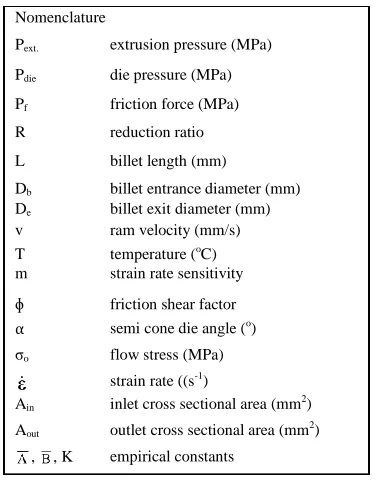
Nomenclature
Pext. extrusion pressure (MPa)
Pdie die pressure (MPa)
Pf friction force (MPa)
R reduction ratio
L billet length (mm)
Db billet entrance diameter (mm) De billet exit diameter (mm) v ram velocity (mm/s) T temperature (oC) m strain rate sensitivity
ɸ friction shear factor
⍺ semi cone die angle (o) σo flow stress (MPa)
strain rate ((s-1)
Ain inlet cross sectional area (mm2) Aout outlet cross sectional area (mm2)
, , K empirical constants
TABLE I
CHEMICAL COMPOSITION OF 2124 ALUMINUM ALLOY Component Al Cu Mg Mn Fe Zn Sr Ti Cr
Wt.% 93 4 1.5 0.5 0.3 0.25 0.2 0.15 0.1
(a) Compacted sintered samples before extrusion
(b) Extrusion test
(c) Samples after extrusion Fig. 1. Setup of extrusion process
TABLE II
EXAMPLES OF EXTRUSION CONDITIONS FOR 2124 AL ALLOY AND 2124Al/SiCp COMPOSITES
The experiments were carried out at strain rate varied from 0.01s-1 to 1.0s-1; temperatures of 300, 400, and 500 oC; and extrusion ratios of 2, 4, and 6. After extrusion process, the cross sections were examined for microstructure by using an optical microscope. Also the mechanism of deformation was studied. Tensile tests were performed on MTS universal testing machine with a load capacity of 25 Tones to determine the ultimate strength and yield strength of the extruded materials. These tests have been conducted according to ASTM E8M-01 standard. During the tests, the tensile load as well as the elongation of a previously marked gauge length in the specimen was measured with the help of load cell of the machine and extensometer respectively.
III. RESULTSANDDISCUSSION
A.Extrusion Pressure
Referring to table 2 (columns 5, 6, and 7) the increase in extrusion temperature resulted in decreasing the pressure. This occurred because of the effect of high temperature that decreases the plastic flow stress. Regarding Aluminum 2124 Alloy and the composites, the extrusion pressure increased with increase in extrusion ratio. Also the extrusion pressure of the composites is higher than those of 2124 Aluminum Alloy. The reason of this difference is the presence of silicon carbide particlesthat acts as hard insertions. As strain rate increased from 0.01 to 1.0s-1 at constant temperature and extrusion ratio, the extrusion pressure is increased by ≈172%, 188%, 192% for Al 2124 alloy, 2124Al/10% and 2124 Al/20%SiCp respectively. Furthermore, the extrusion pressure decreased by ≈33%, 34%, 37% for 2124Al Alloy, 2124Al/10%SiCp, 2124Al/20% SiCp with increasing the temperature of the billet from 300 to 500oC respectively.
B.Mechanical Properties
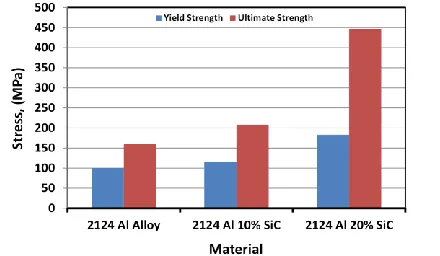
The ultimate tensile strength and yield strength of the extruded 2124 Al Alloy and 2124 Al SiCp composites with different SiCp volume fractions were measured. Fig. 2 shows that the yield strength as well as ultimate strength of 2124 Al Alloy and its composites increase with increasing the volume percentage of silicon carbide particles.
C.Constitutive Equation
The composites used in this study consist of Al 2124 with various volume fractions (0%, 10%, and 20%) of SiCp
reinforcement. Direct extrusion experiments were conducted and empirical models were developed for extrusion pressure. The behavior of the material during extrusion can be expressed by an equation relating the total extrusion pressure to both the operating conditions and geometrical parameters. The extrusion pressure Pext. is the sum of the die pressure Pdie and friction contribution Pf,
Pext = Pdie + Pf (1) Compared to the deformation force, the friction force between the ram of the wall and the container can be neglected
Pdie
=
σo
ABlnR
(2)
R=
out in
A
A
(3)
Where, Pdie: die pressure, Pf: friction pressure, R: Reduction ratio,
σ
o: flow stress at corresponding temperature and strain rate, A and B are constants to be obtained from experimental results.Pf
=
b i
D
4Lτ
3 σ D 4L
υ o
b
(4)
Where, φ: Frictional shear factor, L: Length of billet, Db: Diameter of billet.
The flow stress influences the die pressure and the friction term. The shear factor φ can take values ranging from 0 to 1. The assumption for the present case is φ=1 (i.e. sticky friction condition between the billet and cylinder wall. The average strain rate for a die angle and ram velocity v, is given by:
3 e D 3
b D
α tan R ln 2
b D v 6
ε
(5)
Where, v: ram velocity, De: diameter at exit, ⍺- Semi cone angle,
m
o Kε
σ
(6) Where, m: strain rate sensitivity, k: constant, and
ε
: strain rate.The extrusion pressure Pext. as a function of the characteristics of the material and the geometric parameters can be obtain by combining equations (1) through (6) with considering the temperature dependence of σo,
Pext.
=
K
b n
m
D 3 4L lnR B A T ε
(7) Where, A , B , and K are empirical constants.
The extrusion pressure and the ram displacement were determined experimentally. The extrusion force decreased after the peak during the steady state region. This decrease is related to a reduction in the contact surface between the billet and the cylinder resulting in a reduction of friction force component. As a result, the value of Pext was used for the calculation corresponds to the average between the maximum and the minimum values of extrusion force. Then regression Fig. 2. Mechanical properties of the extruded 2124 Al Alloy and
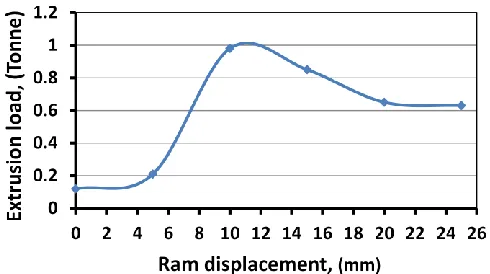
analysis was applied to evaluate the constant k, the strain rate sensitivity exponent m, and the temperature exponent n. Data acquisition system has been used during the experiments to record the temperature, the ram displacement, the time and the extrusion force. The extrusion output for 2124 Al alloy is shown in Fig.3. At the beginning of the extrusion process; as the ram advanced from 0 to 5mm, the extrusion load was low and constant due to the weak resistance of the solid cylindrical billet during the deformation. At the end of the first stage, a rapid rise in pressure was noticed due to compression of the material in the container prior to extrusion. During this stage the extrusion load increased significantly to reach its maximum value. Then the load decreased linearly with increasing ram displacement till the steady state condition was reached.
Fig.4 shows the extrusion load versus ram displacement for
2124 Al Alloy and 2124 Al/SiCp composites with different
silicon carbide fractions. For all types of materials, it can be seen that the extrusion load increases rapidly with the lowering of punch and reaches the maximum value, subsequently the extrusion load decreases. According to the theories of metal forming, this load decrease is attributed to a shortening billet and a decrease in frictional force at the billet container interface [5].
The extrusion pressure requirement and the maximum temperature of the extrudate depend on the alloy and its metallurgical conditions including billet length, billet temperature, reduction ratio, cross sectional diameter of the extrudate, die design and its conditions. Furthermore, it is
important to consider the process parameters such as ram speed and lubrication. From above figures, it can be observed that the extrusion load increases with the lowering of punch and reaches the peak value; subsequently decrease of the extrusion load. According to metal forming theories, the load decrease is attributed to a shortening billet and thus a decrease frictional force at the billet container interface. At the beginning of the process, the extrusion force was low due to the weak resistance of the solid cylindrical billet. The rise in pressure at the end of the stage was due to compression of the material in the container prior to extrusion. As a result the
value of Pext used for the calculation corresponds to the
average between the maximum and the minimum values of extrusion force. Extrusion pressure as a function of the characteristics of the material and the geometric parameters can be calculated by using equation 7.
The evaluated constants for the model are given in Table 3.
By evaluating the constants, the following empirical relations were obtained for different materials.
For 2124 Al Alloy,
For 2124 Al/10%SiCp,
For 2124 Al/20%SiCp,
Due to hard particle addition to Al 2124 Alloy, the extrusion stress increases with increase in the SiCp volume fraction. The results revealed that extrusion pressure gradually decreased with increase in extrusion temperature because of the decrease in plastic flow stress with increase in extrusion temperature. The extrusion pressure of the Al 2124 Alloy and the composites gradually increased with increase in extrusion ratio, because of the increase in plastic flow stress resulting from the friction between the materials and the extrusion die and container. The extrusion pressure of the composites were much higher than those of 2124 Al Alloy because the SiCp act as hard inclusions which is shown in Tables 2. Increasing of strain rate from 0.01 to 1.0 s-1 the maximum extrusion pressure is increased by about 170, 190, 195 % for Al 2124 alloy, 2124Al/10% and 2124 Al/20%SiCp respectively at constant temperature and extrusion ratio. Increasing the temperature of the billet from 300oC to 500oC the extrusion pressure decreases by about 33, 37, 39% for 2124Al Alloy,
𝑃𝑒𝑥𝑡 .= 5.4952(𝜀)0.2111 (𝑇)−0.8438 1.0252 + 1.5000 𝑙𝑛𝑅 +
4𝐿 √3𝐷𝑏
𝑃𝑒𝑥𝑡 .= 5.4952(𝜀)0.2111 (𝑇)−0.8438 1.0252 + 1.5000 𝑙𝑛𝑅 + 4𝐿
√3𝐷𝑏
𝑃𝑒𝑥𝑡 .= 9.3081(𝜀)0.2242 (𝑇)−0.8961 0.9992 + 1.5872 𝑙𝑛𝑅 +
4𝐿 √3𝐷𝑏
𝑃𝑒𝑥𝑡 .= 11.9974(𝜀)0.2303 (𝑇)−0.9201 1.0364 + 1.6302 𝑙𝑛𝑅 +
4𝐿 √3𝐷𝑏
Fig. 3. Extrusion load versus ram displacement for 2124 Al Alloy
Fig. 4. Extrusion load versus ram displacement
2124Al/10%SiCp, 2124Al/20% SiCp respectively at constant strain rate of 0.01/s and extrusion ratio. Furthermore, the values of constants K, m and n increase due to work hardening when the percentage volume of SiCp increases.
D., Microstructure Examination
The microstructures of the samples extruded in the
temperature range of 300oC and 1.0 s-1 strain rate exhibit flow
bands, these bands being manifestations of flow instabilities [23] which is shown in Fig.9. The microstructure of the
samples extruded at temperature above 350 oC exhibit wavy
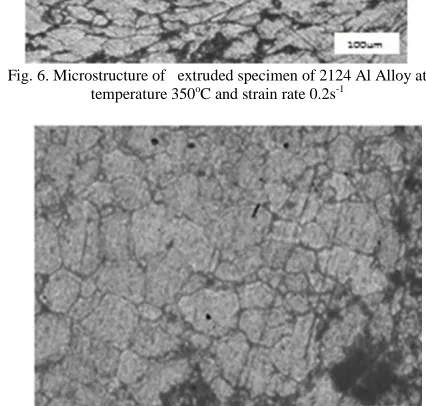
grain boundaries, which are shown in Figs. (5-8). The surface finish, straightness, and microstructural observations indicate that the products possess a high surface quality after the extrusion testing.
IV. CONCLUSION
Hot working by extrusion process has been performed for Al 2124 Alloy and 2124Al SiCp composites to investigate the behavior of the materials under varying conditions. The following conclusions have been drawn:
1. Extrusion process at elevated temperature can be conducted successfully for 2124 Al/SiCp composites. 2. The constitutive equations of extrusion process of 2124 Al
Alloy and 2124 Al SiCp composites have been obtained. These equations might be useful in the prediction of the extrusion pressure.
3. The extrusion pressure of both 2124 Al Alloy and 2124 Al SiCp composites increases with increasing the strain rate. 4. The extrusion pressureof both 2124 Al Alloy and 2124 Al
SiCp composites decreased with increasing extrusion temperature because of the decrease in plastic flow stress. 5. The extrusion pressure of the 2124 Al Alloy and its
composites gradually increased with increase in extrusion ratio, because of the increase in plastic flow stress resulting from the friction between the materials and the extrusion die and container.
6. The extrusion pressures of the composites are much higher than those of 2124 Al Alloy because of silicon carbide particles which act as hard inclusions.
REFERENCES
[1] J. Hemanth, ―Quartz (SiO2) Reinforced Chilled Metal Matrix Composite (CMMC) for Automotive Applications‖, Mater. Des. 2009.
[2] D.B. Miracle, Metal Matrix Composites—From Science to Technological Significance, Compos. Sci. Technol., 65, p 2526–2540, 2005.
Fig. 5. Microstructure of extruded specimen of 2124 Al/10%SiCp at temperature 300oC and Strain rate 1.0s-1
Fig. 6. Microstructure of extruded specimen of 2124 Al Alloy at temperature 350oC and strain rate 0.2s-1
Fig. 7. Microstructure of extruded specimen of 2124Al/10%SiCp at temperature 350oC and strain rate 0.3 s-1
Fig. 8. Microstructure of extruded specimen of 2124 Al / 15% SiCp at temperature 400oC and strain rate 0.2 s-1
[3] S. Basavarajappa and G. Chandramohan, ―Application of Taguchi Techniques to Study Dry Sliding Wear Behavior of Metal Matrix Composites‖, Mater. Des., 2007.
[4] Y. Yang et al., ―A Modified Constitutive Equation for Aluminum Alloy Reinforced by Silicon Carbide Particles at Elevated Temperature‖, J. Mater. Eng. Perform., 22(9), p.p. 2641–2655, 2013.
[5] M. Rajamuthamilselvan, S. Ramanathan, and S. Krishnamohan, ―Deformation Stability of Al 7075/20% SiCp (63 lm) Composites during Hot Compression‖, Advances in Engineering, Science and Management (ICAESM), International Conference on. 2012: IEEE 24, 2012.
[6] M. Rajamuthamilselvan, S. Ramanathan, and R. Karthikeyan, ―Processing Map for Hot Working of SiCp/7075 Al Composites‖, Trans. Nonferrous. Met. Soc., 20(4), p 668–674, 2010.
[7] D. J. Lloyd, ―Particle reinforced aluminum and magnesium matrix composites‖, Int. Mater. Rev. 39, 1–23, 1994.
[8] H. R. Sherdiff and M. F. Ashby, ―Design with metal matrix composites‖, Mater. Sci. Technol. 10, 443–451, 1994.
[9] S. V. S. Narayana Murty, B. Nageswara RAO and B. P. Kashyap. ―On the hot working characteristics of 2124 Al–SiCp metal matrix composites‖, Adv. Composite Mater., Vol. 11, No. 2, pp. 105–120, 2002.
[10]Amir Pakdel and Hassan Farhangi, ―Influence of Extrusion Ratio on the Mechanical Behavior of AL6061/Sic Composites‖, The Arabian Journal for Science and Engineering, Volume 34, Number 1C, pp. 167-174, 2009. [11]P. Zhang, F. Li, and H. Li, ―Optimization of General Constitutive Equation for Hot Deformation of SiC Particle Reinforced Al Matrix Composites‖, J. Aeronaut. Mater, 29, p 51–56, 2009
[12]N.P. Cheng, S.M. Zeng, and Z.Y. Liu, ―Preparation, Microstructures and Deformation Behavior of SiCP/6066Al Composites Produced by PM Route‖, J. Mater. Process. Technol., 202, p 27–40, 2008.
[13]Yajing Yang, Fuguo Li, Zhanwei Yuan, and Huijuan Qiao, ―A Modified Constitutive Equation for Aluminum Alloy Reinforced by Silicon Carbide Particles at Elevated Temperature‖. Journal of Materials Engineering and Performance, 22(9), 22:2641–2655, 2013.
[14]N. Bontcheva and G. Petzov, ―Microstructure Evolution during Metal Forming Processes‖, Comput. Mater. Sci., 28, p 563–573, 2003
[15]N. Bontcheva, G. Petzov, and L. Parashkevova, ―Thermomechanical Modelling of Hot Extrusion of Al-Alloys, Followed by Cooling on the Press‖, Comput. Mater. Sci., 38, p.p. 83-89, 2006.
[16]H. Grass, C. Krempaszky, and E. Werner, ―3D FEM-Simulation of Hot Forming Processes for the Production of a Connecting Rod‖, Comput. Mater. Sci., 36, p 480–489, 2006.
[17]T. S. Srivastan, D. Lanning, Jr. and K. K. Soni, ―Microstructure, tensile properties and fracture behavior of an Al-Cu-Mg alloy 2124‖, J. Mater. Sci. 28, 3205– 3213, 1993.
[18]J. N. Hall, J. Wayne Jones, and A. K. Sachdev, ―Particle size, volume fraction and matrix strength effects on fatigue behavior and particle fracture in 2124 aluminum-SiCp composites,‖ Materials Science and Engineering A, vol. 183, no. 1-2, pp. 69–80, 1994.
[19]G. Ganesan et al., ―Development of Processing Map for 6061 Al/15% SiCp Through Neural Networks‖, J. Mater. Process. Technol., , 166(3), p 423–429, 2005.
[20]Rajamuthamilselvan, M., S. Ramanathan, and S. Krishnamohan. ―Deformation Stability of Al 7075/20% SiC p (63 lm) Composites During Hot Compression‖, Advances in Engineering, Science and Management (ICAESM),, International Conference on. 2012: IEEE, 2012.
[21]M. Rajamuthamilselvan, S. Ramanathan, and R. Karthikeyan, ―Processing Map for Hot Working of SiCp/7075 Al Composites‖, Trans. Nonferr. Met. Soc., 20 (4), p 668–674, 2010.
[22]Radhakrishna Bhat .B.V, Mahajan Y.R and Prasad. Y.V.R.K, ―Effect of Volume Fraction of SiCp Reinforcement on the Processing Maps for 2124 Al Matrix Composites‖, Metallurgical and Materials Transactions A, , vol.31, pp629-639, 2000.