OPTIMAL PLACEMENT OF CAPACITORS IN DISTRIBUTION SYSTEMS FOR EMISSION
REDUCTION USING ANT LION OPTIMIZATION ALGORITHM
Kalyani. S
Department of
A R T I C L E I N F O
INTRODUCTION
Many distribution grids suffer from a lot of problems while feeding consumers with inductive loads. Some of these problems related with low voltage regulation, and high power losses. Increasing reactive power consumption leads to higher lines currents with un-allowed voltage drop. As a result, about 13% of total generated power is lost as power line losses. Consequently, about 40% of total cost is consumed to compensate what is lost. These losses should be reduc increase capability of the system, decrease its overloaded components, and improve its stability.
Connecting Capacitor banks is one of intrinsic methods of DS in distribution grids which used to perform the last destinations. The merits of shunt capacitor usage are: its availability with low cost, simplicity of installation, and performance in operation. The main disadvantage of shunt capacitor is that the reduction in its output VARs is proportional to the power squared of bus voltage. As capacitors are available at specified sizes in market, so the capacitor size and placement in RDG are discrete variables. Recently several optimization techniques have been employed for solving the optimal allocation of capacitors such as particle swarm algorithm (PSO), genetic algorithm (GA), gravitat search algorithm (GSA), analytical-IP, Seyedali Mirjalili proposed a novel meta-heuristic technique called Ant lion optimizer (ALO) which is inspired from the intelligence behavior of antlions in hunting ants. Latest optimization techniques are presented in [1-25] in the literature.
International Journal of Current Advanced Research
ISSN: O: 2319-6475, ISSN: P: 2319-6505,
Available Online at www.journalijcar.org
Volume 7; Issue 11(C); November 2018
DOI: http://dx.doi.org/10.24327/ijcar.2018
Copyright©2018 Kalyani. S., Sudhakara Reddy A. V., Vara Prasad N
Attribution License, which permits unrestricted use, distribution, and reproduction in any medium, provided the original work Article History:
Received 06th August, 2018 Received in revised form 14th September, 2018
Accepted 23rd October, 2018
Published online 28th November, 2018
Key words:
Fixed capacitor, power flow, Ant lion optimizer, Radial distribution systems
*Corresponding author: Kalyani. S
Department of E.E.E, C.B.I.T, Vidya Nagar, Proddatur, India
OPTIMAL PLACEMENT OF CAPACITORS IN DISTRIBUTION SYSTEMS FOR EMISSION
REDUCTION USING ANT LION OPTIMIZATION ALGORITHM
Kalyani. S., Sudhakara Reddy A. V., Vara Prasad N
ent of E.E.E, C.B.I.T, Vidya Nagar, Proddatur, India
A B S T R A C T
The utilization of fixed capacitors (FCs) in shunt connection is one of the common methods to improve the power quality of distribution systems. In this paper, a novel optimization technique called Ant lion optimizer (ALO) is used to determine the optimal generated VARs capacity and locations of FCs. The objective functions are adopted to minimi total distribution power loss and to improve the voltage profile. The ALO is performed its ability to cover medium and large scales radial distribution systems (RDS) such as; IEEE 15-bus and 69-bus test systems. The Numerical results illustrate that
(ALO) offer optimal solutions properly better than many other reporter heuristic algorithms.
Many distribution grids suffer from a lot of problems while feeding consumers with inductive loads. Some of these problems related with low voltage regulation, and high power onsumption leads to higher allowed voltage drop. As a result, about 13% of total generated power is lost as power line losses. Consequently, about 40% of total cost is consumed to compensate what is lost. These losses should be reduced to increase capability of the system, decrease its overloaded
Connecting Capacitor banks is one of intrinsic methods of DS in distribution grids which used to perform the last acitor usage are: its availability with low cost, simplicity of installation, and performance in operation. The main disadvantage of shunt capacitor is that the reduction in its output VARs is proportional to the power squared of bus voltage. As are available at specified sizes in market, so the capacitor size and placement in RDG are discrete variables. Recently several optimization techniques have been employed for solving the optimal allocation of capacitors such as particle SO), genetic algorithm (GA), gravitational IP, Seyedali Mirjalili et. al heuristic technique called Ant lion optimizer (ALO) which is inspired from the intelligence ts. Latest optimization 25] in the literature.
In this work, ALO is utilized for two intrinsic principles: the reduction of the grid power losses and
improve the stability and keeping voltage profile steady at all distribution systems. It is experienced on two test cases of standard distribution grids 15
results from ALO are entered in competitive with those of other techniques and proved its efficiency in solving problems to confirm its performance.
Problem Formulation
Load Flows
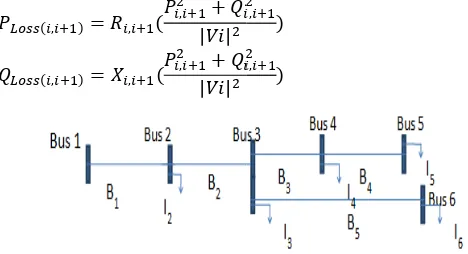
The backward/forward sweep is a modern technique which widely utilized in recent years. Because of its accuracy, and simplicity, it is used in this paper to calculate power flow analysis of any sophisticated system using the following algebraic formulas supported with simple d
Power flow solution is used in the planning and design stages as well as during the operating stages. Two matrices are developed to obtain load flow solution.
( , )= , (
, +
| |
( , )= , (
, +
| |
Fig 1 Simple radial distribution system
International Journal of Current Advanced Research
6505, Impact Factor: 6.614
www.journalijcar.org
November 2018; Page No. 16339-16343
//dx.doi.org/10.24327/ijcar.2018.16343.3016
Kalyani. S., Sudhakara Reddy A. V., Vara Prasad N. This is an open access article distributed under the Creative Commons Attribution License, which permits unrestricted use, distribution, and reproduction in any medium, provided the original work
Department of E.E.E, C.B.I.T, Vidya Nagar, Proddatur, India
OPTIMAL PLACEMENT OF CAPACITORS IN DISTRIBUTION SYSTEMS FOR EMISSION
REDUCTION USING ANT LION OPTIMIZATION ALGORITHM
The utilization of fixed capacitors (FCs) in shunt connection is one of the common methods to improve the power quality of distribution systems. In this paper, a novel optimization technique called Ant lion optimizer (ALO) is used to determine the optimal generated VARs capacity and locations of FCs. The objective functions are adopted to minimize the total distribution power loss and to improve the voltage profile. The ALO is performed its ability to cover medium and large scales radial distribution systems (RDS) such as; IEEE bus test systems. The Numerical results illustrate that the Ant lion optimizer (ALO) offer optimal solutions properly better than many other reporter heuristic
In this work, ALO is utilized for two intrinsic principles: the reduction of the grid power losses and total annual cost to improve the stability and keeping voltage profile steady at all distribution systems. It is experienced on two test cases of d distribution grids 15-bus and 69-bus systems. Net results from ALO are entered in competitive with those of other techniques and proved its efficiency in solving problems
sweep is a modern technique which widely utilized in recent years. Because of its accuracy, and simplicity, it is used in this paper to calculate power flow analysis of any sophisticated system using the following algebraic formulas supported with simple diagram as Fig. 1 Power flow solution is used in the planning and design stages as well as during the operating stages. Two matrices are developed to obtain load flow solution.
,
)
,
)
Simple radial distribution system
Research Article
The bus-injection to branch-current matrix
[B] = [B I B C] [ I ] (1)
The branch-current to bus-voltage matrix
[ ∆V] = [B C B V] [ B ] (2)
Two matrices are developed, viz. the bus injection to branch current (BIBC) matrix and branch current to bus voltage (BCBV) matrix. By using simple multiplication of these two matrices, the load flow solution is obtained.
Development of these two matrices is explained with reference to figure.1
Equivalent current injection:
For distribution systems, the models which are based on the equivalent current injection are more convenient to use. At each bus ‘I, the complex power Sis specified by,
= P + j Q (3)
Corresponding equivalent current injection at the k-th iteration of the solution is given by,
= + =
∗
(4)
is the node voltage at the kth iteration.
is the equivalent current injection at the k-th iteration.
and are the real and imaginary parts of the equivalent current injection at the k-th iteration respectively.
Bus injection to branch current matrix: (BIBC)
The power injections can be converted into equivalent current injections using the equation (2.4). The set of equations can be written by applying Kirchhoff’s current law (KCL) to the distribution network. Then the branch currents can be formulated as a function of the equivalent current injections. Consider the sample distribution system shown in the figure 2.1. Now applying Kirchhoff’s current law (KCL) to the distribution network we get,
(5)
(6)
(7)
Where B1, B3, B5…..branch currents and I2, I3 and I4…. are load
currents respectively at buses 2, 3 and 4
[B] = [B I B C] [ I ] (8)
(9)
The constant BIBC matrix has non-zero entries of +1 only. For a distribution system with m-branch sections and n-buses, the dimension of the BIBC is m x (n-1).
Proposed ALO Approach
The Ant Lion optimizer was produced in 2015 by Seyedali
antlion's larvae in hunting ants. The ants perform the capacitors positions in free space, and the antlions perform the hidden positions. When an ant has a fittest solution than that of antlion, this means that antlion has caught the ant and consumed it. This antlion becomes the fittest and named as the elite.
Initialization of operation
The positions of ants and antlions are initially created with random numbers under dimensions and limits which modeled as:
= [0,1]. − +
∀ ∈ {1,2, … . . }, j ∈ {1,2, … . . }
Where and are the upper and lower boundaries of the control variables.
The OF determines the antlions initial fitness and arranges them. The fittest antlions positions and optimal solutions are saved as the elite.
Five main steps of ALO algorithm
During searching for the optimal solution, there are five main steps are modeled mathematically in hunting the pray which proposed as:
Ants randomly walk
Ants improve their positions in searching for foods in free space every iteration which is given as:
X(t)= [0, cumsum(2r(t1)-1), cumsum(2r(t2)-1),….. cumsum
(2r(tn)-1)
where cumsum is the cumulative sum of series numbers, n is the iterations number and r(t) is a random number which is modeled as:
r(t)=0 1 > 0.5≤ 0.5
This updating is tied to a range of upper and lower boundaries. To keep it between these ranges, the identified equation must be applied as:
X =(X − a ) ∗ (d − c ) b − a + c
where is the lowest number of ants walks, bi is the topmost
number of ants walks in each iteration, is the lowest variable of a changed function at t-th iteration, and is the topmost variable of a changed function at t-th iteration.
Area of trap structure
The volume of the trap is direct proportional to the degree of antlion hunger by applying a roulette wheel which is given as:
Accumulation = cumsum (Weights)
Weights =
( )
Where cumsum is the cumulative sum of series numbers, Weight is an array which determines the degree of antlions' fitness by arranging them according to preference and MOAL is
an array which saves the antlions' fitness.
Trapping in Antlion’s pits
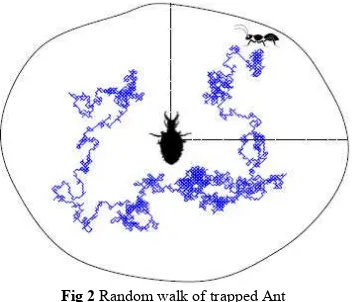
Fig. 2 illustrates the confused ants which are fallen in the trap of one chosen antlion only. Decline the area aroundantlions' digs
The random walk boundaries of ants are reduced during approaching from antlions' digs. This process can be modeled as:
C = Antlion + c
d = Antlion + d
Where ct, dt are the lowest and top most numbers of all variables in the current iteration, respectively. , are the lowest and topmost numbers for the i-th respected to ct, dt variables, is the position of antlion for j-th in free space for the current iteration.
Fig 2 Random walk of trapped Ant
Sliding of ants inside the trap
After entering the circle receding of chosen antlion, it pushes the sand behind ants to slide down the ants towards the bottom of the cone where the antlion exists. The modeled equations are written as:
c =c
I , d = d
I
= 10 ∗
Where t is the current iteration, T is the maximum number of iterations, I is a ratio which is varied respected to the current iteration t and w is a constant which is varied respected to the current iteration t.
=
2 > 0.1 × _ 4 > 0.75 × _ 6 > 0.95 × _
Consuming prey and re-modifying the trap
The final step of hunting, is while an ant reaches the bottom, the antlion catches it with its jaws then enter it inside the sand and consumed it (means that when the ant become fitter or has a better solution than the antlion, it takes its best solution to tie themselves up with ants). The mathematical model of this operation is offered as:
Antlion = Ant , if f Ant > (Antlion )
Where is the position of antlion for j-th as a selected one at the t-th iteration.
Elitism
To obtain the best solution at each phase, this fittest one is saved and named as elite. The elite affects the steps of all ants random walks and therefore their destinations. This can be offered as:
Ant =R + R 2
Where and are random walks of an ant the first is around the trap of chosen antlion, and the second is around the trap of the elite respectively at t-th Biteration.
RESULTS AND DISCUSSION
To evaluate the performance of ALO technique, standard IEEE test systems are used (IEEE 15-bus and IEEE 69-bus test systems). However, the obtained results from the developed ALO algorithm are compared with other well-known optimization methods to proof its effectiveness and superiority. The selected parameters are adjusted as listed in Table I.
Table no 1 Parameters Used in ALO lgorithm
S.No Parameters size
1 Maximum number of iterations 500 2 Search agents No. 50
3 Allowable capacitor range 1 to 1250 KVAR 4 Bus voltage constraint 0.90≤Vi≤1.05
Minimization of active power loss
The ALO technique is applied on IEEE 15-bus and IEEE 69-bus test systems to minimize the total power loss.
The all system data are given in [16]. In the base case (without compensation), the minimum bus voltage is 0.9038 p.u at bus no. 8 and Three capacitors are optimally located at the studied system. In case of incorporating the capacitors optimally by the developed ALO, the power loss is diminished to 32.4613 KW as 44.41% reduction ratio, while this ratio is 18.576% for Analytical IP technique [16], 31.72% for GA [13], 33.05% as reported in Table no 2.
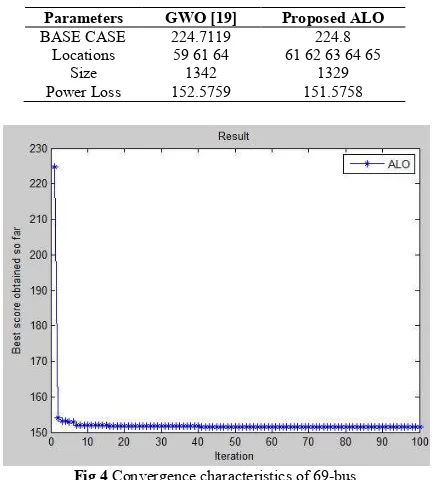
The minimum bus voltage without compensation is 0.9092 p.u. at bus 65 and the total active power loss is 224.8 KW. The optimal locations and sizes of capacitors that determined by ALO are listed in Table no.3. After incorporating the capacitors, the best active power loss reduction is 150.23 KW as 35.364% reduction ratio compared with 30.379% of GA [13], 32.22% of PSO [14]. The convergence characteristics of 15-bus and 69-bus system is shown in fig. 3 and Fig. 4 respectively.
Table No 2 Optimal Results of 15-Bus Network
Parameters GWO [19] Proposed ALO
Fig 3 Convergence characteristics of 15-bus
Table 3 Optimal Results of Ieee 69-Bus System
Parameters GWO [19] Proposed ALO
BASE CASE 224.7119 224.8 Locations 59 61 64 61 62 63 64 65
Size 1342 1329 Power Loss 152.5759 151.5758
Fig 4 Convergence characteristics of 69-bus
CONCLUSIONS
This paper has studied the ability of new optimization technique called ant lion optimizer (ALO) in order to find the optimal solution of capacitor allocation problem in radial distribution systems. The location and size of shunt capacitors have been determined based on the minimization of power loss and to improve the voltage profile.
The developed optimization algorithm has been applied on IEEE 33-bus and IEEE 69-bus radial distribution systems. However, the obtained results have been compared with other well-known methods. The numerical results verified that the ALO algorithm is capable of producing superior solutions with excellent performance of convergence.
References
1. J.V. Schmill, “Optimum size and location of shunt capacitors on Distribution feeders.” IEEE Trans on PAS, Vol-84, pp.825-832, Sept 2002.
2. Duran H. “Optimum number, location and size of shunt capacitors in radial distribution feeders: A dynamic programming approach”, IEEE Trans on power apparatus and systems, Vol-87(9): pp.1769-1774, September, 2003.
3. Baran M.E. and Wu F.F. “Optimal capacitor placement on radial distribution systems”. IEEE Trans on power delivery, Vol-4(1): pp.725-734, January, 2005.
4. Baran M.E and Wu F.F. “Optimal sizing of capacitors placed on a radial distribution system”. IEEE Trans on power Delivery, Vol-4(1), pp.735-743, January, 2007. 5. Sundharajan and A. pahwa, “Optimal selection of
capacitors for radial distribution systems using genetic algorithm”, IEEE Trans. Power systems, vol-9, pp.1499-1507, Aug, 2007.
6. Das D.Kothari D.P. and kalam A. “Simple and efficient method for load flow solution of radial distribution networks”, Electrical Power and Energy Systems, 2009. 7. Chis M. Salama M.M.A. and Jayaram S. “Capacitor
placement in distribution systems using heuristic search strategies”, IEEE proceedings on Transmission and Distribution, Vol-144(3), pp.225-230, May, 2011. 8. Haque M.H. “Capacitor placement in radial distribution
systems for loss reduction”, IEEE Proceedings on Generation, Transmission and Distribution, Vol-146(5),pp.501-505, September,2013
9. N.g H.N.. Salama M.M.A and Chikani A.Y.”Capacitor allocation by approximate reasoning: Fuzzy Capacitor placement’’, IEEE Trans on power Delivery ,Vol-15(1),pp.393-398, January,2013
10. Prakash K. and Sydulu M. “Particle swarm optimization based capacitor placement on radial distribution systems”, IEEE Power Engineering Society general meeting, PP. 1-5, June, 2007
11. M. Damodar Reddy and V.C.Veera Reddy “Optimal capacitor placement using fuzzy and real coded genetic algorithm for maximum savings”, Journal of Theoretical and Applied Information Technology, Vol- 4(3),pp.219-226,2008
12. M. Damodar Reddy and V.C Veera Reddy “Capacitor placement using fuzzy and particle swarm optimization method for maximum annual savings”, ARPN Journal of Engineering and Applied Information Technology, Vol-4(3),pp.219-226,2008
13. Sydulu.M and V.V.K Reddy, “Index and GA based optimal location and sizing of distribution system capacitor”, IEEE power engineering society journal meeting, pp.1-4,june,2007.
14. K.Prakash and M.Sydulu, “Particle swarm optimization based capacitor placement on radial distribution system”, IEEE power engineering society journal meeting, pp.1-4, june, 2007.
15. H.D.Chiang, J.C.Wang, O.Cockings and H.D.Shin, “optimal capacitor placement in distribution systems: Part I: a new formulation and the overall problem”, IEEE Trans power deliv, Vol-5(2), pp.634-642, 2010. 16. Ahmed.R Abul Wafa,” optimal capacitor allocation in
radial distribution systems for loss reduction: A two stage method”, Elsevier Electric power system, pp.168-174, 2013.
17. Y.Mohamed Shuaiba and M.Surya kalavathi,” optimal capacitor placement in radial distribution system using GSA”, International Journal of Electrical Power and energy systems, Vol-64, pp.384-397, 2015.
18. Sneha Sultana and Provas kumar Roy,” optimal capacitor placement in radial distribution system using teaching learning based optimization”, Elsevier Int. J. Electr. Power energy syst., Vol-54, pp. 387-398, 2014.
0 10 20 30 40 50 60 70 80 90 100
30 35 40 45 50 55 60 65
Result
Iteration
B
es
t
sc
or
e
ob
ta
in
ed s
o f
ar
19. A. V. Sudhakara Reddy, Prof. M. Damodar Reddy, “Optimization of Distribution Network Reconfiguration Using Dragonfly Algorithm”, Journal of Electrical Engineering, Vol.16, No.4, No.30, pp.273-282, ISSN: 1582-4594, March 2017.
20. A. V. Sudhakara Reddy, Prof. M. Damodar Reddy, “Optimization of network reconfiguration by using particle swarm optimization”, 2016 IEEE First International Conference on Power Electronics, Intelligent Control and Energy Systems (IEEE ICPEICES-2016), Delhi Technological University (DTU), New Delhi, India, July 4th - 6th, 2016.
21. A. V. Sudhakara Reddy, Prof. M. Damodar Reddy, “Optimal Capacitor allocation for the reconfigured Network using Ant Lion Optimization algorithm, ” IJAER, Vol.12, No.12, pp.3084-3089, 2017.
22. A. V. Sudhakara Reddy, Dr. M. Damodar Reddy, M. Satish Kumar Reddy “Network Reconfiguration of Distribution Systems for Loss Reduction using GWO algorithm” IJECE, Vol. 7, No. 6, pp.3226-3234, December 2017.
23. A. V. Sudhakara Reddy, Dr. M. Damodar Reddy, “Network Reconfiguration of Distribution System for Maximum Loss Reduction using Sine Cosine Algorithm” IJERA, Vol.7, Issue.10, pp.34-39, October 2017.
24. A. V. Sudhakara Reddy, Dr. M. Damodar Reddy, “Distribution Network Reconfiguration for Maximum Loss Reduction using Moth Flame Optimization”, International Journal of Emerging Technologies in Engineering Research (IJETER), Vol.6, No.1, pp.86-90, January 2018.
25. A. V. Sudhakara Reddy, Dr. M. Damodar Reddy, “Application of Whale Optimization Algorithm for Distribution feeder reconfiguration”, i-manager’s Journal on Electrical Engineering, Vol.11, No.3, pp.17-24, Jan-Mar 2018.
How to cite this article:
Kalyani. S., Sudhakara Reddy A. V., Vara Prasad N (2018) 'Optimal Placement of Capacitors in Distribution Systems for Emission Reduction Using ant Lion Optimization Algorithm', International Journal of Current Advanced Research, 07(11), pp. 16339-16343. DOI: http://dx.doi.org/10.24327/ijcar.2018.16343.3016