10 S.Afr.Tydskr.Bibl.lnligtingk., I 998,66( I)
Community libraries: the concept and its application by
the Pinetown Public Library
B.J. Mostert* & W.M. Vermeulen
Department of Library and Information Science, University of Zululand, Private Bag X 100 I, KwaDlangezwa
3886 Republic of South Africa
Public libraries in South Africa have largely failed to address the information needs of developing communities. As a result the establishment of alternative library services, notably resource centres and community libraries, have gathered momentum since the 1980s. The concept of community libraries, currently embraced by an increasing number of public libraries, is explored, and the community library system implemented by the Pinetown Public Library is evaluated against norms derived from the literature on the development of public libraries in Africa and South Africa.
Openbare biblioteke in Suid-Afrika het nie noemenswaardig daarin geslaag om dienste te voorsien wat die wesentlike behoeftes van ontwikkelende gemeenskappe aanspreek nie. Gevolglik het alternatiewe dienste soos byvoorbeeld bronnesentrums en gemeenskapsbiblioteke ontstaan, veral vanaf die vroee tagtiger jare. Die konsep van gemeen-skapsbiblioteke wat besig is om in openbare biblioteke veld te wen, word ontleed en die stelsel wat deur Pinetown se Open bare Biblioteek in werking gestel is, word geevalueer aan die hand van norme gebaseer op die literatuur oor die ontwikkeling van open bare biblioteke in Afrika en Suid-Afrika.
*Author to whom correspondence
should be addressed.Background
African communities initially embraced public libraries,
ex-pecting them to support the educational and informational
needs of the people, and to assist in the process of general
upliftment and development of the disadvantaged. Contrary
to these expectations public libraries did not flourish in spite
of remarkable quantitative expansion experienced at first.
Sturges and Neill (1990:71,73) blame this on a lack of
re-search into the particular information needs of Africa which
led to the establishment of services which had very little to
offer the African people. Chijioke (\ 989: 176) reports that
libraries are not seen as significant role players in the process
of national development, for example, a study conducted in
Nigeria emphasised information as an important factor in
development, but libraries were not assigned any role in the
process. In South Africa Zaaiman, Roux &Rykheer (1988:5) came to much the same conclusion. The literature therefore,
not surprisingly, shows that existing library services are not
extensively used. Less than 2% of the population in Tanzania
and approximately 5% in Botswana use libraries (Mchombu
199 I). In South Africa the 1996 figure was 8.8% of the total
population which includes a signiticant component of users
from developed communities (Mostert 1997 :57).
Shera (1972: 190) provides a sober perspective in this
re-gard when he says public libraries, like all other social
institutions are shaped by two forces: by the demands made
on them by society and the changes in those demands
re-sulting from social change; and by the objectives of the
professional leaders in the field of librarianship. Conflict
be-tween these two forces could arise when the demands of
society do not correspond with the objectives of the
professional leaders, and when such conflict arises, it is the
responsibility of the public library to resolve the conflict, for
an institution that does not meet the social demands placed
upon it, will ossify or decay, and be replaced.
Librarians on the African continent have for some time
been concerned about the conflict between the needs of the
people and the services provided. The reasons for ~he
un-satisfactory performance of public libraries have been quite
widely researched, and various alternatives to the Western
library model which has been singled out as a major
stumb-ling block, have been implemented. Tanzania, for example,
introduced a system of bare-foot librarians with the libraries
owned and controlled by the communities served (Banach
1989: 10). Botswana launched the Village Reading Room
Pro-ject in which the community took ownership of the building,
materials and service, sometimes even erecting the buildings
themselves (Raseroka 1994:6). In South Africa resource
centres, being aligned to the progressive movement, were
particularly successful during the apartheid years. Between
1984 and 1989,93 resource centres were established (Stilwell
1992:214), while more recently community libraries have
gained in popularity because of their commitment to
em-powerment of the entire community through their information
service (Mostert 1997:82). Some public libraries in South
Africa have displayed a tendency to adopt features common
to community libraries. The Vosloorus Public Library has
been so successful with its involvement of the community
that Stilwell (\ 991 b:268) regards it as representing the
S.Afr.J .Libr.lnf.Sci., I 998,66( I)
named its new public library the Pretoria Community Library. The Pinetown Public Library claims more progress towards a community library than a mere change of name. It is a conventional public library system which is in the process of
establishing community libraries as part of its main library system. The question which interested the research team was, -whether the Pinetown community libraries were community libraries in the true sense of the word, or whether they were still conventional public libraries disguised as community libraries to follow the winds of change sweeping the country.
Purpose of the study
The purpose of the study was to identify the characteristics and possible weaknesses of public libraries, specifically in South Africa; to study trends with regard to community libra-ries and to establish norms for community libraries; to con-duct a survey of the community libraries in the Borough of Pinetown, and to test the validity of these libraries against the norms established.
Methodology
The major steps followed in conducting the project were the following:
- A literature review of the development of public libraries in South Africa (and also the rest of the African continent) was conducted. The results were used to abstract verbal models to provide a basis for comparison and evaluation. Only models relevant to this article are included.
A survey was conducted to collect information on the Pinetown community libraries. The survey involved two target groups: the librarians of the community libraries; and members of the communities served, users as well as non-users.
Interviews and self-administered questionnaires were used to collect information from the librarians. The questionnaires provided background material regarding the libraries and the services they provide, while the interviews were used to collect in-depth information with regard to specific aspects of the community libraries. Self-administered questionnaires were used to ascertain the communities' reaction to the com-munity libraries (and libraries in general), and to determine whether the libraries served the purpose which the com-munities had in mind for them when they initially requested the facilities, namely to assist the school children and students in their school work, to nurture a reading culture and also to contribute to community activities.
Responses were received from ten community librarians (each library had two staff members), and 109 community members. The convenience method was used to select com-munity respondents. Questionnaires were handed out to users who were available at the time when the Zulu-speaking field worker visited a specific library. All the questionnaires were distributed on the same day, and collected on that day before the users left the library. The field worker also remained on hand to assist respondents with questions which needed
II
clarification. Questionnaires for non-users were distributed at a shopping centre in Pinetown South to the first 25 people willing to co-operate. The field worker collected the question-naires as they were completed.
Nature of public libraries
Society creates institutions to provide for needs which are regarded as crucial for its survival. Six spheres of needs are commonly distinguished: the economy, religion, law, the family, politics and education, and the public library is re-garded as part of the institution of education (Wilson 1977: 6). The manner in which to function as an educational agency
has however posed problems for public libraries, resulting in several paradigm shifts. To achieve the most appropriate paradigm to meet the challenge of relevance to the demands of society, public libraries have at various times tried to play different roles, even attempting to be all things to all men which Martin (1989: 18) ironically describes as a passive stage because this role requires social neutrality. By the early 1980s shifts in roles, for example, from outreach to com-munity librarianship, to community information centres left public librarians rather confused with regard to their
pro-fessional identity because their many initiatives had still not provided the ideal solution. Williams (1988: 137) and Astbury (1993:64-65) introduced some sanity into this confusion by a strong plea for the public library's identity to be restored to that of an institution for formal self-education. It should be left to perform the only task of importance it ever had, namely to provide education for those who seek it, adapting its educational role to changing circumstances.
In developing countries the public library's educational role is closely linked to support for development, a process during which the quality of human life is improved (Todaro 1989: 89-90). Cillie (1995:4) describes information as a strategic resource which contributes directly to socio-cultural, eco-nomic, scientific, technological and personal development, and which is indispensable for education and fulfilment of public life. Therefore it is a commodity from which the entire community must benefit. Zaaiman, Roux and Rykheer (1988: 35) as well as Kagan (1982: I)emphasize the role of libraries in disadvantaged communities with regard to educational and developmental work.
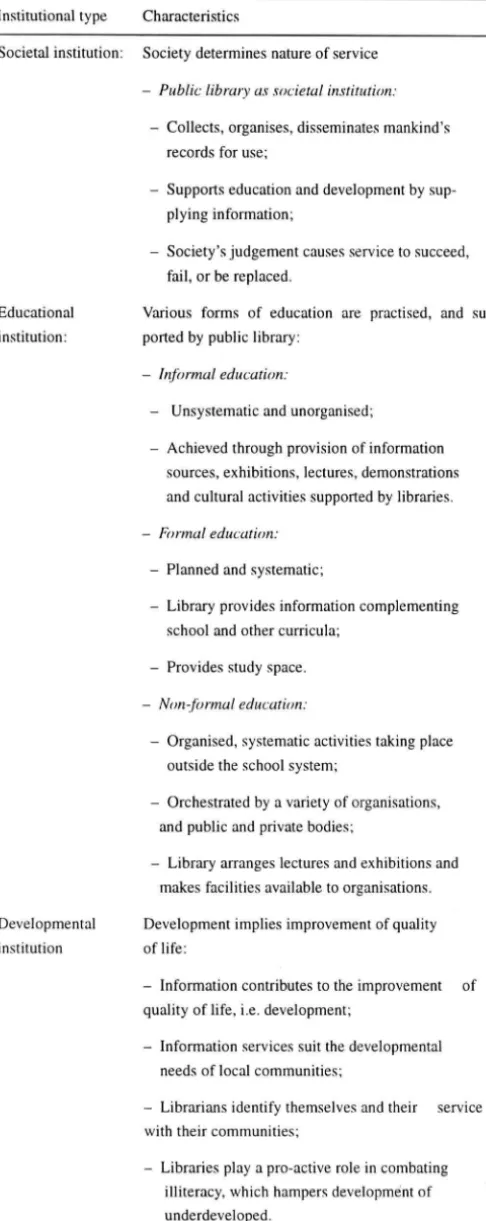
Table I provides a model showing the various positions oc-cupied by the public library in society, and the roles it should play.
Public library in South Africa
12
Table 1 Nature of the public library
!nstitutionaltype Characteristics
Societal institution: Society determines nature of service
- Public Iibrwy as societal institution:
- Collects, organises, disseminates mankind's records for use;
- Supports education and development by sup-plying information;
- Society's judgement causes service to succeed, fail, or be replaced.
S.Afr.Tydskr.Bibl.Inligtingk., 1998,66( I)
(1993: 101) conclude that public libraries, also those established especially for Blacks, are neither reflecting, nor addressing the real needs of their communities. This corroborates Bekker and Lategan's earlier finding (1988:69) that by their nature urban libraries do not cater _ for the needs of the black community because people need to be advised, and need to be given the opportunity to ask questions. It is the awareness of the inadequate provision of library services to disadvantaged communities that led to the establishment of the alternative services referred to above.
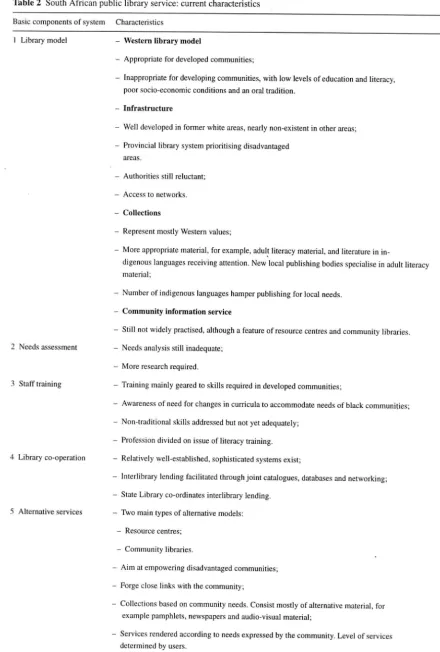
Table 2 summarises the characteristics of the South African public library system as revealed by the literature.
retarding the public library's entry into the development
arena); inappropriate traInIng of staff; and poor co-operation with other information agencies especially with
regard to information for developmental purposes (Cillie 1995:2). Underlying most of these weaknesses is the lack of in-depth needs analysis. Fairer-Wessels and Machet Educational
institution:
Developmental institution
Various forms of education are practised, and sup-ported by public library:
- lnt;mnal education:
- Unsystematic and unorganised;
- Achieved through provision of information sources, exhibitions, lectures, demonstrations and cultural activities supported by libraries.
- Formal education:
- Planned and systematic;
- Library provides information complementing school and other curricula;
- Provides study space.
- Non~t;JI'I/lal education:
- Organised, systematic activities taking place outside the school system;
- Orchestrated by a variety of organisations, and public and private bodies;
- Library arranges lectures and exhibitions and makes facilities available to organisations.
Development implies improvement of quality of life:
- Information contributes to the improvement of quality of life, i.e. development;
- Information services suit the developmental needs of local communities;
- Librarians identify themselves and their service with their communities;
- Libraries playa pro-active role in combating illiteracy, which hampers development of underdeveloped.
Community libraries
A community library means different things to different people and its services will differ according to the needs of specific communities. The literature therefore attributes a variety of characteristics to community libraries.
Community libraries differ from public libraries in that they are established at the request of the community, and are maintained and funded through resources made available by the community. Community libraries need to be established with the full co-operation of the local population. Consultation with accepted leaders in the community should be used to establish the nature of the service expected. Stilwell (in South African libraries must adapt or die, 1991 :6) advocates participative research and participative management as methods for ascertaining the needs of the community. An important aspect that needs to be taken into account is the existing information networks in the community, so as to harness, and not compete with them.
The social purpose of these libraries differs .markedly from those of the public library. While the public library is passive about its sense of social purpose, community libraries are pro-active. In community libraries neutrality of service is seen as neither possible nor desirable.
Community libraries should be accessible to all members of the community, regardless of social standing. Coleman (in Barnes 1994:79) describes these services as highly political by nature in the sense that everybody should have the right to equal access of information and society's resources. This is also a characteristic that distinguishes the community library from other information servIces. Expensive buildings do not have to be the norm for housing these libraries. According to Stilwell (in Soltth African libraries must adapt or die, 1991 :6) small, cheap units, in close proximity to the people's abodes, can be used.
Information provided should address the real needs of the people. Positive discrimination In favour of the disadvantaged is needed when providing access to the nation's resources. Community information services aim at providing information to the community to help members cope with their designated roles within that community. The information provided covers all aspects of life to assist
S.Afr.J .Libr.Inf.Sci., I998,66{ I)
Table 2 South African public library service: current characteristics
Basic components of system Characteristics
I Library model - Western library model
- Appropriate for developed communities;
- Inappropriate for developing communities, with low levels of education and literacy, poor socio-economic conditions and an oral tradition.
- Infrastructure
- Well developed in former white areas, nearly non-existent in other areas;
- Provincial library system prioritising disadvantaged areas.
- Authorities still reluctant;
- Access to networks.
- Collections
- Represent mostly Western values;
- More appropriate material, for example, adul.t literacy material, and literature in
in-digenous languages receiving attention. New local publishing bodies specialise in adult literacy material;
- Number of indigenous languages hamper publishing for local needs.
- Community information service
- Still not widely practised, although a feature of resource centres and community libraries.
13
2 Needs assessment
3 Staff training
4 Library co-operation
5 Alternative services
- Needs analysis still inadequate;
- More research required.
- Training mainly geared to skills required in developed communities;
- Awareness of need for changes in curricula to accommodate needs of black communities;
- Non-traditional skills addressed but not yet adequately;
- Profession divided on issue of literacy training.
- Relatively well-established, sophisticated systems exist;
- Interlibrary lending facilitated through joint catalogues, databases and networking;
- State Library co-ordinates interlibrary lending.
- Two main types of alternative models:
- Resource centres;
- Community libraries.
- Aim at empowering disadvantaged communities;
- Forge close links with the community;
- Collections based on community needs. Consist mostly of alternative material, for example pamphlets, newspapers and audio-visual material;
- Services rendered according to needs expressed by the community. Level of services determined by users.
community members to cope with day-to-day problems and to improve their quality of life (Legoabe 1995: 16). This type of information encompasses:
survival information: rf lating to aspects, such as health, childcare, housing, finance, legal and political rights;
14
growth and specialisation of bureaucracies, as well as
the increase in, and complexity of the legislation
regulating our everyday lives (Pilkington & Morrison
1996:6).
The materials are mainly of a transitory nature, for
ex-ample, leaflets, posters, pamphlets and newspaper cuttings.
In mainly illiterate communities resources should also
include audio-visual material. A main resource is that of
repackaged material for which the librarian is responsible.
Community information services call for a different kind
of staff member to provide the information service. Stilwell
(1991 a:20,24) sees the ideal candidate as a person coming
from the community, keeping a high profile in his/her
com-munity by being an active member in community activities.
This will enable the librarian to forge a close relationship
between him/herself and the community. Active
involve-ment between the librarian and the user is imperative, as
it leads to a better understanding of the nature of the
user's problem. Good communication and motivational
skills are necessary to ensure involvement of the whole
community (Ferguson [I 987?]:9). This interaction will
result in staff not merely being passive mediators between
the published sources and the public, but becoming active
participants in the creation of new information sources
(Kambule 1992:43).
New skills should also include methods in which
inform-ation is to be disseminated to the community. Information
and skills should be shared to demystify and challenge the
traditional power relations in society (Stilwell 199 I b:3 I 8).
Kantumoya (1992:34) advocates easy access to information
for all-and-sundry, but especially the lower social groups,
against whom information networks have always been
biased. He maintains that information in Africa is being
disseminated through methods inaccessible to the common
man, be it in the rural or urban areas. The National
Consumer Reference Council (in Kantumoya 1992:34) has
the following to say about the lack of access to information
by the majority of people:
'People will not be able to get their due as citizens
of present day society unless they have continuous
access to the information which will guide them
through and where necessary, the advice to help
them translate that information into effective
action. and unless they get their due, they are
unlikely to recognise the reciprocal obligation that
all citizens have to the society'.
The unbiased dissemination of information, using means
and methods known and accessible to the man in the street,
would thus be a major task of the librarian. This would
entail different skills in actively finding the correct
information, repackaging and disseminating it, skills which
are not normally used in. the traditional public library
sector.
Community information services can be provided from a
library, or from a separate centre. It can take several forms,
ranging from information and referral, direct service, and
S.Afr.Tydskr.Hibl.lnligtingk .• 1998,66( I)
back-up service to self-help services (Pilkington &Morrison 1996:7).
Close co-operation with other organisations and
program-mes operating in the community is seen as essential. The
community library forms only a part of the overall
in-formation network. It needs to rely on the co-operation of the
other agencies to assist the library in information gathering
processes. It also needs to rely on these agencies to refer their
clients to, when mere provision of information is not enough
to solve a problem. Community libraries cannot operate in
isolation (Stilwell in South African libraries must adapt or die, 199 1:6).
Table 3 summarises the basic characteristics of community
libraries as presented in the literature.
Pinetown Public Library system
The Pinetown Public Library system consists of a mam
(Western model) library with four branches, and ten
com-munity libraries established since 1992 (Van der Merwe
1995:26) which are accountable to the Chief Librarian for all
activities and programmes offered by them. Only the five
oldest community libraries were included in the study
because the others were still in the process of establishing
themselves in their respective communities.
All the libraries in the system are tinancially supported by
the local authority, and the entire system is affiliated to the
Provincial Library Service from which it receives its book
stock. Staff from each library visit the Provincial Library to
select and exchange books (Van der Merwe 1995:26).
Community library development
The establishment of the community libraries was the direct
result of requests made by the respective community
organi-sations and residents' associations. The many students in
need of a library service, the distance between the residences
of the communities and the Pinetown Library, as well as the
prospect of instilling a reading culture in the high school
students were cited as reasons for the wish that library
services should be established (Klaarwater Residents
As-sociation 1992). It was also envisaged that these libraries
would be used by adult community groups (Mpola
Co-ordinating Committee 1992), After several representations to
the Borough of Pinetown, conditional approval was given to
become involved in the establishment of community libraries
(Community library development [n.d]). The first community
libraries to be established were St Wendel ins, Klaarwater,
Mpola and Tshelimnyama which opened their doors to the
public in May 1992. In 1993 Thornwood was established.
These tive community libraries were included in the study.
The members of the communities were not local ratepayers,
therefore the services could initially not be tinanced from
Borough funds, Funds for salaries and operating costs were
obtained from the KwaZulu-Natal Provincial
Administra-tion's Community Service Branch. Since 1994 the Borough
S.Afr.J .Libr.lnLSci., 1998,66( I)
Table 3 Nature of community libraries
15
Components
I Establishment
2 Governance
3 Finance
4 Aims
.5 Users
6 Information
7 Services
8 Staff
9 Co-operation
Characteristics
- Established at request of community;
- Needs full co-operation from community.
- Participative management in the form of a community committee;
- Participation ensures relevant services.
- Funds provided by community/sponsors.
- Pro-active service;
- Empowerment of all community members, especially the disadvantaged;
- Making all community resources available to all community members.
- Can determine membership - either open to whole community, or restrictions can be
imposed.
- Directly linked to the everyday lives of community members;
- Two kinds of information:
- survival information, for example, on health and childcare;
- citizens action information, for example, information concerning social. political and legal
rights;
- Mainly alternative materiaL for example, pamphlets, brochures, newspaper clippings and oral
material;
- Pro-actively provides information to the disadvantaged in the community. to help them cope
with problems in their daily lives.
- Active interaction between librarians and users;
- Pro-active approach necessitates different forms of service, for example.
- Information and referral:
- Linking the correct service with the correct user.
- Direct service:
- Face-to-face contact between the librarian and user to solve the user's problem:
- Back-up service:
- Based on active involvement of library staff in community activities and services that can
make the community aware of sources that can solve their problems;
- Self-help:
- Teaching the users to become self-reliant.
- Each community determines the type of service rendered.
- Different qualities than those of traditional librarians. are required from staff-members. for
example.
- Staff are known to. and trusted by the community;
- Good communication and motivational skills are essential;
- Staff are able to repackage information.
16
are paid hy the Borough of Pinetown. The Provincial
Library Service provided book stock, furniture, shelves and
some audio-visual equipment.
Some of the libraries were initially housed in temporary
buildings until proper accommodation could be supplied.
The Durban Functional Region provided the funds for the
building of Klaarwater and alterations to St. Wendel ins.
The local Joint Services Board approved funds for the
building of Mpola (Community Libraries of Pinetown
South [n.d]). Funds for activities and special programmes
must be generated by the community library staff
themselves (Van der Merwe 1995:26).
Each community library started with a complement of
two volunteers. These volunteers came from each
community, and in most cases had no previous experience
of library work.
Training and supervision of the staff are provided on a
one-to-one basis by the Pinetown Public Library. They
receive in-house training for a three- to four-week period,
and from there on are assisted on a personal basis when
problems arise. Aspects covered in this period include:
issue desk duties, weeding, mending of material, how to do
shelf reading, how to run a story-hour, and cataloguing and
classification. These are all skills taught to librarians
functioning in traditional public libraries. It is not quite
clear to what extent skills such as good communication and
co-operation with individuals and the community;
repackaging of information; and marketing the library
services using innovative methods, skills commonly
associated with community libraries, are covered.
In an effort to create better co-operation between the
central library and the community and branch libraries, a
senior branch librarian was appointed in January 1994. The
job description of this staff member includes daily contact
with the libraries to help with problem-solving and
tr~ining, to conduct inspections, write progress reports and
render general assistance (Van del' Merwe 1995:26).
Combined staff meetings are currently held on a monthly
basis. During these meetings problems can be discussed
with the Chief Librarian (Van der Merwe 1995:26).
1600 1400
1200
1000
800
600
400
200
o
S.Afr.Tydskr.Bibl.lnligtingk., i998,66( I)
Community librarians are responsible for their own
acti-vities, workshops and story hours. They are also expected
to assist with community needs assessment and this
knowl-edge is used when selecting books for their libraries from
the Regional Provincial depot.
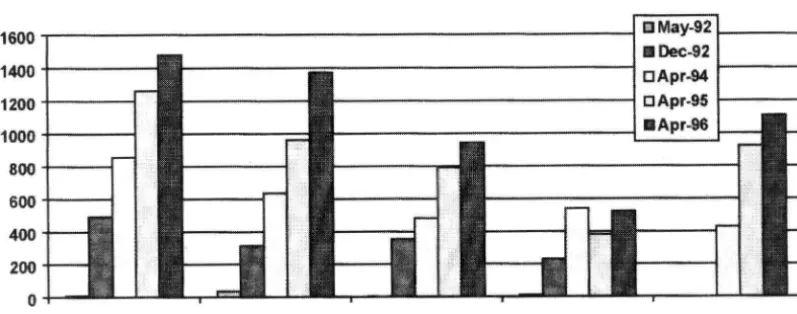
Membership has shown considerable growth since thc
establishment of the libraries, as illustrated in Figure I.
The only library that had a negative growth rate in any
year since 1992 was Mpola in 1995. Much of this can be
attributed to the fact that the library space was extremely
cramped at that time, and it had no study space for students.
Liaison with community leaders still seems to be a
problem, as the Residents Committees seem to be changing
all the time. The librarians all experience problems with the
civic organisations in their communities, in the sense that
they want to prescribe to the librarians how they should run
their libraries. Involvement from community members
themselves in the running of the library also varies from
library to library.
Two of the community libraries, Thornwood and
Tsheli-mnyama, experience serious problems with lack of space.
The rooms in which the libraries are housed are very small,
and staff do not have enough space for the processing of
books and library activities such as story hours. Study
space for students and scholars are also very restricted.
Pinetown Community Library survey
The librarians questionnaire and interview schedule were
designed to test the community libraries against the norms
presented in Table 3. The questions were formulated to
obtain information regarding the following:
- type of material used and the extent to which the
material is circulated;
- reasons why the libraries are used by the community;
- training received by the librarian's in running a library;
- activities offered by the library to the community;
- extent to which the libraries cater for the information
needs of the illiterate;
community involvement in the running of the library,
and of the librarians' involvement in community affairs.
IJMay-92 II Dec-92
oApr.94
oApr.95 II Apr.96
StWendelins Klaarwater Tshellmnyama Mpola Thom\Wod
Figure 1 Community library membership
S.Afr.J.Libr.lnf.Sci., I998,66( I)
The community questionnaire was compiled to:
- obtain personal information about members of the com-munity, both library members and non-members, for ex-ample, age, sex, educational level and employment;
establish the extent of reading among the community members, as well as their preferred language type of material;
determine reasons for non-use of the community library;
establish the extent of community library utilisation, as well as the type of material used to find information;
determine the attendance of activities organised by the community library, as well as the need for certain act-ivities normally associated with community libraries.
Problems experienced
Several problems were experienced during the empirical testing of the community library programmes. With the translation of the questionnaires to and from Zulu some of the original meaning of sentences could have been lost, resulting in not eliciting the response anticipated.
Concentrating the. community survey on a central shopping area where people were readily available, could have resulted in not all the communities being represented evenly.
The use of a ranking system for some of the questions also proved to be a problem especially in the community questionnaire. A large number of the respondents did not
follow the instructions correctly, and therefore the questions requiring ranking showed many discrepancies. The feedback that was received was however regarded as useful for identifying certain trends.
Interpretation of librarian's questionnaire and interviews
From the answers provided by the librarians, as well as the literature provided by the Chief Librarian of the Pinetown Public Library, it is clear that the community libraries function as part of the Pinetown Public Library system which is accountable to the local authority. Although the request for the establishment of these libraries originated from the communities themselves, apart from some initial consultation with the community leaders, the communities are not in any other way responsible for the management of the libraries. The community does not contribute either in a financial sense or In an administrative or organisational sense.
In the cases where some community involvement does exist, it is fairly limited, for example, at Tshelimnyama the Library Committee members have been trained as assistants to assist the staff whenever one of the staff members is absent, and at St. Wendel ins the Committee members actively try to promote library services. At Thornwood it is mainly the literacy teachers who are involved in the library programme. The only other
17
contribution by the community is through the suggestion box at St. Wendelins which offers the community the opportunity to air their views. Autonomous existence and accountability to the community therefore do not exist. This contradicts Fairer-Wessels and Machet's view (1993: 106) that a community library is one owned, sustained and maintained by members of a disadvantaged community.
In most cases the location of the community libraries is relatively central and they are fairly accessible to the people in the communities, although not all of them are central to the abodes of the people as suggested by Stilwell (South African libraries must adapt or die, 1991:6). Where the community libraries form part of a community centre, especially if an activities hall forms part of the library, it enhances its chances of becoming a focal point in the community's social acti-vities. This concept is also recommended by Iwuji (1990:58). Where the libraries stand isolated, for example, in Mpola, Tshelimnyama, and to some extent, St. Wendelins, they do
not form part of the community life. The library thus loses much of its ability to playa meaningful role in the develop-ment of the disadvantaged in the community.
The materials offered by these libraries do not differ
sub-stantially from those offered by the traditional public library. According to Fairer-Wessels (1988:3) and Shillinglaw (1986: 40) the traditional public library is mainly print-based, and aims at self improvement and leisure reading, thus pre-supposing a reading public. The Pinetown community libraries concentrate less on leisure reading than traditional public libraries but the information on offer in the community libraries are still mostly print-based. Although the librarians all expressed satisfaction with the subjects covered by the available material, scanning of the shelves indicated that the materials available were those found in any traditional library, with very little, if any, information available on issues concerning the day-to-day life of the community. The material available mainly represented the Western culture, making its applicability remote to the circumstances of people living in Third World conditions.
18
the libraries indicated the existence of cuttings. The librarians
and community members should be made aware of the
importance of this information source, especially for
com-munity and current information. Librarians should be taught
how to organise and maintain this kind of material for the
benefit of their users.
Community information services are offered by all the
libraries. This is a service which characterises community
libraries, although many traditional public libraries are also in
the process of adopting it as part of their services. Information
is regularly updated through the active canvassing of the
librarians. Referrals are part of the service offered by the
Pinetown Community Libraries, although the librarians do
not physically accompany the enquirer to the referred
destina-tion. As a result the librarian is not in a position to determine
whether the enquirer could actually satisfy his/her
inform-ation need. In disadvantaged communities, follow-up is
important, as empowerment of the people can only be
achieved when they obtain the correct information.
The staff complement is very small, and therefore
person-alised service can unfortunately not be rendered on a full-time
basis. At the same time, empowerment and upliftment of the
community are closely related to giving practical assistance
to those who are unable to do certain things for themselves,
for example, the illiterate and unemployed. Ways and means
to render such services should therefore be sought.
All the community libraries, with the exception of Mpola
Community Library, are actively trying to be of practical
assistance to the disadvantaged in the community, through
teaching literacy classes, or by making facilities available for
these classes, or by assisting the unemployed to gain skills.
The librarians indicated that they were actively involved with
community organisations. This involvement is also used to
gather information, and to forge contacts which can be
utilised if need be to assist a user with an information need
when the opportunity arises. The librarians also use these
contacts to advertise their library's services.
No restrictions are placed on the type of material available
in the library. The stock however mainly consists of material
obtained from the Provincial Library Services, and therefore
reflects the selection policy of this institution. No trace could
be found of material, for example, to inform people about
political matters, of legal material informing people about
their rights, or material on contentious issues like abortion.
An interlibrary lending system is in place, but from the
inter-views it became clear that it is mainly used to request
text-books and study material.
Changed staff attitudes are vital for the success of
commu-nity libraries. For example, good communication and
moti-vational skills, skills in repackaging of information, skills to
obtain community information and to be able to utilise
com-munity sources to refer people to when necessary, contribute
to attitude changes and should be instilled during training
(Nassimbeni. Stilwell & Walker 1993:40). The community
librarians received only in-house training for a relatively
short period of time. The information supplied indicated that
S.Afr.Tydskr.l3ibl.lnligtingk., I 998.66( I)
the training received was mainly based on the traditional
chores normally performed in a public library. Although all
the librarians claim to have been taught how to repackage
information, no evidence of such activities could be found.
They also did not mention that they were taught specific skills
like, for example, how to effectively communicate with a
person needing advice, or needing guidance in a certain
mat-ter, which are communication skills closely associated with a
community information service.
All the community librarians are active members of their
communities. Most have lived in the community for a long
time, and some were even born and bred in the community.
Despite being well known, some librarians mentioned that
they experienced difficulty in being accepted by the
com-munity, and had to use their involvement in community
organisations to win the trust of the community.
Interpretation of community questionnaire
Generally speaking the communities appeared to be reading
communities, as most of the respondents indicated that they
read in their spare time. This could be due to the fact that
school children and students represented a significant
per-centage (47.7%) of the respondents.
Zulu and English were indicated as being the most popular
languages. The popularity of these languages, especially
those materials written by African authors, was confirmed by
the community librarians. What was interesting was that
books were the preferred medium, while newspapers and
magazines were not as popular. This coincides with the
findings of Johnstone (1988: 129). However, in a study done
in Botsw.ana, Mchombu and Mtunyatta (1988:30) found that
the main reason for people visiting the village reading rooms
was to read magazines and newspapers. It would thus seem
that community libraries in South Africa are mainlY,used as
study centres, and sources for finding information. With
newspapers arnvlng a day or two late in the community
libraries it is perhaps not surprising that they are a less
popular medium.
There still seems to be much ignorance concerning the
library and the services it offers. It can either be attributed to
unsatisfactory marketing of the library, or apathy on the part
of community members. Most of the community members
indicated that they would support programmes like literacy
classes, and a community information service, if offered by
the library. These services exist in the libraries, or are
sup-ported by the libraries, yet members of the public seem
generally unaware of them.
There also seems to be a need in communities for activities
like crafts classes, talks, and video shows; and space for
com-munity meetings and extra curricular activities should also be
provided. Most of the community libraries, however. are
hampered by the lack of a community hall. Where an
activities hall exists, crafts classes are offered, mainly for the
benefit of the women. This perhaps explains why so many
respondents indicated that they seldom or never attended
S.Afr.J.Libr.lnf.Sci.,1998,66( I)
master should be determined to attract as many members of the community as possible.
Although a fair number of the respondents indicated that they found the information they were looking for either al-ways or occasionally when visiting the library, it is alarming that most of the time many (30.2%) did not find what they were looking for. This could indicate that either the material in the collection is not what the community needs, or it could indicate that the users are too shy to ask for assistance from the librarians. Better communication between the librarians and the users would help to rectify the problem, and the collection should also be developed to support the real needs of users.
A significant percentage of the respondents (71.6%) in-dicated one or more visits within a two-week range. This tendency was confirmed during the authors' visits, when a constant movement of users was observed. The libraries therefore seem to play an important role in the lives of many of the residents in the communities, albeit then only to supply a convenient study space. Non-awareness of the library and its services were indicated as the main reasons for non-use which indicates inadequate marketing. In a community which includes many illiterates the librarians should concentrate on marketing methods that will also reach that part of the community, for example, by making use of audio-visual media like radio and TV to advertise their services. Librarians should also exploit opportunities offered at blood donor clinics, school meetings and local authority meetings to market the library by word of mouth. Attention should also be given to the other reasons for non-use, that is unsuitable library hours, reading difficulties, and uninteresting material, as it could be an indication that other members of the com-munities could experience the same problems.
As mentioned above attention should be paid to commu-nication between librarians, users and other community members. Although library committees do exist, it would seem that they are only partially involved in giving advice on certain library matters, for example, renovations and literacy classes. The exception is' Thselimnyama where active in-volvement is encouraged, and the users are actually deployed in the library as assistants when needed. This results in lively community participation in the running of the library and its services. At the two libraries without any community involve-ment the librarians seemed dejected by the lack of interaction. As user involvement is imperative for the success of com-munity libraries, this is an aspect that needs urgent attention.
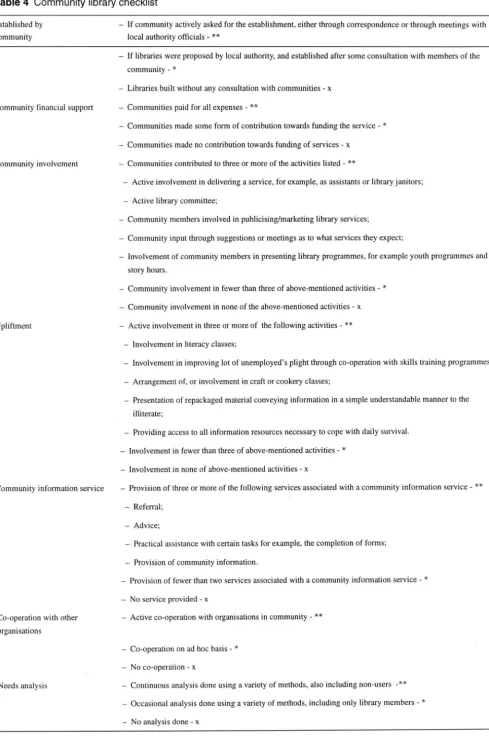
The results of the questionnaires and interviews were used to evaluate the Pinetown Community Libraries individually according to the following characteristics:
- community involvement in establishment; - financial support provided by community;
- community involvement in management of library; - library support for upliftment programmes; - provision of a community information service;
- co-operation with other organisations to provide service to users; and
19
- needs analysis to determine service needs.
A checklist for these characteristics presented in Table 4, was developed to indicate levels of satisfaction. Table 5 con-tains the results of the evaluation. If a characteristic is not met, it is indicated by a x. If the characteristic is met, but un-satisfactorily, that is, not sufficiently active, it is indicated by a
*.
If it is met at a satisfactory level, that is, sufficiently active, it is indicated by **.Table 5 indicates that St. Wendelins and Tshelimnyama per-formed well in four out of seven categories (10
*
each). Thornwood and Klaarwater in two categories with an overall score of 8* and 7* respectively. The common weakness according to the norms is the lack of community financial support. The level of satisfaction of community members with regard to certain aspects of the community libraries services, for example, the community information service, could not be determined on the information collected. It is possible that according to them, this service did not function at a satisfactorily level. This aspect could be a topic for further research.Conclusion
The evaluation of the performance of each community library shows that these libraries are still in a transition phase. Through co-operation with other organisations the com-munity libraries are starting to break out of the isolated mould which became a trademark of public libraries, and have be-come more active participants in the information transfer process. The focus has also shifted from service to the educated elite to involvement in efforts to uplift the dis-advantaged in the communities, thus resulting in a whole new attitude towards the library user. One can therefore conclude that the Pinetown Community Libraries have moved away from the traditional public library service model, and at least two, namely St. Wendelins and Tshelimnyama, are well on their way to offering their communities a pro-active com-munity library service. Much more work remains to be done especially in Mpola, with regard to community financial support, and community involvement especially with regard to upliftment programmes.
For these libraries to become community libraries in the full sense of the word, the following aspects should be ad-dressed:
- The community should become more involved, especially with regard to the planning of new services, recom-mendations regarding different types of information sources, assistance with obtaining oral information from members of the community, and the use of community members for activities such as storytelling, crafts classes and music and drama classes.
20
Table 4 Community library checklist
S.Afr.Tydskr.Bibl.lnligtingk., I 998,66( I)
Established by community
Community financial support
Community involvement
Upliftment
Community information service
Co-operation with other organisations
Needs analysis
If community actively asked for the establishment, either through correspondence or through meetings with local authority officials -
**
If libraries were proposed by local authority, and established after some consultation with members of the community -
*
- Libraries built without any consultation with communities - x
- Communities paid for all expenses -
**
Communities made some form of contribution towards funding the service -
*
- Communities made no contribution towards funding of services. x
- Communities contributed to three or more of the activities listed -
**
Active involvement in delivering a service, for example, as assistants or library janitors;
Active library committee;
Community members involved in publicising/marketing library services;
Community input through suggestions or meetings as to what services they expect;
Involvement of community members in presenting library programmes, for example youth programmes and story hours.
- Community involvement in fewer than three of above-mentioned activities -*
- Community involvement in none of the above-mentioned activities - x
Active involvement in three or more of the following activities -
**
- Involvement in literacy classes;
Involvement in improving lot of unemployed's plight through co-operation with skills training programmes;
- Arrangement of, or involvement in craft or cookery classes;
- Presentation of repackaged material conveying information in a simple understandable manner to the illiterate;
Providing access to all information resources necessary to cope with daily survival.
- Involvement in fewer than three of above-mentioned activities -
*
Involvement in none of above-mentioned activities - x
Provision of three or more of the following services associated with a community information service -
**
- Referral;
- Advice;
Practical assistance with certain tasks for example, the completion of forms;
- Provision of community information.
- Provision of fewer than two services associated with a community information service -*
- No service provided - x
Active co-operation with organisations in community -
**
- Co-operation on ad hoc basis -*
- No co-operation - x
Continuous analysis done using a variety of methods, also including non-users **
- Occasional analysis done using a variety of methods, including only library members -*
- No analysis done - x
S.Afr.J.Libr.lnf.Sci., 1998,66( I)
Table5 Community library performance
21
Name of library Community library norms
Established by Community Community Upliftment community financial support involvement
St .Wendelins ** x ** *
Mpola ** x x x
Klaarwater ** x x *
Tshelimnyama ** x ** *
Thornwood ** x * *
Community
information Co-operation with Needs service other organisations analysis
** **
** * *
** * *
** ** *
** * *
and how to go about ensuring that a high standard ot
service is maintained.
A publicity campaign should be conducted to introduce
the library and its services to the community. This
should be followed by a community meeting where
community involvement is advocated.
Own funds for every community library should be dealt
with as a matter of urgency. Due to the current
economic situation in South Africa, most community
libraries cannot function autonomously. However, the
system of obtaining all materials from the Provincial
Library Service does not necessarily allow scope for
meeting specific community needs through the
provision of alternative materials. Own funds will allow
scope for acquiring community specific information.
Community fund-raising events could generate funds
for the library and provide an opportunity for
community involvement in the spending of these funds.
Staff should be trained to develop skills that will enable
them to become pro-active agents of information
transfer. They should learn how to anticipate needs, in
order to act even before such needs are expressed. They
should also be taught how to go out into the community,
using knowledge gained to bring the library to the
people, instead of adopting a sit-and-wait attitude. A
demonstration programme utilising expertise within the
library system as well as in the broader professional,
and also local community, would facilitate continued
education for community library staff. The librarians
have to be recruited from the communities served which
means that they come from the information-poor sector
of society, and therefore need to experience first hand
how a successful programme operates. A well-planned
demonstration programme could well be the key factor
in the upgrading of these libraries to fully fledged
community library services.
References
Astbury, R. 1993. The public library of the twenty first century: the key learning and information institution in the community? InRevision of the Unesco public library manifesto '72. ed. by C.J.M. Gomes:63-67.
tlanach, C. IY~Y.The role ot the publIc lIbrary in a changing society. Artes Natales, 7(II):5-11.
Barnes, E.A. 1994. Library outreach services in South Africa. M.Bibl dissertation, Rand Afrikaans University, Johannesburg: RAU.
Bekker, S.&Lategan, L. 1988. Libraries in black urban South Africa: an exploratory study. South African journal of library and information science, 56(2):63-72.
Chijioke, M.E. 1989. Public library services as information net-works: Nigeria in the twenty-first century. Journal of librarianship,21(3):174-185.
Cillie, R.M. 1995. Co-operation between librarians and development agents. Meta-info bulletin, 4(3):2-6,7.
Community Libraries of Pinetown South (pamphlet). [n.d.]. Community library development (pamphlet). [n.d.].
Fairer-Wessels, EA. 1988. The role of the public in developing communities: the promotion of literacy. Free State libraries,
April-June:2-4.
Fairer-Wessels, EA. &Machet, M.P. 1993. The development of alternative information services for the black community in South Africa. Mousaion, II (I): I DO-Ill.
Ferguson, S. [1987?] Resource mobilization for the
implementation of the rural community resource centre. Paper presented at the COMLA workshop, New Delhi, August 27th-28th:I-13.
Iwuji, H.O.M. 1990. Librarianship and oral tradition in Africa.
International library review, 22:53-59.
Johnstone, I.Y.1988. Die openbare biblioteek as instrument tot ontwikkeling met verwysing na enkele swart ontwikkelende gemeenskappe in Natal- 'n verkennende ondersoek. M.Bibl-verhandeling, Universiteit van Pretoria, Pretoria.
Kagan, A. 1982. Literacy, libraries and underdevelopment - with special reference to Tanzania. Africana journal, 13(1-4): 1-23. Kambule, A. 1992. Rural libraries and resources - whither a
de-mocratic information base? Matlhasedi, 11(2):40-43.
Kantumoya, A. 1992. Public libraries and community information service in Africa. African journal of libraries, archives and information science, 2(1):33-38.
Klaarwater Residents Association. 1992. Letter written to the Chief Librarian requesting establishment of a library service, 2 February.
Legoabe, N. 1995. Community information services (CIS): a powerful instrument for the RDP.Free State libraries, Jan-March: 16-17.
Louw, A. 1993. Some responses of libraries to changing user and community requirements. South African archives journal,
35:14-23.
22
Mchombu, K.J. 1991. Which way African librarianship? IFLA journal, 17( I ):26-38.
Mchombu, K.J.&Mutanyatta, J. 1988. The Village Reading Room pilot project: an evaluation report. Information trends: news magazine, I(I ):28-34.
Mostert. B.J. 1997. Community libraries: the concept and its ap-plication: with particular reference to the Pinetown community libraries. M.Bibl dissertation, University of Zululand, Kwa-Dlangezwa.
Mpola Coordinating Committee. 1992. Letter written to the Town Clerk requesting establishment of a library service, 21 February.
Nassimbeni, M., Stilwell, C.&Walker, C. 1993. Education and training for library and information work: and analysis of the current South African situation with a view to the way forward. Innovation, 6:31-44.
Pienaar, R.E. 1995. Survival information and public libraries.
IFLAjournal,21(1):15-18.
Pilkington, A.&Morrison, J. 1996. Community information centres in public libraries. KWAZNAPLlS, Jan/Feb:6-9. Raseroka, K. 1994. Rural services to developing communities.
Artes Natales, 13( 1):3-6.
Shera, J. H. 1972.The foundations of education for librarians hip.
New York: Becker &Hayes.
Shillinglaw, N. 1986. The role of the public library in the develop-ment of South Africa. South African journal of library and information science, 54( I ):38-44.
S.Afr.Tydskr.Bibl.lnligtingk., 1998,66( I)
Shillinglaw, N.&Thomas, W. 1988.The information society.
Craighall: A.D. Donker.
South African libraries must adapt or die.Artes Natales, 10(3):4-7.
Stilwell, C. 1991 a. Community libraries: a viable alternative to
the public library. Progressive librarian, 4(Winter): 17-27. Stilwell, C. 1991b. The community library as an alternative to the
public library in South Africa. M.1nf dissertation, University of Natal, Pietermaritzburg:
Stilwell, C. 1992. The resource centre forums: democratic and
alternative information networks for South Africa.
International information and libra!}' review, 24:213-220.
Sturges, P.&Neill, R. 1990.The quiet struggle: libraries and in-formationfor Africa. London: Mansell.
Todaro, M.P. 1989.Economic development in the Third World.
4th. ed. New York: Longman.
Van der Merwe, M. 1995. Gemeenskapsbiblioteke werk! Cape librarian, 39(3):26-27.
Williams, P. 1988.The American public libra!}' and the problem of purpose. New York: Greenwood Press.
Wilson, P. 1977.A community elite and the public library: the uses of information in leadership. Westport: Greenwood Press. Zaaiman, R.B., Roux, P.J.A.&Rykheer, J.H. 1988. The use of
libraries for the development of South Africa. Pretoria: Uni-versity of South Africa.