International Journal of Engineering & Computer Science IJECS-IJENS Vol:13 No:06 12
LAMP vs. Closed Code –The Trend of Usage in
Albania
Albana Gorishti
1, Edlira Kalemi
2, Gloria Tyxhari
31Lecturer, FE, UT 2
Lecturer, FIT, “Aleksander Moisiu” University of Durres 3Lecturer, FE, UT
[email protected], [email protected], [email protected] Abstract
--
Lamp is free open source software thatcombines4different types of technology which helps to develop Websites. It consists of Linux, Apache, MySQL and PHP. Websites or web systems can also be designed, developed and deployed by using the Microsoft.Net platform. The person who works on them, may choose any platform based on the advantages and disadvantages that they bring. Open Source platforms are good alternatives for application and technology development even for Albanian Businesses: mostly for SME (Small and Medium Enterprises). The aim of this study is to address questions related to the usage of LAMP recently in Albanian companies. Some of the questions included are: which of these technologies is used mostly and why, how does their choice affect the efficiency and quality of their work, etc. A questionnaire is written by us and it is answered by programming companies or other companies which have a programming department in their structure for e.g. Eagle Mobile, Vodafone Albania, etc. These companies have been asked during two periods of time (2011 and 2013). A comparison of the results is made and we noticed that the result has changed on the way of how this technology is used and how much it is used compared to closed code. What we saw else is the fact that the usage of LAMP and other open source services has been increased not only for the simple reason that these services are free but also because of the increase of faith on the security that these technologies provide.
Index Term
--
LAMP, closed code, open source, webapplications
1. INTRODUCTION
Over the last decades we were used with the idea of acquiring and using proprietary software, meanwhile it is strongly discussed that this trend has changed. Nowadays other types of software are being used. Their source code can be satisfyingly adopted with their user’s demand, being specified as Open Source Software. The visibility of the source code to everyone, offers the possibility to study the code and find in it the week and vulnerable parts of the software. These vulnerabilities can be used either to attack or to defend the work of the software. On the other hand, proprietary software forces users to accept whatever the programmers or vendors offers to them.
Taking in consideration the differences between Open Source Software and proprietary software we can say that the availability of source code for review is the main difference. The code for Open Source is publicly available, but for the proprietary software is mostly closed source which means that
the code is not publicly available creating a barrier to code’s access for attackers, resulting in less vulnerability in the source code. Regarding to this issue, there have been many debates claiming that Open Source Software are more preferable and more secure than proprietary or closed source software, others oppose that this is not true. This debate continues and seems to continue for a while.
A lot of studies have been done and they show that OSS (Open Source Software) has been accepted recently more and more in: web development, enterprise environment, government digitalization, e-banking, etc. This happens because they are considered to be a major component of the IT infrastructure including web development. One of the fields OSS is being used are web servers where LAMP technology (Linux, Apache, MySQL and PHP) is mostly preferred. In sustain to our topic we will continue with section II, giving a theoretical view of these technologies and how do they operate in web in general.
2. THEORETICAL BACKGROUND
The term Free/Open Source Software (F/OSS) has nowadays occupied an important position in the field of engineering applications development. The term Open Source Software was used for the first time at the F/OSS meeting, developed in 1998 in Palo Alto [1].
International Journal of Engineering & Computer Science IJECS-IJENS Vol:13 No:06 13 Source Software, which describe the environment that was
created by the issues of copyright, licensing, domain (application areas) and customers.
According to some companies, the use of Open Source software for development can reduce time and budget by 50%. [5]. Open Source Methods for testing and debugging, have shown that they lower pretty much the product development costs, meanwhile the use of Open Source software channels for marketing and distribution, increases the possibility of the product to reach wider market.
A question that naturally arises is: can we benefit from open source software? Open Source is a commercial program, but at any stage, its licenses have not expelled commercial exploitation of the program. Open Source licenses are not anti-commercial; they are against the restriction or closure of the program or system that uses them. This is a good thing for users and can be used for marketing purposes. Open Source has not suddenly become commercial, it has always been so. The model of revenue from the Open Source is based on a revenue stream from services rather than by licenses. Most Open Source software is copyrighted, but issued by such licenses that allow free redistribution. It is precisely this quality that makes it possible to achieve the economic benefits of Open Source. At the same time this thing also attracts potential clients that consider the usage of software created by small programming companies, clients who otherwise would not have taken any account of your program.
If we refer to the Open Source Initiative [6], for the terms of distributing the open source software; it says that it must meet 10 criteria, specified in the Open Source Definition [7]. As we check the top 3 from these 10 criteria are:
1. Software should be redistributed freely.
2. Software must allow for distribution as source code as well as in a compiled form,
3. Licenses must allow modifications and for derivatives generated from the source code.
As we mentioned earlier in this article, one of the Open Sources platform is LAMP. LAMP consists of four layers and each of them is considered to be a critical part of the entire software package. They are:
• Linux as the lowest-level layer provides the operating system. It is Linux that actually runs any other component. Linux is not the only operating system used in this level, it can also be one of the following: Microsoft®, Windows®, Mac OS X, or UNIX®. • Apache, the Web server is the next level. Apache
offer the mechanical part for enabling any user to get to the Website. Apache is that kind of server that is capable to handle critical works. The PHP layer actually is inside Apache, and Apache and PHP are used together to create any dynamic Web sites. According to Netcraft, the Apache web server is currently the most popular web server in the world [8]. It dominates about 70% of the server market (Figure 1).
Fig.1. Netcraft Server Survey - Market share of all sites 1995 –2012
The reasons why Apache is so popular are: the high security record, this compared to the next most popular server Microsoft’s IIS which is considered to have a poor security track record, and because of its low price (Apache is open source and free). Apache has a big advantage supporting a number of different languages and databases like: PHP, Perl,
Python, Java, C, C++, MySQL, PostgresSQL and Oracle, [Varner, P. 2001][9].
International Journal of Engineering & Computer Science IJECS-IJENS Vol:13 No:06 14 personal information will be stored in this database in
a format that can be easily queried with the SQL language.
• PHP is a very efficient programming language. It is simple and provides the glue for all the layers of the LAMP system. PHP is used to write dynamic web content capable of accessing the data in the MySQL database and some of the features that Linux provides.
Brydon & Vining [10] in their article mention that open source provision works best for low-level system-oriented technologies, while large and complex enterprise business applications are best served by commercial software vendors.
In Europe, Open Source is considered to be an improving tool to compete in IT sector [11]. To sustain this, since 2005 it was reported that about 50% of all European local government bodies were somehow using open source software [12]. Next Section, titled Data Analysis will introduce the results of our study which as mentioned earlier in the abstract is conducted with different Albanian companies. Referring to other authors mentioned earlier in this article we can say that
open source software are a appropriate alternative for developing countries in various ways. Some impacts are positive for example, cost savings, flexibility of software, obtaining negotiation power against big software companies, fighting piracy, building its own software industry, and even increase national security by less dependence on a few foreign companies [13].
3. DATA ANALYSIS
A questionnaire was developed so we could get the answers to the questions raised for this study. The questionnaire was completed by programming companies or other companies with an influential programming department in their structure like mobile companies, banks etc. The data have been processed with the help of SPSS software (Statistical Package for the Social Sciences), a software package used for statistically analyses.
The first question we raised was: “Why do programmers use LAMP as a technology?” The responses for 2011 and 2013 respectively are as in table below:
Table 1. Question 1
Why do programmers use LAMP?
Years /
Answers
Lower cost of
Ownership
Easier to
customize
Reduce
dependence
on software
vendors
Higher level
of security
Do not see a
significant
advantage
Year 2011
57%
50%
47%
17%
6.7%
Year 2013
22%
30%
20%
10%
18%
During 2011 the main reason is the lower cost of ownership, this compared to other technologies. During 2013 the main reason has changed into it is easier to customize. What we else noticed, is a redistribution of the results for reasons of “why do programmers prefer LAMP?”.This redistribution may be caused by the simple fact that IT community has a better knowledge now, towards open source software. This community appraises LAMP not only because of its zero cost but they evaluate is easiness of customization and the
reduction on dependence of software vendors. The fact that awareness of the IT environment for customization of open source software has grown, is one more good reason to recommend this kind of applications according to the specific conditions that Albanian companies have.
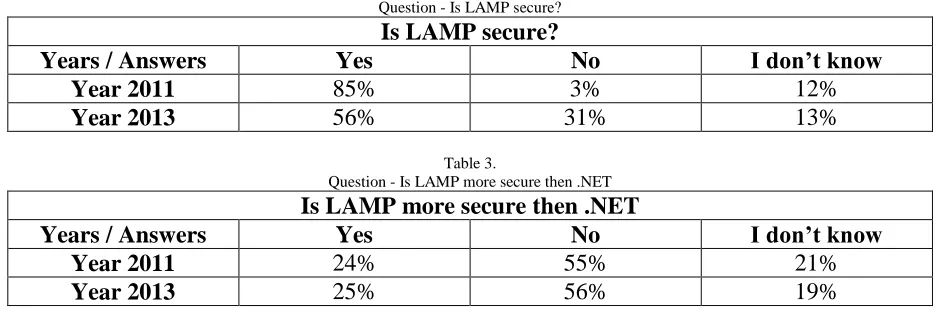
The next questions are: “Is LAMP secure?” and “Is LAMP more secure then .NET?”. The results are gathered in the tables below.
Table 2. Question - Is LAMP secure?
Is LAMP secure?
Years / Answers
Yes
No
I don’t know
Year 2011
85%
3%
12%
Year 2013
56%
31%
13%
Table 3.
Question - Is LAMP more secure then .NET
Is LAMP more secure then .NET
Years / Answers
Yes
No
I don’t know
Year 2011
24%
55%
21%
International Journal of Engineering & Computer Science IJECS-IJENS Vol:13 No:06 15
Another aspect of the technology that we chose to analyze is about the security that LAMP offers to us. Comparing these results we can say that there is a fluctuation towards LAMP’s security. During 2011, 85% of programmers thought LAMP was secure. Now only 56% of them think LAMP is secure. In previous years, the IT community was focused more in the usage of open sources not caring that much about the issues surrounding open sources, for example security. Precisely this change in the ratio indicates awareness on this issues and providing solutions for them.
Most of the programmers think that LAMP is a secure technology, but compared to close source platforms like Microsoft.Net they think that LAMP is less secure. Security is a crucial point when developing web application since the number of users is large and from different communities. As a result, the IT staffs have to increase security level or have to add new security modules.
The next question is: “Do you ever combine these two technologies together, open source and close source?”
Table 4.
The technologies, open source ande closed source
Do you ever combine these two technologies together, open source and close source?
Years / Answers Yes No
Year 2011 67% 33%
Year 2013 75% 25%
To this question 67% of the companies have answered with “Yes” in 2011 and 75% answered “Yes” in 2013. The number of companies that combine these two technologies together is increasing. This is seen as a good combination in order to reach the project objectives.
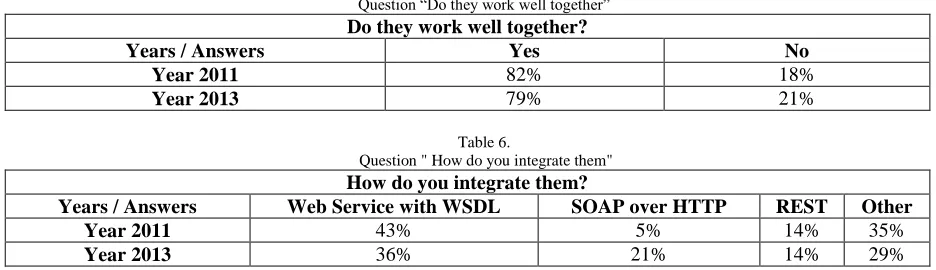
Other questions we took in consideration related with the combination of the two technologies (open and closed source) are: “Do they work well together?” and “How do you integrate them?”.
Table 5.
Question “Do they work well together” Do they work well together?
Years / Answers Yes No
Year 2011 82% 18%
Year 2013 79% 21%
Table 6.
Question " How do you integrate them" How do you integrate them?
Years / Answers Web Service with WSDL SOAP over HTTP REST Other
Year 2011 43% 5% 14% 35%
Year 2013 36% 21% 14% 29%
Those who combine these technologies together accept that they work well together and the most spread way they are combined is using Web Services with WSDL. While other options retain almost the same value, the SOAP over HTTP option has a big difference among these two years. The value has increased from 5% in 2011 to 21% in 2013.
The next questions are related with the support of LAMP. They are as follow: ”Do you easily find support for LAMP” and “Does the support for LAMP respond to you rapidly?”.
Table 7. Support for LAMP
Do you easily find support for LAMP?
Years / Answers Yes No I don’t know
Year 2011 84.8% 12.1% 3%
Year 2013 63% 31% 6%
Table 8.
How is this support for LAMP
Does the support for LAMP respond to you rapidly?
Years / Answers Yes No I don’t know
Year 2011 69.7% 15.2% 15.2%
International Journal of Engineering & Computer Science IJECS-IJENS Vol:13 No:06 16
Regarding the support, the answers are positive in both 2011 and 2013. As for the support of LAMP, if it responds rapidly, we have an overturn result. We noticed that in 2011 the answers were positive. Nearly 70% of the answers were yes they respond rapidly, meanwhile in 2013 the answers is negative, 50% don’t get a rapid support.
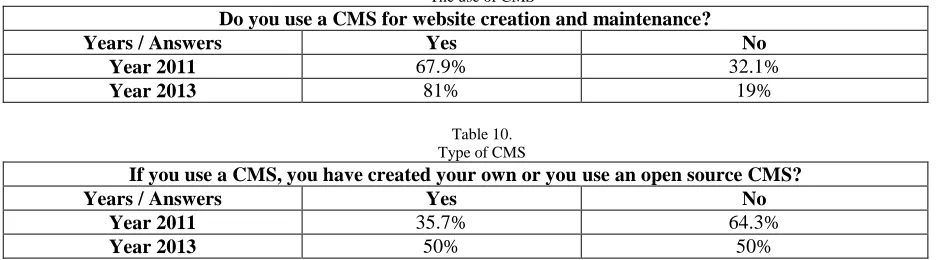
Next question are about CMS (Content Management Software) as open source software. The questions are: “Do you use a CMS for website creation and maintenance?” and “If you use a CMS, you have created your own or you use an open source CMS?”.
Table 9. The use of CMS
Do you use a CMS for website creation and maintenance?
Years / Answers Yes No
Year 2011 67.9% 32.1%
Year 2013 81% 19%
Table 10. Type of CMS
If you use a CMS, you have created your own or you use an open source CMS?
Years / Answers Yes No
Year 2011 35.7% 64.3%
Year 2013 50% 50%
The results of using CMS for creating and maintaining a website are positive and there is an increasing result from 2011 to 2013. There is also an interesting change in the results of using their own CMS versus an open source one. During 2011 only 35.7% use their own CMS but in 2013 the result has changed in 50%. Albanian state and private sector are aware of the advantages that bring an interactive web-based
application. Therefore the IT companies offers as a suitable alternative the usage of CMS to meet the requirements of customers.
To get a more detailed information regarding the above mentioned issue, we asked this question: “If you use open source CMS, is it: Joomla, Drupal, Wordpress, etc?”.
Table 11. Web CMS
If you use open source CMS, is it:
Years / Answers Joomla Drupal Wordpress Tetjera
Year 2011 57.9% 15.8% 15.8% 10.5%
Year 2013 31% 13% 31% 25%
The results show that CMS mostly used is Joomla for 2011. Meantime Joomla and Wordpress are the CMS mostly used during 2013, which they share the same result also during this year. This shows that in 2013 we have a more balanced distribution between two of the most used CMS in the world Joomla and Wordpress. Many sites that not so long ago have been developed with Joomla, have changed their development with Wordpress. We can mention here several sites like
newspapers sites, government sites etc. This is probably explained by the fact that Wordpress provides more opportunities for building online communities.
Web applications may vary from simple websites to large scale applications and 43% of the companies that have been studied say that they use LAMP even for large scale applications, see the table below.
Table 12.
LAMP and large scale application
Do you use LAMP for large scale applications?
Years / Answers Yes No No answer
Year 2011 43% 57% 0%
Year 2013 25% 75% 0%
Analyzing the results of our questionnaires:
Answers from the people that don’t use LAMP for large scale applications: 17.6% think that LAMP is more securing then .NET, 64.7% think that LAMP is not more secure than .NET, the others choose to answer “I don’t know”.
But even from the 43% of people that use LAMP for large scale applications: 46% don’t think that LAMP is more secure then .NET, meanwhile 30.8% think that it is more secure then .NET.
International Journal of Engineering & Computer Science IJECS-IJENS Vol:13 No:06 17 tendency it is noticed between those that use LAMP for large
scale applications and those that don’t use it.
These questions, as mentioned above, were made at an interval of two years and were taken in for questioning 40 companies. These companies were selected as part of this questionnaire as they are leaders in the IT field of Albanian market.
In the next session are listed the conclusions of our study.
4. CONCLUSIONS
This article gave an overview of LAMP, as a part of open source platform, and its usage in Albania during 2011 and 2013. This technology is used a lot in our country. Different companies use it because of its low cost of ownership, easiness in customization, security, etc. LAMP can be used to design software for small and medium enterprise but not only, it can be used even for large scale applications and you can easily find people to design projects of any company.
Furthermore, it is noted the increase in use of open source CMS that best meet the demands of the Albanian market, not only to create a good interactive presentations but later on the maintenance can be done by the businesses without the need for further genuine programming knowledge.
We also recommended continuing with the use of both open and closed platforms, having regard to the continued growth of security.
Based on these results we encourage even the skeptics of open source platforms to try and use them in implementing their web applications. We also recommend the usage of open source software, moreover LAMP, because it is very suitable for developing countries like Albania.
REFERENCES
[1] Feller J., Fitzgerald B. Understanding Open Source Software
Development. Addisson-Wesley, London (2002)
[2] Behlendorf B. Open Source as a Business Strategy. In: C. DiBona,
S. Ockman, M. Stone (eds). Open Sources: Voices from the Open Source Revolution. O'Reilly and Associates, Cambridge, MA (1999)
[3] Raymond E.R. (1999). The Revenge of the Hackers. In: C.
DiBona, S. Ockman, M. Stone(eds). Open Sources: Voices from the Open Source Revolution. O'Reilly and Associates, Cambridge, MA (1999)
[4] Stamelos I., Angelis L., Oikonomou A., Bleris G.L. Code Quality
Analysis in OSS Development. Information Systems Journal, 12(1):43-60 (2002)
[5] Nichols D.M., Twidale M.B. The Usability of Open Source
Software. (2003)
[6] http://opensource.org
[7] http://opensource.org/docs/osd
[8]
http://news.netcraft.com/archives/2012/09/10/september-2012-web-server-survey.html
[9] Varner, P. 2001. Multi-tiered Web Architectures Using Open
Source Software. Available
at: www.cs.virgina.edu/~pev56/writing/academic/osspres/oss-press-handout.pdf
[10] M. Brydon, A. R. Vining , Adoption, Improvement, and
Disruption: Predicting the Impact of Open Source Applications in
Enterprise Software Markets, Journal of Database Management (JDM),Volume 19, Issue 2, 2008.
[11]
http://blogs.the451group.com/opensource/2007/11/22/europes-open-source-opportunity/
[12] http://www.theregister.co.uk/2005/10/21/opensource_government/
[13] Alfreda Dudley-Sponaugle, The Social and Economical Impact of